
Hurricane Season
National Oceanic and Atmospheric Administration (NOAA)
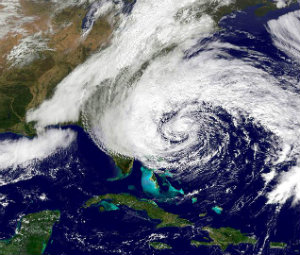
The National Oceanic and Atmospheric Administration (NOAA) defines a hurricane as “an intense tropical weather system with a well-defined circulation and maximum sustained winds of 74 mph (64 knots) or higher.”
Be prepared – have a plan!
For assistance with making an emergency plan read more here »
. 1) FEMA Ready
. 2) American Red Cross Disaster and Safety Library
. 3) ReadyNC
. 4) Town Emergency Information
. 5) HBPOIN Hurricane Emergency Plan
THB – EVACUATION, CURFEW & VEHICLE DECALS
For more information » click here
If the Town declares a mandatory evacuation, PLEASE LEAVE
General Assembly during the 2012 Session, specifically authorizes both voluntary and mandatory evacuations, and increases the penalty for violating any local emergency restriction or prohibition from a Class 3 to a Class 2 misdemeanor. Given the broad authority granted to the governor and city and county officials under the North Carolina Emergency Management Act (G.S. Chapter 166A) to take measures necessary to protect public health, safety, and welfare during a disaster, it is reasonable to interpret the authority to “direct and compel” evacuations to mean ordering “mandatory” evacuations. Those who choose to not comply with official warnings to get out of harm’s way, or are unable to, should prepare themselves to be fully self-sufficient for the first 72 hours after the storm.
No matter what a storm outlook is for a given year,
vigilance and preparedness is urged.
Brunswick County – Hurricanes
Overview
Hurricanes are tropical cyclones that rotate counterclockwise with wind speeds in excess of 74 mph. Most hurricanes form over warm seas near the equator. They are created when the sun heats the ocean surface, causing heated water vapor to rise, condense, and form clouds. These clouds begin to spiral as the earth rotates. More air is pulled underneath and a large vortex is formed. On average, six Atlantic hurricanes develop each year. When a hurricane moves toward coastal areas it often causes severe damage. Strong winds create storm surges, floods, rip tides, and can even spawn tornadoes. As the hurricane moves forward, its right front quadrant is typically where the most devastation occurs. Hurricane season begins June 1 and continues through November 30. Be sure to practice hurricane preparedness and learn about hurricane safety and survival. To assist in being prepared before, during, and after a storm, review the following links for helpful information.
-
- FEMA: How to Prepare for a Hurricane (PDF)
- Ready: Hurricanes
- C. Department of Public Safety: Hurricane Guide (PDF) | Guia Sobre Hurricanes (PDF)
- C. Department of Public Safety: Know Your Evacuation Zone | Brunswick County Evacuation Zones Map (PDF)
- C. Department of Transportation: Evacuation Routes
- C. Cooperative Extension – Brunswick County Center: Hurricane Meal Kits Program
- Brunswick County: Know Your Flood Zone and Flood Risk
- Brunswick County: Hurricane Preparation Checklist (PDF)
- National Weather Service: Latest Weather Briefing for Southeast North Carolina
Hurricane Preparedness Tips We would like to encourage you to start preparing for emergencies and stay #ReadyBrunswick by reviewing the following tips.
STAY INFORMED KNOW THE TERMS KNOW YOUR EVACUATION ZONE MAKE A PLAN KNOW WHO TO CALL GATHER IMPORTANT DOCUMENTS CHECK YOUR INSURANCE PREPARE YOUR HOME LEARN / PRACTICE SAFETY SKILLS SUBSCRIBE TO EMERGENCY ALERTS SIGN UP FOR THE ACCESS AND FUNCTIONAL NEEDS REGISTRY ACCESS LOCAL RESOURCES
Quick Links
NOAA predicts below-normal 2026 Atlantic hurricane season Early preparation essential to staying safe all season Forecasters with NOAA’s National Weather Service are predicting a below-normal hurricane season for the Atlantic basin this year. NOAA’s outlook for the 2026 Atlantic hurricane season, which runs June 1 to November 30, predicts a 35% chance of a near-normal season, a 10% chance of an above-normal season, and a 55% chance of a below-normal season. The agency is forecasting a total of 8-14 named storms (winds of 39 mph or higher). Of those, 3-6 are forecast to become hurricanes (winds of 74 mph or higher), including 1-3 major hurricanes (category 3, 4 or 5 with winds of 111 mph or higher). NOAA has a 70% confidence in these ranges. An average season has 14 named storms with seven hurricanes, including three major hurricanes. “With the most advanced forecast modeling and hurricane tracking technologies, NOAA and the National Weather Service are prepared to deliver real-time storm forecasts and warnings,” said Commerce Secretary Howard Lutnick. “Our experts are integrating cutting-edge tools to ensure communities in the path of storms receive the earliest, most accurate information possible.” “NOAA’s rapid integration of advanced technology, including AI-based weather models, drones, and next-generation satellite data will deliver actionable science to safeguard the lives and livelihoods of the American people,” said NOAA Administrator Neil Jacobs, Ph.D. “These new capabilities, combined with the unmatched expertise of our National Weather Service forecasters, will produce the most accurate forecasts possible to protect communities in harm’s way.” Key factors driving NOAA’s forecast The Atlantic season is expected to be below-normal due to competing factors. El Niño is expected to develop and intensify during the hurricane season, while ocean temperatures in the Atlantic are expected to be slightly warmer than normal and trade winds are likely weaker than average. El Niño conditions tend to support less tropical storms and hurricanes, while warmer ocean temperatures and low winds support a more active year. “Although El Niño’s impact in the Atlantic Basin can often suppress hurricane development, there is still uncertainty in how each season will unfold,” said NOAA’s National Weather Service Director Ken Graham. “That is why it’s essential to review your hurricane preparedness plan now. It only takes one storm to make for a very bad season.” NOAA’s outlook is for overall seasonal activity based on large-scale weather and climate patterns. It does not indicate where or when any storms may affect land as that is determined by short-term and variable weather patterns is not a landfall forecast. “Preparing now for hurricane season — and not waiting for a storm to threaten — is essential for staying ahead of any storm. Visit weather.gov/safety and Ready.gov for important preparedness information,” added Graham. New and enhanced communication products this season
-
- NOAA’s National Hurricane Center (NHC) will implement an improved version of the tropical cyclone forecast cone graphic that will now include tropical storm and hurricane watches and warnings for inland areas for the continental United States, Hawaii, Puerto Rico and the U.S. Virgin Islands.
- NHC will begin testing an experimental version of the tropical cyclone track forecast cone that will capture a greater range of possibilities for the track of the storm by incorporating uncertainties for both direction of movement and timing.
- NHC will provide new products and services for the Hawaiian Islands to include storm surge watches and warnings, and a peak storm surge graphic. These will be publicly available for the main Hawaiian Islands on gov.
Advancements to hurricane analysis and forecasts
-
- NOAA, in collaboration with the Unified Forecast System community, is testing an experimental high-resolution Seasonal Forecast System that utilizes the latest modeling technology and new methods to assess the evolution of the global ocean-atmosphere system. The system is helping forecasters better simulate tropical storms and hurricanes, and more effectively predict the number of hurricanes and major hurricanes.
- NOAA’s Atlantic Oceanographic and Meteorological Laboratory (AOML) is using machine learning to quality-control data collected from tail Doppler radar — a specialized radar system mounted on the back of NOAA’s “Hurricane Hunter” aircraft. This new method gathers more than 25% more meteorological data than the current method and leads to more high-quality data to support structure and wind analysis by forecasters.
Innovative technologies for this year
-
- NOAA’s Office of Water Prediction high-resolution Flood Inundation Mapping (FIM) services provide emergency managers visualizations of those streets and neighborhoods likely to go underwater. FIM covers 60% of the U.S. population and will expand to nearly 100% by late September 2026.
- For the first time, data from small uncrewed aircraft systems (sUAS) will be integrated into NOAA’s hurricane forecast model during the 2026 hurricane season. Scientists from the Cooperative Institute for Marine and Atmospheric Studies (CIMAS) and NOAA’s Atlantic Oceanographic and Meteorological Laboratory (AOML) determined that incorporating sUAS data into NOAA’s Hurricane Analysis and Forecast System (HAFS) can improve hurricane intensity forecast accuracy by 10%.
- NOAA’s Weather Prediction Center launched the experimental Urban Rain Rate Dashboard, a customizable, real-time tool that shows the probability of extreme rainfall a week in advance for more than 60 U.S. cities.
NOAA also issued seasonal hurricane outlooks for the eastern Pacific and central Pacific hurricane basins, with both anticipated to have active seasons. The 2026 Atlantic seasonal outlook will be updated in early August, ahead of the historical peak of the season, which typically extends from mid-September through October. Read more » click here 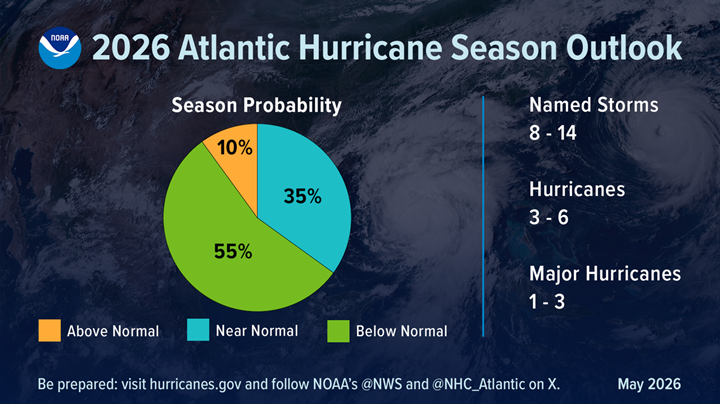
Don’t get complacent with tropical outlook; ‘it only takes one’ The below-normal activity predicted for the 2026 Atlantic hurricane season doesn’t give North Carolinians a pass on preparation this year. “For the Atlantic hurricane season, NOAA is predicting a below-normal season for 2026, with roughly a 55% chance of being below normal, a 35% chance of near normal, and a 10% chance of above normal,” National Oceanic and Atmospheric Association Administrator Dr. Neil Jacobs said during a media conference Thursday morning from NOAA’s Aircraft Operations Center at Lakeland Linder International Airport in Lakeland, Florida. “This equates to eight to 14 named storms with winds at or above 39 miles an hour. Of these, three to six hurricanes with winds at or above 74 miles an hour, and one to three major hurricanes, that’s your Category 3 to 5 with winds at or above 111 miles an hour,” he added. Jacobs is referring to the Saffir-Simpson hurricane wind scale, which categorizes maximum sustained wind speeds for tropical storms. Categories 1 and 2 are windspeeds between 74 and 110 mph, categories 3 to 5 are major hurricanes with speeds from 111 to 157 or higher, according to NOAA. Hurricane season begins Monday, June 1, and ends Nov. 30. “Even though we’re expecting a below-average season in the Atlantic, it’s very important to understand that it only takes one,” Jacobs said, adding there have been Category 5s that made landfall in the past during below-average seasons. During the news conference Thursday morning, Jacobs said that “what’s driving this forecast is largely an El Niño event. There’s a 98% chance of El Niño conditions occurring later this season, and an 80% chance that this El Niño will be moderate to strong.” NOAA National Weather Service Director Ken Graham, who spoke after Jacobs, reiterated that “it just takes one,” and urged the public during the press conference not to “let words like ‘below average’” change the way you prepare. “Now’s the time to start thinking about your hurricane preparedness,” Graham said. “Early preparedness is absolutely everything. Period. End of story. The actions that you take today really get you ready for the hurricane season.” Especially a season like this, “there’ll never be a Hurricane Just-a. We’ll never make that a name. There’s no such thing as just a Cat 1, just a tropical storm, just a Cat 2. That is absolutely not the case,” Graham said. “It doesn’t matter what it is, you got to look at the size, the forward motion, little wiggles matter on the impacts. Even the smallest storm, if it’s slow enough and big enough, it’s going to create catastrophic flooding and storm surge.” Graham said that the public needs to pay attention to every single one of the storm “systems, and the actual impacts, not the category, not the name, but the actual impacts associated with that storm, and that includes the tornadoes, heavy rain, damaging winds, even the high surf and rip currents, as well, including storm surge.” Erik Heden, warning coordination meteorologist in the National Weather Service’s Newport office, said in an interview with Coastal Review that just because the forecast calls for a below-normal season, residents shouldn’t let their guard down. “Just because the outlook says it’s going to be a low year doesn’t mean we won’t be impacted,” he said, adding “It just takes one storm. The graphic says a 55% chance below-normal year, but if we get one storm, it really doesn’t matter what the prediction was, it could be a big deal for us.” Heden also warned in the interview against making decisions based on the category of the storm. “Categories are only wind,” he said. Wind is to be respected, but the other storm impacts are more likely to be more frequent in terms of issues in our area. “Water is what kills people. About 85% of people that die in hurricanes, it’s water related — nothing to do with the wind. but it’s, it’s things like rip currents, storm surge, and flooding. Those are the three things that would get us if we get a storm.” Two years ago, the Southeast faced a potential tropical cyclone that didn’t have a name. No. 8 resulted in almost 20 inches of rain in the Wilmington area, and last year Tropical Storm Chantal produced six to 10 inches of rain in Raleigh. Steven Pfaff, meteorologist-in-charge for the National Weather Service’s Wilmington office, in an email to media partners Thursday morning, also expressed concern that the forecast for below-normal activity can cause messaging challenges because people may misinterpret what it means for any potential local impacts. “All it takes is one storm to define a hurricane season regardless of the outlook,” his emphasis, “Given southeast NC’s and northeast SC’s hurricane history our communities must prepare the same way every year,” Pfaff continued. “Now is the time to prepare for hurricane season and remain vigilant this summer and fall.” Jacobs said during the press conference that for official forecast guidance, go to hurricanes.gov. “June 1 is almost here. Be ready, have a plan, listen to your state and local emergency managers. Preparation is essential. You can learn more at ready.gov,” Jacobs added. Heden told Coastal Review that the best way to stay informed in eastern North Carolina is to remember “if it’s the weather you love, it’s weather.gov,” where there’s up-to-date information, as well as on the office’s website, Facebook or X.
Read more » click here
Previously reported – June 2026
Brunswick County reminds community to prepare for 2026 Atlantic hurricane season June marks the start of the Atlantic hurricane season, which runs from June 1 through Nov. 30, and the National Oceanic and Atmospheric Administration (NOAA) predicts below-normal hurricane activity in the Atlantic basin this year. Brunswick County encourages all community members to start preparing now. For the 2026 Atlantic hurricane season, NOAA is forecasting a range of 8 to 14 total named storms (winds of 39 mph or higher). Of those, three to six are forecast to become hurricanes (winds of 74 mph or higher), including one to three major hurricanes (category 3, 4 or 5; with winds of 111 mph or higher). NOAA has a 70% confidence in these ranges. An average season has 14 named storms with seven hurricanes, including three major hurricanes. The alphabetical list of 2026 Atlantic hurricane names can be found at hurricanes.gov/aboutnames.shtml#atl. Prepare for Hurricane Season with Brunswick County To be ReadyBrunswick is to be responsible for your personal and household preparedness efforts, and to stay alert for any events that could impact you and your loved ones. During the month of June, Brunswick County will be doing a weekly countdown for hurricane preparedness. Each week will focus on different actions you and your household can take to prepare for any tropical activity that may impact the area.
-
- Week 1 (June 7-13): Make a plan. Create and practice a Family Emergency Communication Plan that includes all members of your household and pets. Discuss your household evacuation plan for every member of the household and pets. Review your insurance policies (including flood insurance) to ensure your property is covered for any flooding or natural disasters that could occur.
- Week 2 (June 14-20): Build a kit. An emergency kit is vital for your survival in situations where help might not be easily accessible due to power outages and road damage. When preparing an emergency kit, it is recommended to prepare three to seven days’ worth of medicine, water, and non-perishable food for each person and pet in your home. Make sure you store important documents physically and digitally in secure locations.
- Week 3 (June 21-27): Stay informed. It’s important to plan for multiple ways you will receive credible and accurate information before, during, and after a tropical event. To get updates from Brunswick County, sign up for the ReadyBrunswick Emergency Notification System and follow Brunswick County on social media. Know the terms and categories used by weather professionals and public safety officials for tropical cyclones.
- Week 4 (June 28-July 4): Practice resilience. Take time to learn how to prepare your home/property before, during, and after a storm. Know who maintains roads and how residents play a part. Practice home safety skills to protect your family and property.
For more hurricane preparedness tips from Brunswick County, visit BrunswickCountyNC.gov/hurricanes. Find information on emergency planning and hurricane safety online at ReadyNC.gov or Ready.gov. View updates from the National Hurricane Center, a real-time emergency weather map, and additional online resources at nhc.noaa.gov. Read more » click here Prepare now as hurricane season begins, NC officials urge With this year’s Atlantic hurricane season beginning Monday, which is forecast to have below-normal activity, state officials are urging residents to prepare now for tropical weather impacts because “North Carolinians know that it takes only one storm to affect communities statewide.” Gov. Josh Stein said Monday in a press release marking the start of hurricane season that this time of year brings uncertainty for families across the state. “I encourage all North Carolinians to make a plan now to keep themselves and their families safe in case of a storm,” he explained. “Just as you prepare your family for hurricane season, the state emergency management team is preparing by closely monitoring forecasts, updating response plans, and coordinating with federal and local partners.” The State Emergency Response Team has been preparing for the hurricane season that ends Nov. 30 by reviewing lessons learned from past storms, updating response procedures, meeting with all levels of government, coordinating with the private sector and nonprofit organizations, and conducting exercises. “Preparation is the key to resilience during hurricane season. We encourage all North Carolinians to take time to develop plans and take proactive steps with their loved ones before a storm impacts our state,” N.C. Emergency Management Director Will Ray said Monday. Ray added that preparation includes “creating evacuation plans in case you must leave your home, securing all important documentation in a waterproof container, and checking your insurance policies to make sure you are properly covered. Home and flood insurance are especially important resources in returning to normalcy after a disaster.” Officials recommend taking the following steps to be prepared before disaster strikes:
-
- Put together an emergency kit with up to a week’s supply of nonperishable food, including one gallon of water per person per day, and prescription and over-the-counter medication.
- Be aware of any unique needs for babies, elderly, or disabled members of the household, as well as pets.
- Have multiple ways to receive severe weather warnings such as a weather alert app on your phone, a battery-powered or hand-crank radio or other device and extra batteries to listen to NOAA Weather Radio, or app or radio access to local news outlets.
- If you live along the coast or are planning to visit the beach this season, Know Your Zone! This is how local governments order evacuations along the coast when storm surge is a threat. Visit KnowYourZone.NC.Gov to search by address.
- Establish an emergency evacuation plan and meeting point if your group becomes separated.
- Have a printed list of family member’s phone numbers, social media handles, email addresses, and medical information in case mobile devices lose power or otherwise become disabled.
- Have copies of important papers such as birth and adoption certificates, driver licenses, or military IDs.
- Meet with your insurance agent so you know what is covered should a storm affect your neighborhood.
- Prepare a full list of personal items, along with photos and videos of every room in your home, to help with insurance settlements or tax deductions.
- Be sure you know how to shut off your utilities safely. Water, electricity, and gas are key services that can also cause special problems during an emergency. Do not try to turn the gas back on yourself. Call a trained expert.
- The N.C. Flood Inundation Mapping and Alert Network, or FIMAN, features access over 700 flood gauges across the state. Visit Fiman.NC.Gov to search for the flood gauges closest to your home and to sign up for alerts.
To become involved in preparedness efforts where you live, officials recommend learning about schools, workplace, and neighborhood emergency plans and join in preparedness exercises and drills. Other ways include volunteering with a Community Emergency Response Team, or CERT, to learn about disaster preparedness and receive training in basic disaster response skills or contacting N.C. Volunteer Organizations Active in Disaster at ncvoad.org for more ways to help. For more information on how to prepare for hurricane season, visit ReadyNC.Gov.
Read more » click here