Previously reported – September 2015 Resolution 15-09 is in opposition to offshore exploration and drilling. Why? Because we have a tourism based economy, along with the local fishing industry and quality of life depends on the health and welfare of our natural resources.We believe that the inherent risks to our region from offshore exploration and drilling have the potential to irrevocably harm our natural environment, our economic well-being and our overall quality of life. Including us there are now 79 municipalities that have passed resolutions opposing offshore exploration and drilling.
Previously reported – August 2017 Offshore drilling along NC coast draws opposition from Governor Roy Cooper North Carolina Democratic Gov. Roy Cooper says he’s opposed to drilling for natural gas and oil off the Atlantic coast, saying it’s not worth the risk of harming the state’s pristine beaches and tourism economy. The Trump administration is rewriting a five-year drilling plan that would open portions of the Atlantic now off-limits to drilling and has asked permission for companies to use seismic air guns to find oil and gas formations. Cooper says he’ll file the state’s opposition to the seismic testing ahead of Friday’s deadline for comment. Read more » click here
As the debate over offshore drilling heats up, what’s at stake? The past few months have seen a contentious debate resurface along the shores of the North Carolina coast, as the Bureau of Ocean Energy Management (BOEM) explores the concept of opening the Atlantic coast to offshore oil drilling and natural gas exploration. Read more » click here
Previously reported – January 2018 Trump Moves to Open Nearly All Offshore Waters to Drilling The Trump administration said Thursday it would allow new offshore oil and gas drilling in nearly all United States coastal waters, giving energy companies access to leases off California for the first time in decades and opening more than a billion acres in the Arctic and along the Eastern Seaboard. The proposal lifts a ban on such drilling imposed by President Barack Obama near the end of his term and would deal a serious blow to his environmental legacy. It would also signal that the Trump administration is not done unraveling environmental restrictions in an effort to promote energy production. While the plan puts the administration squarely on the side of the energy industry and against environmental groups, it also puts the White House at odds with a number of coastal states that oppose offshore drilling. Some of those states are led by Republicans, like Gov. Rick Scott of Florida, where the tourism industry was hit hard by the Deepwater Horizon rig disaster in 2010 that killed 11 people and spilled millions of gallons of oil into the Gulf of Mexico. Read more » click here
‘Drill, baby drill!’ comes to oil safety regulator The Trump administration wants to open virtually all federal waters to offshore drilling even as his administration pushes to relax regulations designed to prevent a repeat of the BP oil spill. Read more » click here
Cooper to “pursue every option” against offshore drilling North Carolina Democratic Gov. Roy Cooper says he’ll keep fighting efforts by President Donald Trump’s administration to expand oil and gas exploration off the Atlantic coast, saying such drilling “represents a critical threat” to the state’s coastal economy. Cooper responded Thursday to news of additional opportunities proposed by the federal government for offshore energy development starting in 2019. He said in a release his administration “will pursue every option” to prevent drilling near the state’s beaches, fishing waters and coastal communities. The governor last summer announced opposition to expanded coastal oil and gas exploration. Last month, a state regulatory agency asked companies interested in testing to provide more information that reflects potential marine life problems. State Republican legislative leaders generally back offshore exploration, as did Cooper’s predecessor, Republican Pat McCrory. Read more » click here
NC governor, DEQ secretary oppose Trump’s plan to expand offshore drilling The new five-year drilling plan also could open new areas of oil and gas exploration in areas off the East Coast from Georgia to Maine, where drilling has been blocked for decades. Many lawmakers in those states support offshore drilling, although the Democratic governors of North Carolina and Virginia oppose drilling off their state coasts. “Offshore drilling and the seismic testing that would precede it pose environmental and economic risks to North Carolina’s coastal communities that we cannot afford,” NC Department of Environmental Quality Secretary Michael Regansaid in a statement Thursday. “Protection of our beaches, sounds and marine life is vital to ensuring a robust coastal economy.”
The proposal follows President Donald Trump’s executive order in April encouraging more drilling rights in federal waters, part of the administration’s strategy to help the U.S. achieve “energy dominance” in the global market. A coalition of more than 60 environmental groups denounced the plan, saying in a joint statement that it would impose “severe and unacceptable harm” to America’s oceans, coastal economies, public health and marine life. The proposal comes less than a week after the Trump administration proposed to rewrite or kill rules on offshore oil and gas drilling imposed after the deadly 2010 rig explosion and oil spill in the Gulf of Mexico. The accident on BP’s Deepwater Horizon rig killed 11 workers and triggered the biggest offshore oil spill in U.S. history. The Trump administration called the rules an unnecessary burden on industry and said rolling them back will encourage more energy production. Environmentalists said Trump was raising the risk of more deadly oil spills. The Obama administration imposed tougher rules in response to the BP spill. The rules targeted blowout preventers; massive valve-like devices designed to prevent spills from wells on the ocean floor. The preventer used by BP failed. The rules require more frequent inspections of those and other devices and dictate that experts onshore monitor drilling of highly complex wells in real time. Read more » click here
OpposeOffshore Oil Federal government moves to open nearly all of the N.C. coast and U.S. waters to offshore drilling.
Yesterday the Bureau of Ocean Energy Management released the draft 2019-2024 National Outer Continental Shelf Oil and Gas Leasing Program. This plan opens 25 of the 26 planning areas in the Atlantic Ocean, Arctic Ocean, Pacific Ocean and Gulf of Mexico to offshore drilling – including the North Carolina coast. Drilling leases will be allowed within just three miles of our oceanfront beaches under this plan. Gov. Roy Cooper already released a statementreiterating his opposition to offshore drilling because of the harm it could cause to North Carolina’s coastal environment and economy.
We now have another long fight to keep North Carolina off limits to offshore drilling. Public opposition to drilling protected our coast in 2016, and we need your help to protect it again.
Send a comment to BOEM. The comments received during the 60-day comment period will help develop the Programmatic Environmental Impact Statement.
Attend and try to speak at the public meeting in Raleigh scheduled for Feb. 26. We will send out future notices of this hearing as the date approaches to remind you of the hearing.
Questions? Contact coastal advocates Mike Giles at mikeg@nccoast.org or Michael Flynn at michaelf@nccoast.org. You can also reach them at 252-393-8185.
Gov: NC wants exemption from offshore drilling Citing local pushback and a burgeoning tourism economy, U.S. Secretary of the Interior Ryan Zinke announced Tuesday that he would remove a state from the now-under-review Trump administration’s offshore drilling plan. That state was Florida, not North Carolina, where more than 30 municipalities have opposed either seismic testing or offshore drilling, and coastal tourism generates about $3 billion annually. Now, N.C. Gov. Roy Cooper and environmentalists are wondering if the Old North State will be afforded a similar chance to be removed from the plan, which opens up exploration off the coast of every state but — possibly — Florida between 2019 and 2024. “Just as you acknowledge in removing Florida, offshore drilling threatens tourism, which is a vital economic driver,” Cooper wrote in a letter to Zinke. “The same holds true for North Carolina.” Read more » click here
Threat of oil, natural gas drilling off Brunswick County returns with Trumpdeclaration Following up on an order and promise made by President Donald Trump last April, Interior Secretary Ryan Zinke has announced plans to open nearly all the nation’s offshore waters for drilling for oil and natural gas. The move follows another recent announcement that the Trump administration is looking to scale-back some safety regulations enacted after the 2010 Deepwater Horizon disaster that killed 11 workers and released 215-million gallons of crude oil into the Gulf of Mexico, fouling beaches from Louisiana to Florida.
The draft Five-Year Outer Continental Shelf Oil and Gas Leasing Program would sell leases for drilling as soon as next year in nearly all U.S. waters in the Atlantic, Pacific and Arctic oceans, with the exception of American Samoa. It is a dramatic reversal of the Obama administration’s ban on expanded drilling areas and faces opposition from governors from Delaware to Florida and more than 140 Atlantic coastal communities. Zinke said that responsible development of offshore energy resources would boost jobs and economic security while providing billions of dollars to fund conservation along U.S. coastlines. The secretary outlined 47 possible offshore leases from 2019 to 2024. Nineteen sales would be off Alaska, 12 in the Gulf of Mexico, nine in the Atlantic and seven in the Pacific, including six off California. “This is a draft program,” Zinke said in a conference call. “Nothing is final yet, and our department is continuing to engage the American people to get to our final product.”
Industry groups praised the plan, the most favorable to exploration and drilling in more than 30 years. Dozens of environmental organizations protested, and Gov. Roy Cooper has formally requested that North Carolina be excluded from the leasing plan. “Offshore drilling represents a critical threat to our coastal economy,” Cooper said in a prepared statement. “Protecting North Carolina families and businesses is my top priority, and we will pursue every option to prevent oil drilling near North Carolina’s beaches, coastal communities and fishing waters.” Last month, the Division of Coastal Management asked four companies to submit additional information about proposed seismic testing for offshore oil development because original proposals did not consider the latest scientific studies on harmful impacts to marine life, the governor stated.
The federal draft plan invites public comment. Cooper and the N.C. Department of Environmental Quality have responded for the record.”It’s clear that opening North Carolina’s coast to oil and gas exploration and drilling would bring unacceptable risks to our economy, our environment and our coastal communities–and for little potential gain,” Cooper stated. “As governor, I’m here to speak out and take action against it. I can sum it up in four words: not off our coast.” Randy Sturgill of Oak Island, an organizer for the non-profit environmental group Oceana, was more direct. “This insane plan from the Trump administration proves they are only listening to oil interests while threatening all North Carolina coastal communities with their dirty and dangerous business,” Sturgill said. “This is a radical offshore free-for-all, as the administration ignores the cries of coastal residents and elected officials that have for years made it clear they don’t want the oil industry setting up shop along our beautiful Brunswick beaches.” Sturgill called the issue “a battle for the Atlantic” that will set the stage for what residents leave for their grandchildren along the coast. “The Trump administration’s plan not only ignores the risky nature of dirty and dangerous drilling, but also the people and coastal businesses who would be most affected,” said Diane Hoskins of Oceana. “The administration’s proposal would put large multi-national corporations ahead of coastal residents and healthy ocean-dependent economies.”
Brunswick County commissioners, in the majority, have formally endorsed oil and gas exploration. They are in the minority, as more than 140 Atlantic coastal communities and groups representing 41,000 businesses have opposed drilling in the Atlantic. Southport, Oak Island, Bald Head Island, Caswell Beach, Holden Beach, Ocean Isle Beach, Sunset Beach and Belville have passed resolutions against drilling. “By opening these areas to drilling, the Trump administration will be acting counter to the best available science–and the will of coastal communities,” said Drew Ball of Environment NC. “We have seen an unprecedented outcry against drilling in recent years. “Local resistance matters,” Ball continued. “More than 140 East Coast communities, including more than 30 North Carolina coastal municipalities, and thousands of businesses, trade groups and tourism associations have passed resolutions opposing Atlantic drilling and seismic testing.” “Instead of threatening our waterways and marine wildlife, President Trump should pay attention to the thousands of citizens, fishermen, town councils and business owners along the Atlantic coast and the millions of Americans from Alaska to Maine who have already said ‘no’ to offshore drilling,” Ball said. “Today’s action is the wrong decision and we will do whatever it takes to block proposals to drill off ourcoasts.” Read more » click here
NC officials, environmentalists concerned over offshore drilling plan North Carolina’s inclusion on a draft five-year offshore drilling plan has state officials and environmental organizations concerned, while oil industry representatives are calling for the public comment and review process to be carried out. Read more » click here
Brunswick revokes previous stance on offshore drilling Narrow vote means the county does not support or oppose offshore drilling, at least fornow. Read more » click here
Previously reported – February 2018 Offshore drilling: coming to a beach near you?
Offshore drilling on the Atlantic Coast has been prohibited since the 1980s
The new plan would allow for nine new leases in the Atlantic
More than 1,200 local, state, and federal leaders have opposed opening the Atlantic to oilexploration
So, what does this mean for Coastal Carolina? According to Brunswick County Deputy County Manager Steve Stone, the proposed plan would allow for most of the waters off the N.C. coast would be open to exploration – these waters have been off-limits since the1980s. Read more » click here
Cooper: NC to sue if kept in offshore drilling plan Governor threatens legal action if Trump administration pushes plan to open coast to oil exploration. “No way. Not off our coast,” Cooper said of oil exploration. Read more » click here
Gov. Cooper talks NC opposition to offshore drilling with Trump official Governor Cooper had a meeting with President Trump’s Interior Secretary Ryan Zinke Saturday to talk about North Carolina’s opposition to offshore drilling and seismic testing, according to a press release from the Governor’s office. Elected officials and stakeholders from coastal North Carolina also joined Cooper in the meeting. They stressed the threats that offshore drilling and seismic testing pose to North Carolina’s coastal economies and tourism industry.In the meeting, Gov. Cooper made a point that offshore drilling would put North Carolina’s $3 billion coastal economy, 22 barrier islands and millions of acres of estuaries at risk.
Cooper asked Zinke for a 60-day extension of the public comment period earlier this week. He also asked the Bureau of Ocean Energy Management to hold additional public hearings on the North Carolina coast in Kill Devil Hills, Morehead City, and Wilmington.The only public feedback session scheduled to take place currently is set to be held in Raleigh as an “open house.” Read more » click here
Previously reported – March 2018 Resolution against offshore drilling stalls in Brunswick In a 4-1 vote, Brunswick County Commissioners voted to remove a resolution against offshore drilling from their meeting agenda Monday night. Read more » click here
Previously reported – April 2018 Zinke sees low demand, strong opposition, for new offshore drilling Interior Secretary Ryan Zinke acknowledged Friday that President Trump’s plan to open large swaths of the East and West coasts to offshore oil and natural gas drilling faces significant headwinds. Speaking to an offshore wind conference in New Jersey, Zinke said drilling companies are not that interested in new areas offshore, while there’s “strong opposition” in most of the neighboring states. The acknowledgements could be a sign that Zinke will significantly narrow his plan, released in January, for offshore drilling. Under the plan, the entire Gulf of Mexico, Pacific and Atlantic coasts and areas around Alaska would be open to drilling. Read more » click here
Previously reported – August 2018 North Carolina Gov. Cooper joins others in protest of federal fines for opposing offshore drilling North Carolina Gov. Roy Cooper has joined four other Atlantic coast governors to oppose the Enhancing State Management of Federal Lands and Waters Act, a proposal that could cost the state millions if it bans offshore drilling for oil and gas. Last Thursday, Cooper and governors from Connecticut, Rhode Island, New Jersey and Virginia called on Congress to reject the act, which would impose a tax on states that want to exempt more than half of federal lands from oil and gas leases.
Initial calculations estimate North Carolina could have to pay more than $500 million to receive a drilling waiver. “North Carolina should not have to pay a ransom to protect our beaches from the dangers of offshore drilling,” Cooper said in a prepared statement. “Our coastal communities generate more than 30,000 jobs and the risk posed by offshore drilling simply isn’t worth it.”
In a reversal of previous policy, the Trump administration has opened most of the Atlantic coast for potential leases. Cooper previously expressed opposition to seismic air gun tests and drilling. In January, he formally requested that North Carolina be exempt from leasing, a status already granted to Florida. Dozens of beach communities have passed resolutions against offshore drilling. Brunswick County’s governing board is now officially neutral on the issue, after earlier passing a resolution in support of drilling. Read more » click here
Previously reported – October 2018 County commissioners ignore pleas, won’t join opposition to offshore oil drilling Activists who want to protect area beaches from offshore drilling took their pre-election message to the Brunswick County Board of Commissioners again. More than a dozen residents asked commissioners at their October 15 meeting to adopt a resolution opposing offshore drilling and seismic testing off the North Carolina coast. They have addressed commissioners each meeting since the board voted 4-1 in April to remove from the agenda a resolution offered by District 1 commissioner Randy Thompson. Thompson’s proposal would have positioned the county against offshore drilling, keeping it in line with the more than 140 Atlantic coastal communities and groups that have adopted resolutions. They include Southport, Oak Island, Bald Head Island, Caswell Beach, St. James and Holden Beach. “Elections are upon us,” Southport resident Michael Rice told commissioners. “Will we be governed by an unseen boss, or by representatives who listen to us and manage our county in our interests as we express them?” Since a resolution opposing offshore drilling hasn’t been introduced by the county, Rice presented one for commissioners to consider. It stated that commissioners “upon hearing the views of its citizens and municipalities in public forums, unequivocally opposes drilling for minerals in the waters off of our shores, and likewise opposes activities in such waters in furtherance of such drilling.” Commissioners did not respond and took noaction. Read more » click here
Previously reported – December 2018 Trump admin. approves seismic tests for Atlantic offshore oil drilling The approval moves forward a policy that many affected states don’t want. On Friday, the National Marine Fisheries Service (NMFS) approved a plan to make it legal for five companies to conduct seismic testing off the Atlantic coast, in an area stretching from Delaware to Florida. The seismic testing is an initial step toward leasing federal offshore waters to oil companies that may want to drill there. In January, the Trump Administration opened up more than 90 percent of the federal offshore area to potential lease sales. Individual states largely oppose offshore drilling, fearing that another Deepwater Horizon disaster could ruin their tourism economies. But because state waters end three miles off the coast and federal waters aren’t subject to state rules, states have found themselves trying to negotiate with a mercurial federal government. Read more » click here
Did drilling off NC coast just move one step closer? Environmentalists sue NOAA after agency last month said companies could harass fish and mammals during seismic testing A federal agency announced last month that companies exploring for oil and natural gas in the Atlantic Ocean could incidentally harass marine mammals using seismic airguns, a process that has been widely criticized by environmental groups and leaves the door open to further activity off the North Carolina coast. Read more » click here
Groups sue feds to stop seismic airgun blasting in Atlantic Ocean Leading environmental groups sued the federal government today to preventseismic airgun blastingin the Atlantic Ocean. This extremely loud and dangerous process, which is used to search for oil and gas deposits deep below the ocean’s surface, is the first step toward offshore drilling. If allowed, seismic airgun blasting would harm marine life, including whales, dolphins, fish and zooplankton – the foundation of the ocean food web.
The lawsuit, filed in South Carolina, claims that the National Marine Fisheries Service (NMFS) violated the Marine Mammal Protection Act, the Endangered Species Act and the National Environmental Policy Act when it issuedIncidental Harassment Authorizations (IHAs)in late November. Those permits authorize five companies to harm or harass marine mammals while conducting seismic airgun blasting in an area twice the size of California, stretching from Cape May, New Jersey to Cape Canaveral, Florida.
The government has estimated that seismic airgun blasting in the Atlantic could harass or harm marine mammals like dolphins and whales – which depend on sound to feed, mate and communicate – hundreds of thousands of times. Seismic airgun blasting would also jeopardize the iconic North Atlantic right whale, a critically endangered species,according to 28 leading right whale experts. Read more » click here
What did N.C. leaders do to reinforce their opposition to offshore drilling? Less than a month after the federal government took an important step toward issuing seismic testing permits, North Carolina leaders have reiterated the state’s opposition to seismic and any other steps that could ultimately lead toward offshore drilling. Thursday, N.C. Governor Roy Cooper joined a bipartisan group of East Coast governors in a letter stating their strong opposition to both offshore drilling and seismic testing, while Attorney General Josh Stein was part of a group of attorneys general intervening in a lawsuit against the National Marine Fisheries Service (NMFS). Read more » click here
Previously reported – January 2019 Dems introduce bills to block offshore drilling A group of House Democrats introduced a suite of eight bills Tuesday aimed at blocking President Trump‘s proposal to expand offshore oil and natural gas drilling around the country. Taken together, the bills would ban or put a 10-year moratorium on offshore drilling in the Atlantic, Pacific and Arctic oceans, as well as the eastern Gulf of Mexico. The bills came as the Interior Department is expected soon to move forward on its plan released in January 2018 to open the offshore areas of the Atlantic, Pacific, Arctic and Gulf coasts to offshore oil and natural gas drilling. That plan has met stiff opposition from political leaders and coastal communities that neighbor nearly all of the areas. Read more » click here
Previously reported – February 2019 Bill introduced to prevent seismic air gun testing in Atlantic Ocean Read more » click here
Previously reported – March 2019 Bipartisan opposition is clear against Trump’s offshore drilling Read more » click here
The objections to offshore drilling are economic, environmental and bipartisan Offshore drilling in the Atlantic and the related seismic airgun blasting used to identify oil and gas deposits pose unacceptable risks to East Coast economies, marine life and our environment.
But the Trump administration, with a “drill baby, drill” mind-set, has awarded permits allowing five companies to “incidentally” harass whales, dolphins and other marine life by performing deafening seismic blasting – the precursor to oil and gas drilling – from Cape May, N.J., to Cape Canaveral, Fla.
While federal lawsuits aim to stop the rush to blast and drill, the Trump administration should abandon this precipitous course. Every state governor up and down the coast from both sides of the aisle is opposed to this terrible move, and coastal communities are united against it. President Trump has the opportunity to do the right, bipartisan thing by stopping these permits from moving forward – or the courts may decide for him.
The Virginia, Maryland and North Carolina coasts, which boast some of the best beaches, magnificent natural habitats and robust coastal economies on the Eastern Seaboard, are firmly in the oil industry’s crosshairs.
For Virginia, offshore drilling would put 86,000 jobs and $4.8 billion in GDP from coastal tourism and fishing at risk, according to the environmental and conservation group Oceana. For Maryland, 96,000 jobs and $6 billion would be imperiled, while in North Carolina, offshore drilling would threaten 51,000 jobs and $2.2 billion in GDP. This when there is little demand for more oil.
But let’s not forget about the impact on marine life.
In Virginia and Maryland, the Chesapeake Bay’s blue crab, the protagonist in William W. Warner’s Pulitzer-winning Beautiful Swimmers, have survived just about every attack thrown its way – overharvesting, pollution and habitat destruction among others. Now, one threat looms that may be their death knell.
Maryland often takes credit for the blue crab, but every bay crab is born a Virginian. Pregnant females spend the winter at the mouth of the bay, then release their larvae to float as far as 50 miles out into the ocean, directly where energy companies are proposing to test and drill.
When they grow fins, they dive to the bottom and ride underwater currents back to the bay. Until then, they are vulnerable, and an oil spill could be their undoing, potentially killing an entire year of juvenile crabs. That’s to say nothing of the impact on other finfish and shellfish.
If implemented, seismic airgun blasts – which are used to identify offshore deposits and can be heard up to 2,500 miles away – would occur five million times, or every 10 seconds for weeks on end, disrupting turtle mating, whale migrating, fish feeding and other marine activities along the entire East Coast.
Among the louder noises in oceans, the blasts would endanger communities of beaked whales, which are particularly sensitive to underwater noise, off North Carolina’s Outer Banks, and could irreparably harm North Atlantic right whales, which are on the verge of extinction, with only 400 remaining in the Atlantic.
When the blasting is over, it’s time for the drilling. With oil spills, it’s not a question of if, but when, and the results can be catastrophic. The 2010 BP Deepwater Horizon disaster spilled 4.9 million barrels of oil into the Gulf of Mexico, killed 11 workers and caused fisheries to lose $8.7 billion and 22,000 jobs by 2020. But leaving Deepwater aside, the Bureau of Ocean Energy Management says that another 2,440 oil spills in the Gulf of Mexico between 1964 and 2015 discharged more than 12 million gallons of oil into the Gulf. A 2016 survey of the oil industry found an average 23 spills a day across the UnitedStates.
Offshore wells also pollute the air. An typical oil and gas exploration well releases roughly 50 tons of nitrogen oxides, 13 tons of carbon monoxide and six tons of sulfur oxides a year. And what goes up does come down. Almost 30 percent of the Bay’s nitrogen pollution, the chemical responsible for underwater dead zones, arrives on the wind, and introducing a new pollution source would put the bay’s fragile recovery at risk.
Communities up and down the east coast have voted to oppose offshore drilling. They all recognize the risk is simply not worth the meager rewards, if any, of more oil produced in an oil-glutted market on a planet with a rapidly changing climate threatening our very existence.
Now is the time to move away from expensive and inefficient fossil fuels toward a 21st-century regime of innovative, job-creating alternative energies that will promise a brighter future for all. And, at the same time, save precious marine life and coastal economies alike. Read more » click here
Previously reported – April 2019 Bill would ban offshore drilling on the Atlantic and Pacific coasts In late March, Rep. Joe Cunningham, D-S.C., introduced the Coastal and Marine Economies Protection Act, bipartisan legislation that would permanently ban oil and gas leasing off the coasts of the Pacific and Atlantic. The bill would amend the Outer Continental Shelf Lands Act to prohibit the secretary of the Interior from including in any leasing program certain planning areas. Read more » click here
Report finds ‘alarming unaddressed deficiencies’ in US offshore oil drilling Even as the Trump administration has taken steps to expand offshore oil drilling, a new report shows that thousands of oil spills are still happening and that workers in the oil and gas industry are still dying on the job. The report comes from Oceana, a nonpartisan nonprofit dedicated to protecting and restoring the oceans, which has sued the federal government to stop seismic airgun blasting in the Atlantic Ocean. The blasting is the first step needed to allow offshore drilling, when seismic airguns are used to find oil and gas deep under the ocean. Every state along the Atlantic coast has opposed the blasting, worried that spills could hurt tourism and local fisheries. Some scientists say the testing could also hurt marine life, including the highly endangered North Atlantic right whale. The group tied its report, released Thursday, to the ninth anniversary of the BP Deepwater Horizon oil spill to show what has been happening since the government promised to hold the industry accountable to higher safety standards. Read more » click here
Previously reported – May 2019 Interior Dept. Delays Its Plan to Open U.S. Coastline to Drilling The Trump administration on Thursday confirmed that it will likely delay the release of a long-awaited plan that had been expected to open most of the nation’s coastline for offshore oil drilling, pending the final outcome of a recent court decision that blocks drilling off the Alaskan coast. The delay appears to be an acknowledgment that the court decision is a significant setback for what President Trump has called his policy of “energy dominance” – an effort to rapidly expand oil and gas drilling across the country. The reason given for the delay was a March decision by a federal judge in Alaska to reinstate an Obama-era ban on Arctic drilling. “Given the recent court decision, the Department is simply evaluating all of its options to determine the best pathway to accomplish the mission entrusted to it by the President,” a spokeswoman for the Interior Department, Molly Block, wrote in an email. The delay was reported by The Wall Street Journal, quoting the Interior Department’s new secretary, David Bernhardt, as saying, “By the time the court rules, that may be discombobulating to our plan,” adding, “What if you guess wrong?” in reference to the uncertain outcome of the legal appeals process. The delay is the latest legal stumble in Mr. Trump’s effort to roll back environmental protections and increase fossil fuel production. Experts in environmental law estimate that, in its quest to quickly undo existing environmental protections, the administration has now lost about 40 cases in federal courts. In following Mr. Trump’s directive to expand offshore oil and gas drilling to almost the entire United States coastline, the Interior Department released a draft plan last year and was expected to release a final version this year. Oil industry lobbyists and Republicans on Capitol Hill who have worked closely with the administration on crafting the plan said earlier this year that they expected the final plan to be released this spring. The draft plan called for drilling off nearly the entire United States coastline. But the March 30 decision by Judge Sharon L. Gleason of the United States District Court for the District of Alaska concluded that a ban by President Obama on about 120 million acres of the Arctic Ocean and about 3.8 million acres in the Atlantic “will remain in full force and effect unless and until revoked by Congress.” She wrote that an April 2017 executive order by Mr. Trump revoking the drilling ban “is unlawful, as it exceeded the president’s authority.” Environmental groups cheered Thursday’s delay. “Every single governor from Maine to Florida and from Washington to California oppose offshore drilling off their coast,” said Collin O’Mara, president of National Wildlife Federation. “Republican and Democrat alike.” The oil industry expressed optimism that the legal case would be resolved quickly and that the plan could then be finalized. “We are hopeful that an appeal of this case will move quickly and that we can proceed with the important work of exploring for America’s offshore resources without unnecessary delay,” said Erik Milito, a vice president of the American Petroleum Institute, which lobbies for oil companies. Read more » click here
Trump’s Offshore Oil-Drilling Plan Sidelined Indefinitely
Interior Secretary David Bernhardt cites recent court decision blocking Arctic drilling The Trump administration’s proposal to vastly expand offshore oil and gas drilling has been sidelined indefinitely as the Interior Department grapples with a recent court decision that blocks Arctic drilling, according to Interior Secretary David Bernhardt. The ruling by a federal judge last month may force Interior officials to wait until the case goes through potentially lengthy appeals before they can make a final decision on what offshore areas to open up for the oil-and-gas industry, Mr. Bernhardt said. Read more » click here
For now, plans are on hold for oil drilling off the North Carolina coast. This comes after an announcement by Secretary of the Interior David Bernhardt. In late April, he announced the Department was waiting for a decision on appeals of a court order blocking offshore drilling in the Arctic and within specific canyons in the North and Mid-Atlantic before continuing expansions on the East Coast.
While the news is good, it is being met with cautious optimism and opponents to drilling are not letting their guard down.
“This ruling may have temporarily stopped the clock but it does not diminish the threat of drilling along the North Carolina coast,” said Todd Miller, executive director of the North Carolina Coastal Federation.
The Bureau of Ocean Energy Management still has scheduled open houses in Kill Devil Hills and Morehead City later this year, indicating the East Coast could still be considered in long-term drilling plans.
Federation members are encouraged to call their state and federal representatives to express concerns about the detrimental impacts offshore oil and gas exploration and seismic surveying would have on our coast. We support and are encouraging state legislation that would prevent offshore drilling.
The federation and Don’t Drill NC Coalition partners continue to track activity and are providing updates at nccoast.org/oil.
Brunswick commissioners pressured on offshore drilling Board is one of the few NC coastal governments that hasn’t come out against offshore drilling and seismic testing “Save our Coast.” Those words echoed across the parking lot of the Brunswick County Government Center Monday night as citizens held a rally to oppose offshore drilling and seismic testing along North Carolina’s coast. The rally was one of many that have taken place in recent years, and it comes on the heels of Saturday’s “Hands Across the Sand,” where hundreds of citizens gathered on Brunswick County’s beaches and joined hands to show their opposition to the opening of the Tar Heel coast to drilling. For years, citizens across the county have urged commissioners to take a stance against offshore drilling. But despite the pleas, the board has taken no action, opting to take a neutral stance. In 2015 Brunswick County became one of the only local coastal N.C. governments to come out in favor of offshore drilling. The commissioners rescinded that resolution in March 2018 after a narrow 3-2 vote, but have yet to take any further action for or against drilling off the N.C. coast. So far, 13 of the county’s 19 municipalities have adopted resolutions against offshore drilling. The New Hanover County Commissioners, Wilmington City Council and beach towns in New Hanover and Pender counties also have passed resolutions opposing offshore drilling. Residents Monday night said they will continue to attend the meetings and speaking out against drilling and seismic testing until the Brunswick commissioners “takes a stand, one way or the other.” Read more » click here
Previously reported – June 2019 State finds seismic testing inconsistent with coastal management policies The N.C. Division of Coastal Management has found that a proposed seismic survey related to oil and gas exploration in the Atlantic Ocean off the North Carolina coast is inconsistent with state coastal management policies. After review, the agency formally objected to the proposed activity by WesternGeco and found it inconsistent with state policies as outlined in a letter to the company from Coastal Management Director Braxton Davis. “Our review included substantial input from outside subject matter experts, North Carolina state agencies and the general public,” Davis said. “Based on our review, we have determined that the proposed seismic surveys would have significant adverse impacts on fish and marine food webs, sensitive fish habitats, commercial and recreational fisheries, and the coastal economy.” WesternGeco proposes to conduct a Marine Geophysical Survey via 2D seismic survey off the North Carolina coast to gather geological and geophysical data that could provide information about the feasibility of future development of offshore oil and gas resources. The full proposed survey area extends from approximately 19 miles offshore of the southeast coast of Maryland south to approximately 50 miles offshore of St. Augustine, Florida. The survey would involve a vessel towing a seismic airgun array, with operations occurring an estimated 208 days over a period of about a year. The Division of Coastal Management anticipates that airgun arrays will fire approximately every 10 seconds and be in continuous operation as weather and other logistics allow. Sound will be generated across a wide range of frequencies, from approximately 10 to 2000 Hz, with noise levels generally ranging from 225 to 260 decibels. The survey would take place entirely in federal waters, adjacent to North Carolina’s coastal zone. State law does not require coastal development permits for projects outside of the state waters, but the federal Coastal Zone Management Act requires that projects needing federal permits be found consistent with the state’s coastal policies when the proposed activity may affect any land use, water use or natural resource within the state’s coastal zone. Under the Coastal Zone Management Act, WesternGeco may appeal the state’s objection to the federal secretary of commerce, who can override or sustain the state objection. The appeal must be filed within 30 days of receipt. Documents pertaining to the proposed project are available on the division’swebsite. Read more » click here
House votes to block offshore drilling across US for one year A spending bill passed by the House late Thursday would block offshore drilling along most U.S. shores, taking development of all of the Atlantic and Pacific coasts off the table. Passed as part ofa bill funding the Department of the Interior, the measure would bar new offshore development through fiscal2020. Members on both sides of the aisle have pushed for measures that would limit drilling along their state’s shorelines. The collection of amendments included in the bill limit new development in most coastal waters, including the Florida portion of the Gulf of Mexico. “It’s pretty cut and dry where I come from. We don’t want it and we don’t need it,” Rep. Joe Cunningham (D-S.C.) said at a meeting earlier this week to review offshore drilling bans. Another portion of the bill would block the seismic testing used to find oil and gas reserves.The Trump administration has pushed an energy dominance strategy that includes further offshore drilling, but Interior SecretaryDavid Bernhardt has yet to unveil the department’s five-year offshore drilling plan, citing the uncertainty surrounding an Alaska case that blocks development there. A number of environmental groups expressed support for the spending bill. “Today’s vote to block offshore drilling underscores the strength and bipartisanship of opposition to dirty and dangerous offshore drilling,” Diane Hoskins, campaign director at Oceana, a marine protection group, said in a statement. The spending bill must still be taken up by the Senate. Earlier this week, a House committee forwarded two stand-alone bills that would also block drilling in most U.S. waters. Read more » click here
Previously reported – February 2020 Report details risks to N.C. coastline from planned offshore drilling A report by a North Carolina-based research center claims the Trump Administration’s proposal to open much of the Atlantic, Pacific and Arctic Oceans could endanger the environment and the health of coastal communities. Environment North Carolina Research and Policy Center’s December report said the expansion of offshore drilling off North Carolina’s coast will endanger public health. Its reliance on onshore pipelines, waste disposal facilities, ports and refineries pollute the air, water, and threaten wildlife andecosystems. Read more » click here
Previously reported – September 2020 NC attorney general files federal lawsuit to block offshore drilling Attorney General Josh Stein on Wednesday announced he has filed a lawsuit that seeks to block the Trump Administration from allowing seismic exploration for oil and gas off the North Carolina coast. “Protecting our state’s beautiful natural resources – and the critical economic benefits they bring to our state – is one of the most important mandates of my job,” said Attorney General Josh Stein. “North Carolinians have made their views crystal clear: We do not want drilling off our coast. I am going to court to fight on their behalf.” The Trump administration overruled North Carolina’s objections to offshore drilling, opening the way for WesternGeco, one of five companies seeking to conduct seismic exploration, to move one step closer to receiving necessary permits. Seismic testing uses powerful airguns that blast sounds at the ocean floor repeatedly for long periods of time. Marine experts say these sounds can harm sea life and coastal resources – and could have significant impacts on North Carolina’s fishing and tourism industries. “It will have real impact on marine life and our fisheries, which will damage our economy,” Stein said. The state denied a permit WesternGeco needed to move forward with the process after holding a series of hearings, but the federal government cast that aside, which Stein argues violates the state’s right to control what happens off the coast. “They ignored the decision that the state of North Carolina made, I find that offensive and that’s why I’m going to go to court to try to stop it,” he said. Stein said coastal communities are largely in agreement that they don’t want drilling allowed. “Almost every single coastal county commission has issued a resolution opposing these oil rigs, and it doesn’t matter if it’s a Democratic commission or Republican commission. This is not a partisan issue,” the attorney general said. “This is do you value the Outer Banks, the crystal coast, the Brunswick beaches, and if you do and you recognize its importance to the vitality and health of eastern North Carolina, then you will inevitably oppose the oil rigs.” Read more » click here
NC officials appeal federal decision to allow seismic surveying Governor Roy Cooper Wednesday announced North Carolina will continue to fight against seismic testing along the state’s coast. North Carolina has filed an appeal of the decision by the U.S. Secretary of Commerce to override the state’s objection to WesternGeco’s plan for offshore seismic testing. Gov. Cooper said in a press release Wednesday North Carolina has been clear in its position on seismic surveys. “We do not want seismic testing in our coastal waters, or the damage from offshore drilling that could follow,” the governor said. “The studies of our waters show little prospect for drilling, and the environmental damage to our coast could be irreparable if seismic testing goes forward.” Seismic surveying is a matter that has proven contentious in recent years, including in Carteret County. The surveys use blasts from pressurized air guns to test for offshore oil and natural gas deposits without exploratory drilling. Concerns have been raised by environmentalists, scientists, and others about the potential environmental effects of the surveys and the offshore drilling that may result from them. These concerns range from the blasts potentially injuring marine animals to the long-term effects of allowing offshore drilling near coastal economies that are heavily reliant on tourism. The complaint was filed in the U.S. District Court for the Eastern District of North Carolina, Northern Division to appeal the National Oceanic and Atmospheric Administration’s June decision to override the state’s objection to the consistency certification under the Coastal Zone Management Act. In June of 2019, the Department of Environmental Quality’s Division of Coastal Management objected to WesternGeco’s proposal to conduct a Geological and Geophysical survey off the North Carolina coast. DEQ Secretary Michael Regan said in the press release state officials “will continue to take all necessary actions to protect our coastal resources and economy.” “These destructive activities are not welcome off the North Carolina coastline,” Mr. Regan said. “We support the communities along our coast who have vehemently opposed seismic testing that would lead to offshore drilling.” In 2019, local government leaders signed a resolution to oppose seismic testing and the offshore drilling that could follow. Coastal leaders also expressed their concerns about the effects of offshore drilling on the state’s coastal economy during a roundtable with Gov. Cooper last fall. The N.C. Department of Justice is representing the state in the matter. Documents related to the case can be found on the DCM website at deq.nc.gov/about/divisions/coastal-management/coastal-management-permits/federal-consistency/national-oil-and#seismic-surveys. Read more » click here
NC Absent from Expanded Offshore Drilling Moratorium Just after labor day, President Trump extended a moratorium on oil and gas drilling in a portion of the Central and most of the Eastern Gulf of Mexico, and expanded the decade-long ban to planning areas off the coast of Florida, Georgia and South Carolina. During his remarks, the President extended “congratulations to Florida, Georgia, South Carolina, and frankly North Carolina.” Unfortunately, North Carolina was not included in the expanded moratorium so frankly, there is no reason to celebrate. If anything, the recent order should cause concern since North Carolina remains under consideration for proposed offshore oil and gas lease sales. As background, the Bureau of Ocean and Energy Management is the federal agency responsible for administering the National Outer Continental Shelf Oil and Gas Leasing Program (National OCS Program) and established schedule for oil and gas lease sales, which is developed on a 5-year basis. BOEM is currently administering the lease sale schedule outlined in the 2017 – 2022 Outer Continental Shelf Oil and Gas Leasing Proposed Final Program that includes sales within the Central and Western Gulf of Mexico as well as Cook Inlet, AK. In 2017, President Trump issued an Executive Order to implement an America-First Offshore Energy Strategy and develop a new National OCS Program that would allow oil and gas drilling along the South Atlantic. As a result, 2019 -2024 Draft Proposed Program, or plan for future offshore oil and gas lease sales, was released to the public for review and comment in January 2018. Offshore drilling and seismic surveying for oil and gas exploration would not be compatible with our vibrant coastal environment and economy. That’s the sentiment from 100% of the oceanfront municipalities.The North Carolina coast has been off-limits to offshore drilling for over 30 years, help us keep it that way by contacting your local, state, and federal representatives to request they call for expansion of the recently announced moratorium to include North Carolina and the entire Atlantic Coast. Read more » click here
Cooper urges Trump administration to include North Carolina in offshore oil drilling moratorium Governor Roy Cooper said he’s reached out to President Donald Trump and his administration to include North Carolina in the recently announced moratorium on offshore oil drilling in the Atlantic Ocean. Last week, Trump extended a ten-year moratorium on offshore oil drilling for South Carolina, Georgia, and Florida, but did not include North Carolina in the executive order. “I am deeply concerned and disappointed that you did not include North Carolina in the moratorium,” Cooper wrote in a letter to President Trump on Tuesday. “Offshore drilling threatens North Carolina’s coastal economy and environment and offers our state minimal economic benefit. Accepted science tells us that there is little, if any, oil worth drilling for off North Carolina’s coast, and the risks of offshore drilling far outweigh the benefits.” Cooper said the dangers of offshore drilling would threaten coastal communities by jeopardizing tourism, commercial and recreational fishing, and natural resources that generate $3 billion annually for North Carolina and supports 30,000 jobs. During a virtual briefing last week, Senator Lindsey Graham of South Carolina said President Trump would include North Carolina in the executive order if state officials wanted to be. “I don’t know where North Carolina will be, but I talked to the president last night. He said if they wanted to be included in the executive order then he would do that,” Graham said during the Sept. 9 briefing.Forty-five North Carolina communities have adopted formal resolutions opposing the expansion of drilling, Cooper said.In the meantime, Attorney General Josh Stein told WECT on Monday that his office will continue its lawsuit against the Trump administration for approving permits for seismic testing off North Carolina’s coast. Read more » click here
Previously reported – October 2020 Offshore Drilling Moratorium Requested for NC Senator Tillis issued a news release on Monday, September 21 announcing that “North Carolina will be included in a Presidential Memorandum withdrawing new leasing for offshore oil and gas developments for the next 12 years. Under the order leases for the purposes of offshore development are prohibited between July 1, 2022, and June 30, 2032.” This followed an earlier request Governor Cooper sent in a letter Sept. 15 that urged President Trump and his administration to include North Carolina in the recently announced moratorium. Governor Cooper released a statement on Sep. 22 that he will “stay vigilant and ready to resume the fight in the event the federal government makes any move toward offshore drilling,” while waiting for confirmation that the President will extend the offshore drilling moratorium to North Carolina’s waters. Offshore drilling and seismic surveying for oil and gas exploration are not the types of activities that are compatible with our vibrant coastal environment and economy. Thank you to everyone that contacted their local, state, and federal representatives to request they pursue action that expands the moratorium for North Carolina and the entire AtlanticCoast! Read more » click here
Previously reported – September 2020 Report touts benefits of bans on new offshore drilling leases An international advocacy group released Wednesday a state-based analyses detailing the economic benefits of banning new offshore drilling for the East and West coasts. In the report, Oceana, an organization dedicated to ocean conservation, looked at data on ocean-dependent jobs and fishing, tourism and recreation revenue along the coasts of Atlantic and Pacific states, North Carolina, and Florida’s Gulf coast. Based on Oceana’s findings in January, findings suggest that ending new leasing for offshore oil and gas in the United States could prevent more than 19 billion tons of greenhouse gas emissions as well as more than $720 billion in damages. Ending new leasing also will support around 3.3 million American jobs and $250 billion in gross domestic product, according to the organization. The analysis for North Carolina says that the state has 3,375 miles of coastline that supports 62,000 jobs with a clean coast economy. Tourism, recreation, and fishing bring in about $3.1 billion. Additionally, the economically recoverable oil and gas resources would only meet demand for roughly 65 days of oil and 57 days of gas. A catastrophic oil spill would pose a great risk to North Carolina’s coastal economies that depend on a healthy ocean. For the East Coast, offshore drilling threatens more than 1.6 million jobs and about $127 billion for seven months’ worth of oil and six months’ worth of gas, the analysis finds. The House Committee on Natural Resources proposed Monday a legislative measure that would permanently protect the Atlantic, Pacific and Eastern Gulf of Mexico from future offshore drilling. Additionally, the Biden-Harris administration is expected to release an interim report on the federal oil and gas leasing program, which Oceana officials said, “must result in an end to new leasing for offshore drilling.” Oceana campaign director Diane Hoskins said that to protect coastal economies and combat climate change, “we must stop looking for new fossil fuels in the ocean.” Hoskins said in a news release that the new state-level analysis offers the clearest picture yet of the economic dangers associated with expanded offshore drilling. Permanent protections will safeguard states’ tourism, recreation, and fishing industries and prevent climate pollution that is incompatible with addressing the climate crisis. “President Biden has taken bold, swift action on climate, which stands in stark contrast to the denial of climate change and the attacks our oceans and coasts faced during the previous administration. Now, President Biden and Congress must go further to ensure our coasts are permanently protected from new offshore drilling,” Hoskins said. Oceana reports that the following oppose or are concerned over offshore drilling activities:
Every East and West Coast governor, including North Carolina’s Gov. Roy Cooper.
More than 390 local municipalities, 2,300 local, state and federal bipartisan officials, 120 scientists and 80 former military leaders.
Alliances representing more than 56,000 businesses on both coasts.
Pacific, New England, South Atlantic, and Mid-Atlantic fishery management councils, and commercial and recreational fishing interests
Department of Defense, NASA, U.S. Air Force and Florida Defense Support Task Force
Previously reported – October2021 Report touts benefits of bans on new offshore drilling leases An international advocacy group released Wednesday a state-based analyses detailing the economic benefits of banning new offshore drilling for the East and West coasts. In the report, Oceana, an organization dedicated to ocean conservation, looked at data on ocean-dependent jobs and fishing, tourism and recreation revenue along the coasts of Atlantic and Pacific states, North Carolina, and Florida’s Gulf coast. Based on Oceana’s findings in January, findings suggest that ending new leasing for offshore oil and gas in the United States could prevent more than 19 billion tons of greenhouse gas emissions as well as more than $720 billion in damages. Ending new leasing also will support around 3.3 million American jobs and $250 billion in gross domestic product, according to the organization. The analysis for North Carolina says that the state has 3,375 miles of coastline that supports 62,000 jobs with a clean coast economy. Tourism, recreation, and fishing bring in about $3.1 billion. Additionally, the economically recoverable oil and gas resources would only meet demand for roughly 65 days of oil and 57 days of gas. A catastrophic oil spill would pose a great risk to North Carolina’s coastal economies that depend on a healthy ocean. For the East Coast, offshore drilling threatens more than 1.6 million jobs and about $127 billion for seven months’ worth of oil and six months’ worth of gas, the analysis finds. The House Committee on Natural Resources proposed Monday a legislative measure that would permanently protect the Atlantic, Pacific and Eastern Gulf of Mexico from future offshore drilling. Additionally, the Biden-Harris administration is expected to release an interim report on the federal oil and gas leasing program, which Oceana officials said, “must result in an end to new leasing for offshore drilling.” Oceana campaign director Diane Hoskins said that to protect coastal economies and combat climate change, “we must stop looking for new fossil fuels in the ocean.” Hoskins said in a news release that the new state-level analysis offers the clearest picture yet of the economic dangers associated with expanded offshore drilling. Permanent protections will safeguard states’ tourism, recreation, and fishing industries and prevent climate pollution that is incompatible with addressing the climate crisis. “President Biden has taken bold, swift action on climate, which stands in stark contrast to the denial of climate change and the attacks our oceans and coasts faced during the previous administration. Now, President Biden and Congress must go further to ensure our coasts are permanently protected from new offshore drilling,” Hoskins said. Oceana reports that the following oppose or are concerned over offshore drilling activities:
Every East and West Coast governor, including North Carolina’s Gov. Roy Cooper.
More than 390 local municipalities, 2,300 local, state and federal bipartisan officials, 120 scientists and 80 former military leaders.
Alliances representing more than 56,000 businesses on both coasts.
Pacific, New England, South Atlantic, and Mid-Atlantic fishery management councils, and commercial and recreational fishing interests
Department of Defense, NASA, U.S. Air Force and Florida Defense Support Task Force
Previously reported – January 2025 Biden makes protections from offshore drilling permanent President Joe Biden has permanently closed off much of the nation’s coasts from prospective offshore drilling for oil and natural gas. The move, announced Monday as Biden wraps up his presidency, includes more than 330 million acres of the Atlantic outer continental shelf, from Canada to the southern tip of Florida, and the eastern Gulf of Mexico, as well as the West Coast, and the remainder of Alaska’s northern Bering Sea. Everyone from coastal advocates to typically opposite-of-the-aisle politicians representing North Carolina coastal communities, which have overwhelmingly opposed offshore oil and gas exploration and drilling, lauded the president’s action. Wilmington City Councilman and Republican Charlie Rivenbark introduced a resolution opposing seismic airgun testing and offshore drilling off the North Carolina coast to fellow board members nearly 10 years ago. The board unanimously adopted the resolution, aligning the Port City with dozens of other North Carolina municipalities and counties opposed to then-President Barack Obama’s administration’s plan to open waters off the Southeast coast to oil exploration. “I would still be opposed to offshore drilling anywhere, particularly along the North Carolina, South Carolina, Virginia coasts, and I’m glad President Biden’s doing this on his way out,” Rivenbark said Monday morning. “This to me is almost a nonpartisan issue. I grew up on the coast. I know the other side has got terrific arguments and reasons why, but I just can’t take a chance at an oil spill.” That sentiment has resonated throughout not only coastal North Carolina, but also across the state over the course of the last several years. Concerns about the potential for oil spills were specifically cited in the North Carolina Coastal Resources Commission’s April 2019 resolution that opposes offshore drilling. The resolution, which was adopted unanimously, pointed to impacts from the Exxon Valdez oil spill in 1989, the 2010 Deepwater Horizon oil spill and several scientific studies that raise concerns about seismic testing on marine mammals and fisheries. “Seismic surveys and offshore drilling are just not compatible with our coast,” North Carolina Coastal Federation Executive Director Braxton Davis said in an email response to Coastal Review Monday. The Coastal Federation publishes Coastal Review. “Keeping our coast healthy, thriving and free of oil spills is crucial for the survival and prosperity of our communities and is at the heart of our work at the Federation,” Davis said. “For decades now, North Carolina’s opposition to offshore oil and gas has been largely bipartisan. Even under ideal conditions, drilling operations release a number of dangerous pollutants into the ocean, not to mention the potential for larger spills that can devastate local tourism and fisheries.” Governors of both Atlantic and Pacific coastal states pushed back on President-elect Donald Trump’s plan to expand offshore drilling during his first tenure in the White House. In fall 2020, Trump announced he was withdrawing federal waters off the Atlantic Coast from Virginia to Florida from the possibility of drilling for oil and gas. The 10-year moratorium he established ends in 2032. Michelle Bivins, Oceana’s Carolinas Field Campaigns representative, said Monday afternoon that Biden’s announcement “essentially codifies those protections and makes them permanent.” “As for Trump reversing this policy once he’s in office, during his last presidency he protected the South Atlantic from the threat of offshore drilling for almost 10 years, following bipartisan support. He knows that coastal economies and businesses depend on healthy, oil-free oceans,” she said. Shortly after the White House announced the ban Monday morning, the American Petroleum Institute, or API, released a statement calling for the reversal of Biden’s withdrawal the offshore areas from future oil and natural gas leasing. “American voters sent a clear message in support of domestic energy development, and yet the current administration is using its final days in office to cement a record of doing everything possible to restrict it,” API President and CEO Mike Sommers stated in a release. “Congress and the incoming administration should fully leverage the nation’s vast offshore resources as a critical source of affordable energy, government revenue and stability around the world. We urge policymakers to use every tool at their disposal to reverse this politically motivated decision and restore a pro-American energy approach to federal leasing.” Two separate but similar letters – one signed by members of the U.S. Senate, the other signed by House representatives – calling late last year for Biden to implement the ban pointed out that presidential withdrawals had not been successfully challenged in court. Trump in 2017 reversed Obama’s Arctic and Atlantic withdrawals. A district court judge in Alaska ruled presidents do not have authority under the law, in this case the Outer Continental Shelf Lands Act, to revoke prior withdrawals. “A large-scale withdrawal of the Atlantic, Pacific, and Eastern Gulf from fossil fuel development while maintain the development of renewable energy solutions would provide durable protections for these critical areas,” according to the Dec. 19, 2024, letter signed by nine U.S. senators. The areas included in the withdrawal encompass more than 625 million acres, the largest in the country’s history, according to the U.S. Department of Interior. “President Biden’s actions today are part of our work across this Administration to make bold and enduring changes that recognize the impact of oil and gas drilling on our nation’s coastlines,” Interior Secretary Deb Haaland said in a release. “Today, the President is taking action that reflects what states, Tribes and local communities have shared with us – a strong and overwhelming need to support resilient oceans and coastlines by protecting them from unnecessary oil and gas development.” The withdrawals do not affect rights under existing leases, of which there are about 30 off the southern California coast and about a dozen in the Eastern Gulf of Mexico, according to the release. In fiscal 2023, production in the outer continental shelf resulted in about 675 million barrels of oil and 796 billion cubic feet of gas. Almost all of that production is in the western and central Gulf of Mexico, “where industry has yet to produce on more than 80 percent of the 12 million acres already under lease,” according to the release. The current leasing program that runs through 2029 includes three potential lease sales in the Gulf of Mexico planning areas. Those areas are not included in the withdrawal. Read more » click here
What Biden’s big ban on offshore oil and gas drilling means for NC and the East Coast The president permanently placed off limits significant portions of the country’s outer continental shelf from future drilling activity. The move represents the largest withdrawal in U.S. history. In one of his most far-reaching and last moves as the country’s top official, President Joe Biden earlier this month announced he was using his presidential authority to permanently withdraw most unleased areas in federal waters to future offshore oil and gas drilling. The move, which covers the East Coast, West Coast, Alaska and the eastern part of the Gulf of Mexico, was hailed by environmentalists and clean energy advocates as a pro-active measure that sets the U.S. firmly on the path of a decarbonized energy future. But the fossil fuel industry and many Republicans, including President-elect Donald Trump, have railed against the move, calling the blanket ban too much and potentially seriously damaging the push toward making the country energy independent. But while the presidential ban generated plenty of headlines and polished Biden’s environmental credentials, what does it really mean for states like North Carolina that have little to no existing offshore oil or gas industry or infrastructure to speak of?
What exactly did Biden do? Using his authority under the Outer Continental Shelf Lands Act, Biden withdrew significant portions of the country’s outer continental shelf from future oil and natural gas leasing. The withdrawal areas, which are in waters that extend up to 200 miles from the U.S. coastline, encompass more than 625 million acres, more than 330 million of those in the Atlantic, and represent the largest withdrawal in U.S. history. According to the U.S. Department of the Interior, oil production in 2024 on federal lands and water is at an all-time high. In fiscal year 2023, the outer continental shelf produced approximately 675 million barrels of oil and 796 billion cubic feet of gas, accounting for roughly 14 percent of all oil production and 2 percent of natural gas production in the U.S. Nearly all of this production is in the western and central Gulf of Mexico, where industry has yet to produce on more than 80 percent of the 12 million acres already under lease, the department noted. Most of the Gulf of Mexico isn’t included in the president’s drilling moratorium.
What drilling activity takes place in areas that are part of the new ban? In short, not much. According to the federal government, there is no active oil and gas exploration and development along the U.S. East Coast or in much of Alaska. There are approximately 30 decades-old existing offshore leases off southern California, and approximately a dozen in the eastern Gulf of Mexico. “Nothing in the withdrawals affects rights under existing leases,” stated a release from the Interior department.
So, is this a big deal? Yes and no. From a practical point of view, the impact is likely to be minimal. Take North Carolina, for example. The Tar Heel State is not believed to have enough hydrocarbon resources in the waters off its coast to make drilling a viable economic endeavor for the oil and gas industry. It’s been decades since any serious survey work has been done, and even with new advanced ways of extracting fossil fuels from the ocean bottom the uncertainty over just how much of the resource is out there − especially when considering the expense of finding out − likely isn’t an attractive proposition for industry. On top of that, North Carolina doesn’t have the onshore infrastructure to support any serious offshore development of an oil and gas industry and then get any fuels that are brought to land from the coast to more built-up areas inland. That could mean any economic benefit from drilling off the N.C. coast, aside from some royalties to sweeten any concerns state politicians might have, would be enjoyed by the larger and more developed ports of Norfolk, Virginia, to the north and Charleston, S.C., to the south.
What about the optics of the ban? North Carolina coastal officials of all stripes have been against offshore drilling for decades. That opposition only heightened 15 years ago after the Deepwater Horizon disaster in the Gulf of Mexico soiled beaches and wetlands in several Gulf Coast states with oil, damaging the environment, killing birds and marine life, and leaving coastal communities reliant on tourism on economic life support. Wilmington and many other coastal communities have passed resolutions opposing offshore drilling, and the N.C. Coastal Resources Commission − which manages development and policies in the state’s 20 coastal counties − also has come out against the practice. Elected statewide officials from both parties in Raleigh and Washington also have pushed back against efforts to open East Coast waters to drilling, both by President Barack Obama and more recently Trump during his first term. That opposition, along with a push for votes, prompted Trump in fall 2020 to announce he was removing federal waters from Virginia to Florida from the possibility of drilling, a ban that was set to expire in 2032.
Can Republicans reverse Biden’s ban? The fossil fuel industry has come out aggressively against the new moratorium. “American voters sent a clear message in support of domestic energy development, and yet the current administration is using its final days in office to cement a record of doing everything possible to restrict it,” said Mike Sommers, president of the American Petroleum Institute, in a release. “Congress and the incoming administration should fully leverage the nation’s vast offshore resources as a critical source of affordable energy, government revenue and stability around the world. We urge policymakers to use every tool at their disposal to reverse this politically motivated decision and restore a pro-American energy approach to federal leasing.” But the courts historically have said only Congress can reverse a presidential declaration adopted under the Outer Continental Shelf Lands Act, a move that could prove tricky considering how divided and gridlocked Capitol Hill remains. One thing Trump could do, however, and on the campaign trail threatened to do so immediately after taking office, is torpedo a different kind of offshore energy development − wind farms. Steps the incoming administration could take to hamper development of the renewable energy source, long a favorite of Biden and environmentalists worried about the impacts of climate change, is to slow the issue of regulatory permits or opening new lease sites for projects in federal waters and strip wind projects of federal tax credits and other incentives. That could make many of the projects, already costly and facing opposition from some coastal politicians and residents, financially unviable. Read more » click here
Previously reported – June 2025 Offshore drilling still has no place on the Atlantic Coast It’s a story Carolinians already know: The Trump administration is once again pushing to expand offshore drilling along America’s coasts. It claims to have a mandate, insisting that “America spoke” in last November’s election and that those results endorse the administration’s energy agenda and “national energy emergency” claims. When America last had a real chance to weigh in on offshore drilling during the first Trump term, it spoke loudly and clearly in opposition. Nowhere was this more evident than in the Carolinas, where communities, local leaders and even Republican lawmakers stood up and firmly said, “No.” In 2018, the first Trump administration proposed opening up vast stretches of the Atlantic Coast to offshore drilling, including waters off North and South Carolina. That plan ran headfirst into a wall of resistance built by residents from coastal towns and inland cities who came together to protect their way of life. Environmental groups, fishermen, small business owners and tourism industry leaders formed unlikely alliances to stop the drilling. More than a hundred coastal communities passed formal resolutions against Atlantic oil drilling. Those unlikely alliances bloomed into rallies, marches and protests for months on end. Their message was simple: Environmentally and economically, the risks were too high. That opposition was echoed by elected officials, regardless of their side of the aisle. Republican governors and lawmakers broke ranks with the administration to defend their states’ coastlines. Former North Carolina Governor Roy Cooper and South Carolina’s Henry McMaster both called for their states to be excluded from the drilling plan. Coastal communities passed resolutions opposing drilling off their shores. It was a rare display of bipartisan unity, driven by the urgent need to protect local economies, natural heritage and public safety. The high stakes haven’t changed. The Atlantic Ocean is home to fragile marine ecosystems including species like endangered North Atlantic right whales, sea turtles and countless fish species. Those species and ecosystems are under constant pressure from overfishing, climate change, as well as plastic, chemical and noise pollution. Habitat destruction from coastal development, bottom trawling and dredging further disrupts vital ecosystems. The oil industry could very well be the tipping point for our Atlantic species. The damage doesn’t stop at the drill site. Seismic testing – the method used to locate oil beneath the ocean floor – blasts powerful sound waves through the water, disorienting and sometimes killing marine animals. Infrastructure to support offshore drilling brings onshore pollution, industrialization of coastal areas, and heightened risk of oil spills. And the closer the drilling moves to shore, the greater the danger to beaches, estuaries, as well as the tourism and fishing industries that rely on clean water and healthy ecosystems. Additionally, due to the proximity of the Gulf Stream in the Atlantic, spilled oil could rapidly travel thousands of miles, creating widespread ecological damage that would be incredibly difficult to mitigate. That’s thousands of miles of chances for oil to get on and inside the bodies of wildlife, leading to everything from hypothermia to ulcers and a gruesome death. Now, the first public comment period is open in the 11th National Outer Continental Shelf Oil and Gas Leasing Program, which the Department of the Interior will use to create a process for selling leases for drilling off our coasts. The people of North and South Carolina stood up to offshore drilling once before, and we must do it again: Submit comments to the Bureau of Ocean Energy Management and demand that our coast be kept free from new drilling. Offshore drilling has had no place on the Atlantic Coast before, and it has no place here now. America didn’t ask for oil rigs off its beaches – and the Carolinas are once again ready to lead the fight to keep them out. Read more » click here
NC, SC governors push to keep offshore lease moratorium The two Carolina governors are urging the Trump administration to maintain the moratorium on offshore drilling the president set during his first term, citing possible disruptions to the coastal economy from a disaster without the existing protection. Trump issued in September 2020 memoranda preventing leases for oil and gas drilling off the coast of North Carolina and South Carolina until June 30, 2032.The Bureau of Ocean Energy Management announced plans in April to begin the process of developing a new schedule for offshore oil and gas lease sales for the outer continental shelf. Called the “11thNational Outer Continental Shelf Program,” the public comment period opened April 29. The 45-day comment period closes Monday, June 16. In the letter to BOEM dated June 16, Gov. Josh Stein and South Carolina Gov. Henry McMaster urge removing North Carolina and South Carolina’s outer continental shelf from consideration for the program. “Because of the significant risks associated with offshore oil and gas exploration, development and production off the Carolina coasts, every North Carolina and South Carolina coastal municipality has passed a resolution opposing offshore drilling and seismic testing,” the governors wrote. “This position has been reaffirmed by other municipalities and counties, as well as state legislators and members of our Congressional delegations from both parties. We ask you to respect the wishes of our states and our coastal communitiesand reaffirm President Trump’s decision to protect our coastlines and the industries they support.” North Carolina and South Carolina have a combined 513 miles of ocean beaches and 6,251 miles of coastline that are home to more than 2.7 million people and include numerous national wildlife refuges. The coastal economy for the two states in 2021 contributed $9.6 billion to the gross domestic product, supported more than 125,000 jobs, and provided $3.8 billion in wages, led by tourism and recreation, shipbuilding, fishing, and marine transportation industries. “These industries would be highly vulnerable to disruption from offshore drilling,” according to the governors’ offices. Read more » click here
How NC’s wind energy plans could be thwarted by Brunswick County Brunswick County beach towns that thrive on tourism are banding together to oppose the installation of wind turbines off their shores. In the last few months Sunset Beach, Ocean Isle Beach, Caswell Beach, and the Village of Bald Head Island have all passed resolutions taking issue with wind turbines that could be seen from their beaches, askingfor them to be positioned at least 24 nautical miles away. Oak Island Mayor Ken Thomas said the town will be working on a similar ordinance soon. “I’m not against wind energy, or solar or any other kind of energy, but it doesn’t need to be stuck in your face,” Thomas said. “You didn’t buy a vacation home at the beach to look at a wind turbine. They need to be off in the ocean where we don’t see them.” While each of the resolutions cited the effect the turbines would have on tourism and were not opposed to wind energy, if the turbines are forced to be at least 24 nautical miles off the coast, it could effectively shut down the prospects for new offshore wind energy in North Carolina. Last month, Governor Roy Cooper signed an executive order aimed at accelerating wind energy production off the North Carolina coast before a federal moratorium prohibiting offshore leasing for energy production takes effect in July 2022. The order sets a goal for the state to develop 2.8 gigawatts of offshore wind energy resources by 2030 and 8 gigawatts by 2040. In order for the state to get more offshore leases in place before the moratorium takes effect, a bi-partisan group of N.C. lawmakers wrote a letter to the Bureau of Ocean Energy Management urging the federal agency to “expeditiously” begin leasing existing wind energy areas. “We respectfully urge the BOEM to take swift action to hold lease sales for two of our existing WEAs – Wilmington East and Wilmington West – so that lease agreements can be executed in advance of the July 1 deadline,” the letter read. The Wilmington West wind energy area consists of about 51,595 acres starting around 11.5 nautical miles from shore, while the Wilmington East area starts 15.5 miles from shore and is about 133,590 acres. In order to get leases for wind energy production to take effect before the moratorium, the state would likely have to use the two designated wind energy area off the coast of Brunswick County, only a small sliver of which is outside of 24 nautical miles. Next week the Bureau of Energy Management will meet with stakeholders to discuss their approach for possible leasing in the area. The agency has granted other jurisdictions, like the state of Virginia, a 24 nautical mile buffer from the shore. “I think we need to go on record as having concerns,” Ocean Isle Beach Mayor Debbie Smith said at their meeting passing the wind turbine resolution. “And we need to follow up and keep that pressure if it has any meaning whatsoever.” Read more » click here
Offshore wind turbines: not in my backyard Even as Gov. Roy Cooper sets ambitious goals for electricity production from green sources like wind energy, a growing contingent of coastal communities are pushing back with “not in my backyard” concerns. The complicated, long-running story of wind energy off the Carolinas goes back to 2014 when the federal government’s Bureau of Ocean Energy Management (BOEM) first laid it on the table. Now, the effort faces a July 2022 deadline before all offshore energy leases – including oil, natural gas and wind – will be banned in the Atlantic Ocean. BOEM has proposed two areas off Brunswick County for wind turbine leasing by private companies. The areas account for shipping, military interests, fishing, water depth, average wind speeds and proximity to the electric grid, among other factors. Areas off of Brunswick and Horry, South Carolina counties are called Wilmington West (52,000 acres) and Wilmington East (134,000 acres). BOEM has announced no specific timeline for offering leases for those areas. For administrative purposes, they are grouped with other areas off the South Carolina coast. The East area starts slightly more than 11 nautical miles offshore; the West area begins 15.5 nauticalmiles off the Brunswick coast. The concept of limiting proximity of turbines to the shore started with the 70-mile-long Cape Hatteras National Seashore, which borders a proposed offshore lease area called Kitty Hawk. Managers of the federal lands asked that wind turbines be at least 24 nautical miles offshore to preserve the viewshed of the first federally protected seashore in the United States. Development is not allowed in the seashore, except for established municipalities and historic sites, access areas and a few minimal facilities, such as restrooms and trash containers. Leaders of village council at Bald Head Island picked up on that number, and council passed a resolution requesting the same 24-mile buffer zone and Ocean Isle Beach, Sunset Beach and Caswell Beachhave passed similar resolutions. The Commonwealth of Virginia has made a parallel request. Oak Island Mayor Ken Thomas said his town council will also soon be asked to consider the measure. “I am in favor of wind power,” Thomas said. “I just don’t want to see it or hear it from the beach. I don’t know what the right number is; I just don’t want to see or hear them.” More wind power Last month, Gov. Cooper issued an executive order calling for the state to invest more in wind energy and move away from fossil fuels for electricity. “Offshore wind power will help North Carolina create jobs and generate economic development while helping us transition to a clean energy economy,” Cooper said in a prepared statement. “North Carolina’s national leadership in clean energy and manufacturing plus our highly trained workforce create a strong business environment for offshore wind supply chain and manufacturing companies.” The order establishes offshore wind development goals of 2.8 gigawatts off the North Carolina coast by 2030 and 8 GW by 2040. Achieving these goals will power roughly 2.3 million homes by 2040. In addition to creating economic benefits across North Carolina, the development will help achieve the North Carolina Clean Energy Plan goal of a 70-percent reduction in power sector greenhouse gas emissions by 2030 and carbon neutrality by 2050, the governor stated. “This coordinated approach to developing our offshore wind supply chain will bring new jobs to North Carolina for generations to come,” state Commerce Secretary Machelle Baker Sanders said in a prepared statement. “From building out the supply chain, to installing equipment, to operating the wind facilities, North Carolina’s manufacturers and workforce are well positioned to play an integral role in the entire East Coast market, not just for projects directly off the state’s coast. Other players A bipartisan group of North Carolina U.S. representatives endorsed federal efforts to develop offshore wind energy. Seven members of Congress – more than half the delegation – stated in April they wanted to act quickly and avoid a decade-long moratorium on new wind energy leases set to begin July 2022. Signers included U.S. Rep. David Rouzer, whose 7th District includes Brunswick and New Hanover counties. The letter from two Republicans and five Democrats acknowledges a recent study commissioned by the N.C. Department of Commerce that found tremendous potential for growth in offshore wind generation. The study stated, in part, that North Carolina could generate far more energy than the state is projected to use in 2035 and could capture future investments exceeding $100-billion in the wind energy business. The study, by industry consultants and N.C. State University, details how North Carolina’s existing ports and other infrastructure could support expansion of wind energy and provides a blueprint for long-term improvements. The letter from the Congress members asks BOEM to promptly and responsibly advance existing lease areas and identify new ones, if possible. “The way forward is, as Rep. Rouzer says, ‘All of the above’ with one caveat. Fossil fuels are a dead end and we need to leave that street as quickly as we can. Down the road the bridge is out,” said Pete Key, president of Brunswick Environmental Action Team. “I again applaud Governor Cooper’s bold leadership in protecting our planet,” said Randy Sturgill, field representative for Oceana, the largest ocean environmental group in the world. “This North Carolina executive order will help move forward the development of offshore wind in North Carolina. Offshore wind should be part of the climate solution and can be done in a responsible manner that ensures protections for critically endangered species like the North Atlantic right whale.” Read more » click here
Previously reported – August 2021
Prospect of visible ocean wind farms unites Brunswick towns in opposition The opposition movement began earlier this summer in Bald Head Island. The village council approved a resolution in May that makes it clear any efforts to place wind farms within the island’s viewshed – the territory of ocean in which the turbines could be seen from the beach, or the Old Baldy lighthouse – will be met with a fight. The campaign spread to neighboring coastal towns, with Ocean Isle Beach and Sunset Beach passing similar resolutions in July. With the tourism economy in mind, beach-town politicians across Brunswick County feared if an offshore wind farm were visible from the shoreline, it would deter would-be beachgoers and corrupt views. As stated in the Bald Head resolution: “Such a change would represent for us the most destructive commitment of ocean resources that we have ever heard proposed in North Carolina – one that could irreversibly damage the natural environment and resources that we cherish and that drive our economy.” The Brunswick County Board of Commissioners added to the chorus Monday, approving a resolution that says allowing wind farms within 24 nautical miles of the coast would damage tourism and the county’s economy by “transforming open ocean views to views of massive industrial machinery.” Meanwhile, the federal government is ramping up plans for the renewable energy source in waters offshore of the east coast. Last week the U.S. Bureau of Ocean Energy Management (BOEM) began the process of kickstarting an environmental review for a “wind lease” in the Atlantic Ocean off the coast of the Outer Banks. Wind developers pay the bureau for exclusive rights to huge chunks of ocean territory in cases like this where they’re looking to install offshore energy sources. North Carolina only has jurisdiction for 3 miles beyond the coastline. The Kitty Hawk wind farm will consist of up to 69 wind turbine generators if approved; it’s part of the Biden administration’s effort to create 80,000 jobs through the development of 30 gigawatts of offshore wind energy by 2030. BOEM also has its sights on two other portions of ocean domain in the vicinity of North Carolina – one called the “Wilmington East” wind energy area and the other called “Wilmington West.” The two zones identified by the federal government as suitable territories for offshore wind farms. Wilmington East (Blue) starts approximately 15 miles south of Bald Head Island. The rub for the coastal towns of Brunswick County is that Kitty Hawk’s wind farm was buffered at least 24 nautical miles out into the ocean at its closest point to shore. In most places, it is at a far greater distance, making it impossible for locals and Outer Banks tourists to see the turbines from the coast. The two wind energy areas offshore of Brunswick County, however, are a different scene. The Wilmington West area begins about 10 nautical miles from shore, and the Wilmington East area starts about 15 nautical miles south of BaldHead Island. “I think we need to go on record as having concerns,” Ocean Isle Beach Mayor Debbie Smith said at a July board of commissioners meeting when the resolution was discussed. “And we need to follow up and keep that pressure.” BOEM is in the planning stages for potentially issuing new leases offshore of the Carolinas. In July the bureau hosted a task force meeting with intergovernmental stakeholders. The Wilmington East area, in particular, is being considered for a lease sale, and BOEM is also seeking comment on whether to consider Wilmington West for a lease sale. BOEM anticipates holding an auction for an offshore lease in the Carolina region next year, according to a bureau spokesperson. The push from BOEM to get new projects like Kitty Hawk off the ground dovetails with Gov. Roy Cooper’s intentions. He signed an executive order in June with the goal of making N.C. a state friendly to wind farm development. It targets development of 2.8 gigawatts of offshore wind energy resources by 2030 and 8 gigawatts by 2040. “Offshore wind power will create jobs and help the state develop a clean energy economy,” a spokesperson for Cooper wrote in an email. “Governor Cooper’s Executive Order 218 sets a vision for offshore wind development to move the state to a clean energy future and increase supply chain and manufacturingopportunities.” Read more » click here
County pushes back on offshore wind turbines Brunswick County Commissioners want any offshore wind turbines built off of local beaches to be at least 24 nautical miles away, so they don’t impact tourism and the view of the coast. Commissioners unanimously adopted a resolution Monday in opposition to any wind energy leases within 24 nautical miles of North Carolina’s shoreline. They want the same protections the federal government’s Bureau of Ocean Energy Management (BOEM) has established for the State of Virginia and other areas of coastal North Carolina. BOEM established a 24 nautical mile no-leasing buffer for Virginia’s coast and the Kitty Hawk area in North Carolina, plus a 33.7 nautical mile buffer to protect the Bodie Island Lighthouse. “Wind turbines located within the viewshed of Brunswick County beaches would damage tourism and the economy of the county by transforming open ocean views to views of massive industrial machinery,” the resolution adopted Monday states. It adds, “Such a change would represent a destructive commitment of ocean resources that could irreversibly damage the natural environment and resources that drive our economy.” BOEM has proposed two areas off Brunswick County for wind turbine leasing by private companies. Areas off of Brunswick and Horry (South Carolina) counties are called Wilmington West (52,000 acres) and Wilmington East (134,000 acres). There is no timeline for offering leases for these areas. The East area starts slightly more than 11 nautical miles offshore; the West area begins 15.5 nautical miles off the Brunswick coast. Commissioners asked staff Monday to send the resolutions to Brunswick County municipalities. Towns that have adopted similar resolutions include Bald Head Island, Ocean Isle Beach, Sunset Beach and Caswell Beach. Oak Island is also expected to consider the matter at an upcoming meeting. Gov. Roy Cooper last month issued an executive order calling for the state to invest more in wind energy and move away from fossil fuels for electricity. Some members of Congress have also stated they want to act quickly and avoid a decade-long moratorium on new wind energy leases set to begin in July 2022. The county’s resolution states BOEM “has not analyzed the visual impacts of wind turbines on Brunswick County and will likely not do so until it is too late to reasonably do anything about wind turbine distance from shore.” It states the county is committed to challenge any BOEM issuance of wind energy leases within the visual impact area. It calls on Gov. Cooper, N.C. Department of Environmental Quality Secretary Elizabeth Biser, and the N.C. General Assembly to protect the state’s ocean viewshed from leases within 24 nautical miles off the shore. Read more » click here
BOEM seeks comment on more NC, SC wind leasing options The Bureau of Ocean Energy Management is considering a lease sale for the Wilmington East Wind Energy Area, or WEA, offshore of the North Carolina-South Carolina border. BOEM is preparing a supplemental environmental assessment to consider the additional wind leasing options for the area. The agency said Friday it will accept comment for the next 30 days ending at 11:59 p.m. Sept. 12. To comment and for a copy of the 2015 environmental assessment, visit https://www.boem.gov/renewable-energy/state-activities/north-carolina-activities. “Environmental reviews are essential to a strong resource management program,” said BOEM Director Amanda Lefton in a statement. “At BOEM, scientific based decision-making remains a top priority and will inform the path forward offshore the Carolinas. We welcome and appreciate your input into this process.” The supplemental assessment is to consider new information relevant to environmental considerations that were not available when BOEM published the Commercial Wind Lease Issuance and Site Assessment Activities on the Atlantic Outer Continental Shelf Offshore North Carolina – Revised Environmental Assessment in 2015. As part of this public process, BOEM said it is seeking input on additional information, issues and alternatives to be considered in the supplemental assessment. BOEM’s 2015 assessment considered the lease sale of the Kitty Hawk Wind Energy Area, as well as the Wilmington East and West WEAs. Officials said that BOEM found at the time that no reasonably foreseeable significant impacts were expected as a result of the proposed lease sales or any of the alternatives in the environmental assessment. BOEM held in 2017 an auction for the Kitty Hawk WEA and is now considering a lease sale for the Wilmington East WEA. The supplemental environmental review evaluates new circumstances and information relevant to reasonably foreseeable environmental impacts that would occur from site characterization activities such as shallow hazards, surveys of the lease area and potential cable routes as well as site assessment activities including installation and operation of meteorological buoys associated with issuing wind energy leases in the Wilmington East WEA. Some of the new information includes a recent marine cultural resources survey, changes in the status of some Endangered Species Act-listed species, the listing of new species, and the designation of critical habitat for the North Atlantic right whale. Read more » click here
Previously reported – September 2021
Offshore North Carolina Visualization Study
Background: During BOEM’s North Carolina offshore wind planning process, the need for accurate representations of offshore wind turbines to help evaluate potential visual impacts became apparent.
In cooperation with the National Park Service, the Bureau of Ocean Energy Management (BOEM) contracted with Mangi Environmental Group and its subcontractors, T.J. Boyle Associates and LPES, Inc., to undertake a visualization study. This effort involved the creation and development of photo documentation, photomontages, and videos to provide an accurate representation of the appearance of offshore wind facilities from a variety of locations along the coast of North Carolina.
In total, 234 offshore wind turbine simulations were created. Each simulation consists of an array configuration of 200 turbines and utilizes 1,000-meter turbine spacing.
The simulations included:
18 different locations (from Corolla Lighthouse to Sunset Beach);
Four lighting conditions (morning, afternoon, starlit night, and misty nights);
Three distances (10, 15, and 20 nautical miles [nm] from shore); and
Two turbine models (Siemens 3.6 MW and Vestas 7 MW).
An overview location map of this information can be found here
This effort also included an analysis of the meteorological conditions along the coast of North Carolina. This analysis was an integral part of the study. The report can be foundhere.
A presentation outlining the technical aspects of the study can be found here.
Photo and Video Simulations: Below are two matrices with links to the photo simulations and the 30-second video simulations. The matrices show each simulation’s viewing location, distance from the viewing location, the lighting condition, and the turbine type simulated.
Matrix of Photo Simulations Conducted In North Carolina 017 Holden Beach – Mockup photographs of wind farms at various distances Read more » click here
Brunswick officials’ worries over offshore wind unresolved Brunswick County beach towns are back to square one in a push to ensure potential offshore wind farms are out of the line of sight from shore. “Nothing has changed,” said Village of Bald Head Island Councilor Peter Quinn. “We’re still in the exact same situation. Nothing has been addressed.” The village council first adopted a resolution in 2015 urging the Bureau of Ocean Energy Management, or BOEM, to establish a buffer for offshore wind energy leases no closer than 24 nautical miles, or about 27 miles, off North Carolina’s southern coast. In May, councilors once again passed a similar resolution, a move that triggered other beach towns in the county, including Sunset Beach, Ocean Isle Beach, Caswell Beach, most recently, Oak Island, and the county board of commissioners to follow suit. As opposition mounts along North Carolina’s southernmost coast to wind turbines within the viewshed, or line of sight from shore, the federal government is ramping up proposed plans for what could be the first wind energy farms off the state’scoast. BOEM earlier this month began hosting a series of virtual public meetings as part of the agency’s environmental review of the proposed project’s construction and operations plans. In all, three wind energy areas, or WEAs, spanning more than 307,000 acres have been identified off the state’s coast for potential commercial wind energy development. These areas include the Kitty Hawk WEA, Wilmington West WEA and Wilmington East WEA, the latter two of which are off Brunswick County’s ocean shoreline. BOEM has established a 24-nautical-mile no-leasing buffer for Virginia and the Kitty Hawk WEA. A 33.7 nautical mile no-leasing buffer has been established to protect the Bodie Island Lighthouse. Meanwhile, the proposed lease sites offshore of Brunswick County are considerably closer to the coast, raising concerns about how the potential for hundreds of wind turbines towering over the ocean and changing the view of the horizon from shore might impact, among other things, tourism. As it stands, the closest border of the Wilmington West WEA is 10 nautical miles from shore. The Wilmington East WEA would be as close as about 15 miles from Bald Head Island. John Filostrat, director of public affairs of BOEM’s Gulf of Mexico region, said in an email response to Coastal Review that BOEM is preparing a proposed sale notice that will identify potential lease areas in the Wilmington East area. A draft of the proposed sale was discussed in July at a meeting of the Regional Carolina Long BayIntergovernmental Renewable Energy Task Force. “BOEM anticipates holding an auction in the Carolina Long Bay region next year,” Filostrat said in the email. “Any potential lease sale would be informed by science and other information collected from the Carolina Long Bay Intergovernmental Renewable Energy Task Force, ocean users, and key stakeholders. He explained that BOEM’s environmental review process includes potential impacts of wind turbines within viewsheds. “Visual impacts are one of many resources that BOEM evaluates through its National Environmental Policy Act (NEPA) process,” he said. “BOEM requires all offshore wind project proposals (as detailed in an offshore wind developer’s Construction and Operations Plan) to include viewshed mapping, photographic and video simulations, and field inventory techniques, as appropriate, so that BOEM can determine, with reasonable accuracy, the visibility of the proposed project from shore. Simulations should illustrate sensitive and scenic viewpoints.” Property owners and visitors to Block Island, a small island a little more than 10 miles south of mainland Rhode Island, have a front-row view of the first commercial offshore wind farm in the United States. The 840-foot-tall turbines are little more than 3½ miles offshore. “We’re right at ground zero,” said Block Island property owner Rosemarie Ives. The 30-megawatt wind farm is operated by Orstead, a Denmark-based company. The wind farm’s five turbines became operational in December 2016. They generate enough energy to power 17,000 homes, according to Orstead. Block Island, once powered by five diesel generators, is now powered entirely by offshore wind, according to information provided on the company’s website. The island’s local government board, the New Shoreham Town Council, supported the project. The response among property owners – there are about 1,000 year-round residents on the island – and tourists have been a mixed bag. Ives and her husband were part of a handful of property owners, including a family on the mainland, thrust into the spotlight as they fought the project. Three months out of the year, they leave their home on the West Coast to vacation at the cottage, which sits atop the island’s bluffs, offering a panoramic view from south to east. During a recent telephone interview, Ives described the scene from the cottage, one that has been in her husband’s family since 1924. “We get to see all five of (the turbines) and they’re not moving one inch today because there’s absolutely no wind,” she said. “I remember the first time we came here in 1967 and I thought, oh my God, this is like nothing else. I think it was almost hypnotizing. It used to be quite majestic. It’s not the same.” Now, the dark sky that stretched over the ocean is peppered with blinking lights on the turbines. “You’re not having the experience of seeing the ocean rise above,” she said. “There’s something spiritual, magical about looking out and seeing the ocean and seeing the sky and now you’re seeing these turbines that are right there.” She describes the process for which the wind farm was approved “complex” and “convoluted,” one that she said inflates the project’s touted benefits. Ives is a former mayor of Redmond, Washington, for 16 years, to be exact. She chaired the U.S. Conference of Mayors Sustainability Task Force, and was an initial signatory of the Mayors Climate Protection Agreement. She refers to her background with an emphasis that she’s not anti-renewable energy. “I was green way, way befre it was politically correct,” she said. There’s a seemingly similar sentiment among those in Brunswick County asking for the buffer. When the Holden Beach Property Owners Association adopted in 2018 a resolution asking BOEM for the buffer, its members were intent onmaking sure it was not worded in a way that could be construed as anti-renewable energy. “We debated all that and tweaked the wording to make sure we didn’t across as anti-wind,” said Tom Meyers, the association’s president. “We’ve been mostly focused on the view from the beach strand. It’s the lights as much as what we’ll see in the day. We’re all on the same page. When you go out to the ocean and you look out at the night you just want to see the sky. I really wish the town would pass a resolution and take a stand here. Once you’re changing the view from the beach you’re impacting a lot.” Read more » click here
Previously reported – October2021 Biden Administration Plans Wind Farms Along Nearly the Entire U.S. Coastline Interior Secretary Deb Haaland announced that her agency will formally begin the process of identifying federal waters to lease to wind developers by 2025. Speaking at a wind power industry conference in Boston, Interior Secretary Deb Haaland said that her agency will begin to identify, demarcate, and hope to eventually lease federal waters in the Gulf of Mexico, Gulf of Maine and off the coasts of the Mid-Atlantic States, North Carolina and South Carolina, California, and Oregon, to wind power developers by 2025. The announcement came months after the Biden administration approved the nation’s first major commercial offshore wind farm off the coast of Martha’s Vineyard in Massachusetts and began reviewing a dozen other potential offshore wind projects along the East Coast. On the West Coast, the administration has approved opening up two areas off the shores of Central and Northern California for commercial wind power development. Taken together, the actions represent the most forceful push ever by federal government to promote offshore wind development. “The Interior Department is laying out an ambitious road map as we advance the administration’s plans to confront climate change, create good-paying jobs, and accelerate the nation’s transition to a cleaner energy future,” said Ms. Haaland. “This timetable provides two crucial ingredients for success: increased certainty and transparency. Together, we will meet our clean energy goals while addressing the needs of other ocean users and potentially impacted communities.” Read more » click here
Previously reported – December2021 Draft environmental assessment for wind leasing out for review The federal Bureau of Ocean Energy Management on Wednesday released a draft supplemental environmental assessment related to its plan announced in August to update the environmental review of proposed wind leasing options off the North Carolina coast. The release opens a 30-day public comment period on the draft assessment. Comments are due by 11:59 p.m. Jan. 7. BOEM is proposing a lease sale for the Wilmington East Wind Energy Area, or WEA, in the Carolina Long Bay Area offshore North Carolina and South Carolina. The proposed area is about 127,865 acres and includes the majority of the Wilmington East WEA, which officials said has the potential to produce 1.5 gigawatts, or enough to power more than 500,000 homes. BOEM had said the update of the environmental review would factor in new information relevant to environmental considerations that were not available in 2015 when Commercial Wind Lease Issuance and Site Assessment Activities on the Atlantic Outer Continental Shelf Offshore North Carolina – Revised Environmental Assessment was released. BOEM is hosting two virtual public meetings to provide an overview of the supplemental assessment and to obtain public input. The meetings are set for 1 p.m. Dec. 14 and 5 p.m. Dec. 15. Ways to comment and more information on the meetings can be found on the BOEM website. Read more » click here
Feds Release Draft Assessment For ‘Wilmington East’ Offshore Wind Plan The possibility of wind turbines off Southeastern North Carolina shoreline is coming into focus as federal and state interests signal strong support for advancing clean energy initiatives. Meanwhile, local concerns over adverse visual impacts persist. The Bureau of Ocean Energy Management (BOEM) released a draft environmental assessment Wednesday, providing an updated overview of anticipated impacts prompted by potentially leasing the Wilmington East Wind Energy Area, roughly 128,000 acres offshore located about 17 miles from Bald Head Island. Up to three companies could lease the region, as outlined in BOEM’s proposed sale notice issued Nov. 1. Should a lease be awarded, the patch of ocean could generate 1.5 gigawatts (GW) of offshore wind energy, enough to power half a million homes, according to BOEM estimates. That would get North Carolina more than halfway to its goal of 2.8GW of offshore wind energy by 2030, detailed in Gov. Roy Cooper’s Executive Order 218, issued in June. The governor’s commitment to clean energy was further christened through his signing of House Bill 951 in October, which orders state utility regulators to come up with a plan to cut carbon emissions by 70% by 2030. Duke Energy (NYSE:DUK) – which supports the latest clean energy legislation – is considering entering the wind energy realm by applying to lease Wilmington East. CEO Lynn Good first acknowledged the company’s interest in the area in its third quarter earnings call last month, as reported by WUNC. In an emailed statement, Duke Energy spokesperson Jennifer Garber said the company is committed to achieving its own net-zero carbon emissions goal by 2050 as it transitions its infrastructure to cleaner energy sources. “As we evaluate the potential for offshore wind and other next generation clean energy technologies … we will engage members of the communities we serve,” she wrote. The company does not have experience with offshore wind leases. It does, however, have wind experience on land through its unregulated renewables subsidiary, Duke Energy Sustainable Solutions. The spin-off owns and operates 23 wind farms across the country, according to Garber. North Carolina’s foray into offshore wind energy advanced with BOEM’s first leased offshore wind area, Kitty Hawk, a 122,000-acre span roughly 27 miles from Corolla. Avangrid Renewables, a subsidiary of Avangrid Inc. (NYSE:AGR), won a $9 million bid to lease the space, which first went into effect in 2017. Last December, the company submitted its construction plan and is awaiting BOEM approval before work commences. The company did not immediately return an inquiry seeking to determine whether it was also interested in leasing WilmingtonEast. Local opposition Wilmington East has opposition from some of its nearest local government neighbors. Work investigating the area began in 2014, when it was included alongside Kitty Hawk and a section closer to the Brunswick shoreline. Both Wilmington sections were nixed due to shoreline sight concerns, with Wilmington West also located in a right whale critical habitat. Local governments have objected to the plans to erect turbines in the Wilmington East area for years. Of chief concern to the local communities is a disruption of views. When crafting the Kitty Hawk area, BOEM pushed back the offshore area’s setback to about 39 miles, upon the request of the National Parks Service, to avoid visual impacts to the Bodie Island Lighthouse. A similar, repeated request from local governments of a minimum distance of about 27 miles offshore has not been incorporated in BOEM plans to date. BOEM did not immediately return a request to comment. “We have raised this objection persistently since at least 2015, with no response or clarification from BOEM regarding how it may (or may not) address the concern,” Village of Bald Head Island Mayor Andy Sayre wrote in his Sept. 12 comments on the proposed sale notice. “This is unacceptable.” Wilmington East begins about 17 miles offshore. As currently planned, there would be no visual impacts caused by meteorologic buoys installed in the area, according to the draft assessment. Meteorologic towers were initially considered in a 2015 assessment, but the industry has strayed from towers in favor of buoys, which reduce ocean and visual impacts. A full study on actual turbines would be forthcoming, after a lease is awarded. This summer, Caswell Beach, Sunset Beach, Ocean Isle Beach, Bald Head Island, and Brunswick County each adopted resolutions, calling for a 27-mile setback for offshore wind resources. Should BOEM take heed of this request, it would “turn potential opponents into supporters,” Sayre wrote. Brunswick County will review the draft environmental assessment, according to its spokesperson, but has no immediate plans to comment on it; Bald Head Island intends to comment on the assessment, according to its spokesperson. Economic, environmental positions still forming Wilmington Chamber of Commerce CEO Natalie English – who on Tuesday accepted a Clean Energy Champion Award from the Chambers for Innovation and Clean Energy and served as co-chair on Mayor Bill Saffo’s Clean Energy Task Force – said the chamber is still developing its position on the proposal to lease Wilmington East. “Our legislative agenda supports legislative action to reduce carbon emissions, modernize the grid, and keep energy prices as affordable as possible,” English wrote in an email. “We are very intrigued by the potential for investment and job growth in our region that would come with the leases. We have plans to consider the proposals in more detail early in 2022.” The N.C. Coastal Federation is meeting Friday to discuss and develop its stance on wind energy in general, according to coastal advocate Kerri Allen. The federation supports “responsible offshore wind development,” according to its website. The comment period on the proposed sale notice closes Jan. 3. To submit a comment on the supplementary environmental assessment released Wednesday, interested parties may comment online or attend two virtual public meetings. The first will be held Dec. 14 at 1 p.m., and the second will be held the following day, Dec. 15 at 5 p.m. Comments will be accepted through noon on Jan. 7. Read more » click here.
Push for wind farm off Wilmington’s coast continues despite local concerns The proposed development could go a long way to meeting the state’s offshore wind energy goal Bill Franks squinted his eyes on a sunny and unusually warm mid-December day and looked out into the Atlantic from the sandy shore of Caswell Beach. “I support clean energy, so they would be good to have,” said the Michigan resident, visiting family in Brunswick County for the holidays, when asked if having wind turbines in the near-shore waters off the North Carolina coast would alter his view of vacationing here. “But I just don’t know. I guess it depends on what they’d look like from here.” That’s the rub for many coastal officials in this pocket of Southeastern North Carolina. While most have said they openly support the push to a carbon-free energy future, they also don’t want to kill the golden goose of their economies – namely the oceanfront views that draw tourists and an increasing number of fulltime residents to their beach towns. A new supplemental environmental assessment is likely to do little to alleviate concerns of coastal officials and residents worried the development of the Wilmington East Wind Energy Area, roughly 17 miles south of Bald Head Island, could ruin views from their oceanfront communities. With clean energy near the top of the agenda for President Joe Biden and North Carolina Gov. Roy Cooper, the federal government this month released an updated environmental report on potential impacts of a proposed wind farm off the Brunswick County coast. The move by the federal Bureau of Ocean Energy Management (BOEM) highlights the push to get offshore wind farms, which have been mired in changing political winds in recent years, in the water, with the agency suggesting a lease could be issued as soon as mid-2022. The new assessment, which is open for comment until Jan. 7, recommends dividing the Wilmington East area, which covers nearly 128,000 acres, into three lease areas instead of one. According to BOEM, the site could generate up to 1.5 gigawatts (GW) of energy, enough to power up to 500,000 homes. Cooper has said he’d like to see offshore wind generate 2.8 GW for the state grid by 2030. The report also includes additional comments about the North Atlantic right whale, one of the most endangered animals in the world. According to the New England Aquarium, the whale’s population dropped to 336 in 2020, an 8% decrease from 2019. The marine mammal is known to travel through the area proposed for the Wilmington wind farm. The report recommends removing some areas from the initial lease area to reduce potential whale-industry impacts. ‘Transforming’ ocean views? But the report offers little new to ease the concerns of local officials worried about potential visual pollution from the proposed farm. The draft assessment notes that industry has moved away from meteorological towers, which were initially proposed in an earlier assessment to help assess wind and other weather factors, to buoys that have little to no visual impacts. It is expected a look into the visual impacts from the actual wind turbine towers, which can extend more than 500 feet from the ocean surface to the top tip of the blade, would occur later in the review process. The Wilmington East site was one of three areas initially identified by regulators as possible sites for offshore wind farms. A proposed site closer to the Brunswick shore, dubbed Wilmington West, has been dropped due to visual pollution concerns. But the third site, off the Outer Banks, is moving forward, with the 122,000-acre parcel leased to Avangrid Renewables in 2017. Construction plans have since been submitted to BOEM for its review. The Outer Banks site, roughly 26 miles east of Kitty Hawk, also raised shoreline sight concerns when first proposed, including from the National Park Service. The result was the farm was pushed farther from the coast. Brunswick County officials have requested a similar modification for the Wilmington East project, so far with little success. On Aug. 3, the Brunswick County Commissioners joined the county’s beach towns in adopting a resolution opposing any wind turbines located within 24 nautical miles (27 miles) of the coast. “Wind turbines located within the viewshed of Brunswick County beaches would damage tourism and the economy of the county by transforming open ocean views to views of massive industrial machinery,” the resolution states. Economic windfall? Even as some officials ruminate over the potential negative impacts of offshore wind farms, others are looking at the possible economic shot the arm the industry’s arrival could bring to the region. One of those groups is the Wilmington Chamber of Commerce, which was recently recognized by the Chambers of Innovation and Clean Energy for its community discussions on the opportunities offered by the growth of the clean energy industry. Chamber CEO Natalie English said her organization has yet to take a position on the proposed Wilmington East wind farm. But the economic potential is hard to ignore. “We are very intrigued with the investment and job creation that might come along with the project,” English said via email. “We plan to learn more about the project in 2022.” Matt Abele, spokesman for the N.C. Sustainable Energy Association, said that while the idea of business friendly chambers of commerce embracing clean energy ideas might not come naturally to some, it makes perfect business sense. “Innovative chambers recognize the growth opportunities associated with clean energy, and see how fast the industry is growing,” he said, noting it already supports more than 112,000 jobs across the state. “And in some cases, they have been strong advocates and worked with their municipal leaders to promote those economic development opportunities.” That can be especially important when many of these new and emerging economic opportunities aren’t your typical, more traditional business developments, such as solar farms and – in the coast’s case – offshore wind, Abele added. With active offshore wind farm proposals for nearly all East Coast state between Massachusetts and Georgia, North Carolina could be well placed to capitalize on the growth of the emerging industry. A March 2021 presentation by the N.C. Department of Commerce, dubbed “Building North Carolina’s Offshore Wind Supply Chain,” highlighted the state’s industrial base already involved in wind turbine production and port facilities that could help it serve the offshore farms. Sites included the state ports of Wilmington and Morehead City, the state-owned undeveloped 600-acre tract north of Southport that was once proposed for an international port, and several smaller facilities in and around the Outer Banks. “This really is an exciting time for North Carolina and one that carries significant economic opportunities,” Abele said. “And if we can get a source of clean energy and some good quality jobs, it really is a win-win situation.” Read more » click here
Previously reported – January 2022 Wind energy lease spots closest to beach eliminated The new federal review of an area planned for wind energy eliminates spots closest to Brunswick County beaches and splits the remaining site into three pieces. The area considered for leasing – Wilmington East – starts about 15 nautical miles south of Bald Head Island. The new review incorporates information gleaned since the 2015 federal study, but the conclusions are the same – the Wilmington East site has tremendous potential to generate energy at no significant impact to the environment, tourism and fishing industries. It’s worth noting that the Kitty Hawk wind area lease (the other area in the Carolinas) will net $9 million in revenues to the government, even if wind turbines are not put into function. Granting the local lease would not be a done deal. There are a host of site-specific studies and permits needed to move forward with construction.
How they look The updated supplement to the 73-page environmental assessment concludes that impacts to sea life, recreation and tourism would be minor at most. “The WEAs (wind energy areas) were designed to minimize effects on the viewshed and primary recreational resources; therefore, effects on tourism and recreation, as a result of meteorological tower and buoy placement, also were anticipated to be negligible to minor,” the report stated. The report also said, “the 2015 (study) concluded that the overall visibility of meteorological towers was expected to be relatively minimal when viewed from shoreline locations (occupying less than 1-percent of the visible seascape), even when viewed from higher elevations. Atmospheric haze reduces visibility and wave action can obscure objects very low on the horizon. Limits to human visual acuity also reduce the ability to discern objects at great distances, and nighttime lighting on the meteorological towers would be similar to lights visible from existing vessel traffic. The 2015 EA (environmental assessment) also concluded that meteorological buoys would not be visible from onshore locations. Based on the foregoing, the visual resource impacts associated with site characterization surveys and site assessment activities were anticipated to be negligible.” BOEM (Bureau of Ocean Energy Management) stated that this has not changed since the earlier assessment. The lease area does not include artificial reefs or area of concern by the Department of Defense and places considered critical to migration by North Atlantic Right Whales (one of the planet’s most-endangered species).
Mitigation and protection BOEM stated it has incorporated several measures to respond to local concerns,including:
* Analysis of the potential harmful effects of wind power generation on birds and other fauna that depend upon the offshore ecosystem;
Incorporating mitigation efforts in a lease agreement;
Setting vessel speed restrictions;
Analysis of the potential conflict with the Coast Guard’s proposed Atlantic CoastFairway;
Engaging the local communities;
Defining BMPs (Best Management Practices) throughout the regulatory process; and
Enhancing the data collection for future offshore wind energy facility siting.
More background There are two proposed lease areas, Wilmington East and Wilmington West, which are both offshore past the three-mile demarcation between state and federal waters. Brunswick County and several beach communities, including Oak Island, Caswell Beach and Bald Head Island, have asked the federal government to restrict wind turbine placement to no closer than 24 nautical miles from shore. Their concern is that windmills could detract from the viewshed of the beach. This request, if granted, precludes all of the Wilmington West lease area. The west area is not up for consideration at this time. What is on the table is Wilmington East, a 127,865-acre area that could be leased in three separate portions. BOEM stated that the Wilmington East area has the potential to produce 1.5-gigawatts of energy, enough to power 500,000 homes. Gov. Roy Cooper’s administration has stated it would like to see about twice that much wind power in the grid by 2030. BOEM has further stated that leasing agreements could include credits for local workforce training and improvements to the supply chain for wind energy. After the close of public notice, BOEM stated it would publish a final notice of sale. BOEM’s draft (report) assesses the potential impacts from the issuance of commercial leases within the Wilmington East lease area. Potential impacts include those that could occur from site characterization activities (shallow hazards, geological, geotechnical, archeological, and biological surveys of the lease area and potential cable routes) and site assessment activities (installation and operation of meteorological buoys) associated with issuing wind energy leases in the WEA. BOEM will accept public comment on the supplemental environmental assessment until midnight on Friday, January 7, 2022. Those who wish to comment should visit https://www.boem.gov and navigate to the renewable energy section associated with Carolina Long Bay. Read more » click here
Previously reported – February 2022 Coalition answers wind turbine questions The Southeastern Wind Coalition had an open house Jan. 28 to open a discussion on the Wilmington East Offshore Wind Plan turbine project. Many residents and experts gathered in a room in the Southport Community Building. There were photographic examples of Bald Head Island, Holden Beachand Oak Island beaches who would be closest to the turbine location. Southeastern Wind Coalition president Katharine Kollins said the turnout to the open house was phenomenal and better than she expected. “Folks are staying and talking and that’s really what we wanted,” she said. She said the coalition hosted the event so there could be good discussion among community members, environmental nonprofits, and anyone else to learn about offshore wind power, what it might look like and what it could mean to the community. “From what I’ve seen, people have just really come open-minded,” she said, explaining one of the coolest parts of the open house she has noticed. Kollins added she hasn’t seen anyone “vehemently against.” She said many came with questions about if the offshore turbines will hurt the birds or wildlife. Kollins said the turbines will be located outside of the migratory patterns, environmentally sensitive areas, and marine shipping lanes. These areas are “deconflicted areas” that were picked out about a decade ago by states, local committees, the Coast Guard, and other groups. There were also many questions on how they will handle hurricanes. Kollins said, “These things are clearly built to withstand some incredibly crazy weather.” She said offshore turbines are built to withstand a direct hit from a category three hurricane at a base level. She added there were instances in Asia with typhoons where the turbines withstood category four hurricanes. She said if the turbines were directly hit by a category 5 hurricane, nothing is going to survive that. She said a nuclear facility couldn’t even withstand that hit. Kollins said that’s an insurable risk that can be calculated and insurers are still willing to back it. She said the most interesting question she had gotten was where the electricity goes. She said she thought people would be much more concerned how this will impact their lives. However, people have told her that if these turbines are going to be set up off their coast, they want the electricity. Kollins said people said the Kitty Hawk Offshore Wind project might go to Virginia and this project’s electricity might go to South Carolina. “And we might not get the electricity in North Carolina,” she said, recalling what people told her. Kollins said she tells those people the project has to work with utility, utilities commission and residents need to work with the elected officials to let the officials know they want the electricity to go to North Carolina. “Because that’s where things actually happen,” she said. Kollins said to make sure the electricity comes to North Carolina, elected officials have to make sure the utility company can purchase offshore wind power, otherwise this electricity can go anywhere. So far, no decisions have been made. The electricity, which is transferred onshore through cables underwater and under the beach, won’t be decided on until after a wind energy area has been leased and after a buyer for that energy. She said the developer will determine the best electricity infrastructure on land to bring the power on land. Kollins added the developers usually chose places with that infrastructure already existing. Kollins said the most likely site, after doing some work with the North Carolina Transmission Planning Collaborative, will be New Bern. She said there is a large substation there that could take power from the Kitty Hawk Project and a Wilmington project. She said the point of this event was for people to come with open minds and learn. “You can’t ask for anything better than somebody who is willing to have a conversation and ask questions,” she said. Kollins said the staff is also learning what kind of questions those coming to the open house will have. Kollins said the coalition will gladly host more open houses to help spread information about the turbines. She said it doesn’t mean someone attending the open houses will leave loving off shore winds. But the residents’ can get answers and be able to voice concerns and who to talk to about those concerns. Kollins said the lease sale is expected to be in May and once there is a developer, this will be that company’s role. She said the Southeastern Wind Coalition is trying to fill that role for now.
Previously reported – April 2022 Biden-Harris Administration Announces Wind Energy Lease Sale Offshore theCarolinas The Department of the Interior announced today that the Bureau of Ocean Energy Management (BOEM) has completed its environmental review and will hold a wind energy auction for two lease areas offshore the Carolinas on May 11. The lease areas cover 110,091 acres in the Carolina Long Bay area that, if developed, could result in at least 1.3 gigawatts of offshore wind energy, enough to power nearly 500,000 homes. The announcement is part of President Biden’s agenda to grow a clean energy economy that harnesses offshore wind projects to strengthen U.S. energy independence, create good-paying jobs, and lower energy bills for consumers. “The Biden-Harris administration is committed to supporting a robust clean energy economy, and the upcoming Carolina Long Bay offshore wind energy auction provides yet another excellent opportunity to strengthen the clean energy industry while creating good-paying union jobs,” said Secretary Deb Haaland. “This is an historic time for domestic offshore wind energy development. We will continue using every tool in our toolbox to tackle the climate crisis, reduce our emissions to reach the President’s bold goals, and advance environmental justice.” President Biden catalyzed the offshore wind energy industry by announcing the first-ever national offshore wind energy goal, creating a clear vision for the future of this innovative industry. This goal is reinforced by President Biden’s Bipartisan Infrastructure Law, which will make historic investments to build a better America with clean energy, resilient infrastructure, and strong domestic manufacturing and supply chains. The Carolina Long Bay offshore wind energy auction will allow offshore wind developers to bid on one or both of the lease areas within the Wilmington East Wind Energy Area (WEA), as described in BOEM’s Final Sale Notice (FSN), which is available today in the Federal Register Reading Room. The two lease areas include similar acreage, distance to shore, and wind resource potential. The FSN includes several lease stipulations designed to promote the development of a robust domestic U.S. supply chain, advance flexibility in transmission planning, and encourage project labor agreements. Among the stipulations announced today, BOEM will offer a 20 percent credit to bidders if they commit to invest in programs that will advance U.S. offshore wind energy workforce training or supply chain development. To advance BOEM’s communication and environmental justice goals, the leases will also require lessees to identify Tribal Nations, underserved communities, agencies, ocean users and other interested stakeholders, and report on their communication and engagement activities with these parties. These stipulations are intended to promote offshore wind energy development in a way that coexists with other ocean uses and protects the ocean environment, while also facilitating our nation’s energy future for generations to come. These innovative stipulations were embraced in the Department’s recent lease sale for the New York Bight, which set a record as the nation’s highest-grossing competitive offshore energy lease sale in history, including oil and gas lease sales. “BOEM is focused on ensuring that any development offshore North Carolina is done responsibly, in a way that avoids or minimizes potential impacts to the ocean and ocean users in the region,” said BOEM Director Amanda Lefton. “The milestones announced today mark significant progress in achieving this Administration’s goal for deploying 30 gigawatts of offshore wind energy by 2030, while creating jobs and strengthening a sustainable domestic supply chain.” In November 2021, BOEM published a Proposed Sale Notice (PSN) and requested public comments on the proposed leasing of nearly 128,000 acres in the Wilmington East WEA. Based on the bureau’s review of scientific data and extensive input from the commercial fishing industry, Tribes, partnering agencies, key stakeholders, and the public, BOEM reduced the acreage available for leasing in the FSN by 14 percent from the areas proposed in the PSN to avoid conflicts with ocean users and minimize environmental impacts. BOEM will continue to engage with its partners and stakeholders as the process unfolds. In addition, this past fall the Administration announced a new leasing path forward, which identified up to seven potential lease sales by 2025, including the upcoming Carolina Long Bay lease sale and last month’s New York Bight lease sale. Lease sales offshore California and Oregon, as well as in the Central Atlantic, Gulf of Maine, and the Gulf of Mexico are expected to follow. A recent report indicates that the United States’ growing offshore wind energy industry presents a $109 billion revenue opportunity to businesses in the supply chain over the next decade. More information about the FSN, lease stipulations, the list of qualified bidders for the auction, and auction procedures can be found on BOEM’s”¯Carolina Long Bay website. Read more » click here
Previously reported – May 2022 These two companies paid $315 million to develop wind energy off the Brunswickcoast More than 110,000 acres off the Bald Head Island coast will soon be home to a wind turbine farm. The Bureau of Ocean Energy Management has auctioned off the two wind energy lease sites roughly 20 nautical miles from the coast of Brunswick County for a combined $315 million. Duke Energy Renewables Wind won the right to develop offshore wind on the eastern 54,154-acre site with a bid of $155 million. Total Energies Renewables USA bid $160 million to develop the 54,937-acre western site. The combined sites are expected generate 1.3 gigawatts of renewable energy if fully developed, enough to power about 500,000 homes. Last year, N.C. Gov. Roy Cooper announced a statewide goal to produce 2.8 gigawatts of offshore wind energy by 2030 and 8 gigawatts by 2040. The auction comes at a time of increased urgency, as a looming 10-year moratorium on offshore wind energy development is set to take effect in July. Over the past year, several Brunswick municipalities have come out against the offshore leases, citing affects the visual impacts would have to the tourist-dependent economy. Brunswick County, Sunset Beach, Ocean Isle Beach, Caswell Beach and the Village of Bald Head Island have all passed resolutions opposing their construction. Charter fisherman have also questioned how the turbines might affect migratory fish and say the turbines are located in a popular fishing spots such as Southwest Tower Bottom and The Horseshoe. According to BOEM, they’ve responded to local concerns by reducing the wind lease area by 14%, making it less visible from the mainland, and requiring monitoring on migration patterns. The winning bidders also pledged to invest $42 million total in domestic supply chain and workforce training. A January 2022 study from the Southeastern Wind Coalition found that if the state reaches its 2.8-megawatt wind energy production goal by 2030, it will result in “a net economic benefit of up to $4.6 billion.” “Investments from two developers means increased supply chain investment and recruitment, workforce development and thousands of good-paying jobs, and infrastructure development that will support other North Carolina industries,” coalition president Katharine Kollins said in a release. An anti-competitiveness review of the auction will be conducted by the Department of Justice and Federal Trade Commission before the leases are finalized. Read more » click here
Duke, TotalEnergies winning bidders in wind lease auction Federal officials Wednesday auctioned two lease areas off the North Carolina and South Carolina coast, the second major offshore wind lease sale this year. The Department of the Interior announced results late Wednesday. The provisional winner for renewable energy lease No. OCS-A 0545, the westernmost, 54,937-acre section of the Carolina Long Bay area was TotalEnergies Renewables USA, LLC, which bid $160 million. Duke Energy Renewables Wind, LLC was the provisional winner for lease No. OCS-A 0546, a 55,154-acre area, with a $155 million bid. The winning bids each dwarfed that for the Kitty Hawk offshore wind lease auction five years ago. The Bureau of Ocean Energy Management says OCS-A 0545 and OCS-A 0546 together, if developed, could generate 1.3 gigawatts or more, enough to power nearly 500,000 homes.”¯Officials called the auction a significant milestone towards achieving the Biden-Harris administration’s goal of deploying 30 gigawatts of offshore wind energy capacity by 2030. “The Biden-Harris administration is moving forward at the pace and scale required to help achieve the President’s goals to make offshore wind energy a reality for the United States,” said Secretary Deb Haaland in the announcement. “Together with an all-of-government approach, we can combat the effects of climate change while creating good-paying union jobs that can benefit underserved communities. Today’s lease sale is further proof that there is strong industry interest and that America’s clean energy transition is here.” The Carolina Long Bay offshore wind auction included a new 20% credit for bidders, which commits to a monetary contribution to programs or initiatives that support workforce training programs for the offshore wind industry, development of a U.S. domestic supply chain for the offshore wind energy industry, or both. The credit will result in $42 million for the programs or initiatives, officials said. “This auction puts real dollars on the table to support economic growth from offshore wind energy development – including the jobs that come with it,” said BOEM Director Amanda Lefton. “The new bidding credit in the Carolina Long Bay auction will result in tangible investments for workforce training and businesses in the United States, to ultimately create jobs in the U.S. across the industries needed to support achieving our offshore wind goals.” Periodic updates on the auction, which began at 9 a.m. and wrapped up about 5 p.m., were posted at the BOEM website. Bidders could vie for one or both of the lease areas within the Wilmington East Wind Energy Area. The two lease areas include similar acreage, distance to shore and wind resource potential. The Carolina Long Bay wind energy area’s closest distance to shore is about 15 nautical miles. Federal officials have said the location and shape of the lease areas were drawn based on considerations such as vessel traffic patterns, North Atlantic right whale habitat, Defense Department considerations and visual concerns expressed in coastal communities. The Interior Department said that to advance its environmental justice goals, leaseholders are also required to identify Tribal nations, underserved communities, agencies, ocean users and other stakeholders and to report on those communications and engagement activities. “These stipulations are intended to promote offshore wind energy development in a way that coexists with other ocean uses, addresses potential impacts and benefits, and protects the ocean environment, while also facilitating our nation’s energy future for generations to come,” according to the announcement. Before the leases are finalized, the Department of Justice and Federal Trade Commission must conduct an anti-competitiveness review of the auction, and the provisional winners will be required to pay any balance on the winning bids and provide financial assurance to BOEM. Read more » click here.
Previously reported –June 2022 NC governor joins state-federal offshore wind partnership Gov. Roy Cooper has joined 10 other East Coast governors and the Biden administration in the new Federal-State Offshore Wind Implementation Partnership. An effort to accelerate offshore wind progress, the partnership, in addition to Cooper, includes the White House national climate adviser, the secretaries of the Interior, Energy, Commerce and Transportation, and governors of Connecticut, Delaware, Maine, Maryland, Massachusetts, New Hampshire, New Jersey, New York, Pennsylvania and Rhode Island, the administration announced June 23. “I think we’re at a place where we’re reaching an exciting point where it seems like there’s been a coalescence of notion that, you know, alternative energy makes sense, and wind is a gigantic piece of it,” Biden said last week before a meeting on this partnership. The partnership is intended to be a forum for new initiatives and to coordinate ongoing efforts to address ocean co-use, transmission needs and other offshore wind priorities that could benefit from more federal, state, and regional coordination. The partnership will look to expand to the West Coast and the Gulf of Mexico as offshore wind energy projects develop in those areas. Biden set a goal in March 2021 to deploy 30 gigawatts of offshore wind by 2030, which officials say is enough to power 10 million homes with clean energy, support 77,000 jobs, and spur $12 billion per year in private investment in offshore wind projects. States in the partnership have committed to develop a domestic offshore wind manufacturing and logistics network, a sustainable workforce, and to support local and domestic businesses, when possible, for products and services. Commitments on the federal level include timely and effective permitting and environmental reviews and use of the lease auction process to incentivize investing in the country’s offshore wind supply chain. Read more » click here
Previously reported –November 2022Public comment period opens on draft offshore wind areas The federal Bureau of Ocean Energy Management on Wednesday announced that a 30-day public comment period has begun on eight draft offshore wind energy areas, including off the North Carolina coast.BOEM said it will hold virtual public meetings to engage the fishing community and environmental organizations to gather more information on the proposed areas and discuss next steps. The proposed areas cover about 1.7 million acres off North Carolina, Virginia, Maryland and Delaware. The distances to their closest points range from about 19 to 77 nautical miles offshore. “As BOEM moves forward to identify wind energy areas in the central Atlantic, we continue to prioritize a robust and transparent process, including early engagement with Tribal governments, state and federal agencies and ocean users,” said BOEM Director Amanda Lefton in a statement. “We want to gather as much information and traditional knowledge as possible to help us identify Wind Energy Areas – the offshore areas that are most suitable for commercial wind energy activities while having the fewest apparent environmental and user conflicts.” Environmental and energy advocates praised the announcement. “Today’s announcement lays the groundwork for additional offshore wind development in the Atlantic, which will help lower energy costs, create jobs, and fight climate change. Unlike dirty and dangerous offshore drilling that pollutes our waters, worsens the climate crisis, and harms frontline communities, offshore wind can support a just and equitable transition away from the fossil fuels that are driving the climate crisis,”³ said Oceana Campaign Director Diane Hoskins in a statement. “With growing offshore wind opportunities, the states along the Central Atlantic coast have a chance to become part of the next wave of offshore wind hubs. While these states will clearly benefit tremendously from jobs and investment associated with offshore wind development, the benefits will stretch across our nation,” said National Ocean Industries Association President Erik Milito in a statement. Federal officials said the process to identify the potential offshore locations considered areas that appear most suitable for renewable energy development. BOEM said it collaborated with the National Oceanic and Atmospheric Administration’s National Centers for Coastal Ocean Science to use an ocean planning model that seeks to minimize conflicts. The eight areas were carved out of the original 3.9 million acres that the Department of the Interior announced for public comment in April. Officials said the final areas may be further changed based on feedback from government partners, ocean users and stakeholders. BOEM seeks comment on potential conflicts, including with a potential U.S. Coast Guard “fairway” for transiting vessels, commercial fishing, a NASA danger zone, and marine habitat areas. BOEM said it intends to further explore the areas with the Department of Defense, Coast Guard, NASA and other ocean users, such as the fishing industry, to collect additional information that should be considered before finalizing the wind energy areas.
To comment on the draft wind energy areas, visit regulations.gov and search for docket number BOEM-2022-0072. BOEM will accept comments through 11:59 p.m. Dec. 16.
Previously reported –December 2022 Draft wind energy areas off NC coast may be downsized Proposed central East Coast offshore wind energy areas, including two off the northern North Carolina coast, may be scaled back in size by the time they are finalized early next year.Sea scallop fishing, a NASA danger zone, a proposed shipping safety fairway, and marine habitat could further trim eight draft wind energy areas, or WEAs, the federal government is eyeing offshore from Delaware south to Cape Hatteras.These areas encompass about 1.7 million acres, a little less than half of the original 3.9 million acres the Interior Department identified as potential wind energy areas.Last month, the Bureau of Ocean Energy Management, or BOEM, opened a 30-day public comment period on the draft WEAs, including one area located about 28 miles offshore of southern Virginia and northern North Carolina and one about 50 miles from those coasts.BOEM hosted two virtual meetings last week, giving members of the fishing community and environmental organizations an opportunity to ask questions about and comment on the draft WEAs. Among some of the concerns raised during the meetings were potential impacts to Atlantic sea scallop fishing off Delaware’s coast and recreational fishing vessel businesses, possible effects on deep sea coral, and impacts to shorebirds and endangered right whales.One participant suggested BOEM include exclusion zones for right whales.”If these right whales are gone, that’s it. They’re gone forever,” he said.A representative with the Maryland Climate Action Network encouraged BOEM officials to move forward with examining the potential for wind development within secondary areas, where conflicts may exist, of the draft WEAs.In order to reach the country’s clean energy goals, we’re going to need as many acres as possible for offshore wind development, she said.Capt. Cane Faircloth, a resident of Brunswick County and president of the North Carolina For-Hire Captain’s Association, asked BOEM to take into consideration potential impacts to fishermen who hold operator of uninspected passenger vessels licenses.Operator of uninspected passenger vessel licenses, also called OUPVs or six-packs, allow recreational charter fishermen to carry as many as six passengers as far as 100 miles offshore. These licenses are the most popular issued by the Coast Guard.Peggy Schultz, a representative of Coalition POWER, which stands for People for Offshore Wind Energy Resources, out of Delaware, asked about the viability of deep-water offshore wind farms and whether floating turbines are in the planning stages in the U.S.”We really don’t know,” BOEM’s David MacDuffee, chief, projects and coordination branch said. “It really is a big question for BOEM on how viable these areas are.”He said floating turbines have been deployed in waters in other areas of the world, but that the technology is still new.Bridgette Duplantis, BOEM’s central Atlantic team lead, said companies that have indicated an interest in the proposed deep-water sites have said they expect a “longer timeline” for technology to be developed for areas farther offshore.BOEM says it will collect additional information about activities in the draft WEAs with the Department of Defense, U.S. Coast Guard, NASA and other ocean users, including the fishing industry before finalizing the areas. Once the final central Atlantic Ocean WEAs are selected, those areas will be environmentally assessed through the National Environmental Policy Act process.The final WEAs are expected to be published in the first quarter of 2023.The first lease sale is expected to occur about a year later, according to BOEM officials.Those lease sales will expand the wind energy footprint offshore of North Carolina.Plans are underway for a 2.5-gigawatt wind farm off Kitty Hawk. Avangrid, the company that won the lease sale of that WEA, has indicated construction could start in 2026 and eventually power as many as 700,000 homes.And, in May, Duke Energy and French company TotalEnergies won leases for sites south of Bald Head Island to the tune of more than $300 million.Energy produced at those sites could eventually power up to 500,000 homes.Development of these wind farms will help North Carolina close in on Gov. Roy Cooper’s goal for offshore wind to generate 2.8 gigawatts by 2030 and 8 GW by 2040, which would power some 2 million homes.BOEM is accepting comments on the draft WEAs through 11:59 p.m. Dec. 16. Comments may be made by visiting regulations.gov, docket number BOEM-2022-0072. Read more » click here
Previously reported –August 2023 Survey work for offshore wind leases to start this month Leaseholders for future offshore wind locations off the coast of Brunswick County will be performing survey work and collecting data this month. TotalEnergies and Duke Energy will be working in the area Aug. 16 to Aug. 31 to collect data for the future employment of met-ocean buoys within the Carolina Long Bay offshore wind lease areas. The survey activity is part of an early-stage evaluation process and expected to last three to five days, depending on weather conditions. The results of the survey will provide information required by the Bureau of Ocean and Energy Management for site assessment planning. The process of constructing offshore wind in the area, now announced at 17 nautical miles offshore, started in 2014, with final sales going through March 25, 2022. A recent report shows North Carolina could bring in $4.6 billion and 10,000 jobs over three years for offshore wind energy. Read more » click here
North Carolina’s exclusion from wind energy area study ‘disappointing’ Governor RoyCooper responded Friday to the Bureau of Ocean Energy Management’s recent notification of final wind energy areas in the Central Atlantic Call Area that excluded areas of the coast of North Carolina. On Monday, the bureau announced the three final wind energy areas for further study in the Central Atlantic Call Area located offshore from Delaware, Maryland, and Virginia. Two sites offshore from North Carolina were being considered for the project. “While this decision is extremely disappointing, it will not slow North Carolina’s momentum in reaching our offshore wind energy goals as we transition to a clean energy economy,” said Governor Roy Cooper said in a press release. “The Biden-Harris Administration and North Carolina have outlined strong goals to increase offshore wind energy generation and this decision jeopardizes both plans. North Carolina remains committed to becoming the nation’s leader in offshore wind energy and stands ready to work with the Bureau of Ocean Energy Management to identify alternative solutions to solve this problem.” Cooper’s office said despite the decision, North Carolina is committed to building out the supply chain and workforce necessary to be the nation’s leader in offshore wind energy with more than 232,496 acres already leased off our coast for offshore wind development. In 2021, Governor Cooper signed Executive Order 218 that established offshore wind development goals of 2.8 gigawatts off the North Carolina coast by 2030 and 8.0 GW by 2040. Achieving these goals would power roughly 2.3 million homes across the state by 2040 and would bring the state in line with statutory requirements. President Biden has also setoffshore wind goals at 30 GW by 2030 and 110 GW by 2050 – enough to power more than 10 million American homes with clean energy by 2030. A 30-day comment period is open for stakeholders to provide feedback on the proposed final WEAs. Read more » click here
Brunswick, Carolina coast excluded from wind energy areas Three final Wind Energy Areas (WEA) selected last week by the Bureau of Ocean Energy Management (BOEM) to host offshore wind turbines along the Atlantic Coast exclude all areas off the North Carolina and Brunswick County coast. It appears construction of turbines on the 232,496 acres already leased off the Carolina coast won’t be moving forward anytime soon. Last year, BOEM auctioned off two wind energy lease sites about 20 miles off the Brunswick County coast for a combined $315 million. BOEM’s goal is to pursue deployment of 30 gigawatts of offshore wind energy capacity along the East Coast by 2030. Making the final list were 356,550 total acres offshore from Delaware, Maryland and Virginia. In a news release, BOEM said the decision was made “following extensive engagement and feedback from states, Tribes, local residents, ocean users, federal government partners and other members of the public.” The closest WEA approved to North Carolina would be 176,506 acres about 35 nautical miles from the mouth of the Chesapeake Bay area in Virginia. Some North Carolina officials had hoped the state would make the list. A statement released by North Carolina Gov. Roy Cooper says the state will continue to work with BOEM to identify additional wind energy areas that will allow the state to meet its future offshore wind goals. “While this decision is extremely disappointing, it will not slow North Carolina’s momentum in reaching our offshore wind energy goals as we transition to a clean energy economy,” said Cooper. “The Biden-Harris administration and North Carolina have outlined strong goals to increase offshore wind energy generation and this decision jeopardizes both plans.” BOEM partnered with the National Oceanic and Atmospheric Administration’s National Centers for Coastal Ocean Science to develop a comprehensive, ecosystem-based ocean planning model that assisted in the selection of the final WEAs. BOEM says it used the best available data on natural resources, on ocean industries like fisheries, and areas of national security activities to identify areas with high wind energy that would also reduce impacts to other ocean users and sensitive environmental resources. Last November, BOEM received public comment on eight draft areas offshore of North Carolina, Delaware, Virginia and Maryland covering 1.7-million acres. “The final WEAs are in comparatively shallow water,” BOEM states. “BOEM may identify additional WEAs in deepwater areas offshore the U.S. Central Atlantic coast for future leasing once further study of those areas have been done.” In 2021, Gov. Cooper signed an executive order that reaffirmed the state’s commitment to offshore wind power and established offshore wind development goals of 2.8 gigawatts off the Carolina coast by 2030 and 8 gigawatts by 2040. Achieving those goals would power roughly 2.3-million homes across the state by 2040. Gov. Cooper said the state encouraged BOEM to engage with the state, all interested stakeholders and N.C. Department of Military and Veterans Affairs in completing its assessment of the state’s offshore lease areas. “Unfortunately, it doesn’t appear that BOEM did those things,” added Cooper. BOEM published a notice of intent to prepare an environmental assessment of potential impacts from offshore wind leasing in the final WEAs on August 1, which initiates a 30-day public comment period for stakeholders to provide feedback on the proposed final WEAs. More information is available at www.boem.gov. Read more » click here
Previously reported – March2024With an eye out for whales, survey work starts on offshore wind farms south of Wilmington Researchers are collecting data for the best place to moor buoys that will measure wind speeds and monitor environmental conditions, including the presence of marine life There are still plenty of hurdles to overcome, including lots of federal and state regulatory approvals, making sure the projects are economically viable, and securing customers for the power the giant turbines will produce. But a pair of offshore wind farms proposed about 22 miles south of Bald Head Island took a major step forward this month with the first survey work for the projects. Sailing from Southport, a research vessel owned by Geodynamics spent recent days mapping the seafloor to help identify the best locations for the placement of scientific buoys. The surveys will be used to find mooring areas for three buoys that will be the least environmentally intrusive while also allowing the collection of data to help direct the subsequent development of the offshore turbines that will rise more than 500 feet from the ocean’s surface. The buoys also will be equipped with sensors to detect marine life, including birds. TotalEnergies Renewables USA and Cinergy Corp., a non-regulated subsidiary of Duke Energy, spent a combined $315 million to lease nearly 140 miles of ocean from the federal government for the pair of huge wind farms. Once fully up and running, probably in the early 2030s, the wind farms could produce enough power to supply 750,000 homes. With the two wind farms adjacent to each other, the companies have decided to work together to help limit costs and take advantage of economies of scale. But first the companies have to determine where to place the giant windmills. “This is just initial information data gathering,” said Elizabeth Bennett, spokesperson for TotalEnergies, adding that the buoys will likely be deployed next year. “And while these projects are still in their very early stages, we see this as an opportunity for the Carolinas to take advantage of the millions of dollars in investments these projects can bring.”
Watching out for whales Offshore wind is seen by clean energy advocates as a key component in helping governments de-carbonize their energy grids by reducing their reliance on dirty, greenhouse gas-spewing power sources like coal and natural gas. That includes North Carolina, which has a stated goal of reducing its 2005 level of carbon emissions by 70% by 2030. Offshore wind farms, however, have their critics. The projects are very capital intensive to build, although those costs drop dramatically once the turbines are up and running. Some coastal residents are also concerned that the giant windmills will damage their ocean “viewscapes,” and local officials fear the visual pollution also could harm the region’s vital tourism industry. Industry officials say the giant wind turbines will be next to invisible on the horizon. But perhaps the biggest concerns surround the wind farms potential impact on marine life, particularly the highly endangered North Atlantic right whale that migrates through North Carolina’s near-shore waters. A recent report by the National Oceanic and Atmospheric Administration (NOAA) estimated only 338 whales remain, a decrease from the 2021 estimate of 368 individuals. Ship strikes and entanglements with fishing gear are the top dangers for the highly endangered animals. Bennett said to help limit interactions with marine life the R/V Shackelford, the survey vessel, had a dedicated observer on board. It also voluntarily operated at a maximum speed of 10 knots to allow maximum time for proactive measures if a whale or other marine mammal was spotted. In addition, no equipment was used during the survey work that had sound frequencies harmful to marine life. The Natural Resources Defense Council (NRDC) has praised the companies for the protective measures they’ve put into place to limit interactions with the right whales.
Balancing cost with economic benefits The pair of wind farms planned for Long Bay south of Brunswick County will join another offshore wind farm planned for roughly 27 miles off Kitty Hawk on the Outer Banks. While North Carolina has space and the wind resources for more offshore facilities, that idea appears cloudy right now. The U.S. Bureau of Ocean Energy Management (BOEM) this month rejected proposals for two new wind farm sites off the Outer Banks due to concerns raised by the Pentagon that the wind farms could interfere with military aviation training. Governor Roy Cooper, a big proponent of renewable energy, called the decision “extremely disappointing.” In 2021, Cooper signed an executive order that doubled down on the state’s commitment to offshore wind power, with goals of 2.8 gigawatts (GW) off the North Carolina coast by 2030 and 8 GW by 2040 − enough to power roughly 2.3 million homes. But a bigger speed bump to more offshore wind could be the state’s carbon-reduction plan, a roadmap on how the state’s will reach its aggressive goals to reduce emissions and reach a carbon-neutral energy sector by 2050. Although the plan has to be approved by the N.C. Utilities Commission, it is Duke Energy that largely lays out the way forward as the largest utility in the state. In the latest version of its plan, which is reviewed every two years, the utility’s favored proposal retains an option for adding up to 1.6 GW of offshore wind by 2035. Katharine Kollins, president of the Southeastern Wind Coalition, a nonprofit that advocates for wind energy development in the Southeastern U.S., thinks the company should be looking to do more. “It made a case for offshore wind, but not as strongly as we’d like to see,” she said of Duke’s plan. While offshore wind’s upfront capital costs can be substantial, Kollins said so are the potential economic development benefits for North Carolina of tapping into a largely undeveloped business sector that holds huge potential to grow as more and more states turn to offshore wind to meet their carbon-reduction goals. Without taking into account those economic benefits, you only have the carbon-reduction benefits from a power sector that’s still immature and expensive when compared to solar and other renewables and will likely stay that way for years to come. “Yes, there are significant capital expenses right now,” Kollins said. “But offshore wind comes with benefits that we’re not going to get with anything else.” Read more » click here
Previously reported – September2024 Why development of Brunswick County’s offshore wind farms has largely moved onshore Duke Energy has included offshore wind in its latest plan to reduce carbon emissions. Now state regulators are reviewing the proposal The wind hasn’t stopped blowing, and the waters just off the Brunswick County coast are as prime a spot for an offshore wind farm as they always have been.But after a flurry of announcements and activity in previous years, including offshore survey work last summer, things have been largely quiet on the ground and in the waters roughly 22 miles south of Bald Head Island.That’s not the case in Raleigh, though ’ and that’s largely where the future of the Brunswick wind farms will be decided.“Industry is waiting to hear if the N.C. Utilities Commission is going to green light offshore wind as part of the state’s electricity mix in the coming years,” said Katharine Kollins, president of the Southeastern Wind Coalition, a nonprofit that advocates for wind energy development in the Southeastern U.S. “It’s hard for them to consider spending huge sums of money on these projects if they don’t have some guarantees and cost certainty.”
Pros and cons Offshore wind is seen by clean energy advocates as a key component in helping governments de-carbonize their energy grids by reducing their reliance on dirty, greenhouse gas-spewing power sources like coal and natural gas. That includes North Carolina, which has a stated goal of reducing its 2005 level of carbon emissions by 70% by 2030 − although Duke Energy would like to see that goal pushed back to 2035 − and becoming carbon-neutral by 2050.In 2022, TotalEnergies Renewables USA and a Duke Energy subsidiary paid the federal government a combined $315 million to lease nearly 140 miles of ocean off Brunswick County for a pair of huge wind farms. If fully developed, which would occur sometime in the early 2030s, the wind farms could produce enough power to supply 750,000 homes.The pair of wind farms proposed for Long Bay will join another offshore wind farm planned for waters roughly 27 miles off Kitty Hawk on the Outer Banks. That project is farther along than the Southeastern N.C. wind projects.While embraced by clean energy advocates, offshore wind farms have their critics. The projects are very capital intensive to build, although those costs drop dramatically once the turbines are up and running.Some coastal residents are also concerned that the giant windmills will damage their ocean “viewscapes,” although officials have said the Brunswick turbines will be next to invisible from the county’s south-facing beaches.Concerns also have been raised about the offshore turbines impacts on marine life, specifically marine mammals like the highly endangered North Atlantic right whale.
Offshore wind moves center stage As the state’s largest utility, Duke is largely driving the train on what sort of mix of power production sources will be needed to meet the state’s carbon-reduction goals in the electricity sector while also keeping the lights on at an affordable price for consumers.In 2021, Cooper signed an executive order that doubled down on the state’s commitment to offshore wind power, with goals of 2.8 gigawatts (GW) off the North Carolina coast by 2030 and 8 GW by 2040 ’ enough to power roughly 2.3 million homes.But Duke’s initial Carolinas Resource Plan, basically a road map on how the utility proposed to reduce its future carbon emissions in both Carolinas, only had offshore wind as an option to meet future power needs.That changed in January, however, when the utility, citing a projected surge in future electricity demand, proposed moving forward with plans to add 2.4 GW of offshore wind to its grid in the 2030s as part of its updated carbon plan.That plan, which environmentalists and clean energy advocates are contesting as still being too reliant on old energy sources like natural gas plants instead of focusing on renewables like wind and solar, is now being reviewed by the utilities commission.Duke spokesperson Bill Norton said the utility has asked regulators to allow it to gather additional information to make sure integrating power produced by offshore wind farms into the company’s power grid is financially viable.That work would include pricing information, an issue that derailed several other proposed offshore wind projects after companies decided they couldn’t build and operate the wind farms at the contracted price utilities had agreed to buy the power at.“TotalEnergies looks forward to the (utilities commission) order in December 2024 and additional approvals from N.C. and S.C. as necessary, which will inform the next steps for development activities in 2025,” said company spokesperson Elizabeth Bennett in an email.
‘Moving in a positive direction’ Offshore wind projects, while certainly green, have run into some rough financial waters in recent years.That stormy weather included efforts by companies to renegotiate their contracts with utilities due to rising construction costs, higher inflation and supply chain disruptions, surging interest rates, and the war in Ukraine. Those headwinds culminated in some wind developers in New York and New England deciding to walk away from projects rather than get stuck in money-losing endeavors.But Kollins said the offshore wind sector is rebounding, with several large farms in the Northeast now sending power onshore and some of the financial and supply chain issues that plagued earlier projects getting ironed out as the industry matures in the U.S.“There are a lot of good things happening for offshore wind now,” she said. “Certainly, challenges for the industry remain, but I think it’s definitely moving in a positive direction.” Read more » click here
Previously reported – October2024
11 things to know about offshore wind farms in North Carolina and the United States There are currently three offshore wind farms proposed for the N.C. coast, including two off Brunswick County. After a few industry hiccups, the proverbial winds seems to be blowing back in the right direction for offshore wind projects that the Biden administration and many states, including North Carolina, are relying on to help them tackle carbon emissions from their power sectors.
Among the offshore wind projects on the drawing board are three wind farms off the coast of North Carolina, including a pair roughly 20 miles south of Bald Head Island in Brunswick County.
Here are 11 facts and tidbits to know about the Brunswick projects and offshore wind farms in general.
In 2022,TotalEnergies Renewables USA and a Duke Energy subsidiary paid the federal government a combined $315 million to lease nearly 140 miles of ocean off Brunswick County for a pair of huge wind farms. The projects are currently in the very early stages of planning and survey work.
If the Brunswick wind farms are fully developed, which would occur sometime in the early 2030s, the projects could produce nearly 2.4 GW of power, enough to supply 750,000 homes.
In 2021, Gov. Roy Cooper signed an executive order that doubled down on the state’s commitment to offshore wind power, with goals of 2.8 GW off the N.C. coast by 2030 and 8 GW by 2040 ’ enough to power roughly 2.3 million homes.
The latest version of Duke Energy’s Carolinas Resource Plans, which includes carbon-reduction proposals for both North and South Carolina, includes plans to add 2.4 GW of offshore wind to its grid by 2035. The N.C. Utilities Commission is currently reviewing Duke’s proposed plan, with a decision expected by the end of the year.
According to the National Renewable Energy Lab (NREL), Virginia, North Carolina, South Carolina, and Georgia have 82% of the East Coast offshore wind resource in shallow water and 45% of the total East Coast offshore wind resource.
Currently the largest offshore wind farm under construction in the U.S. is being built by Dominion Energy 27 miles off the coast of Virginia. The project, which should be finished in about two years, is expected to generate 2.6 GW from 176 turbines.
Offshore wind turbines are getting taller and taller. According to the U.S. Department of Energy, the average height of the hub − where the large, spinning blades are attached to the monopole ’ was about 330 feet in 2016. That is expected to increase to 500 feet, the height of the Washington Monument, by 2035. Add the height of the blades at their apex, and that increases to more than 800 feet.
A 12-turbine wind farm off the Hamptons on New York’s Long Island became the first U.S. offshore wind project to provide power onshore when it was connected to the grid in December 2023.
Despite significant federal incentives and strong political support, offshore wind has had a rough few years. Issues that have arisen include post-pandemic inflation spikes, rising interest rates, supply chain bottlenecks, and worries from coastal residents that huge turbines would ruin their “viewscapes.” Some Republicans and environmentalists also have raised concerns about the wind farms’ impacts on marine life, particularly whales.
Compared to other countries around the world, the U.S. is a laggard in harnessing the energy potential of offshore winds. The top five countries, in descending order, generating electricity from offshore wind farms are China, the United Kingdom, Germany, the Netherlands, and Denmark.
Previously reported – November 2024 Update provided on offshore wind off Brunswick County coast During the Oct. 23 Brunswick County Shoreline Protection Consortium meeting, representatives from one of the offshore wind lease holders for the Carolina Long Bay Wind Energy Area, located off the Brunswick County coast, provided an update on the project, while local officials and stakeholders pushed back on the plans. TotalEnergies, a French multinational energy and petroleum company, and Cinergy Corporation, a direct non-regulated Duke Energy subsidiary, won the May 2022 auction for lease of the 86 square nautical mile Carolina Long Bay Wind Energy Area (WEA), with TotalEnergies leasing 54,937 acres and Cinergy Corporation leasing 55,154 acres. If developed, the WEA could generate at least 1.3 gigawatts of offshore wind energy, enough to power nearly 500,000 homes. The Carolina Long Bay area encompasses much of the Brunswick County coast and extends into South Carolina past Myrtle Beach. The wind turbines will be located at least 22 miles from Bald Head Island’s shores and eight miles west of Frying Pan Tower, representatives confirmed during last month’s meeting. The turbines would be less visible as one moves further south down the county’s coast. The Brunswick County Board of Commissioners in 2021 adopted a resolution opposing offshore wind turbines sited fewer than 24 nautical miles from the shoreline. Several Brunswick County municipalities have adopted similar resolutions. During the Oct. 23 meeting, Representative Frank Iler asked if the turbines would be visible from shore. In response, Susan Munroe, TotalEnergies community engagement manager, said the turbines would be “minimally visible.” “The closer we get to development, we’re going to do some visualizations,” she said. “It’s going to be minimally visible depending on the time of day, depending on where you are.” Albie Solana, TotalEnergies’ fisheries liaison, noted the moisture in the air during the summertime in Brunswick County will further reduce visibility. Regarding a timeline for development and construction of offshore wind turbines there is still a “long, long, long way to go,” according to Munroe. Munroe explained that the North Carolina Utilities Commission (NCUC) will release its next order of the state’s carbon plan, originally adopted in 2022. The plan is a result of the ratification of House Bill 951 in 2021, which requires the NC Utilities Commission (NCUC) to take “all reasonable steps” to achieve 70% carbon emissions reductions from 2005 levels by 2030 and achieve carbon neutrality by 2050. “The [NC] Utilities Commission will release their next order of the carbon plan December of 2024,” she said, “and for us, for the project what that means is that they will provide some sort of direction.” Although TotalEnegeries or Duke Energy are not currently privy to what the updated order will call for, Munroe said the next major action on the Carolina Long Bay project would be installation of data collection buoys in the lease area. The Carolina Long Bay WEA was surveyed in 2023 to find “suitable” locations for the deployment of three data-collection buoys, The Brunswick Beacon reported. If approval for the buoys is granted, two will be used to collect meteorological data and one will be used to collect environmental data, namely for wildlife monitoring. Data will be collected over a one- to two-year period. Following the TotalEnergies presentation, local leaders pushed back on the plans for offshore wind development off the county’s coast, asking about the benefits the project will bring to Brunswick County, the municipalities and citizens versus the impacts. Brunswick County Commissioner Marty Cooke said the Carolina Lay Bay project is “being forced down our throats” by the Bureau of Ocean Energy Management (BOEM), North Carolina Governor Roy Cooper and the former Obama Administration, notingthe county is not in favor of offshore wind development off its shores. “We don’t want these things anywhere near us, and if you’re going to have a 300-foot tall tower out there that’s 22 miles out or whatever, we’re going to see them,” Cooke said. Oak Island Mayor Elizabeth White pressed TotalEnergies representatives on how towns and citizens within the turbines’ viewshed will benefit from the project. “The benefits, I’m not hearing them being articulated – it’s all very vague at this point. … It’s hard to support something when we don’t know what it is we’re supporting other than visually offshore, but I can’t go back to my community and as the mayor say, ‘This is how our community will benefit from this project.’ We’ll pay the price for years,” White said. North Carolina For-Hire Captain Association Officer Cane Faircloth echoed Cooke’s sentiment, noting the organization, based on its independent research, feels the offshore wind industry is not being truthful and transparent about the effects of offshore wind projects. Munroe, in response to these comments, said they hear the various concerns “loud and clear” and will work to address them as the project moves forward. “We are so early in the process and I’m grateful for that,” she said. “We have a lot to learn. We have a lot of time to listen to concerns and learn.” Read more » click here
Previously reported – January 2025 Ports, suppliers in 40 states are invested in offshore wind The nation’s burgeoning offshore wind energy industry has created thousands of jobs, boosted work in shipyards and ports, and includes a supply chain that spans 40 states, according to a new report. Billions of dollars have been invested in things like new and retrofitted vessels for offshore wind developers, ports infrastructure, and the expansion of renewable energy manufacturing facilities that support offshore wind, according to Oceantic Network, a Baltimore-based nonprofit that advocates growing the country’s offshore renewable energy industry and supply chain. According to the report, “Offshore Energy at Work,” 25 U.S. ports are either taking part in the industry or preparing to support it. Last February, North Carolina State Ports Authority Executive Director Brian Clark signed a record of decision on a proposed plan to create a multi-use terminal that would support manufacturing and operations for offshore wind and automotive industries at the Morehead City port. The proposed project entails developing land the port owns on Radio Island. It includes construction of a 300,000-square-foot manufacturing facility with office space for offshore wind, a roughly 60-acre gravel pad for storage, a new rail spur that would tie into the existing rail, roadway improvements, and the installation of a gas line from Morehead City to the island. The estimated price tag is $250 million to $285 million. “We have no updates to provide at this time,” Elly Cosgrove, N.C. Ports senior communications manager, said in an email Wednesday. “The Record of Decision signed in February is the latest as it pertains to Radio Island.” It is unclear how an executive order President Donald Trump signed in his first day back in the White House pumping the brakes on new offshore wind development might affect the ports’ proposed plans, including four lease areas off the North Carolina coast. Five days after Oceantic Network released its 60-page report, Trump suspended new leases on the entire outer continental shelf. The order will stand until it is revoked. The order also blocks the federal government from issuing new federal permits to offshore and onshore wind projects, including four lease areas off the North Carolina coast, until the secretary of Interior conducts a “comprehensive assessment and review” of the permitting process. Oceantic Network joined other renewable energy proponents in immediately rebuking the president’s order, calling the permitting pause “a blow to the American offshore wind industry.” Trump’s actions threaten thousands of American offshore wind industry-related jobs in shipyards, factories, and ports, and “strand businesses who have reorganized their operations to support the sector,” Oceantic said in a release. “While under a National Energy Emergency created by an unprecedented rise in energy demand, we should be working to quickly bring generation online instead of curtailing a power source capable of providing base load generation and creating new jobs across 40 states,” Oceantic founder and CEO Liz Burdock said in the release. “We urge the administration to reverse this sweeping action and keep America working in offshore energy as part of its commitment to an ‘all-of-the-above’ energy strategy.” A spokesperson for Oceantic Network declined to comment further. In a statement it released following Trump’s order, the Southeastern Wind Coalition called offshore wind “an economic force” in the U.S., investing billions of dollars in reviving previously underutilized ports and creating training programs for the work sector. “Wind energy is critical to achieving American energy dominance, meeting our growing electricity demand, and creating stable manufacturing jobs across the nation,” Southeastern Wind Coalition President Katharine Kollins said in a release. “Wind energy is a vital part of the global electricity system, and ceding the advancement and development of wind technologies to other nations will only set us back.” More than 100 companies in the Southeast produce components for the industry, according to the wind coalition. But at least one of those has turned to the European market to stay afloat. An official with Nexans, a France-based power and communications cable producer, said in an article published earlier this month that the company’s Charleston, South Carolina, plant – the largest subsea cable manufacturer in the U.S. – is shipping its product to Europe. Nexans vice president for generation and transmission told renewable energy publication Recharge that high demand for cables in Europe is “a blessing in disguise” for the plant. Still, all is not all doom-and-gloom for the industry. In an email announcing the dates and location for the International Partnering Forum, the largest offshore wind energy conference in the U.S., Burdock noted that five commercial-scale, federally approved offshore projects are either under or near construction. Another six projects have received federal approvals. “Despite misleading headlines, there is no question that the industry is moving forward,” Burdock wrote. Read more » click here
Previously reported – February 2025 As NC wind energy projects advance, uncertainty rules Wind projects that are leased, permitted or under construction in or near North Carolina are likely to survive buffeting by renewed wind energy skepticism from the Trump administration. Shortly after taking office in January, President Donald Trump issued an executive order barring new offshore wind leases and requiring reviews of existing and permitted wind projects. Although it was not targeting existing leases, industry supporters have questions about what rules, permits or projects it could impact and the potential for broader impacts through the workforce and manufacturing industries. “It’s not that companies are moving on as business as usual, but there’s so much uncertainty that they can’t just come to a screeching halt, and then all of this could change in five minutes,” Karly Lohan, Southeastern Wind Coalition’s senior Carolinas program manager, recently said in an interview with Coastal Review. “They have to keep going and figure this out as they go. And realistically, we’re probably not going to know an answer to a lot of those questions, and the true implications of this offshore wind executive action until … we know.” Lohan noted that the nonprofit coalition she represents is focused on educational outreach about wind energy and does not speak or act as a trade organization for the industry. A wind project off Kitty Hawk along the Outer Banks that’s owned by Avangrid Renewables and Dominion Energy is not yet under construction, but it still has active leases. Dominion Energy’s $9.8 billion Coastal Virginia Offshore Wind, or CVOW, project off Virginia Beach is going full speed ahead. The 2.6-gigawatt project is currently about half done and is expected to be completed on schedule by the end of 2026, according to company spokesman Jeremy Slayton. Duke Energy, along with Total Energies, has leased an offshore area off Southport for a wind farm known as Carolina Long Bay project, but it is in very early permitting stages. “We are still easily at least six or seven years away from construction for any of those projects,” Lohan said. The two land-based wind energy projects in North Carolina – Amazon Wind U.S. East in Elizabeth City, completed in 2017, and Timbermill Wind in Chowan County, completed in 2024 – will not be affected by the orders, Lohan said. Duke Energy has expressed interest in future land-based projects in North Carolina, but no information has been released about potential locations or plans, she said. While Dominion is working to complete its Virginia Beach project, it is keeping its CVOW-South, formerly the Kitty Hawk North project, on hold for the time being, Slayton, the company’s spokesman, said. “CVOW-South provides us with a potential option for additional offshore wind development,” he said in an email. “Our most recent long-term planning document, the Integrated Resource Plan, forecasts this project, if we pursue it, for the mid-2030s. At this time, we do not have a firm timeline or cost for developing this lease area.” Dominion Energy came to an agreement in July 2024 to purchase one-third of the Kitty Hawk North project, which is about 27 miles east of Corolla, the northern end of the Outer Banks, and about 38 miles southeast of the Sandbridge community in Virginia Beach. “Avangrid was willing to sell a portion of the project at a reasonable cost,” Slayton told Coastal Review at the time. “And we believe it was prudent to take advantage of this opportunity to meet the growing needs of our customers with clean energy and also help us achieve the requirements of the Virginia clean Economy Act, which calls for up to 5.2 gigawatts of offshore wind.” If developed, the project will connect to the grid for CVOW-South at a new substation at Corporate Landing in Virginia Beach, near Naval Air Station Oceana, he said. Katharine Kollins, president of Southeastern Wind Coalition, a nonprofit advocacy group, said that wind power production in the U.S. is behind the mature development of both offshore and onshore wind in Europe, but it has the capacity and resources to build a robust wind energy industry. “It requires economies of scale in manufacturing, all of the components it requires, economies of scale in construction and development and even in operations and maintenance,” she told Coastal Review recently. “And so, what the manufacturers have been saying to advocates in the industry for years is, ‘We need a solid pipeline of projects before we can commit a billion dollars to building a manufacturing facility in the U.S. that can then produce the major components, or an offshore wind turbine that would include your towers, your blades.’ Right now, I think the only thing that we can manufacture in the U.S. is foundations.” Like any energy production, wind energy is an equation of risk versus benefits, she said. And wind is economical, clean and safe, she added. “You don’t hear anything about wind spills,” she said. Yes, there are bird mortalities associated with strikes, but far, far less than the estimated one billion annual deaths from birds striking buildings. Kollins said the problem is uncertainty. “You know, uncertainty is not good for investment, and so if you have some significant political uncertainty, which makes it really hard for investors to move forward with any of those components that I was mentioning, whether in components, referencing manufacturing, referencing development, even thinking about leases. “Like, am I going to go pay $100 million to lease a square of ocean that, then I might have another presidential administration that says, ‘I don’t really like this?’ No thanks,” she said. “It does make it hard to overcome. This is an industry that should be nonpartisan.” Read more » click here
Previously reported – February 2025 Trump’s decision to pause offshore wind farms creates stormy waters for NC projects The president’s move has brought into question the political and financial viability of future offshore wind farms, including two large projects for near-shore waters off Brunswick County They are expensive to build, just finding their footing on this side of the Atlantic and have faced backlash from parties as varied as beachfront property owners and fishermen to coastal businesses and fossil fuel backers.But the U.S.’s still-young offshore wind industry has recently run into its biggest challenge of all, and one that could seriously destabilize the entire industry − including here in North Carolina: President Donald Trump.“I’d say it’s in critical condition,” said Dr. Brian Murray, director of the Nicholas Institute for Energy, Environment and Sustainability at Duke University. Trump’s move announced on his first day in office to cancel all future leases for offshore wind farms and block the federal government from issuing new permits for existing projects has effectively taken the wind out of the sails of several projects that were in the exploratory and planning stages, including two off Brunswick County and one off Kitty Hawk on the Outer Banks. The president also has asked federal officials to see if they could claw back any permits issued for existing projects. Trump’s executive order doesn’t stop the handful of offshore wind projects, primarily in the Northeast, that are already under construction from moving forward. But because building offshore wind farms is incredibly capital intensive, which much of that money coming at the front-end of the massive projects, stopping any additional offshore wind projects severely limits companies and utilities from taking advantage of economies of scale. Murray said the president also has hinted that he could seek to end the tax credits for renewable energy projects included in President Joe Biden’s Inflation Reduction Act, which was one of the big financial incentives that made many of these billion-dollar wind projects financially attractive in the first place. “Now there’s a big question if those tax credits will even materialize,” he said. Katharine Kollins, president of the Southeastern Wind Coalition, a nonprofit that advocates for wind energy development in the Southeastern U.S., said all of this political and financial uncertainty has left the industry largely in limbo and wondering what the future of offshore wind is in the U.S.
Ceding another industry to China? Trump said he was taking the step to all-but end future offshore wind farms, which he railed against during his campaign, because the U.S. is facing an “energy emergency.” But to clean energy supporters and environmentalists, the president’s actions don’t add up. “To most folks in the energy industry, you don’t declare an energy emergency and then ensure your country can’t access one of the largest and easiest ways to generate electricity,” Kollins said, noting that it also up ends the “all of the above” approach to having a diverse mix of energy sources in your power portfolio. Ending federal support for offshore wind could also cede another renewable energy business sector that most economists believe will offer huge growth opportunities in the coming decades as fossil fuels run out and become more politically unpalatable to foreign countries, particularly China. Already, the West has all but given up in competing in the solar panel market, with China dominating the industry, and the Chinese are making great leaps and strides in dominating the electric vehicle market as American and European automobile manufacturers dither. That’s not to say the offshore wind industry doesn’t already have a sizeable economic footprint in the U.S. According to the Oceantic Network, which promotes the offshore renewable energy industry and associated supply chain, there’s a $25 billion supply chain in 40 states and at more than two dozen ports that supports the industry. One business that has been looking to get into the wind field is the N.C. State Ports Authority, which last year floated a plan to build a multi-use terminal that would support the state’s offshore wind and automotive industries at its Morehead City port. “These initial actions by the president have been incredibly harmful for the industry,” she said.
‘Delays cause more problems’ With federal support for renewable energy sources looking shaky at best, it isn’t known what that might mean for states and had planned on integrating lots of offshore wind into their future energy grids as a way of increasing their clean energy footprint and reducing their greenhouse gas emissions, which is the primary driver of climate change. According to Oceantic, as of the start of 2025 there are six offshore wind projects in operation or under construction delivering 5 megawatts of power to the nation’s grid, with state demand for another 116 megawatts to meet future power demands and clean energy mandates. In North Carolina, the latest iteration of the Carolinas Resources Plan approved last fall by the N.C. Utilities Commission calls for including up to 2,400 megawatts of offshore wind in Duke Energy’s portfolio by 2035 if a study due later this year shows it is feasible to move forward.Two of North Carolina’s major wind projects are planned for the waters just south of Brunswick County, with initial development and evaluation of the projects ’ including potential impacts to marine life like the high endangered North Atlantic right whale ’ already started. One of the Brunswick sites is leased to one of Duke’s unregulated affiliates, while the other is leased to France’s TotalEnergies. “We are continuing to evaluate all the Presidential Executive Orders that came out in January, including the executive order on offshore wind,” said Duke spokesperson Bill Norton. “We look forward to working with the new administration on constructive outcomes to ensure reliable and affordable energy for our growing customer base.” Kollins said the industry already was facing some headwinds because of inflationary pressures and the need to rework or cancel existing contracts with utilities that didn’t make the offshore projects financially viable. Now with Trump’s actions, some companies are abandoning projects or completely exiting the U.S. market. That, in turn, leaves businesses that support the industry with fewer potential customers and projects and wondering if they’ll be able to weather the storm until the political winds hopefully change in a couple years. “There’s a negative feedback loop with the supply chain, unfortunately,” Kollins said. Duke’s Murray said the political and regulatory uncertainties have put a big chill on the offshore wind industry. “It was already a challenging industry in many respects,” he said. “But what’s happened now will cause delays, and delays cause more problems.” Read more » click here
Previously reported – August 2025 Have politics and changing energy policies sunk Brunswick’s proposed offshore wind farms? A move away from clean energy in Washington and Raleigh could make it more difficult for N.C.’s large, expensive offshore wind projects to get built. Call it a state of suspended animation. A mix of politics, changing national energy priorities, a lack of regulatory direction, and industry nervousness has all but frozen progress on a handful of wind farms that were under development off the North Carolina coast, including two roughly 20 miles south of the Brunswick County shoreline. But does that mean the state, and the U.S. as a whole, is out of the offshore wind game even as they continue to increasingly sprout in waters around Europe, China and South Asia? Not necessarily, experts say. But until there’s more political support for the renewable energy source, they admit it’s going to be hard to convince companies to make the massive investments it takes to get the still-nascent industry in the U.S. really up and running.
What’s planned for Brunswick County? In 2022, TotalEnergies Renewables USA and a Duke Energy subsidiary paid the federal government a combined $315 million to lease nearly 140 miles of ocean off Brunswick County for a pair of huge wind farms. If fully developed, which would occur sometime in the early 2030s, the wind farms could produce enough power to supply 750,000 homes.The pair of wind farms proposed for Long Bay will join another offshore wind farm, now also split into two parts, planned for waters roughly 27 miles off Kitty Hawk on the Outer Banks. That project is farther along than the Southeastern N.C. wind projects.
Why look to offshore wind for power? Offshore wind is seen by clean energy advocates as a key component in helping governments de-carbonize their energy grids by reducing their reliance on dirty, greenhouse gas-spewing power sources like coal and natural gas. While embraced by clean energy advocates, offshore wind farms have their critics − including notably President Donald Trump. The projects also are very capital intensive to build, although those costs drop dramatically once the turbines are up and running.Some coastal residents are also worried that the giant windmills will damage their ocean “viewscapes,” although officials have said the Brunswick turbines will be next to invisible from the county’s south-facing beaches.
What is the situation today? When many of the offshore wind farms for the East Coast were proposed, President Joe Biden was in office and pushing green energy as a way to fight climate change was a government priority.To help jump start the industry, the Biden administration simplified and speeded up the permit process and, crucially, provided tax breaks and other incentives for the projects, notably in the massive 2022 Inflation Reduction Act.Trump has all but ended those perks for offshore wind, although a handful of projects mostly in the Northeast are still moving forward. His administration also has slow-walked issuing new permits for projects and, in some cases, begun a review of previously approved offshore wind farms to see if they were adequately vetted.But the biggest hit occurred recently with Congress approving Trump’s “One Big Beautiful Bill” that removed almost all of the federal financial incentives for renewable energy like wind and solar in favor of giving breaks to more traditional, fossil fuel-driven sources like oil, coal and natural gas.
State mandates and goals While federal support for offshore wind projects has all but evaporated over the past six months, many states have goals of incorporating more and more energy from renewable sources into their power sectors to help reduce their greenhouse gas emissions. That includes North Carolina, where carbon emissions from the power sector are the state’s second largest source of heat-trapping gasses after transportation. Current state law requires the state’s utilities, which largely means Duke Energy, to reduce its 2005 level of carbon emissions by 70% by 2030 − although that goal has been pushed back to 2035 − and become carbon-neutral by 2050.Duke has proposed to meet those goals by incorporating solar, land and offshore-based wind farms, more nuclear and maybe even hydrogen into its future energy grid as it retires its older, dirty coal-fired power plants. The latest version of the company’s carbon plan calls for including up to 2,400 megawatts (MW) of offshore wind in its energy portfolio by 2035.But Senate Bill 266 in Raleigh that has passed the Republican-run General Assembly, but been vetoed by Gov. Josh Stein, a Democrat, would eliminate the 2030-35 interim carbon reduction goal while keeping in place the longer-term goal of being carbon neutral by 2050. Legislators are likely to consider overriding the governor’s veto when they reconvene later this summer.Supporters say the bill will save customers money by keeping utility bills from rising too quickly and offer Duke flexibility in meeting rising electricity demand from a growing population and power-hungry businesses, like data centers.But environmentalists and clean energy advocates say the move, which mirrors some of the climate change rollbacks implemented by the Trump administration, would be short-sighted and slow down the state’s transition to sources of clean energy − especially capital-intensive projects like offshore wind farms.“You really need that interim carbon target to make sure we are taking steps now to put as many renewables on the grid as possible in the short term, otherwise we won’t see any real movement until decades from now, and by then it’s going to be too late,” said Katharine Kollins, president of the Southeastern Wind Coalition, a nonprofit that advocates for wind energy development in the Southeastern U.S.
Future of the Brunswick offshore wind farms With the projects still young in the development stage, not a lot has changed. Among the work that is going on is a Duke-led study, due this summer, into the financial feasibility of offshore wind ordered by the N.C. Utilities Commission. “We still have a long-term horizon before we see any steel in the water,” Collins said. That gives plenty of time for maybe a change of focus in Washington and Raleigh back toward a more green energy friendly view − or even moves to show continued support for the green energy path the states have been on. But even the most optimistic clean energy supporters know the clock is ticking. “There is a lot states can do even with federal permitting and financial support paused,” Kollins said. “It really is in the hands of the states right now as to where things go and if we do move forward, especially in North Carolina.” Read more » click here
Duke Energy scraps wind projects off NC coast, including Brunswick County. Here’s why. The decision is another blow to the state’s nascent offshore wind sector that has been facing serious economic and political headwinds in Washington and Raleigh recently In a move sure to draw blowback from clean energy advocates, Duke Energy says it won’t pursue any wind farms off the N.C. coast − including two wind-to-energy areas just south of Brunswick County − in the coming years. The move was driven by financial considerations, the utility giant said this week. “The (acquisition request for information) process determined that offshore wind is not cost-competitive at this time, so no RFP will be issued – this decision is supported by the independent evaluator that oversaw the proceedings,” said Duke spokesperson Bill Norton. “Nonetheless, the evaluation process provided valuable project, cost and schedule data that will inform long-term planning assumptions for the Carolinas Resource Plan being filed later this year.” Offshore wind, along with solar, was seen by environmentalists and others as a key component of an ambitious plan by North Carolina officials to significantly reduce the state’s carbon footprint from the Tar Heel State’s energy sector, the second largest polluter of greenhouse gasses that fuel climate change after transportation. But since legislation hashed out by then-Gov. Roy Cooper, GOP legislative leaders and Duke in 2021 set goals of substantially reducing carbon emissions by 2030 and the state reaching carbon-neutral by 2050, the law has been steadily chipped away at by economic factors and changing political winds. First, the N.C. Utilities Commission agreed with Duke and others that the 2030 goal was unrealistic and should be pushed back to at least 2035. Second, a bill passed this summer over the veto of Gov. Josh Stein drops the interim carbon-reduction goal, but maintains the 2050 target, due to concerns over rising power bills and the reliability of some renewable energy sources under certain conditions. And finally, President Donald Trump has not hidden his disdain for renewable energy sources − and offshore wind in general. That has sent the sector into financial limbo as permitting for projects has been halted or placed under additional review and financing for the projects, which require a lot of upfront capital, has become increasingly hard to secure.
‘Not cost effective’ The decision announced this week by Duke to scrap any immediate plans for offshore wind comes out of an update last year to the Carolinas Resource Plan, commonly known as the carbon plan, which called for a review of the financial feasibility of possibly developing up to 2,400 megawatts of N.C. offshore wind power on one or more of three sites approved by the federal government. Two of those areas are about 20 miles south of Brunswick County and the other is roughly 27 miles off Kitty Hawk on the Outer Banks. The independent evaluator’s review, approved by the N.C. Utilities Commission, started in January and was filed with the commission Aug. 11. The report included several different financial scenarios, involving confidential pricing details, submitted by the three owners of the lease areas −Cingery, a nonregulated subsidiary of Duke Energy, and TotalEnergies off Brunswick County and Avangrid off Kitty Hawk. “Because all submissions exceeded the reference price, the companies determined through the (action request for information) that offshore wind generation is not cost effective relative to other available resources at this time such that undertaking a binding RFP to procure offshore wind would not be a reasonable step toward executing the least cost (combined carbon plan and integrated resource plan),” states the filing.
So, is this the end of offshore wind in N.C.? While obviously not a good sign for supporters of clean energy, this week’s announcement isn’t likely the end of offshore wind as a potential power source for North Carolina’s future power grid. While Duke officials said no further action will be taken on pursuing offshore wind in the near term, the information gathered through the economic report and other actions will be incorporated into future reviews of the carbon plan and help inform long-term planning considerations. The next proposed update to the carbon plan is to be submitted by Duke to the utilities commission in October. The alure of renewables as a way of building a greener power grid also isn’t going away, especially as economies of scale mean the cost of building wind and solar projects will continue to drop in the future and the impacts of climate change − from warmer summers and more intense rain events to stronger hurricanes and increased sea-level rise − continue to impact more and more parts of the globe. How Duke will replace the power generation that could have been produced by the offshore wind farms, whether through more natural gas plants or relying on emerging technologies like hydrogen or small modular nuclear reactors, also is a question that needs to be answered. But at least in the short term, it doesn’t look like offshore wind will be part of the answer to North Carolina’s future power needs. Read more » click here
Previously reported – January 2026 Trump Halts 5 Wind Farms Off the East Coast The Interior Department said the projects posed national security risks, without providing details. The decision imperils billions of dollars of investments. The Trump administration on Monday said it would pause leases for five wind farms under construction off the east coast, essentially gutting the country’s nascent offshore wind industry in a sharp escalation of President Trump’s crusade against the renewable energy source. The decision injected uncertainty into $25 billion worth of projects that were expected to power more than 2.5 million homes and businesses across the Eastern United States, according to Turn Forward, an offshore wind advocacy group. The five wind farms were projected together to create together about 10,000 jobs. The move left intact just two operational wind farms in U.S. coastal waters — one small project off Rhode Island that began running in 2016 and a larger project off New York that has been fully operational since 2023. The five wind farms targeted on Monday had obtained leases from the Biden administration. Citing unspecified national security concerns, the Trump administration said it would freeze those leases, effectively blocking construction or operations and jeopardizing billions of dollars that had already been invested. One project, Vineyard Wind 1 off Massachusetts, is already partly running, with about half of the project’s 62 turbines sending power to the electric grid. In announcing the pause, Doug Burgum, the secretary of the interior, said in a statement that “the prime duty of the United States government is to protect the American people.” He said the decision addressed emerging national security risks as well as “vulnerabilities created by large-scale offshore wind projects with proximity near our East Coast population centers.” In a letter to the wind farm developers, Matthew Giacona, the acting director of the Bureau of Ocean Energy Management, declined to explain the national security concern but wrote that the danger posed by the projects could be averted only by suspending them. Mr. Trump has repeatedly called offshore wind turbines ugly, costly and inefficient. He has disparaged the clean energy source ever since, 14 years ago, he failed to stop an offshore wind farm visible from of one of his golf courses in Scotland. In addition to Vineyard Wind 1, other projects affected by the pause are Coastal Virginia Offshore Wind off Virginia, Sunrise Wind and Empire Wind off New York, and Revolution Wind off Rhode Island and Connecticut. The abrupt announcement left the wind farm builders sputtering. David Schoetz, a spokesman for Equinor, the developer of Empire Wind, said the company was reviewing the stop-work order and seeking more information from the government. Jeremy Slayton, a spokesman for Dominion Energy, which is building the Coastal Virginia Offshore Wind project, called it “essential for American national security and meeting Virginia’s dramatically growing energy needs.” Mr. Slayton argued that stopping the project for any length of time would threaten grid reliability “for some of the nation’s most important war fighting, A.I. and civilian assets.” He also dismissed the administration’s national security concerns, saying the wind farm was developed “in close coordination with the military.” The project’s two pilot turbines had been operating for five years without causing any impacts to national security, he said. “We stand ready to do what is necessary to get these vital electrons flowing as quickly as possible,” Mr. Slayton said. Orsted, the Danish energy giant that is building Sunrise Wind and Revolution Wind, said it was weighing its options, including discussions with the Trump administration “as well as the evaluation of legal proceedings.” The Interior Department said that the Pentagon had produced classified reports that found the wind farms posed national security risks and that an unclassified report from the Energy Department had found that wind farms could interfere with radar systems. Coastal Virginia Offshore Wind had escaped attention from the Trump administration for months, in part because of strong support from Gov. Glenn Youngkin, Republican of Virginia. But its fate became uncertain after Abigail Spanberger, a moderate Democrat, won the Virginia governor’s race in November to succeed Mr. Youngkin. In New York, Empire Wind has had an on-again, off-again relationship with the Trump administration. In April, the Interior Department ordered that construction on Empire Wind be stopped, pushing the $5 billion project to the brink of collapse. After several weeks and negotiations with Gov. Kathy Hochul, a Democrat, the administration allowed the project to proceed, at least until now. White House officials suggested they had relented only after Ms. Hochul agreed to approve new gas pipelines in the state, although the governor denied that any such deal had been made. New York’s lieutenant governor, Antonio Delgado, who is challenging Ms. Hochul in next year’s Democratic primary, said on social media on Monday: “Hochul got played. She sold out New Yorkers by fast tracking Trump’s fracked gas pipeline, thinking Trump would fund wind projects here in NY. There is no deal making with someone like Trump.” Representatives for Ms. Hochul did not respond to Mr. Delgado’s remarks. At a news conference on Monday, the governor lamented the impact of the pause. “Labor unions who very likely support the president are now having their holiday ruined because they’re now going to be losing their jobs,” she said. Mayor John Mitchell of New Bedford, Mass., a hub for the Vineyard Wind 1 project, said local officials were scrambling to understand the Trump administration’s order, but believed it could require “shutting down an operating power plant in the middle of the ocean.” The wind farm was expected to power nearly 200,000 homes this winter when its final turbines were connected. “It has the immediate effect, as far as we can tell, of throwing people who were working on our waterfront out of work three days before Christmas,” Mr. Mitchell said. The financial consequences for the companies behind the five offshore wind farms could be dire. When work on Empire Wind was initially paused in April, Equinor said it was losing $50 million a week. Delays to Revolution Wind were estimated to cost its developer, Orsted, approximately $15 million per week. In October, Orsted said it would cut about 2,000 jobs, or around 25 percent of its work force, over the next two years — a decision fueled by the Trump administration’s actions as well as tariffs, high inflation and interest rates. Offshore wind farms are generally expensive to build because they require specialized equipment and economies of scale are difficult to achieve. But at a moment when affordability has become a national concern, the five paused projects were largely expected to save consumers money on their electric bills, since many of the developers had locked in contracts with utilities to purchase the power at lower prices. At the same time, electricity demand is spiking, partly because of the growth of data centers, and power companies are struggling to keep up. “It is very hard to square this with the rising demand that so much of the government and industry is scrambling to address,” said Seth Kaplan, a vice president at Grid Strategies, a consulting firm. On the first day of his second presidential term, Mr. Trump issued an executive order halting all leasing of federal lands and waters for new wind farms. His administration has since gone after wind farms that had received permits from the Biden administration and were either under construction or about to start operation, using shifting explanations. The administration’s approach has suffered some legal setbacks. A federal judge this month struck down the halt on leasing mandated by the January order, saying it was “arbitrary and capricious” and violated federal law. Attorney General William Tong of Connecticut, a Democrat, said in a statement that the new order to pause Revolution Wind was “even more lawless and erratic” than the first. “We went to court over this before,” Mr. Tong said, noting that a court order was in place blocking the administration’s previous attempt to stop the wind farm. “Every day this project is stalled is another day of lost work, another day of unaffordable energy costs and other day burning fossil fuels when American-made clean energy is within reach,” he said. Executives in the offshore wind industry called the administration’s move on Monday harmful to the U.S. economy. “America’s offshore energy industry has put thousands of Americans to work in high-paying jobs in the construction of offshore projects that will effectively meet burgeoning demand for power throughout the Northeast,” said Erik Milito, the president of the National Ocean Industries Association, which represents offshore oil drilling firms and offshore wind developers. Cmdr. Kirk Lippold, who retired from the U.S. Navy in 2007, disputed the Trump administration’s claim that offshore wind projects threaten national security. He noted that all five projects halted on Monday had undergone rigorous reviews, including by the Defense Department. “Ironically, these projects will actually benefit our national security by diversifying America’s energy supplies, providing much-needed reliable power for the grid and helping our economy,” Mr. Lippold said. Read more » click here
Trump administration suspends 5 wind projects off the East Coast, cites national security concerns The Trump administration is suspending leases for five large-scale offshore wind projects under construction on the East Coast due to what it said were national security risks identified by the Pentagon The Trump administration on Monday suspended leases for five large-scale offshore wind projects under construction along the East Coast due to what it said were national security risks identified by the Pentagon. The suspension, effective immediately, is the latest step by the administration to hobble offshore wind in its push against renewable energy sources. It comes two weeks after a federal judge struck down President Donald Trump’s executive order blocking wind energy projects, calling it unlawful. The administration said the pause will give the Interior Department, which oversees offshore wind, time to work with the Defense Department and other agencies to assess the possible ways to mitigate any security risks posed by the projects. The statement did not detail the national security risks. It called the move a pause but did not specify an end date. “The prime duty of the United States government is to protect the American people,” Interior Secretary Doug Burgum said in a statement. “Today’s action addresses emerging national security risks, including the rapid evolution of the relevant adversary technologies, and the vulnerabilities created by large-scale offshore wind projects with proximity near our east coast population centers.” Wind proponents slammed the move, saying it was another blow in an ongoing attack by the administration against clean energy. The administration’s decision to cite potential national security risks could complicate legal challenges to the move, although wind supporters say those arguments are overstated.
Projects paused over national security concerns The administration said leases are paused for the Vineyard Wind project under construction in Massachusetts, Revolution Wind in Rhode Island and Connecticut, Coastal Virginia Offshore Wind, and two projects in New York: Sunrise Wind and Empire Wind. The Interior Department said unclassified reports from the U.S. government have long found that the movement of massive turbine blades and the highly reflective towers create radar interference called “clutter.” The clutter caused by offshore wind projects can obscure legitimate moving targets and generate false targets in the vicinity of wind projects, the Interior Department said. National security expert and former Commander of the USS Cole Kirk Lippold disputed the administration’s national security argument. The offshore projects were awarded permits “following years of review by state and federal agencies,” including the Coast Guard, the Naval Undersea Warfare Center, the Air Force and more, he said. “The record of decisions all show that the Department of Defense was consulted at every stage of the permitting process,” Lippold said, arguing that the projects would benefit national security because they would diversify the country’s energy supply. Sen. Sheldon Whitehouse, D-R.I, said Revolution Wind was thoroughly vetted and fully permitted by the federal government, “and that review included any potential national security questions.” Burgum’s action “looks more like the kind of vindictive harassment we have come to expect from the Trump administration than anything legitimate,’’ he said.
A judge ruled blocking wind projects was unlawful The administration’s action comes two weeks after a federal judge struck down Trump’s executive order blocking wind energy projects, saying the effort to halt virtually all leasing of wind farms on federal lands and waters was “arbitrary and capricious” and violates U.S. law. Judge Patti Saris of the U.S. District Court for the District of Massachusetts vacated Trump’s Jan. 20 executive order blocking wind energy projects and declared it unlawful. Saris ruled in favor of a coalition of state attorneys general from 17 states and Washington, D.C., led by New York Attorney General Letitia James, that challenged Trump’s Day One order that paused leasing and permitting for wind energy projects. Trump has been hostile to renewable energy , particularly offshore wind, and prioritizes fossil fuels to produce electricity . Trump has said wind turbines are ugly, expensive and pose a threat to birds and other wildlife.
Wind proponents slam the move Wind supporters called the administration’s actions illegal and said offshore wind provides some of the most affordable, reliable electric power to the grid. “For nearly a year, the Trump administration has recklessly obstructed the build-out of clean, affordable power for millions of Americans, just as the country’s need for electricity is surging,” said Ted Kelly of the Environmental Defense Fund. “Now the administration is again illegally blocking clean, affordable energy,” Kelly said. “We should not be kneecapping America’s largest source of renewable power, especially when we need more cheap, homegrown electricity.’’ The administration’s actions are especially egregious because, at the same time, it is propping up aging, expensive coal plants “that barely work and pollute our air,” Kelly said. Connecticut Attorney General William Tong called the lease suspension a “lawless and erratic stop-work order” that revives an earlier, failed attempt to halt construction of Revolution Wind. “Every day this project is stalled is another day of lost work, another day of unaffordable energy costs and burning fossil fuels when American-made clean energy is within reach,” Tong said. “We are evaluating all legal options, and this will be stopped just like last time.”
Suspension is praised by anti-wind group A New Jersey group that opposes offshore wind hailed the administration’s actions. “Today, the president and his administration put America first,’’ said Robin Shaffer, president of Protect Our Coast New Jersey, a nonprofit advocacy group. “Placing largely foreign-owned wind turbines along our coastlines was never acceptable,” he said, arguing that Empire Wind, in particular, poses a threat because of its close proximity to major airports, including Newark Liberty, LaGuardia and JFK. Offshore wind projects also pose a threat to commercial and recreational fishing industries, Shaffer and other critics say. Developers of U.S. offshore projects include Denmark-based Orsted, Norway-based Equinor and a subsidiary of Spanish energy giant Iberdrola. Orsted, which owns two of the projects affected, saw stock prices decline by more than 11% Monday. Richmond-based Dominion Energy, which is developing Coastal Virginia Offshore Wind, said its project is essential for national security and meeting Virginia’s dramatically growing energy needs, driven by dozens of new data centers. “Stopping CVOW for any length of time will threaten grid reliability … lead to energy inflation and threaten thousands of jobs,” the company said in a statement. Pausing the Virginia project, which is nearly 70% complete, creates a “perfect storm” to harm customer affordability and grid reliability, said David Shepheard, an energy expert at Baringa, a global consulting firm. East Coast residents are familiar with winter storms that can devastate local economies, Shepheard said, adding: “This is a new one for the area: a Washington-borne nor’easter where the political winds are going to stop the blades from spinning.” Read more » click here
Trump administration pauses 5 wind projects off the East Coast The Trump administration said Monday it is pausing leases for five large-scale offshore wind projects under construction along the East Coast due to what it said were national security risks identified by the Pentagon. The pause, effective immediately, is the latest step the administration has taken to hobble offshore wind in its push against renewable energy sources. It comes two weeks after a federal judge struck down President Donald Trump’s executive order blocking wind energy projects, calling it unlawful. The administration said the pause will give the Interior Department, which oversees offshore wind, time to work with the Defense Department and other agencies to assess the possible ways to mitigate any security risks posed by the projects. “The prime duty of the United States government is to protect the American people,” Interior Secretary Doug Burgum said in a statement. “Today’s action addresses emerging national security risks, including the rapid evolution of the relevant adversary technologies, and the vulnerabilities created by large-scale offshore wind projects with proximity near our east coast population centers.” The statement did not detail the national security risks. Wind proponents slammed the move, saying it was another blow by the administration against clean energy. The administration said leases are paused for the Vineyard Wind project under construction in Massachusetts, Revolution Wind in Rhode Island and Connecticut, Coastal Virginia Offshore Wind, and two projects in New York: Sunrise Wind and Empire Wind. The Interior Department said unclassified reports from the U.S. government have long found that the movement of massive turbine blades and the highly reflective towers create radar interference called “clutter.” The clutter caused by offshore wind projects obscures legitimate moving targets and generates false targets in the vicinity of wind projects, the Interior Department said. National security expert and former Commander of the USS Cole Kirk Lippold said the projects were awarded permits “following years of review by state and federal agencies,” including the Coast Guard, the Naval Undersea Warfare Center, the Air Force and more. “The record of decisions all show that the Department of Defense was consulted at every stage of the permitting process,” he said, arguing that the projects would benefit national security because they would diversify the country’s energy supply. The action comes two weeks after a federal judge struck down Trump’s executive order blocking wind energy projects, saying the effort to halt virtually all leasing of wind farms on federal lands and waters was “arbitrary and capricious” and violates U.S. law. Judge Patti Saris of the U.S. District Court for the District of Massachusetts vacated Trump’s Jan. 20 executive order blocking wind energy projects and declared it unlawful. Saris ruled in favor of a coalition of state attorneys general from 17 states and Washington, D.C., led by New York Attorney General Letitia James, which challenged Trump’s Day One order that paused leasing and permitting for wind energy projects. Trump has been hostile to renewable energy, particularly offshore wind, and prioritizes fossil fuels to produce electricity. Wind supporters called the administration’s actions illegal and said offshore wind provides some of the most affordable, reliable electric power to the grid. “For nearly a year, the Trump administration has recklessly obstructed the build-out of clean, affordable power for millions of Americans, just as the country’s need for electricity is surging,” said Ted Kelly of the Environmental Defense Fund. “Now the administration is again illegally blocking clean, affordable energy,” Kelly said. “We should not be kneecapping America’s largest source of renewable power, especially when we need more cheap, homegrown electricity.” The administration’s actions are especially egregious because, at the same time, it is propping up aging, expensive coal plants “that barely work and pollute our air,” Kelly said. The Conservation Law Foundation, a Boston-based environmental group, called the pause “a desperate rerun of the Trump administration’s failed attempt to kill offshore wind,” noting that courts have already rejected the administration’s arguments. “Trying again to halt these projects tramples on the rule of law, threatens jobs and deliberately sabotages a critical industry that strengthens — not weakens — America’s energy security,” said Kate Sinding Daly, senior vice president for law and policy at the law foundation. Read more » click here
What to know about wind power in the US as Trump administration pauses leases Billions of taxpayers’ dollars will be wasted as a result, energy experts say. The Trump administration’s decision to pause five offshore wind projects will have reverberating impacts on the nation’s energy sector, according to experts in renewable energy. “The U.S. is facing a historic increase in electricity demand,” Lara Skinner, executive director of the Climate Jobs Institute at Cornell University, told ABC News. “One of the main reasons electricity prices are increasing in the U.S. is because we’re not building and producing enough electricity.” On Monday, Interior Secretary Doug Burgum announced that the Department of Defense had identified “emergency national security concerns” to warrant the halting of offshore wind projects along the East Coast. The administration did not disclose the national security risks, only saying the Department of Defense found the threats in “completed classified reports.” In a post on X, Burgum described the projects as “expensive, unreliable, heavily subsidized offshore wind farms.” The “national security” issue could be related to the interference with radar signal, Elizabeth Wilson, a professor of environmental studies at Dartmouth College, told ABC News. The large towers and moving blades on wind towers reflect electromagnetic radiation, which can cause interference for radar systems, according to the Department of Energy. This can create clutter, reduce detection sensitivity, interfere with target tracking and impede critical weather forecasting, according to the DOE. A 2022 report by the National Academies of Science, Engineering and Medicine found that offshore wind farms can have “significant” electromagnetic reflectivity and interfere with radar systems operating nearby. Countries like the U.K and Denmark have been using offshore wind for decades without any national security issues, Skinner noted. Separately, not providing enough reliable energy to power the energy needs of U.S. citizens could also be seen as a “national security issue,” according to Julie Lundquist, a Bloomberg distinguished professor of atmospheric science and wind energy at Johns Hopkins University.
Here is what to know about the wind power industry in the U.S.
Wind is the largest and most reliable source of renewable energy, experts say About 10% of electricity generated annually in the U.S. comes from wind power, according to the Department of Energy. There are currently about 75,000 wind turbines in the U.S., according to the Geological Survey’s wind turbine database. The majority of wind farms are located onshore in the Great Plains, with Texas, Kansas, Oklahoma, Iowa and Illinois, Matthew Lackner, a professor of mechanical and industrial engineering at the University of Massachusetts Amherst, told ABC News. In these regions, the winds are “steady and consistent,” Lundquist said. But in the eastern U.S., the wind supply is located offshore, Wilson said. “Offshore wind farms would be valuable because they’re generating a lot of domestic energy close to population sources, and we need that,” Lundquist said.
Experts condemn administration’s decision to cancel offshore wind leases The halting of these offshore wind projects would waste billions of taxpayer dollars as well as eliminate 6 to 8 gigawatts of annual power, Wilson said. “That’s like the Vogtle nuclear power plant times three,” she said. Vogtle, located in Georgia, is the largest nuclear power plant in the country. And unlike nuclear energy, wind power does not create radioactive waste. Put together, the five halted projects would have produced enough energy to power millions of homes in the U.S., according to Skinner. “At a time when the U.S. needs to produce more electricity to lower utility costs for American families, President Trump’s decision to stop projects that are close to completion is puzzling and concerning,” she said. Many of the administration’s energy policies have focused on oil and gas production. This year, Republican-led Senate voted to overturn Biden-era Arctic protections and open the National Petroleum Reserve in Alaska to drilling. In addition, Trump has been touting the idea of a looming energy crisis in the U.S., campaigning heavily on the promise of increasing fossil fuel production. Immediately upon taking office for his second term in January, Trump declared a “national energy emergency,” claiming that leasing, development, production, transportation, refining and generation capacity of energy in the U.S. is “far too inadequate” to meet the nation’s needs. Offshore wind is an easy target “since siting is invariably in federal waters,” James F. Manwell, founding director of the University of Massachusetts Amherst’s Wind Energy Center, told ABC News. Canceling the offshore wind leases will be detrimental for both the overall energy supply in the U.S. as well as the transition from fossil fuels to renewable energy, experts and advocates told ABC News. “The Trump Administration’s decision to stop construction of five major energy projects demonstrates that they either don’t understand the affordability crises facing millions of Americans or simply don’t care,” Jason Grumet, CEO of American Clean Power, said in a statement. Elie Bou-Zeid, a professor of civil and environmental engineering at Princeton University, described the move as “a terrible decision that is made for purely ideological reasons.” “Without offshore wind, net-zero in the U.S. would be more expensive and complex,” Bou-Zeid told ABC News. “More worryingly, with this decision, no investor or company will ever again trust the U.S. government again and make investments in green energy infrastructure.” Despite political challenges in the U.S., renewable energy has continued to grow worldwide, according to a report released by the International Energy Agency in October. Last year, more than 90 percent of new electric power worldwide was from renewable sources, according to the data collected by the World Resources Institute.
Trump has long criticized wind turbines Trump has been critical of wind power since his first term. In 2019, the president claimed that the noises from wind turbines “cause cancer,” and in May 2024 he stated that turbines “kill whales.” Trump has continued to make his distaste toward wind mills clear during his second term. At a speech in Pennsylvania earlier this month, he said, “wind is the worst,” adding, “We don’t want — we don’t approve windmills. We don’t approve it. I’m sorry.” There are no case series, clinical studies or epidemiological studies reliably documenting a link between wind turbine exposure and cancer. According to the National Oceanic and Atmospheric Administration, “There are no known links between large whale deaths and ongoing offshore wind activities.” A federal judge in December struck down an executive order signed by Trump on the first day of his second term that would have blocked wind energy projects, saying the effort to halt virtually all leasing of wind farms violates U.S. law and is “arbitrary and capricious.” Read more » click here
Offshore Wind Projects Challenge Trump Administration’s Order to Stop Work The developers of Revolution Wind off Rhode Island and Empire Wind off New York are the latest to sue the Trump administration. Developers of five offshore wind farms that were ordered last week by the Trump administration to halt construction are suing to restart work on at least three of the projects. The Interior Department on Dec. 22 ordered companies to halt work on five wind farms in various stages of construction along the East Coast. They were: Sunrise Wind and Empire Wind, both off the coast of New York; Revolution Wind off Rhode Island and Connecticut; Vineyard Wind 1 off the coast of Massachusetts; and Coastal Virginia Offshore Wind off Virginia. The administration cited unspecified national security concerns about the projects. On Thursday, Orsted, the Danish energy giant that is building Revolution Wind, filed a lawsuit in the U.S. District Court for the District of Columbia. On Friday Equinor, the developer of Empire Wind, did the same. Both companies said they are seeking preliminary injunctions that would allow construction to continue as the litigation proceeds. Orsted is also building Sunrise Wind and said it was considering a similar legal challenge to restart work on that project, too. The action this week comes after Dominion Energy, the developer of Coastal Virginia Offshore Wind, filed the first legal challenge, on Dec. 23. In its complaint in federal court in Virginia, Dominion said the administration’s actions were causing “immediate, irreparable harm” and $5 million in losses per day. The Virginia project is the largest of the five. A judge has scheduled a hearing for Jan. 9. Avangrid, the developer of the fifth wind farm, Vineyard Wind 1 off the Massachusetts coast, has not indicated whether it plans to fight the administration. Vineyard Wind is already partly running, with about half of the project’s planned 62 turbines sending power to the electric grid. The Interior Department did not respond to a request for comment. At stake overall is about $25 billion of investment in the five wind farms. The projects were expected to create 10,000 jobs and to power more than 2.5 million homes and businesses. Revolution Wind is more than 87 percent complete, and the company has already installed all offshore foundations as well as 58 of 65 wind turbines. Empire Wind is more than 60 percent complete and is slated to deliver power to the grid in 2027. Orsted and Equinor said their projects went through lengthy federal reviews that included addressing any concerns about national security before they received permits under the Biden administration. They said they are working with Trump officials to address whatever new issues have arisen but described the suspensions as illegal. “Litigation is a necessary step to protect the rights of the project” and avoid “substantial harm” to the project if the suspension order remained in place, Orsted said in a statement. In its lawsuit, Equinor said the Interior Department’s Bureau of Ocean Energy Management ordered it to halt work “with no meaningful explanation or attempt to first engage Empire Wind in addressing new concerns that it alleges have arisen.” The company said the administration claimed it has a classified report containing new information about security threats posed by offshore wind for more than a month before ordering the suspension. “The United States’ non-explanation for its about-face is as hollow as it is pretextual,” the lawsuit said. The court filings this week are the latest in a series of legal disputes between the Trump administration and the offshore wind industry. Mr. Trump has falsely claimed that wind farms kill whales (scientists have said there is no evidence to support that) and that turbines “litter” the country and are like “garbage in a field.” Immediately upon returning to the White House last January, Mr. Trump issued a moratorium on federal approvals for new offshore wind projects. In April, Mr. Trump halted work on Empire Wind and Revolution Wind. After weeks of negotiations with Gov. Kathy Hochul, Democrat of New York, the administration allowed construction to resume. White House officials suggested they had relented only after Ms. Hochul agreed to approve new gas pipelines in the state. She has denied that any such agreement was made, saying her recent approval of a gas pipeline was part of a broader effort to bring more energy to the state. A federal judge lifted the administration’s order to stop work on Revolution Wind. “It is literally weeks away from beginning to deliver power,” Senator Jack Reed, Democrat of Rhode Island, said on Friday about Revolution Wind. He said he called the deputy secretary of defense to ask for information about what national security concerns offshore wind creates and was told it was classified. “Which means, we don’t have a reason, we just want to do it,” the senator said. This week President Trump posted on social media a photo of a bird beneath a windmill and suggested it was a bald eagle killed in the United States by a wind turbine. “Windmills are killing all of our beautiful Bald Eagles,” the president wrote. It was also posted by the White House and the Department of Energy. The post turned out to be a 2017 image from Israel, and the animal was likely a kestrel. On Friday Mr. Trump posted on Truth Social again, this time an image of birds flying around a wind turbine, that read, “Killing birds by the millions!” Wind energy is responsible for less than 0.01 percent of human-caused bird fatalities, per federal data, significantly less than buildings, cats or oil pits. The Audubon Society says that climate change poses a bigger threat to birds than wind power. Read more » click here
Billions at Stake in the Ocean as Trump Throttles Offshore Wind Farms The Trump administration has repeatedly ordered work to stop on offshore wind farms along the East Coast, pushing at least two projects to the brink of collapse. It was three days before Christmas, and Patrick Crowley was getting ready for a holiday party when he got a shocking text. Mr. Crowley, the president of the Rhode Island A.F.L.-C.I.O., learned that the Trump administration had halted construction on Revolution Wind, a nearly completed $6.2 billion wind farm off the coast of Rhode Island that employed hundreds of his members. Again. The same thing had happened in August, stunning leaders in Connecticut and Rhode Island, where the wind farm was expected to power more than 350,000 homes and businesses once completed. But the two states and Orsted, the Danish energy giant behind Revolution Wind, had sued and in September a federal judge had allowed construction on the project to resume. Months had passed since that initial disruption. Construction was now 87 percent complete, with 58 of 65 wind turbines installed. “People at the Christmas party were really in shock,” Mr. Crowley said. “We had already gone through this in August.” Businesses around the world have been roiled by President Trump’s sudden policy shifts. But few have had it worse than offshore wind companies. In its abrupt Dec. 22 announcement, the Trump administration halted work on all five wind farms currently under construction off the East Coast. They are collectively worth $25 billion and were expected to power more than 2.5 million buildings and create around 10,000 jobs. The five wind farms were pioneers in what President Joseph R. Biden Jr. had hoped would be a new era of offshore wind power in the United States. The Biden administration had vetted the projects and awarded the permits, allowing the developers to secure financing, sign contracts to sell the electricity to states and utilities, hire workers, lease equipment and begin construction. The projects — Revolution Wind, Empire Wind and Sunrise Wind off New York, Vineyard Wind off Massachusetts and Coastal Virginia Offshore Wind off Virginia — would join two smaller operating offshore wind farms in U.S. coastal waters. But as it did in August, the Trump administration said last month that the projects posed undisclosed risks to national security, even though the federal judge had previously rejected a similar claim. Now, workers are idled in the middle of winter when other construction jobs are scarce. The companies building the wind farms are hemorrhaging tens of millions of dollars a day. Some have said that if the work stoppage lasts much longer, they may have to abandon their projects altogether, absorbing billions of dollars in losses and laying off thousands of workers. Developers of four of the five wind farms, along with the states of Connecticut, New York and Rhode Island, are suing to try to restart construction. Court hearings start on Monday and rulings could come as soon as next week. This account of the turbulence in the country’s nascent offshore wind industry is based on interviews with more than a dozen union workers, energy lobbyists and politicians in both parties as well as a review of hundreds of pages of court filings. Some of the individuals spoke on the condition of anonymity to describe sensitive deliberations. Several people used the word “whiplash” to describe the shifting status of the five wind farms in the Atlantic Ocean. The Interior Department notified developers of the latest halt just minutes before Interior Secretary Doug Burgum announced it on Fox News. And Gov. Ned Lamont, a Democrat of Connecticut, found out from a call from Mr. Burgum soon afterward. Mr. Lamont said that he told the secretary, “You’re a business guy. I thought this was a pro-business administration. This is incredibly anti-business. It’s so erratic, helter-skelter, back-and-forth, on-again, off-again.” White House officials say their stance on offshore wind power has not changed since Mr. Trump’s first day back in office, when he issued a memorandum freezing approvals of all new wind projects on federal lands and waters. The president has repeatedly called wind turbines ugly, expensive and inefficient. “President Trump’s position on offshore wind has been consistent for years — from his first-term actions to his campaign trail messaging to his day-one executive order that scrapped offshore wind leases,” Taylor Rogers, a White House spokeswoman, said in an email.
A brief reprieve In the months leading up to the December stoppage, many lobbyists and executives at offshore wind companies had thought the political turmoil was over and the projects could safely proceed. The outlook seemed stable enough for Equinor, the developer of the $5 billion Empire Wind project off the coast of Long Island, N.Y., to pour an additional $1.5 billion into the project since May, court filings show. The Trump administration had paused construction on Empire Wind in April but allowed it to restart in May after weeks of negotiations with Gov. Kathy Hochul, Democrat of New York. The administration suggested it had relented only after Ms. Hochul agreed to approve new gas pipelines in the state, although Ms. Hochul has denied that such a deal was made. Everything seemed to have returned to normal throughout the fall. Even on Friday, Dec. 19, just three days before the latest stoppage, many developers thought their projects were in the clear, according to two Republican energy lobbyists briefed on the matter. But that day, senior administration officials met to discuss a classified report by the Defense Department that found the projects could threaten national security by interfering with radar systems, the two lobbyists said. By Monday, the administration announced it was pausing the leases that all five projects hold to build and operate in federal waters. Representatives for Orsted and Equinor, who had been meeting regularly with officials from the Interior Department and the Coast Guard throughout the fall, were blindsided. Not once had any national security concerns ever come up, the companies both said in legal filings. The Defense Department had repeatedly reviewed the plans for all five wind farms for years after they were proposed, and the companies had taken steps requested by the military to reduce impacts on radar systems. Dominion Energy, the developer of the largest stalled wind farm off Virginia, had paid $250,000 to upgrade military radar in the area. Orsted, Equinor and Dominion have asked the Trump administration to give classified briefings on its concerns to representatives who hold national security clearances. But to date the Pentagon has not granted these requests, the companies said in legal filings. “We have been clear and consistent that we are ready to address any additional national security concerns that were not already addressed over our lengthy engagement with defense agencies,” said Molly Morris, a senior vice president at Equinor overseeing Empire Wind. “So this does come as a surprise to us,” she added, “and we have not been given access to the top secret evidence that apparently is available now.” Orsted and Dominion declined to comment beyond what was in their public court filings. Representative Jeff Van Drew, a Republican of New Jersey and a leading critic of offshore wind power on Capitol Hill, said he thought the national security concerns were legitimate. “If someone were to try to suggest that Trump is just using the Department of Defense as a vehicle or a tool in order to stop wind, I don’t think that’s accurate,” he said. But experts who have researched radar interference from offshore wind farms have found that it can be addressed with technological fixes and training for boat captains. “It is a known problem and it has been studied, but it doesn’t seem like the problem can’t be resolved,” said Frank Rusco, the director of natural resources and environment at the Government Accountability Office and an author of an April 2025 report on the topic.
From ‘dire’ to ‘near terminal’ Shutting down a partly built, multibillion-dollar wind farm in the middle of the ocean is neither cheap nor easy. That’s because these projects involve a careful choreography of specialized workers, equipment and ships. Any delays can cause the entire timeline to unravel. At Revolution Wind, Orsted is using a 450-foot-long ship called the Wind Scylla to install towering steel turbines. The ship is only under contract until Feb. 22 and then is scheduled to depart for other projects around the world. Off the shores of Long Island, Empire Wind is in an even more precarious position. Initially, the Interior Department allowed Equinor to conduct activities deemed necessary for health and safety, such as its work installing a 3,000-ton electrical substation in the ocean that would include lighting systems to help ships and aircraft avoid collisions in the area. But the agency ordered a halt to most of these activities, too, on Jan. 5 with little explanation. “This development turned a dire situation for Empire Wind into a near terminal one,” lawyers for Equinor wrote in a court filing. The company said that if it could not resume work by Jan. 16, it would likely have to cancel Empire Wind altogether because the vessel needed to lift the substation onto its foundations has to leave this month and would not become available for at least another year. Three court hearings are scheduled for next week to determine whether the stop-work orders should be lifted. Judge Royce Lamberth of the U.S. District Court for the District of Columbia, who previously ruled that construction could restart on Revolution Wind, will preside over the first hearing on Monday. The fate of workers like Nick Reynolds, 35, an industrial painter who has been laid off since the first halt to Revolution Wind in August, now rests with Judge Lamberth, a Reagan appointee. “There is no work for me in Providence right now,” Mr. Reynolds said. “Hopefully this illegal order doesn’t stand up in court.” Hillary Bright, the executive director of Turn Forward, an offshore wind advocacy group, said that if the Trump administration prevails in its quest to quash the five wind farms, it could feel emboldened to stop a range of other projects, even if they are already approved and nearly complete. “This is whiplash that could easily be seen by a lot of different industries,” she said. Read more » click here
Judge Strikes Down Trump’s Latest Effort to Stop Offshore Wind Project The ruling means that construction can continue on Revolution Wind, a $6.2 billion project off the coast of Rhode Island, at least for now. A federal judge on Monday ruled that construction could resume on a $6.2 billion wind farm off the coast of Rhode Island, striking down the Trump administration’s decision last month to halt work on the Revolution Wind project. Judge Royce Lamberth of the U.S. District Court for the District of Columbia ruled that the Interior Department’s suspension order was “arbitrary and capricious” in violation of federal law. Revolution Wind is one of five offshore wind projects under construction along the East Coast that were ordered to stop work last month by the Trump administration, which cited unspecified national security concerns. Several states, as well as developers of four of the projects, have challenged the move in court. The case involving Revolution Wind was the first complaint to be heard. The decision is a temporary victory for Revolution Wind and the offshore wind industry, which has been roiled by the Trump administration’s efforts to block offshore wind farms that had received permits under the Biden administration. Orsted, the Danish energy giant that is building Revolution Wind, can now continue with construction as litigation it has filed against the Trump administration proceeds. In his ruling, Judge Lamberth said the Interior Department’s Bureau of Ocean Energy Management did not adequately explain how the project posed security risks or why halting construction of Revolution Wind would address these concerns. “Purportedly new classified information does not constitute a sufficient explanation for the bureau’s decision to entirely stop work on the Revolution Wind project,” Judge Lamberth, a Reagan appointee, said while ruling from the bench. Representatives for the Interior Department did not immediately respond to requests for comment. Orsted issued a statement saying Revolution Wind would resume construction work “as soon as possible” to deliver power to the Northeast. Revolution Wind is roughly 87 percent complete, with 58 of 65 wind turbines installed. It was scheduled to be fully operational by the second half of this year, delivering power to more than 350,000 homes and businesses in Connecticut and Rhode Island by year’s end. This is the second time the administration has tried to stop the project. In August, the administration initially ordered work to halt on Revolution Wind, citing unspecified national security concerns. But Connecticut, Rhode Island and Orsted sued, and in September, Judge Lamberth allowed construction to continue. On Dec. 22, the Interior Department again ordered Revolution Wind to halt. The suspension order also applied to Sunrise Wind and Empire Wind, both off the coast of New York; Vineyard Wind 1 off the coast of Massachusetts; and Coastal Virginia Offshore Wind off Virginia. Together the projects represented $25 billion of investment and about 10,000 jobs and were expected to power more than 2.5 million homes and businesses. During the court hearing on Monday, Janice Schneider, a partner at the law firm Latham & Watkins, argued on behalf of Revolution Wind that the suspension order was costing Orsted “at least $1.44 million per day.” She said the earlier stop-work order, in August, had cost the company a total of around $100 million over the several weeks that order had remained in effect. Ms. Schneider said the Defense Department had refused to share the classified Pentagon report with Orsted employees who have national security clearance. “We’re flying blind, admittedly, because we’ve not had access to the classified material,” she said. Peter Torstensen, a deputy assistant attorney general in the Justice Department’s Environment and Natural Resources Division, defended the government’s handling of the classified information. He said that “protecting against the new national security risk outlined in the classified materials outweighs any alleged irreparable harm” to the offshore wind developers and states. Kevin Book, managing director of ClearView Energy Partners, a research firm, said the ruling could reverberate. It offers a window into how the same judge is likely to view a similar upcoming legal challenge being brought by Sunrise Wind, and “could suggest favorable outlooks” for other challenges as well, Mr. Book said in a note to clients Monday. William Tong, the attorney general of Connecticut, praised the ruling. “This project is on the finish line to begin delivering clean, affordable energy to Connecticut families,” Mr. Tong said in a statement. “With yet another clear defeat, it is my hope that Donald Trump will drop his lawless and erratic attacks for good. We’re prepared to keep fighting — and winning — for as long as it takes to protect Connecticut ratepayers, workers and our environment.” President Trump has been hostile to offshore wind since he failed to stop an offshore wind farm visible from of one of his golf courses in Scotland 14 years ago. He has called wind farms ugly and inefficient and when he returned to the White House last year, he ordered the Interior Department to halt new leases in federal waters for wind farms. “My goal is to not let any windmill be built,” Mr. Trump said on Friday at a meeting of oil executives at the White House. Proponents of the offshore wind projects called the ruling evidence that the Trump administration was putting politics over the country’s energy needs. “Allowing these projects to move forward is good news, not just for the project developers but also for the rest of us who pay bills and depend on the grid to power our homes and offices,” said Seth Kaplan, a vice president at Grid Strategies, a consulting firm. Additional court hearings are scheduled this week in cases where developers of other projects are challenging the suspension orders. The next hearing is scheduled for Wednesday and will center on Equinor’s challenge to the halt to Empire Wind off Long Island, N.Y. Read more » click here
Previously reported – February 2026 Judge Hands Trump a Fifth Loss in His Effort to Halt Offshore Wind Projects The court ruled that construction can restart on a wind farm off the coast of New York State. The Trump administration had ordered work to stop in December. A federal judge on Monday struck down the Interior Department’s order to halt work on a multibillion-dollar wind farm off the coast of New York State, the fifth time the courts have ruled against the Trump administration’s efforts to throttle the country’s offshore wind industry. The administration is now 0-5 in its effort to stop wind farms under construction along the East Coast. Judge Royce Lamberth of the U.S. District Court for the District of Columbia issued a preliminary injunction that would allow the developer of the New York project, known as Sunrise Wind, to restart construction while the broader legal battle unfolds. In December, the Interior Department ordered all work to halt on Sunrise Wind and four other wind farms off the East Coast. To justify the sweeping move, officials cited a classified report by the Defense Department that they said found the projects to be a national security threat. But Judge Lamberth, who was nominated to the bench by President Ronald Reagan, said he was unpersuaded by the government’s claims about national security after reviewing the classified report under seal. He said the actions of the Interior Department’s Bureau of Ocean Energy Management had caused “irreparable harm” to the developer of Sunrise Wind. “Purportedly new classified information does not constitute a sufficient explanation for the bureau’s decision to entirely stop work on the Sunrise Wind project,” Judge Lamberth said while ruling from the bench after a two-hour court hearing. Upon learning of the ruling, many energy executives had a feeling of déjà vu. It was the fifth time in the past three weeks that a federal judge had rebuked the Trump administration’s crusade against the five wind farms under construction in federal waters along the East Coast. The previous four rulings allowed work to continue on Revolution Wind off Rhode Island, Empire Wind off New York, Coastal Virginia Offshore Wind off Virginia and Vineyard Wind off Massachusetts. Judge Lamberth also presided over the case brought by Revolution Wind. Sunrise Wind is in federal waters about 30 miles east of Montauk Point, N.Y. The project is already 45 percent complete, with 44 out of 84 turbine foundations installed on the ocean floor. Once fully operational, the project is expected to generate enough renewable energy to power nearly 600,000 homes in New York State. Orsted, the Danish energy giant that is building Sunrise Wind, wrote in court filings that it was losing $2.5 million each day that the project was paused. The company said it had already spent or committed to investing $7 billion in the project so far. Karl-Erik Stromsta, a spokesman for Orsted, said in a statement on Monday that Sunrise Wind would resume construction “as soon as possible” and “with safety as the top priority.” A spokeswoman for the Interior Department declined to comment on pending litigation. Environmentalists and Democrats hailed the ruling as a temporary victory. The decision is a “big win for New York workers, families and our future,” Gov. Kathy Hochul said in a statement. “It puts union workers back on the job, keeps billions in private investment in New York and delivers the clean, reliable power our grid needs, especially as extreme weather becomes more frequent.” President Trump has disparaged offshore wind power since 2012, when he failed to stop a wind farm visible from one of his golf courses in Scotland. He has often called the projects ugly and expensive, and he has claimed without evidence that they do not work and that they are “driving whales crazy.” During the court hearing on Monday, Janice Schneider, a partner at the law firm Latham & Watkins, argued on behalf of Sunrise Wind that the government was using concerns about national security as a pretext to target projects that the president dislikes. Ms. Schneider cited Mr. Trump’s comments last month at the World Economic Forum in Davos, Switzerland, where he described wind farms as “losers.” John Kenneth Adams, the chief of staff and senior counsel in the Justice Department’s Environment and Natural Resources Division, argued on behalf of the Trump administration that there was “nothing inconsistent” about the national security claims. “All these things can be true: Wind farms can be inefficient, wind farms can increase consumer prices, wind farms can cause damage to our natural resources, and wind farms can pose national security risks,” Mr. Adams said. It was unclear whether the Justice Department would appeal Monday’s ruling and the four related decisions. Read more » click here
Previously reported – April 2026 Trump Administration to Pay $1 Billion to Energy Giant to Cancel Wind Farms In exchange, the French company TotalEnergies would invest in oil and natural gas projects in Texas and elsewhere. The Trump administration will pay the French energy giant TotalEnergies nearly $1 billion to abandon its plans to build wind farms off the East Coast, the Interior Department said on Monday at an energy conference in Houston. Under the unusual deal, TotalEnergies would forfeit its leases in federal waters for two wind farms, which would have been built off New York and North Carolina. The Justice Department would then reimburse TotalEnergies $928 million, the amount it paid for the leases during the Biden administration. In exchange, TotalEnergies would invest that money in oil and gas projects in the United States, including a facility in Texas that would export liquefied natural gas to global markets. The company would also commit to producing more oil in the Gulf of Mexico and said it was developing some additional gas-burning power plants to meet rising electricity demand from data centers. The deal is an extraordinary transfer of taxpayer dollars to a foreign company for the purposes of boosting the production of fossil fuels, a main driver of climate change, while throttling offshore wind power. It comes as the war in the Middle East has shocked global oil markets, prompting concerns about energy supplies. The New York Times first reported last week that the administration was considering the agreement. Interior Secretary Doug Burgum unveiled the deal on Monday at CERAWeek by S&P Global, an annual energy conference in Houston, where he claimed that wind power was ineffective. “The era of taxpayers subsidizing unreliable, unaffordable and unsecure energy is officially over, and the era of affordable, reliable and secure energy is here to stay,” Mr. Burgum said. Patrick Pouyanné, the chief executive of TotalEnergies, called the agreement a “pragmatic” business decision. “When the Trump administration came to power and began setting U.S. energy policy, we said that we’ll have to reconsider, clearly, these offshore wind project developments,” Mr. Pouyanné said. He said that since winning the leases, the company had concluded that offshore wind was “not the most affordable way to produce electricity” and would require federal subsidies that are now being phased out by the Trump administration. “To be clear, we don’t renounce onshore wind,” Mr. Pouyanné added. “We continue to invest in onshore solar, onshore wind, batteries.” But in the United States, he said, “offshore wind is too expensive from our point of view.” Late last year, the Trump administration tried to quash five wind farms in various stages of construction along the East Coast. It took the drastic step of ordering a halt to construction of the projects, which had each received federal permits after years of review. The projects’ developers and several states sued. Federal judges ruled against the Trump administration in every case. The larger of the two wind farms planned by TotalEnergies, known as Attentive Energy, would have been built 54 miles south of Jones Beach, N.Y. It would have produced enough electricity to power more than one million homes and businesses in New York and New Jersey. The smaller wind project, Carolina Long Bay, would have operated 22 miles south of Bald Head Island, N.C., and could have powered around 300,000 homes and businesses starting in the early 2030s. The agreement between TotalEnergies and the administration comes as the war in the Middle East has rattled global oil markets. Some experts have argued that investments in renewable energy, including wind and solar power, can help countries protect against the volatility of oil prices, particularly during wartime. “The lesson that folks in Europe learned when the full-scale Ukraine invasion happened was that they really needed to look at their own native energy resources,” said Seth Kaplan, a vice president at Grid Strategies, a consulting firm focused on the power sector. Gov. Kathy Hochul of New York criticized the deal in a statement on Monday. “Using a pay-not-to-play scheme to pressure a company to not build offshore wind is an outrageous abuse of taxpayer dollars,” Governor Hochul, a Democrat, said. “I remain committed to moving forward with my all-of-the-above approach that includes renewables, nuclear and other energy sources needed to keep the lights on and costs down.” The governor of North Carolina, Josh Stein, a Democrat, assailed the deal. “Our state has the offshore wind potential to power millions of homes with renewable American-made energy,”he said. “It’s ludicrous and wasteful that the Trump Administration is spending $1 billion in taxpayer money to pay off a company to stop it from investing private dollars to create the clean energy we need.” Representatives for Gov. Mikie Sherrill of New Jersey did not respond to requests for comment. Representatives for the Interior Department also did not respond to questions about the source of the nearly $1 billion. Energy lawyers said it would probably come from the Justice Department’s Judgment Fund, which is used to pay court judgments and settlements with the government. Mr. Trump has disparaged offshore wind power since 2012, when he tried unsuccessfully to stop a project visible from one of his golf courses in Scotland. He has often called the projects ugly and has claimed without evidence that they are “driving whales crazy.” When it ordered construction to halt on the five other wind farms being built along the East Coast in December, the administration cited a classified report that it said found that the projects threatened national security. Federal judges said they were unpersuaded by the government’s national security claims after reviewing the report, which has not been made public. Read more » click here
Wind farm deal off Wilmington coast canceled. Here’s why. French-based TotalEnergies in a deal with the White House has canceled its offshore wind lease off Brunswick County, investing in fossil fuels instead, drawing criticism from N.C. Gov. Stein. With the political climate, at least in Washington, working against it, a French energy giant has cut a deal with the Trump administration to cancel its offshore wind lease off Southeastern North Carolina for investing an equal amount in fossil fuels. The agreement by TotalEnergies is another move that brings into stark question the chance of any wind farms rising in the waters off the Cape Fear coast − at least in the short term. It also is another front opened by the White House on the future of offshore wind, an energy source that President Trump, a Republican, has vocally criticized since his first term in office. “The Trump Administration is spending nearly $1 billion in taxpayer money to pay off a company to stop investments in the clean energy we need,” N.C. Gov. Josh Stein, a Democrat, said on a social media post. “This is a terrible deal for the people of North Carolina and our country.”
‘Renouncing offshore wind development in the United States’ Under the agreement, Total will invest the value of its two offshore leases − the one off Brunswick County and the other off New York − into oil and natural gas production in Texas and the Gulf of Mexico, also called the Gulf of America. The U.S. Department of Interior then will reimburse Total up to the roughly $928 million the French company paid the government for the two offshore leases. “Offshore wind is one of the most expensive, unreliable, environmentally disruptive, and subsidy-dependent schemes ever forced on American ratepayers and taxpayers,” said Interior Sec. Doug Burgum in a news release. “We welcome TotalEnergies’ commitment to developing projects that produce dependable, affordable power to lower Americans’ monthly bills while providing secure U.S. baseload power today − and in the future.” Total had originally purchased the lease in Long Bay, roughly 21 miles south of Bald Head Island, for $133 million in 2022. A Duke Energy subsidiary had leased a neighboring block of ocean for another proposed wind farm for $155 million. Together, the two farms, if fully built out, were projected to generate enough energy to power nearly 750,000 homes. “Considering that the development of offshore wind projects is not in the country’s interest, we have decided to renounce offshore wind development in the United States, in exchange for the reimbursement of the lease fees,” stated Total CEO Patrick Pouyanne in the Interior Department release.
‘Shouldn’t be ignoring’ offshore wind Offshore wind is seen by clean energy advocates as a key component in helping governments fight climate change by de-carbonizing their energy grids and their reliance on dirty, greenhouse gas-spewing power sources like coal and natural gas. While embraced by clean energy advocates and many Democrats, including former President Joe Biden, offshore wind farms have their fair share of critics − including notably Trump. The projects are very capital intensive to build, although those costs drop dramatically once the turbines are up and running, and some claim −without scientific proof − that they are dangerous to marine life. Some coastal residents are also worried the giant windmills will damage their ocean “viewscapes,” although clean energy advocates have called that nothing but local NIMBYism. While promoted with financial incentives and regulatory assistance by the Biden administration, that support government evaporated when Trump took office in 2025. His administration moved quickly to halt several East Coast offshore wind projects already underway, claiming they threatened national security, and announced that no new projects would be approved by the federal government. But courts in recent months have declared many of the government’s actions illegal, allowing existing projects to resume construction. This new approach to target the offshore wind, where the government is effectively returning money to industry rather than allowing them to develop, isn’t one that has been seen before in the energy sector, said Katharine Kollins, president of the Southeastern Wind Coalition, a nonprofit that advocates for wind energy development in the Southeastern U.S. It also reinforces the administration’s support of the fossil fuel industry, long seen as staunch backers of Trump, even as recent weather and economic events show the need to have a diverse and reliable power grid that isn’t focused on just one energy sector. “At a time when the country is seeing an increasing demand for electricity for the first time in decades, offshore wind offers a clean, reliable and domestic source of energy that we shouldn’t be ignoring,” Kollins said.
Not cost-competitive Total’s decision means there remain two possible offshore wind farms for waters off North Carolina. One is off the Outer Banks that is under development by Avangrid and Dominion Energy, which has started producing power from a nearby wind farm 27 miles off Virginia Beach, Va. The other site is the Duke Energy parcel off Brunswick County. But in August 2025 Duke announced it wouldn’t pursue plans, at least in the short term, to develop the wind farm after an independent study determined that offshore wind wasn’t cost-competitive with other energy sources at this time. The independent evaluator’s review, approved by the N.C. Utilities Commission, started in January 2025 included several different financial scenarios, involving confidential pricing details, submitted by the three then-owners of the N.C. offshore lease areas − Cinergy, a nonregulated subsidiary of Duke Energy, TotalEnergies, and Avangrid. The decision prompted Duke to drop any immediate plans for offshore wind in its Carolinas Resource Plan, a blueprint updated every few years that lays out how the utility giant intends to affordably and reliably meet the state’s growing power needs while reaching the state-mandated goal of being carbon-neutral by 2050. So could Duke seek a Total-like agreement with the federal government for its Long Bay offshore wind lease? “We continue to evaluate next steps as it relates to the Carolina Long Bay lease, which is currently maintained by Duke Energy’s nonregulated subsidiary, Cinergy,” said Duke Energy spokesperson Bill Norton. Read more » click here
Carolina Long Bay wind energy firm takes Trump buyout Before accepting the Trump administration’s $1 billion taxpayer buyout, TotalEnergies fostered a campaign that its wind energy project off the coast of Brunswick County would eventually generate enough electricity to power 300,000 homes in the Carolinas. “Our team is passionate about creating a clean energy economy and the new opportunities it brings to our local communities,” reads an excerpt from TotalEnergies Carolina Long Bay website. “Our partnerships in the Carolinas are making renewable energy a regional priority, building a stronger future for us all.” TotalEnergies Carolina Long Bay, a wholly owned subsidiary of the France-based global energy company, “will harness the power of offshore wind to generate abundant energy and significant economic growth for the communities of the Southeast.” The Interior Department’s announcement Monday that TotalEnergies had accepted a federal buyout of its wind energy leases off the New York and North Carolina coasts is a sharp pivot from the company’s previous narrative on offshore wind in the United States. TotalEnergies’ chief executive officer and chair of the company’s board of directors said in a Department of Interior release that the decision to relinquish offshore wind development in the United States was made because such projects are “not in the country’s interest.” Instead, TotalEnergies will invest the refunded money in a liquefied natural gas export terminal in Texas and other fossil fuel projects. The Trump administration lauded it as an “innovative agreement,” one that is a major win for President Donald Trump, who has made offshore wind the biggest bullseye in his target to dismantle renewable energy projects and replace them with fossil fuel and nuclear power. “Offshore wind is one of the most expensive, unreliable, environmentally disruptive, and subsidy-dependent schemes ever forced on American ratepayers and taxpayers,” Interior Secretary Doug Burgum said in a release. “We welcome TotalEnergies’ commitment to developing projects that produce dependable, affordable power to lower Americans’ monthly bills while providing secure U.S. baseload power today – and in the future.” Shortly after taking office in January 2025, Trump issued an executive order barring new offshore wind leases and requiring reviews of existing and permitted wind projects. Last December, the Trump administration, citing risks to national security, ordered work to stop in five offshore wind energy areas on the East Coast, including Dominion Energy’s 2.6-gigawatt project based in Hampton Roads, Virginia. Courts have since allowed all five of the projects to operate for the time being until final judgments are rendered in those cases. Monday’s announcement drew immediate rebuke from opponents who argue the deal sets a dangerous precedent and limits alternative energy production as Americans face rising electricity bills and concerns mount about the amount of power artificial intelligence data centers use. “Donald Trump truly can’t leave a good thing alone,” BlueGreen Alliance Vice President of Federal Affairs Katie Harris said in a release. “His never-ending vendetta against offshore wind shows that he either doesn’t understand the affordable energy crisis or that he just doesn’t care. Either way, it’s clear he’s never paid his own electricity bill, and he’s determined to raise bills for working people.” Southeastern Wind Coalition Senior Program Manager Karly Brownfield said that the agreement “feels really counterproductive” at a time when people are closely watching their energy costs at home and at the pump. “The whole thing is unprecedented and it’s also completely unprecedented to take a lease payment and then refund it in exchange for investment in the natural gas industry. That has never happened before,” she said in a telephone interview earlier this week. “Whether you’re investing in offshore wind or you’re investing in solar or whatever it might be, it’s not a great feeling to know that just because you have a project that’s permitted or a project that’s received all the stamps of approval that it still runs the risk of the plug being pulled halfway down the line. Certainty is what drives business and the more uncertain we make our energy market the more complicated this is all going to become in the long term.” North Carolina is investing in natural gas, but the gas turbine industry is facing years-out backlogs on turbine orders. Nuclear power, from permitting to production, can take upwards of 15 years to build. “And the leg up we had with offshore wind was that these projects were leased. Permitting had started. The sites were secured. There was some sort of headway that was made on those projects,” Brownfield said. The Carolina Long Bay wind energy area spans a little more than 110,000 acres roughly 22 miles offshore, south of Bald Head Island. The area is split into two leases. In May 2022, Duke Energy paid $155 million for what equates to a little more than half of the total wind energy area. In June of that same year, TotalEnergies Renewable USA paid more than $133 million for the adjacent lease. Projects in the Carolina Long Bay area were anticipated to generate up to 3 gigawatts of electricity, enough to power about 675,000 homes, and estimated to provide more than $4 billion in net economic impacts. According to information on its website, Duke Energy was collaborating with TotalEnergies on “early development activities.” When asked for comment, Duke Energy spokesperson Bill Norton responded to Coastal Review by email, writing in part, “Large offshore wind projects involve substantial capital investments and extensive development timelines. It’s reasonable that policy makers question cost-exposure of such projects to customers. We continue to evaluate next steps as it relates to the Carolina Long Bay lease, which is currently maintained by Duke Energy’s nonregulated subsidiary, Cinergy.” Duke Energy prioritizes energy sources “proven to be the most cost-effective while meeting the growing needs of our customers,” he wrote. “A diversified energy mix is essential to meeting the moment of high demand under all conditions.” Offshore wind, Brownfield said, offers just that. “What offshore wind is really, really good at is providing that really stable and predictable energy during extreme weather, and especially at nighttime, when solar is not really working, or when either gas is really constrained or you’re looking at scarcity pricing,” she said. “And, with wind being a free resource, yes, it’s an upfront investment, but it’s a very predictable cost of the project.” There are still active leases for a wind project off Kitty Hawk that’s owned by Avangrid Renewables and Dominion Energy. “As far as I know, Avangrid is still very much firm on engaging in North Carolina and they’re still looking at a longer-term future for their lease,” Brownfield said. As she sees it, the Interior Department’s agreement with TotalEnergies is perhaps less of a setback to offshore wind energy production in the U.S. but rather increases the need for other energy resources. “Not saying that we don’t need natural gas. SEWC is a very technology-neutral organization,” Brownfield said. “We don’t want to shoot down other resources by any means. But your grid is a lot more balanced when you’ve got a little bit of everything on it. And, right now, we’re on track for our grid to be about 50% gas by 2034, and that’s a lot of gas.” Read more » click here
Previously reported –June 2026 Renewable Groups Sue to End Pentagon’s ‘Total Halt’ of Wind Power More than 100 planned wind farms in 21 states are now stalled indefinitely as the Pentagon delays military reviews once seen as routine. A coalition of renewable energy groups asked a federal court on Friday to order the Pentagon to resume reviews of onshore wind projects, in an attempt to end delays by the Trump administration that have brought the U.S. wind power industry to a standstill. Since April, the Pentagon has stopped all military reviews of proposed wind farms, which are meant to ensure that turbines don’t interfere with local radar or flight paths. Virtually every new wind project in the country needs to undergo these reviews, which until recently were considered routine and often completed within months.The delays have led to a “total halt of all wind development in the United States,” the groups told the U.S. District Court for the District of Oregon in a lawsuit filed against the Defense Department last week. At least 106 planned wind projects in 21 states have been stalled indefinitely, representing an estimated $47 billion in potential investment. The nine regional renewable energy groups — including Renewable Northwest, Advanced Power Alliance and Alliance for Clean Energy New York — filed a new motion on Friday asking the court for a preliminary injunction that would order the Pentagon to resume its reviews while litigation over the case continued. “The American wind industry is ready to meet growing energy demand,” said Jason Grumet, chief executive of the American Clean Power Association, an industry trade group that is not a plaintiff in the lawsuit. “We need the U.S. government to carry out normal review and permitting processes to keep the lights on for American families and businesses.” A spokesman for the Pentagon declined to comment on the ongoing litigation. In May, Joel Valdez, the agency’s acting press secretary, said in a statement that the Defense Department was “actively evaluating land-based wind energy projects to ensure they do not impair national security or military operations, in accordance with statutory and regulatory requirements.” The delayed reviews are the latest in a series of extraordinary actions by the Trump administration to halt the expansion of wind power in the United States. On his first day in office, President Trump issued a moratorium on all approvals for wind farms on federal lands, and the Interior Department last year issued stop-work orders for five wind farms in the Atlantic Ocean that were already under construction. More recently, the administration agreed to pay several companies $1.8 billion to abandon their offshore wind plans. Mr. Trump has called wind turbines ugly and expensive and has instead pushed to meet rising power demand with fossil fuels like coal and natural gas. “My goal,” he said in January, “is to not let any windmill be built.” Federal courts have ruled against many of those actions. Earlier this year, several judges said they were not convinced by the administration’s arguments that offshore wind farms posed a threat to national security and allowed the five projects currently under construction to proceed. Yet wind developers say the delays at the Pentagon could pose the biggest risk yet to the industry. Before any large wind farm can begin construction, its developers need to apply for clearances from the Federal Aviation Administration, which regulates the national airspace. As part of that process, the F.A.A. refers the application to the Pentagon, which checks to see whether a project might interfere with military radar or nearby air bases. In the past, many wind projects have quickly received “no hazard” determinations, allowing them to move forward. But some projects do create issues, and they typically need to reach a mitigation agreement with the Pentagon. That might involve the company paying to upgrade nearby radar systems or modifying the layout of its turbines. This process was for years considered routine and predictable, with deadlines set by Congress. But since last August, wind developers began encountering severe delays, the lawsuit said. Companies that had negotiated mitigation agreements could not move forward because top Pentagon officials would not deliver the final signatures needed. Then, in April, the review process halted entirely, and Pentagon staff were directed to stop work on wind projects, the lawsuit says. Meetings with developers were suddenly canceled. That same month, the Pentagon sent some companies a letter explaining that it was looking at new national security concerns with wind turbines. But it did not provide specifics. The renewable energy groups argued that the freeze violates federal law and asked the courts for an injunction because, they said, further delays could jeopardize many projects. Some may miss deadlines to qualify for federal tax credits, while others may get canceled entirely. Of the wind projects affected by the freeze, 41 are in Texas, which produces more wind power than any other state. Large projects in Colorado, Illinois, Iowa, Kansas, New Mexico, Oregon and Washington are also affected. Wind power currently provides about 10 percent of the nation’s electricity. About 15 gigawatts worth of wind projects are currently under development and have already received F.A.A. approval. But another 29 gigawatts still need review by the Pentagon, according to the lawsuit. (One gigawatt can provide enough electricity for roughly 300,000 homes, although wind turbines don’t run at all hours.) Read more » click here
PUBLIC HEARING: Ordinance, 26-02, An Ordinance Amending the Holden Beach Code of Ordinances, Section 30.15 Voting and Quorums.
THB Newsletter (05/14/26) TOWN OF HOLDEN BEACH PUBLIC HEARING NOTICE / May 19, 2026 Take notice that there will be a public hearing on Tuesday, May 19, 2026, beginning at 5:00 p.m. or shortly thereafter, in the Holden Beach Town Hall Public Assembly, 110 Rothschild Street, Holden Beach, NC 28462 to hear public comments on proposed Ordinance 26-02, An Ordinance Amending the Holden Beach Code of Ordinances, Section 30.15 Voting and Quorums. The proposed ordinance amends the Town’s definition of quorum to make it consistent with NCGS 160A-74.
Click here to view a copy of the proposed ordinance.
All interested persons are invited to attend.
Update – The Public Hearing was held to hear comments on the proposed changes to Section 30.15 Voting and Quorums
Regular Meeting
1. Consent Agenda Items
a) Police Report – Chief Barger Agenda Packet – pages 11 – 17 Police Report » click here
b) Inspections Department Report – Inspections Director Evans Agenda Packet – pages 18 – 21 Inspections Report »click here
c) Finance Department Report – Finance Officer McRainey Agenda Packet – pages 22 – 27 Finance Report »click here
d) Public Works Department Report – Public Works Director Benton Agenda Packet – pages 28 – 29 Public Works Report »click here
2. Discussion and Possible Action on Ward and Smith Contract for Fiscal Year Beginning July 1, 2026 – Assistant Town Manager Ferguson
Agenda Packet – pages 30 – 34
ISSUE/ACTION REQUESTED: Consideration and possible action on Ward and Smith Contract for upcoming fiscal year.
BACKGROUND/PURPOSE OF REQUEST: Ward and Smith serve as our federal advocates assisted by the Ferguson Group with federal research. This contract comes before you yearly for consideration and renewal, outlining the scope of work they will undertake for the Town.
Update – Our lobbyist Mike McIntyre with Ward & Smith in conjunction with the Ferguson Group represents the town in advocacy matters at the federal level. The monthly retainer minimal fee will remain at $9,725 per month, plus out-of-pocket expenses that typically total approximately $2,000 per month for The Ferguson Group. The agreement with Ward and Smith is for an annual total estimated advocacy cost of $140,700. We are simply updating our existing agreement by extending it out till the end of June of 2027. The motion was made to approve renewing the contract without any price increase and have the Town Manager execute the contract.
A decision was made – Approved unanimously
Editor’s Note – Since January of 2019, when their work officially commenced with the Town of Holden Beach, Ward and Smith have helped the Town secure $8,599,867in appropriations. We have spent less than one million dollars and, in return, secured nearly nine million dollars in funding — an excellent return on investment.
3. Discussion and Possible Approval of Ordinance, 26-02, An Ordinance Amending the Holden Beach Code of Ordinances, Section 30.15 Voting and Quorums – Town Clerk Finnell
ISSUE/ACTION REQUESTED: Discussion and Possible Action on Ordinance 26-02, An Ordinance Amending the Holden Beach Code of Ordinances, Section 30.15 Voting and Quorums
BACKGROUND/PURPOSE OF REQUEST: The Board adopted Resolution 26-05 in April which expressed the Board’s intent to update Section 30.15 Voting and Quorums of the Code of Ordinances and scheduled a public hearing on the topic. The proposed change makes the ordinance consistent with the Board’s current Rules of Procedure and NCGS 160A-74. The final step to make the amendment is to adopt Ordinance 26-02.
Previously reported – December 2025 The Board considered amending the Town’s Code of Ordinances to align the definition of a quorum with North Carolina General Statute 160A-74 and the Town’s Rules of Procedure. During the discussion, Board members raised questions about the proper procedure for making this amendment. Consequently, the Board decided to revisit the item at the next meeting, during which a Public Hearing will also be scheduled. The Board further discussed the importance of revising the quorum definition to ensure consistency across all governing documents. Staff will provide additional information and recommendations at the April meeting to support the continuation of this process. No decision was made – No action taken
ISSUE/ACTION REQUESTED: Discussion and Possible Action on Resolution 26-05, Resolution of Intent to Consider an Ordinance Amending the Holden Beach Code of Ordinances, Section 30.15 Voting and Quorums and Setting the Date for a Public Hearing Thereon
BACKGROUND/PURPOSE OF REQUEST: Resolution 26-05 was prepared based on discussion from the March meeting. The resolution expresses the Board’s intent to update Section 30.15 Voting and Quorums of the Code of Ordinances to make it consistent with the Board’s current Rules of Procedure and NCGS I 60A-74. It also schedules a public hearing for May 19th at 5:00 p.m.
The proposed resolution aims to update the Town’s definition of quorum, aligning it with the current Rules of Procedure and NCGS 160A-74. A Public Hearing regarding this matter is scheduled for May 19th at 5:00 p.m., providing an opportunity for community input. A motion was made to accept the Resolution, reflecting the Town’s commitment to maintaining clarity and consistency in its governance procedures. A decision was made – Approved (3-1) Commissioner Myers opposed the motion
Holden Beach proposes quorum update, schedules hearing The Holden Beach Board of Commissioners voted April 21 to move forward with a proposed update to the town’s quorum definition, setting a public hearing for May 19 at 5 p.m. The change would amend the town’s code of ordinances to align its quorum language with North Carolina General Statutes and the board’s current rules of procedure. Under the proposed revision, a quorum would be defined as “a majority of the actual membership of the council plus the mayor, excluding vacant seats.” The update also states that “a member who has withdrawn from a meeting without being excused by majority vote of the remaining members present shall be counted as present for purposes of determining whether or not a quorum is present.” The current code defines a quorum as the mayor and three commissioners, or three commissioners without the mayor. The initial push to update this language came soon after the November 2025 election, which changed the membership of the board. During the board’s December meeting, while discussing changes to its rules of procedure, newly seated Commissioner Keith Smith suggested revisiting “the power of the mayor to be a part of quorum,” The Brunswick Beacon reported. The topic had also gained attention earlier in 2025 when the town faced a lawsuit relating to this issue. In that case, a citizen challenged a special meeting held by the previous board where only three commissioners were present, alleging the town’s quorum did not comply with state law. The lawsuit was later voluntarily dismissed, The Brunswick Beacon reported. While the board updated its rules of procedure in December, it at that time tabled changes to the quorum definition due to the formal process required to amend the code of ordinances. The topic returned during the board’s March 17 regular meeting. During that meeting, Town Clerk Heather Finnell said the proposed language was taken directly from state statute. Commissioner Tom Myers is the only current commissioner who was present at the contested January 2025 special meeting that spurred a lawsuit. He questioned the need for change. “I don’t understand why we’re doing it,” Myers said. “It just seems like a big change to something that has been in place for a really long time, and I don’t understand what’s driving it.” Smith said the update would resolve inconsistencies between the town’s ordinance and state law. Commissioner Sylvia Pate agreed. “That’s my understanding as well,” Pate said. “We were in conflict with what the general statute says.” Following that discussion, the board directed staff to prepare a resolution of intent to amend the ordinance. During the April 21 meeting, Mayor Pro Tem Page Dyer made a motion to accept that resolution. Myers again opposed the change. “This is a solution looking for a problem for me,” Myers said. “So I just don’t think we should be making these kinds of changes to our charter, unless there’s a real driving need on why we need to do this.” Smith said he felt like the proposed amendment was administrative and would not make a “huge change.” The resolution passed by a vote of 3-1, with Myers opposed. Read more » click here
Update – The required Public Hearing was held on the proposed change to quorums. The Board approved the Ordinance amending the Town Charter definition of a meeting quorum to make it consistent with their current Rules of Procedure and NCGS 160A-74.
A decision was made – Approved unanimously
4. Discussion and Possible Action on the Board of Commissioners’ Vacancy – Town Clerk Finnell
Agenda Packet – page 38
ISSUE/ACTION REQUESTED: Discussion and Possible Action on Board of Commissioners’ Vacancy.
BACKGROUND/PURPOSE OF REQUEST: Interviews for the vacancy were held in April. The next step would be for the Board to determine the process for selection. Ballots are available for the Board as an option. If you chose to vote by ballot, please make sure to sign the bottom.
Previously reported – February 2026 Commissioner Vacancy Several commissioners have asked about the vacancy and the process to replace Recommend you discuss at either a special meeting or the March meeting on process of filling the vacant position
BOC’s discussed the various ways that they can proceed to fill the vacancy. They seemed to agree that it needs to be filled sooner rather than later. The decision was made to have the staff call for applications now and instructed them to utilize The Board Membership Application form with a request for a copy of a resume. Once they receive applications they will determine how to move forward
THB Newsletter (02/18/26) Board of Commissioners’ Vacancy There is currently a vacancy on the Holden Beach Board of Commissioners. If you are a resident and interested in filling the vacancy, please send your resume, along with a completed Application for Board Membership to Heather Finnell at heather@hbtownhall.comor to 110 Rothschild Street, Holden Beach, NC 28462 by March 11th.
Process for Filling Vacant Commissioner Position
§30.11 TERMS OF OFFICE; FILLING OF VACANCIES. (A) Commissioner shall be two years, both of which begin on the day of first regular meeting in December following their election, except in case either is elected to serve an unexpired term, in which case the newly elected officers shall qualify and commence serving immediately upon the declaration of the result of the election by the Town BOC. (B) Vacancies shall be filled as provided for in North Carolina General Statute § 160A-63
§160A‑63. Vacancies. A vacancy that occurs in an elective office of a city shall be filled by appointment of the city council. If the term of the office expires immediately following the next regular city election, or if the next regular city election will be held within 90 days after the vacancy occurs, the person appointed to fill the vacancy shall serve the remainder of the unexpired term. Otherwise, a successor shall be elected at the next regularly scheduled city election that is held more than 90 days after the vacancy occurs, and the person appointed to fill the vacancy shall serve only until the elected successor takes office. The elected successor shall then serve the remainder of the unexpired term.
Previously reported – March 2026 BOC Vacancy Resumes » click here
ISSUE/ACTION REQUESTED: Discussion and Possible Action on Next Steps in Filling the Vacancy on the Board of Commissioners.
BACKGROUND/PURPOSE OF REQUEST: Seven applications were received for the commissioner vacancy. The Board needs to determine the next steps in the process.
A total of seven (7) applications were received to fill the Commissioner vacancy. To move forward in the selection process, the Board agreed to interview all applicants. It was determined that all interviews will be conducted during the April Regular Meeting, following the same process used during the previous election. The Board will make a final decision regarding the appointment at a later date. A decision was made – Approved unanimously
Previously reported – April 2026 ISSUE/ACTION REQUESTED: Interviews for Vacancy on the Board of Commissioners
BACKGROUND/PURPOSE OF REQUEST: At the March meeting, the Board agreed to schedule interviews for the interested applicants. Interviews will consist of one-minute opening remarks, several questions and then one-minute closing remarks.
The Board conducted interviews with the applicants seeking to fill the commissioner vacancy. Out of the seven applicants, only five participated in the interview process.
Editor’s note – Participated: Robert Brown, Chad Hock, Regina Martin, Richard McInturf, and Maria Surprise
Did not participate: Gerald Arnold, and April Branick
Update – The Board selected Robert Brown to fill the vacant commissioner position. Following his selection, he was sworn into office.
A decision was made – Approved unanimously
5. Discussion and Possible Action on Agreement Between the Town and McGill Associates for Professional Services (Comprehensive Design Plan for Block Q, Jordan Boulevard and Bridge Area) – Assistant Town Manager Ferguson
Agenda Packet – pages 39 – 49
ISSUE/ACTION REQUESTED: Consideration and possible action on a contract for McGill Associates.
BACKGROUND/PURPOSE OF REQUEST: The Town issued an RFQ for engineering services for the Block Q/Jordan Boulevard Master Plan. The BOC chose McGill at a previous meeting. This contract outlines the proposed services and price for the services.
Previously reported – April 2026 ISSUE/ACTION REQUESTED: Consideration and possible action on a draft contract for McGill Associates.
BACKGROUND/PURPOSE OF REQUEST: The Town issued an RFQ for engineering services for the Block Q/Jordan Boulevard Master Plan. The BOC chose McGill at a previous meeting. This is a draft contract and outline of the proposed services so that the board can make any changes prior to McGill presenting a final, including the price for the plan.
The Board was presented with a draft contract and an outline of the proposed services, allowing them to make any necessary changes before McGill presents a final version that includes the pricing for the plan. The scope defined in the draft contract for engineering services related to the Block Q/Jordan Boulevard Master Plan between the Town and McGill Associates was approved. McGill Associates will prepare and submit a finalized contract, including the proposed price, for the Board’s review at a future meeting. A decision was made – Approved unanimously
Update – The Board awarded the contract for engineering services to McGill for the Block Q/Jordan Boulevard master plan design.
A decision was made – Approved unanimously
The need is for a cohesive and comprehensive plan that incorporates all of the properties. Ideally, the board should approach development with the end goal in mind. Hopefully, the resulting plan will address not only Block Q but also the surrounding parcels, creating a comprehensive vision for the entire area.
6. Proposal to Initiate Request for Qualifications/Request for Proposals Process for Economic and Business Planning Services Related to the Pier Property Located at 441 Ocean Boulevard West – Commissioner Smith
Agenda Packet – pages 50 – 51, plus separate packet
Social & Economic Profile of Fishing Piers Report »click here
ISSUE/ACTION REQUESTED: Proposal to Initiate RFQ/RFP Process for Economic and Business Planning Services related to the Pier Property located at 441 Ocean Blvd. West, Holden Beach, NC 28462 otherwise known as The Holden Beach Fishing Pier.
I move that the Board of Commissioners direct Town staff to prepare and issue a Request for Qualifications (RFQ) and/or Request for Proposals (RFP) to retain a qualified economic consulting firm.
The selected firm shall be tasked with developing one or more of the following items:
An Economic Impact Study quantifying local and regional benefits of an Oceanic Fishing Pier, namely The Holden Beach Fishing Pier including associated public amenities, parking infrastructure, and potential revenue-generating components related to the pier property located at 44 l Ocean Blvd. West, Holden Beach, NC
A Long-Term Economic Plan to guide sustainability and funding strategy for the project
A Business and Operations Plan for the entire Holden Beach Pier Property
The deliverables should provide a clear financial and economic roadmap for the pier project, ensuring alignment with state and federal funding criteria and long-term viability.
BACKGROUND/PURPOSE OF REQUEST: The Town of Holden Beach is evaluating the long-term redevelopment, sustainability, and economic viability of the town pier and associated public assets. In order to support informed decision-making and position the project for potential state and federal funding opportunities, the Town should obtain professional analysis regarding operational feasibility, long-term financial sustainability, and overall economic impact.
To accomplish this, staff is requested to initiate a competitive procurement process to retain qualified consulting services capable of preparing one or more of the following:
An Economic Impact Study quantifying local and regional benefits of an Oceanic Fishing Pier, namely The Holden Beach Fishing Pier including associated public amenities, parking infrastructure, and potential revenue-generating components related to the pier property.
A comprehensive Business and Operations Plan
A broader Long-Tenn Economic Development Strategy associated with the pier property and related amenities
The purpose of these studies is to provide the Town with objective financial and economic data to guide future policy decisions, capital planning, operational strategy, and potential funding applications related to the pier and associated public assets.
Update – The proposal involved issuing a Request for Qualifications (RFQ) for an economic impact study of the pier property, with the goal of evaluating the project from an economic standpoint. Discussion centered on the need to wait until there is a clearer understanding of the future direction for the property before proceeding further. It was suggested that the process should begin with the development of a comprehensive Business and Operations Plan, as a key consideration is determining whether there will ultimately be a pier on the property. There was consensus that staff needs clear and defined direction in order to move forward effectively. It was also noted that there had already been agreement to wait until the underwater study is completed before developing a plan. The final decision was to defer further action until the underwater study report is completed and reviewed. The final decision was to defer further action until the underwater study report is complete and has been reviewed before proceeding any further.
No decision was made – No action taken
Editor’s note – The agenda item stated initiate not for discussion and possible action. They amended the item and changed it to for discussion and possible action. Items added to the agenda at the meeting are designated for discussion only unless the item could be considered time critical. Therefore they still did not follow protocol. It is academic since motion was withdrawn.
A Request for Proposal (RFP) is a solicitation, often made through a bidding process, by an agency or company interested in procurement of a commodity, service or valuable asset, to potential suppliers to submit business proposals.
A Request for Qualifications (RFQ) is a document that asks potential suppliers or vendors to detail their background and experience providing a specific good or service. In this case, the buyer is only concerned about the vendor’s skills and experience. Professionals responding will be selected solely based on their qualifications and not on price. Once a firm is selected the Town will negotiate a contract for the desired services. Therefore, the response is not a bid.
It is my opinion that this discussion is premature. This is a clear case of putting the cart before the horse. Even if there is a valid economic argument for maintaining or rebuilding a fishing pier, what difference does that make at this stage? We have not yet determined whether the existing pier can be economically repaired. Whether the outcome is repair or full replacement, we currently have no identified means to pay for either option. Until the feasibility and funding questions are answered, debating the economic benefits of a fishing pier seems secondary to the more immediate issue of how such a project could realistically be accomplished.
Pier Property
Holden Beach solicits underwater pier study The Holden Beach Board of Commissioners is taking another step in evaluating the future of the town pier, voting April 21 to move forward with an underwater study of the structure’s pilings. The pier property has been one of if not the most contentious topic of debate in town hall since the town bought it in 2022. It currently sits bare of any building, and the pier is closed to the public because of its instability. While some residents want to have a functioning pier back at all costs, others would rather focus on public safety and infrastructure projects, like building a fire station on the island. The current board is now tasked with navigating those competing priorities while trying to determine what is both financially and structurally feasible. The board during its April 10 special meeting discussed the project with staff, HDR Senior Engineer Bill Kincannon and HDR Project Manager Will Fuller. Some commissioners expressed desire to solicit realistic cost estimates of both repair and replacement options. HDR had been contracted in early 2025 to evaluate both repair and reconstruction options, including preliminary designs and cost estimates. However, after an initial structural inspection, the firm recommended against pursuing repairs, stating they were unlikely to be cost-effective compared to rebuilding, Fuller said. “Not that it is not possible,” Fuller said, “but it is not going to be cost-effective.” That recommendation led the town to halt further repair analysis at the time and focus instead on reconstruction concepts. It asked HDR to give a not-to-exceed cost estimate for the purpose of a referendum, which came out to $7.3 million. However, the engineers cautioned that the not-to-exceed estimate was partially based on speculation because of several unknowns that remain. Typically, those estimates are made much further along in the design process. Most importantly, the town has no credible study that tells what type of wood the pilings are made of, or what the condition the existing pilings are in. “You’re not really going to have a good handle on your final design until we have the underwater testing done,” Kincannon said, “and until we’ve validated the material that is out there.” Kincannon noted that even details such as how deep the pilings were driven during past repairs are unclear, which raises concerns about their structural reliability. Without that information, engineers cannot determine how much of the pier could realistically be reused or what additional work would be required, he said. Commissioner Keith Smith said that he senses an unequivocal desire for a fishing pier in the town. He wants to find out what it would cost the town for a repair and compare it to what it would realistically cost the town to replace, he said. “Until we know what the repair number is,” Smith said, “we can’t really make an educated decision that repair is better than rebuild.” Inspections Director Tim Evans echoed that concern, pointing to the possibility that some pilings could be made of green heart wood, a highly durable material commonly used in marine construction. However, he said that cannot be confirmed without testing. “Without the actual testing of the piles,” Evans said, “without us actually knowing what’s there, I think the town is risking too much.” He added that the condition of the underwater foundation is likely to be the most significant factor in determining the overall project cost. Following that discussion, the board on April 21 considered how to best obtain that information. Town Manager Bryan Chadwick presented two options: re-engaging HDR under a new contract that would include the underwater study as part of the broader scope or issuing a separate request for qualifications (RFQ) to hire an engineering firm directly for the inspection. Chadwick said using HDR would involve subcontracting the work, which could add 5% to 10% in administrative costs. Issuing an independent RFQ, he said, would allow the town to obtain the study more directly and potentially move faster. “My recommendation would be to go with the second one,” Chadwick said. Smith agreed, saying pursuing the study independently would allow the town to determine whether repairs are even feasible before committing to additional engineering work. Commissioner Tom Myers raised concerns about costs even if the pilings are found to be in good condition, noting that bringing the pier up to code could still require significant investment. “If the piles are bad, it’s no go,” Myers said. “But if piles are good, I’m still not convinced we don’t have a lot more costs involved to do all the hardware repairs and build it to code.” Ultimately, Smith made a motion to issue the RFQ for an underwater study. The motion passed by a 3-1 vote, with Myers opposed. Read more » click here
Previously reported – April 2026 HDR is the engineering firm we hired to evaluate the pier structure. During the meeting, HDR representatives recapped the process that led us here, including their thorough assessment of the pier’s condition and their recommendations. According to their report, both the superstructure and substructure of the pier have reached the end of their useful service life, and repairing the existing pier would not be cost effective. They determined that pursuing repairs was not a financially sound option. A licensed marine structural engineer concluded that while repairs are technically possible, they are not practical in this situation. HDR made a concerted effort to explain and persuade the Board that it is not in the town’s best interest to pursue repairs. Planning & Inspections Director Evans emphasized that before deciding whether to repair or rebuild, an underwater inspection and study of the pilings must be conducted. Once the condition of the pilings is known, an informed decision can be made. Timbo noted that, ultimately, the only potentially salvageable portion of the pier may be the pilings.
The HDR report makes it clear thatrepairing the existing pier is not a cost-effective solution. The structure is already at the end of its useful service life,which means any repairs would only be temporary. On top of the significant upfront cost, the ongoing maintenance expenses would continue to add up, creating a long-term financial burden. From a fiscal responsibility standpoint, it’s difficult to justify investing substantial funds into a structure that will require continual repairs and still ultimately need to be replaced. In other words, it risks throwing good money after bad. Additionally, this isn’t just a financial issue. On five (5) separate occasions, public input has consistently shown that there is not adequate support for a pier. Ignoring both the economic realities and repeated public feedback raises serious questions about priorities and decision-making.
Previously reported – March 2025 HDR Executive Summary » click here
ISSUE/ACTION REQUESTED: Consideration and possible action to accept recommendations from HDR regarding the condition assessment of the pier.
BACKGROUND/PURPOSE OF REQUEST: HDR was hired to engage in engineering analysis of the pier. The condition assessment of the pier structure has been initiated by their structural lead. HDR will present the findings.
TOWN MANAGER’S RECOMMENDATION: Receive report and provide direction to HDR for continued work.
On March 3, 2025, HDR conducted a site investigation and condition assessment as defined in the “Waterfront Facilities Inspection and Assessment – Manuals and Reports on Engineering Practice No. 130” published by the American Society of Civil Engineers.
In summary, the overall condition of the existing fishing pier was assessed to be in POOR condition and HDR recommends replacing the timber superstructure in its entirety. The pier approach (superstructure and substructure) will also be required to be replaced in its entirety to satisfy federal ADA requirements. The existing substructure has many structural deficiencies which would require extensive repairs and is currently at the end of its useful service life. This coupled with the fact that the recommended construction methods would be similar for both repair and replacement options supports the conclusion that repairing the existing pier would not be structurally cost effective, nor would it provide the longevity or service life that results from replacing the timber fishing pier. Therefore, it is HDR’s recommendation that the Town of Holden Beach consider a pier replacement option only.
HDR is the engineering firm we hired to evaluate the pier structure. The presentation was on the pier condition assessment and their recommendations. The pier superstructure and substructure are currently at the end of their useful service life. Their report indicates that repairing the existing pier would not be cost effective. Commissioner Smith seemed to refuse to accept the report created by a licensed marine structural engineer that repair is doable but not practical. Commissioner Smith had an antagonisticexchange with the vendor. His behavior was completely inappropriate, the relationship between the Board and the engineering firm should not be adversarial. It’s the firm’s recommendation that the Town consider the pier replacement option only. Now that they are able to make an informed decision they have decided to cut our losses, to save both time and money, by not considering the repair option. HDR will begin to develop an engineering design with cost estimates for both the building and maintaining a new pier. The motion was made to accept their preliminary report and their recommendation to move forward on preliminary planning to build a new pier. So, we are back to the drawing board. A decision was made – Approved (3-2) Commissioners Smith and Dyer opposed the motion
Previously reported – April 2025 HDR Condition Assessment » click here
ISSUE/ACTION REQUESTED: Consideration and possible action on HDR’s scope of work and structural questions regarding pier construction.
BACKGROUND/PURPOSE OF REQUEST: At the March meeting, HDR presented a preliminary structural report that indicated a feasible path forward for the pier was a rebuild option. At this meeting, they will be presenting the final report, a revised scope of work/timeline for completion, and questions for the board’s consideration regarding future construction.
TOWN MANAGER’S RECOMMENDATION: Receive information and consider making structural recommendations
At the March meeting, the BOC voted to move to remove the repair option and only consider a rebuild option for the pier, which would result in a scope change for the HDR agreement. The firm will be at the meeting to present the final structural analysis, outline the scope/time line change, and to ask the BOC for guidance regarding several construction questions. Questions are concentrated in the following areas:
Topside structural functionality requirements such as covered structures at the end of the pier, any dedicated vendor spaces along or at end of pier,
UTV, emergency (or other) vehicle, or top-down construction equipment access (currently only a standard pedestrian rating is assumed)
Timber versus concrete or a timber /concrete hybrid (currently an all-timber design is assumed)
Besides these main considerations the firm would also like to understand what the BOC sees as expected operations the pier must support and preferred construction windows to adequately account for the economic cost analysis. Specifically, would the board want to avoid summer construction, which may indicate that two mobilizations might be needed.
7. Updates and Discussion on Proposed Budget for Next Fiscal Year – Town Manager Chadwick
Agenda Packet – page 52
ISSUE/ACTION REQUESTED: Updates and discussion on proposed budget for next fiscal year
BACKGROUND/PURPOSE OF REQUEST: The Town has some updates from the previous budget workshop that need to be relayed and discussed.
Update – The following budget-related items were discussed and are typically addressed during a budget workshop. A proposed change to sewer and water fees was presented for consideration. A proposal was discussed to add four part-time police officers at no additional cost by offsetting overtime expenses. This approach has been discussed previously, but prior police chiefs did not support it. The Board was advised that more than one million dollars in Central Reach Project funds, currently being held by the County, are expected to be returned sometime during the next fiscal year. Commissioner Myer stated that the funds should be earmarked for beach nourishment. The Town Manager will determine whether that is the appropriate use of the funds.
How coastal Brunswick towns prepare to keep you safe from the unknown Summer weather, riding waves and long walks on the beach may be on most of our minds while coastal Brunswick County towns prepare for a beach battering that could come at any time. Residents rely on coastal Brunswick municipalities to have funds ready in the event of a natural disaster. While a small storm could cause minimal damage, big and small coastal towns are saving money for when a larger, unexpected disaster strikes. North Carolina General Statute 159-8(a) defines and limits the maximum amount of fund balance that may be appropriated in an annual budget. Though there is no statutory minimum requirement for the amount of fund balance required, the North Carolina Local Government Commission often recommends municipalities keep a minimum available to cover one month of expenditures and operations. Years ago, the city of Southport received correspondence from the Local Government Commission identifying concerns in audits related to a low fund balance, Southport City Manager Noah Saldo confirmed. “The Local Government Commission does not mandate a fixed fund balance percentage (such as 8%) for all municipalities,” Saldo said. “Instead, it evaluates each local government individually, taking into account factors such as size, financial condition and risk exposure.” Between erosion maintenance along shorelines and unexpected weather destruction in towns, repairs and operations are often costly and sometimes unexpected for coastal municipalities. Even if a state of emergency is called, enabling state and federal financial help, recovery funding is often reimbursement-based and towns are still responsible for paying for initial repairs and operations, Ocean Isle Beach Town Administrator Justin Whiteside said. It can take months and years for towns to see reimbursement money, Whiteside added.
Policies to help fund the unexpected Several Brunswick towns, including Holden Beach, Ocean Isle Beach, Oak Island and Southport, have adopted policies that keep a percentage of their fund balance available. The city of Southport has a policy to keep 55% of available fund balance on hand to ensure the town is “well prepared for any unexpected needs,” Saldo said. Other towns’ policies range in minimum accessible fund balance requirements between 25% and 80%. “While the amount varies from year to year, it is important to note that the town consistently maintains well beyond the minimum set by this policy; solely due to the experience and knowledge of how financially devastating just one natural disaster can be,” Oak Island spokesperson Mike Emory said. The town of Oak Island has established a fund balance that can sustain operations through some of the worst events and a strategic plan that runs through 2027. Maintaining resiliency against natural disasters is part of that plan. “However, we also recognize the extreme destruction possible from even a ‘non-named’ storm, such as Potential Tropical Cyclone 8 in September 2024,” Emory said. “That is why with each budget planning cycle, emergency response and recovery needs are always a top planning priority.”
A snapshot of funding percentages The town of Caswell Beach maintains a fund balance of “over 100%” for immediate response, funding ongoing infrastructure and equipment needs, Town Manager Joseph Pierce said. The funds can be used to cover emergency expenditures such as debris removal, temporary staffing and equipment repair while awaiting reimbursement from federal and state programs, Pierce explained. Holden Beach’s audit for fiscal year 2025 showed the town had an available fund balance of 82% for the general fund, which could help cover costs for food, overtime and other immediate needs during emergency situations, Town Manager Bryan Chadwick said. At the end of fiscal year 2024-25, the town of Ocean Isle Beach had a fund balance reserve percentage of 58%, Whiteside said. “We are working to build it to our board approved amount of 80%,” Whiteside said. “Fund balance reserves help us with any unforeseen expenses resulting from natural disasters and can help pay for one-time capital projects to not necessitate a tax increase.” The town of Sunset Beach has $50,000 in the current budget for natural disaster reimbursables, explained Finance Director Alisha Armstrong. The town had an unassigned fund balance of approximately 106.55% of total general fund expenditures at the end of the last fiscal year, Armstrong added. Since the Local Government Commission’s concerns, Saldo said the city has made a concerted effort to strengthen its budgeting and financial management practices. “As of June 30, 2025, for fiscal year 2025, our audited total fund balance was $14,192,356,” Saldo said, noting the city’s fund balance has increased over the past several years. Southport’s current fund balance represents approximately 84.9% of budgeted expenditures, which equates to roughly 10 months of general fund operating expenses, Saldo said. This allows the flexibility to respond to emergencies, including natural disasters, and begin investing in “long-needed” capital projects,” Saldo said. “It is important to note that fund balance levels fluctuate throughout the fiscal year based on the timing of revenues and expenditures,” Saldo added. “Final figures are confirmed upon completion of the annual audit at the close of the fiscal year.” Read more » click here
8. Town Manager Report – Town Manager Chadwick
Agenda Packet – background information was not provided
Ocean Boulevard Stormwater Meeting is being coordinated with McGill, the USACE, and the Town
Previously reported – February 2026 Contract is included in February agenda packet
Previously reported – June 2025 The Town was awarded $2.2Min Environmental Infrastructure Disaster Relief Funding for stormwater projects. To get started USACE requires the execution of the Project Partnership Agreement. The Town portion of the 2.2 million dollar project is 25%, which would cost us $550,000. The motion was made to approve the project partnership agreement with the USACE and have the town staff execute the paperwork.
Block Q Restrooms & Parking Restrooms are finally open
Previously reported – April 2026 Certificate of Compliance has been issued
Previously reported – November 2025 Grant extension was applied for with the state and timeline has been extended
Block Q Master Plan RFQ Contract with McGill in agenda packet, contract approved tonight
Previously reported – April 2026 Draft contract with McGill in agenda packet
Previously reported – March 2026 Staff met with McGill to narrow the scope for inclusion in contract
Previously reported – February 2026 Discussion and recommendation for a firm on agenda
Block Q Stage Area Construction in progress
Previously reported – April 2026 Work started last week on the site
Previously reported – March 2026 Request for Proposals are out for bid Bids will be returned to staff with a recommendation for approval by commissioners
Previously reported – February 2026 Final specs are completed for distribution in Request for Proposals Bids will be returned to staff with a recommendation for approval by commissioners
Halstead Park Work is completed and facility is open to the public now
Previously reported – April 2026 Work has started and expected to be completed in less than 60 days
Previously reported – March 2026 Working on getting the CAMA permit so contractor can begin work Pier is closed due to safety until further notice as previously advertised
Previously reported – February 2026 Contractor will begin work the next couple of weeks
Previously reported – January 2026 Scope of work that was previously advertised needs to be changed to include new piles Pier is closed due to safety until further notice as previously advertised
Resilient Coastal Communities Program (RCCP) Survey is on the Town website to help identify potential projects
The Town is currently participating in the 2025 – 2026 cycle of the North Carolina Resilient Coastal Communities Program (RCCP). The RCCP is a community-based initiative that greatly benefits from involvement, engagement and feedback among local stakeholders. Click here to view details on the program.
Previously reported – April 2025 ISSUE/ACTION REQUESTED: Discussion and Possible Action regarding an application to the N.C. Resilient Coastal Communities Program for Phases 1 and 2.
Possible Action: Direct town staff to complete and submit an application for Phases 1 and 2.
BACKGROUND/PURPOSE OF REQUEST: The Resilient Coastal Communities Program (RCCP) is a component of the North Carolina Resilient Communities Program, developed through the 2020 North Carolina Climate Risk Assessment and Resilience Plan. The North Carolina Division of Coastal Management (DCM) administers the RCCP with funding from the NC State Legislature and the National Fish and Wildlife Foundation (NFWF).
DCM is accepting applications from eligible communities for no-cost technical assistance to complete Phases I and 2 of the RCCP.
Phase 1: Community Engagement and Risk & Vulnerability Assessment
Phase 2: Planning, Project Identification, and Prioritization
There is no cash or in-kind match requirement from community applicants. DCM will contract directly with third-party contractors to assist communities in completing Phases 1 and 2.
The application involves responses to 14 questions. Applications are due at 5PM on April 25th,
N.C. Resilient Coastal Communities Program »click here
The RCCP is a four-phase program designed to:
Address local barriers to coastal resilience, including limited capacity, economic constraints, and social inequities .
Assist communities in conducting risk and vulnerability assessments to create a prioritized portfolio of resilience
Advance coastal resilience projects through engineering and design to achieve shovel ready
Link communities with funding sources for project
The four phases are :
Phase 1: Community Engagement and Risk & Vulnerability Assessment
Phase 2: Planning, Project Identification, and Prioritization
Phase 3: Engineering and Design
Phase 4: Project Implementation
Update – North Carolina Division of Coastal Management is accepting applications from eligible communities for no-cost technical assistance to complete Phases I and 2 of the Resilient Coastal Communities Program. The motion was made to complete an application to Resilient Coastal Communities Program by the deadline of April 25th, if it is at all possible. A decision was made – Approved unanimously
Lockwood Folly Dredging has been completed
Previously reported – April 2026 Dredging of the inlet and sand placement on the east end should be completed in the coming days
Previously reported – March 2026 Congress approved an appropriation for maintenance of Lockwood Folly Inlet
Previously reported – February 2026 Congress approved an appropriation of $900,000for maintenance of the inlet
Dredging The Corps is conducting maintenance at DA293 which is off Sailfish. Please be aware there may be work occurring in this dredge spoil area.
Previously reported – March 2026 USACE maintenance work in the inlets utilizing dredge spoil area on Sailfish
Canal Dredging No change, still working
Previously reported – April 2026 Staff is actively working with the Corps on the cost of Dredge spoils disposal
Previously reported – March 2026 Plans are being made to dredge canals next winter
THB Newsletter (02/05/26) In anticipation of a potential dredge event next winter, Coastal Geomatics will begin surveying the canals in mid-February. Their trucks will be seen parked on the side streets.
Pier Property Site RFQ will be coming out shortly
Previously reported – April 2026 BOC at the Special Meeting asked him to review the HDR contract and see if it covers them evaluating the condition of the pilings. Bryan presented them with two options to move forward. This is a necessary step if the piles are bad the entire project would be a NO GO. The Board voted to have the Town rather than HDR send out a Request for Qualifications for an underwater engineering study of the pier pilings. A decision was made – Approved (3-1) Commissioner Myers opposed the motion
Editor’s note – A Request for Qualifications (RFQ) is a document that asks potential suppliers or vendors to detail their background and experience providing a specific good or service. In this case, the buyer is only concerned about the vendor’s skills and experience. Professionals responding will be selected solely based on their qualifications and not on price. Once a firm is selected the Town will negotiate a contract for the desired services. Therefore, the response is not a bid.
Inlet Hazard Area Previously reported – April 2026 Staff attended the recent Coastal Resources Commission (CRC) meeting and are actively involved in the discussion of possible changes to the Inlet Hazard Area
Hot Button Items / Inlet Hazard Areas For more information » click here
Paving Work has been completed on Swordfish and Tuna
Previously reported – April 2026 Paving on Swordfish and Tuna will begin in early May and they plan to have it completed by Memorial Day
Restroom Maintenance and Cleaning Analyzing, trying to work it out
Previously reported – April 2026 Staff is making changes and proposing other changes to help mitigate damages and maintenance of restroom facilities
Beach Access Trash Receptacles They are monitoring the situation
Previously reported – April 2026 Staff will be moving receptacles to the roadside of the beach accesses.This will be easier to maintain even in the middle of the day when beach access is difficult. Despite objections from Commissioner Myers the majority of the Board decided to allow them to try this.
The beaches are the economic engine of our tourism-based economy.
I strongly oppose this decision. I walk the beach strand four days a week and routinely pick up trash. Even though trash cans are out there, I typically pick up one to two bags per day this time of year, and more than three bags daily during peak tourist season. Based on this firsthand experience, I can say with confidence that reducing or removing trash cans will make an existing problem significantly worse. When trash cans are full, people leave their garbage next to them. When cans are removed, due to storm events, people continue to leave trash where the cans used to be. This behavior is consistent and predictable, and it is unlikely to change. Expecting the public to walk off the strand and up to street-level disposal points is unrealistic—they simply don’t or won’t do it. If anything, we should be making disposal easier, not more difficult. The practical solution is clear: more trash cans and more frequent pickups, especially during peak seasons. This service is currently funded through the BPART account, so cost should not be a barrier to maintaining or improving it. There are also logistical inconsistencies that need to be addressed. For example, some trash cans on the strand are located in front of oceanfront homes where there is no public beach access. What is the plan for locations like this? As it stands, this approach gives the impression that operational convenience is being prioritized over maintaining a clean and safe public environment. Additionally, the suggestion that mid-day pickups are too difficult does not reflect operational reality. Trash collection should occur early each morning on a daily basis to prevent overflow issues. With proper enforcement of ordinance (§94.06), including maintaining the required ten-foot corridor adjacent to the dunes, there should be adequate access for collection vehicles—even if a mid-day schedule is required. In short, reducing or removing trash cans will result in more trash on our beach.
Editor’s note – If you would like to share your perspective on this matter, I encourage you to reach out to the Town Manager and the Board of Commissioners. Your input is valuable and can help inform their decisions.
Tax Laws Monitoring the proposed changes, letter sent to our representatives
Previously reported – April 2026 Staff was directed to draft a letter opposing proposed changes to property tax laws at the state level
Commissioner Vacancy Filled vacancy earlier at this meeting
Previously reported – April 2026 Interviews on tonight’s agenda
Town Attorney The RFQ/RFP for our Town Attorney had only one response.
Previously reported – May 2026 ISSUE/ACTION REQUESTED: Discussion and Possible Action on Legal Services
BACKGROUND/PURPOSE OF REQUEST: Attorney Moore submitted her resignation effective May 1st. In order to solicit new legal counsel, the Board would need to accept the resignation and determine the process for selection of the new attorney/firm. Staff recommends the Board direct staff to issue a Request for Proposals for Legal Services unless a different method is preferred to move forward.
Update – The Board accepted attorney Moore’s resignation A decision was made – Approved unanimously
A second motion was made to issue a Request for Proposals for Legal Services in order to start the replacement process A decision was made – Approved unanimously
Employee Updates
Steve Barger has been sworn in as our Police Chief. The Town hosted a meet and greet before the meeting tonight to welcome Chief Barger to our community.
THB Newsletter (05/07/26) HB Police Department Receives NCLM Soft Body Armor Grant Approval The Holden Beach Police Department has received approval for a Soft Body Armor Grant from the North Carolina League of Municipalities (NCLM) Workers’ Compensation Program. The grant approval allows the department to receive reimbursement for the purchase of approved soft body armor, helping offset the cost of essential officer safety equipment. The program reimburses departments at a flat rate for qualifying armor purchases, supporting agencies in maintaining compliant and up to date protective gear for sworn officers. Chief Steven Barger expressed appreciation for the grant approval and the continued support of officer safety initiatives. “Body armor is critical, lifesaving equipment for our officers. This grant helps ensure we can continue to provide that protection while responsibly managing department resources.” The Holden Beach Police Department remains committed to prioritizing officer safety while serving the community with professionalism, transparency and dedication.
In Case You Missed It
THB Newsletter (05/20/26) Solid Waste/Recycling Weekly Saturday pickup begins this weekend on May 23rd.
Pick-ups are scheduled for every Tuesday and Saturday through the end of September. All carts must be curbside by 6:00 a.m. on collection days.
Reminders:
All trash must be bagged.
Antifreeze, paint, electronics, lead acid batteries, rechargeable batteries, medical waste, tires, used oil, hazardous waste, appliances, yard waste and demolition waste are banned from the landfill and must not be placed in the trash cart.
Any trash that does not fit in your trash cart with the lid closed will not be picked up. Do not place trash on top of the cart.
Large items (furniture, bikes, etc.) will not be picked up. They may be taken to a convenience center or the landfill.
Weekly recycling begins on Tuesday, June 2nd and runs through the end of September. Visit https://hbtownhall.com/solid-waste%2Frecycling if you are interested in this service, but have not yet signed up.
THB Newsletter (04/18/26) Pets on the Beach Strand Pets are not allowed on the beach strand starting May 20th– September 10th, except between 5:00 p.m. and 9:00 a.m. daily. Please make sure to always clean up after your pet and keep them on a leash at all times.
THB Newsletter (04/18/26) North Carolina Resilient Coastal Communities Program The Town is currently participating in the 2025 – 2026 cycle of the North Carolina Resilient Coastal Communities Program (RCCP). The RCCP is a community-based initiative that greatly benefits from involvement, engagement and feedback among local stakeholders. Click here to view details on the program and to take the associated survey.
THB Newsletter (04/02/26) 2026 Vehicle Decals 2026 vehicle decals were included in the April water bill.
Decals are your passes to get onto the island to check your property only in the case of a storm that would necessitate restricting access to the island. These are to be used only for your primary vehicles and should be placed on the interior of the lower driver side windshield.
Please make sure to place your decals in your vehicle or in a safe place. Property owners without a valid decal will not be allowed on the island during restricted access. No other method of identification is accepted in an emergency situation. Click here to visit our website to find out more information regarding decals and emergency situations.
Dog Reminders Please remember that any time your dog is off your premise, they must be on a leash, cord or chain at all times. Also, dog owners must remove dog waste immediately after it is deposited by the dog when on public property or any private property, including vacant lots, without the permission of the private property owner. Dog waste stations are conveniently located throughout the island.
National Flood Insurance Program: Reauthorization Congress must periodically renew the NFIP’s statutory authority to operate. On February 3, 2026, the president signed legislation passed by Congress that extends the National Flood Insurance Program’s (NFIP’s) authorization to September 30, 2026.
News from Town of Holden Beach The town sends out emails of events, news, agendas, notifications and emergency information. If you would like to be added to their mailing list, please go to their web site to complete your subscription to the Holden Beach E-Newsletter. For more information » click here
What He Did Not Say
It’s the beginning of the busy season on Holden Beach
Memorial Day is the official kickoff for the 100 fun days of summer
Memorial Day is the unofficial start to summer and Labor Day is the unofficial end, from May 25th to September 7th, this year delivers the earliest and latest possible dates for both holidays.
Remind everyone it’s Hurricane Season – be prepared, have a plan!
Public Service Announcements
Remember that parking ordinances are strictly enforced, including pay-to-park requirements. Do not block the emergency beach accesses located on the far east end, at the pier, the 500 block or the 800 block. These accesses are for emergency response access, not temporary parking to unload passengers or beach equipment. Blocking accesses creates a life threatening time delay to emergency response.
The new bike lines are for bikes, not Low Speed Vehicles (LSV) and not for parking. Bicyclists under the age of 16 are required to wear a helmet.
LSVs are still required to follow the same traffic laws as every other motor vehicle, including travel lane regulations and very importantly seatbelt and child restraint regulations.
Pets are required to be on a leash at all times when off of your property, and no pets are allowed on the beach strand from 9:00 a.m. – 5:00 p.m.
Beach equipment must be removed daily and cannot be left overnight. Storage of beach equipment on the frontal dunes is also restricted. Items left unattended will be removed and discarded as trash.
Fireworks and pyrotechnics create a safety risk to the operator and bystanders as well as a fire hazard to the dune vegetation and houses. Fireworks are illegal on the island; possession of fireworks is a Class 2 misdemeanor which carries a maximum penalty of 60 days in jail and a $1,000 fine. If you light it, we write it.
If you know something, hear something, or see something – call 911 and let the police deal with it.
A reminder of the Town’s beach strand ordinances: …..1) Chapter 90 / Animals / §90.20 / Responsibilities of owners …….a) pets are not allowed on the beach strand except between 5p.m. and 9a.m. daily …….b) dog’s must be on a leash at all times …….c) owner’s need to clean up after their animals …..2) Chapter 94 / Beach regulations / §94.05 / Digging of holes on beach strand …….a) digging holes greater than 12 inches deep without responsible person there …….b) holes shall be filled in prior to leaving …..3) Chapter 94 / Beach regulations / §94.06 / Placing obstructions on the beach strand …….a) all unattended beach equipment must be removed daily by 6:00pm
Beach Rangers They began the patrols on Thursday , May 20th. That is the same day that the ordinance takes effect for the summer season with no pets on the strand between 9 a.m. and 5 p.m.
Previously reported – 2017
Target Ordinances –
Fill holes
Remove gear
Stay off dunes
No glass
Control pets – leash / waste
Purpose –
Put a friendly face out there to interact with guests
Educate guests about targeted ordinances to get compliance
Explain the purpose of the ordinance and consequences for non-compliance
Goals – keep beach protected, clean and safe
Beach Rangers are out there from Memorial Day to Labor Day. Rangers are on the beach strand during the busiest time frame from roughly 8:30am till 7:30pm. They are out there to educate, provide information and assist folks. Beach strand ordinance compliance is a real quality-of-life issue. They need to be on the beach strand to enforce ordinances and to ensure public safety.
Low Speed Vehicle Safety » click here Public Service Announcement from Chief Dixon regarding low speed vehicle safety.
Chief Dixon encourages everyone to download the app
2026 Concert Schedule The 2026 concert schedule is now available. Enjoy the sounds of summer at our FREE concert series starting May 24th. Concerts are held on Sundays at 6:30 p.m. throughout the summer.
Tide Dyed Program The Tide Dye program will be held on Tuesdays between 1:00 to 2:30 p.m. at Bridgeview Park picnic pavilion. Participants must be in line by 2:00 p.m. to participate because the process takes approximately 30 minutes to complete. Fee is $7 per shirt for youth sizes through Adult XL and $10 per shirt for 2XL. Payment via cash or check only.
.Beginning June 9th and continuing through August 11th
Turtle Talk Two programs both are held every Wednesday during the summer at the Holden Beach Chapel. Children’s Turtle Time is at 4:00 p.m. with crafts, stories and activities for children ages 3 – 6. All children must be accompanied by an adult. Turtle Talk is an educational program at 7:00 p.m. for everyone else.
Beginning June 24th and continuing through August 12th
9. Mayor’s Comments Brunswick Community College (BCC) cordially invites you to attend the ribbon cutting ceremony for the Alan Holden Public Safety Center on June 11th at 1:00pm.
THB Newsletter (05/21/26) Have a great Memorial Day!
Things to remember:
Thank all of our service people, past and present and their families for their sacrifices.
Pray for our country!
Free Concert Sunday (May 24, 2026) at Bridgeview Park behind the Town water tank at 6:30 p.m. Enjoy the “Special Occasion Band”. This concert series will continue throughout the summer with different bands.
Dogs must be on a leash at all times. No dogs on the beach strand between 9:00 a.m. and 5:00 p.m. May 20th – September 10th.
For safety and other reasons be sure to keep your house numbers in compliance with Town codes. Oceanfront, canal and waterway homes must have numbers on the water and street side of homes.
The Town restrooms are open, including the newest one at 101 Brunswick Avenue East in “Block Q” by the bridge.
The beach strand trash cans of the past are relocated to the street side. This is due to several reasons. Please continue to keep our island as clean as possible.
The new fire station at 854 Sabbath Home Road is operational. The Town is still working toward a new facility located on the island.
Plans for the Holden Beach fishing pier are still being debated. An engineering report stating the condition of the existing pilings is forthcoming.
Robert Brown has been appointed to fill the vacant seat on the Board of Commissioners.
The Army Corps of Engineers has been dredging in the Lockwood Folly Inlet the past few days. Still use caution!
The Beach Patrol and the Turtle Patrol have resumed their activities.
The new concert facility is under construction at 105 Brunswick Avenue East. Completion is expected to be before July.
Holden Beach Chapel services will be at 8:30 a.m. and 10:00 a.m. starting this Sunday (May 24, 2026) for the prime summer week schedule.
Be cautious along the high tide lines on the beach strand. Some areas may have a “step down” approach due to the past winter storms. The summer winds and tides will again “level off” these areas.
The Holden Beach Police Department will continue to provide us safety. The department is fully staffed, which will include auxiliary members.
Licensed golf carts and other low speed vehicles are required to meet all standards described by the state of North Carolina. This includes seatbelts, child safety devices, etc.
Don’t leave unfilled holes on the beach strand as they are hazardous to humans and turtles.
Unusually high temperatures are expected this week. Possible rain showers will help with the drought. Overall this holiday is expected to be very nice!
There are a lot of construction vehicles on our streets. Activity here is busy due to the pre-summer rush to get homes prepared for guests.
Thanks to all of you who love this beach and work hard to make it EVEN BETTER!!
General Comments
BOC’s Meeting The Board of Commissioners’ next Regular Meetingis scheduled on the third Tuesday of the month, June 16th
Budget Season They have a proposed budget meeting schedule as follows:
April 10th Expenditures
May 1st Revenues
May 5th Cancelled
May 31st Budget Message
June 4th Budget Message Discussion
Budget Calendar The Town Manager’s proposed budget is due by June 1st Commissioners must adopt budget no later than June 30th for the next fiscal year Adopting the annual budget is a primary responsibility of the Board.
It’s not like they don’t have anything to work on …
The following five (5) items are what’s In the Works/Loose Endsqueue:
2019 – Dog Park
2021 – Pier Properties Project
2021 – Rights-of-Way
2021 – Block Q Project/Carolina Avenue
2023 – Fire Station Project
The definition of loose ends is a fragment of unfinished business or a detail that is not yet settled or explained, which is the current status of these items. All of these items were started and then put on hold, and they were never put back in the queue. This Board needs to continue working on them and move these items to closure.
.
Lost in the Sauce
.
From 2025 / Boat Ramps
From ramps to paid parking, how boating in Brunswick is ‘in a crisis’ With the popularity of the Brunswick coast, the need for more public boat ramps is on the rise.“We’re in a crisis,” boat captain Cane Faircloth said.Local captains and state representatives are asking for more boat ramps and boat trailer parking in southern Brunswick County.
Existing ramps and parking spaces The North Carolina Wildlife Resources Commission (NCWRC) builds and maintains boat ramps throughout the state. These ramps can be viewed online using the NCWRC’s interactive maps.The boating access area map marks six public boat ramps in Brunswick County that connect people to the Intracoastal Waterway. The six NCWRC-maintained ramps are located at Sunset Beach, Ocean Isle Beach, Bricklanding Road in Shallotte, Holden Beach, Sunset Harbor and Oak Island.With five out of the six ramps having over 22 boat trailer parking spaces, a total of 233 boat trailer designated parking spaces are at the NCWRC boat ramps. The Oak Island ramp has around 80 boat trailer parking spaces while Holden Beach only has around 15.There are other Intracoastal Waterway boat ramps in Brunswick County that are not maintained by the state. Some additional public boat ramps are the Southport Marina Ramp, Dutchman Creek Boat Launch, NE 55th Street Municipal Boat Ramp in Oak Island, Brunswick River Park in Leland and the Varnamtown Public Boat Ramp.
A need for more Coastal North Carolina and Brunswick County are seeing rapid growth, Faircloth said. The growth is causing a shortfall in local coastal infrastructure that goes beyond roads and sewer.“It’s a Southeastern North Carolina issue,” Faircloth said.Some neighborhoods along the Intracoastal Waterway have private boat ramps and some boat owners store their boats at a privately owned marina, where the marina transports the boat to and from water for the customer.However, Faircloth said many local boat owners cannot afford marina prices and rely on public boat ramps as their way to the water.“This is the area with the biggest need,” Faircloth said.NCWRC Commissioner Steve Windham said the six boat ramps operate at over 150% capacity.“We need a whole lot more boat ramps,” Windham said, noting the need has only increased in recent years as the number of boat registrations and fishing licenses in the state grows.The lack of boat ramps and parking for vehicles with trailers around Holden Beach are infrastructure shortfalls, Faircloth said.Parking at boat ramps in Brunswick County is “crowded,” Windham said.There are 15 parking spaces at the Holden Beach Boat Ramp and people are fighting for a place to park on a regular work day. Some boaters are being forced to awkwardly park their trailer upwards on a hill.Captain Ryan Williams runs Catch 22 Charters. Williams and Faircloth are regular users of the Holden Beach Boat Ramp for recreational and business uses.Both captains said challenges that come with using the Holden Beach Boat Ramp impact their work life.Local captains have to get to the boat ramp before sunrise so they can avoid wait times and have a parking spot for both their vehicle and boat trailer, Faircloth said.Like Faircloth, Williams said his biggest fight is getting access to the ocean.“I’ve waited over an hour before,” said Williams, noting other charter boat captains use the boat ramps to make a living too.Paid parking programs have also caused hardships for boaters, Faircloth said.Paid parking programs at Brunswick beach towns have forced many people to pay double when all boat trailer parking spaces are full due to their vehicle and boat trailer taking up two parking spaces, he explained.“Most of your working class people can’t afford to pay $40 to go take their Jon Boat out and their two small kids to go fish in the waterway. … It’s just not feasible,” Faircloth said.
Opportunities ahead with state support Holden Beach commissioners have different ideas for Block Q, a chunk of property located near the boat ramp. As previously proposed, Block Q could have been a new, paved boat trailer parking lot. However, plans have changed, and the paved boat trailer parking design has been scratched.Williams hopes to see the demand for boat ramp parking met soon as more residents and visitors flood the boat ramp at Holden Beach.“We’re so far behind. … It really puts a strain on the fact that we have far outgrown the 15 spots 30 years ago,” Williams said. There are few available properties around Holden Beach that could be used for an additional public boat ramp and boat trailer parking but the NCWRC is working on building a new one, the captains said.“Right now, we are in the process of trying to secure funding for a boat ramp in Holden Beach,” Windham said.The NCWRC’s goal is to purchase a four-acre property and build a boat ramp and kayak/canoe launch near Holden Beach, Windham said. The whole project, including purchasing the property, is expected to cost around $8 million, he said.Local and state officials have seen the need and shown support for a new ramp in the Holden Beach area, Windham added.If people want to show their support, Windham encourages people reach out to local legislatures and Brunswick County commissioners. Read more » click here
Hurricane Season For more information » click here.
Be prepared – have a plan!
No matter what a storm outlook is for a given year, vigilance and preparedness is urged.
Brunswick County – Hurricanes Overview Hurricanes are tropical cyclones that rotate counterclockwise with wind speeds in excess of 74 mph. Most hurricanes form over warm seas near the equator. They are created when the sun heats the ocean surface, causing heated water vapor to rise, condense, and form clouds. These clouds begin to spiral as the earth rotates. More air is pulled underneath and a large vortex is formed.
On average, six Atlantic hurricanes develop each year. When a hurricane moves toward coastal areas it often causes severe damage. Strong winds create storm surges, floods, rip tides, and can even spawn tornadoes. As the hurricane moves forward, its right front quadrant is typically where the most devastation occurs.
Hurricane season begins June 1 and continues through November 30. Be sure to practice hurricane preparedness and learn about hurricane safety and survival.
To assist in being prepared before, during, and after a storm, review the following links for helpful information.
Hurricane Preparedness Tips We would like to encourage you to start preparing for emergencies and stay #ReadyBrunswick by reviewing the following tips.
NOAA predicts below-normal 2026 Atlantic hurricane season Early preparation essential to staying safe all season Forecasters with NOAA’s National Weather Service are predicting a below-normal hurricane season for the Atlantic basin this year. NOAA’s outlook for the 2026 Atlantic hurricane season, which runs June 1 to November 30, predicts a 35% chance of a near-normal season, a 10% chance of an above-normal season, and a 55% chance of a below-normal season. The agency is forecasting a total of 8-14 named storms (winds of 39 mph or higher). Of those, 3-6 are forecast to become hurricanes (winds of 74 mph or higher), including 1-3 major hurricanes (category 3, 4 or 5 with winds of 111 mph or higher). NOAA has a 70% confidence in these ranges. An average season has 14 named storms with seven hurricanes, including three major hurricanes.
“With the most advanced forecast modeling and hurricane tracking technologies, NOAA and the National Weather Service are prepared to deliver real-time storm forecasts and warnings,” said Commerce Secretary Howard Lutnick. “Our experts are integrating cutting-edge tools to ensure communities in the path of storms receive the earliest, most accurate information possible.” “NOAA’s rapid integration of advanced technology, including AI-based weather models, drones, and next-generation satellite data will deliver actionable science to safeguard the lives and livelihoods of the American people,” said NOAA Administrator Neil Jacobs, Ph.D. “These new capabilities, combined with the unmatched expertise of our National Weather Service forecasters, will produce the most accurate forecasts possible to protect communities in harm’s way.”
Key factors driving NOAA’s forecast The Atlantic season is expected to be below-normal due to competing factors. El Niño is expected to develop and intensify during the hurricane season, while ocean temperatures in the Atlantic are expected to be slightly warmer than normal and trade winds are likely weaker than average. El Niño conditions tend to support less tropical storms and hurricanes, while warmer ocean temperatures and low winds support a more active year.
“Although El Niño’s impact in the Atlantic Basin can often suppress hurricane development, there is still uncertainty in how each season will unfold,” said NOAA’s National Weather Service Director Ken Graham. “That is why it’s essential to review your hurricane preparedness plan now. It only takes one storm to make for a very bad season.” NOAA’s outlook is for overall seasonal activity based on large-scale weather and climate patterns. It does not indicate where or when any storms may affect land as that is determined by short-term and variable weather patterns is not a landfall forecast. “Preparing now for hurricane season — and not waiting for a storm to threaten — is essential for staying ahead of any storm. Visit weather.gov/safety and Ready.gov for important preparedness information,” added Graham.
New and enhanced communication products this season
NOAA’s National Hurricane Center (NHC) will implement an improved version of the tropical cyclone forecast cone graphic that will now include tropical storm and hurricane watches and warnings for inland areas for the continental United States, Hawaii, Puerto Rico and the U.S. Virgin Islands.
NHC will begin testing an experimental version of the tropical cyclone track forecast cone that will capture a greater range of possibilities for the track of the storm by incorporating uncertainties for both direction of movement and timing.
NHC will provide new products and services for the Hawaiian Islands to include storm surge watches and warnings, and a peak storm surge graphic. These will be publicly available for the main Hawaiian Islands on gov.
Advancements to hurricane analysis and forecasts
NOAA, in collaboration with the Unified Forecast System community, is testing an experimental high-resolution Seasonal Forecast System that utilizes the latest modeling technology and new methods to assess the evolution of the global ocean-atmosphere system. The system is helping forecasters better simulate tropical storms and hurricanes, and more effectively predict the number of hurricanes and major hurricanes.
NOAA’s Atlantic Oceanographic and Meteorological Laboratory (AOML) is using machine learning to quality-control data collected from tail Doppler radar — a specialized radar system mounted on the back of NOAA’s “Hurricane Hunter” aircraft. This new method gathers more than 25% more meteorological data than the current method and leads to more high-quality data to support structure and wind analysis by forecasters.
Innovative technologies for this year
NOAA’s Office of Water Prediction high-resolution Flood Inundation Mapping (FIM) services provide emergency managers visualizations of those streets and neighborhoods likely to go underwater. FIM covers 60% of the U.S. population and will expand to nearly 100% by late September 2026.
Don’t get complacent with tropical outlook; ‘it only takes one’ The below-normal activity predicted for the 2026 Atlantic hurricane season doesn’t give North Carolinians a pass on preparation this year. “For the Atlantic hurricane season, NOAA is predicting a below-normal season for 2026, with roughly a 55% chance of being below normal, a 35% chance of near normal, and a 10% chance of above normal,” National Oceanic and Atmospheric Association Administrator Dr. Neil Jacobs said during a media conference Thursday morning from NOAA’s Aircraft Operations Center at Lakeland Linder International Airport in Lakeland, Florida. “This equates to eight to 14 named storms with winds at or above 39 miles an hour. Of these, three to six hurricanes with winds at or above 74 miles an hour, and one to three major hurricanes, that’s your Category 3 to 5 with winds at or above 111 miles an hour,” he added. Jacobs is referring to the Saffir-Simpson hurricane wind scale, which categorizes maximum sustained wind speeds for tropical storms. Categories 1 and 2 are windspeeds between 74 and 110 mph, categories 3 to 5 are major hurricanes with speeds from 111 to 157 or higher, according to NOAA. Hurricane season begins Monday, June 1, and ends Nov. 30. “Even though we’re expecting a below-average season in the Atlantic, it’s very important to understand that it only takes one,” Jacobs said, adding there have been Category 5s that made landfall in the past during below-average seasons. During the news conference Thursday morning, Jacobs said that “what’s driving this forecast is largely an El Niño event. There’s a 98% chance of El Niño conditions occurring later this season, and an 80% chance that this El Niño will be moderate to strong.” NOAA National Weather Service Director Ken Graham, who spoke after Jacobs, reiterated that “it just takes one,” and urged the public during the press conference not to “let words like ‘below average’” change the way you prepare.“Now’s the time to start thinking about your hurricane preparedness,” Graham said. “Early preparedness is absolutely everything. Period. End of story. The actions that you take today really get you ready for the hurricane season.” Especially a season like this, “there’ll never be a Hurricane Just-a. We’ll never make that a name. There’s no such thing as just a Cat 1, just a tropical storm, just a Cat 2. That is absolutely not the case,” Graham said. “It doesn’t matter what it is, you got to look at the size, the forward motion, little wiggles matter on the impacts. Even the smallest storm, if it’s slow enough and big enough, it’s going to create catastrophic flooding and storm surge.” Graham said that the public needs to pay attention to every single one of the storm “systems, and the actual impacts, not the category, not the name, but the actual impacts associated with that storm, and that includes the tornadoes, heavy rain, damaging winds, even the high surf and rip currents, as well, including storm surge.” Erik Heden, warning coordination meteorologist in the National Weather Service’s Newport office, said in an interview with Coastal Review that just because the forecast calls for a below-normal season, residents shouldn’t let their guard down. “Just because the outlook says it’s going to be a low year doesn’t mean we won’t be impacted,” he said, adding “It just takes one storm. The graphic says a 55% chance below-normal year, but if we get one storm, it really doesn’t matter what the prediction was, it could be a big deal for us.” Heden also warned in the interview against making decisions based on the category of the storm. “Categories are only wind,” he said. Wind is to be respected, but the other storm impacts are more likely to be more frequent in terms of issues in our area. “Water is what kills people. About 85% of people that die in hurricanes, it’s water related — nothing to do with the wind. but it’s, it’s things like rip currents, storm surge, and flooding. Those are the three things that would get us if we get a storm.” Two years ago, the Southeast faced a potential tropical cyclone that didn’t have a name. No. 8 resulted in almost 20 inches of rain in the Wilmington area, and last year Tropical Storm Chantal produced six to 10 inches of rain in Raleigh. Steven Pfaff, meteorologist-in-charge for the National Weather Service’s Wilmington office, in an email to media partners Thursday morning, also expressed concern that the forecast for below-normal activity can cause messaging challenges because people may misinterpret what it means for any potential local impacts. “All it takes is one storm to define a hurricane season regardless of the outlook,” his emphasis, “Given southeast NC’s and northeast SC’s hurricane history our communities must prepare the same way every year,” Pfaff continued. “Now is the time to prepare for hurricane season and remain vigilant this summer and fall.” Jacobs said during the press conference that for official forecast guidance, go to hurricanes.gov. “June 1 is almost here. Be ready, have a plan, listen to your state and local emergency managers. Preparation is essential. You can learn more at ready.gov,” Jacobs added. Heden told Coastal Review that the best way to stay informed in eastern North Carolina is to remember “if it’s the weather you love, it’s weather.gov,” where there’s up-to-date information, as well as on the office’s website, Facebook or X. Read more » click here
Do you enjoy this newsletter?
Then please forward it to a friend!
Lou’s Views . HBPOIN
. • Gather and disseminate information . • Identify the issues and determine how they affect you . • Act as a watchdog . • Grass roots monthly newsletter since 2008
Held along the Waccamaw River in downtown Conway the festival celebrates Independence Day since 1980 with music and events for the entire family. For more information »click here
N.C. 4th of July Festival July 4th
Southport
The patriotic spirit of America is alive and well in the City of Southport. For over 200 years this small maritime community has celebrated our nation’s independence in a big way. Incorporated as the N.C. 4th of July Festival in 1972 the festival committee strives to keep the focus of the festival on honoring our nation’s birthday with a little fun thrownin.
For more information » click here
Battleship Blast4th of July Celebration July 4th Wilmington
. . Annual 4th of July Celebration at Riverfront Park in downtown Wilmington since 1981. Featured entertainment will perform from 6:00 PM to 9:00 PM, followed by fireworks at 9:05 PM launched from a barge in the Cape Fear River adjacent to the USS North Carolina Battleship. The only place you need to be this holiday is downtown Wilmington for the best view of fireworks. For more information » click here
Brunswick County invites residents to participate in lifesaving certification training in 2026
Brunswick County’s Risk Management and Parks and Recreation departments are partnering to offer First Aid/CPR/AED Certification Training in 2026.
This training program is designed to provide residents with the knowledge and skills needed to recognize and respond appropriately to cardiac, breathing and first aid emergencies.
The training is open to any Brunswick County residents 12-years-old and up. Participants under 18-years-old must be accompanied by an adult guardian for the entire training session. Upon successful completion of the course, participants will receive an American Trauma Event Management (ATEM) First Aid/CPR/AED certification card, which is valid for two years.
There are only 12 seats available per training session and the registration fee is $10 per person. Participants must register and pay online here, https://bcparks.recdesk.com/Community/Program, before the training date.
Each class will consist of an morning Session from 9 a.m. to 12 p.m., a 30-minute lunch break (participants must bring their own lunch and beverages) and an afternoon session from 12:30 p.m. to 3:30 p.m. Attendees must attend and complete both sessions to receive certification.
2026 First Aid/CPR/ AED Certification Training Sessions
Discover a wide range of things to do in the Brunswick Islands for an experience that goes beyond the beach. For more information » click here.
Calendar of Events Island
Concerts on the Coast Series The Town’s summer concert series calendar has been released! Live performances featuring local musical groups will be held at the Bridgeview Park picnic pavilion across from Town Hall. It will be on Sunday evenings at 6:30pm from May 24th to September 6th. The concerts are FREE of charge.
The park will be blocked from vehicular access beginning Saturday evening. The splash pad will be closed on Sundays and the multipurpose court will close at 3:00 p.m. each Sunday. No seating will be provided so everyone should bring their own chair for the event.
Meet the Holden Beach Police Dept. and the Tri-Beach Fire Dept. before the concert.
Tide Dyed Program The Tide Dye program will be held on Tuesdays between 1:00 to 2:30 p.m. at Bridgeview Park picnic pavilion. Participants must be in line by 2:00 p.m. to participate because the process takes approximately 30 minutes to complete. Fee is $7 per shirt for youth sizes through Adult XL and $10 per shirt for 2XL. Payment via cash or check only. .
Beginning June 9th and continuing through August 11th
Turtle Talk Two programs both are held every Wednesday during the summer at the Holden Beach Chapel. Children’s Turtle Time is at 4:00 p.m. with crafts, stories and activities for children ages 3 – 6. All children must be accompanied by an adult. Turtle Talk is an educational program at 7:00 p.m. for everyone else.
Beginning June 24th and continuing through August 12th
Parks & Recreation / Programs & Events For more information » click here
Pets are not allowed on the beach strand during the hours of 9am through 5pm
Dog’s need to be on a leash
Owner’s need to clean up after their animals
Bird Nesting Area NC Wildlife Commission has posted signs that say – Bird Nesting Area The signs are posted on the west end beach strand around 1335 OBW. People and dogs are supposed tostay out of the area from April through November . 1) It’s a Plover nesting area . 2) Allows migrating birds a place to land and rest without being disturbed
A Second Helping
.
Program to collect food Saturday mornings(8:00am to 10:30am) during the summer at the Beach Mart on the Causeway. . 1) Twenty-second year of the program . 2) Food collections have now exceeded 317,000 pounds . 3) Collections will begin on Memorial Day weekend . 4) Food is distributed to the needy in Brunswick County For more information »click here . Hunger exists everywhere in this country; join them in the fight to help end hunger in Brunswick County. Cash donations are gratefully accepted. One hundred percent (100%)of these cash donations are used to buy more food. You can be assured that the money will be very well spent.
Mail Donations to: A Second Helping
% Sharon United Methodist Church 2030 Holden Beach Road
Supply, NC 28462
News from Town of Holden Beach
The town sends out emails of events, news, agendas, notifications, and emergency information. If you would like to be added to their mailing list, please go to their web site to complete your subscription to the Holden Beach E-Newsletter. For more information » click here
Paid Parking
Paid parking in Holden Beach Paid parking will be enforced from 9:00 a.m. to 5:00 p.m. daily with free parking before and after that time. All parking will use license plates for verification.
Rates Parking rates for a single vehicle in all designated areas will be:
$5 per hour for up to four hours $20 per day for any duration greater than four hours $80 per week for seven consecutive days
Handicap Parking A vehicle displaying a handicap license plate and/or hang tag parked in a designated handicap space is free. Any other parking space will require a parking permit via the app.
Annual Passes Annual permits for the calendar year allow vehicles (this includes low-speed vehicles and trailers) access to designated parking.
$175 for a single vehicle
Passes can be purchased via the app, website or by telephone.
Where to Park Per ordinance, there is no parking on the streets or rights-of-way except in designated parking spaces identified by Pay-to-Park signs. Click here to view an interactive map. The table with authorized parking can be viewed below.
Citations will be issued for:
Parking without an active paid permit in a designated parking area
Parking within 40 feet of a street intersection
Parking in a crosswalk, sidewalk, or pedestrian access ways
Parking blocking a driveway or mailbox
Parking facing opposing traffic
Parking in a no parking zone, or within right-of-way
Parking on any portion of the roadway or travel lane
Parking a non-LSV vehicle in an authorized LSV location
How Do I Pay to Park The Town uses the SurfCAST by Otto Connect Mobile Solution. This is a mobile app downloadable for Apple and Android devices. Download the app today. Users will setup their account, enter their license plate details and pay for parking directly on the app. Alternatively, users can scan the QR Code located on the parking signs to access a secure website.
The Otto Connect customer service team will be available to help via phone and email.
Solid Waste Pickup Schedule GFL Environmental change in service, the Saturday before Memorial Day till the end of September, trash pickup will be twice a week.
Please note:
Trash carts must be at the street by 6:00 a.m. on the pickup day BAG the trash before putting it in the cart Carts will be rolled back to the front of the house
GFL Refuse Collection Policy GFL has recently notified all Brunswick County residents that they will no longer accept extra bags of refuse outside of the collection cart. This is not a new policy but is stricter enforcement of an existing policy. While in the past GFL drivers would at times make exceptions and take additional bags of refuse, the tremendous growth in housing within Brunswick County makes this practice cost prohibitive and causes drivers to fall behind schedule.
Solid Waste PickupSchedule
starting the Saturday before Memorial Day (May 23rd)twice a week
Recycling
starting after Memorial Day (June 2nd) weekly pick-up
Curbside Recycling – 2026 GFL Environmental is now offering curbside recycling for Town properties that desire to participate in the service. The service cost per cart is $122.93 annually paid in advance to the Town of Holden Beach. The service consists of a ninety-six (96) gallon cart that is emptied every other week during the months of October – May and weekly during the months of June – September. Curbside Recycling Application » click here Curbside Recycling Calendar »click here
Trash Can Requirements – Rental Properties GFL Environmental – trash can requirements Ordinance 07-13, Section 50.08
Rental properties have specific number of trashcans based on number of bedrooms.
*One extra trash can per every 2 bedrooms ..
§ 50.08 RENTAL HOMES. (A) Rental homes, as defined in Chapter 157, that are rented as part of the summer rental season, are subject to high numbers of guests, resulting in abnormally large volumes of trash. This type of occupancy use presents a significantly higher impact than homes not used for summer rentals. In interest of public health and sanitation and environmental concerns, all rental home shall have a minimum of one trash can per two bedrooms. Homes with an odd number of bedrooms shall round up (for examples one to two bedrooms – one trash can; three to four bedrooms – two trash cans; five – six bedrooms – three trash cans, and the like).
Upon Further Review
Fire Fee Increase
Brunswick County formally requests fire fee cap increase The Brunswick County Board of Commissioners on May 4 voted to ratify a resolution requesting the North Carolina General Assembly amend local fire fee legislation to increase fire fee caps by 50% total over the next two fiscal years. Fire fees are imposed by the county on real property owners to fund the furnishing of fire protection services, per state law. Fire fees for improved properties are calculated based on a building’s heated square footage; fire fees for vacant land are calculated based on property acreage. Fire fees are not based on tax value. The cap increase, originally requested by local fire departments through the Brunswick County Fire Chiefs’ Association, would allow fire departments to increase maximum collectable fire fee amounts by a total of 50% by fiscal year 2027-2028, with a maximum 25% cap increase in FY 2026-2027 beginning July 1. The requested cap increase, if approved, will not require local fire departments to increase fire fee rates, but rather will allow them to do so if demand requires it. For example, Calabash Fire Department in a social media statement last week said it does not plan to raise fire fees in FY 2026-27. Primary fire service in Brunswick County jurisdiction is typically provided by nonprofit volunteer fire departments — most of which now are primarily staffed by paid firefighters — with nearby municipal fire departments, and other nonprofit departments, providing secondary response. Municipal departments also often cover areas in county jurisdiction within their respective fire districts that also include areas within municipal jurisdiction. Many local nonprofit departments, which operate entirely on fire fees and grants, fundraising and donations, are facing challenges stemming from exploding call volume, declining volunteer firefighter numbers, increasing costs for fire apparatus and other equipment and the need for new or updated facilities due to ongoing growth. Some municipal departments, funded partly by fire fees supplemented by property taxes collected by their respective municipalities, are facing similar struggles related to growth and increased costs. The current fire fee schedule was last adjusted in 2017, and the resolution notes in-county growth and fire service demand has necessitated another adjustment. The existing fee schedule, the resolution states, has “become further outdated” and is “insufficient to keep up with inflation as well as the growing population and needs of Brunswick County.” The resolution asserts that the requested cap increase will “enhance the ability of Brunswick County to meet the fire protection needs of its citizens.” During the May 4 meeting, Calabash Fire Department Chief and Fire Chiefs’ Association Vice President Keith McGee requested commissioners support for the resolution. Read more » click here
Previously reported – February 2026 County proposes new fire service contract focused on performance, accountability While Brunswick County continues working out how it will fund local fire service in the future, county commissioners on Jan. 20 were presented with an updated fire services agreement draft aimed at establishing performance standards and improving financial reporting standards for local nonprofit fire departments. The board did not vote on adopting the updated agreement on Jan. 20, instead providing county administration with feedback on the proposed changes. The primary changes outlined in the updated service contracts related to establishing performance standards for local fire departments and increasing financial accountability for departments that plan to accept additional funding the county plans to provide in the upcoming fiscal year, county staff explained. For over a year, Brunswick County has been investigating how to sufficiently fund in-county fire service following concerns about the existing fire fee funding model adequacy. Fire fees are imposed by the county on real property owners to fund the furnishing of fire protection services, per state law. Fire fees for improved properties are calculated based on a building’s heated square footage; fire fees for vacant land are calculated based on property acreage. Fire fees are not based on tax value. Many local nonprofit departments are facing challenges stemming from declining volunteer numbers necessitating most departments to hire paid staff, increasing costs and delivery time for fire apparatus and equipment, increased call volume and the need for new or updated facilities due to growth. These departments operate entirely on fire fees, grants, fundraising and private donations. Municipal departments are facing similar struggles related to growth and increased costs. These departments are funded partly by fire fees supplemented by ad valorem (property) taxes collected by each department’s municipality. As a potential solution, the county has been exploring moving away from its fire fee funding model to a fire tax funding model. With a fire tax model, counties can charge a 10-cent fire tax per $100 property value in each fire district or between 11- and 15-cents per $100 value with a voter-approved referendum. If the county moves to a fire tax system, citizens would no longer pay fire fees. Though this change is not planned for fiscal year 2026-2027, which begins July 1, county officials are working to prepare for a possible change in FY 2027-2028. In lieu of the funding model switch in FY 26-27, County Manager Steve Stone in November recommended the county revise its fire service funding contracts with local nonprofit departments to clarify its service expectations and require more financial accountability aimed at improving service across the county. The county is also considering providing between $10 million and $12 million in one-time supplemental funding to local departments to help meet service demands while a permanent solution is worked out. Stone said the $10-$12 million estimate is based on funding needed for minimum staffing levels at each department. The final subsidy funding figure will be calculated as part of the FY 26-27 budget process, he added. “It could be more. It could be less.” The county manager also explained fire departments would need to sign the finalized new services agreement “to be eligible to receive supplemental funding.” Brunswick County Spokesperson Meagan Kascsak said the current agreements between local fire departments and the county do not expire for another two fiscal years, and departments can continue operating under those agreements if they so choose. “However, if a department chooses this route, they will not be able to request subsidized funding for particular projects or purchases that their current fire fee allotment may not be able to cover,” Kascsak said. The new agreement contains a proposed stipulation requiring any equipment fire departments purchase with county-subsidized funds to be titled to Brunswick County and leased to respective fire departments, Kascsak confirmed. “Any existing equipment a fire department owns that was purchased in the past from their general fund/fire fees allocation, grant funding, donations, etc. will continue to belong to that fire department and will not be titled to the county,” she added. County staff has met with the Brunswick County Fire Chief’s Association to discuss the updated agreement and its provisions, Stone said. County officials following the Jan. 20 meeting were also set to meet with the municipal fire departments, he added, though these departments’ contracts differ and will apply to areas outside municipal fire departments’ corporate limits. The county manager during the Jan. 20 meeting explained the major changes in the proposed new agreement. “What we have here essentially are for the really the first time in the past 26 or 27 years or more, whereby we have some specific department performance standards which are based on national standards from the National Fire Protection Association for rural areas,” Stone said. “We also are moving towards more financial accountability with this agreement, but we would not really require additional financial work on the part of the departments. The additional auditing, we would propose that the county actually engage an auditor to do that work.” The proposed agreement also adds requirements related to response times, staffing, operational capabilities, required data collection and reporting that data to the county Fire Oversight Committee. Concerning response times, the proposed agreement requires fire departments to “make reasonable efforts to deliver the first-arriving unit and the minimum Effective Response Force (ERF) to emergency incidents within” 14 minutes or less from dispatch to arrival on-scene for structural fire suppression, and eight minutes or less from dispatch to arrival on-scene for single unit response. Departments would be expected to achieve these response times in “at least 80% of all emergency incidents occurring within the contract service area, measured annually.” If a department’s performance falls below the outlined 80% threshold, it would be required to: conduct a root-cause analysis with the county fire administrator and submit a written corrective action plan within 60 days identifying the deficiency and outlining corrective measures. Regarding response staffing, the proposed agreement would require a total of six “qualified firefighters” on the scene for fire suppression incidents requiring an initial attack capability within the required response times. Four of the six qualified firefighters would be required to be from the primary responding department. The proposed agreement defines “qualified firefighters” as “individuals of the department who meet the training and certification standards recognized by the department and applicable state and federal regulations for their assigned role.” Additionally, each department would be required to maintain records of dispatch times, turnout times, travel times, personnel counts upon arrival on scene, incident types and locations and any factors resulting in delayed or impaired response. Departments would also need to submit quarterly performance reports to the Brunswick County Fire Oversight Committee. Information contained in those reports include the percentage of incidents in which the departments met the 14-minute performance objective, staffing compliance data, analysis of deficiencies and contributing factors and performance improvement recommendations. The county would provide the software to each department for aforementioned data and records collection, Stone told the board. Brunswick County Fire Chiefs Association Vice President Keith McGee, who is also the Calabash Fire Department Chief, said the proposed agreement “represents several fundamental shifts in how fire service governance, performance expectations, and accountability are structured in Brunswick County,” noting the chief’s association is “not at this time expressing agreement with the contract as currently written.” McGee asked the county to continue conservation and collaboration with local fire departments and allow departments more time to review the agreement before bringing it to a vote. “We believe that this approach will help ensure a final agreement that is clear, workable, and supported by both the county and the fire departments that are responsible for delivering emergency services to our citizens,” he said. County administration is expected to bring an updated draft, incorporating board feedback and additional feedback from local fire departments to the board of commissioners during its Monday, Feb. 16 meeting at 6 p.m. Read more » click here
ISSUE/ACTION REQUESTED: Discussion and Possible Approval of Resolution 25-11, Resolution Opposing the Fuquay-Varina Interbasin Transfer and Request for Additional Comment
BACKGROUND/PURPOSE OF REQUEST: Representatives from the Lower Cape Fear Water and Sewer Authority (LCFWASA) distributed a draft resolution opposing the Fuquay-Varina Interbasin Transfer (IBT) and requesting additional comment. The resolution outlines concerns regarding the Town of Fuquay-Varina ‘s proposal to transfer water from the Cape Fear River Basin to the Neuse River Basin and it requests additional time and opportunities for the impacted Cape Fear Basin communities to review and provide input on the proposed transfer.
Given the potential regional impacts to water availability and future growth, LCFWASA is asking local governing bodies to consider adopting a similar resolution to support this effort.
TOWN MANAGER’S RECOMMENDATION: Recommend approval of resolution opposing the Fuquay-Varina lnterbasin Transfer (IBT) and request for additional comment.
Interbasin Transfer The Town of Fuquay-Varina has partnered with the City of Sanford to purchase up to 6 million gallons per day (mgd) of finished water from the City to meet the Town’s water supply needs over a 30-year planning period. Finished water will be transferred from the Cape Fear River basin (Lee County) to the Neuse River basin (Wake County). An interbasin transfer is defined as the regulated movement of surface water from one river basin to another. Law does not prohibit transfers but requires that effects of the transfer on the source and receiving basins be quantified prior to the transfer.
The proposed water balance and interbasin transfer (IBT) meet the statutory definition of a transfer per General Statutes 143-215.22G and 215.22L, therefore the Town of Fuquay-Varina must prepare an Environmental Impact Statement, conduct Public Hearings, and submit a petition to the Environmental Management Commission for the IBT Certificate. The process is anticipated to take three to five years.
Update – It’s plain and simple, we oppose the water transfer as requested since it will be taking away water from us. Given the potential regional impacts to water availability and future growth, Lower Cape Fear Water and Sewer Authority (LCFWASA) is asking local governing bodies to consider adopting a similar resolution to support opposing the Fuquay-Varina lnterbasin Transfer (IBT) and request for additional comment. A decision was made – Approved unanimously
Fight over Cape Fear River water sparks widespread downstream anger A fast-growing suburb near Raleigh wants to take water from the Cape Fear and then dump it into the Neuse River basin. Downstream users are saying not so fast. For most of its nearly 190-mile journey through Central and Southeastern North Carolina, the murky Cape Fear River flows slowly and peacefully through a relatively flat landscape as it makes its way from the Piedmont to the coast. But over the past few weeks the river’s waters have been anything but tranquil as local government officials, environmentalists, concerned citizens and regulators tussle over plans by one Triangle community to take water from the river basin to meet the needs of a booming population. While withdrawing water from a river basin isn’t uncommon in North Carolina, it’s what Fuquay-Varina wants to do with the water after its been through the town’s utility systems and used by homes and businesses that’s generating concerns.
What’s the issue? Fuquay-Varina in Wake County is proposing to partner with Sanford in nearby Lee County to draw up to 6 million gallons per day− enough to fill nine Olympic-sized swimming pools − from the Cape Fear River over the next 30 years to meet its growing population. According to the N.C. Office of State Budget and Management, Fuquay-Varina’s population in 2020 was 34,000, and the town added another estimated 12,000 people by the end of 2024. That figure could reach 100,000 by 2050. But while the water will be drawn from the Cape Fear River near Sanford, it will dumped as wastewater into the Neuse River basin in Wake County. “An interbasin transfer is defined as the regulated movement of surface water from one river basin to another,” according to a post on Fuquay-Varina’s website. “Law does not prohibit transfers but requires that effects of the transfer on the source and receiving basins be quantified prior to the transfer.” Right now Fuquay-Varina gets its water from Raleigh and Harnett and Johnston counties. “Long-term water supply solution from current water purveyors is not feasible,” the town stated in a PowerPoint presentation. According to the project’s draft environmental impact statement (EIS), it would be about $200 million cheaper to take the water from the Cape Fear and release it into the Neuse than to send it back into the Cape Fear River basin.
Water supply, environmental concerns But downstream communities that rely on the Cape Fear for their drinking water needs, including Fayetteville, Wilmington and much of Brunswick County, have raised a host of concerns about the proposal. At a series of meetings earlier this month in Fayetteville and around the Triangle, dozens of people spoke out passionately and many angrily against the proposed water transfer. Opponents’ arguments included concerns over lower water flows in the Cape Fear, especially during periods of extended drought − something that’s expected to occur more frequently thanks to climate change, which could impact downstream utilities from meeting the water needs of their own growing populations. Several speakers also expressed worries that reduced flows could harm potential economic opportunities, especially if a steady flow of water can’t be guaranteed. Roger Shew, an environmental scientist with the University of North Carolina Wilmington, said lower water flows − something that’s happened four times in the Lower Cape Fear since 2000 and prompted water conservation measures twice − also can have significant environmental impacts. That includes potentially harming migratory fish species, some endangered like the pair of sturgeon species found in the river, which require sustained water levels to successfully breed. Reduced water flows also increase the chance for harmful algal blooms and could increase contamination levels in raw water drawn from the Cape Fear, not to mention the ongoing concerns over “forever chemicals” like GenX found in the waterway. Nearly two dozen local governments, utility authorities, environmental groups, and business organizations have passed resolutions opposing the proposed interbasin transfer.
What happens now? Shew said North Carolina isn’t a stranger to interbasin transfers, and many of the state’s fast-growing metros and counties have implemented them in one form or another. But he said concerns over the long-term impacts of taking water from one basin and dumping back into another one prompted the N.C. General Assembly this year to adopt a moratorium on new water transfers until March 2027. The ban, however, only covers interbasin transfers of 15 million gallons per day or greater. Fuquay-Varina’s proposal is only for a daily transfer of 6.17 million gallons. But Shew said with so little data on the long-term effects of these water movements, they should be carefully scrutinized no matter what their proposed size. “Hopefully the (N.C. Environmental Management Commission) and (N.C. Department of Environmental Quality) will scrutinize these types of transfers to ensure that no negative impacts occur with this proposal or others,” he said. “And the only way to guarantee that is to keep the water in the basin.” At the least, Shew and others have said the state should hold a public hearing on the proposal in the Lower Cape Fear region where Wilmington-area officials and residents can have their say without having to drive two hours inland to air their concerns. “The draft EIS acknowledges that pollution, reduced flows, increased wastewater discharge, stormwater runoff, and flooding currently threaten the Cape Fear River, and these threats may be exacerbated with the (interbasin transfer),” states a Dec. 5 letter the Southern Environmental Law Center, which is representing a slew of environmental groups opposed to the proposal, sent to state regulators. “In sum, we request that DEQ and the EMC schedule a public hearing on the draft EIS for the Fuquay Varina IBT certificate in or around Wilmington to give communities downstream of the transfer point a full opportunity to participate in the public process on this important issue.” As of publication time no additional public hearings had been scheduled. But the state has extended the window to accept written comments until April 1. They can be mailed to Maya Holcomb, Division of Water Resources, 512 N. Salisbury St., Raleigh, N.C., 27604, or by email to maya.holcomb@deq.nc.gov. Read more » click here
Previously reported – March 2026
ISSUE/ACTION REQUESTED: Discussion and Possible Action to Grant Permission to the Mayor of Manager to Sign a Letter in Opposition of the Town of Fuquay-Varina’s Interbasin Transfer Request
BACKGROUND/PURPOSE OF REQUEST: The Board approved Resolution 25-11, Opposing the Fuquay-Varina Interbasin Transfer (IBT) and Request For Additional Comment in December. Our resolution, in additional to multiple others were hand-delivered by the Cape Fear Council of Governments (COG) to the Environmental Management Commission. A group of working professionals has been assembled to develop a follow-up response in the form of a letter that will discuss specific points related to water quality, water quantity impacts of the proposed IBT, several flaws with the environmental study and flaws in the decision-making process for IBTs. Allen Serkin from the COG is requesting that local governments grant permission to the mayor or manager to sign the letter on behalf of the Board once it is completed.
TOWN MANAGER’S RECOMMENDATION: Grant permission to the mayor and/or manager to sign the letter in order to meet the submittal deadline of April 1st.
Public comments regarding river basin transfer plan pour in It’s been nearly a month since a video first aired of Wilmington’s mayor invoking residents to voice their opposition to one town’s plans to pull millions of gallons of water daily from the Cape Fear River. “Today this vital resource is under threat from growing water-hungry communities upstream,” Mayor Bill Saffo says in the clip as he stands along the city’s downtown Riverwalk. Fuquay-Varina, a town about 30 miles south of Raleigh, wants to move more than 6 million gallons of water each day from the Cape Fear River to the Neuse River, he explains in the video made in collaboration with the Cape Fear Public Utility Authority. “That’s 6 million gallons gone, each day, forever. It is important that you make your voice heard now for your family and for future generations. Add your voice to those of your neighbors and friends who already are telling the state to say no to Fuquay-Varina’s permanent taking of our water,” Saffo concludes. Only a couple of more weeks are left until the public comment period on Fuquay-Varina’s request for an interbasin transfer, or IBT, certificate closes. Maya Holcomb, a Division of Water Resources representative, told members of the state Environmental Management Commission’s Water Allocation Committee last week that she anticipated receiving comments all the way through to the April 1 deadline. In her presentation to the committee Thursday, Holcomb provided an update on the numbers of correspondence she’d received in the days since she initially crafted her report, when the email count was at 283. “But I just keep getting so many emails, which — we’re hearing from the public, that’s great — but I have received an additional 42 emails since this PowerPoint was created last week,” Holcomb said. Holcomb said she had also received 41 resolutions from cities, towns, counties, homebuilders, substations and public utilities. She did not say how many of those resolutions oppose the IBT but instead highlighted what she described as the “newest” issues of concern: loss of water for agricultural purposes, nutrient concentration in the Neuse River Basin, such as those that cause algal blooms, per- and polyfluoroalkyl substances, hypoxia, drought vulnerability and chemical export of industrial pollutants from the Cape Fear River. Those concerns mirror some of arguments made by dozens of people who spoke out against the transfer during a series of state-hosted public hearings in December. Fuquay-Varina projects that the water supply, from which it currently buys from Raleigh and Harnett and Johnston counties, will fall short of demand by 2030. Under the proposed preferred alternative identified in a draft environmental impact statement for the transfer, Fuquay-Varina would source its entire water supply from a water treatment plant in Sanford, which is in the Cape Fear River Basin. Once water pulled from the Cape Fear River is used by residents and businesses in that town, the treated wastewater would then be discharged into the Neuse River Basin. This would permanently subtract 6.17 million gallons each day from the river flow that currently serves about 900,000 residents of counties, cities, towns and communities from Fayetteville to Wilmington. “Put in perspective, 6.17 (million gallons per day) of raw water from the river is enough to provide treated drinking water to more than 27,000 homes,” according to Cape Fear Public Utility Authority’s website. In the weeks and months leading up to CFPUA’s campaign against Fuquay-Varina’s plan, several local governments and utilities adopted resolutions and sent letters of opposition to the state. New Hanover County, Wilmington and Brunswick County and more than a dozen Brunswick County municipalities have officially gone on record opposing Fuquay-Varina’s request. Holcomb explained last week that, after April 1, state environmental officials will respond to comments on the draft environmental impact statement and then formulate a hearing officers’ report, which will be finalized sometime between July and September. After that, the Environmental Management Commission will determine whether the EIS is technically adequate. Following that determination, the Department of Environmental Quality will issue its record of decision. Another round of public hearings will be held before the EMC makes its final determination. If approved, the transfer would occur after 2031, according to the draft impact statement. Comments may be submitted to Maya Holcomb, Division of Water Resources, 512 N. Salisbury St., Raleigh, NC, 27604, or by email to maya.holcomb@deq.nc.gov. Read more » click here
Update – The Board authorized the Mayor and Town Manager to sign a letter expressing opposition to the Town of Fuquay-Varina’s Interbasin Transfer Request. A decision was made – Approved unanimously
Wilmington officials, residents fight plan to take water from Cape Fear Wilmington and other communities oppose a Raleigh suburb’s plan to take 6 million gallons a day from the Cape Fear and return it to the Neuse River. In the short video, Wilmington Mayor Bill Saffo doesn’t hold any punches. “Our region’s drinking water is under threat,” he says while standing on the city’s downtown Riverwalk with the Cape Fear River in the background. “Say no to the permanent taking of our water.” What prompted the city, in conjunction with the Cape Fear Public Utility Authority, to make the video in mid-February 2026 is a proposal by a fast-growing Raleigh suburb to draw water from the Cape Fear River to meet its growing drinking water demands. In the video, Saffo asks Port City residents to “add your voice to those of your neighbors and friends who already told the state to say no to Fuquay-Varina’s permanent taking of our water.”
A need for additional water While withdrawing water from a river basin isn’t uncommon in North Carolina, it’s what Fuquay-Varina wants to do with the water after its been through the town’s utility systems and used by homes and businesses that’s generating concerns. Fuquay-Varina in Wake County is proposing to partner with Sanford in nearby Lee County to draw up to 6 million gallons per day − enough to fill nine Olympic-sized swimming pools − from the Cape Fear River over the next 30 years to meet its growing population. But while the water will be drawn from the Cape Fear River near Sanford, it will dumped as wastewater into the Neuse River basin in Wake County. “An interbasin transfer is defined as the regulated movement of surface water from one river basin to another,” according to a post on Fuquay-Varina’s website. “Law does not prohibit transfers but requires that effects of the transfer on the source and receiving basins be quantified prior to the transfer.” Right now Fuquay-Varina gets its water from Raleigh and Harnett and Johnston counties. “Long-term water supply solution from current water purveyors is not feasible,” the town stated in a PowerPoint presentation. According to the N.C. Office of State Budget and Management, Fuquay-Varina’s population in 2020 was 34,000, and the town added another estimated 12,000 people by the end of 2024. That figure could reach 100,000 by 2050. But Wilmington-area officials say they have to worry about meeting the water-hungry needs of their own fast-growing populations, too. The population of New Hanover, Brunswick and Pender counties was estimated to be 482,000 in 2024. That number is expected to be more than 743,000 by 2050. According to the project’s draft environmental impact statement (EIS) submitted by Fuquay-Varina, it would be about $200 million cheaper to take the water from the Cape Fear and release it into the Neuse than to send it back into the Cape Fear River basin. But Saffo and others argue that this issue is about more than just the cost of a utility project. “That’s 6 million gallons gone each day forever,” Saffo says in the video.
‘A growing issue for us’ Downstream communities that rely on the Cape Fear for their drinking water needs, including Fayetteville, Wilmington and much of Brunswick County, have raised a host of concerns about the proposal. They include diminished water flows that could exasperate drought conditions − a growing concern as climate change warms the planet, increased chances of algal blooms, reduced economic opportunities if governments can guarantee a steady flow of water, harm to endangered migratory fish species, and what increased low-flow levels could mean for the presence of “forever chemicals” like GenX in the river basin. More than two dozen local governments, utility authorities, environmental groups, and business organizations have passed resolutions opposing the proposed interbasin transfer. “If we are to have sustainable long-term growth in North Carolina, our communities must exist within the carrying capacity of their natural systems and return any drawn water to the originating watershed,” the Southern Environmental Law Center, which is representing several environmental groups, said it comments submitted to the state. “And our communities must bear their fair share of costs associated with growth and development.” State Rep. Deb Butler, D-Wilmington, said everyone she’s talked to locally is united in the belief that Fuquay-Varina’s plan would be bad for the region and bad for the future health of the river. They also fear that the town’s proposed water grab could be the first of several facing the Cape Fear River basin as local governments in central North Carolina look for ways to meet the needs of their burgeoning populations. “It’s going to become a growing issue for us because we’re at the proverbial end of the line,” Butler said, referring to the Wilmington area sitting near the end of the river’s trek from the Piedmont to the Atlantic. “We need to draw those lines in the sand now because yes, we do want to be good neighbors, but you’ve got to put it back from where you got it.” Lingering concerns over the long-term impacts of taking water from one basin and dumping back into another one prompted the N.C. General Assembly in 2025 to adopt a moratorium on new water transfers. But that ban expires in March 2027. Fuquay-Varina is proposing to start taking water from the Cape Fear sometime after 2031.
More public hearings planned The window for public comments of the interbasin transfer closed April 1, 2026. State officials will now respond to the comments they received and prepare a report, likely to be finished by late summer. The N.C. Environmental Management Commission will then review Fuquay-Varina’s draft environmental impact statement, with the state making a final decision sometime after that. An additional slate of public hearings is required before any final decision is made. Read more » click here
Powerful NC senators oppose proposed Cape Fear River water diversion A Raleigh suburb wants to take water from the Cape Fear River and return it to the Neuse River basin. Wilmington politicians say not so fast. Two powerful Wilmington-area legislators have added their voices to the chorus of opposition over a proposal by a Raleigh suburb to remove water from the Cape Fear River basin. State Sens. Michael Lee, R-New Hanover, and Bill Rabon, R-Brunswick, arguably among the most influential politicians in Raleigh, joined other colleagues that represent the river basin in “firm opposition” to the proposal by Fuquay-Varina to draw millions of gallons of water a day from the Cape Fear and then release it into the adjacent Neuse River basin. “This proposed transfer, if approved as submitted, would inflict lasting harm on the water supply, water quality, ecological health, and economic prospects of the people we represent,” states the March 31, 2026, letter submitted to the N.C. Environmental Management Commission. Fuquay-Varina in Wake County is proposing to partner with Sanford in nearby Lee County to draw up to 6 million gallons per day − enough to provide drinking water to more than 27,000 homes, according to the Cape Fear Public Utility Authority − from the Cape Fear River over the next 30 years to meet its growing population. While that’s not a major concern for downstream communities that also rely on the Cape Fear for their drinking water needs, it’s what Fuquay-Varina wants to do with the water after its been used by its residents and businesses that has raised numerous red flags. The town, which could see its population double to more than 100,000 by 2050, wants to release the water after its been treated into the Neuse River basin, not return it to the Cape Fear. According to the project’s draft environmental impact statement (EIS) submitted by Fuquay-Varina, it would be about $200 million cheaper to take the water from the Cape Fear and release it into the Neuse than to send it back into the Cape Fear River basin.
Economic, environmental concerns But officials, environmental groups, and increasingly residents in Southeastern North Carolina that see the Cape Fear River as a vital environmental and economic resource have called this unacceptable. Along with worries about their own future drinking water needs, concerns that have been raised include diminished water flows that could exasperate drought conditions − a growing concern as climate change warms the planet; increased chances of algal blooms; reduced economic opportunities if governments can guarantee a steady flow of water; harm to endangered migratory fish species; and what increased low-flow levels could mean for the presence of “forever chemicals” like GenX in the river basin. Among the communities and groups that rely on the Cape Fear for their drinking water, serving more than 500,000 customers, are Wilmington, Fayetteville, Brunswick County, Pender County, and Fort Bragg. Numerous agricultural users and other industries also use the river water for a variety of purposes, ranging from irrigation to cooling to an input in their manufacturing processes. Officials also are pouring cold water on Fuquay-Varina’s argument that returning the water back to the Cape Fear could place an undue financial burden on its customers. They state that placing financial needs as the primary driver of approving an inter-basin river transfer could set a dangerous precedent − especially as pressure for the state’s finite water resources will only keep growing in future decades as North Carolina’s population continues to increase. “The recognized best practice for municipalities that draw water from a shared resource like the Cape Fear is to return that water to the same basin after treatment,” states the politicians’ letter to the environmental commission. “This principle should not be abandoned to accommodate the budgetary preferences of a single applicant.”
Review underway Along with Lee and Rabon, also signing the letter were state Sens. Brent Jackson, R-Bladen, Val Applewhite, D-Cumberland, Tom McInnis, R-Cumberland, and Danny Britt Jr., R-Hoke. The window for public comments on the proposed inter-basin transfer closed April 1, 2026. State officials will now respond to the comments they received and prepare a report, likely to be finished by late summer. The state environmental commission will then review Fuquay-Varina’s draft environmental impact statement, with the state making a final decision sometime after that. An additional slate of public hearings is required before any final decision is made. Read more » click here
Corrections & Amplifications
Carolina Bays Parkway project S.C. 31
Carolina Bays Parkway could be rerouted after public pushback Years of waiting for a new highway connecting North and South Carolina has resulted in going back to the drawing board in hopes to please the public. After Brunswick County residents shared how the Carolina Bays Parkway Extension project could negatively impact their lives and businesses, the North Carolina Department of Transportation (NCDOT) has decided to take a different route. The NCDOT, South Carolina Department of Transportation (SCDOT) and Federal Highway Administration are working to extend S.C. 31, known as Carolina Bays Parkway, from S.C. 9 in Horry County, South Carolina, to U.S. 17 in Brunswick County. If funded and constructed, the proposed project will result in a new multi-lane full access freeway connecting the Carolinas. Though the project is not fully funded, negative feedback from residents pushed the NCDOT to reroute.
Alternative maps presented, residents opposed In October 2025, NCDOT and SCDOT held joint public hearings regarding the project. Seven different design alternatives were presented, including the preferred alternative. All seven of NCDOT’s alternative maps for the highway route can be viewed on NCDOT’s website. Alternative map 4, which crosses through Hickman’s Crossroads and the Longwood area, was the preferred route in Brunswick County that would eventually dump onto U.S. 17. Phase one included constructing the highway from the state line to Ash Little River Road, according to a previous presentation made by David Roy with the North Carolina Turnpike Authority. Phase two had two scenarios, either continuing the route from Ash Little River Road to N.C. 904 or stretching the route to the U.S. 17 Shallotte Bypass/N.C. 130 area. After reviewing public feedback and considering funding challenges, the NCDOT will not be moving forward with Alternative 4, according to a recent NCDOT news release.
A new alternative in the making Project Manager Brian Harding said the NCDOT is now crafting new options for the Carolina Bays Parkway Extension project. The new design, or designs, are being shaped by public and stakeholder feedback “to minimize potential impacts,” Harding said. Though the NCDOT is developing a new alternative design, existing alternative maps — not including alternative 4 — remain on the table for consideration, Harding explained.
NCDOT plans to present this year Additional information regarding the new design will be presented to the public at a later date, the news release states. The goal is to have the new design ready to share with the public this year, Harding said. “The main thing driving the schedule is the funding that South Carolina has and trying to get them to the point that they can obligate the funding to the project and the timeline they have to start spending that money,” Harding said. Boom or doom: How a new highway could transform rural Brunswick County
Funding remains minimal Currently, the NCDOT only has funding for planning the North Carolina side, Harding explained, not right-of-way nor construction funding. Staff is moving forward with what they can to get through the planning document and get a final product that is “more preferred by the public,” Harding said. As of now, there is no construction timeline for the North Carolina side of the project, A response to all comments received is available on the project webpage along with the most updated information regarding the project. Read more » click here
Previously reported – April 2026 Public sways officials to ax parkway plan’s preferred NC route The North Carolina Department of Transportation announced Wednesday that its officials are considering new design options for the Carolina Bays Parkway Extension project in Brunswick County after feedback from the public. NCDOT, in collaboration with the South Carolina Department of Transportation, is planning to extend S.C. Highway 31, aka the Carolina Bays Parkway, from S.C. Highway 9 in Horry County across the state line to U.S. Highway 17 in Brunswick County. Proposed is a multilane highway that would use portions of the existing road in addition to building roadway in new areas. The total anticipated cost for the project is $797 million. North Carolina’s share of the cost is estimated at $610.9 million. South Carolina anticipates construction commencing in 2029. North Carolina’s start date was listed as “TBD” on the project website. In October 2025, the state highway departments jointly held two public hearings about the project. Seven different design alternatives were presented, including the departments’ preferred alternative known as Alternative 4. NCDOT said Wednesday that, after reviewing public feedback and considering funding challenges, it’s not going to proceed with the North Carolina portion of Alternative 4, which builds on new location, tying in near the intersection of U.S. 17 and N.C. Highway 904. Alternative 4 would also upgrade part of U.S. 17 to a fully controlled freeway from N.C. 904 to N.C. Highway 130 in Shallotte. The two state agencies and the Federal Highway Administration continue to collaborate and explore other alternatives and modified routes to minimize impacts and meet the purpose and need of the project, according to NCDOT’s announcement. “NCDOT deeply values the input from this community and our stakeholders. We want to provide the region with the best possible roadway designs. We’ve listened to the feedback, and we’re working hard to prepare a new alternative,” said Division 3 Engineer Trevor Carroll in a statement. Alternative 4 was preferred because of factors such as requiring the lowest number of residential displacements, estimated at 39, and the lowest number of identified noise effects. The impacts to wetlands and streams were also deemed moderate relative to other alternatives, despite a large amount of designated High-Quality Waters impacted. A new alternative must include connectivity through the transportation network, increased mobility for the region and reduced travel time through the project corridor, officials noted in the announcement. Additional information regarding the new design is to be presented to the public at a later date. NCDOT said it is “committed to transparency, innovative solutions and exploring community feedback regarding this project.” Its response to all comments received is available on the project webpage along with the most updated information regarding the project. You can also follow NCDOT on social media for additional updates. Read more » click here
Previously reported – February 2025 Study analyzes tolling proposed Carolina Bays Parkway Extension Findings from a state tolling analysis indicate the proposed Carolina Bays Parkway Extension into Brunswick County wouldn’t generate enough traffic and revenue to significantly reduce the cost of the estimated $800 million project. The North Carolina Turnpike Authority analyzed the feasibility of tolling the highway project that would connect North and South Carolina, potentially providing a quicker route between Wilmington and Myrtle Beach. “This project will help alleviate congestion,” said David Roy, who oversaw the study. “But the volumes on the new location, from a tolling perspective, just weren’t gonna be sufficient.” The study found that tolls could generate several million dollars annually by 2045. However, Roy said that revenue would only cover regular road maintenance. “Analysis shows the project would be unlikely to generate sufficient revenues to reduce the cost of construction to the State as a result of tolling under any of the scenarios analyzed,” the study says. “NCDOT and NCTA are not advocating for a particular path forward.” The analysis examined three scenarios for the parkway extension. The first phase would connect the Carolinas to Ash Little River Road, north of Route 17. There are two options for the second phase: a shorter connection eventually linking to Route 17 near Grissettown or a longer option extending to Shallotte. The longer option would generate the most revenue if tolled, the study found. “In any of those three scenarios…none of them showed significant revenue,” Roy said. The proposed project has drawn opposition from Brunswick County residents. Several hundred people attended a public hearing in Sunset Beach in October, with many expressing concerns about traffic, cost and environmental impacts. Adding a toll would likely generate further frustration, but Roy said tolls aren’t always the answer for funding. “It’s not the right solution for every project, and it really does require significant volume before, I think, it starts to make sense,” he said. Transportation leaders on both sides of the state line must now determine how to fund the project. Alternative funding options, beyond a toll, include a sales tax, bond or state appropriation. North Carolina, where most of the construction would take place, would be responsible for about $610 million of the $797 million cost. Construction is scheduled to begin in 2028, with completion timelines varying based on which scenario moves forward. In the study, the first phase was assumed to open in 2035, with the second phase in 2040. Roy said the project has also been submitted as a toll project in the latest NCDOT Prioritization round, where it’ll receive a score that could impact future funding decisions. Read more » click here
Toll study sheds new light on major Brunswick road project A new study reveals what tolling a new highway connecting North and South Carolina would actually look like for Brunswick County. After years of waiting, the Carolina Bays Parkway Extension project is slowly picking up speed and costs. The North Carolina Turnpike Authority has presented a tolling analysis for the project as one local transportation organization continues its search for funding opportunities to move the road off paper, and onto dirt. The North Carolina and South Carolina departments of transportation and Federal Highway Administration are working together to extend S.C. 31, known as Carolina Bays Parkway, from S.C. 9 in Horry County, South Carolina, to U.S. 17 in Brunswick County. If funded and constructed, the proposed project will result in a new multi-lane full access freeway connecting the Carolinas. Alternative map 4, which crosses through Hickmans Crossroads and the Longwood area, as the preferred route in Brunswick County that will eventually dump onto U.S. 17. All seven of NCDOT’s alternative maps for preferred routes can be viewed on NCDOT’s website. In June 2025, the Grand Strand Area Transportation Study Metropolitan Planning Organization Transportation Advisory Committee, comprised of Brunswick County leaders, passed a resolution requesting NCDOT conduct a feasibility study to consider tolling the Carolina Bays Parkway Extension project. The resolution also recognized other funding sources will need to be explored. Here’s a look at what the toll study includes and potential revenue that could come if the new highway is built and tolled.
Analysis data and current traffic counts The StarNews obtained the Carolina Bays Parkway tolling analysis presentation, made by David Roy with the North Carolina Turnpike Authority. The study analyzed three scenarios based off alternative map 4 and 4A and included a “sketch level” traffic and revenue forecast for the project from Stantec. Phase one, projected to open in 2035, is constructing the highway from the state line to Ash Little River Road. Phase two included two scenarios, either could open in 2040. One phase two scenario continues the route from Ash Little River Road to N.C. 904, the other scenario stretching the route to the U.S. 17 Shallotte Bypass/N.C. 130 area. Like other state turnpike authority projects, as stated in the presentation, the project was modeled using an electronic toll collection/bill by mail tolling structure. The analysis used data collected 2023-2025 traffic counts from the NCDOT, NCTA and SCDOT. In 2024, S.C. 31 south of S.C. 9 East in South Carolina had an annual average daily traffic count of 37,000 and U.S. 17 near the state line had an approximate 19,000 annual average daily traffic count, per the presentation. The annual average daily traffic count west of N.C. 904 on U.S. 17 in 2025 was just under 32,000 in 2025.
Estimated revenue from tolling Carolina Bays Parkway extension If phase one were to open in 2035, the study calculated the road having 630,000 transactions the first year and 1.1 million transactions by 2040. That would bring a net revenue of $500,000 to $860,000 each year for the first five years. Continuing the route from Ash Little River Road to N.C. 904 could climb the number of yearly transactions to 4.3 million in 2040 and 6.8 million in 2045. If built, this could generate $3.9-6.2 million in annual net revenue, according to the presentation. The highest revenue-generating route, from the study, would be building the highway from the state line to Ash Little River Road to the U.S. 17 Shallotte Bypass/N.C. 130 area. The study calculated this route could produce a total of $1170 million in revenue from 2035-2085. If completely built to this route, the lifecycle operations and maintenance are anticipated to cost around $660 million, with an additional $410 million in major road maintenance.
The NCDOT website, updated Nov. 21, has the total projected cost at $797 million, over $200 million more than the previous cost estimate. North Carolina’s portion is expected to cost $610.9 million, and the anticipated start date is 2028, per the website. A completion date has not been determined. The NCDOT portion of the project is only funded for preliminary engineering, NCDOT representatives previously told the StarNews, but not for right-of-way, utilities or construction. Despite the project anticipated to bring millions of dollars over the years, the analysis shows tolling the road could only support operations and maintenance costs, not create enough revenue to support construction funding through a “toll revenue supported debt.” A toll revenue bond is an example of a toll revenue supported debt. “Analysis shows the project would be unlikely to generate sufficient revenues to reduce the cost of construction to the state as a result of tolling under any of the scenarios analyzed,” the presentation states. The presentation notes the NCDOT and NCTA will continue supporting the organization but are not advocating for a specific path forward. The highway extension project has also been submitted as a toll project in the NCDOT Prioritization 8.0 process. Read more » click here
Previously reported – June 2025 To fast-track highway extension into Brunswick, leaders push for toll study A toll could be the only way to fund a new highway connecting North and South Carolina. After years of waiting, one local transportation organization is pressing the gas on a new highway in Brunswick County as the clock continues to tick by without funding.
Here’s what to know.
A new highway? The N.C. Department of Transportation and the S.C. Department of Transportation are working together to extend S.C. 31, known as Carolina Bays Parkway, from S.C. 9 in Horry County, South Carolina, to U.S. 17 in Brunswick County. The Carolina Bays Parkway Extension project began in 2006 with a feasibility study with conceptual alternative routes and has evolved into seven potential routes being studied. Interactive maps of the alternatives can be viewed on NCDOT’s website.
Funding troubles for North Carolina The NCDOT’s website, last updated in October 2024, has the total project cost estimated at $552 million with North Carolina’s portion costing $367 million. However, the Federal Infrastructure Projects Permitting Dashboard lists the estimated project cost at $797 million. Read more » click here
Previously reported – September 2025 OCEAN RIDGE MASTER ASSOCIATION COMMUNITY IMPACT COMMITTEE The North Carolina Department of Transportation (NCDOT) is implementing several initiatives to relocate the Carolina Bays Parkway Extension to Brunswick County. Following extensive planning and anticipation, a recent environmental assessment has identified a suitable location for the significant highway project and initiated a public comment period. The NCDOT and the South Carolina Department of Transportation (SCDOT) are collaborating to extend South Carolina Highway 31 (SC 31), commonly referred to as the Carolina Bays Parkway, from South Carolina Highway 9 (SC 9) in Horry County to U.S. Route 17 (US 17) in Brunswick County. Should the project secure funding and proceed with construction, it will result in a newly constructed multi-lane full-access freeway that will connect the Carolinas. The route will be constructed in phases, potentially enhancing evacuation routes as Brunswick County experiences population growth. The Carolina Bays Parkway Extension project commenced in 2006 with a feasibility study that evaluated conceptual alternative routes. The construction of the road would have a significant impact on areas situated on either side of U.S. 17 in southern Brunswick County. The North Carolina Department of Transportation (NCDOT) had prepared seven alternative maps for preferred routes in Brunswick County, which ultimately converge onto U.S. 17. However, five alternatives have been eliminated, and the options have been reduced to Routes 4 and 4a. Attached are the maps for each route. The North Carolina Department of Transportation (NCDOT) website, updated on August 22, indicates that the $797 million project is currently in development with an anticipated commencement date of 2028. North Carolina’s portion of the project is projected to incur a cost of $610.9 million. South Carolina has secured the necessary funding and intends to initiate the process to connect Carolina Bays 31 from Route 9 to the state line at Hickman Road. Currently, North Carolina has secured funding for only the planning document, but not for the right-of-way or construction phases. Public hearings for the North Carolina side of the extension have been postponed on several occasions as the NCDOT awaited the availability of the draft environmental impact statement. However, the draft environmental impact statement is now available, and public hearings have been scheduled. The proposed project will involve two pre-hearing open houses and corridor public hearings. During these events, information will be presented, and NCDOT representatives will be available to address inquiries. The first public hearing will be from 5-8 p.m. on Sept. 29 at the Sea Trail Convention Center in Sunset Beach. The second hearing will be 5-8 p.m. on Sept. 30 at the North Strand Recreation Center in Longs, South Carolina. Alternative map 4 is identified in the Draft Environmental Impact Statement as the preferred alternative. Alternative map 4 crosses through Hickmans Crossroads and the Longwood area and continuing out to connect to Route 17 at the intersection of Route 904 and Route 17. Following the public hearing, the merger team will meet to select the preferred/ least environmentally damaging practicable alternative corridor, also called LEDPA, in accordance with the National Environmental Policy Act/ Section 404 Merger Process. This includes consideration of public comments and the local sponsors’ preferred alternative, potential impacts to noise, low income and disadvantaged populations, cultural resources and the environment are considered when selecting the least environmentally damaging and practicable alternative route. According to the merger process, the preferred/LEDPA corridor is the best solution to the problem satisfying the transportation need and considering environmental and community resources.
Landing spot identified for new highway connecting Brunswick County to SC The North Carolina Department of Transportation is taking several steps toward moving the Carolina Bays Parkway Extension into Brunswick County. After years of planning and hoping, a recent environment statement has identified a landing spot for the major highway project and kickstarted a public comment period. The NCDOT and the South Carolina Department of Transportation are working together to extend S.C. 31, known as Carolina Bays Parkway, from S.C. 9 in Horry County, South Carolina, to U.S. 17 in Brunswick County. If funded and constructed, the proposed project will result in a new multi-lane full access freeway connecting the Carolinas. The route will be built in phases and could enhance evacuation routes as Brunswick County continues to grow in population.
Carolina Bays Parkway Extension project history The Carolina Bays Parkway Extension project began in 2006 with a feasibility study with conceptual alternative routes. The road, if constructed, could impact places on each side of U.S. 17 in southern Brunswick County. NCDOT has seven alternative maps for preferred routes in Brunswick County that will eventually dump onto U.S. 17. However, five alternatives cross on the northern side of U.S. 17 around Hickman Crossroads along Hickman Road in Calabash. Interactive maps of the alternatives can be viewed on NCDOT’s website. “The primary purpose of the project is to improve transportation in the area by enhancing mobility and connectivity for traffic moving in and through the project area,” per NCDOT website.
New movement on the nearly $800 million project The NCDOT website, updated Aug. 22, states the $797 million project is in development with an anticipated start date of 2028. The project is also part of NCDOT and SCDOT’s state transportation improvement program. North Carolina’s portion is expected to cost $610.9 million, per the website. “In North Carolina, this project is currently funded for the planning document, but not for right-of-way or construction,” Jenkins said. Read more » click here
OIB Terminal Groin Ocean Isle Beach completed construction of a terminal groin on its east end in April 2022 to help protect the beach immediately behind it. However, this structure has contributed to significant erosion at the east end near Shallotte Inlet by interrupting natural longshore drift, prompting ongoing efforts such as sandbag use to prevent ocean encroachment on properties in that area.
On Holden Beach, the recent volume change rates (May 2024 to November 2024) along the oceanfront shoreline indicated erosion at 12 of the 21 monitoring stations. Similarly, the MHW shoreline change rates indicated a shoreline retreat at 15 of the 21 monitoring stations. The long-term post-construction linear shoreline changes along the Holden Beach oceanfront shoreline indicated landward retreat. However, volumetric changes indicated slight accretion (0.2 cy/ft./yr.) within this area over the long-term period. The shoreline threshold analysis results along the Holden Beach oceanfront shoreline show that the post-construction shoreline change threshold was exceeded at only one monitoring station. This is the first time a threshold has been exceeded at Holden Beach since this annual analysis started in 2022. In addition, the analysis of May 2024 aerial imagery-derived wet/dry line revealed an 885 ft. section of Holden Beach’s inlet shoreline that exceeded the inlet shoreline threshold by a maximum distance of 100 feet. The inlet shoreline threshold on Holden Beach was also exceeded in Year-2. This marks two straight years where this threshold was exceeded.The inlet shoreline recession is believed to likely be attributed to a combination of morphological changes within Shallotte Inlet including the position and orientation of the main channel through Shallotte Inlet and the formation of a flood channel on the inlet shoulder of Holden Beach. Regardless, as stated in the Plan, because the shoreline changes in this area exceeded the threshold over the entire 2-year confirmation period, an assessment of the proper responsive measures will be made through coordination with State and Federal regulatory officials.
Sand is vanishing on east side of Ocean Isles $11M erosion fix Read more » click here
Town of Ocean Isle Beach provides update on East End erosion Read more » click here
Erosion at Brunswick beach under review after major road washout Read more » click here
Ocean Isle seeks to modify permit, nourish beach at east inlet Read more » click here
Panel takes new look at beach erosion-control structures Something potentially and significantly consequential is underway now in North Carolina that could alter management of the state’s increasingly battered Atlantic coastline. The state Coastal Resources Commission’s Science Panel is in the process of finalizing an analysis of beach erosion-control structures, a report that is expected to be submitted to the commission in June. Although the 10-member advisory panel’s study is meant to inform policymakers of their options, some fear – or hope – that it’s the first step toward repealing the state’s longstanding ban on hardened shoreline structures. “Alarms are sounding in nearly all of our oceanfront counties,” state Division of Coastal Management Director Tancred Miller said at the commission’s meeting in November at Atlantic Beach, referring tothreats from accelerating beach erosion.“Nourishment costs continue to rise and the lifespan of many of these projects is painfully short. Infrastructure is increasingly vulnerable, and some communities are very concerned.” Since September 2025, the Hatteras Island village of Buxton, home of the Cape Hatteras Lighthouse and the massive corner of wild beach known as Cape Point, has seen 19 unoccupied oceanfront homes collapse into the surf. In addition to a beach nourishment project, Dare County this summer is planning to restore the only salvageable groin of a 57-year-old groin field in an attempt to prolong the project’s lifespan. In response to calls from Dare and Hyde counties, among others, to allow more options to address erosion, the division last winter asked the Coastal Resources Commission to review the structures. “We must approach these challenges with open minds, innovation, and balanced pragmatism,” Miller urged. “We must take a critical view of our past and current practices, embrace what continues to succeed, and replace practices that are no longer working.” But even the draft outline that the Science Panel submitted at the commission’s February meeting, titled “Report on The Effects of Hard Structures on Sandy, Open-ocean Coastlines,” revealed the complexity involved in redirecting, blocking, deflecting, buffering, or absorbing the power of an open ocean energized by high winds, with forceful longshore and cross-shore currents feeding beaches with sand here, starving them of sand there. “We’ve broken this into two categories according to how these erosion-management measures function; essentially all erosion-management approaches fall into two categories,” CRC Science Panel Chair Laura Moore told the commission. “One is structures or approaches that trap sand, and the second is structures that that really harden the shoreline.” While the report will provide details about protective barriers and techniques, she said, it is less about offering remedies than providing information about effects of each option. It will also include comparisons to beach-restoration methods such as nourishment and living shorelines. Erosion has been a fact of life along North Carolina’s 320-mile-long ocean shoreline for centuries, but before coastal development and tourism went into overdrive, the Coastal Resources Commission, the 13-member body that sets coastal policy in the state, took steps to preserve beaches. In 1985, after studying the down-shore erosive effects of seawalls, bulkheads, groins, jetties and sandbags, the commission established a policy banning permanent hardened structures on the ocean coast. Sandbags were permitted as temporary structures. Upheld in court in 2000, the ban was codified as law three years later by the North Carolina General Assembly. Then in 2011, a law was passed that permitted a limited number of terminal groins — sand-trapping barriers built near inlets or at the end of an island. Much of the ban, however, remains the law of the land. Environmentalists and countless coastal scientists have credited the limits on hard structures for preserving the state’s coastal wildlife and beautiful natural beaches, which attract millions of tourists every year. But critics blame the ban for limiting the ability to protect shorelines, as well as private and public property and infrastructure. No magic, one-size-fits-all formula exists to address erosion, Moore said, and many factors will need to be weighed. “There are approaches and strategies that can either shift the erosion problem to another adjacent location, or in some cases, we can slow the problem down,” said Moore, who is professor of coastal geomorphology at the University of North Carolina Chapel Hill. “We can create more time to make perhaps bigger adjustments that are likely to be needed going forward.” With seas rising and Atlantic storms intensifying over recent decades as a result of climate change, erosion on the state’s barrier island beaches has been happening faster and more dramatically, especially along the high-energy Outer Banks coastline, where erosion rates at some locations – as severe as an annual average of 14 feet – are among the highest on the East Coast. Dozens of oceanfront houses on eroded beaches, pounded and undermined by surging surf, have fallen into the sea. At the same time, more Outer Banks inlets and waterways are filling with sand, clogging channels that until the recent past had always been navigable. But the entire coast has been experiencing its own degree of changing and increasingly destructive conditions, and the pressure has been building to find ways to prevent or mitigate damages at different locations, each with different conditions. “I would say most of the North Carolina coastline is either barrier or behaves like barrier,” Moore told Coastal Review. “Certainly, subsidence in the north is a factor that’s going to make the relative rate of sea level rise a little higher. But there’s also the shape and the orientation of the shoreline and the wave approach angles and the wave energy and how those drive longshore sediment transport gradients, and how much sand is coming into a stretch of coast versus how much is leaving. Also, a really big factor is how frequently in the past the coast has been nourished.” The final report is to be centered on sand-trapping and shoreline-hardening structures, Moore said. But it will also look at other widely used erosion management tactics, ranging from avoidance with setbacks or relocation, sand trapping with fences or beach plants, and building the beach with sand nourishment and dunes. The two-category design of the document is focused on function of the structures, she said, “because there are hundreds, maybe even thousands, of coastal erosion management approaches out there, and they all essentially fall into two buckets.” What the panel of volunteer scientists cannot do, she added, is analyze each approach. “What we are trying to do is provide a better, clearer explanation of how structures function and what their effects are,” Moore said. Moore emphasized that the science panel’s task is to provide an assessment of structures on the coastline. But she understands the urgency people feel for finding a “solution” rather than a range of options. “And although we’re not providing recommendations, I do want to highlight that we will be discussing tradeoffs, and I think that’s really important, because whether an approach has benefits or negative effects depends on the perspective and goals of the beholder,” she said. “We certainly know that there are efforts afoot to repeal the ban. And again, it’s not our job to say whether that should or should not happen. It’s our job to lay out in a clear way what the tradeoffs are, given how these different approaches to mitigating erosion function.” Read more » click here
Study of past erosion-control lessons key to ongoing review As the North Carolina Coastal Resources Commission’s Science Panel studies the effects of permanent beach erosion control structures such as seawalls and jetties, a critical aspect of the analysis will be looking at the lessons learned. The commission banned hardened structures on the ocean shoreline in 1985 because of the down-shore erosive effects on the beach. Still, there are numerous examples of such structures in place along different parts of the coast, with varied degrees of effectiveness. Erosion is not only more severe and longstanding on the Outer Banks, which are more exposed to the power of the open ocean and coastal storms than other parts of the North Carolina coast, it is the most dramatic and unforgiving, especially on Hatteras and Ocracoke islands. But coastal erosion is a statewide issue. To that point, federal beach nourishment projects in North Carolina began in 1965 at Wrightsville Beach and at Carolina Beach, and nourishment at both locations has been done in recent years. When development and tourism took off on the Outer Banks in the 1980s, it didn’t take long before beach cottages began lining ocean shorelines. Still, the forces of erosion had no mercy, and Kitty Hawk began losing beachfront properties. After the commission issued a variance to the hardened structures ban in 2003, permitting sheet-piling along N.C. Highway 12 in the beach community, then-Sen. Marc Basnight strongarmed the state’s ban into legislation. Then in 2011, the North Carolina General Assembly passed a law that permitted four “test” terminal groins and has since expanded the permissible number of groins to seven. To date, four communities submitted permit applications: Figure Eight Island, Ocean Isle Beach, Bald Head Island and Holden Beach. Holden Beach has since withdrawn its application. Long before the ban, numerous attempts were made to shore up the beach oceanward of the 1870 Cape Hatteras Lighthouse in Buxton. By 1930, the nation’s tallest brick lighthouse was a mere 98 feet from the ocean. According to National Park Service records, interlocking steel sheet-pile groins were installed in the 1930s on the beach near the lighthouse and reinforced a few years later. Over the years, dunes were built, grasses were planted, the beach was nourished, revetment and sandbag walls were installed. In 1969, the U.S. Navy installed three reinforced concrete groins to protect its base, which was adjacent to the lighthouse at the time. But the erosion continued. More sandbags were put in place; more beach nourishment was done. The Navy left in the 1980s. While the National Park Service officially gave up its beach nourishment and dune stabilization efforts in 1973, it continued trying in ensuing years to protect the lighthouse from the sea with rip-rap, artificial seagrass, sandbags and a scour-mat apron. Finally, after much study and public debate, with the ocean lapping at its foundation, in 1999 the lighthouse was relocated about a half mile from the beach. Fast-forward a quarter-century and, since September 2025, 19 unoccupied beach houses near that same beach in Buxton have collapsed into the ocean. Escalating beach erosion along the state’s entire coast, but especially in Buxton, has put difficult discussions about lifting the hardened shorelines ban back on the table. The few existing permanent erosion-control structures built over the years on North Carolina beaches have yielded mixed results.
Oregon Inlet One of the most successful examples of a terminal groin doing what it was intended to do, and with relatively minimal harm, is the 3,125-foot terminal groin and 625-foot revetment built in 1991 to protect the N.C. Highway 12 tie-in at the Herbert C. Bonner Bridge, which has since been replaced and renamed the Marc Basnight Bridge. The $13.4 million groin is substantial — ranging from 110 to 170 feet wide at its base and 25 feet wide at its landward end, and 39 feet wide at its seaward end — and was built to withstand waves as high as 15 feet, according to an analysis done by the state Division of Coastal Management, “North Carolina’s Terminal Groins at Oregon Inlet and Fort Macon, Descriptions and Discussions.” Located on the south side of Oregon Inlet at the north edge of Pea Island National Wildlife Refuge land, the groin placement encouraged sand buildup, or accretion, landward, resulting in a wide expansion of 50 acres of sandy property on the inlet side of the historic state-owned Oregon Inlet Life-Saving Station. The building is vacant but has been weatherized to preserve it for future use. The groin site and surrounding beach have been regularly monitored by state and federal coastal scientists. Studies have shown that the structure has likely increased shoaling of a spit on the Bodie island side and deepening of the channel. Yet, the groin has cause little if any destructive downstream erosion while adequately protecting the highway and bridge infrastructure. But the report warned that within the next 20 years or so, the continued southward migration of the Bodie Island spit could push the inlet’s main navigational channel up against the terminal groin structure itself. “If this were to occur, the result would be severe scour and an increase in the maintenance necessary to preserve the threatened integrity of the structure itself,” according to the document.
Beaufort Inlet/Fort Macon Since Fort Macon was constructed in 1834, about 25 erosion-control structures adjacent to Beaufort Inlet have been built, including groins, breakwaters, timber cribbing, sand-fencing and seawalls, as well as multiple beach nourishment projects, according to the terminal groin report. The first phase of the terminal groin project began in 1961 and included a 530-foot seawall, a 250-foot revetment and 720-foot long, 6-foot-high terminal groin. Phase II, beginning in 1965, extended the groin 410 feet oceanward, and another groin was built west of the revetment to address extensive sound side erosion, while 93,000 cubic yards of sand was placed on the ocean beach. The third phase, started in 1970, extended the terminal groin another 400 feet, to a total of 1,530 feet long. A 480-foot-long stone groin was built to stabilize the beach fill, and another 100,000 cubic yards of sand was placed on the ocean beach. Total costs for the three-phase project was $1.35 million. Effects of the project include increased wave energy along the Fort Macon State Park and Bogue Banks area and continued increases in wave energy were predicted. A sediment deficit has created erosion on the inlet’s western shoreline. Meanwhile, the sand spit at Fort Macon has migrated into the western bank of the navigation channel, indicating that the terminal groin has become inefficient at trapping sediment. “Without constant beach nourishment, the terminal groin would no longer perform as observed historically and potentially fail altogether,” the report concluded.
Buxton Dare County is planning a nourishment project in Buxton, as well as restoration of one of the Navy’s three abandoned reinforced sheet-pile groins that had been installed in 1969. According to the recent application to repair the southernmost groin, which is 50% or more intact, that groin had been lengthened in 1982 on the landward side by 300 feet, and armor stone was added two years later. New sheet piles and additional scour protection were added to the structures in 1994. The other two groins in the original groin field are too damaged to qualify under the Coastal Resources Commission’s “50% rule” that permits repairs. Dare County Manager Bobby Outten has said publicly that the county is under no illusions that the project planned for this summer will solve the erosion issue for good. But the hope is that it will serve as a Band-Aid long enough to find a more permanent solution to erosion that is now so severe it is threatening the livelihoods of community residents and the island’s tourism economy, as well as N.C Highway 12. Retired East Carolina University professor and veteran coastal geologist Dr. Stanley Riggs, who has studied the Outer Banks since the 1970s, agreed that the fact that the lighthouse had to be relocated to save it illustrates why Buxton’s erosion is not going to be easy to tame for long, with or without groins. When the first coastal survey from Virginia to Ocracoke was done in 1852, the original 1802 Cape Hatteras Lighthouse, which was destroyed, had been 1,000 feet from the shoreline, Riggs recently told Coastal Review. All told, the shoreline has receded 3,000 feet, or about two-thirds of a mile, at the cape, he said. “And it’s been constant,” Riggs said. “It oscillates a little bit, but the main direction has been constant.” As Riggs explained, offshore just north of the motel area in Buxton, there is an underwater rock structure that is set at an oblique angle relative to the barrier island. Similar “old capes” are also off Avon and Rodanthe, he said. The rocks are under as much as 50 feet of water, and they dictate how the waves refract there. “And so, if you fly over it, and you get the right angle down there, what you see is a series of cusps, and one side of that cusp will be stable, the other side will be highly erosional,” he said. Groins will only make the eroding side erode faster. And when there are permanent or semipermanent structures along the beach, the shore face — the part that is under water — starts to erode and gets steeper and steeper, he said. And the steeper it gets, the more severe the over wash and the more difficult it is to hold the sand in place. That’s a big reason why beach nourishment is having to be done more frequently. Not only does the Outer Banks stick out farther into the Atlantic, but there is also a narrower continental shelf, which allows the bigger waves to come ashore from the open ocean without the wider “speed bump” needed to dissipate the power. There’s no negotiating with the ocean, Riggs said. Considering the combination of coastal dynamics at play in Buxton, efforts to control erosion will continue to fail. “It’s that land-sea-air interface that is really the highest energy place that we’ve got on our planet,” Riggs said. “And there’s some things you can do there. There’s some things you shouldn’t do there, you can’t do there, and it’s a matter of understanding how that system works.”
Ocracoke Island A persistent erosion hot spot on the north end of the island along N.C. Highway 12, the only road between the Hatteras Ferry Docks and Ocracoke Village, has been patched on and off for decades by increasing numbers of ever larger numbers and size of sandbags. But even the type of large, new, trapezoidal bags permitted at Ocracoke, Pea Island and Mirlo Beach have not held up as expected, according to a presentation provided by Paul Williams of the North Carolina Department of Transportation at the February Coastal Resources Commission meeting. Williams presented details at the meeting of NCDOT’s revised request to increase the base of the sandbags from 20 to 30 feet and the height from 6 feet to 10 feet, to better protect them from being undermined by waves. The newer bags have open ends at the top, which proved to be a problem at Pea Island, Williams told the commission. The Pea Island Refuge at the Visitor Center, he added, faces similar risks now to that seen at Mirlo Beach in Rodanthe in the years before the hotspot was bypassed with completion of the Rodanthe “Jug-Handle” Bridge. “The performance has not been what we anticipated,” he said, describing how they were flooded at the top, which caused the sandbags to deflate. “This product, there may be some modifications that can be made to make them more resilient.” Some of the new bags were also installed along with traditional sandbags at Ocracoke, and they’re still covered, Williams said, but roughly 1 mile of sandbags along N.C. 12 are at risk of being undermined during the next big storm. “So it’s basically to give us more latitude on different products, to try to protect the roadway out there better than traditional sandbags have,” Willams told Coastal Review after the meeting. “We’ve used them for decades out there, and especially Mirlo, they really got tossed around during storms. We were looking to find a more resilient product, and we’re working on evaluating other options out there.” The new sandbags with an opening at the top are quicker to fill, he said. They’ve worked at other areas, but conditions elsewhere are not as fierce. “When you’re on the Outer Banks, you’re under constant pressure during some of these storm events, because we’ll have a storm set up on the coast and grind for days at a time,” Williams said. “And every tide cycle is just steadily pulling sand out of the bags, and we need to have some way to stop that.” Even though many of the traditional sandbags without the troublesome opening are still in place at Ocracoke, Williams said that about half of them, or about 1,000, have been exposed and need to be replaced. Another issue on the island is the limited amount of sand available to cover. Sandbags, which are considered temporary erosion-control structures that are permitted parallel to shore to protect imminently threatened roads or structures, have rules about color and size, but those rules have been notoriously abused with regard to the “temporary” part, with extensions often adding up to decades at a site, making them “hardened structures” in everything but name. Before Nags Head in 2011 started nourishing its eroded beaches in South Nags Head, for instance, even battered and torn sandbags weren’t removed for years, and property owners often successfully sued the state to keep longstanding stacked rows of protective bags in place in front of their oceanfront homes on the eroded beach. As sea levels continue to rise, storms intensify and erosion accelerates, even sandbags as fallbacks in the absence of other impermissible erosion-control structures are becoming less effective, as evidenced by photographs of huge piles of sandbags lined up against undermined houses at North Topsail Beach.
Ocean Isle Beach Responding to the state legislature’s repeal of the ban on hardened erosion-control structures on the coast, Ocean Isle Beach in 2011 began the planning process to pursue permits to install a terminal groin at Shallotte Inlet to stem erosion that for decades had chewed away at the island’s east end. Five years later, state and federal approval was in hand to build a 750-foot-long terminal groin, but environmental groups in 2017 filed a lawsuit to stop the project. A ruling in March 2021 in the 4th Circuit U.S. Court of Appeals affirmed a lower court’s ruling that the project alternatives were properly considered. By April 2022, the $11 million terminal groin was completed. Today, a diminished beach remains in front of multi-million-dollar homesthat were built after the groin was in place. Rows of sandbags block the surf from reaching some of the oceanfront homes, and several lots remain vacant because there is no longer enough property left to meet setback requirements. In November, the Coastal Resources Commission allowed the owners of eroding vacant oceanfront lots to use larger sandbags to protect their properties.
Interest in future terminal groins The Village of Bald Head Island, the first community to build a terminal groin after the “test groin” law passed, was issued a permit in October 2014 to build the erosion-control structure, which was completed in 2015. North Carolina Department of Environmental Quality monitoring of the project after its completion did not turn up significant issues requiring corrective measures, according to its January 2024 report. “While ongoing post-construction monitoring performed by the permittee has not identified any significant issues that would require corrective or mitigative measures, the Village performed a maintenance beach nourishment event, received nourishment from the U.S. Army Corps of Engineers’ regularly scheduled Wilmington Harbor maintenance project, and is currently seeking permit authorization for a second Village-sponsored maintenance nourishment event,” according to the document. Six other communities have expressed “varying degrees” of interest in building a terminal groin project, including North Topsail Beach and Figure Eight Island, as noted in the report. Read more » click here
Odds & Ends
The beaches are the economic engine of our tourism-based economy.
Beach Access Trash Receptacles
Previously reported – April 2026 Staff will be moving receptacles to the roadside of the beach accesses. This will be easier to maintain even in the middle of the day when beach access is difficult. Despite objections from Commissioner Myers the majority of the Board decided to allow them to try this.
I strongly oppose this decision. I walk the beach strand four days a week and routinely pick up trash. Even though trash cans are out there, I typically pick up one to two bags per day this time of year, and more than three bags daily during peak tourist season. Based on this firsthand experience, I can say with confidence that reducing or removing trash cans will make an existing problem significantly worse.When trash cans are full, people leave their garbage next to them. When cans are removed, due to storm events, people continue to leave trash where the cans used to be. This behavior is consistent and predictable, and it is unlikely to change. Expecting the public to walk off the strand and up to street-level disposal points is unrealistic—they simply don’t or won’t do it. If anything, we should be making disposal easier, not more difficult. The practical solution is clear: more trash cans and more frequent pickups, especially during peak seasons. This service is currently funded through the BPART account, so cost should not be a barrier to maintaining or improving it. There are also logistical inconsistencies that need to be addressed. For example, some trash cans on the strand are located in front of oceanfront homes where there is no public beach access. What is the plan for locations like this? As it stands, this approach gives the impression that operational convenience is being prioritized over maintaining a clean and safe public environment. Additionally, the suggestion that mid-day pickups are too difficult does not reflect operational reality. Trash collection should occur early each morning on a daily basis to prevent overflow issues. With proper enforcement of ordinance (§94.06), including maintaining the required ten-foot corridor adjacent to the dunes, there should be adequate access for collection vehicles—even if a mid-day schedule is required. In short, reducing or removing trash cans will result in more trash on our beach.
Editor’s note – If you would like to share your perspective on this matter, I encourage you to reach out to the Town Manager and the Board of Commissioners. Your input is valuable and can help inform their decisions.
Holden Beach concert stage construction underway Holden Beach Residents and visitors will be able to enjoy a new concert stage and dance floor this summer if all goes to plan. Construction is underway on Block Q, the town-owned lot near the bridge, and the contractor is expected to finish work by June 30 at the latest. The town is also currently working with an engineering firm to create a comprehensive master plan for Block Q and the surrounding area.
Concert stage, dance floor The Holden Beach Board of Commissioners, during an April 10 special meeting, unanimously approved a contract with A. W. Babson Construction, a local builder, for construction of the stage. The project will cost the town $349,154, per the contract. “This contractor has a very good work history with the town,” Assistant Town Manager Christy Ferguson said. “They’re currently working on Halstead [Park], they’ve done several of our walkways … I feel that they will meet the timeline that they laid out.” Until that construction is completed, the town’s scheduled concerts will be held at Bridgeview Park. The concert season will kick off on May 24 with a performance from Special Occasion Band. All concerts are free and will continue throughout the summer. Holden Beach has been without a concert stage since 2024 when the previous board voted to tear down the old pavilion due to safety concerns. Concert-goers will also be able to use the newly opened restroom building on Block Q. That project, completed by a different builder, took much longer to complete than was expected. The original contract had a completion date in July 2025, The Brunswick Beacon reported. The bathroom project had been delayed because a subcontractor performed work incorrectly, necessitating the contractor, Caleb Chavis, to redo a portion of the project. To mitigate delays in the stage’s construction, town staff will meet with A. W. Babson every other week, Town Manager Bryan Chadwick said. Both the pavilion and concrete dance floor will be 40-foot by 40-foot, with the front of the pavilion facing the Intracoastal Waterway. The stage will be raised two feet off the ground and the pavilion roof will feature a cupola, Inspections Director Tim Evans said in January. Four parking spaces included behind the pavilion along Brunswick Avenue East will be designated for the entertainers. The portion of Carolina Avenue between South Shore Drive and Quinton Street will be removed, Evans said.
Comprehensive master plan During its April 21 meeting, the board of commissioners unanimously approved a draft contract with McGill Associates for the completion of a master plan for the area surrounding Block Q and Jordan Boulevard. The draft contract does not yet include a total cost for the project, but the board will consider a formal contract with a price tag during its next meeting, Chadwick said. The town had previously issued a request for qualifications (RFQ) for services to complete a master plan, and the board selected McGill for the project in February. As there have been several sharp turns in the town’s vision for this project, Chadwick brought the draft contract in front of the board April 21 to make sure that the commissioners agreed to the scope before moving toward a formal contract, he said. The draft contract states that McGill will create a comprehensive design plan for the Jordan Boulevard, Block Q, and bridge area. The scope of services includes a kick-off meeting, site assessment and public engagement. Among other plans, it recommends a community workshop, two work sessions and a final, public presentation of the plan to the board. Read more » click here
New concert venue to open soon in this Brunswick beach town After knocking down a former concert venue, a Brunswick beach town expects to have its new facility completed in time for summer. The town of Holden Beach is preparing for completion of its new stage and dance floor as town officials still mull over what to do with the rest of Block Q. The town purchased the 1.79-acre lot between Shore Drive and Brunswick Avenue, commonly known as Block Q, for $2 million in early 2022. Town officials have gone back and forth on plans for Block Q since, countering a variety of property uses, including recreational activity space, parking, boat parking, and leaving it open. Well over four years later, the town is taken a few steps forward with plans to transform the space and create more than just a parking lot.
Performance and dance space The former pavilion was built in 2010 underneath the Holden Beach Bridge and served as a homebase for summer concerts, festivals and town events. After a slew of public safety concerns and discussions about whether the pavilion was worth saving, the town ultimately voted to both close and demolish the pavilion in 2024. Work has begun on the town’s new open-air pavilion and dance floor. Town commissioners decided to build the stage on Block Q, facing the Intracoastal Waterway, instead of rebuilding it on the former pavilion site. The project is located at the intersection of Brunswick Avenue East, Quinton Street, and Jordan Boulevard in Block Q. The town expects the new concert venue to be up and running by June 30, a month into the roughly 16-week long summer concert series. The facilities are expected to be used during festivals as well.
ADA bathrooms Despite several delays, the Americans with Disabilities Act-compliant restroom facility and associated parking at Block Q is completed. The project is part of a grant through the North Carolina Public Beach and Coastal Waterfront Access Program, a program to help local governments fund projects that improve pedestrian access to beaches and waterways.
Next steps Commissioners in April unanimously approved a draft engineering services contract between the town and McGill & Associates for the Block Q/Jordan Boulevard Master Plan, which includes the old pavilion area. McGill & Associates also constructed a parks and recreational master plan for the town in 2021. A formal contract and estimated price tag is to be presented to the town in May. Prior board discussions and ideas for the property on Jordon Boulevard revolved around bathrooms, pickleball courts, concerts and boat parking. Now, McGill & Associates are to look at what the town needs are today, and how the site can be used to best address those needs. In McGill & Associates’ statement for qualification, it stated the process will take about eight months for engineers to present a final comprehensive, conceptual design plan. During those eight months, engineers will analyze the site and engage with both the town and public. Read more » click here
Previously reported – April 2026 Project Overview the Town of Holden Beach is seeking sealed bids from qualified general contractors for the complete construction of the Holden Beach Pavilion in accordance with the provided plans and specifications. The project is located at the intersection of Brunswick Avenue East, Quinton Street, and Jordan Boulevard in Block Q, Holden Beach, NC (part of Carolina Avenue Park). It involves a 40′ x 40’open-air pavilion structure stage and 40′ x 40′ Dance Floor designed for coastal conditions, with associated site improvements including stormwater management.
The low bid was from A.W. Babson at a cost of $349,150, which does not include the bid bond which is required. The BOC’s decided to move forward including the cost of the bid bond awarding the contract to A.W Babson. A decision was made – Approved unanimously
This and That
Property Tax Cap
North Carolina is advancing a proposed constitutional amendment (House Bill 1089) that would require the General Assemblyto limit how much local governments can increase property tax collections.If passed by the legislature, voters will decide whether to implement these levy limits on the November 3, 2026 ballot.
Current Tax Caps Under current state law, North Carolina caps the maximum property tax rate that local governments can levy at $1.50 per $100 of assessed property value, though no county currently reaches this symbolic limit.
Proposed Constitutional Amendment (2026)
What it does: Instead of capping the tax rate, the proposed “levy limits” would cap the total revenue (levy) a municipality or county can collect, protecting homeowners from surging tax bills caused by skyrocketing property valuations.
The unknown variables: The exact limit (e.g., whether it will be tied to inflation, population growth, or a set percentage) and any specific exceptions are not defined in the amendment itself. Those details will be determined by follow-up legislation if the amendment is enacted.
NC lawmakers advance proposed property tax cap, affordable housing exemption The state House of Representatives’ Finance Committee on Tuesday voted to advance a proposed state constitutional amendment restricting how much city and county governments could raise property taxes each year. State lawmakers on Tuesday advanced a proposal to limit property tax increases — putting the idea one step closer to a ballot referendum in November. The state House of Representatives’ Finance Committee on Tuesday gave a favorable report to a proposed state constitutional amendment restricting how much city and county governments could raise property taxes each year. The bill goes next to the House Rules Committee. Amendments to the state Constitution must be approved by North Carolina voters. If the idea is approved by a supermajority of legislators, North Carolinians would be asked to decide the issue through a ballot vote, likely in November. Legislative leaders said Tuesday they plan to adopt the proposal. “Both chambers want to deliver additional tax relief to the citizens of North Carolina,” Senate leader Phil Berger said when announcing that he and House Speaker Destin Hall had reached agreements on key details of a state budget. The legislation, House Bill 1089, doesn’t outline a limit for property tax increases. It calls on state lawmakers to come up with specific restrictions at a later date — if the referendum is approved by voters. The bill enjoyed bipartisan support among committee members, with Republicans and Democrats disagreeing over why the amendment is needed. Republicans accused city and county governments of raising taxes to pay for frivolous projects. “We don’t have a taxing problem, we have a spending problem,” said Rep. Keith Kidwell, R-Beaufort. Democrats said many municipalities are raising taxes to fill budget holes created by a lapse in state funding, specifically for education. Legislative leaders failed to adopt a comprehensive state budget for the current fiscal year. “When you squeeze the balloon up top, that balloon is gonna pop out somewhere else,” said Rep. Eric Ager, D-Buncombe. The proposed constitutional amendment is part of a broader push by legislators in the Republican-controlled General Assembly to address affordability issues ahead of the midterm elections. Republicans in the state Senate last week approved a bill that would temporarily block county governments from applying appraisals conducted during this calendar year to property tax bills. Reappraisals often lead to higher property tax bills. Republican Senate leader Phil Berger has referred to that proposal as a “moratorium” that could bring temporary relief to taxpayers in a number of counties scheduled to reappraise properties this year — including Guilford and Harnett. Berger has framed the idea as simply buying time for the legislature to come up with more sweeping reforms. The proposed constitutional amendment could serve as that more sweeping idea, although it’s unclear if the Senate will go along if the idea passes the House. Tax reduction has been a stated goal of Republican lawmakers for decades, but the proposed reappraisal moratorium and constitutional amendment are not guaranteed to pass. Neither Berger nor House Speaker Destin Hall has committed to supporting the other chamber’s idea for addressing rising property taxes. Democrats have expressed skepticism over both plans. Senate Minority Leader Sydney Batch, D-Wake, chided Senate Republicans last week for failing to take up an amendment to Berger’s bill that would have lowered the state’s income threshold to qualify for property tax exceptions. Rep. Lindsey Prather, D-Buncombe, said Monday — during a press conference calling for higher taxes on millionaires — that the property tax changes being proposed by GOP lawmakers seemed aimed more at gathering political credit than solving a problem. “We can be the quote-unquote ‘good guys’ down here in Raleigh and say we’re going to lower your property taxes,” Prather said. “But all that means is that the local governments are going to have to be the ‘bad guys’ to raise revenue in other ways.”
Closing a loophole The House Finance committee on Tuesday also advanced a proposal that could help municipal governments recoup more property tax revenue. The committee gave a favorable report to House Bill 1042, which would tighten rules for nonprofit organizations that receive property tax exemptions. The bill goes next to the House Rules Committee. The state currently allows certain organizations to avoid paying property taxes if they use their property entirely for charitable purposes and are not run for profit. However, some developers have identified a loophole in the law that allows them to build housing with a minimal number of affordable units. State Rep. Erin Pare, R-Wake, said the loophole enabled developers to keep nearly $750 million worth of property out of Wake County’s tax base in 2025. The proposed change seeks to winnow down the list of who qualifies, especially nonprofits that provide affordable housing for low- or moderate-income people. “The intent of this work is to preserve the affordable housing exemption … and to sure there is a public benefit to providing this exemption,” Pare told the committee. Read more » click here
Turtle Watch Program –
Turtle Watch Program – 2026
. .
The first nest of the 2025 season was on May 21st
Average annual number of nests is 45
Current nest count –(3) as of 05/23/26
Members of the patrol started riding the beach every morning on May 1 and will do so through October looking for signs of turtle nests. For more information » click here.
.Turtle Talks The Holden Beach Turtle Watch Program conducts weekly educational programs on selected Wednesday evenings in June, July and August. Please check our Events Calendar for details on dates, times and locations. Seating is limited.
Children’s Turtle Time Special programs for younger turtle enthusiasts are held at 4 p.m. on Wednesday afternoons in June, July and August on select dates.
Both programs arefree of charge and will be held at the Holden Beach Chapel.
How you can protect sea turtles at NC beaches during nesting season People aren’t the only folks flocking to North Carolina’s beaches as the weather warms up. In the coming weeks, beachgoers could find themselves sharing the sand with mamma sea turtles and shorebirds looking for a spot to start a new family. Already, skimmers, oystercatchers and other birds are vying for space on the sandy spits at the tips of barrier islands like Wrightsville Beach, and North Carolina has already seen one false crawl by a sea turtle even though sea turtle nesting season doesn’t generally start until May 1, according to the N.C. Wildlife Resources Commission. But sharing the beach can be a challenge, with the deck largely stacked against coastal wildlife as the lure of sand and the ocean keeps attracting more and more people to the N.C. coast − never mind the other challenges the animals face in the wild off the beach. Still, officials say following a few simple rules can give the critters a flipper and wing up during their beach visit. “Seeing a sea turtle on the beach is a wonderful, rare experience,” said Terry Meyer, deputy and conservation director at the Karen Beasley Rescue and Rehabilitation Center in Surf City. “But just keep a respectful distance while enjoying it.”
One in 1,000 Sea turtle nesting season in North Carolina occurs from May through September. Female sea turtles emerge from the ocean at night, and using their flippers, dig an 18-inch-deep hole that will serve as the nest where she will deposit 80 to 120 eggs. After laying the eggs, she covers the nest and returns to sea. After about a 60-day incubation period, the hatchlings emerge and make their way to the ocean. Only about one in 1,000 hatchlings will live to reproduce. In 2025 North Carolina recorded 1,088 nests, with the first one recorded on Topsail Island on May 8, 2025. The first nest to emerge was a Kemp’s Ridley nest on Ocean Isle Beach on July 10, 2025. The vast majority of North Carolina nests were laid by loggerheads. Green sea turtle nest numbers are slowly increasing in the state, with Tar Heel beaches seeing 58 last year. There also were 10 Kemp’s Ridley nests.
Range of threats Both in the water and on land, sea turtles face a range of threats. In the ocean, dangers range from entanglement in fishing gear to boat strikes to ingesting plastics and other trash. But that’s if the hatchlings even make it off the beach to have a life at sea. “Our No. 1 greatest threat by far is artificial lighting,” Meyer said. She said it’s the biggest concern because the lights can not only disorientate the nesting female as she comes ashore, but also hatchlings as they move toward the brightest light they see when they come out of their nest. In a perfect world, that’s the moon or the stars as they make their way toward the ocean. And it isn’t just exterior lighting that is a problem. Meyer said a recent study found 57% of the light pollution along the Topsail Island beachfront was from interior lights − a major concern since many oceanfront homes don’t have shades or curtains on their ocean-facing windows. Factor in a rotating mix of residents as vacationers cycle on and off the island almost weekly and it’s a constant battle for the turtle volunteers and others to get the message about lighting out there. “We just can’t stay ahead of the light situation,” Meyer said, noting volunteers hand out door hangers warning about the danger of keeping lights on at night and promote the use of turtle-friendly ambient light bulbs for exterior uses instead of traditional bulbs. “It’s definitely a challenge.” Predators like foxes and raccoons along with overanxious tourists eager to see and get selfies with a giant marine reptile that predates the dinosaurs are other challenges nesting sea turtles and their hatchlings can face. Climate change also is a growing concern. On the beach, the warming weather is increasing sand temperatures, which helps determine the sex of hatchlings as the buried eggs incubate. If the beach is warmer than 89 degrees, most of the hatchlings will be female; if it’s cooler more will be male. For a long time, researchers have believed that the cooler beaches in the Carolinas produced males to mate with the female-heavy hatchlings produced by the warmer beaches in Florida and along the Gulf Coast. But what will happen if all the country’s beaches get so warm that the vast majority of hatchlings are female? A warming climate, which scientists are predicting for North Carolina in the coming years, also could impact when sea turtles nest, prompting turtles to lumber ashore earlier than the traditional May start date.
‘Fill in those holes’ The Topsail Turtle Project, run by the sea turtle hospital, monitors the beaches in Topsail Beach, Surf City and North Topsail Beach. With volunteer groups in other beach towns along with federal and state agencies, officials monitor all 330 miles of ocean-facing sandy beaches in N.C. for sea turtle nests, stranded animals and even signs of false crawls. “We want them all counted, all documented,” Meyer said. “We want to know how many turtles we have.” If an injured or stressed sea turtle is found, it often ends up at the sea turtle hospital. As of April 21, the turtle hospital was treating 45 patients − most cold-stun victims from this winter that were slowly being nursed back to health. Kathy Zagzebski, the hospital’s executive director, said during the busy fall and winter season the facility sometimes deals with more than 100 turtles at a time, many cold-stunned animals brought down from New England for treatment. Recovery times can often take several months per turtle. As the weather warms up, the hospital sees fewer turtles being brought in suffering from hypothermia or other temperature-related issues. But the animals that are brought in are often those that have been accidently hooked by a fishermen or hit by a boat. “We usually see fewer turtles, but those that we do see probably require more treatment,” Kathy said. Like Meyer, Zagzebski said just taking a few steps and being considerate can help people and sea turtles better share the state’s coastal environment. “And fill in those holes,” she said, noting that holes dug on the beach can deter mother sea turtles from nesting and prevent hatchlings from reaching the ocean after they emerge from the nest. Read more » click here
The N.C. Sea Turtle Project works with 20 different volunteer groups. Contact information for each is available at nc-wild.org/seaturtles/contacts, or call the statewide sea turtle hotline at 252-241-7367.
North Carolina Extension Gardener Plant Toolbox » click here
Fauna & Flora » click here Holden Beach recommended plant list – deer resistant & salt tolerant
Factoid That May Interest Only Me
A Powerful El Niño Is Forming. If History Is a Guide, It Could Hit Hard. The biggest episodes of the past have altered the course of human events, according to researchers. An emerging one is drawing historic comparisons. Well before it was understood, the El Niño phenomenon was leaving its marks on humanity. El Niño is the name given to powerful shifts in Pacific Ocean winds and water temperatures that can drastically transform global weather patterns. Over the centuries these natural patterns have sparked epic droughts and heat waves and have intensified epidemics. Some academics even claim to see the fingerprints of El Niño on political and economic crises in ancient Egypt, or on the downfall of the Moche civilization in present-day Peru, more than 1,000 years ago. And in 1877 and 1878, a famine fueled by El Niño killed millions of people across the tropics, hardening inequities that, as one research paper put it, “would later be characterized as the ‘first world’ and ‘third world.’” Right now, the world is entering a new El Niño phase. Researchers are warning it could be one of the strongest on record and are invoking this history as an admonition that natural forces, when they reach their highest magnitude, can lead to profound volatility and hardship. In general, El Niño makes for wetter conditions in some parts of the Americas while suppressing the Atlantic hurricane season. The phenomenon raises the risk of dryness in South and Southeast Asia, Australia, and southern Africa. Of course, the current El Niño is in the early stages of formation and might not live up to the hype. But if the forecasts prove accurate, it would be a whopper and its consequences would play out across a world that has grown far more resilient but also has new vulnerabilities. Compared with those early times, countries today track El Niño events with oceanic gauges and early warning systems. Agriculture is far more sophisticated, and many countries vulnerable to food shocks hold strategic grain reserves. Nobody is predicting large-scale famine. But experts say an El Niño would add pressure to an already precarious global system. Fertilizer shortages caused by the effective closure of the Strait of Hormuz are straining farmers. Rising energy prices resulting from war in Ukraine and Iran are eating into countries’ budgets. And a longstanding safety net has been weakened by cuts in foreign aid to poorer countries by the United States and other nations. There’s possibility for “a perfect storm of factors,” said Laurie Laybourn, who leads the Strategic Climate Risks Initiative, a think tank based in Britain. “You could see an increase in poverty, malnutrition, conflict, indebtedness, and all of the domino effects that come from that.” If history offers any lesson, it’s that strong El Niño events, like the one that started in 1877, play upon existing weaknesses. That El Niño led to punishingly dry conditions that spanned the world, including Brazil, southern Africa and China. Few places were hit harder than southern India. Contemporaneous accounts describe stick-thin people trying to survive on roots and even selling off children they couldn’t afford to care for. But for all the power of nature, man-made factors very likely raised the death toll, which ultimately rose to tens of millions of people. At the time, India was under British colonial rule, and the historian Mike Davis, in his 2001 book “Late Victorian Holocausts,” portrays Britain as prioritizing its imperial interests by maintaining huge grain exports from India even as Indians starved. “Londoners were in effect eating India’s bread,” Mr. Davis wrote. Of course, there was another factor complicating the response. People at the time had no idea why the monsoon rains had failed. Scientists in the 19th century theorized a link with weakened sunspot activity. But a far better picture emerged in the 1960s, when Jacob Bjerknes, a meteorologist at the University of California, Los Angeles, pieced together the global consequences of the feedback between the ocean and atmosphere in the Pacific. Centuries earlier, Peruvians had noticed that sometimes tropical fish would unexpectedly show up on their shores around Christmas, a phenomenon eventually named “El Niño,” or “the Christ child” in Spanish. Dr. Bjerknes made the connection: The Pacific warming that the Peruvians had spotted was, in fact, altering weather patterns around the world. “That was the big bang” realization, said Michael McPhaden, a senior scientist at the National Oceanic and Atmospheric Administration. “He opened up a new universe of study.” By the 1980s, scientists were on a vessel in the middle of the Pacific, anchoring buoys that enabled improved monitoring of ocean temperature. Separately, researchers sought out clues for El Niño’s place in human history, studying tree ring samples, coral reefs and sailors’ logbooks, and creating a crude timeline of its spikes. The records weren’t sharp enough to measure past events with certainty. But they have led to speculation about the role of El Niño events across history, including that an El Niño in the late 1700s might have played a role in the crop failures that contributed to uprisings in the French Revolution. For the 1877 El Niño, the one that hit India so hard, the documentation is better but still involves guesswork. “Working with nineteenth-century sea surface temperature data is a bit like assembling a puzzle with many missing pieces,” Boyin Huang, a NOAA oceanographer who has studied the scale of the event, wrote in an email. El Niño events are measured by looking at temperature levels in a vast rectangular zone in the central Pacific. In a moderate El Niño, temperatures might climb, say, 1 degree Celsius, or 1.8 degrees Fahrenheit, above a longer-term average. But in the biggest El Niños of the past 50 years — the ones that started in 1982, 1997, and 2015 — temperatures have soared 2 degrees Celsius or more beyond the norm. Each of those events levied a global economic toll. This year, many forecasts say the temperature could increase by an unprecedented 3 degrees Celsius. Even the 1877 El Niño, by the best estimates, didn’t have that magnitude. “A number of the models now show a real chance for a record-setting El Niño event,” said Zeke Hausfather, a research scientist at Berkeley Earth. “It is still too early to know for sure.” El Niño events typically peak in strength late in a calendar year and then cause warmer global temperatures on land in the months that follow. As a result, many scientists predict that 2027 will be the warmest year on record. In India, which tends to be drier during El Niño periods, the government has already held preparatory meetings. Vimal Mishra, a professor at the Indian Institute of Technology Gandhinagar, said his country did not face risks on the same scale as it did more than a century ago. “If one year the monsoon fails, we won’t see famine,” he said. He cited India’s public distribution system, which guarantees access to basic staples at subsidized prices. But Dr. Mishra said India, like other countries, still faced risk. If there is very little rainfall, people will draw down on savings. They’ll spend less. They’ll close down businesses. During droughts, school dropout rates rise. “It has a direct impact on the growth rate of India’s economy,” he said. Dr. Mishra has studied India’s major famines and he draws a direct line between the one from the 1870s and the preparations India is now taking. “It gives us an idea of how to be better prepared,” he said. “It shows you, this is the worst that could happen.” Read more » click here
Beach Strand
Most rip current deaths are preventable. Yet people keep drowning. Beach-safety experts are frustrated by the mounting fatalities despite awareness campaigns and improved forecasts Rip-current deaths in the United States are running ahead of last year’s pace – at least 29 since the beginning of the year – with peak beach season yet to come. Experts are warning the public to be aware of this largely hidden hazard ahead of Memorial Day weekend, traditionally one of the busiest beach weekends of the year. The risk of dangerous rip currents is expected to be particularly high this weekend along portions of the Southeast coast where a storm could produce heavy rain, gusty winds and rough seas. Experts say most rip-current fatalities can be prevented. Still, the number of annual rip-current deaths has steadily climbed since the National Weather Service began tracking them in 2010, reaching a record of 130 in 2021, then dipping to 85 last year. Rip currents were the third-leading cause of weather-related deaths from 2012 to 2021, behind only heat and flooding, according to the Weather Service, and in a typical year they kill more people than lightning, hurricanes or tornadoes. Rip currents are strong, narrow streams of water that flow away from the shoreline and can suddenly sweep swimmers out to sea. They can form on almost any beach with breaking waves, especially near low spots or breaks in sandbars, and near jetties or piers. Predicting where and when a rip current will form is difficult because of the many weather and ocean factors involved. The Weather Service cautions that “rip currents often form on calm, sunny days.” The Weather Service lists 26 rip-current deaths this year through April 27, not including three deaths believed to be caused by rip currents on April 28 in Destin, Fla., May 6 in Ocean City, Md., and May 12 at Cannon Beach, Ore. At this point last year, there were 19 total such deaths. Beach-safety experts are expressing frustration as fatalities trend higher again this year despite annual awareness campaigns, such as the United States Lifesaving Association’s National Beach Safety Week held every year during the week before Memorial Day, and recent improvements to rip current forecasts. “It is frustrating when we produce videos and graphics and educational information and release it at the beginning of each beach season, and it still misses so many people,” Scott Stripling, a senior meteorologist at the National Hurricane Center in Miami, said in an email. “The problem seems to be one of communication and/or lack of attention by the general public.” Rip-current forecasts and warning signs The Weather Service issues daily rip-current forecasts for beaches on the Atlantic Ocean, Gulf Coast, Southern California, Great Lakes, Puerto Rico and the U.S. Virgin Islands. The forecasts categorize the rip-current risk as low, moderate or high, and are informed by a rip-current model recently developed by NOAA that has made it possible to differentiate the risk between adjacent beaches. Previously the same forecast could span 100 miles or more. However, the model doesn’t enable reliable forecasts of the exact location and time of rip currents. These are influenced by a number of factors including wave characteristics, water levels, winds and the shape of a beach. Advances in artificial intelligence could help with rip-current detection – NOAA is partnering with the Southeast Coastal Ocean Observing Regional Association on a project using AI to detect rip currents in webcam imagery – but such efforts are still in their infancy. In some cases, there are visible clues to the existence of a rip current, such as a break in the waves, foamy water or objects being carried offshore, or darker water that is due to a break in a sandbar. Often, though, rip currents are difficult to see, or are best seen from a high point such as a dune line or the top of a beach access. Rip currents are particularly hard to spot in South Florida, where, the Weather Service says, they “consistently rank at or near the top of the list of deadliest weather-related hazards,” because there is not much sediment to darken or muddy the current at the shoreline. In Brevard County alone, home to nearly 72 miles of sandy beaches, there have been eight apparent rip-current drownings since November, all at beaches without lifeguards. “We have clear-water rips, so these offshore-flowing currents are very hard to detect,” Stephen Leatherman, a professor in the department of earth and environment at Florida International University, said in an email. “The best thing is to have lifeguards and for people to swim close to lifeguards. But lifeguards are very expensive, and Florida has 825 miles of good quality sandy beaches which are swimmable for most of the year.” Warnings and tips for surviving a rip current Rip currents flow at speeds up to 5 miles per hour. That may not sound fast, but it’s faster than many Olympic swimmers. If you are caught in a rip current, experts say not to swim directly back to shore against the current, which can quickly exhaust and drown you. Instead, swim parallel to the shore until you are out of the current, which is typically no wider than about 50 to 100 feet. You might also escape by floating or treading water, allowing the current to take you out just past the breaking waves where many rip currents tend to dissipate, and then circulate you back toward the shore. However, some rip currents can extend hundreds of yards offshore. If you see someone caught in a rip current, experts urge you not to risk your own life to attempt a swimming rescue unless you have been trained to do so and have a flotation device to assist you and the person in distress. Instead, you should get help from a lifeguard or call 911 if no lifeguard is present. You should also throw the victim something that floats, such as a lifejacket, body board, cooler or a ball, and yell instructions on how to escape. Experts agree that the best way to survive a rip current is to avoid it in the first place. That means checking the rip-current forecast before you enter the water, heeding warnings for rip currents or rough surf, and only swimming close to a lifeguard. The United States Lifesaving Association estimates the chance of someone’s drowning at a beach with a lifeguard at 1 in 18 million. “Lifeguards are trained to spot rip currents and other beach hazards and intervene as and when needed,” Chris Houser, a professor at the University of Windsor School of Environment and a longtime beach-safety researcher, said in an email. “While there is some evidence that individual beach users can be trained to spot rips, most beach users are not aware of what to look for.” U.S. lifeguards make an estimated 80,000 or more rip-current rescues each year, which suggests that education and warning messages are not reaching or are not resonating with as many people as experts would like. “If the lifeguards are flying precautionary flags, and there are signs on the lifeguard stand identifying the potential for rips in that area, and the National Weather Service and media have advertised that there is at least a moderate risk for rip currents to be present at your local beach, what else can we do?” the Weather Service’s Stripling said. Read more » click here
Staying safe at the beach: Rip currents, jellyfish, sharks, and other hazards A trip to the beach can turn deadly (or painful) due to natural hazards but being aware of risks and mitigating hazards is a good way to prevent problems. Picture this: warm weather, blue skies, and your toes in the sand – it sounds like a perfect lazy summer day at the beach. Maybe you decide to cool down in the ocean and find yourself bobbing around when suddenly you realize you are a little too far out. As panic sinks in and you start to swim towards dry land you realize your efforts are in vain and your whole body is getting tired, all the while you are drifting further into the Atlantic – you have gotten stuck in a rip current. It’s not the only potential danger in the ocean, though. There are also sharks. And, of course, there are some things on shore that ruin your day at the beach, too, including stepping on jellyfish and, of course, good old-fashionedsunburn.
Rip currents According to the U.S. Lifesaving Association (USLA), 80 percent of all ocean rescues are related to rip currents and annually more than 100 fatalities across the countryare due to rip currents. While it is obvious that swimming at a beach with lifeguards is one of the safer options, there are plenty of area beaches that lack lifeguards or maybe ocean rescue season has not started just yet. So, what is the best course of action for surviving a rip current? According to the National Weather Service, there are several things swimmers should keep in mind when dealing with these often-unseen dangers.
Relax. Rip currents don’t pull you under.
A rip current is a natural treadmill that travels an average speed of 1-2 feet per second but has been measured as fast as 8 feet per second – faster than an Olympic swimmer. Trying to swim against a rip current will only use up your energy; energy you need to survive and escape the rip current.
Do NOT try to swim directly into to shore. Swim along the shoreline until you escape the current’s pull. When free from the pull of the current, swim at an angle away from the current toward shore.
If you feel you can’t reach shore, relax, face the shore, and call or wave for help. Remember: If in doubt, don’t go out!
If at all possible, only swim at beaches with lifeguards.
If you choose to swim on beaches without a lifeguard, never swim alone. Take a friend and have that person take a cell phone so he or she can call 911 for help.
Sharks Sharks are a fear on most every swimmer’s mind, regardless of the actual dangers posed by the large predatory fish. “NOAA states that while shark attacks are rare, they are most likely to occur near shore, typically inshore of a sandbar or between sandbars where sharks can be trapped by low tide, and near steep drop-offs where sharks’ prey gather. While the risks are small, it’s important to be aware of how to avoid an attack,” according to previous reporting.
Suggestions from NOAA for reducing the risk of a shark attack include:
Don’t swim too far from shore.
Stay in groups – sharks are more likely to attack a solitary individual.
Avoid being in the water during darkness or twilight when sharks are most active.
Don’t go in the water if bleeding from a wound – sharks have a very acute sense ofsmell.
Leave the shiny jewelry at home – the reflected light resembles fish scales.
Avoid brightly-colored swimwear – sharks see contrast particularly well.
Sunburns Most everyone has experienced a sunburn at one point in their life and while not often thought as a major concern for many, overexposure to UV light can cause serious long-term problems including skin cancer. The Centers for Disease Control and Prevention (CDC) recommends using at least S.P.F. 15 sunscreen at least 15 minutes prior to sun exposure. Wearing a hat, long sleeves, and other protective clothing is also recommended to keep skin protected.
Jellyfish Jellyfish and Portuguese Man of War have been spotted along the beaches of New Hanover County and surrounding area beaches already this season and the little floating creatures can pack a punch. Often times beachgoers will spot them washed up on shore and other times they can be spotted in the water, but it is best to avoid them when you can. “While all jellyfish sting, not all contain poison that hurts humans. Be careful of jellies that wash up on shore, as some can still sting if tentacles are wet. NOAA recommends that if you are stung by a jellyfish to first seek a lifeguard to give first aid. If no lifeguards are present, wash the wound with vinegar or rubbing alcohol,” NOAA suggests. And what about that … other method of treating stings? Turns out, it’s a myth. In fact, urine can actually aggravate the stinging cells of jellyfish, making things worse. These cells, which detach and stick into the skin of prey, can continue to inject venom. Urine, as well as fresh water, can cause an imbalance to the salt solution surrounding the stinging cells, causing them to continue to fire. According to Scientific American, if you don’t have vinegar or rubbing alcohol, rinsing with salt water may be your best bet. Read more » click here
Hurricane Vehicle Decals Property owners were provided with four (4) decals that were included in this month’s water bill.It is important that you place your decalsin your vehicle or in a safe place. A $10 fee will be assessed to anyone who needs to obtain either additional or replacement decals. Decals will not be issued in the 24-hour period before an anticipated order of evacuation.
The decals are your passes to get back onto the island to check your property in the event that an emergency would necessitate restricting access to the island. Decals must be displayed in the driver side lower left-hand corner of the windshield, where they are not obstructed by any other items. Officials must be able to clearly read the decal from outside the vehicle.
Property owners without a valid decal will not be allowed on the island during restricted access. No other method of identification is accepted in an emergency situation. Click here to visit the Town website to find out more information regarding decals and emergency situations.
NC General Statute 166A-19.22 Power of municipalities and counties to enact ordinances to deal with states of emergency.
Synopsis – The governing body may impose by declaration or enacted ordinance, prohibitions, and restrictions during a state of emergency. This includes the prohibition and restriction of movements of people in public places, including imposing a curfew; directing or compelling the voluntary or mandatory evacuation of all or part of the population, controlling ingress and egress of an emergency area, and providing for the closure of streets, roads, highways, bridges, public vehicular areas. All prohibitions and restrictions imposed by declaration or ordinance shall take effect immediately upon publication of the declaration unless the declaration sets a later time. The prohibitions and restrictions shall expire when they are terminated by the official or entity that imposed them, or when the state of emergency terminates.
Violation – Any person who violates any provisions of an ordinance or a declaration enacted or declared pursuant to this section shall be guilty of a Class 2 misdemeanor.
Hot Button Issues
Subjects that are important to people and about which they have strong opinions
There’s something happening here What it is ain’t exactly clear
The Balance That Keeps Climate Stable Is Out of Whack, U.N. Report Finds The continued burning of fossil fuels is locking heat in Earth’s atmosphere, oceans and land — instead of allowing it to reflect back into space, a new report finds. The Earth is out of balance. That’s the message from a United Nations report released late Sunday that looked at how much energy from the sun is absorbed by the Earth or reflected back into space. Researchers found the gap between the two is the biggest since measurements began in 1960, meaning more of the sun’s heat energy is now staying on Earth. And that energy imbalance is heating up the oceans, atmosphere, and frozen regions of the world, according to the World Meteorological Organization’s State of the Global Climate report. Ashkay Deoras, a research scientist at Britain’s National Center for Atmospheric Science at the University of Reading, likened the planet to a heated room with the windows closed. “If you open the window, naturally, you will allow the hot air to escape,” said Dr. Deoras, who was not associated with the report. “But now what is happening is that, because of all these greenhouse gases, they are just trapping more and more heat. The planet is just not getting a chance to cool down.” In previous reports, the U.N.-based meteorological organization documented changes in each element of the Earth’s system, such as surface temperatures, ocean heat, melting glaciers and sea level rise. This year, the authors, who include climate scientists and meteorologists, examined shifts on a wider scale. “The energy imbalance gives you the full picture,” Karina Von Schuckmann, an author of the report and senior adviser at Mercator Ocean International, a French scientific oceanographic organization, said at a news briefing. Under a stable climate, about the same amount of energy comes in from the sun as is reflected back. Now, however, emissions of heat-trapping greenhouse gases — carbon dioxide, methane and nitrous oxide — have surged to their highest level in at least 800,000 years and have upset this equilibrium, the researchers found. The past 11 years have been the hottest since record-keeping began. Last year was either the second- or third-hottest on record, depending on which record is used, with global average temperatures 1.43 degrees Celsius (2.5 degrees Fahrenheit) higher than preindustrial levels. The year 2024 was the hottest year, at 1.55 degrees Celsius above the preindustrial average. The world’s oceans continue to warm as they absorb carbon dioxide from the atmosphere. The extent of sea ice in the Arctic region is at or near a record low, while Antarctic sea ice extent was the third lowest on record, according to the report. Describing the energy imbalance allows scientists to assess the rate of global warming because it encompasses all the components of the climate system. “Sometimes independent graphs are not explaining the full narrative,” said Ko Barrett, deputy secretary-general of the W.M.O. and a former U.S. climate official during the Biden administration. The surplus energy that the Earth retains gets moved around from ocean to atmosphere to land. The increase in heat within the climate system raises the likelihood and intensity of extreme weather events such as powerful storms, heat waves, droughts and extreme rainfall. About 91 percent of the Earth’s surplus heat energy is stored in the oceans; 5 percent is stored in land, 3 percent in ice sheets, and 1 percent is stored in the atmosphere near the Earth’s surface — where it affects the temperatures that humans feel, the report said. The amount of heat stored in the oceans reached a record high in 2025. The rate of ocean warming more than doubled from the period between 1960 and 2005 to the period between 2005 and 2025, the report stated. One worrying result is that scientists are detecting more heat deeper in the ocean, rather than just at the surface, according to Dr. Von Schuckmann. Below 2,000 meters, oceans store and hold heat longer than at the surface layer, which releases it to the atmosphere. That means that the effects of climate change will continue for a long time, she said. “The more we have heat kept away from communication with the atmosphere,” Dr. Von Schuckmann said, “the more we are moving to time scales of committed climate change of 400 to 1,000 years.” Read more » click here
Flood Insurance Program For more information » click here
National Flood Insurance Program: Reauthorization Congress must periodically renew the NFIP’s statutory authority to operate. On February 3, 2026, the president signed legislation passed by Congress that extends the National Flood Insurance Program’s (NFIP’s) authorization to September 30, 2026.
Congress must now reauthorize the NFIP
by no later than 11:59 pm on September 30, 2026.
Homeowners Insurance For more information » click here
Hurricane Season For more information » click here
Hurricane season runs from June 1 through November 30
Brunswick County – Hurricanes Overview Hurricanes are tropical cyclones that rotate counterclockwise with wind speeds in excess of 74 mph. Most hurricanes form over warm seas near the equator. They are created when the sun heats the ocean surface, causing heated water vapor to rise, condense, and form clouds. These clouds begin to spiral as the earth rotates. More air is pulled underneath and a large vortex is formed.
On average, six Atlantic hurricanes develop each year. When a hurricane moves toward coastal areas it often causes severe damage. Strong winds create storm surges, floods, rip tides, and can even spawn tornadoes. As the hurricane moves forward, its right front quadrant is typically where the most devastation occurs.
Hurricane season begins June 1 and continues through November 30. Be sure to practice hurricane preparedness and learn about hurricane safety and survival.
To assist in being prepared before, during, and after a storm, review the following links for helpful information.
Hurricane Preparedness Tips We would like to encourage you to start preparing for emergencies and stay #ReadyBrunswick by reviewing the following tips.
NOAA predicts below-normal 2026 Atlantic hurricane season Early preparation essential to staying safe all season Forecasters with NOAA’s National Weather Service are predicting a below-normal hurricane season for the Atlantic basin this year. NOAA’s outlook for the 2026 Atlantic hurricane season, which runs June 1 to November 30, predicts a 35% chance of a near-normal season, a 10% chance of an above-normal season, and a 55% chance of a below-normal season. The agency is forecasting a total of 8-14 named storms (winds of 39 mph or higher). Of those, 3-6 are forecast to become hurricanes (winds of 74 mph or higher), including 1-3 major hurricanes (category 3, 4 or 5 with winds of 111 mph or higher). NOAA has a 70% confidence in these ranges. An average season has 14 named storms with seven hurricanes, including three major hurricanes.
“With the most advanced forecast modeling and hurricane tracking technologies, NOAA and the National Weather Service are prepared to deliver real-time storm forecasts and warnings,” said Commerce Secretary Howard Lutnick. “Our experts are integrating cutting-edge tools to ensure communities in the path of storms receive the earliest, most accurate information possible.” “NOAA’s rapid integration of advanced technology, including AI-based weather models, drones, and next-generation satellite data will deliver actionable science to safeguard the lives and livelihoods of the American people,” said NOAA Administrator Neil Jacobs, Ph.D. “These new capabilities, combined with the unmatched expertise of our National Weather Service forecasters, will produce the most accurate forecasts possible to protect communities in harm’s way.”
Key factors driving NOAA’s forecast The Atlantic season is expected to be below-normal due to competing factors. El Niño is expected to develop and intensify during the hurricane season, while ocean temperatures in the Atlantic are expected to be slightly warmer than normal and trade winds are likely weaker than average. El Niño conditions tend to support less tropical storms and hurricanes, while warmer ocean temperatures and low winds support a more active year.
“Although El Niño’s impact in the Atlantic Basin can often suppress hurricane development, there is still uncertainty in how each season will unfold,” said NOAA’s National Weather Service Director Ken Graham. “That is why it’s essential to review your hurricane preparedness plan now. It only takes one storm to make for a very bad season.” NOAA’s outlook is for overall seasonal activity based on large-scale weather and climate patterns. It does not indicate where or when any storms may affect land as that is determined by short-term and variable weather patterns is not a landfall forecast. “Preparing now for hurricane season — and not waiting for a storm to threaten — is essential for staying ahead of any storm. Visit weather.gov/safety and Ready.gov for important preparedness information,” added Graham.
New and enhanced communication products this season
NOAA’s National Hurricane Center (NHC) will implement an improved version of the tropical cyclone forecast cone graphic that will now include tropical storm and hurricane watches and warnings for inland areas for the continental United States, Hawaii, Puerto Rico and the U.S. Virgin Islands.
NHC will begin testing an experimental version of the tropical cyclone track forecast cone that will capture a greater range of possibilities for the track of the storm by incorporating uncertainties for both direction of movement and timing.
NHC will provide new products and services for the Hawaiian Islands to include storm surge watches and warnings, and a peak storm surge graphic. These will be publicly available for the main Hawaiian Islands on gov.
Advancements to hurricane analysis and forecasts
NOAA, in collaboration with the Unified Forecast System community, is testing an experimental high-resolution Seasonal Forecast System that utilizes the latest modeling technology and new methods to assess the evolution of the global ocean-atmosphere system. The system is helping forecasters better simulate tropical storms and hurricanes, and more effectively predict the number of hurricanes and major hurricanes.
NOAA’s Atlantic Oceanographic and Meteorological Laboratory (AOML) is using machine learning to quality-control data collected from tail Doppler radar — a specialized radar system mounted on the back of NOAA’s “Hurricane Hunter” aircraft. This new method gathers more than 25% more meteorological data than the current method and leads to more high-quality data to support structure and wind analysis by forecasters.
Innovative technologies for this year
NOAA’s Office of Water Prediction high-resolution Flood Inundation Mapping (FIM) services provide emergency managers visualizations of those streets and neighborhoods likely to go underwater. FIM covers 60% of the U.S. population and will expand to nearly 100% by late September 2026.
Don’t get complacent with tropical outlook; ‘it only takes one’ The below-normal activity predicted for the 2026 Atlantic hurricane season doesn’t give North Carolinians a pass on preparation this year. “For the Atlantic hurricane season, NOAA is predicting a below-normal season for 2026, with roughly a 55% chance of being below normal, a 35% chance of near normal, and a 10% chance of above normal,” National Oceanic and Atmospheric Association Administrator Dr. Neil Jacobs said during a media conference Thursday morning from NOAA’s Aircraft Operations Center at Lakeland Linder International Airport in Lakeland, Florida. “This equates to eight to 14 named storms with winds at or above 39 miles an hour. Of these, three to six hurricanes with winds at or above 74 miles an hour, and one to three major hurricanes, that’s your Category 3 to 5 with winds at or above 111 miles an hour,” he added. Jacobs is referring to the Saffir-Simpson hurricane wind scale, which categorizes maximum sustained wind speeds for tropical storms. Categories 1 and 2 are windspeeds between 74 and 110 mph, categories 3 to 5 are major hurricanes with speeds from 111 to 157 or higher, according to NOAA. Hurricane season begins Monday, June 1, and ends Nov. 30. “Even though we’re expecting a below-average season in the Atlantic, it’s very important to understand that it only takes one,” Jacobs said, adding there have been Category 5s that made landfall in the past during below-average seasons. During the news conference Thursday morning, Jacobs said that “what’s driving this forecast is largely an El Niño event. There’s a 98% chance of El Niño conditions occurring later this season, and an 80% chance that this El Niño will be moderate to strong.” NOAA National Weather Service Director Ken Graham, who spoke after Jacobs, reiterated that “it just takes one,” and urged the public during the press conference not to “let words like ‘below average’” change the way you prepare.“Now’s the time to start thinking about your hurricane preparedness,” Graham said. “Early preparedness is absolutely everything. Period. End of story. The actions that you take today really get you ready for the hurricane season.” Especially a season like this, “there’ll never be a Hurricane Just-a. We’ll never make that a name. There’s no such thing as just a Cat 1, just a tropical storm, just a Cat 2. That is absolutely not the case,” Graham said. “It doesn’t matter what it is, you got to look at the size, the forward motion, little wiggles matter on the impacts. Even the smallest storm, if it’s slow enough and big enough, it’s going to create catastrophic flooding and storm surge.” Graham said that the public needs to pay attention to every single one of the storm “systems, and the actual impacts, not the category, not the name, but the actual impacts associated with that storm, and that includes the tornadoes, heavy rain, damaging winds, even the high surf and rip currents, as well, including storm surge.” Erik Heden, warning coordination meteorologist in the National Weather Service’s Newport office, said in an interview with Coastal Review that just because the forecast calls for a below-normal season, residents shouldn’t let their guard down. “Just because the outlook says it’s going to be a low year doesn’t mean we won’t be impacted,” he said, adding “It just takes one storm. The graphic says a 55% chance below-normal year, but if we get one storm, it really doesn’t matter what the prediction was, it could be a big deal for us.” Heden also warned in the interview against making decisions based on the category of the storm. “Categories are only wind,” he said. Wind is to be respected, but the other storm impacts are more likely to be more frequent in terms of issues in our area. “Water is what kills people. About 85% of people that die in hurricanes, it’s water related — nothing to do with the wind. but it’s, it’s things like rip currents, storm surge, and flooding. Those are the three things that would get us if we get a storm.” Two years ago, the Southeast faced a potential tropical cyclone that didn’t have a name. No. 8 resulted in almost 20 inches of rain in the Wilmington area, and last year Tropical Storm Chantal produced six to 10 inches of rain in Raleigh. Steven Pfaff, meteorologist-in-charge for the National Weather Service’s Wilmington office, in an email to media partners Thursday morning, also expressed concern that the forecast for below-normal activity can cause messaging challenges because people may misinterpret what it means for any potential local impacts. “All it takes is one storm to define a hurricane season regardless of the outlook,” his emphasis, “Given southeast NC’s and northeast SC’s hurricane history our communities must prepare the same way every year,” Pfaff continued. “Now is the time to prepare for hurricane season and remain vigilant this summer and fall.” Jacobs said during the press conference that for official forecast guidance, go to hurricanes.gov. “June 1 is almost here. Be ready, have a plan, listen to your state and local emergency managers. Preparation is essential. You can learn more at ready.gov,” Jacobs added. Heden told Coastal Review that the best way to stay informed in eastern North Carolina is to remember “if it’s the weather you love, it’s weather.gov,” where there’s up-to-date information, as well as on the office’s website, Facebook or X. Read more » click here
Inlet Hazard Areas For more information » click here
Commission to consider updating inlet hazard areas The North Carolina Coastal Resources Commission is to meet next week to consider proposed language amendments for inlet hazard areas. The meeting for the commission, which establishes policies for the N.C. Coastal Management Program and adopts rules for both the Coastal Area Management Act and the N.C. Dredge and Fill Act, will begin with a field trip to Ocean Isle Beach’s terminal groin at 3 p.m. on April 15. The full commission meeting is scheduled for 9 a.m. on April 16 at 111 Causeway Drive, Ocean Isle Beach. An in-person public comment period is scheduled for 9:30 a.m. that day. The public may sign up to speak upon arrival at the meeting. Members of the public may attend in-person or join the meeting Thursday through the North Carolina Department of Environmental Quality’s YouTube channel. The commission establishes areas of environmental concern, which are authorized under CAMA, and are the bases of the permitting program for regulating coastal development. There are three types of ocean hazard AECs: ocean erodible, inlet hazard, and unvegetated beach. The ocean erodible area is “the area where there exists a substantial possibility of excessive erosion and significant shoreline fluctuation,” and the inlet hazard area is defined as “locations that ‘are especially vulnerable to erosion, flooding and other adverse effects of sand, wind, and water because of their proximity to dynamic ocean inlets,” according to the division, which carries out the rules and regulations for the commission. During the meeting, the commission will consider ocean erodible area and inlet hazard area erosion rates and setback factors. The division has since 1979 used the same long-term erosion data to determine construction setbacks in inlet and ocean hazard areas, and to establish the landward boundaries of ocean erodible areas of environmental concern. The commission’s setback rules are used to site oceanfront development based on the size of the structure according to the graduated setback provisions. In areas where there is a high rate of erosion, buildings must be located farther from the shoreline than in areas where there is less erosion. The size of the structure determines how far back a house must be located away from the shoreline. Because of limited data and resources, erosion rate setback factors within inlet hazard areas have traditionally been based on the rates of adjacent ocean erodible areas. “Given the rapid changes that can occur at inlets, this method has often resulted in setback factors that underestimate the true erosion dynamics of these areas,” division documents state. During the commission’s August 2025 meeting, Dr. Laura Moore, the chairperson of the commission’s Science Panel on Coastal Hazards, presented the panel’s recommendations on updated boundaries for inlet hazard areas and ocean erodible areas, and their corresponding erosion rate setback factors. A subcommittee was appointed at the time to evaluate the possible changes and presented its recommendation during the February meeting. Updating ocean hazard area boundaries for inlet hazard areas and ocean erodible areas, along with the associated erosion rate setback factors, requires rule amendments to reference the updated report and maps, documents continue. Because inlet hazard area boundaries have remained static and adjacent ocean erodible area erosion rates were applied within the inlet hazard areas, the primary amendment has been to the rule “to simply reference the updated oceanfront erosion rate report. However, this update includes revised IHA boundaries and inlet-specific erosion rates within IHAs, necessitating additional rule amendments to reference the applicable reports, maps, and use standards,” documents explain. Division staff noted that the 2025 study is consistent with previous update studies, in that inlet hazard area boundaries at undeveloped inlets were not analyzed. The commission at this month’s meeting is to consider approving rule amendments that reflect the subcommittee’s findings and recommendations and supported by the Coastal Resources Advisory Council, updated inlet hazard boundaries, and updated ocean erodible areas and inlet hazard areas erosion rate setbacks, to include ocean erodible areas landward boundaries. Division staff are to recommend removing the inlet hazard area designations from Little River Inlet, New River and Brown’s Inlets at Marine Corps Base Camp Lejeune, Bogue Inlet at Hammocks Beach State Park, Barden Inlet, Ocracoke Inlet and Hatteras Inlet. “It is important to note that while inlet hazards are present at these sites, these areas are not being developed,” staff said. In addition, division staff are to present updates on septic systems within the ocean hazard areas of environmental concern, consider draft rule amendments for human-made ditches requested by a petition for rulemaking, and a permit for temporary weather monitoring structures on the beach in the ocean hazard area of environmental concern. The full meeting agenda and briefing materials are on the commission’s website. Read more » click here
Commission moves forward with inlet hazard area updates North Carolina’s Coastal Resources Commission is moving through the steps to update rules for building along high-hazard coastlines that are particularly vulnerable to erosion and flooding. When the commission met April 16 in Ocean Isle Beach’s town hall, members voted unanimously to advance the rulemaking process to draft language amendments for ocean erodible areas and inlet hazard areas. Proposed changes include using the most recent data for erosion rates and maps for the two zones, which are classified as areas of environmental concern. If approved, this will be the first time new inlet hazard boundaries have been updated since they were initiated in the late 1970s. The commission has been discussing revisions for decades, but the complicated process and public blowback have pushed talks of updates year to year. Both inlet hazard and ocean erodible areas fall under the ocean hazard areas category of areas of environmental concern, which are the foundation for the Coastal Area Management Act permitting program. CAMA was enacted in 1974, along with the commission to adopt rules for legislation that protects the state’s coastal resources. The Division of Coastal Management, under the North Carolina Department of Environmental Quality, acts as staff to the commission. Inlet hazard areas, or IHAs, encompass land along the narrow body of water that allows for tidal exchange between the ocean and inland waters. These swaths of shoreline are susceptible to inlet migration, rapid and severe erosion, and flooding. Land within the boundaries is subject to the commission’s development rules. Ken Richardson, the division’s shoreline management specialist, told Coastal Review that in addition to the proposed updates to inlet hazard area boundaries, one of the primary changes under consideration is that erosion rate setbacks within inlet hazard areas will be based on inlet-specific erosion rates detailed in a 2025 report rather than the adjacent ocean erodible area, or oceanfront, rates, which is currently the case. Because of limited data and resources, erosion rate setback factors within inlet hazard areas have been based on the rates of adjacent ocean erodible areas, essentially treating the inlet shoreline as an extension of the oceanfront. “Given the rapid changes that can occur at inlets, this method has often resulted in setback factors that underestimate the true erosion dynamics of these areas,” according to the division. Erosion rates are used to determine how far back new construction must be from the shoreline. Richardson said that, “Additionally, the rules would effectively ‘hold the line’ of existing development by preventing seaward expansion of new development in inlet areas that have experienced natural accretion.” He referenced the “Inlet Hazard Area Boundaries, 2025 Update: Science Panel Recommendations to the North Carolina Coastal Resources Commission,” presented in August 2025 to the commission that explains “any accretion at most inlets is temporary and likely to reverse over time; maintaining this line helps reduce future exposure to erosion hazards.” The commission’s Science Panel on Coastal Hazards was directed in 2016 to update IHA boundaries. Rules were in the process of being updated in 2019, but the COVID-19 pandemic paused draft rules from moving forward. The “Science Panel recommended updating IHAs on a five-year cycle alongside oceanfront erosion rates, by the time work resumed after the pandemic, the next oceanfront study (2025) was already approaching. As a result, some stakeholders asked the CRC to proceed with a coordinated update,” leading to the directive in 2023 to provide another five-year review, Richardson told Coastal Review. Richardson explained during the meeting last week that the science panel analyzed for the 2025 update the state’s developed inlets, which are Bogue, New River, New Topsail, Rich, Mason, Masonboro, Carolina Beach, Lockwood Folly, Shallotte and Tubbs. Panel Chair Dr. Laura Moore, professor of coastal geomorphology at the University of North Carolina Chapel Hill, presented the findings in the inlet hazard area boundaries report during the August 2025 meeting. Last February, the Coastal Resources Advisory Council and a subcommittee reviewed the report and suggested deviating from the panel’s recommendation to measure setbacks from the hybrid-vegetation line because of concerns that existing structures would be nonconforming, and therefore harder to replace if something happened to the structure. They decided to base the language on existing rules and continue to measure setbacks within inlet hazard areas from the actual vegetation line or pre-project line but not extend farther oceanward than the footprint of an existing structure, or, in the case with vacant lots, the landward-most adjacent neighboring structure, according to the division. Richardson told the commission that another recommendation included amending the language for ocean erodible areas language citing the 2019 report to the “North Carolina 2025 Oceanfront Setback Factors & Long-Term Average Annual Erosion Rate Update Study: Methods Report.” Richardson noted that there are no boundary maps for ocean erodible areas because boundaries are measured from the vegetation line, which are dynamic and could change overnight, so the landward boundary is determined in the field. Staff also proposes eliminating the distinction of residential or nonresidential for the type of structure, because “It doesn’t matter to erosion what the structure is being used for,” Richardson said. Now, the proposed rule changes will go through the fiscal analysis. This step in the rulemaking process determines the financial impact of the proposed amendments. After the analysis is presented and voted on, the commission will decide to move on to the public comment period, then to final approval before sending it to the Rules Review Commission.
Septic tank update Cameron Luck, a policy analyst for the division, briefed the commission on the work to develop rules for septic system siting, repair and replacement within ocean hazard areas. He began by sharing what took place during a meeting March 30 in Buxton coordinated by the North Carolina Coastal Federation, with representatives from the North Carolina Home Builders Association, North Carolina Septic Tank Association, Outer Bank Association of Realtors, National Park Service, and from county health departments. Attendees were brought up to speed on some of the issues surrounding failed septic tanks on the oceanfront, heard from Cape Hatteras National Seashore representatives about their policies and ongoing struggles and efforts to address both the threatened oceanfront structures and the failed septic tank systems and systems out on the beach Department of Health and Human Services provided a quick synopsis of their process, focusing on the role within and alongside local health departments, with a discussion on how the department permits and cites septic tanks and how and failure enforcement. Luck said that he and other division staff presented the most recently proposed rule language for discussion. “We spent a good amount of time talking through the proposed language and some areas that could be improved,” Luck said. Main points in the discussion focused on defining what type of repair would qualify for a permit. “In other words,” Luck explained, would property owners be required to secure a permit if a filter or a section of pipe needs to be replaced, or does the rule need to be more focused on extreme failures. Discussion also focused on whether the proposed rule changes should be applied coastwide or be more targeted to specific situations or locations. “Perhaps, key takeaway from that meeting was a clear consensus among those attendees that some form of action is needed to limit the repair of failed septic systems on the ocean beach and to prevent them from remaining on the beach once they failed,” he said, adding that staff is working on those rule language updates. Read more » click here
CRC approves draft inlet development rule changes The Coastal Resources Commission (CRC) has approved draft rules that would update how the state regulates development near coastal inlets in Brunswick County. The commission voted unanimously April 15 to move forward with the proposed changes, which include updates inlet hazard area (IHA) maps, new erosion rate data and revised setback requirements. The vote does not finalize the rules but begins the formal rulemaking process that will include fiscal analysis, public hearings, additional review and an adoption vote before any changes would take effect, Department of Coastal Management Shoreline Management Specialist Ken Richardson said. The CRC has been working on these proposed rule amendments since August and has focused most on the IHA boundaries. IHAs define the most dynamic and erosion-prone parts of barrier islands near inlets, where development is subject to stricter regulations — mainly setback factors. The current IHA maps date back to 1979 and were originally intended to be updated more regularly, Richardson said. The new rules are based on data presented by the CRC’s science panel, which published a report last summer proposing new inlet hazard area boundaries for each inlet in Brunswick County. In Ocean Isle Beach (OIB), the number of structures within the IHA would jump from 41 to 230. In Holden Beach, the number would increase from 63 to 186. Sunset Beach, however, would see a decrease from 206 to just 17, Richardson said. The proposed changes would divide some inlet areas into multiple sections with varying setback factors. Setback factors are based on erosion rates, and they determine how far structures must be built or rebuilt from the vegetation line. The vegetation line is the line between the dry sand on the beach and the dune vegetation.
Here’s how the current setback factors would change:
Setback factors in Sunset Beach’s IHA at Tubbs Inlet would not change. They are two.
The OIB IHA at Tubbs Inlet would be split into two sections with setback factors of 10 and two.
The OIB IHA at Shallotte Inlet would be split into eight sections with setback factors ranging from 2 to 17.5.
Setback factors in the Holden Beach IHA at Shallotte Inlet would largely remain at two except for two small sections on the northern bend that would increase to nine and 16.
The Holden Beach IHA at Lockwood Folly Inlet setback factors would decrease. Two sections would have setback factors of two and five.
Alongside the boundary updates, the CRC is also proposing to adopt a study that recalculates long-term erosion rates for Brunswick County shorelines. Those rates are used to define ocean-erodible areas (OEA), where additional development restrictions apply. The updated erosion data would not change setback factors in any OEAs on Brunswick County’s beaches, according to the study. However, the proposed changes would significantly change how many properties fall within IHAs in Brunswick County, and some inlets would see high increases in setback factors. The east end of OIB would see the most drastic change in numbers. The CRC took a field trip to this area on April 14, where OIB’s terminal groin sits. The terminal groin, completed in 2022, is a jetty structure made of large rocks that juts out into the ocean on OIB’s east end. “The inlet where we were at yesterday,” Richardson said, “that’s going to be one of the places where you’re going to see the most significant impact in terms of how erosion rates are applied.” During the 2025 hurricane season, the east end of OIB partially washed away. Erosion threatened homes in The Pointe OIB subdivision and collapsed a portion of its culdesac, Grand View Drive. This area would see sharp required setback increases under the new rules. During the field trip, the group stood at the base of the terminal groin as it heard from representatives of the engineering firm the town of OIB hired to design the terminal groin. Some CRC commissioners questioned what was causing such extreme erosion just east of the terminal groin, and whether it was the terminal groin itself. Coastal Protection Engineering’s Senior Marine Biologist Brad Rosov said he believes that it is impossible to pinpoint one factor as the cause of erosion on any barrier island. Just west of the terminal groin, sand from a 2022 beach renourishment project remains in front of homes that used to have ocean water underneath them at high tide, he noted. Mayor Debbie Smith explained that sandbags still remain beneath the budding dunes in front of those homes behind the terminal groin. Those sandbags used to be the only wall of protection. Now, the terminal groin appears to be protecting those homes, while The Pointe OIB stands behind a wall of sandbags waiting for renourishment. Jimmy Bell, a representative of The Pointe OIB community, spoke during the public comment period at the beginning of the April 15 meeting. He inquired about the financial implications that the updated setback requirements would have on existing homes and undeveloped lots in the proposed IHAs. The proposed rules include provisions allowing existing structures that become nonconforming to be rebuilt under certain conditions. Property owners would be allowed to replace damaged or destroyed structures as long as the new building does not exceed the original footprint or square footage, meets the required setback and is placed as far landward on the lot as feasible, Richardson said. For undeveloped lots within IHAs, new construction would be limited to a line no farther seaward than the landward most adjacent neighboring structure and must be as landward as feasible. Richardson said the intent of the “grandfathering” rules is to prevent incremental encroachment toward the ocean in areas that may temporarily gain sand but be expected to erode again. Questions remain about how the proposed changes could affect specific areas and property owners. The next step in the approval process is the fiscal analysis, which will likely come back before the CRC for approval in August. After that is approved, the CRC would hold a public hearing in Brunswick County, Richardson said. Read more » click here
.
Lockwood Folly Inlet For more information » click here.
Seismic Testing / Offshore Drilling For more information » click here.
Offshore Wind Farms For more information » click here
Things I Think I Think
Eating out is one of the great little joys of life.
Restaurant Review: The Dinner Club visits a new restaurant once a month. Ratings reflect the reviewer’s reaction to food, ambience and service, with price taken into consideration. ///// April 2026 Name: Genki Sushi Cuisine: Japanese Location:4724 New Centre Dr Ste 5, Wilmington, NC Contact: 910.796.8687 / https://genkisushiwilmington.com/ Food: Average / Very Good / Excellent / Exceptional Service: Efficient / Proficient / Professional / Expert Ambience: Drab / Plain / Distinct / Elegant Cost: $26Inexpensive <=20 / Moderate <=26 / Expensive <=35 / Exorbitant <=60 Rating: Three Stars ///// Genki Sushi is an authentic Japanese restaurant that is located near Costco in a nondescript strip mall off Market Street. It’s the real deal! It is ranked #1 out of @694 restaurants located in Wilmington. The main focus of the restaurant is on the sushi bar. Upon entering you receive a warm welcome, the service reflects a commitment to the customer, combined with great Japanese cuisine it makes for a delightful experience.
Book Review: Read several books from The New York Times best sellers fiction list monthly Selection represents this month’s pick of the litter
THE LAST THING HE TOLD ME by Laura Dave / 2021 A mystery about a woman who forms an unexpected relationship with her stepdaughter while searching for the truth about why her husband has mysteriously disappeared amidst a work scandal. She quickly realizes her husband isn’t who he said he was. But as they start putting together the pieces of his past, and why he really disappeared, they soon realize they are also building a new future. Jennifer Garner is to star in an Apple Limited Series adaptation of the book.
THE FIRST TIME I SAW HIM by Laura Dave / 2026
This sequel opens exactly where the original story ended, using its epilogue as the starting point. Five years after Owen’s disappearance, Hannah and her stepdaughter, Bailey, have rebuilt their lives, determined to leave the past behind. Then Owen suddenly reappears—with a warning: they are in grave danger. The life Hannah thought she’d escaped is no longer behind her. Forced to run once again, she and Bailey flee from a ruthless criminal organization tied to Owen’s past. As the threat closes in, Hannah will risk everything to protect the girl she loves as her own—while clinging to the fragile hope that she and Owen might still have a future together. That hope, however, depends on making a dangerous deal with the very crime syndicate that wants them dead.
That’s it for this newsletter
See you next month
Lou’s Views . HBPOIN
Gather and disseminate information
Identify the issues and determine how they affect you
1. Discussion and Possible Award of Bid for Street Paving (Swordfish and Tuna) – Public Works Director Benton
Agenda Packet – pages 3 – 17
ISSUE/ACTION REQUESTED: Consideration and possible action on a bid for street paving.
BACKGROUND/PURPOSE OF REQUEST: The Town issued an RFP for street paving projects. There were two bids received. The lowest bid is from Highland Paving . Staff recommends including the option for all of Swordfish which will be accomplished through a budget adjustment.
TOWN MANAGER’S RECOMMENDATION: Approve bid to Highland Paving including option for all of Swordfish.
Previously reported – November 2024
Maintenance Needs Of the 12.8 miles of streets inspected, approximately 25% are in need of maintenance. The survey indicated a total estimated maintenance need for plant mix resurfacing of $1,021,874. This represents an average of $72,350 per mile for the entire town street system. It should be noted that this cost estimate is for pavement repair only. Additional costs can be incurred for drainage improvements, administration, utility adjustments, work zone traffic control, and other items. Please note that these costs are variable and can increase the total project cost significantly.
Pavement Condition Rating / PCR Listing The type and amount of distress that was observed on each street was used to obtain a Pavement Condition Rating (PCR). A 66 – 80 rating indicates a general condition of just fair.
The following streets had the lowest PCR:
Sand Dollar / 73
Heron / 75
Swordfish / 75
Tuna / 75
Lois / 77
Lumberton / 77
Charlotte / 78
Heron Landing / 80
Update – The BOC’s decided to move forward with the street paving for Swordfish and Tuna including the option for paving all of Swordfish. A motion was made to award the contract to Highland Paving for street paving of Swordfish and Tuna in the amount of $182,250.
A decision was made – Approved unanimously
Editor’s note – For the last few years, Right Angle Engineering reviewed the bids and has recommended Highland Paving, who has done satisfactory work for the Town before. Although it was not discussed they normally try to have paving work completed before Memorial Day.
2. Discussion and Possible Selection of Contractor for the Block Q Stage Project – Assistant Town Manager Ferguson
Agenda Packet – pages 18 – 41
Project Overview the Town of Holden Beach is seeking sealed bids from qualified general contractors for the complete construction of the Holden Beach Pavilion in accordance with the provided plans and specifications. The project is located at the intersection of Brunswick Avenue East, Quinton Street, and Jordan Boulevard in Block Q, Holden Beach, NC (part of Carolina Avenue Park). It involves a 40′ x 40’open-air pavilion structure stage and 40′ x 40′ Dance Floor designed for coastal conditions, with associated site improvements including stormwater management.
Update – The low bid was from A.W. Babson at a cost of $349,150, which does not include the bid bond which is required. The BOC’s decided to move forward including the cost of the bid bond awarding the contract to A.W Babson.
A decision was made – Approved unanimously
3. Budget Workshop . a) Expenditures
Agenda Packet – pages 42 – 69
Update – Christy did a slide presentation to set the stage for the Board discussion.
4. Pier Property Discussion and Possible Direction – Town Manager Chadwick
Agenda Packet – page 70
ISSUE/ACTION REQUESTED: Discussion and Possible Action for the next steps with the Holden Beach Pier Property.
BACKGROUND/PURPOSE OF REQUEST: Since the Holden Beach Pier /Property was purchased 4 years ago, there have been a number of recommendations, plans and changes for what should be done. This includes repairing or rebuilding. The BOC recommended this be discussed during this meeting. Our engineer, HDR, is here to give an overview of what has been done so far and help the BOC come to an agreement of how the Town should proceed.
Previously reported – March 2025 Discussion and Possible Action to Accept Recommendations from HDR Regarding the Condition Assessment of the Pier – Interim Town Manager Ferguson
ISSUE/ACTION REQUESTED: Consideration and possible action to accept recommendations from HDR regarding the condition assessment of the pier.
BACKGROUND/PURPOSE OF REQUEST: HDR was hired to engage in engineering analysis of the pier. The condition assessment of the pier structure has been initiated by their structural lead. HDR will present the findings.
TOWN MANAGER’S RECOMMENDATION: Receive report and provide direction to HDR for continued work.
On March 3, 2025, HDR conducted a site investigation and condition assessment as defined in the “Waterfront Facilities Inspection and Assessment – Manuals and Reports on Engineering Practice No. 130” published by the American Society of Civil Engineers.
In summary, the overall condition of the existing fishing pier was assessed to be in POOR condition and HDR recommends replacing the timber superstructure in its entirety. The pier approach (superstructure and substructure) will also be required to be replaced in its entirety to satisfy federal ADA requirements. The existing substructure has many structural deficiencies which would require extensive repairs and is currently at the end of its useful service life. This coupled with the fact that the recommended construction methods would be similar for both repair and replacement options supports the conclusion that repairing the existing pier would not be structurally cost effective, nor would it provide the longevity or service life that results from replacing the timber fishing pier. Therefore, it is HDR’s recommendation that the Town of Holden Beach consider a pier replacement option only.
HDR is the engineering firm we hired to evaluate the pier structure. The presentation was on the pier condition assessment and their recommendations. The pier superstructure and substructure are currently at the end of their useful service life. Their report indicates that repairing the existing pier would not be cost effective. Commissioner Smith seemed to refuse to accept the report created by a licensed marine structural engineer that repair is doable but not practical. Commissioner Smith had an antagonisticexchange with the vendor. His behavior was completely inappropriate, the relationship between the Board and the engineering firm should not be adversarial. It’s the firm’s recommendation that the Town consider the pier replacement option only. Now that they are able to make an informed decision they have decided to cut our losses, to save both time and money, by not considering the repair option. HDR will begin to develop an engineering design with cost estimates for both the building and maintaining a new pier. The motion was made to accept their preliminary report and their recommendation to move forward on preliminary planning to build a new pier. So, we are back to the drawing board.
A decision was made – Approved (3-2) Commissioners Smith and Dyer opposed the motion
ISSUE/ACTION REQUESTED: Consideration and possible action on HDR’s scope of work and structural questions regarding pier construction.
BACKGROUND/PURPOSE OF REQUEST: At the March meeting, HDR presented a preliminary structural report that indicated a feasible path forward for the pier was a rebuild option. At this meeting, they will be presenting the final report, a revised scope of work/timeline for completion, and questions for the board’s consideration regarding future construction.
TOWN MANAGER’S RECOMMENDATION: Receive information and consider making structural recommendations
At the March meeting, the BOC voted to move to remove the repair option and only consider a rebuild option for the pier, which would result in a scope change for the HDR agreement. The firm will be at the meeting to present the final structural analysis, outline the scope/time line change, and to ask the BOC for guidance regarding several construction questions. Questions are concentrated in the following areas:
Topside structural functionality requirements such as covered structures at the end of the pier, any dedicated vendor spaces along or at end of pier,
UTV, emergency (or other) vehicle, or top-down construction equipment access (currently only a standard pedestrian rating is assumed)
Timber versus concrete or a timber /concrete hybrid (currently an all-timber design is assumed)
Besides these main considerations the firm would also like to understand what the BOC sees as expected operations the pier must support and preferred construction windows to adequately account for the economic cost analysis. Specifically, would the board want to avoid summer construction, which may indicate that two mobilizations might be needed.
Update – HDR is the engineering firm we hired to evaluate the pier structure. During the meeting, HDR representatives recapped the process that led us here, including their thorough assessment of the pier’s condition and their recommendations. According to their report, both the superstructure and substructure of the pier have reached the end of their useful service life, and repairing the existing pier would not be cost effective. They determined that pursuing repairs was not a financially sound option. A licensed marine structural engineer concluded that while repairs are technically possible, they are not practical in this situation. HDR made a concerted effort to explain and persuade the Board that it is not in the town’s best interest to pursue repairs. Planning & Inspections Director Evans emphasized that before deciding whether to repair or rebuild, an underwater inspection and study of the pilings must be conducted. Once the condition of the pilings is known, an informed decision can be made. Timbo noted that, ultimately, the only potentially salvageable portion of the pier may be the pilings.
The HDR report makes it clear thatrepairing the existing pier is not a cost-effective solution. The structure is already at the end of its useful service life,which means any repairs would only be temporary. On top of the significant upfront cost, the ongoing maintenance expenses would continue to add up, creating a long-term financial burden. From a fiscal responsibility standpoint, it’s difficult to justify investing substantial funds into a structure that will require continual repairs and still ultimately need to be replaced. In other words, it risks throwing good money after bad. Additionally, this isn’t just a financial issue. On five (5) separate occasions, public input has consistently shown that there is not adequate support for a pier. Ignoring both the economic realities and repeated public feedback raises serious questions about priorities and decision-making.
BOC’s Regular Meeting 04/21/26
Board of Commissioners’ Agenda Packet » click here
2. Interviews for Vacancy on the Board of Commissioners – Town Clerk Finnell
Agenda Packet – page 29
ISSUE/ACTION REQUESTED: Interviews for Vacancy on the Board of Commissioners
BACKGROUND/PURPOSE OF REQUEST: At the March meeting, the Board agreed to schedule interviews for the interested applicants. Interviews will consist of one-minute opening remarks, several questions and then one-minute closing remarks.
Previously reported – February 2026 Commissioner Vacancy Several commissioners have asked about the vacancy and the process to replace Recommend you discuss at either a special meeting or the March meeting on process of filling the vacant position
BOC’s discussed the various ways that they can proceed to fill the vacancy. They seemed to agree that it needs to be filled sooner rather than later. The decision was made to have the staff call for applications now and instructed them to utilize The Board Membership Application form with a request for a copy of a resume. Once they receive applications they will determine how to move forward
THB Newsletter (02/18/26) Board of Commissioners’ Vacancy There is currently a vacancy on the Holden Beach Board of Commissioners. If you are a resident and interested in filling the vacancy, please send your resume, along with a completed Application for Board Membership to Heather Finnell at heather@hbtownhall.comor to 110 Rothschild Street, Holden Beach, NC 28462 by March 11th.
Process for Filling Vacant Commissioner Position
§30.11 TERMS OF OFFICE; FILLING OF VACANCIES. (A) Commissioner shall be two years, both of which begin on the day of first regular meeting in December following their election, except in case either is elected to serve an unexpired term, in which case the newly elected officers shall qualify and commence serving immediately upon the declaration of the result of the election by the Town BOC. (B) Vacancies shall be filled as provided for in North Carolina General Statute § 160A-63
§160A‑63. Vacancies. A vacancy that occurs in an elective office of a city shall be filled by appointment of the city council. If the term of the office expires immediately following the next regular city election, or if the next regular city election will be held within 90 days after the vacancy occurs, the person appointed to fill the vacancy shall serve the remainder of the unexpired term. Otherwise, a successor shall be elected at the next regularly scheduled city election that is held more than 90 days after the vacancy occurs, and the person appointed to fill the vacancy shall serve only until the elected successor takes office. The elected successor shall then serve the remainder of the unexpired term.
Previously reported – March 2026 Discussion and Possible Action on Next Steps in Filling the Vacancy on the Board of Commissioners – Town Clerk Finnell
ISSUE/ACTION REQUESTED: Discussion and Possible Action on Next Steps in Filling the Vacancy on the Board of Commissioners.
BACKGROUND/PURPOSE OF REQUEST: Seven applications were received for the commissioner vacancy. The Board needs to determine the next steps in the process.
A total of seven (7) applications were received to fill the Commissioner vacancy. To move forward in the selection process, the Board agreed to interview all applicants. It was determined that all interviews will be conducted during the April Regular Meeting, following the same process used during the previous election. The Board will make a final decision regarding the appointment at a later date. A decision was made – Approved unanimously
Update – The Board conducted interviews with the applicants seeking to fill the commissioner vacancy. Out of the seven applicants, only five participated in the interview process.
Editor’s note – Participated: Robert Brown, Chad Hock, Regina Martin, Richard McInturf, and Maria Surprise
Did not participate: Gerald Arnold, and April Branick
3. Discussion and Possible Action on Draft Agreement Between the Town and McGill Associates for Professional Services (Comprehensive Design Plan for Block W, Jordan Boulevard and Bridge Area) – Assistant Town Manager Ferguson
Agenda Packet – pages30 – 41
ISSUE/ACTION REQUESTED: Consideration and possible action on a draft contract for McGill Associates.
BACKGROUND/PURPOSE OF REQUEST: The Town issued an RFQ for engineering services for the Block Q/Jordan Boulevard Master Plan. The BOC chose McGill at a previous meeting. This is a draft contract and outline of the proposed services so that the board can make any changes prior to McGill presenting a final, including the price for the plan.
ISSUE/ACTION REQUESTED: Consideration and possible action on a draft contract for McGill Associates.
Previously reported – February 2026 Discussion and Possible Selection of Firm to Provide a Comprehensive Design Plan for Jordan Boulevard/Block Q Area – Town Manager Chadwick & Assistant Town Manager Ferguson
ISSUE/ACTION REQUESTED: Consideration and possible action on RFQ’s for Block Q/Jordan Boulevard master plan.
BACKGROUND/PURPOSE OF REQUEST: The Town issued a RFQ for architect/engineering services for the Block Q/Jordan Boulevard area master plan. Three submissions were received: McGill, HDR, and Pinnacle. Respondents were ranked using the nine criteria outlined in the RFQ (attached). McGill received the most points beating HOR by a score of 455 to 450. The BOC should consider what they want in the master plan final product before a contract comes back before the board.
TOWN MANAGER’S RECOMMENDATION: Board should decide what they want included in the final plan and which firm to complete the product.
There was discussion on the selection of a firm for a comprehensive design plan for the Jordan Blvd/Block Q Master Plan. Three (3) vendors were scored based on nine (9) criteria. HDR and McGill scores were very close. They chose to select McGill and awarded the contract tonight. A motion was made to accept the RFQ from McGill. They will have the planning department and staff work with the board to narrow the scope of the project. A decision was made – Approved (3-1) Commissioner Myers opposed the motion
Previously reported – March 2026 Town Manager Bryan Chadwick led the discussion. The BOC’s were expected to consider what they want included in the final master plan before a contract returns to the board for approval. However, much of the discussion repeated points that had already been raised previously. The original plan had been to provide the vendor only with general guidelines outlining what the board would like to see included. Bryan attempted to get some direction from the board but received very little input. As a result, it was unclear what—if anything—was ultimately decided. It appeared the board effectively abdicated responsibility to McGill to determine the plan.
The need is for a cohesive and comprehensive plan that incorporates all of the properties. Ideally, the board should approach development with the end goal in mind. Hopefully, the resulting plan will address not only Block Q but also the surrounding parcels, creating a comprehensive vision for the entire area.
Update – The Board was presented with a draft contract and an outline of the proposed services, allowing them to make any necessary changes before McGill presents a final version that includes the pricing for the plan. The scope defined in the draft contract for engineering services related to the Block Q/Jordan Boulevard Master Plan between the Town and McGill Associates was approved. McGill Associates will prepare and submit a finalized contract, including the proposed price, for the Board’s review at a future meeting.
A decision was made – Approved unanimously
4. Discussion and Possible Approval of Resolution 26-05, Resolution of Intent to Consider An Ordinance Amending the Holden Beach Code of Ordinances, Section 30.15 Voting and Quorums and Setting the Date for a Public Hearing Thereon – Town Clerk Finnell
ISSUE/ACTION REQUESTED: Discussion and Possible Action on Resolution 26-05, Resolution of Intent to Consider an Ordinance Amending the Holden Beach Code of Ordinances, Section 30.15 Voting and Quorums and Setting the Date for a Public Hearing Thereon
BACKGROUND/PURPOSE OF REQUEST: Resolution 26-05 was prepared based on discussion from the March meeting. The resolution expresses the Board’s intent to update Section 30.15 Voting and Quorums of the Code of Ordinances to make it consistent with the Board’s current Rules of Procedure and NCGS I 60A-74. It also schedules a public hearing for May 19th at 5:00 p.m.
The suggested motion is to approve Resolution 26-05.
Previously reported – March 2026 Discussion and Possible Action on Ordinance 26-02, An Ordinance Amending Holden Beach Code of Ordinances Section 30.15 Voting and Quorums – Town Clerk Finnell
Ordinance 26-02 » click here
ISSUE/ACTION REQUESTED: Discussion and Possible Action on Ordinance 26-02, An Ordinance Amending Holden Beach Code of Ordinances Section 30.15 Voting and Quorums
BACKGROUND/PURPOSE OF REQUEST: Section 30.15 Voting and Quorums of the Code of Ordinances is inconsistent with the Rules of Procedure the Board approved in December. Members of the Board have expressed interest in amending the code to reflect the language approved in the rules. Amending the code would also make the Town’s definition of quorum be consistent with NCGS l 60A-74. If the Board would like to update the definition of quorum in the Code of Ordinances, the suggested motion is approve Ordinance 26-02.
TOWN MANAGER’S RECOMMENDATION: Amend the code to be consistent with NCGS 160A-74 and the Rules of Procedure.
Previously reported – December 2025 Commissioner Pate asked about the quorum definition since Attachment 2 matches the state statute, not the Town ordinance. Town Clerk Finnell explained if Attachment 2 is adopted, the quorum would need to be changed to match the Town’s Code of Ordinances.
The Board considered amending the Town’s Code of Ordinances to align the definition of a quorum with North Carolina General Statute 160A-74 and the Town’s Rules of Procedure. During the discussion, Board members raised questions about the proper procedure for making this amendment. Consequently, the Board decided to revisit the item at the next meeting, during which a Public Hearing will also be scheduled. The Board further discussed the importance of revising the quorum definition to ensure consistency across all governing documents. Staff will provide additional information and recommendations at the April meeting to support the continuation of this process.
Update – The proposed resolution aims to update the Town’s definition of quorum, aligning it with the current Rules of Procedure and NCGS 160A-74. A Public Hearing regarding this matter is scheduled for May 19th at 5:00 p.m., providing an opportunity for community input. A motion was made to accept the Resolution, reflecting the Town’s commitment to maintaining clarity and consistency in its governance procedures.
A decision was made – Approved (3-1) Commissioner Myers opposed the motion
5. Discussion and Possible Approval of Encroachment Agreement Between the Town and Michael McKee – Inspections Director Evans
Agenda Packet – pages44 – 49
ISSUE/ACTION REQUESTED: Encroachment Agreement Greensboro Street
BACKGROUND/PURPOSE OF REQUEST: When property owners need to cross public easements or town property because of physical barriers or natural barriers the town will allow for an agreement so that they may have the ability to do so.
Update – Timbo clarified that the established protocol permits property owners to cross town property when necessary, ensuring access. The Board approved the encroachment agreement with Michael McKee.
A decision was made – Approved unanimously
6. Discussion and Possible Approval of Landscaping Services and Irrigation Maintenance Contracts – Assistant Town Manager Ferguson
Agenda Packet – pages50 – 75
ISSUE/ACTION REQUESTED: Consideration and possible action on a contract on landscape/irrigation maintenance for next fiscal year.
BACKGROUND/PURPOSE OF REQUEST: The Town issued an RFP for landscape and irrigation maintenance services. Two bids were received after two rounds. Low Tide Landscaping is the low bid overall.
Update – Landscape and irrigation maintenance service contracts with Low Tide Landscaping have been approved. The contract will commence on July 1st at an annual cost of $65,835. This represents a savings compared to the current vendor, Carolina Creations, whose proposal was for $70,057.
A decision was made – Approved unanimously
7. Town Manager Report – Town Manager Chadwick
Agenda Packet – background information was not provided
Ocean Boulevard Stormwater Meeting is being coordinated with McGill, the USACE, and the Town
Previously reported – February 2026 Contract is included in February agenda packet
Previously reported – June 2025 The Town was awarded $2.2Min Environmental Infrastructure Disaster Relief Funding for stormwater projects. To get started USACE requires the execution of the Project Partnership Agreement. The Town portion of the 2.2 million dollar project is 25%, which would cost us $550,000. The motion was made to approve the project partnership agreement with the USACE and have the town staff execute the paperwork.
Block Q Restrooms & Parking Certificate of Compliance has been issued
Previously reported – November 2025 Grant extension was applied for with the state and timeline has been extended
Block Q Master Plan RFQ Contract with McGill in agenda packet
Previously reported – March 2026 Staff met with McGill to narrow the scope for inclusion in contract
Previously reported – February 2026 Discussion and recommendation for a firm on agenda
Block Q Stage Area Work started last week on the site
Previously reported – March 2026 Request for Proposals are out for bid Bids will be returned to staff with a recommendation for approval by commissioners
Previously reported – February 2026 Final specs are completed for distribution in Request for Proposals Bids will be returned to staff with a recommendation for approval by commissioners
Halstead Park Work has started and expected to be completed in less than 60 days
Previously reported – March 2026 Working on getting the CAMA permit so contractor can begin work Pier is closed due to safety until further notice as previously advertised
Previously reported – February 2026 Contractor will begin work the next couple of weeks
Previously reported – January 2026 Scope of work that was previously advertised needs to be changed to include new piles Pier is closed due to safety until further notice as previously advertised
Lockwood Folly Dredging of the inlet and sand placement on the east end should be completed in the coming days
Previously reported – March 2026 Congress approved an appropriation for maintenance of Lockwood Folly Inlet
Previously reported – February 2026 Congress approved an appropriation of $900,000for maintenance of the inlet
Dredging The Corps is conducting maintenance at DA293 which is off Sailfish. Please be aware there may be work occurring in this dredge spoil area.
Previously reported – March 2026 USACE maintenance work in the inlets utilizing dredge spoil area on Sailfish
Canal Dredging Staff is actively working with the Corps on the cost of Dredge spoils disposal
Previously reported – March 2026 Plans are being made to dredge canals next winter
THB Newsletter (02/05/26) In anticipation of a potential dredge event next winter, Coastal Geomatics will begin surveying the canals in mid-February. Their trucks will be seen parked on the side streets.
Pier Property Site BOC at the Special Meeting asked him to review the HDR contract and see if it covers them evaluating the condition of the pilings. Bryan presented them with two options to move forward. This is a necessary step if the piles are bad the entire project would be a NO GO. The Board voted to have the Town rather than HDR send out a Request for Qualifications for an underwater engineering study of the pier pilings.
A decision was made – Approved (3-1) Commissioner Myers opposed the motion
Editor’s note – A Request for Qualifications (RFQ) is a document that asks potential suppliers or vendors to detail their background and experience providing a specific good or service. In this case, the buyer is only concerned about the vendor’s skills and experience. Professionals responding will be selected solely based on their qualifications and not on price. Once a firm is selected the Town will negotiate a contract for the desired services. Therefore, the response is not a bid.
This is the second time they have made a motion during the Town Manager’s Report, which raises concerns about procedural consistency and transparency. This item was neither included in the agenda packet nor formally added to the agenda at the start of the meeting, making it difficult for attendees to anticipate or prepare for its discussion. This was an improper motion and clearly violated established rules, undermining the integrity of the proceedings. Therefore, I am perplexed as to why a Point of Order was not immediately raised when the breach occurred, as this would have been the appropriate response to address the violation. I do not understand how the Mayor, Town Manager, Assistant Town Manager, Town Clerk, and Town Attorney all failed to intervene and prevent the improper vote, especially given their roles in safeguarding proper procedure.
Inlet Hazard Area Staff attended the recent Coastal Resources Commission (CRC) meeting and are actively involved in the discussion of possible changes to the Inlet Hazard Area
Hot Button Items / Inlet Hazard Areas For more information » click here
Paving Paving on Swordfish and Tuna will begin in early May and they plan to have it completed by Memorial Day
Restroom Maintenance and Cleaning Staff is making changes and proposing other changes to help mitigate damages and maintenance of restroom facilities
Beach Access Trash Receptacles Staff will be moving receptacles to the roadside of the beach accesses.This will be easier to maintain even in the middle of the day when beach access is difficult. Despite objections from Commissioner Myers the majority of the Board decided to allow them to try this
I strongly oppose this decision. I walk the beach strand four days a week and routinely pick up trash. Even though trash cans are out there, I typically pick up one to two bags per day this time of year, and more than three bags daily during peak tourist season. Based on this firsthand experience, I can say with confidence that reducing or removing trash cans will make an existing problem significantly worse. When trash cans are full, people leave their garbage next to them. When cans are removed, due to storm events, people continue to leave trash where the cans used to be. This behavior is consistent and predictable, and it is unlikely to change. Expecting the public to walk off the strand and up to street-level disposal points is unrealistic—they simply don’t or won’t do it. If anything, we should be making disposal easier, not more difficult. The practical solution is clear: more trash cans and more frequent pickups, especially during peak seasons. This service is currently funded through the BPART account, so cost should not be a barrier to maintaining or improving it. There are also logistical inconsistencies that need to be addressed. For example, some trash cans on the strand are located in front of oceanfront homes where there is no public beach access. What is the plan for locations like this? As it stands, this approach gives the impression that operational convenience is being prioritized over maintaining a clean and safe public environment. Additionally, the suggestion that mid-day pickups are too difficult does not reflect operational reality. Trash collection should occur early each morning on a daily basis to prevent overflow issues. With proper enforcement of ordinance (§94.06), including maintaining the required ten-foot corridor adjacent to the dunes, there should be adequate access for collection vehicles—even if a mid-day schedule is required. In short, reducing or removing trash cans will result in more trash on our beach.
Editor’s note – If you would like to share your perspective on this matter, I encourage you to reach out to the Town Manager and the Board of Commissioners. Your input is valuable and can help inform their decisions.
Tax Laws Staff was directed to draft a letter opposing proposed changes to property tax laws at the state level
Commissioner Vacancy Interviews on tonight’s agenda
Employee Updates Christy Ferguson received Credentialed Manager certification from International City/County Management Association
THB Newsletter (04/23/26) Christy Ferguson, Assistant Town Manager for the Town of Holden Beach, recently received the Credentialed Manager designation from ICMA, the International City/County Management Association. Christy is one of over 1,300 local government management professionals currently credentialed through the ICMA Voluntary Credentialing Program.
ICMA’s mission is to advance professional local government through leadership, management, innovation, and ethics and by increasing the proficiency of appointed chief administrative officers, assistant administrators, and other employees who serve local governments and regional entities around the world. The organization’s 13,000 members in 27 countries also include educators, students, and other local government employees.
To receive the prestigious ICMA credential, a member must have significant experience as a senior management executive in local government; have earned a degree, preferably in public administration or a related field; and demonstrated a commitment to high standards of integrity and to lifelong learning and professional development.
Christy received her Master of Public Administration degree from The University of North Carolina at Pembroke and her undergraduate degree from East Carolina University. She is qualified by over two decades of professional local government experience. Prior to her position with the Town of Holden Beach, she served as the Recreation Program Supervisor for the Town of Oak Island. She sits on the Government Affairs Committee for the American Shore and Beach Preservation Association and is serving as one of the local liaisons for their Coastal Advocacy network.
Christy has always given 110% in everything she does for Holden Beach. This recognition by ICMA is proof of her knowledge, skills, abilities and professionalism in all she does in local government – Bryan Chadwick, Holden Beach Town Manager.
For more information regarding the ICMA Voluntary Credentialing Program, contact Jenese Jackson at ICMA, 777 North Capitol Street, N.E., #500, Washington, D.C. 20002-4201; jjackson@icma.org; 202-962-3556.
About ICMA ICMA, the International City/County Management Association, advances professional local government worldwide. The organization’s mission is to advance professional local government through leadership, management, innovation, and ethics.
ICMA identifies leading practices to address the needs of local governments and professionals serving communities globally. We provide services, research, publications, data and information, peer and results-oriented assistance, and training and professional development to thousands of city, town, and county leaders and other individuals and organizations throughout the world. The management decisions made by ICMA’s members affect millions of people living in thousands of communities, ranging in size from small towns to large metropolitan areas.
Steve Barger has been sworn in as our Police Chief, they plan to host a meet and greet sometime soon
Holden Beach selects new police chief Brunswick County Board of Education member and village of Bald Head Island Public Safety Lieutenant Steven Barger will become the chief of police in the town of Holden Beach on March 30. Town Manager Bryan Chadwick announced Barger’s hiring during the town’s March 17 board of commissioners meeting. Holden Beach Police Interim Chief/Lieutenant Frank Dilworth said that the department is excited to have him. “I believe in service before self,” Barger said. “Taking care of young people, taking care of our communities, making them safer and allowing people to enjoy the beautiful Brunswick County that we all live here and know.” The town had been searching for a new police chief since former Chief Jeremy Dixon decided to take the role of police chief in the town of Shallotte. Dixon was sworn in as Shallotte police chief on March 9, replacing former Chief Adam Stanley. For the past 20 years, Barger has worked in public safety. He has lived in Brunswick County for the last 18 years and currently represents District 4 on the county school board. He also serves the village of Bald Head Island and he is a firefighter, paramedic and police officer, he said. Barger said his role in Bald Head Island is similar to the role he will take on in Holden Beach. He believes in officer wellness: that a police officer who has support and their mental health prioritized provides a great service to the community, he said. “We take care of police officers, and they take care of the community,” Barger said. Barger holds a master’s degree from Columbia Southern University in executive leadership and occupational safety. He has not only learned about operations in his public safety roles, but also how to take care of and lead people. His role on the school board has also helped him learn important leadership skills, he said. “[In] these small towns, there’s so much more than just standard policing,” Barger said. “The police departments and the fire departments do a lot of things that are outside the norm, [that are] extra service to the community.” Interacting with park-goers or helping people bring their groceries into the house are the type of small-town moments that Barger loves being a part of. He is an avid runner, so he plans to run along Holden Beach nearly every day, he said. “I welcome anybody to stop by and talk,” Barger said, “and I’m planning to hold numerous small, community events so people can ask questions and get to know me.” Read more » click here
THB Newsletter (04/20/26) Meet the Chief We are delighted to welcome Steve Barger as our new Police Chief. The Town is proud to have someone with his background and enthusiasm join our team. Chief Barger is an accomplished public safety professional with extensive leadership experience across police, fire and EMS operations. He has served as the Public Safety Lieutenant with the Bald Head Island Department of Public Safety since June 2013. He has a Master and Bachelor of Science and has earned the FBI-LEEDA Trilogy Certificate. He also holds a North Carolina Advanced Law Enforcement Certification. Chief Barger is an active member in our community. He currently serves as a member of the Brunswick County Board of Education and is a youth athletics coach for Brunswick County Parks & Recreation. With his previous employer, he established community policing initiatives to enhance departmental visibility and engagement. Chief Barger, his wife and their three daughters are excited to become an active part of the Holden Beach community and look forward to building lasting relationships here. Chief Barger has a proven track record of integrity and a deep commitment to public safety that aligns perfectly with our town’s goals. Please join us in extending a heartfelt welcome to Chief Barger and his family as he begins his journey with the Town and be on the lookout for an announcement regarding a meet the chief event coming soon.
In Case You Missed It
THB Newsletter (04/01/26) 2025 Annual Drinking Water Quality Report The 2025 Annual Drinking Water Report is now available. Click here to view the water quality results.
THB Newsletter (04/02/26) 2026 Vehicle Decals 2026 vehicle decals will be included in the April water bill.
Decals are your passes to get onto the island to check your property only in the case of a storm that would necessitate restricting access to the island. These are to be used only for your primary vehicles and should be placed on the interior of the lower driver side windshield.
Please make sure to place your decals in your vehicle or in a safe place. Property owners without a valid decal will not be allowed on the island during restricted access. No other method of identification is accepted in an emergency situation. Click here to visit our website to find out more information regarding decals and emergency situations.
Pets on the Beach Strand Effective May 20ththrough September 10th Pets are not allowed on the beach strand during the hours of 9am through 5pm
Dog Reminders Please remember that any time your dog is off your premise, they must be on a leash, cord or chain at all times. Also, dog owners must remove dog waste immediately after it is deposited by the dog when on public property or any private property, including vacant lots, without the permission of the private property owner. Dog waste stations are conveniently located throughout the island.
Yard Debris Service The last yard debris pickup for the season is scheduled for Friday, May 22nd
THB Newsletter (04/02/26) Solid Waste Collection Weekly Saturday pickup will beginMay 23rd the Saturday before Memorial Day.
National Flood Insurance Program: Reauthorization Congress must periodically renew the NFIP’s statutory authority to operate. On February 3, 2026, the president signed legislation passed by Congress that extends the National Flood Insurance Program’s (NFIP’s) authorization to September 30, 2026.
News from Town of Holden Beach The town sends out emails of events, news, agendas, notifications and emergency information. If you would like to be added to their mailing list, please go to their web site to complete your subscription to the Holden Beach E-Newsletter. For more information » click here
Upcoming Events
2026 Concert Schedule The 2026 concert schedule is now available. Enjoy the sounds of summer at our FREE concert series starting May 24th. Concerts are held on Sundays at 6:30 p.m. throughout the summer.
The new Police Chief, Steve Barger, began work on March 30, 2026.
Lockwood Folly Dredging
The dredging company is currently preparing the site. Sand placement on the east-end oceanfront is expected within the next few weeks.
New Tri-Beach Fire Station
The newly constructed fire station on Sabbath Home Road will be placed in service soon. Furniture and final details are currently being completed.
Holden Beach Causeway
The ongoing study and review of plans involving parking, sidewalks, and beautification continues. No final decision has been approved by Brunswick County or the North Carolina Department of Transportation.
Note: The Causeway is not part of the Town of Holden Beach.
Greensboro Street Sewer Station
The new pump station upgrades are complete and are now fully operational.
New Bathrooms (Block “Q” – Beside the Bridge)
The facility is expected to open for public use within the next few days.
New Playground Equipment (Beside the Water Tank) in Bridgeview Park
The new equipment is in place.
Holden Beach Fishing Pier
There has been little change in the status of this project. The Board of Commissioners is working with Town staff to evaluate and make decisions.
The Beach Strand
Winter storms have reshaped the beach strand from the vegetation line to the low watermark—this is normal.
The escarpment (drop-off from dry sand to wet sand) varies across the island, ranging from minimal to as much as 5 feet in some areas. Spring and summer conditions will gradually smooth the beach as sand returns from nearshore sandbars.
New Concert Facility (Block “Q” – Beside the Bridge)
Plans and bidding are being finalized. The facility is expected to open by mid-summer.
In the meantime, an exciting concert lineup has been scheduled:
· Concerts at Bridgeview Park (beside the water tank) at 6:30 p.m.
· First concert features the Special Occasion Band on May 24th
· Additional concerts will continue throughout the summer
All concerts are FREE
Halstead Street Park
The pier at the north end of Halstead Street is temporarily closed for repairs. Delays occurred due to state permitting, but completion is expected before the summer season.
Bike Paths
Bike paths along Ocean Boulevard have recently been swept. Please use caution.
Golf Carts & Low-Speed Vehicles
All vehicles operating on North Carolina roads must meet applicable inspection and licensing requirements.
House Numbers
Please ensure your home complies with requirements for size and placement of house numbers for safety and emergency purposes. Both street-side and waterfront-side numbers are required. Contact Holden Beach Town Hall if you need additional information.
Wishing everyone a happy, safe, and enjoyable summer!
General Comments
BOC’s Meeting The Board of Commissioners’ next Regular Meetingis scheduled on the third Tuesday of the month, May 19th
Budget Season They have a proposed budget meeting schedule as follows:
April 10th Expenditures
May 1st Revenues
May 5th Revenues & Expenditures
June 4th Budget Message Discussion
Budget Calendar The Town Manager’s proposed budget is due by June 1st Commissioners must adopt budget no later than June 30th for the next fiscal year Adopting the annual budget is a primary responsibility of the Board.
Audio Recording This month, the recording quality was outstanding. By far the best we’ve experienced so far. The addition of text scrolling at the bottom of the video was a nice enhancement. KUDOS!
It’s not like they don’t have anything to work on …
The following five (5) items are what’s In the Works/Loose Endsqueue:
2019 – Dog Park
2021 – Pier Properties Project
2021 – Rights-of-Way
2021 – Block Q Project/Carolina Avenue
2023 – Fire Station Project
The definition of loose ends is a fragment of unfinished business or a detail that is not yet settled or explained, which is the current status of these items. All of these items were started and then put on hold, and they were never put back in the queue. This Board needs to continue working on them and move these items to closure.
.
Lost in the Sauce
.
From 2025 / Block Q Restroom Facility
Previously reported – March 2025 Consideration and Possible Action to Award Contract for the Construction of the Restroom Facility and Associated Parking/Sidewalks at Block Q – Interim Town Manager Ferguson
ISSUE/ACTION REQUESTED: Consideration and possible action to award contract for the construction of the restroom facility and associated parking/sidewalks at Block Q.
BACKGROUND/PURPOSE OF REQUEST: The bids for the project were due back on
January 14th. A second bid opening was held January 28th due to an insufficient number on January 14th. This project will include modular stormwater, sitework prep, and construction for the bathrooms and associated parking/sidewalks. Recommendation for award of contract.
TOWN MANAGER’S RECOMMENDATION: Award contract to responsive bidder. Direct interim town manager to sign contract and complete all associated paperwork.
The most responsive bid after two rounds of advertising for the Block Q restroom and parking facility is $543,200. It falls within the budget for the project. The bid proposal outlines one hundred calendar days to completion.
Suggested Motion: Approve the contract for Kowen Construction and authorize the interim manager to execute the associated paperwork.
Update – The Board approved the contract with Kowen Construction for the Block Q restroom and parking facility in the amount of $543,200. Work is expected to be completed within one hundred (100) calendar days from the commencement of the work. Motion was made to award the contract for the construction of the restroom facility on Block Q authorize Town Manager to execute the associated paperwork. A decision was made – Approved unanimously
Editor’s Note – There will be a Ground Breaking ceremony on June 4th at 10:00am The bathroom on Block Q is scheduled to be completed by August 20th Grant extension was applied for with the state and timeline has been extended Completion date has been pushed back at least a half dozen times already
It’s one year later and project has still not been completed
Hurricane Season For more information » click here.
Be prepared – have a plan!
No matter what a storm outlook is for a given year, vigilance and preparedness is urged.
Do you enjoy this newsletter?
Then please forward it to a friend!
Lou’s Views . HBPOIN
. • Gather and disseminate information . • Identify the issues and determine how they affect you . • Act as a watchdog . • Grass roots monthly newsletter since 2008


 NC Absent from Expanded Offshore Drilling Moratorium
 NC Absent from Expanded Offshore Drilling Moratorium

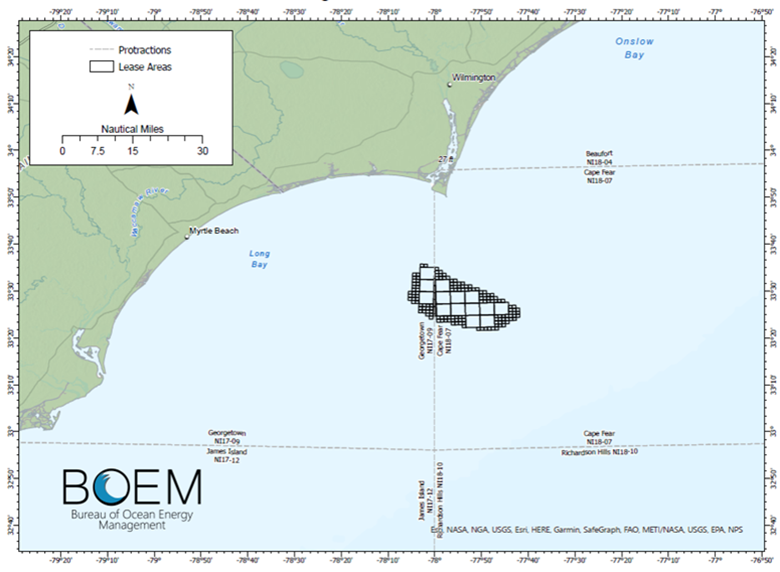
 Previously reported –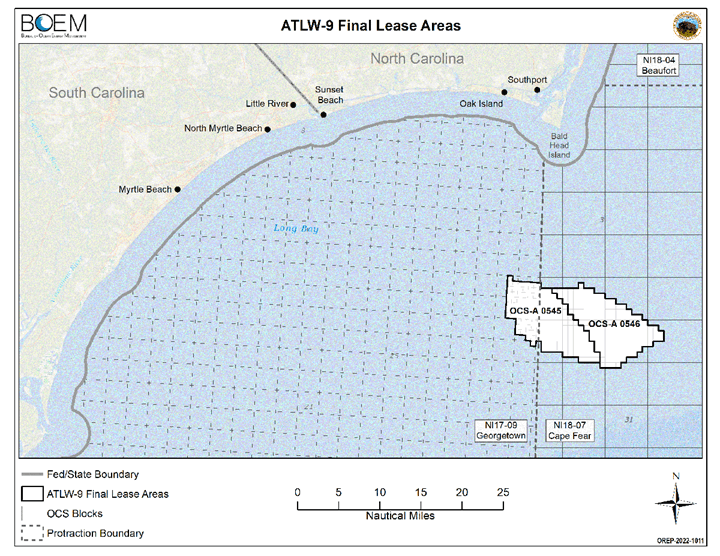
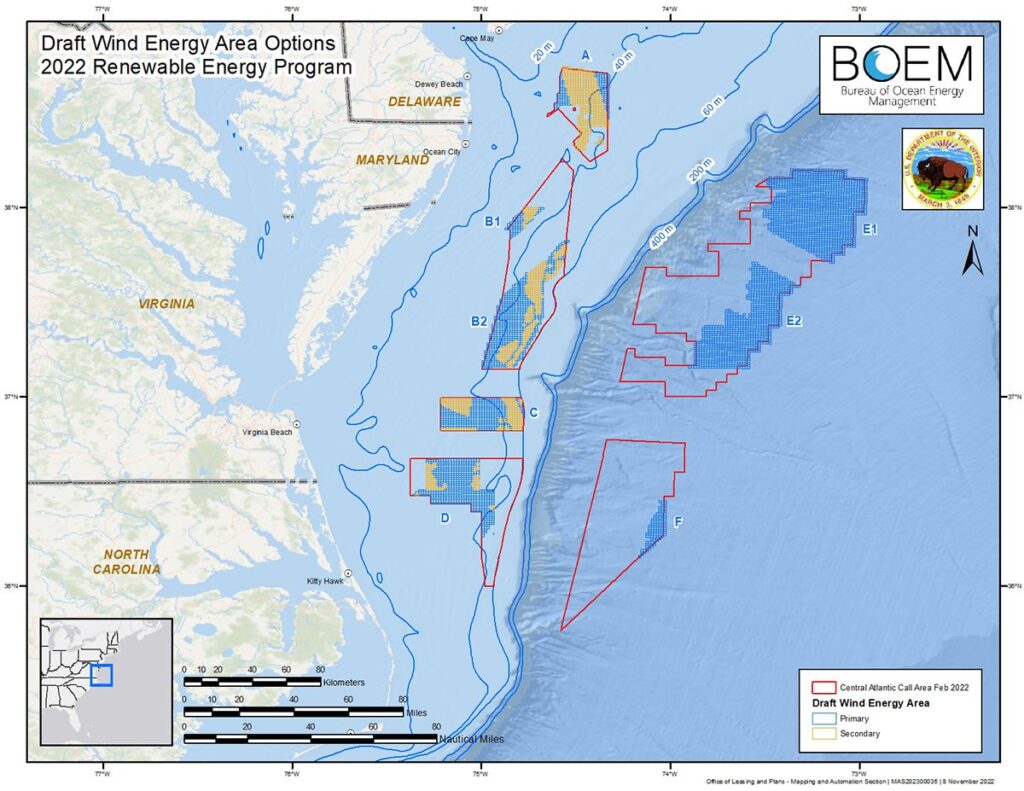
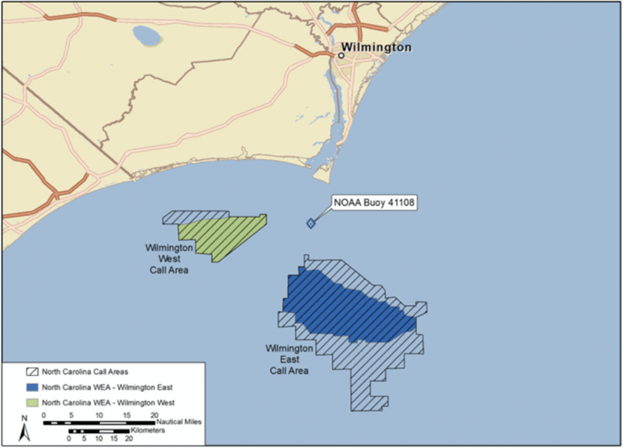
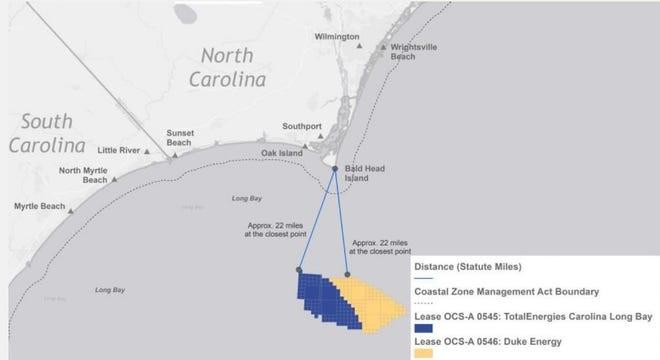
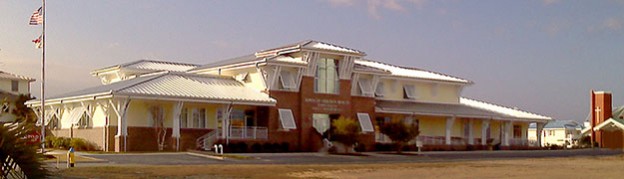


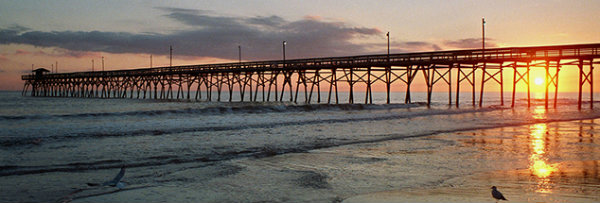

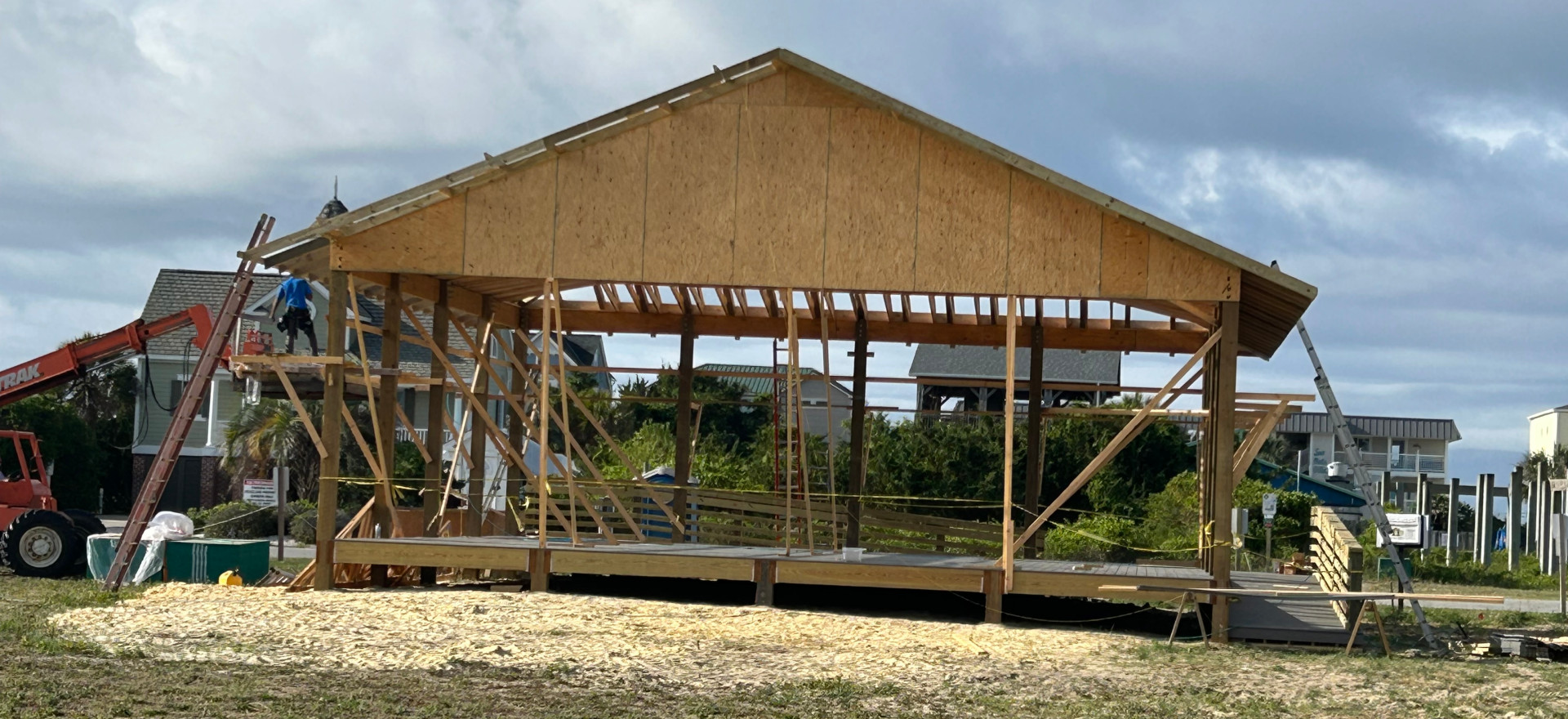 Block Q Stage Area







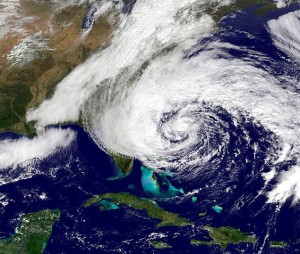






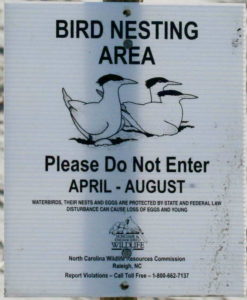

 News from Town of Holden Beach



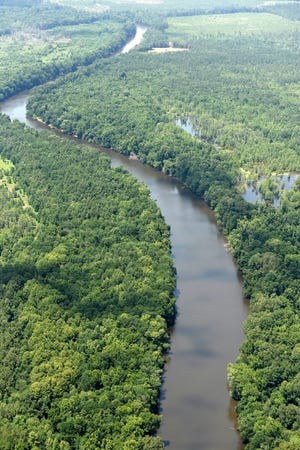 Powerful NC senators oppose proposed Cape Fear River water diversion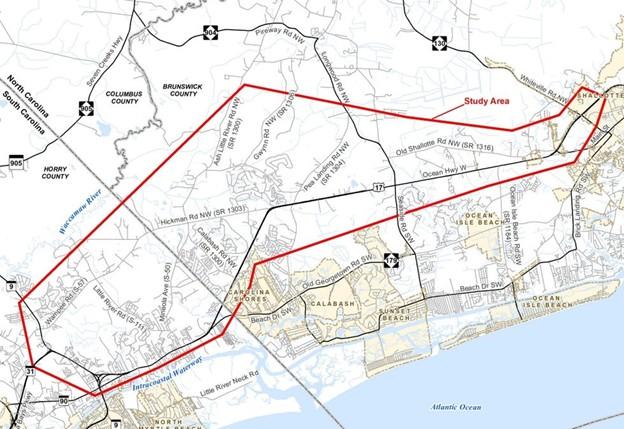

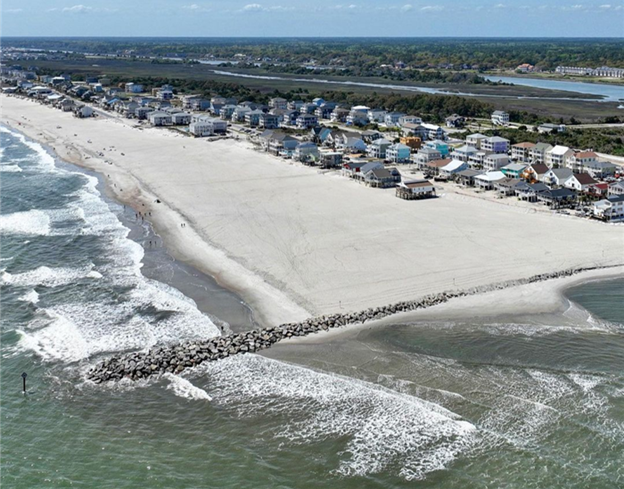
 Sand is vanishing on east side of Ocean Isles $11M erosion fix

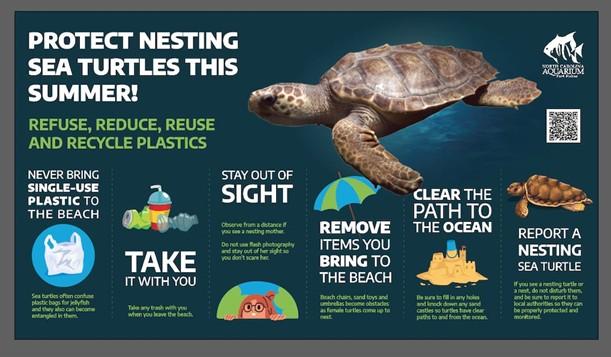


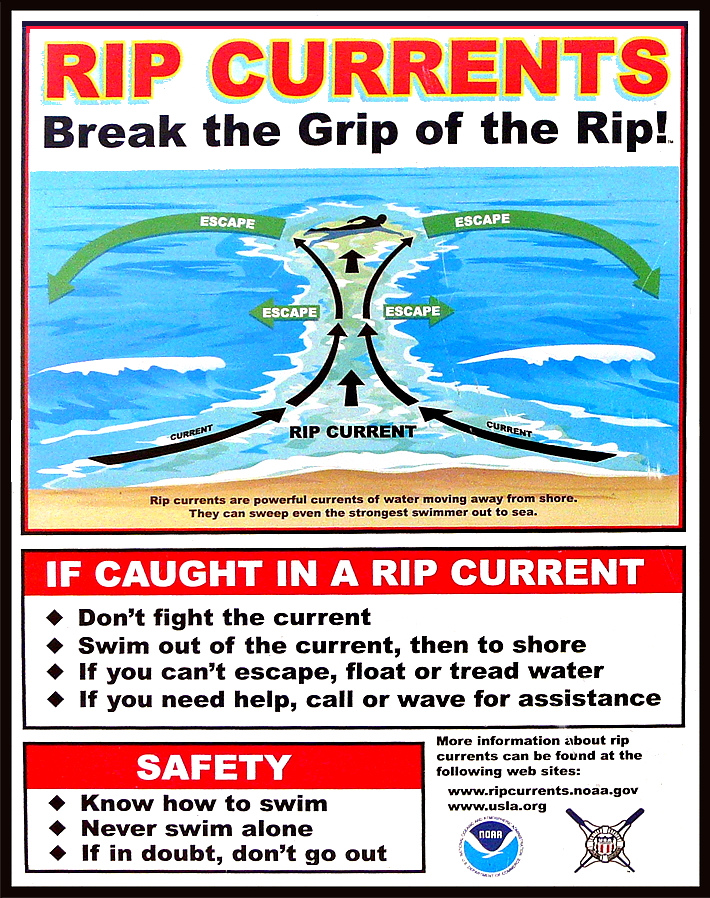







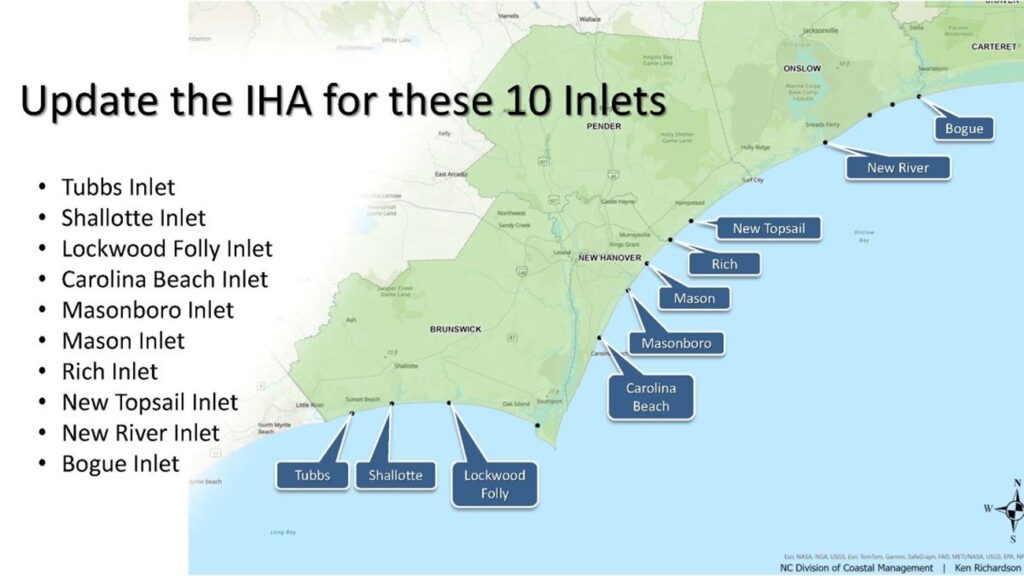







 Holden Beach selects new police chief