
Lou’s Views
News & Views / August Edition
Calendar of Events –
 Discover a wide range of things to do in the Brunswick Islands for an experience that goes beyond the beach.
For more information » click here.
Calendar of Events Island –
 Concerts on the Coast Series
The Town’s summer concert series calendar has been released! Live performances featuring local musical groups will be held at the Bridgeview Park picnic pavilion across from Town Hall. It will be on Sunday evenings at 6:30pm from May 25th to August 31st. The concerts are free of charge.
Summer Concert Schedule * Lou’s Views
The park will be blocked from vehicular access beginning Saturday evening. The splash pad will be closed on Sundays and the multipurpose court will close at 3:00 p.m. each Sunday. No seating will be provided so everyone should bring their own chair for the event.
Parks & Recreation / Programs & Events
For more information » click here
Reminders –
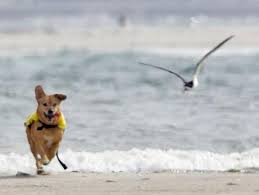
Pets on the Beach Strand
Pets – Chapter 90 / Animals / 90.20
From May 20th through September 10th it is unlawful to have any pet on the beach strand during the hours of 9:00am through 5:00pm.
 Free Cleanup Week
The Brunswick County Solid Waste and Recycling Division hosts two free clean up weeks a year, the third week in April and September. The next Free Cleanup Week at the Brunswick County Landfill will take place September 22nd – 27th. Brunswick County property owners and residents can dispose of all materials, except for regular household trash and hazardous waste, at the Brunswick County Landfill free of charge during Free Cleanup Week events. Individuals can dispose of metal, tires, electronics, appliances, latex paint, clothing, shoes, used oil, oil filters, antifreeze, gasoline, fluorescent bulbs, used cooking oil, smoke detectors, household batteries, and yard debris in their designated areas at the landfill during this week. Participants must show proof of Brunswick County property ownership or residency.
Businesses and commercial vehicles will be charged normal tipping fees.
For questions, email Brunswick County Operation Services or call 910-253-2520.
LOCATION
Brunswick County Landfill
172 Landfill Rd NE
Bolivia, NC 28422
HOURS OF OPERATION
Monday through Friday :30 a.m. until 5:00 p.m.
Saturday 7:30 a.m. until 3:00 p.m.
Bird Nesting Area
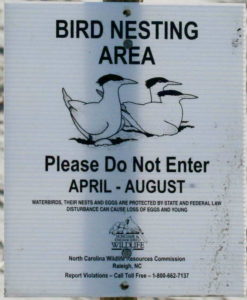
NC Wildlife Commission has posted signs that say – Bird Nesting Area
The signs are posted on the west end beach strand around 1335 OBW.
People and dogs are supposed to stay out of the area from April through November
. 1) It’s a Plover nesting area
. 2) Allows migrating birds a place to land and rest without being disturbed

A Second Helping
.
Program to collect food Saturday mornings (8:00am to 10:30am) during the summer at the Beach Mart on the Causeway.
1) Twenty-first year of the program
2) Food collections have now exceeded 307,000 pounds
3) Collections will begin on Memorial Day weekend
4) Food is distributed to the needy in Brunswick County
For more information » click here
.
Hunger exists everywhere in this country; join them in the fight to help end hunger in Brunswick County. Cash donations are gratefully accepted. One hundred percent (100%) of these cash donations are used to buy more food. You can be assured that the money will be very well spent.
Mail Donations to:
A Second Helping
% Sharon United Methodist Church
2030 Holden Beach Road
Supply, NC 28462
 News from Town of Holden Beach
The town sends out emails of events, news, agendas, notifications, and emergency information. If you would like to be added to their mailing list, please go to their web site to complete your subscription to the Holden Beach E-Newsletter.
For more information » click here
 Paid Parking
Paid parking in Holden Beach
Paid parking will be enforced from 9:00 a.m. to 5:00 p.m. daily with free parking before and after that time. All parking will use license plates for verification.
Rates
Parking rates for a single vehicle in all designated areas will be:
$5 per hour for up to four hours
$20 per day for any duration greater than four hours
$80 per week for seven consecutive days
Handicap Parking
A vehicle displaying a handicap license plate and/or hang tag parked in a designated handicap space is free. Any other parking space will require a parking permit via the app.
Annual Passes
Annual permits for the calendar year allow vehicles (this includes low-speed vehicles and trailers) access to designated parking.
$175 for a single vehicle
Passes can be purchased via the app, website or by telephone.
Where to Park
Per ordinance, there is no parking on the streets or rights-of-way except in designated parking spaces identified by Pay-to-Park signs. Click here to view an interactive map. The table with authorized parking can be viewed below.
Citations will be issued for:
-
-
- Parking without an active paid permit in a designated parking area
- Parking within 40 feet of a street intersection
- Parking in a crosswalk, sidewalk, or pedestrian access ways
- Parking blocking a driveway or mailbox
- Parking facing opposing traffic
- Parking in a no parking zone, or within right-of-way
- Parking on any portion of the roadway or travel lane
- Parking a non-LSV vehicle in an authorized LSV location
-
How Do I Pay to Park
The Town uses the SurfCAST by Otto Connect Mobile Solution. This is a mobile app downloadable for Apple and Android devices. Download the app today. Users will setup their account, enter their license plate details and pay for parking directly on the app. Alternatively, users can scan the QR Code located on the parking signs to access a secure website.
The Otto Connect customer service team will be available to help via phone and email.


Solid Waste Pick-Up Schedule
GFL Environmental change in service, October through May trash pickup will be once a week. Trash collection is on Tuesdays only.
Please note:
. Trash carts must be at the street by 6:00 a.m. on the pickup day
. BAG the trash before putting it in the cart
. Carts will be rolled back to the front of the house
GFL Refuse Collection Policy
GFL has recently notified all Brunswick County residents that they will no longer accept extra bags of refuse outside of the collection cart. This is not a new policy but is stricter enforcement of an existing policy. While in the past GFL drivers would at times make exceptions and take additional bags of refuse, the tremendous growth in housing within Brunswick County makes this practice cost prohibitive and causes drivers to fall behind schedule.
Solid Waste Pickup Schedule –
starting the Saturday before Memorial Day (May 25th) twice a week
Recycling –
starting after Memorial Day (June 4th) weekly pick-up
Curbside Recycling – 2025
GFL Environmental is now offering curbside recycling for Town properties that desire to participate in the service. The service cost per cart is $119.35 annually paid in advance to the Town of Holden Beach. The service consists of a ninety-six (96) gallon cart that is emptied every other week during the months of October – May and weekly during the months of June – September.
Curbside Recycling Application » click here
Curbside Recycling Calendar » click here

Trash Can Requirements – Rental Properties
GFL Environmental – trash can requirements
Ordinance 07-13, Section 50.08
Rental properties have specific number of trashcans based on number of bedrooms.
* One extra trash can per every 2 bedrooms
..
§ 50.08 RENTAL HOMES.
(A) Rental homes, as defined in Chapter 157, that are rented as part of the summer rental season, are subject to high numbers of guests, resulting in abnormally large volumes of trash. This type of occupancy use presents a significantly higher impact than homes not used for summer rentals. In interest of public health and sanitation and environmental concerns, all rental home shall have a minimum of one trash can per two bedrooms. Homes with an odd number of bedrooms shall round up (for examples one to two bedrooms – one trash can; three to four bedrooms – two trash cans; five – six bedrooms – three trash cans, and the like).
Building Numbers
Ocean front homes are required to have house numbers visible from the beach strand.
Please call Planning and Inspections Department at 910.842.6080 with any questions.
§157.087 BUILDING NUMBERS.
(A) The correct street number shall be clearly visible from the street on all buildings. Numbers shall be block letters, not script, and of a color clearly in contrast with that of the building and shall be a minimum of six inches in height.
(B) Beach front buildings will also have clearly visible house numbers from the strand side meeting the above criteria on size, contrast, etc. Placement shall be on vertical column supporting deck(s) or deck roof on the primary structure. For buildings with a setback of over 300 feet from the first dune line, a vertical post shall be erected aside the walkway with house numbers affixed. In all cases the numbers must be clearly visible from the strand. Other placements may be acceptable with approval of the Building Inspector.
Upon Further Review –
 Coastal counties seek regional hazard mitigation plan input
Southeast coastal counties and municipalities within them are teaming with the N.C. Emergency Management to update the Southeastern N.C. Regional Hazard Mitigation Plan. The federally required plan helps prepare for future disasters by identifying natural hazard risks, potential impacts of those risks on communities, and mitigation goals and actions. Plans must be updated every five years. Residents of Brunswick, New Hanover, Onslow and Pender counties are invited to take a short public survey to provide feedback as part of the update to the plan. A virtual meeting about the updated plan is scheduled for 6 p.m. on Aug. 18. Anyone wishing to attend may register online. Hazard mitigation plans are required under the Disaster Mitigation Act of 2000, which mandates state, tribal, county, and local governments create, approve and adopt mitigation plans in order to be eligible for Federal Emergency Management Agency disaster and non-disaster grant programs. There are 30 regional multijurisdictional hazard mitigation plans in North Carolina. This is the state’s fifth update of those local mitigation plans. Updates are managed and funded by N.C. Emergency Management through grant funding. The update process includes a thorough community-level review of natural hazard risks and potential impacts, capabilities, and a review and updating of mitigation goals and actions established in previous plan editions.
Read more » click hereÂ
 How to Stay Safe From Rip Currents, and What to Do if You’re Caught in One
From land, a rip current can appear relatively calm, as a strip of water that extends out between breaking waves. Its appearance can be deceiving.
As hot summer days lure people to sandy shores and cool waters, experts say that people going on beach trips should be aware of the potential danger of rip currents, like one the authorities said swept away the actor Malcolm-Jamal Warner while he was swimming off the Caribbean coast of Costa Rica on Sunday. At least three dozen people in the United States have drowned in the surf so far this summer, most of them caught in rip currents, channels of water that flow away from the shore and can drag people along, according to the National Weather Service, which tracks surf-zone deaths across the country. As the summer holidays get in full swing, reports of rescues and fatalities tend to rise. Mr. Warner, the American actor best known for playing Theo Huxtable on “The Cosby Show,†was swept away at a Costa Rican beach known for rip currents on a day when there was no lifeguard on duty, the local authorities said. Earlier in July, Chase Childers, a former minor league baseball player, died after rushing into the surf in Pawleys Island, S.C., to save swimmers in a rip current, the police said. In Australia, an average of 26 people drowned each year in rip currents, statistics from 2011 to 2021 show. And the fatalities do not just occur in oceans. In the Great Lakes region, rip currents caused an average of 50 drownings per year from 2010 to 2017, Chris Houser, the dean of science at the University of Waterloo in Ontario, Canada, said.
Can you see a calm strip of water cutting through the waves?
Rip currents occur when water flows away from the beach through a narrow channel that has been created by an underwater feature or a sandbar. They are easiest to see from an elevated position like a beach access point and are harder to spot when a person is closer to the water. From land, a rip current can appear relatively calm on the surface, as a strip of water that extends out from the beach between breaking waves. Its appearance can be deceiving, because the forceful flow of water away from the shore can sweep a swimmer far into the body of water. The current can also appear as a patch of darker water stretching away from the beach, or as a distinct offshore flow. Rip currents are swift and unrelenting. They can move at speeds of up to eight feet per second, which is faster than the pace of an Olympic swimmer. But drownings often happen with far weaker currents, said Gregory Dusek, a senior scientist with the Ocean Service at the National Oceanic and Atmospheric Administration. “It doesn’t have to be moving that fast to cause a problem,†Mr. Dusek said. “It just needs to be pulling you enough to get you from where you can touch to where you can’t.†The currents can occur at any time and in any conditions, but they are most dangerous when waves are two to three feet high, Mr. Dusek added. There is also added risk in late summer, when tropical storm systems and hurricanes can move through a region and prompt strong waves, even on clear, sunny days. “You can have a storm far away driving pretty large waves, and you can have strong rip currents where you are, even when the weather seems fine,†Mr. Dusek said.
Check the surf forecast at your beach.
NOAA maintains beach weather forecasts for several popular destinations, which contain information about rip currents and waves, at weather.gov/beach. Surf zone forecasts also assess the low, moderate or high risks of rip currents associated with your destination beach. Some lists of safety tips from government agencies also state the obvious for people dipping into the surf: Make sure you know how to swim.
Read signs and avoid swimming near piers.
Try to swim at a beach that is under the watch of lifeguards and ask them about the conditions before you enter the water. Comply with their orders and read and follow instructions from official posted signs. Do not swim alone or within 100 feet of piers and jetties, because rip currents flourish alongside them, NOAA recommends. Families with children should swim near a lifeguard if there is one. It also helps if children bring something that floats into the water with them, such as a boogie board, a surfboard or a lifejacket, all of which can help weaker swimmers navigate a rip current. Hopefully, you will never need the advice in the next section.
Don’t fight the rip current.
Many people panic when they get pulled into a rip current, which leads them to waste energy and make irrational decisions, Mr. Dusek said. If you find yourself carried off by a rip current, try to relax and evaluate your surroundings. Remember that a rip current will not pull you under, he said. And don’t try to swim against it. Not every rip current is the same, and you may use different strategies depending on the water’s movement and your swimming abilities, Mr. Dusek said. It is possible that the current itself will circulate back to shore. If so, float. The rip current is generally narrow, so try to escape it through its side, rather than head-on. Strong swimmers should move in a direction that follows along the shoreline, or swim toward breaking waves and then at an angle toward the beach, he said. “If you don’t think you can do that, or you feel like you’re swimming anywhere in particular, you want to just float and wave your hands and call for help,†Mr. Dusek said. It’s important to stay above the water and avoid exhausting yourself to give time for a lifeguard to reach you or for someone on the shore to call 911. To do so, you can also embrace the “flip, float, follow†strategy, which involves flipping on your back to float above water and following the current until it takes you past breaking waves or back to shore.
How to help someone stuck in a current.
Rip current drownings often occur when bystanders wade into dangerous conditions to help another person. To assist someone safely, you can help direct them to swim parallel to the shore or flip on their back to float. If you are near someone stuck in a rip current, alert a lifeguard. If there is no lifeguard on duty, call 911. Even if the person escapes the rip current, they may still need lifesaving support, Mr. Dusek said. For swimmers who are pulled by the current closer to the shore, give them something that floats to hold onto, such as a boogie board or a cooler. If you feel like the only option is to enter the water — and you’re a strong swimmer — it’s important to still bring a flotation device, Mr. Dusek said.
Read more » click here
Corrections & Amplifications –
 Brunswick County real estate market stays hot
Brunswick County’s residential real estate market continued its momentum in June, racking up the second highest number of sales in June during the past decade. The luxury market remained strong and total sales volume for the year crossed over $1.4 billion. “Back in 2017, I remember being excited about hitting $1 billion in sales,†said Cynthia Walsh, CEO of the Brunswick County Association of Realtors (BCAR). “Right now, we’re on track with last year’s pace, where we had a total sales of $2.7 billion by the end of the year. Any reports of real estate slowing down are just not factual in Brunswick County.†New listings increased 1% compared to last June, rising from 724 to 731. The number of homes sold was nearly level with last June, increasing from 557 to 558. Thirty-seven% of sales in June were at or above list price, a total of 205. Of those sales, 125 were new construction and 80 were resales. Total sales volume jumped 17.2%, from $248,259,701 to $291,034,700. The average sales price increased 17% from $445,709 to $521,568, and the median sales price rose 9.1%, from $357,000 to $389,500. Brunswick County’s luxury market was especially strong in June 2025, recording 46 sales over $1 million, including a $6 million sale on Bald Head Island, the largest of the year so far. The absorption rate is approaching five months, while average days on market dropped below 75 and median days on market is now 37 days, signaling continued demand and an environment that favors sellers to an extent. Year-to-date sales volume through June totaled $1,382,241,575, up 1.7% from $1,359,525,972 at the same point in 2024. The average year-to-date sales price is holding steady, up just 0.1% from $478,131 to $478,722, while the median sales price dipped slightly by 0.5% from $374,325 to $372,273. The number of units sold through June increased 1.9% compared to last year, rising from 2,836 to 2,889, and new listings are up 9.6%, from 4,267 to 4,678.
 Brunswick County
 New Listings
-
-
- June 2025: 731.
- June 2024: 724.
- Increase/Decrease: +1%.
-
Units Sold
-
-
- June 2025: 558.
- June 2024: 557.
- Increase/Decrease: +0.2%.
-
Average Sales Price
-
-
- June 2025: $521,568.
- June 2024: $445,709.
- Increase/Decrease: +17%.
-
Median Sales Price
-
-
- June 2025: $389,500.
- June 2024: $357,000.
- Increase/Decrease: +9.1%.
-
Total Sales Volume
-
-
- June 2025: $291,034,700.
- June 2024: $248,259,701.
- Increase/Decrease: +17.2%.
-
The Brunswick County Association of Realtors (BCAR) is the local association level of the largest trade association in the nation, presently serving its members, which are comprised of realtors, appraisers and affiliate members. Chartered in 1959 by the National Association of Realtors (NAR), BCAR represents the interests of its members in southeastern North Carolina and northeastern South Carolina. For more information, visit bcarnc.com.
Read more » click hereÂ
County presents timeline for potential fire funding changes
Brunswick County Manager Steve Stone on Monday, July 21 presented the county commissioners with tentative timeline for transitioning the county’s fire service funding mechanism from the existing fire fee structure to a form of fire tax, emphasizing that the goal of the switch is to provide “truly adequate funding for the fire service in Brunswick County to make sure that every community has the fire protection services that they need.†The potential move from fire fees was suggested by Stone in October in response to the commissioners’ request for county administration to bring forward some recommendations to help the county better control and respond to ongoing development. Now is not the first time the county has considered a switch, as it in 2017 conducted a study to investigate changing the fire service funding method but elected to stay under the fire fee system, which was enacted in 1999. Stone, in his October recommendation, said fire fees are an inadequate source of funding for many local departments. Many local nonprofit departments are facing challenges stemming from declining volunteer firefighter number necessitating most departments to hire paid staff, increasing costs for fire apparatus and equipment and increased call volume and the need for new or updated facilities due to ongoing growth. These departments operate entirely on fire fees and grants, fundraising and donations. Municipal departments are facing similar struggles related to growth and increased costs. These departments funded partly by fire fees supplemented by ad valorem (property) taxes collected by the department’s municipality, so municipal residents pay fire fees to the county and pay property taxes to their municipalities that are used to fund fire service. Throughout the process so far, Stone and county commissioners have maintained the county with the change from fire fees to fire tax is not seeking to create a countywide fire department, like in neighboring New Hanover County. “There are several optional ways to do [switch from fire fees], but it is not the intent of anyone in our office for any of those options to be a county fire service,†said Stone during the July 21 meeting. “That is not it’s not even on the maybe list.†The county manager shared the tentative schedule for the next steps in the transition process. The immediate next step, Stone noted, will be for county staff to complete its review and analysis “of the tax rates needed to adequately fund the fire service in each of the current fire districts, as well as the rate needed to adequately fund a theoretical single unincorporated county fire district.†The target completion date for this step is Aug. 29. Next, the county will hold discussions with the Brunswick County Fire Chiefs Association and municipalities that fund fire departments about possible consolidation or reconfiguration of fire service district boundaries, with that step projected to be completed by Oct. 17. The penultimate step will involve presenting draft fire district alignment and tax rate alternatives to the Brunswick County Board of Commissioners on Nov. 17, with staff projected to present final recommendations for changes to the board by its annual January goals retreat next year. As the process gets underway, both the Brunswick County Mayors Association and the Brunswick County Fire Chiefs Association have requested the county include them in discussions concerning the potential switch. In a June 6 letter to county commissioners, the mayors of Bald Head Island, Leland, Ocean Isle Beach, Oak Island, Shallotte, Southport, Sunset Beach and St. James asked the county to include the mayors and eight municipalities in its planning and discussions regarding a new fire service funding system. “We welcome the county’s willingness to review funding alternatives to ensure adequate fire protection for all Brunswick County residents,†the letter notes. “We agree with you that the current fire fee system is inadequate to meet those needs and the increasing costs resulting from the substantial increase in the County’s population. Developing a new fire revenue system is complicated and the two models noted above present a series of challenges. Due to the impact on town citizens and our budgets, we respectfully request that mayors be included in the planning and discussions of any new fire revenue system.†During the July 21 meeting, Brunswick County Fire Chiefs Association President Scott Drew, who is chief of the Southport Fire Department, also asked commissioners and county administration to include the association in its “deliberations, discussions and options with funding of fire service in the county.â€Â Chief Drew, who during the meeting was accompanied by nearly a dozen other local fire chiefs, noted the mayors association wants to partner with the chiefs association and open dialogue to discussion options for funding. “A collaborative effort of nonprofit departments, municipal departments with the mayors, the county commissioners and the citizens of this county will be needed to bring about a successful change to the funding mechanism for Brunswick County,†Drew told commissioners. Stone during the July 21 meeting said the county “fully intends to include the Fire Chiefs Association, the municipalities that have municipal departments, and the municipalities that support volunteer departments, and the other municipalities in the conversation.â€Â Commissioner Marty Cooke reiterated Stone’s comments about the county’s complete disinterest in creating a countywide fire department. “I know of no plans whatsoever create a county wide fire department — none,†Cooke said. “As the manager stated, it’s not even part of the conversation. There’s no plans for it. Nobody wants to do it. Thing about it is, we want to make sure that everybody’s made whole … we want everybody to be on the same page how we bring this thing together.†Commissioner Pat Sykes said she wants to ensure the county is not simply putting “a band-aid†on the issue but is actually working to resolve it. “What’s best for the county, it might not be best for each one of your departments,†told fire chiefs in attendance. “However, we need to do it right for the citizens because if we’re going to give you money, you need to be accountable. Money — people’s tax money — shouldn’t just be spent to be spent.†Other commissioners noted they want to be sure all the important aspects are reviewed and addressed, even if that means not sticking to the proposed timeline. “Don’t skip important steps to get to that timeline,†Commissioner Frank Williams said. “We want it done by the timeline, but we also want to make sure we don’t miss something important that can make a good idea turn into a bad idea because this is a very big change in the way we do fire business in Brunswick County if we go down that path.†Commissioner Randy Thompson said that there will need to be “considerable meetings†between the county and fire service providers to discuss the potential consolidation or reconfiguration of fire service districts, adding that many local fire departments are still in a “very dangerous situation†due to existing staffing levels. “We need to make sure that we’re providing certified personnel at the stations — that still needs to be one of our critical areas,†Thompson said. “I think that we’re running a risk of waiting as long as we’re waiting, but I understand how processes work.â€
Read more » click here
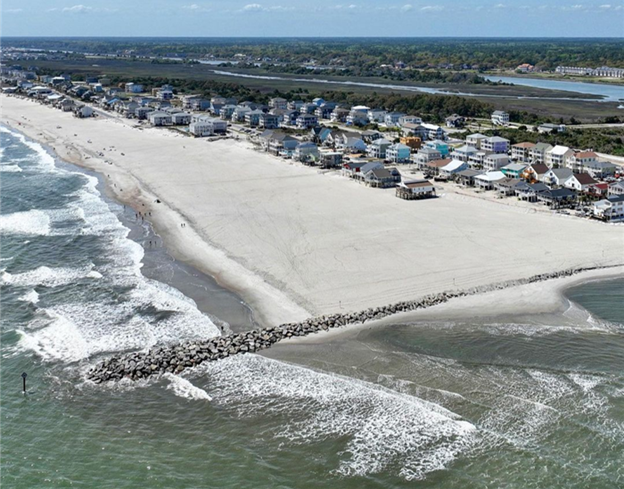 OIB Terminal Groin
Ocean Isle Beach completed construction of a terminal groin on its east end in April 2022 to help protect the beach immediately behind it. However, this structure has contributed to significant erosion at the east end near Shallotte Inlet by interrupting natural longshore drift, prompting ongoing efforts such as sandbag use to prevent ocean encroachment on properties in that area.

View of OIB east of the terminal groin after Hurricane Erin passed offshoreÂ
Odds & Ends –
Warren Buffett’s longtime Social Security warning is coming to fruition, with retirees facing an $18,000 annual cut
In just seven years, Social Security will reach a fiscal cliff that could leave millions of American retirees with drastically reduced benefits, according to a recent analysis by the Committee for a Responsible Federal Budget (CRFB). The think tank’s new report projects that, unless Congress acts, Social Security’s main trust fund will be insolvent by the end of 2032, triggering automatic and painful benefit cuts for everyone relying on the program. How painful? Around $18,000 less per year for retirees who depend on the program. This is not the first time the CRFB has warned about this, and it’s a common refrain from no less than the Oracle of Omaha himself: famed investor Warren Buffett.
The ticking clock
Social Security and Medicare, the two bedrock programs supporting older Americans, are drawing closer to insolvency than many might realize. The most recent data, compiled from the programs’ own trustees and enhanced by CRFB calculations, forecasts that by late 2032, Social Security’s retirement program will no longer be able to pay out promised benefits in full. At that point, the law dictates that payments must be limited to the amount coming in from payroll taxes—resulting in an immediate, across-the-board benefit reduction.
The scope of the cut: $18,100 shortfall for typical couples
For millions of future retirees, the numbers are stark. CRFB’s estimate reveals that a typical dual-earning couple retiring at the start of 2033 would see their annual Social Security benefit drop by approximately $18,100. The percentage cut is projected to be 24% for that year, instantly slashing retirement incomes for over 62 million Americans who depend on the program. The pain would be widespread but would vary by income and household type. For example, single-earner couples could see a $13,600 cut, while low-income, dual-earner couples face a $11,000 shortfall. And high-income couples might lose up to $24,000 a year. While the dollar cut is smaller for lower-income households, the relative burden is even more severe, devouring a larger share of retirement income and past earnings. Also, these cuts are in nominal dollars; adjusted to 2025 dollars, the actual cut would be about 15% less.
What’s causing the crisis?
Social Security is funded by a dedicated payroll tax, but the gap between what goes out in benefits and what comes in through taxes is growing. The newly enacted One Big Beautiful Bill Act (OBBBA) has accelerated the timeline by reducing Social Security’s revenue through tax rate cuts and an expanded senior standard deduction. According to CRFB, these policies increase the necessary benefit reduction by about one percentage point; if the changes become permanent, the benefit cuts would be even deeper. Over time, the gap is expected to worsen: By the end of the century, CRFB adds, Social Security could face required benefit cuts of over 30%, unless lawmakers shore up the program’s finances. Despite these dire projections, many policymakers have pledged not to alter Social Security, promising to keep benefits untouched. But if nothing changes, the law automatically enforces cuts when the trust fund runs dry. The CRFB report urges policymakers to be candid about the situation and to work toward bipartisan solutions that secure Social Security’s future. Ideas could include new revenue sources, adjusting benefits, or a combination—anything to avoid the “steep and sudden†cut that looms for tens of millions. Without meaningful congressional action before 2032, the Social Security safety net will be abruptly—and dramatically—shrunk, so Americans approaching retirement will at least want to pay close attention to congressional action on the looming cliff.
Buffett’s bugbear
Warren Buffett has been vocal about the dangers of Social Security insolvency and the looming benefit cuts that millions of retirees could face if action is not taken soon. The retiring Berkshire Hathaway CEO has stated that reducing Social Security payments below their current guaranteed levels would be a grave mistake, and urged prompt congressional action. Buffett, who has signed the Giving Pledge and has advocated for higher taxes on higher earners, has criticized the cap on income subject to Social Security taxes, arguing that higher earners—including himself—should contribute more. He’s also suggested that Social Security’s finances could partially be eased by raising the retirement age, with the 95-year-old investing legend himself working well beyond the standard end of most careers.
CRFB background
The CRFB is not just any think tank, either. It’s a respected bipartisan institution that stretches back to 1981. Its board has consistently included former members and directors of key budgetary, fiscal, and policy institutions, such as the Congressional Budget Office, the House and Senate Budget Committees, the Office of Management and Budget, and the Federal Reserve. The CRFB regularly produces analyses of government spending, tax proposals, debt and deficit trends, and trust fund solvency (such as Social Security and Medicare), as well as recommendations and scorecards for major fiscal legislation. The CRFB has consistently advanced a centrist position on budgetary matters, regularly advocating for reducing federal deficits and controlling the growth of national debt. The organization has often criticized large spending bills that are not offset by reductions elsewhere, as well as tax cuts that are not revenue-neutral. The think tank favors reforms to federal “entitlement†programs, especially Social Security and Medicare, aiming to make them fiscally sustainable, an emphasis that has drawn criticism from the left. For example, Paul Krugman characterized it as a “deficit scold†when he was still with the New York Times. In the Social Security sphere, the CRFB has supported or proposed ideas like raising the retirement age, adjusting cost-of-living increases (using the chained CPI), increasing the amount of wages subject to payroll tax, and progressive indexing (in which benefits grow more slowly for higher earners). The CRFB has also weighed proposals for new revenue streams and some means-testing of benefits. On the right wing, the CRFB’s proposed reforms to Social Security have drawn criticism for, as Charles Blahous of the Manhattan Institute put it, creating a structure more like “welfare†than an earned income benefit. Still, the CRFB is widely respected in policy circles as a knowledgeable, data-driven budget watchdog, with a long track record of analysis and advocacy for sustainable fiscal policy.
Read more » click here

This and That –
 This Peaceful Southern Spot Was Just Named the Calmest Beach in the U.S. and
It Has Small Town Charm and Few Crowds
With uncrowded sands and small-town vibes, a North Carolina beach leads a new list of America’s calmest shores.
There are many ways to judge a beach: the softness of its sand, the clarity of its water, the quality of the surf, or nearby activities and dining. But for those seeking a peaceful escape, free from crowds and rogue volleyballs, tranquility is key. And when it comes to calm and quiet, one lesser-known U.S. beach stands out. Holden Beach in North Carolina has been named the calmest beach in the U.S., according to a study by McLuck, a social casino platform. The team analyzed approximately 250,000 TripAdvisor reviews from 158 beaches nationwide, tracking how often words like “calm,†“quiet,†and “relax†appeared. Based on the percentage of reviews that mentioned these terms, Holden Beach emerged as the most serene destination of them all. Holden Beach is a quiet seaside town between North Carolina’s more popular coastal destinations of Wilmington and Myrtle Beach. The town has just over 500 people and is primarily a residential community with a small commercial area. For that reason, beachgoers are treated to plenty of open space, natural beauty, and a welcome lack of buzzy beachfront boardwalks. In fact, in the study, over 38 percent of the Holden Beach reviews mentioned calmness. In its findings, the study noted that at Holden Beach, “uncrowded sands, small-town charm, and strict limits on commercial development may explain why so many people find it a peaceful haven. It’s a classic Carolina beach town where time seems to slow down with the tide.†Following Holden Beach on the list was Lewes Beach in Delaware. Like Holden Beach, the town of Lewes has a small population (just over 3,000 people) and is known for being quiet and void of party crowds. Beaches in Virginia came in at No. 3, No. 4, and No. 5, making it the dominant state in the top 10 list. There were no West Coast states in the top 10 ranking and only one beach in the upper Northeast—Goose Rocks Beach in Maine (No. 10).
Read more » click here
 Why the NC coast is a hot bed for fossilized shark teeth, where to look in the Wilmington area
Thanks to lots of fossil beds, lots of beaches, and eager beachcombers, the Cape Fear coast is a known hot spot for finding shark teeth.
If you’re excited about Discovery’s “Shark Week” and the celebrations around the 50th anniversary of the classic “Jaws” film, there’s an easier way to learn about some of the Cape Fear’s oldest and toothiest residents without worrying about having a face-to-face encounter. And with nearly 50 species of sharks found along the N.C. coast and in the state’s extensive estuaries, all of which have different types and shapes of teeth, there’s plenty of opportunity for lucky beachgoers to come across a toothy surprise − even if it’s been thousands of years since that particular shark swam around a Tar Heel State that looked much different then than it does today. The Wilmington area, thanks to geology and a bit of luck, is a known hot spot for shark teeth. “It’s just a good location, with the right fossil beds just off the coast and great sandy beaches and a lot of people looking for them,” said Dr. Christian Kammerer, research curator of paleontology at the N.C. Museum of Natural Sciences. “It’s a matter of geological happenstance. We’re really in this lucky situation down here.”
Why are there so many shark teeth out there?
While humans and sharks both have teeth, that’s about where the commonality ends. Unlike people, sharks are always growing − and losing − their teeth. That’s because unlike teeth in humans, a shark tooth isn’t attached to their gums but instead is connected by tissue. Sharks also have multiple rows of teeth, and when one pops off, say getting stuck in a fish or from biting something hard, a tooth in a row behind it quickly moves up to take its place. With several rows of teeth, and it common for them to drop off, a shark can go through thousands and thousands of teeth during its lifetime. “Some sharks go through 35,000 teeth in their lifetime, so they’re adding a lot to the fossil record,” Kammerer said. “It’s a very valuable resource for showing us about extinct ecosystems and the changes in species over millions of years.”
How do they get “fossilized?”
The outer part of sharks teeth is made of enameloid, a mineralized tissue similar but harder than the enamel found in human teeth. That means when other parts of the shark, which are mainly cartilage instead of bone, dissolve, the teeth hang around. When teeth drop off, they sink to the bottom of the ocean and eventually become buried by sediment. As more material crowds on top of the sharks teeth, pressure grows and minerals and water gets pushed into the tooth’s pores and other small openings. As the minerals then harden, permineralization − a form of fossilization − takes place.
What can shark teeth tell us?
Like nearly all fossils, shark teeth tell a story. While most of us might think finding a shark tooth is just cool, for biologists the teeth can tell them how the fish lived, perhaps what they ate, and how they’ve evolved and some species have thrived while others have disappeared over the past 400 million years. “They have a lot of important information for scientists,” Kammerer said, including showing there’s been a dramatic decrease in biomass and abundance of these top predators in the marine environment in recent times due to overfishing and climate change. Shark’s teeth also range in shape, purpose and size, with the tooth of the now-extinct megalodon reaching almost 7 inches long − not bad for a fish with a jaw big enough to swallow a compact car.
What are the best beaches to go shark-tooth hunting?
Experts say areas near sand bars and tidal pools can be tooth hot spots. Dredging of sand that’s then pumped onto beaches as part of nourishment projects or an inlet deepening also can prove to be a treasure trove for uncovering sharks teeth. But all beaches aren’t created equally when it comes to shark-tooth hunting. Several Brunswick County beaches, notably Holden Beach and Ocean Isle Beach, are often mentioned as offering some of the best opportunities along the N.C. coast. Topsail Island also offers great hunting opportunities. And it’s not just Wilmington-area beaches that are known tooth hot spots. In the Cape Fear River, a series of islands created by the dredging of the river in the late 19th century is such a prolific site for sharks teeth that they’ve been collectively tagged “Shark’s Tooth Island.” The site is easily accessible by kayak or boat and is near New Hanover County’s River Road Park, and several local excursion companies also offer tours of the islands.
Read more » click here
Golf Carts Have Taken Over Suburbia. Cue the Resistance

Demand for street-legal carts is surging, despite complaints; ‘We all hate you’
A slow-rolling cavalry is conquering America’s public roads. Golf carts are becoming street legal in one community after another as families ditch their minivans and SUVs when they want to run a quick errand or ramble around town. Dan Pearson bought a six-seat cart this summer after the village board he leads in the Chicago suburb of East Dundee, Ill., approved the vehicles. As he drove through downtown on a recent afternoon, pedestrians gawked and diners waved. “Dude, I love it,” a man called out as Pearson cruised past. “It’s fun to get out,” Pear–son said. “People tend to talk to people in a small little cart as opposed to a big car or truck.” But with the boom has come a backlash. Some residents of cart-friendly towns say slow drivers are clogging the streets and reckless ones are making them unsafe. They grumble about cart drivers, including tweens and young teens, speeding, swerving and treating the road like their own private parade route. “We all hate you,” a Florida motorist snapped on TikTok when slow-moving carts on a coastal road clogged traffic in both directions. “Get off your golf cart and drive a regular car.” Paul Ernest, a photographer who lives in McKinney, Texas, said a golf cart driven by a young girl, her eyes fixed to her smartphone, almost collided with his pickup truck on a neighborhood road earlier this summer. Some states including Texas require a driver’s license to take a cart on public roads. “These things are dangerous,” he said. “They’re around vehicles much bigger than they are, and when they’re operated by children with no adult supervision, it’s just a recipe for disaster.” The momentum, however, belongs to the carts. Golf carts designed for the road have been around since the early 2000s, but demand has soared in the past five years. Mark Rickell, a sales executive at cart maker Club Car, estimated the total U.S. market for the vehicles at $5 billion, up from $1 billion before the pandemic. “One thing you could do in Covid was get outside,” he said. “I think that really spurred on the popularity of the golf cart lifestyle.” Many of today’s carts have little in common with old-school fairway ramblers. Street-ready versions usually come with seat belts, headlights and turn signals, and can cost anywhere from a few thousand dollars to more than $25,000. Manufacturers typically cap their speed at 20 or 25 miles an hour, though some owners say that can be boosted with a little tinkering. Johnny Horn bought a four-seater this year that looks like a cruise ship crossed with a UFO. It has a turquoise frame, white seats and orange rims, along with four-wheel drive for the rare occasions when it snows in his hometown of Gaffney, S.C. The dashboard has a built-in refrigerator. The sound system has 24 speakers, all of which can light up and pulse to the rhythm of the music. “It’s like a parade,” said Horn, a Realtor who sometimes drives it to showings. South Carolina law allows golf carts to travel on public roads with a speed limit of 35 mph or less and within 4 miles of the driver’s home. The vehicles don’t need a license plate but must have a permit. Other states allow municipalities to decide, and some are pumping the brakes. Last year, the beach town of Norwalk, Conn., rejected a request to allow the vehicles. Police said carts had been acting as rogue food delivery services, and they worried young drivers would take them for wintertime joy rides. In Elburn, Ill., a petition to legalize golf carts on local roads was signed by nearly 600 people—more than typically vote in municipal elections. The village board debated a proposed ordinance for seven months before unanimously voting against it in June, citing the potential for carts crossing busy highways. Resident Melissa Bollivar, who helped gather the signatures, disagreed with the verdict. “You have a seat belt on,” she said. “You have rearview mirrors. You have a frame around you. I feel they’re safer than e-bikes and scooters and everything else flying around here.” Some dealers say only carts classified as low-speed vehicles, which receive license plates, should be allowed on public roads, even though they account for a minority of sales. “Anything without a plate should be like riding a moped on the freeway— you can’t do it,” said Brian Rott, president and chairman of the recently formed Low Speed Vehicle Dealer Association. Back in East Dundee, golf carts are riding high. Ten people sought registration stickers after the village legalized the vehicles. Pearson, the village president, got sticker No. 1. Driving around town, he encountered No. 4. It was a bright yellow golf cart with a Big Bird decal affixed to the hood. Cody and Jessica Wolff had run out to get a bag of ice with their 2-year-old daughter, Winnie, and decided to leave their SUV at home. “It’s just more convenient to bring downtown,” Jessica said. “And it’s fun for our daughter to do. She thinks it’s the coolest experience in the entire world.”
The Wall Street Journal

These crabs probably saved your life. Can we save theirs?
The medical world relies on horseshoe crab blood in the production of vaccines and equipment. A synthetic is available, but companies have been slow to adopt it.
Susan Linder was hunting for buried treasure. Kneeling at low tide, the biologist dug up small shovelfuls of sand, scanning each scoop for tiny jewels. One yielded a cluster of jade-colored beads. Another, from a few feet away, contained a clutch the color of amethyst. They were eggs. In a few weeks, they would hatch into horseshoe crabs, one of the most ancient and important animals in the United States. The crabs in the Delaware Bay are the stars of an annual ecological opera involving sex, binge eating and literal bloodlust. Every spring, the crabs clickety-clack ashore for a massive orgy timed to the rise and fall of the tides, depositing millions of eggs in the sand. “They’re easy to miss, really,†Linder said, digging the day after a new moon, one of the biggest breeding days of the year. Her job is to help conduct an egg census. She returns all the clutches she finds carefully to the holes. She knows, year after year, the numbers have been diminishing. For decades, the biomedical industry has relied on a compound in horseshoe crab blood to protect medical equipment from contamination, saving untold human lives. The surge in vaccine use during the coronavirus pandemic, as well as the growing popularity of injectable weight loss and diabetes drugs, has further fueled the blood harvest. But conservationists say modern medicine’s dependence on this bloodletting is upending a globe-spanning ecosystem in which birds bulk up on fatty crab eggs to fuel epic migrations. “We’re in this battle over horseshoe crab blood,†said Larry Niles, a wildlife biologist and co-founder of the Horseshoe Crab Recovery Coalition, a campaign trying to stop overharvesting. Now, finally, the crabs have a chance at a reprieve. A key group that sets standards for U.S. drugmakers has officially recognized a human-made alternative as safe and effective, opening the way for pharmaceutical companies to widely adopt alternatives and wean themselves off of crab blood. But only a handful of drugmakers have begun to adopt it. “We’re trying to encourage the pharmaceutical companies to switch to the synthetic,†Niles said, “not only to help horseshoe crabs, but also for their own sake.â€
The carnal crabs
It might as well be an extraterrestrial. Its helmet-shaped body is covered with 10 eyes, some sensitive to ultraviolet light so it can follow the phases of the moon and come ashore for a mating frenzy. Its mouth is on its underside and is surrounded by six pairs of legs it uses to test the water composition and to chew its food. When flipped belly-up on a beach, it uses its spear-like tail to pole-vault itself upright. But the crabs’ claim to Earth predates pretty much everything else here. They are what scientists call a “living fossil,†scuttling for hundreds of millions of years before the Atlantic Ocean was even a puddle. “When you think about the genetic diversity and how long these guys have survived, they must be doing something right,†Amanda Dey, a retired zoologist who works with and is married to Niles. Perhaps the best adaptation accumulated over their 445 million years is their blood. It is a haunting blue hue due to copper-based molecules used to transport oxygen. It is also laced with immune cells called amoebocytes that coagulate around bacterial intruders. For a half-century, the biomedical industry has harvested an extract from these immune cells. Known as limulus amebocyte lysate, or LAL, it is used to test for the presence of bacterial contaminants called endotoxins, which could cause a patient’s organ failure and death. Regulators require tests for vaccines, pacemakers, heart stents, surgical tools and other medical devices, as well as water systems used in drug manufacturing. The blood-drawing process involves plucking horseshoe crabs from shores and transporting them miles to bleeding facilities. There, they are inspected, cleaned and bent on racks to expose a membrane for blood extraction. Afterward, they are released back into the water. Companies involved in this work say the crabs are handled with care, with a limited amount of blood taken only from healthy crabs that are subsequently returned to their native waters. “Our processes are designed to preserve and protect horseshoe crabs,†said Nora Blair, a senior manager at Massachusetts-based Charles River Laboratories, a major lysate supplier for the pharmaceutical industry. The company has developed techniques for using crab blood more efficiently for testing, Blair added. As part of a lawsuit settlement with environmentalists in 2023, it also agreed to stop collecting crabs from certain beaches where birds feed and to stop placing female crabs in holding ponds so they can continue spawning. But conservationists say such measures aren’t enough. About 15 percent of the crabs collected each year perish, according to the Atlantic States Marine Fisheries Commission. In 2023 alone, that portion amounted to 178,000 dead crabs. (The bleeding companies contest those figures.) The density of eggs laid on the Delaware Bay beaches has declined by 80 percent, from about 50,000 eggs per square meter in the early 1990s to around just 10,000 today, according to research from Niles, Dey and others. For years, the practice of using horseshoe crab flesh as bait for commercial fishing was responsible for much of the decline. But that practice has become more regulated — while the number of crabs collected for bleeding has swelled, increasing fourfold since 2004. Last year, environmentalists petitioned the federal government to add the American horseshoe crab to the Endangered Species Act list. A decision is pending. The International Union for Conservation of Nature, which also tracks the status of species, has already declared the American horseshoe crab “vulnerable.â€
The binge-eating birds
There used to be more than enough eggs to both perpetuate the horseshoe crab population and provide a fatty feast for hungry shorebirds, establishing this stretch of New Jersey as a key pit stop for ruddy turnstones, sanderlings, short-billed dowitchers, dunlins and other migratory birds. The red knot, in particular, needs the extra calories. It makes one of the longest annual journeys of any bird, flying more than 9,000 miles from the southern tip of South America to its breeding ground in the Arctic tundra — and back again. By the time some arrive in the United States, they will have flown six days without stopping. While Linder counted eggs on the beach, ornithologists Humphrey Sitters and Stephanie Feigin sat at the front of a boat cruising along the New Jersey side of Delaware Bay to tally every shorebird that they could spot. A plane buzzed above to count, as well. “Dead ahead,†Sitters said, pointing across the bow to a flock of red knots on shore, as waves of semipalmated sandpipers darted across the surface of the water. “350 knots,†he announced. Feigin added the tally to her notebook. “Semis?†she asked. “Let’s say 3,000,†he answered. Sitters said he knows from practice what a group of about 50 birds looks like and extrapolates that figure to the size of the flock in front of him. “It’s experience,†he said. “Eventually, you get your eye†for it. There used to be many more knots to tally. The annual bird surveys show the decline in crab eggs has contributed to a staggering 70 percent drop in the average knot count from the early 1980s to 2014, when the U.S. Fish and Wildlife Service listed the bird as threatened under the Endangered Species Act. A quarter-century ago, “the Delaware Bay was one of the top birding destinations in the world,†Niles said as he piloted the boat. “There were so many shorebirds in one place.†Without bulking up on eggs, knots take longer to reach their nesting grounds — and many don’t make it at all, his research suggests. Now, four of the bay’s most abundant shorebirds — red knots, ruddy turnstones, sanderlings and semipalmated sandpipers — are all in decline. “The stopover is becoming unstable,†he said. “One year is good, the next year is not. And it’s all because the level and number of horseshoe crabs are so low.â€
A human-made solution
In the late 1990s, researchers in Singapore patented a lab-made alternative to the lysate in horseshoe crabs’ blood. But that breakthrough has yet to revolutionize the drug-making industry. “Pharma is just inherently conservative,†said Jay Bolden, a senior director at Eli Lilly. “Why change the status quo when it’s been working well for 40 years? But people don’t see the impact outside of our own four walls.†In 2018, the U.S. Food and Drug Administration allowed Eli Lilly to use a synthetic for endotoxin testing for a migraine drug. As both a businessman and amateur birder, Bolden thought the move made sense. One bad year for the crabs, he thought, could stifle drug production if enough blood isn’t harvested. “If we’re not reliant on a wild animal for one of our tests,†he said, “then we’re inherently in a better supply-chain position.†Crab advocates notched another victory when U.S. Pharmacopeia, a nonprofit that sets quality standards for drugs, issued guidelines deeming the synthetic safe and effective. The guidance, approved in July 2024 and made official in May, allows drugmakers to use lab-made alternatives instead of crab-derived lysate for new drugs with less lab testing and paperwork required. “Basically, it leveled the playing field,†Bolden said. But it’s still up to the drugmakers which to use. In May, a coalition of nonprofits that included Horseshoe Crab Recovery released the results of a survey of the 50 largest drugmakers by revenue about their use of horseshoe crab blood. Only 11 responded to acknowledge the need to switch or disclose concrete steps to actually do so. Among those rated highly by the survey were Eli Lilly, GSK, Amgen, Sanofi and Bristol Myers Squibb. One issue is that if a drugmaker wants to switch production of older drugs to a crab-free compound, it needs to do a whole new round of testing to verify that the compound works at catching contamination. “The biggest challenges right now are legacy products,†said Elizabeth Bennett, communications director at Revive & Restore, a conservation nonprofit that helped conduct the survey. For instance, Novo Nordisk, maker of the blockbuster diabetes drug Ozempic that can cause weight loss, has phased out the use of lysate from horseshoe crabs in research, but still uses it to make existing products “due to regulatory requirements.†In a statement to The Washington Post, the company said it has a “road map†for “phasing out the use of any lysate from horseshoe crab.†Johnson & Johnson and Pfizer, two of the biggest drugmakers by revenue, which each developed coronavirus vaccines that relied on crab blood, did not complete the survey. When reached for comment by The Post, Pfizer said it is using synthetics for testing pharmaceutical water systems and has begun implementing it for some products following the U.S. Pharmacopeia decision. Johnson & Johnson did not reply to a request for comment. Eli Lilly, which rated highest in the survey, has 10 products approved that use alternatives to horseshoe crab blood for endotoxin testing. But it still has to convert some of its existing drugs. “It’s been difficult to convert that last 20 percent on legacy molecules,†Bolden said. Horseshoe crabs as a species are survivors. They made it through the asteroid strike that killed the dinosaurs as well as three of Earth’s other mass extinctions. But whether the fragile web of life that depends on them can survive is more uncertain.
Read more » click here
Turtle Watch Program –
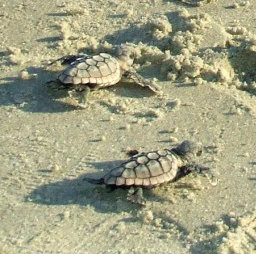
Turtle Watch Program – 2025
The first nest of the 2025 season was on May 22nd
Average annual number of nests is 57
Current nest count – (35) as of 08/22/25
Members of the patrol started riding the beach every morning on May 1 and will do so through October looking for signs of turtle nests.
For more information » click here
Washed away:
Officials say Hurricane Erin likely took a big toll on NC sea turtle nests
Days of pounding surf churned up by Erin has likely inundated or washed away a chunk of NC’s sea turtle nests. But officials added that sea turtles are very resilient and would bounce back.
As the approaching Hurricane Erin brought heavy surf and dune-chewing waves crashing ashore all along the N.C. coast, emergency officials warned beachgoers to stay out of the water and, preferably, off the beach all together. But what if you can’t get off the beach? That’s the situation facing hundreds of sea turtle nests along N.C. beaches, and now officials fear many of those could have been lost to Hurricane Erin that battered the state’s coastline from end to end. According to the N.C. Wildlife Resources Commission, the Tar Heel State has seen 1,057 nests so far this season. Statewide, the two national seashores – Cape Hatteras and Cape Lookout – have seen a combined 432 nests. In the Wilmington area, the top beaches for nests are Topsail Island (90); Oak Island (76); Bald Head Island (58); and Caswell Beach (45). But days of heavy surf pushed hundreds of miles ahead of Erin’s eye have pounded the state’s beaches, washing away dunes and chewing up many beaches. That means some sea turtle nests could have been buried under mounds of wet sand, in effect suffocating any hatchlings, while others could have been exposed to the elements and the eggs simply washed away. Kathy Zagzebski, director of the Karen Beasley Sea Turtle Rescue and Rehabilitation Center on Topsail Island, said nests can handle some wave inundation. “Sometimes, in fact, washover can be helpful in cooling nests,” she said. The sex of hatchlings is based on sand temperature, so a warmer beach means more females and fewer males − a growing problem in a world warmed by climate change. But if hatchlings have started to emerge when the nest is overwashed, the baby turtles generally don’t survive since they breathe air, just like humans do. In short, they drown. On Ocean Isle Beach in Brunswick County, that almost happened on Wednesday, Aug. 20, when a nest started to hatch amid Erin’s storm-driven waves. Luckily, visitors saw the nest cavity and some hatchlings on the beach and alerted authorities, said Deb Allen, island coordinator for the Ocean Isle Beach Sea Turtle Protection Organization. She said team members were able to save 136 hatchlings and help them get to the ocean before the nest was completely flooded, which would have trapped the babies in water and heavy sand. But the overall picture for the island’s sea turtle nests, as likely for all beach areas along the N.C. coast, is pretty grim. “Out of 17 nests, maybe three survived,” Allen said. “We might be able to get some live hatchlings out of some of them, but we just don’t know at this point.” Rules for relocating nests are very strict, due to the difficulty of guaranteeing the health of the baby turtles once they’ve started to incubate in the eggs, and a move is only done in very special cases. Hurricanes also are natural events. But what isn’t natural, Allen said, are the many challenges sea turtles face these days − almost all of which are human-induced. From loss of nesting beach areas to artificial light that distracts hatchlings to fishermen catching and eating sea turtles and even their eggs, the deck is stacked against sea turtles, all species of which are considered threatened or endangered in U.S. waters. That’s why volunteers watch over nests, place predator-proof cages on them, educate the public on what to do and not do when they come across a nest or sea turtle on the beach, and help any stranded babies get out of a nest and reach the ocean. “We do our best to keep everything as natural as possible,” Allen said. “But it can be hard, even if hurricanes are natural events. When things like this happen, we cry. We get very upset. No one wants to see a sea turtle die. But we can’t prevent Mother Nature.” Dr. Matthew Godfrey, sea turtle biologist with N.C. Wildlife, said about half of the state’s turtle nests had finished incubation before the arrival of Erin, and nearly all experienced some inundation. While there are reports of nests washing away, he said some beach towns − like Ocean Isle Beach − reported seeing hatchlings emerge overnight during the storm. “This goes to show that some sea turtle eggs can withstand storm-related inundation and still produce hatchlings,” he said via email. “We won’t have a full account of how many nests were lost or negatively impacted until the end of the season, but based on experience from other years, it is likely that those lost to Erin will include nests that had been moved from more exposed areas to seemingly safer areas of the beach.” Godfrey also noted that sea turtles have evolved to spread their location and timing of their nests to mitigate the risk a single storm event can do to the reptile’s overall reproduction success. “While storms like Hurricane Erin may reduce the production of hatchlings from some specific nests, the overall rate of hatchling production from N.C. nests should remain relatively good this year,” he said.
Read more » click here.

Fort Fisher Aquarium offers tips to protect sea turtles during nesting season
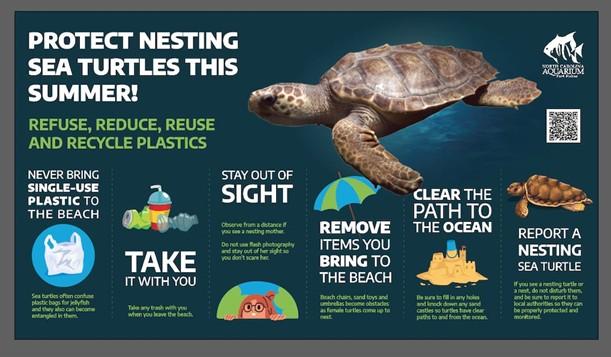
The North Carolina Aquarium at Fort Fisher (NCAFF) has provided the community with tips on how to protect sea turtles during their nesting season beginning this month. “The Aquarium team is passionate about sea turtle conservation and we hope that our work in protecting these species inspires the community to find their own way to protect them,” said NCAFF education curator, Karissa Bearer.
NCAFF suggests a variety of tips, including:
-
-
- Reduce, reuse, and recycle plastics.
- Never release balloons. Pop them and put them in the trash.
- Never release sky lanterns. Try alternatives like bubbles or planting trees in celebration.
- Pick up trash and share that data with scientists studying marine plastics.
- Organize or participate in a beach cleanup or local trash pickup.
- Write a letter to the editor or local government officials about the dangers of marine debris.
-
Read more » click here
Factoid That May Interest Only Me –
The price increases that should cause Americans more alarm
The price of health insurance is rising faster than the price of eggs or gasoline.
Wary of inflation, Americans have been watching the prices of everyday items such as eggs and gasoline. A less-noticed expense should cause greater alarm: rising premiums for health insurance. They have been trending upward for years and are now rising faster than ever. Consider that, from 2000 to 2020, egg prices fluctuated between just under $1 and about $3 a dozen; they reached $6.23 in March but then fell to $3.77 in June. Average gas prices, after seesawing between $2 and $4 a gallon for more than a decade starting in 2005, peaked at $4.93 in 2022, and are now back to just over $3. Meanwhile, since 1999, health insurance premiums for people with employer-provided coverage have more than quadrupled. From 2023 to 2024 alone, they rose more than 6 percent for both individuals and family coverage — a steeper increase than that of wages and overall inflation. For many people who have the kind of insurance plans created by the Affordable Care Act (because they work for small companies or insure themselves), rates have probably risen even more drastically. In this market, state regulators scrutinize insurers’ proposed rate increases, but only if they exceed 15 percent. And the situation is about to get worse: For 2026, ACA marketplace insurers have proposed eye-popping new prices: In New York, UnitedHealthcare has proposed a 66.4 percent rise. HMO Colorado has asked for an increase of more than 33 percent in that state. In Washington, the average proposed increase across all insurers is 21.2 percent, and in Rhode Island it’s 23.7 percent. According to Business Group on Health, a consortium of major employers, “actual health care costs have grown a cumulative 50% since 2017.†In a recent survey, 87 percent of companies said that in the next five to 10 years, the cost of providing health insurance for their workers would become “unsustainable.†And insurers in the ACA marketplace are increasing premiums by an average of 20 percent, according to a new analysis. Imagine if tens of millions of Americans’ rent or mortgage payments were to suddenly increase by that amount. Insurance regulators theoretically could demand that these proposed rates be lowered — and this often happens. But some states are more active than others in this regard. And all are wary that too much regulatory interference will drive insurers from their markets. Insurers offer many explanations for their calculations, some of which are tied to recent actions by Congress and President Donald Trump. New tariffs on America’s trading partners, for example, are expected to push up the cost of drugs and medical supplies. Meanwhile, reductions in health care spending included in the GOP budget bill, along with the expiration of some Biden-era premium subsidies at the end of this year, will cause many people to lose their health insurance. About 16 million Americans are expected to become uninsured in 2026, in many cases because keeping insurance will become unaffordable. Because most of these people are likely to be young and/or healthy, the “risk pool†of those remaining insured will become older and sicker — and therefore more expensive to cover. “Ultimately, we believe the ACA market will likely be smaller and higher acuity-driven next year,†Janey Kiryluik, vice president of corporate communications for Elevance Health (formerly known as Anthem), wrote in an email. She added: “Our position reflects early disciplined action.†Remember, most insurers in the United States are public, for-profit companies; as such, they tend to act in the interests of their shareholders, not the patients whose health care they cover. Large employers that manage their own health care plans might be able to negotiate better deals for their workers. But smaller companies, for the most part, will need to accept what’s on offer. Premiums are not the only part of health insurance that’s getting more expensive. Deductibles — the money that beneficiaries must spend out of pocket before insurance kicks in — are also rising. The average deductible for a standard ACA silver plan in 2025 was nearly $5,000, about double what it was in 2014. (For those with employer-based insurance, the average number is just under $2,000.) A few states are trying to stem the tide by offering a state-run “public option,†a basic affordable insurance plan that patients can choose. But they have struggled because a lower payment rate for workers generally means fewer participating providers and reduced access to care. If voters paid as much attention to the price of health insurance as they do to the cost of gas and eggs, maybe elected officials would respond with more action.
Read more » click here
Washing away: How funding for NC’s beach nourishment projects could erode
The cost and need for fresh injections of sand along the N.C. coast is growing thanks to climate change even as funding for the beach-building projects grows more tenuous
When the Army Corps of Engineers announced in May that a contract had been signed for fresh sand to be pumped onto Pleasure Island’s beaches, Carolina and Kure beach officials expressed a sigh of relief. Without wide, attractive beaches, there wouldn’t be many tourists. And without visitors, well, the economies of the two New Hanover County beach towns would likely find themselves in a financial mess. The announcement was especially welcome after the nourishment project had been delayed a year because initial bids for the project came in well over estimates. To put it simply, there was too much work along the Gulf and East coasts after a series of big tropical storms and not enough money earmarked to cover the escalating project costs. The work, expected to begin this fall or winter, will buy Pleasure Island about three years of beach relief − assuming a sand-chomping hurricane or strong nor’easter doesn’t take aim at the Cape Fear coast. But what happens after that? While the nourishment agreement between Washington and the beach towns has been extended, the Trump administration has shown little reservation in reversing policy decisions and financial agreements made by previous congresses and administrations.
Mix of funding sources
Coastal communities use a variety of financial models to fund their beach-building projects.Arguably among the luckiest North Carolina towns are New Hanover County’s three beach towns and Ocean Isle Beach in Brunswick County, which see periodic federal beach nourishment projects. Under the agreements with Washington, the federal government generally picks up 65% of the nourishment’s cost while the remaining 35% is the responsibility of local governments or the state. In the case of Wrightsville, Carolina and Kure beaches, New Hanover County and the state split the local cost-share. New Hanover uses room-tax proceeds, a special additional tax on hotel and short-term rentals, to pay for its beach nourishment costs. While a sustainable model, even local officials admit the fund could get stretched quickly if the county had to pick up more of a nourishment project’s cost if the aggressive cost-cutting moves underway in Washington take aim at beach funding. Funding for beach building could become a heated issue in a world of tighter budgets when many see nourishment projects as only benefiting oceanfront property owners and that the work needs to be done every several years to be truly effective and offer protection, since erosion is a natural process that’s only been increasing in recent years due to rising seas and increased storm activity fueled by climate change. The upcoming Pleasure Island project, for example, will cost $23.5 million. According to corps and county officials, the cost-share of the Carolina Beach portion of the project is 50% federal, 25% county, and 25% state. In Kure Beach, the break down is 65% federal, with New Hanover and Raleigh splitting the remaining 35%.
Tough choices
For beach towns that don’t have the federal funding backstop, the financial question looms large. Yet local officials admit just letting their beaches wash away isn’t a viable option, either. Beaches draw visitors, prime the local economy, and keep real estate values high. And for communities that have few sources of income and jobs other than tourism, sand is the only game in town. But funding beach nourishment projects is becoming perilously expensive for many coastal communities, and tough choices are already being made. In 2021 North Topsail Beach, which is facing serious erosion woes at the town’s northern end, opted out of a federal beach nourishment project with neighboring Topsail Island town Surf City due to concerns about meeting the cost-sharing requirements. Farther up the coast, Rodanthe on the Outer Banks is a small, unincorporated Dare County community that has some of the highest annual beach erosion rates in North Carolina. That constant pounding of the Atlantic has seen 10 oceanfront homes topple into the ocean in the past four years. But county officials have told residents they simply don’t have the money to fund a nourishment project for the community, especially as they are already paying for other large beach projects along the Outer Banks. They said a one-time beach nourishment for Rodanthe could cost as much as $40 million, and maintaining the village’s beach over 30 years, where sand is washing away upwards of 20 feet a year in places, would cost more than $175 million. Besides room-tax proceeds, many coastal communities dedicate a portion of their property taxes to help fund beach-related project. But most beach towns are pretty small, and the cost of beach nourishment projects isn’t − and have been increasing in recent years. The upcoming Pleasure Island project, for example, had an estimated cost of just under $20 million. But the only bid for the work the corps received came in at $37.5 million, forcing a year-delay to the work until a lower bid could be secured. That’s left many beach towns looking to Raleigh for help. Surf City recently completed a nearly $20 million beach nourishment project, using sand from Banks Channel, which was largely funded with a $14.5 million state grant. Oak Island also is looking at a large-scale, end-to-end nourishment project that will cost at least $40 million, with a state grant projected to pick up about half the cost.But grants are only good for a single dredging contract, and beach nourishment needs to take place every few years to really be effective. And with the state struggling to pay for Tropical Storm Helene relief and recovery efforts, especially with federal support getting cut, pumping sand might not be a priority in Raleigh for much longer. The hollowing out of the Federal Emergency Management Agency by the Trump administration also could hit some coastal towns hard since FEMA often pays to rebuild eroded beaches if the initial placement of sand were paid for by the local community. But with FEMA all but getting out of the disaster-relief business, that funding source also could soon dry up for beach towns.
Read more » click here
 Amidst FEMA staff cuts, worries grow about summer hurricane, tornado seasons
The Trump administration wants to rethink FEMA’s role in disasters. So far it’s mostly ’caused a lot of confusion.’
Federal Emergency Management Agency employees are trained to respond to disasters but have struggled this spring with the situation unfolding at their agency. While they’ve been deployed to wildfires in Los Angeles, flooding along the Kentucky River and throughout the southeast in response to Hurricane Helene, FEMA workers have watched a roiling turmoil of staff cuts, slashed budgets and threats to dismantle their agency. They’re fielding difficult questions from friends, co-workers and disaster victims about what the future holds. “It’s caused a lot of confusion,” said Michael Coen, a FEMA veteran of more than 15 years who left his position as chief of staff on Inauguration Day. At least 2,000 of the agency’s roughly 6,100 full-time employees have either left or plan to leave under the waves of terminations and voluntary retirements ordered by Elon Musk’s Department of Governmental Efficiency, Coen told USA TODAY. That doesn’t include a reduction in force expected to take place in the federal government in the coming weeks. President Donald Trump also has launched an agency review and cut funds for some FEMA grant programs, outraging officials in states where those funds already had been committed. The controversy taps into a long-running debate over the role of states and the federal government in disaster response. It’s hard to find a public official who doesn’t think the way the nation responds to disasters could be improved, but the 30% cut in its full-time staff raises concerns about whether FEMA will be able to respond to major disasters during the approaching summer storm season that could bring hurricanes, tornadoes and wildfires. Jay Inslee, whose term as the Democratic governor of Washington State ended in January, is among those gravely concerned about FEMA’s ability to respond. “Gutting FEMA is just going to make more and more families have to be living under blue tarps for years, and not to have the financial assistance they deserve when they pay their taxes,” Inslee said. “I’m outraged on their behalf.”
States can’t go it alone, workers are worn out
Major disasters require federal resources, and state and local governments cannot cope on their own, said Shana Udvardy, senior climate resilience policy analyst at the Union of Concerned Scientists “With the summer danger season of extreme weather, including climate-fueled disasters, getting underway soon, these attacks on FEMA could not come at a worse time,” Udvardy said. “Congress must push back assertively on these egregious plans in a bipartisan way “’ disasters do not discriminate based on politics.” When enormous natural disasters befall communities, especially small ones, they just don’t have the local resources, Inslee said. “It’s basically everybody pitching in together from the county to the Red Cross to the state, to the federal government.” FEMA’s remaining full-time employees, even those who work at headquarters and don’t typically deploy, have been warned to be ready to deploy to disasters this summer. The agency has been short-staffed for years, federal documents show. The staff flexes up and down as the need arises, with roughly 12,000 employees who respond as reservists or local temporary hires. Among the cuts this year to the permanent employees were 200 probationary staff, dismissed because they had been either recently hired or recently promoted. Coen said another 800 took the “fork-in-the-road” plan that placed employees on administrative leave with pay until the end of the summer, when they’d lose their jobs. “A lot of people with the agency were just exhausted,” he said. “Last year was a very challenging year for FEMA employees with all the disasters that took place, plus all the (Hurricane) Helene misinformation.” In the aftermath of Helene, some FEMA officials found their personal information had been made public on the web, and some were threatened. The inauguration opened a new chapter. Trump had been critical of FEMA during the campaign, and his first official trip was to visit the Helene disaster zone in western North Carolina, where he said the administration was “very disappointed” in FEMA. After information was leaked from one early meeting with the new FEMA officials, at least a dozen staff members were asked to submit to lie detector tests, Coen said. Employees are afraid to talk, even to former colleagues, because they’re afraid they might be subjected to a lie detector, Coen said. “If the head of the agency isn’t even respected by the Secretary’s office, if he’s being subjected to a lie detector test, you know, why would I stay here?” Even some of the younger staff are thinking, “I don’t need this anxiety,” he said.
FEMA’s role in disaster response
FEMA responds to every major natural disaster, assessing damage and providing assistance under pre-established guidelines and state agreements. In Washington State, “FEMA has been a tremendous, absolutely essential partner,” Inslee said. “From a boots-on-the-ground perspective, FEMA has been incredibly valuable.” In recent years, FEMA has seen an enormous increase in the number of disasters that require a response. That’s, in part, because the number of extreme weather events is rising, with more intense rainfall and larger wildfires brought on by climate change, Inslee said. That’s backed up by numerous federal reports. The scope and complexity of disasters are also growing because more people live in vulnerable areas, where they’re more exposed to storms and fires. In the current fiscal year, the agency carries financial obligations for 30 major disasters, dating back to Hurricane Katrina in 2005, according to its February 2025 monthly report. Its actual and estimated total obligations for those disasters are around $57 billion. Its budget authority for this year was $33 million.
FEMA’s reputation problems
The agency’s reputation has struggled in part because FEMA meets people when they are likely to be at their lowest, most desperate point, and, in part, because its mission is often misunderstood, Coen said. FEMA is supposed to function primarily as a backstop for people who don’t have insurance. It covers uninsured losses, so if you have homeowners insurance, “you’re probably not going to be eligible,” he said. “That frustrates people who feel like they did everything right.” Victims often expect FEMA to be there first, even though the agency must wait to be requested by state government. That message is often hammered home by emergency management officials, who remind residents to store enough supplies for five to seven days after a disaster. The agency’s mission has evolved and it walks a tightrope at times between trying to battle fraud and not attach so many rules that money can’t get where it needs to. State and local officials often refer to the recovery phase as the “disaster after the disaster.” A General Accounting Office Report in 2022 made numerous suggestions for addressing “red tape” in disaster recovery. Coen said a prime example of the misunderstandings is the frustration from states where the Trump administration recently denied claims for disaster assistance and denied extensions of certain assistance in others. “I’m personally not critical of that,” he said. When the federal government takes the bulk of the financial responsibility, it often slows down recovery, he said, adding that when new bridges or other infrastructures are complete, other officials and organizations sometimes take credit and forget to acknowledge FEMA’s role.
What happens next with FEMA?
By executive order on Jan. 24, Trump ordered a “full-scale review” of FEMA. Federal responses to Helene and other disasters “demonstrate the need to drastically improve” the agency’s efficiency, priorities and competence, his executive order stated. Appointees to the review council, announced April 28, will be tasked with taking a sweeping look at everything from disaster aid during periods before and after FEMA, the traditional role of states and citizens in securing life, liberty and property and how FEMA could serve as a support agency if the states were in control of disaster relief. They’re expected to make recommendations to Trump for improvements or structural changes to promote the national interest and enable national resilience. Members include Secretary of Defense Pete Hegseth, Homeland Security Kristi Noem, Texas Gov. Greg Abbott, Florida’s emergency management chief Kevin Guthrie and Tampa, Florida, Mayor Jane Castor. Noem already has stated she wants to eliminate FEMA.On Truth Social, Trump posted: “I know that the new Members will work hard to fix a terribly broken System and return power to State Emergency Managers.” Udvardy, with the Union of Concerned Scientists, is among many who agree there’s room for reform at the federal agency. Genuine reforms, she said, “should be informed by science, expertise, and the experiences of disaster survivors.” Meanwhile, the clock is ticking. The start of the Atlantic hurricane season is just a month away.
Read more » click here
States and Cities Fear a Disaster Season Full of Unknowns Amid Federal Cuts
President Trump’s efforts to downsize the government threaten essential functions that Americans have come to rely on before, during and after natural disasters. States and cities along “‹the Atlantic and Gulf coasts are “‹heading into hurricane season“‹ with an extraordinary level of uncertainty, unable to “‹g“‹auge how significant cuts at vital federal agencies will affect weather forecasts, emergency response and long-term recovery. They are bracing for the likelihood that fewer meteorologists at the National Oceanic and Atmospheric Administration will lead to less accurate forecasts, and that the loss of experienced managers at the Federal Emergency Management Agency will lead to less coordination and more inaction. Governors and mayors are also anticipating less financial aid, as the Trump administration shifts the burden of response and recovery away from the federal government. Exactly who will pay for what moving forward is a gaping question as disasters become bigger and costlier. “There’s no plan in writing for how FEMA intends to respond during this disaster season,” said Trina Sheets, the executive director of the National Emergency Management Association, which represents state emergency managers. “Things seem to be changing on a daily basis. But there’s no road map for states to follow or to be able to plan for.” The Department of Government Efficiency, the cost-cutting initiative led by Elon Musk, has left agencies that would normally be preparing for a run of extreme weather at this point in the year trying instead to find their footing after leadership changes and staffing cuts. FEMA has lost about a quarter of its full-time staff, including one-fifth of the coordinating officers who manage responses to large-scale disasters, according to a former senior official. Many of those employees made their own decision to leave. NOAA has lost about one-fifth of its staff, including hundreds of people from the National Weather Service. The thought of a shrunken FEMA – or eliminating the agency altogether, which President Trump has raised – is unnerving coastal residents like Trasi Sharp, of Sanibel Island, Fla. Her business, Over Easy Cafe, was destroyed by Hurricane Ian in 2022. “To just get rid of it with no plan is frightening,” Ms. Sharp said of the agency. It took her 18 months to rebuild, and then she lost $60,000 worth of equipment in Hurricane Milton last year, after the low-lying restaurant took on two-and-a-half feet of water. She did not receive FEMA assistance to repair her restaurant or her home, but she said the agency’s debris removal services were essential to the island’s recovery. “It’s just such a confusing time,” she added. “We’re all on pins and needles this season.” The agency did not respond to requests for comment before this story was published online. In an email after publication, a spokesperson for FEMA said that it was “shifting from a bloated, DC-centric dead weight to a lean, deployable disaster force that empowers state actors to provide relief for their citizens.” Kristi Noem, the Department of Homeland Security secretary, whose department includes FEMA, said on Tuesday that the agency was prepared for hurricane season, which extends from June through November. Some of the other federal agencies involved in disaster response agreed, in responses to emailed questions. But the Army Corps of Engineers, which is often called on to help communities after storms, acknowledged that it did not know “the full impact that staff departures or other reductions will have.” The unknowns extend beyond hurricanes. States and cities in the West, going into peak wildfire season, say they are concerned about how much they will be able to lean on the federal government after the Trump administration reduced the ranks of United States Forest Service personnel who support frontline firefighters. The domino effect may be that more local firefighters are deployed to help other jurisdictions fight wildfires sooner and for longer – leaving fewer available back at home, Chief Leonard Johnson of the McLane Black Lake Fire Department near Olympia, Wash., said in a news conference this month. Several state officials in the West said all the uncertainty affirmed their decision to devote more resources to their own firefighting efforts in recent years. “We have made the effort to try to take our fate back,” said Stan Hilkey, executive director of the Colorado Department of Public Safety. There is no historical comparison since no other administration has made such deep cuts to FEMA or other disaster-response agencies. In the recent past, the nightmare scenario came in 2017, when FEMA struggled to respond to three devastating hurricanes in quick succession – Harvey, Irma and Maria – as well as widespread wildfires in California. The agency came close to running out of staff to deploy. At the start of that year’s hurricane season, FEMA had 6,588 trained staff members available to deploy to disasters, according to agency records. As of Wednesday, it had 1,952. States with robust budgets and considerable experience with disasters, such as Texas and Florida, may be better suited to working with less federal help than less affluent, more rural states that have fewer funds to tap into. Climate change has not only made extreme weather more frequent and deadlier, but also more likely to hit where it rarely did before. Even some who believe that FEMA needs an overhaul have acknowledged that the speed and volume of the changes could make this disaster season bumpy. “We’re going to be massively transforming the response system while that response system has to be effectively responding,” Gov. Glenn Youngkin of Virginia, a Republican, said on Tuesday at the inaugural meeting of a Trump-appointed council that will make recommendations on FEMA’s future. Few question the need for improvements to the nation’s disjointed disaster response system, especially when it comes to long-term recovery. FEMA employees say they are often buried in months of paperwork. States and cities may submit a rebuilding proposal, only to find themselves caught in a lengthy back-and-forth after FEMA underestimates its price tag. Disaster victims often complain that FEMA takes too long, and offers too little, to be of real help. “They need to be revamped,” said Karen Small, 54, whose elevated home on Sanibel Island suffered damage during Hurricane Ian. That storm caused more deaths in Florida than any in almost 90 years. After her property insurance payout fell short, Ms. Small turned to FEMA to help cover some of her repairs. Agency officials insisted on meeting in person four times to review her application, while she was staying more than three hours away. In the end, she received $700, the standard amount that FEMA offers disaster victims. “That $700 covered my gas just to meet them,” she said. “It was almost an insult.” Yet few can fathom disaster recovery without the federal government. “My God where would this community be without FEMA?” said Nic Hunter, the outgoing mayor of Lake Charles, near the Louisiana coastline, who steered the city through Hurricane Laura in 2020. His city alone claimed more than $200 million after that storm and Hurricane Delta that year, he said. Had the federal government not stepped in, the city would have had to raise taxes and cut back services to make up the difference. “By and large, my experience with FEMA has been a positive one,” he said. FEMA is weighing whether to make it more difficult for states to qualify for financial assistance, and whether to reimburse state and local governments at a lower rate. The Trump administration wants states and cities to bear the brunt of the response and cost, saying they can be quicker and more effective. One possibility is to give states block grants to disburse as needed. “He wants us to be there in a time of need, but he wants the response to be led by those who know best,” Ms. Noem told the advisory council on Tuesday. She asked members to think of a new name for the restructured agency. In previous administrations, both Republican and Democratic, new presidents had appointed permanent, Senate-confirmed administrators of FEMA by the onset of hurricane season. Mr. Trump has not. The administration pushed out Cameron Hamilton, its first acting head, after he told lawmakers this month that the agency should not be eliminated. He was replaced by David Richardson, who has no emergency management background and on his first full day told FEMA employees during a town hall that if any of them tried to get in his way, “I will run right over you.” On Wednesday, Mr. Richardson told employees that he was rescinding the agency’s previous strategic plan. He added that a new plan would be developed “this summer,” according to a copy of the memo reviewed by The New York Times. When Arkansas was struck by tornadoes in March, FEMA surprised the state by initially denying its request to help victims cover housing, rental and other expenses. The federal government approved the request this month after Gov. Sarah Huckabee Sanders, a Republican who served as press secretary during Mr. Trump’s first term, sent a personal appeal to the president. Mayor Cara Spencer of St. Louis pleaded for help after a tornado ripped through her city on Friday, killing at least five people and causing an estimated more than $1.6 billion in damage. “We’re going to run out of resources here pretty quickly,” she said in an interview, calling it a “classic” example of when the federal government needs to step in. Beyond concerns about funding, emergency managers fear that sharp cuts to federal weather forecasting may give them less precise information to make decisions on evacuations, shelters and positioning of aid materials. “Having an accurate forecast is one of the most critical pieces of information for effective warning and alerting of populations,” said David Merrick, who runs the emergency management and homeland security program at the Center for Disaster Risk Policy at Florida State University. NOAA did not respond to a request for comment. James Franklin, a meteorologist who retired in 2017 from the National Hurricane Center, which is part of the National Weather Service at NOAA, has seen administrations come and go and federal budgets grow and shrink. What is happening now, he said, is more alarming because it amounts to “hostility to gaining knowledge about how the atmosphere works and how to make forecasts better.” “We are largely giving up on the next 20 years of improvements that we could have had,” he said. “The best we can kind of hope for right now is that we stagnate in our abilities to keep people safe over the next couple of decades.”
Read more » click here
Beach Strand –
 As weather warms, nesting shorebirds and sea turtles join people heading to NC’s beaches
With people flocking to the coast, officials hope education and outreach can help efforts to share the sand with nesting birds and sea turtles.
As the weather warms, sun-seeking tourists aren’t the only ones drawn to North Carolina’s rich necklace of barrier islands along its 320 miles of coastline. If you’re visiting the beach this summer, there’s a good chance you’ll see wildlife mixed in with visitors and the occasional resident. But sharing valuable beach real estate with nesting shorebirds and sea turtles can be challenging. Mix in the loss of habitat on many islands to development, the growing risk from climate change, and the increased threat of disturbance tied to human activities, dogs and even predators and the odds are often stacked against the native fauna. The eggs and chicks of nesting shorebirds often blend in perfectly with the sand, making it easy for people or pets to accidentally step on them. Getting close to the nests or babies can be just as bad, scaring the parents off and leaving the eggs and chicks at the mercy of predators and the summer heat. That’s where groups like the N.C. Wildlife Resources Commission and Audubon North Carolina come in to help level the playing field. Hundreds of signs ring the state’s coastal nesting sanctuaries from Currituck Sound in the north to Sunset Beach in the south, warning visitors to respect nesting areas. In some locations, including Wrightsville Beach, volunteers help reinforce that message. Hope Sutton, eastern wildlife diversity supervisor with the wildlife commission, said education and outreach efforts are some of the most powerful tools officials have to raise awareness about the birds’ requirements. “It’s a critical component, whether its students at Wrightsville Beach Elementary making cute signs to warn beachgoers to stay out of the refuge or adults learning about these birds through one of our outreach activities,” she said. “Our behavior patterns can really impact the chance of success many of these birds species have.” The helping hand comes as regulators worry about the future of some of the state’s shorebirds. North Carolina’s 2023 waterbird survey, which is conducted every three years and is a collaborative effort among government agencies and environmental groups, showed substantial dips in the numbers of many nesting shorebirds. Among wading birds, that list included cattle egrets, tricolored heron, little blue herons, snowy egrets and glossy ibis. Beach-nesting species showing substantial declines included the common tern, gull-billed tern, and Caspian tern. Another species that is in trouble is the black skimmer, with North Carolina’s populationdecreasing by half since 1999. Because skimmers nest directly on the open sand, they are especially vulnerable to disturbance and loss of nesting sites. But the survey wasn’t all bad news. Least tern numbers were found to be increasing, with many of the nests found on the beaches at the south end of Wrightsville Beach and on Lea-Hutaff Island in Pender County. Brown pelicans also are doing well, with 5,227 nests reported in 2023, well above the 15-year average of about 4,000 nests. Many of the shorebirds holding their own nest on spoil islands, like those in the Cape Fear River or Intracoastal Waterway, or on sections of protected natural areas like Masonboro Island that are hard to access. But climate change is an unknown variable that could add to the pressure many species face. On low-lying manmade dredge islands, for example, rising seas and stronger tropical storms tied to warming temperatures could increase erosion and over wash threats. “And the competition for sand is already tough and is likely to get worse in the coming decades,” Sutton said, referring to the limited nearshore sand resources and many coastal towns now seeking nourishment projects to boost their eroding beaches. A warming climate also could prompt some birds to nest sooner. Lindsay Addison, a coastal biologist with Audubon North Carolina, said learning to share the beach and knowing when to back away, such as when a shorebird starts acting irritated, can go a long way to help. “Anyone who has lived down here for a while knows that there are more and more people now, and sometimes it’s really hard to go anywhere along the coast and not run into a lot of people,” she said. “The birds also are experiencing that, and there are a lot of opportunities for people to disturb them and impact their survival. “But if we just keep our distance and take some other steps, like keeping our dogs on a leash during certain times, it can make a really huge difference.” Shorebird nesting season runs from March through mid-September.
Turtle time
Shorebirds aren’t the only ones looking to nest on area beaches. Peak sea turtle nesting season beginsMay 1and continues through the end of October.Most local beaches are monitored daily during sea turtle nesting season to look for evidence of nests, which are then monitored and protected if needed during the roughly two-month incubation period. While sea turtle nesting numbers have been showing increases in recent years, regulators and environmentalists warn the marine reptiles still face many threats − especially during the decades they navigate the oceans before females return to their birth beach to nest. While on the beach, threats dangers include holes dug in the sand and left by beachgoers, which can trap hatchlings after they emerge from the nest, and bright lights from homes and businesses that can distract nesting mothers and hatchlings and lead them away from the ocean.
Sharing the beach
Tips from the N.C. Wildlife Resources Commission on how to share the beach with nesting wildlife this summer:
-
-
- Respect the boundaries of the roped-off nesting areas
- Keep dogs on a leash
- Follow beach driving regulations
- Throw away trash properly, including fishing line and kite strings
- Don’t feed sea gulls or least terns
- Don’t fly drones or kites near nesting sites
-
Read more » click here
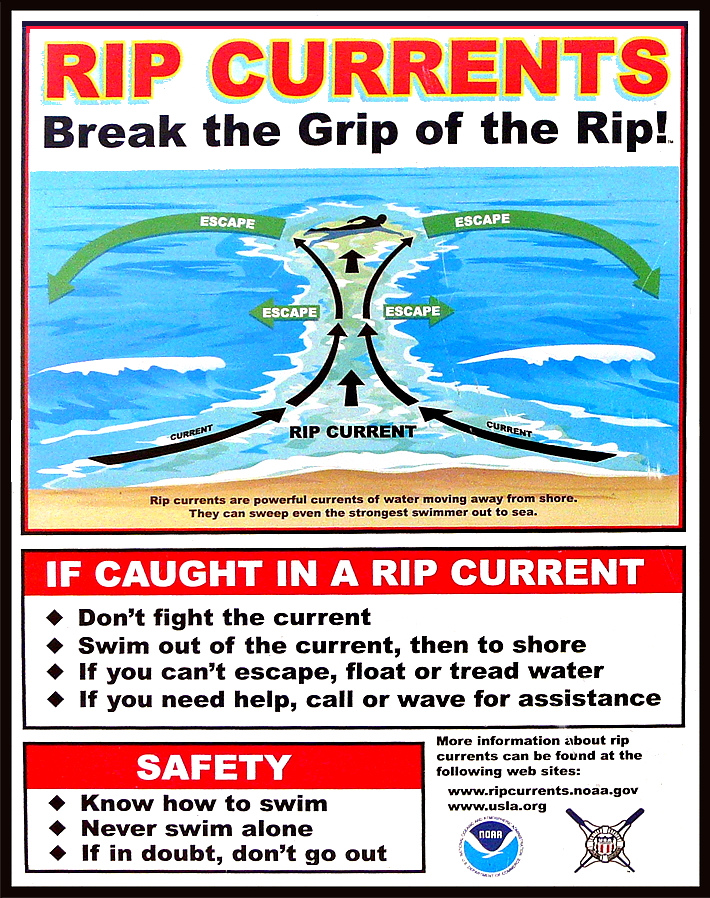
Most rip current deaths are preventable. Yet people keep drowning.
Beach-safety experts are frustrated by the mounting fatalities despite awareness campaigns and improved forecasts
Rip-current deaths in the United States are running ahead of last year’s pace – at least 29 since the beginning of the year – with peak beach season yet to come. Experts are warning the public to be aware of this largely hidden hazard ahead of Memorial Day weekend, traditionally one of the busiest beach weekends of the year. The risk of dangerous rip currents is expected to be particularly high this weekend along portions of the Southeast coast where a storm could produce heavy rain, gusty winds and rough seas. Experts say most rip-current fatalities can be prevented. Still, the number of annual rip-current deaths has steadily climbed since the National Weather Service began tracking them in 2010, reaching a record of 130 in 2021, then dipping to 85 last year. Rip currents were the third-leading cause of weather-related deaths from 2012 to 2021, behind only heat and flooding, according to the Weather Service, and in a typical year they kill more people than lightning, hurricanes or tornadoes. Rip currents are strong, narrow streams of water that flow away from the shoreline and can suddenly sweep swimmers out to sea. They can form on almost any beach with breaking waves, especially near low spots or breaks in sandbars, and near jetties or piers. Predicting where and when a rip current will form is difficult because of the many weather and ocean factors involved. The Weather Service cautions that “rip currents often form on calm, sunny days.” The Weather Service lists 26 rip-current deaths this year through April 27, not including three deaths believed to be caused by rip currents on April 28 in Destin, Fla., May 6 in Ocean City, Md., and May 12 at Cannon Beach, Ore. At this point last year, there were 19 total such deaths. Beach-safety experts are expressing frustration as fatalities trend higher again this year despite annual awareness campaigns, such as the United States Lifesaving Association’s National Beach Safety Week held every year during the week before Memorial Day, and recent improvements to rip current forecasts. “It is frustrating when we produce videos and graphics and educational information and release it at the beginning of each beach season, and it still misses so many people,” Scott Stripling, a senior meteorologist at the National Hurricane Center in Miami, said in an email. “The problem seems to be one of communication and/or lack of attention by the general public.”
Rip-current forecasts and warning signs
The Weather Service issues daily rip-current forecasts for beaches on the Atlantic Ocean, Gulf Coast, Southern California, Great Lakes, Puerto Rico and the U.S. Virgin Islands. The forecasts categorize the rip-current risk as low, moderate or high, and are informed by a rip-current model recently developed by NOAA that has made it possible to differentiate the risk between adjacent beaches. Previously the same forecast could span 100 miles or more. However, the model doesn’t enable reliable forecasts of the exact location and time of rip currents. These are influenced by a number of factors including wave characteristics, water levels, winds and the shape of a beach. Advances in artificial intelligence could help with rip-current detection – NOAA is partnering with the Southeast Coastal Ocean Observing Regional Association on a project using AI to detect rip currents in webcam imagery – but such efforts are still in their infancy. In some cases, there are visible clues to the existence of a rip current, such as a break in the waves, foamy water or objects being carried offshore, or darker water that is due to a break in a sandbar. Often, though, rip currents are difficult to see, or are best seen from a high point such as a dune line or the top of a beach access. Rip currents are particularly hard to spot in South Florida, where, the Weather Service says, they “consistently rank at or near the top of the list of deadliest weather-related hazards,” because there is not much sediment to darken or muddy the current at the shoreline. In Brevard County alone, home to nearly 72 miles of sandy beaches, there have been eight apparent rip-current drownings since November, all at beaches without lifeguards. “We have clear-water rips, so these offshore-flowing currents are very hard to detect,” Stephen Leatherman, a professor in the department of earth and environment at Florida International University, said in an email. “The best thing is to have lifeguards and for people to swim close to lifeguards. But lifeguards are very expensive, and Florida has 825 miles of good quality sandy beaches which are swimmable for most of the year.”
Warnings and tips for surviving a rip current
Rip currents flow at speeds up to 5 miles per hour. That may not sound fast, but it’s faster than many Olympic swimmers. If you are caught in a rip current, experts say not to swim directly back to shore against the current, which can quickly exhaust and drown you. Instead, swim parallel to the shore until you are out of the current, which is typically no wider than about 50 to 100 feet. You might also escape by floating or treading water, allowing the current to take you out just past the breaking waves where many rip currents tend to dissipate, and then circulate you back toward the shore. However, some rip currents can extend hundreds of yards offshore. If you see someone caught in a rip current, experts urge you not to risk your own life to attempt a swimming rescue unless you have been trained to do so and have a flotation device to assist you and the person in distress. Instead, you should get help from a lifeguard or call 911 if no lifeguard is present. You should also throw the victim something that floats, such as a lifejacket, body board, cooler or a ball, and yell instructions on how to escape. Experts agree that the best way to survive a rip current is to avoid it in the first place. That means checking the rip-current forecast before you enter the water, heeding warnings for rip currents or rough surf, and only swimming close to a lifeguard. The United States Lifesaving Association estimates the chance of someone’s drowning at a beach with a lifeguard at 1 in 18 million. “Lifeguards are trained to spot rip currents and other beach hazards and intervene as and when needed,” Chris Houser, a professor at the University of Windsor School of Environment and a longtime beach-safety researcher, said in an email. “While there is some evidence that individual beach users can be trained to spot rips, most beach users are not aware of what to look for.” U.S. lifeguards make an estimated 80,000 or more rip-current rescues each year, which suggests that education and warning messages are not reaching or are not resonating with as many people as experts would like. “If the lifeguards are flying precautionary flags, and there are signs on the lifeguard stand identifying the potential for rips in that area, and the National Weather Service and media have advertised that there is at least a moderate risk for rip currents to be present at your local beach, what else can we do?” the Weather Service’s Stripling said.
Read more » click here

 Staying safe at the beach: Rip currents, jellyfish, sharks, and other hazards
A trip to the beach can turn deadly (or painful) due to natural hazards but being aware of risks and mitigating hazards is a good way to prevent problems.
Picture this: warm weather, blue skies, and your toes in the sand – it sounds like a perfect lazy summer day at the beach. Maybe you decide to cool down in the ocean and find yourself bobbing around when suddenly you realize you are a little too far out. As panic sinks in and you start to swim towards dry land you realize your efforts are in vain and your whole body is getting tired, all the while you are drifting further into the Atlantic – you have gotten stuck in a rip current. It’s not the only potential danger in the ocean, though. There are also sharks. And, of course, there are some things on shore that ruin your day at the beach, too, including stepping on jellyfish and, of course, good old-fashionedsunburn.
Rip currents
According to the U.S. Lifesaving Association (USLA), 80 percent of all ocean rescues are related to rip currents and annually more than 100 fatalities across the country are due to rip currents. While it is obvious that swimming at a beach with lifeguards is one of the safer options, there are plenty of area beaches that lack lifeguards or maybe ocean rescue season has not started just yet. So, what is the best course of action for surviving a rip current? According to the National Weather Service, there are several things swimmers should keep in mind when dealing with these often-unseen dangers.
-
- Relax. Rip currents don’t pull you under.
- A rip current is a natural treadmill that travels an average speed of 1-2 feet per second but has been measured as fast as 8 feet per second – faster than an Olympic swimmer. Trying to swim against a rip current will only use up your energy; energy you need to survive and escape the rip current.
- Do NOT try to swim directly into to shore. Swim along the shoreline until you escape the current’s pull. When free from the pull of the current, swim at an angle away from the current toward shore.
- If you feel you can’t reach shore, relax, face the shore, and call or wave for help. Remember: If in doubt, don’t go out!
- If at all possible, only swim at beaches with lifeguards.
- If you choose to swim on beaches without a lifeguard, never swim alone. Take a friend and have that person take a cell phone so he or she can call 911 for help.
Sharks
Sharks are a fear on most every swimmer’s mind, regardless of the actual dangers posed by the large predatory fish. “NOAA states that while shark attacks are rare, they are most likely to occur near shore, typically inshore of a sandbar or between sandbars where sharks can be trapped by low tide, and near steep drop-offs where sharks’ prey gather. While the risks are small, it’s important to be aware of how to avoid an attack,” according to previous reporting.
Suggestions from NOAA for reducing the risk of a shark attack include:
-
- Don’t swim too far from shore.
- Stay in groups – sharks are more likely to attack a solitary individual.
- Avoid being in the water during darkness or twilight when sharks are most active.
- Don’t go in the water if bleeding from a wound – sharks have a very acute sense ofsmell.
- Leave the shiny jewelry at home – the reflected light resembles fish scales.
- Avoid brightly-colored swimwear – sharks see contrast particularly well.
Sunburns
Most everyone has experienced a sunburn at one point in their life and while not often thought as a major concern for many, overexposure to UV light can cause serious long-term problems including skin cancer. The Centers for Disease Control and Prevention (CDC) recommends using at least S.P.F. 15 sunscreen at least 15 minutes prior to sun exposure. Wearing a hat, long sleeves, and other protective clothing is also recommended to keep skin protected.
Jellyfish
Jellyfish and Portuguese Man of War have been spotted along the beaches of New Hanover County and surrounding area beaches already this season and the little floating creatures can pack a punch. Often times beachgoers will spot them washed up on shore and other times they can be spotted in the water, but it is best to avoid them when you can. “While all jellyfish sting, not all contain poison that hurts humans. Be careful of jellies that wash up on shore, as some can still sting if tentacles are wet. NOAA recommends that if you are stung by a jellyfish to first seek a lifeguard to give first aid. If no lifeguards are present, wash the wound with vinegar or rubbing alcohol,” NOAA suggests. And what about that … other method of treating stings? Turns out, it’s a myth. In fact, urine can actually aggravate the stinging cells of jellyfish, making things worse. These cells, which detach and stick into the skin of prey, can continue to inject venom. Urine, as well as fresh water, can cause an imbalance to the salt solution surrounding the stinging cells, causing them to continue to fire. According to Scientific American, if you don’t have vinegar or rubbing alcohol, rinsing with salt water may be your best bet.
Read more » click here

Storm Events –
 Hurricane Vehicle Decals
Property owners were provided with four (4) decals that were included in this month’s water bill. It is important that you place your decals in your vehicle or in a safe place. A $10 fee will be assessed to anyone who needs to obtain either additional or replacement decals. Decals will not be issued in the 24-hour period before an anticipated order of evacuation.
The decals are your passes to get back onto the island to check your property in the event that an emergency would necessitate restricting access to the island. Decals must be displayed in the driver side lower left-hand corner of the windshield, where they are not obstructed by any other items. Officials must be able to clearly read the decal from outside the vehicle.
Property owners without a valid decal will not be allowed on the island during restricted access. No other method of identification is accepted in an emergency situation. Click here to visit the Town website to find out more information regarding decals and emergency situations.
NC General Statute 166A-19.22
Power of municipalities and counties to enact ordinances to deal with states ofemergency.
Synopsis – The governing body may impose by declaration or enacted ordinance, prohibitions, and restrictions during a state of emergency. This includes the prohibition and restriction of movements of people in public places, including imposing a curfew; directing or compelling the voluntary or mandatory evacuation of all or part of the population, controlling ingress and egress of an emergency area, and providing for the closure of streets, roads, highways, bridges, public vehicular areas. All prohibitions and restrictions imposed by declaration or ordinance shall take effect immediately upon publication of the declaration unless the declaration sets a later time. The prohibitions and restrictions shall expire when they are terminated by the official or entity that imposed them, or when the state of emergency terminates.
Violation – Any person who violates any provisions of an ordinance or a declaration enacted or declared pursuant to this section shall be guilty of a Class 2 misdemeanor.
Hot Button Issues –
Subjects that are important to people and about which they have strong opinions

Climate
For more information » click here.
There’s something happening here
What it is ain’t exactly clear

Flood Insurance Program
For more information » click here
National Flood Insurance Program: Reauthorization
Congress must periodically renew the NFIP’s statutory authority to operate. On March 14, 2025, the president signed legislation passed by Congress that extends the National Flood Insurance Program’s (NFIP’s) authorization to September 30, 2025.
Congress must now reauthorize the NFIP
by no later than 11:59 pm on September 30, 2025.

GenX
For more information » click here

Homeowners Insurance
For more information » click here
Brunswick and New Hanover ranked among NC’s most insurance-stressed counties
A new report on North Carolina’s home insurance ranks both New Hanover and Brunswick counties among the top five most at-risk counties in the state. A Raleigh-based independent insurance agency, Guardian Service, ranked both counties within the top five most at-risk counties in the state where high climate risk and insurance market stress are colliding. Guardian Service researchers analyzed around 90 North Carolina counties using data from a mix of federal, state and proprietary sources. The research team examined climate risk, insurance costs, historical trends and homeowner strain. The report estimates coastal counties such as Brunswick, New Hanover and Pender are expected to see some of the biggest increases in home insurance premiums in the next year.
Here’s how climate-related risks are expected to impact home insurance rates in the Cape Fear region.
New Hanover ranked first in climate and insurance pressures
Guardian Service ranked New Hanover County as the county with the most climate and insurance pressure in the state. In 16 of the studied counties, current average home insurance premium costs exceed $4,000. However, New Hanover County had the highest average cost of $6,631, the report states. Carteret and Dare counties follow suit with average insurance premium cost also above $6,000. According to the report, home insurance premium costs in New Hanover County by 2026 are expected to rise by more than $1,400, pushing the average annual cost of home insurance premiums around $8,000. Reasons for New Hanover County’s high climate and insurance vulnerability, per the report, include a 36% paid loss ratio and insurance claims averaging more than $17,000 each. Paid loss ratio is the percentage of premiums that insurance companies pay back to homeowners in claims, Guardian Service spokesperson Dayna Edens said.
Brunswick County home insurance premiums skyrocket
Brunswick County was the fourth most climate and insurance pressure-burdened counties in the report. The county also ranked fourth in having one of the highest insurance claim severity changes between 2018-2022. “Claim severity has grown by 33% statewide,” the report states. The report reveals that Brunswick County jumped from having a $7,800 average in home insurance claim in 2018 to nearly a $20,500 average in 2022. That’s a 162.4% increase in only five years – higher than both New Hanover and Pender counties. Edens said the average cost of a Brunswick County home insurance policy in 2025 is $4,813, based on a $350,000 dwelling coverage. “That figure is projected to rise to $5,865 in 2026, based on already-approved rate filings,” said Edens. From 2018-2022, the rate at which insurers chose not to renew policies decreased by 1.9% and the average rate of claims filed per policy also decreased by 4.9% since 2018, Edens said. Edens explained that the paid loss ratio in Brunswick County is 26%. “That number can reflect how much weather-related damage or other losses are occurring in the area,” Edens said.
Pender County could also see higher insurance rise
Pender County ranked 13th for climate and insurance pressure-burdened counties in the report. The county also ranked sixth in high claim severity changes from 2018-2022. The report shows Pender County had a 120.5% jump in insurance claim severity between 2018 and 2022. This hike was a nearly $10,000 swell over five years and was 0.3% higher than New Hanover County’s increase. Out of the three counties, New Hanover is expected to have the smallest bump in home insurance premium policy costs in the next year. Guardian Services anticipates the New Hanover County home insurance premium average to increase $999 by 2026.
Read more » click hereÂ
Hurricane Season
For more information » click here
Hurricane season runs from June 1 through November 30
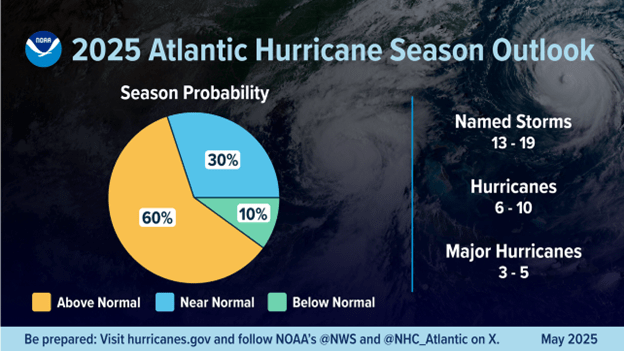
Hurricane Season Outlook Update:
Colorado State University Projects 12 More Storms, Including 8 Hurricanes
Hurricane season still has a long way to go before it ends in November. Here’s a look at how many additional storms are expected.
Atlantic hurricane season has just entered what’s historically been its busiest and most damaging stretch, and the final outlook just issued by Colorado State University is giving a glimpse of what to expect in the coming months.
Updated Outlook By The Numbers
-
- Led by Phil Klotzbach, CSU’s tropical meteorology project team is forecasting 16 total named storms, including the four that have already formed this season: Andrea, Barry, Chantal and Dexter.
- That means 12 additional storms are predicted through the rest of summer and fall, with 8 of them expected to intensify into hurricanes. CSU says 3 of those hurricanes could become Category 3 or stronger, or so-called major hurricanes.
- The number of tropical storms predicted and hurricanes predicted is the same as the July outlook, which is when numbers were dropped by one each compared to earlier outlooks from June and April.
- The new outlook remains slightly above the 30-year average number for both hurricanes and storms, but below the tally of 18 storms, 11 hurricanes and five Category 3-plus hurricanes in 2024. CSU added that confidence in the August forecast is lower-than-normal.
The Season So Far
-
- The number of named storms this season has been a bit above the average pace. Tropical Storm Dexter formed on Aug. 3, which is 12 days ahead of when the average fourth storm has historically arrived, based on the 1991-2020 average.
- However, by another metric called the ACE Index the season’s activity was just 24% of the average to date as of Aug. 5, according to CSU. Instead of just tallying up the number of storms, the index sums up how long storms last and how strong they become. Since this season’s storms have been short-lived and weak, the ACE index is trailing well behind pace for now.
- Despite the weak nature of this year’s storms so far, they have been impactful. Tropical Storm Barry’s remnants played a partial role in fueling the deadly July Fourth Texas flood. Just two days later, Tropical Storm Chantal brought 4 to 12 inches of rain to North Carolina, triggering damaging, deadly floods in a narrow strip between Raleigh and Greensboro.
Forecast Factors Ahead
-
- The primary reason for the slightly more active than average outlook is plenty of warm water fuel in the Atlantic to aid in the formation and strengthening of tropical storms and hurricanes. “Sea-surface temperatures in the eastern and central tropical Atlantic have anomalously warmed over the past few weeks and are now somewhat warmer than normal, although not as warm as they were last year at this time,” Klotzbach wrote.
- Higher-than-average Caribbean wind shear observed in June and July is the top uncertain factor. This change in wind speed and direction with height in the atmosphere can be a hostile factor that tropical storms and hurricanes sometimes battle. The outlook said increased amounts of Caribbean wind shear in June and July have historically been correlated with less active hurricane seasons.
- Another factor weighed in the forecast is the lack of El Niño conditions expected for the peak of the season. This warming of the equatorial Pacific Ocean alters global wind patterns in a way that contributes to less active hurricane seasons. Instead, neutral conditions are in place, which means water temperature in the equatorial Pacific are near average. Neutral conditions have historically tipped the scales toward a more hospitable atmosphere for Atlantic tropical storms to form, although La Niña conditions (cooler equatorial Pacific waters) are usually most favorable.
Outlook Doesn’t Measure A Season’s Impacts
-
-
- What this hurricane season outlook cannot tell you is whether or not your area will get struck this season and when that might happen.
- A season with fewer storms or hurricanes can still deliver the one storm that makes a season destructive or devastating. In 1992, Andrew delivered a catastrophic Category 5 strike on South Florida in what would have been an otherwise forgettable season with just seven storms.
- You can also see the opposite case. The 2010 season was very active, with 19 storms, 12 hurricanes and five Category 3-plus hurricanes. All 12 hurricanes missed the mainland U.S., although Hurricane Earl did pass near enough to produce storm surge flooding in North Carolina’s Outer Banks and downed trees and power lines in eastern Massachusetts.
-
Read more » click here
With hurricane season relatively quiet so far, forecasters warn storms are coming
While seemingly a quiet season so far, officials say things could quickly spin up with favorable ocean temperatures and conditions out there. The historical peak of hurricane season is mid-September
Tropical Storm Dexter? We hardly knew you. But Tropical Storm Chantal was a different story, especially for parts of central North Carolina. Still, the first few months of the 2025 hurricane season have been rather so-so, with some huffing and puffing from tropical waves forming in the Caribbean and Gulf, but not a lot of action from them when it comes to threatening the U.S. mainland. But as we prepare to move into the meat of hurricane season, when historically the tropics heat up just as water temperatures reach their apex, officials are warning residents − especially those along the coast − not to drop their guard. “Based on everything we see right now, it looks like the Atlantic is just heating up and it should stay active over the next couple months,” said Corey Davis, North Carolina’s assistant state climatologist. “The water across the basin is plenty warm enough for storms to form, and we’ve seen a couple of examples already of storms forming right along our coastline.”
What’s happened so far?
In the weeks before the June 1 start of hurricane season, forecasters almost unanimously predicted an above-average 2025 hurricane season due to relatively warm tropical Atlantic waters and neutral El Nino conditions − although one not as busy as the 2024 season. While impacts haven’t been too bad so far, and wind shear and sand from Africa have helped hinder storm development, that prediction has held. “With four named storms and still a month to go before the climatological season peak, it feels like we’re pretty much on schedule for that,” said Dr. Michael Mann, a meteorologist and scientist at the University of Pennsylvania. “But who knows what might still happen. Some of the climate predictions are calling for the development of La Niña conditions this fall, and if that happens we could see things ramp up further.”
What could happen in the coming weeks?
While slightly tweaked downward, updated seasonal forecasts issued recently by NOAA’s National Hurricane Center and Colorado State University are still calling for up to 18 named storms, with winds of 39 mph or greater, and 2-5 major hurricanes of Category 3 or stronger. “Many of the factors we identified ahead of the season are still at play, and conditions are largely tracking along with our May predictions,†said Matt Rosencrans, lead hurricane season forecaster with NOAA’s National Centers for Environmental Prediction, in a release. Davis said the reason officials are maintaining their above-average predictions is due to several factors, including the warm waters in the Gulf and Caribbean that are near last year’s bath tub-like levels. Tropical Storm Helene formed in the Gulf last year thanks to the steaming water temperatures and carried all that moisture and strength hundreds of miles inland, pummeling parts of Georgia, Western N.C., and Tennessee. “That warm water also increases the risk of rapid intensification, and that will become even more of a threat as we near the peak of the season in September, when the water is warmest,” Davis said.
When is the historic height of hurricane season?
According to the National Hurricane Center, the most active time for tropical storm activity is around Sept. 10, although peak season is generally seen as running from mid-August through mid-October. Among the notable storms that have hit the Wilmington area during that window include Hurricanes Bonnie on Aug. 26, 1998; Fran on Sept. 5, 1996; Florence on Sept. 14, 2018; Floyd on Sept. 16, 1999; Matthew on Oct. 8, 2016; and Hazel on Oct. 15, 1954. But Davis said in recent times it hasn’t been hurricanes that have caused the most pain and suffering in the Tar Heel State. While it’s been five years since a hurricane made landfall in North Carolina, with Isaias hitting Brunswick County in early August 2020, the state has been hammered by recent storm systems − fueled by climate change, experts say − that brought intense precipitation and deadly consequences to both ends of the state. Along with Helene out west, that included the no-name storm last September that surprised officials with its intensity and swamped Pleasure Island in New Hanover County and much of Brunswick County. Davis said it’s those storms, and not just the ones that grab all the headlines and online focus, that folks also should prepare for, especially with the state’s long-standing problems in many areas of handling even moderate rain events. “It’s a good reminder that people don’t need to wait to hear that ‘hurricane’ buzzword to start preparing for impacts, especially heavy rain and flooding,” he said.
Read more » click here
Inlet Hazard Areas
For more information » click here
.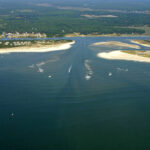
Lockwood Folly Inlet
For more information » click here.

Seismic Testing / Offshore Drilling
For more information » click here.

Offshore Wind Farms
For more information » click here
Have politics and changing energy policies sunk Brunswick’s proposed offshore wind farms?
A move away from clean energy in Washington and Raleigh could make it more difficult for N.C.’s large, expensive offshore wind projects to get built.
Call it a state of suspended animation. A mix of politics, changing national energy priorities, a lack of regulatory direction, and industry nervousness has all but frozen progress on a handful of wind farms that were under development off the North Carolina coast, including two roughly 20 miles south of the Brunswick County shoreline. But does that mean the state, and the U.S. as a whole, is out of the offshore wind game even as they continue to increasingly sprout in waters around Europe, China and South Asia? Not necessarily, experts say. But until there’s more political support for the renewable energy source, they admit it’s going to be hard to convince companies to make the massive investments it takes to get the still-nascent industry in the U.S. really up and running.
What’s planned for Brunswick County?
In 2022, TotalEnergies Renewables USA and a Duke Energy subsidiary paid the federal government a combined $315 million to lease nearly 140 miles of ocean off Brunswick County for a pair of huge wind farms. If fully developed, which would occur sometime in the early 2030s, the wind farms could produce enough power to supply 750,000 homes. The pair of wind farms proposed for Long Bay will join another offshore wind farm, now also split into two parts, planned for waters roughly 27 miles off Kitty Hawk on the Outer Banks. That project is farther along than the Southeastern N.C. wind projects.
Why look to offshore wind for power?
Offshore wind is seen by clean energy advocates as a key component in helping governments de-carbonize their energy grids by reducing their reliance on dirty, greenhouse gas-spewing power sources like coal and natural gas. While embraced by clean energy advocates, offshore wind farms have their critics − including notably President Donald Trump. The projects also are very capital intensive to build, although those costs drop dramatically once the turbines are up and running. Some coastal residents are also worried that the giant windmills will damage their ocean “viewscapes,” although officials have said the Brunswick turbines will be next to invisible from the county’s south-facing beaches.
What is the situation today?
When many of the offshore wind farms for the East Coast were proposed, President Joe Biden was in office and pushing green energy as a way to fight climate change was a government priority. To help jump start the industry, the Biden administration simplified and speeded up the permit process and, crucially, provided tax breaks and other incentives for the projects, notably in the massive 2022 Inflation Reduction Act. Trump has all but ended those perks for offshore wind, although a handful of projects mostly in the Northeast are still moving forward. His administration also has slow-walked issuing new permits for projects and, in some cases, begun a review of previously approved offshore wind farms to see if they were adequately vetted. But the biggest hit occurred recently with Congress approving Trump’s “One Big Beautiful Bill” that removed almost all of the federal financial incentives for renewable energy like wind and solar in favor of giving breaks to more traditional, fossil fuel-driven sources like oil, coal and natural gas.
State mandates and goals
While federal support for offshore wind projects has all but evaporated over the past six months, many states have goals of incorporating more and more energy from renewable sources into their power sectors to help reduce their greenhouse gas emissions. That includes North Carolina, where carbon emissions from the power sector are the state’s second largest source of heat-trapping gasses after transportation. Current state law requires the state’s utilities, which largely means Duke Energy, to reduce its 2005 level of carbon emissions by 70% by 2030 − although that goal has been pushed back to 2035 − and become carbon-neutral by 2050. Duke has proposed to meet those goals by incorporating solar, land and offshore-based wind farms, more nuclear and maybe even hydrogen into its future energy grid as it retires its older, dirty coal-fired power plants. The latest version of the company’s carbon plan calls for including up to 2,400 megawatts (MW) of offshore wind in its energy portfolio by 2035. But Senate Bill 266 in Raleigh that has passed the Republican-run General Assembly, but been vetoed by Gov. Josh Stein, a Democrat, would eliminate the 2030-35 interim carbon reduction goal while keeping in place the longer-term goal of being carbon neutral by 2050. Legislators are likely to consider overriding the governor’s veto when they reconvene later this summer. Supporters say the bill will save customers money by keeping utility bills from rising too quickly and offer Duke flexibility in meeting rising electricity demand from a growing population and power-hungry businesses, like data centers. But environmentalists and clean energy advocates say the move, which mirrors some of the climate change rollbacks implemented by the Trump administration, would be short-sighted and slow down the state’s transition to sources of clean energy − especially capital-intensive projects like offshore wind farms. “You really need that interim carbon target to make sure we are taking steps now to put as many renewables on the grid as possible in the short term, otherwise we won’t see any real movement until decades from now, and by then it’s going to be too late,”  said Katharine Kollins, president of the Southeastern Wind Coalition, a nonprofit that advocates for wind energy development in the Southeastern U.S.
Future of the Brunswick offshore wind farms
With the projects still young in the development stage, not a lot has changed. Among the work that is going on is a Duke-led study, due this summer, into the financial feasibility of offshore wind ordered by the N.C. Utilities Commission. “We still have a long-term horizon before we see any steel in the water,” Collins said. That gives plenty of time for maybe a change of focus in Washington and Raleigh back toward a more green energy friendly view − or even moves to show continued support for the green energy path the states have been on. But even the most optimistic clean energy supporters know the clock is ticking. “There is a lot states can do even with federal permitting and financial support paused,” Kollins said. “It really is in the hands of the states right now as to where things go and if we do move forward, especially in North Carolina.”
Read more » click here
Duke Energy scraps wind projects off NC coast, including Brunswick County. Here’s why.
The decision is another blow to the state’s nascent offshore wind sector that has been facing serious economic and political headwinds in Washington and Raleigh recently
In a move sure to draw blowback from clean energy advocates, Duke Energy says it won’t pursue any wind farms off the N.C. coast − including two wind-to-energy areas just south of Brunswick County − in the coming years. The move was driven by financial considerations, the utility giant said this week. “The (acquisition request for information) process determined that offshore wind is not cost-competitive at this time, so no RFP will be issued – this decision is supported by the independent evaluator that oversaw the proceedings,” said Duke spokesperson Bill Norton. “Nonetheless, the evaluation process provided valuable project, cost and schedule data that will inform long-term planning assumptions for the Carolinas Resource Plan being filed later this year.†Offshore wind, along with solar, was seen by environmentalists and others as a key component of an ambitious plan by North Carolina officials to significantly reduce the state’s carbon footprint from the Tar Heel State’s energy sector, the second largest polluter of greenhouse gasses that fuel climate change after transportation. But since legislation hashed out by then-Gov. Roy Cooper, GOP legislative leaders and Duke in 2021 set goals of substantially reducing carbon emissions by 2030 and the state reaching carbon-neutral by 2050, the law has been steadily chipped away at by economic factors and changing political winds. First, the N.C. Utilities Commission agreed with Duke and others that the 2030 goal was unrealistic and should be pushed back to at least 2035. Second, a bill passed this summer over the veto of Gov. Josh Stein drops the interim carbon-reduction goal, but maintains the 2050 target, due to concerns over rising power bills and the reliability of some renewable energy sources under certain conditions. And finally, President Donald Trump has not hidden his disdain for renewable energy sources − and offshore wind in general. That has sent the sector into financial limbo as permitting for projects has been halted or placed under additional review and financing for the projects, which require a lot of upfront capital, has become increasingly hard to secure.
 ‘Not cost effective’
The decision announced this week by Duke to scrap any immediate plans for offshore wind comes out of an update last year to the Carolinas Resource Plan, commonly known as the carbon plan, which called for a review of the financial feasibility of possibly developing up to 2,400 megawatts of N.C. offshore wind power on one or more of three sites approved by the federal government. Two of those areas are about 20 miles south of Brunswick County and the other is roughly 27 miles off Kitty Hawk on the Outer Banks. The independent evaluator’s review, approved by the N.C. Utilities Commission, started in January and was filed with the commission Aug. 11. The report included several different financial scenarios, involving confidential pricing details, submitted by the three owners of the lease areas − Cingery, a nonregulated subsidiary of Duke Energy, and TotalEnergies off Brunswick County and Avangrid off Kitty Hawk. “Because all submissions exceeded the reference price, the companies determined through the (action request for information) that offshore wind generation is not cost effective relative to other available resources at this time such that undertaking a binding RFP to procure offshore wind would not be a reasonable step toward executing the least cost (combined carbon plan and integrated resource plan),” states the filing.
 So, is this the end of offshore wind in N.C.?
While obviously not a good sign for supporters of clean energy, this week’s announcement isn’t likely the end of offshore wind as a potential power source for North Carolina’s future power grid. While Duke officials said no further action will be taken on pursuing offshore wind in the near term, the information gathered through the economic report and other actions will be incorporated into future reviews of the carbon plan and help inform long-term planning considerations. The next proposed update to the carbon plan is to be submitted by Duke to the utilities commission in October. The alure of renewables as a way of building a greener power grid also isn’t going away, especially as economies of scale mean the cost of building wind and solar projects will continue to drop in the future and the impacts of climate change − from warmer summers and more intense rain events to stronger hurricanes and increased sea-level rise − continue to impact more and more parts of the globe. How Duke will replace the power generation that could have been produced by the offshore wind farms, whether through more natural gas plants or relying on emerging technologies like hydrogen or small modular nuclear reactors, also is a question that needs to be answered. But at least in the short term, it doesn’t look like offshore wind will be part of the answer to North Carolina’s future power needs.
Read more » click here
Things I Think I Think –
 Eating out is one of the great little joys of life.
Restaurant Review:
The Dinner Club visits a new restaurant once a month. Ratings reflect the reviewer’s reaction to food, ambience and service, with price taken into consideration.
/////
Will Chianti South Restaurant in Little River close down?
What we know so far
Chianti South, located at 2109 Highway 17, Little River, will close in 2024. General manager Joseph McDermott told The Sun News that a development company is in the final stages of purchasing the establishment. McDermott said the company is not interested in continuing a restaurant at the location. Chianti South will close down for January, as it typically does, but McDermott said he is unsure if it will reopen in February. If it reopens in February, it will close for good around July 2024. “So much is in the air,†McDermott said. “The current owner would like to reopen, and that’s what he’s shooting for.†A Facebook post from a patron on Dec. 23 said, “Celebratory last meal at Chianti South was Awesome. So many good meals & memories. Bittersweet…We are going to miss this place.†Looking at property records, the land the restaurant sits on has been owned by Vivian Vereen or various partnerships with that name from 2001 until this year. In August, ownership was transferred to Pearl Street LLC. There is little information about the LLC online. Chianti South, which opened the 1997, has a four-star rating or higher on Google, Yelp and TripAdvisor. Chianti will be open from 5 p.m. to 9 p.m. on Friday and Saturday. The restaurant is no longer accepting reservations for New Year’s Eve.
Read more » click here
/////
Name:           Chianti South                                                      Cuisine:     Italian
Location:Â Â Â Â 2109 Highway 17 South, Little River SC
Contact:Â Â Â Â Â 843.249.7888 / NA
Food:Â Â Â Â Â Â Â Â Â Â Â Â Â Â Average / Very Good / Excellent / Exceptional
Service:Â Â Â Â Â Efficient / Proficient / Professional / Expert
Ambience:Â Â Â Drab / Plain / Distinct / Elegant
Cost: $27 Â Â Â Â Inexpensive <=20 / Moderate <=26 / Expensive <=35 / Exorbitant <=60
Rating:Â Â Â Â Â Â Â Â Â Â Two Stars
A great local classic authentic family professionally run Italian restaurant, serving traditional Italian cuisine. Broad based menu offers something for everyone. They also have an extensive wine list, which has earned Wine Spectator’s “Award of Excellence†every year since 1988. We have always enjoyed the dining experience there. I’ve never heard anything but good reviews about this restaurant. Serving some of the best Italian cuisine in the area, it’s as good as it gets here.
/////
Little River Italian restaurant preparing to re-open. Here’s when and where
An Italian restaurant in Little River that has been closed for a year has plans to reopen. Chianti South, located at 2109 Highway 17, is in the process of being spruced up inside and out for a re-opening in the coming months. The restaurant closed in 2024, after a development company bought the property and was no longer interested in continuing to run the restaurant there, The Sun News previously reported. The restaurant opened originally in 1997. Crews working on the restaurant have confirmed that it will re-open, and that parts of the building from the roof to the interior are being worked on. The improvement process is expected to last at least a few more months before the restaurant’s doors are open to customers again, those involved with the project said. The company working on the re-opening project declined to comment with more information until it is closer to the restaurant’s opening date.
Read more » click here
 Cloud 9
9 Estell Lee Pl
Wilmington, North Carolina 28401
910.726.9226
Rooftop Bar
https://cloud9ilm.com/
Enjoy panoramic views from the Cloud 9 rooftop bar which overlooks picturesque downtown Wilmington. This premier open-air rooftop venue is located on the Riverwalk in downtown Wilmington on the ninth floor of the Embassy Suites. The bar is open seven (7) days a week at 4:00 PM and is currently serving almost fifty (50) different brews on tap and in cans and more than 20 wine selections. They also offer live music Thursday through Saturday evenings throughout the summer months.This is a must visit the next time you are in Wilmington.
Dining Guide – Local * Lou’s Views
Dining Guide – North * Lou’s Views
Dining Guide – South * Lou’s Views
Restaurant Reviews – North * Lou’s Views
Restaurant Reviews – South * Lou’s Views
Book Review:
Read several books from The New York Times best sellers fiction list monthly
Selection represents this month’s pick of the litter
 THE WEDDING PEOPLE by Alison Espach
Phoebe Stone a woman in the throes of a personal crisis arrives at an exclusive hotel in Newport, Rhode Island. She has fled her troubled life in St. Louis intending to end her life. Except when she arrives, she unexpectedly becomes involved in the chaos of a lavish wedding celebration. Forming a pivotal connection with the bride, Lila, leading her to choose life and begin a journey of healing and self-discovery.
That’s it for this newsletter
See you next month
Lou’s Views . HBPOIN
-
-
-
-
-
-
-
-
-
- Gather and disseminate information
- Identify the issues and determine how they affect you
- Act as a watchdog
- Grass roots monthly newsletter since 2008
-
-
-
-
-
-
-
-