
09 – News & Views


Lou’s Views
News & Views / September Edition


Calendar of Events –


A massive hurricane seen from space with a distinct eye.
U.S. Open King Mackerel Fishing Tournament
October 2nd thru 4th
Southport


The U.S. Open King Mackerel Tournament has taken place since 1979 and is held annually the first week in October. The U.S. Open is one of the largest king mackerel tournaments on the East Coast and part of the SKA (Southern Kingfish Association) Tournament Trail. The tournament now attracts almost 400 boats annually.
For more information » click here


A massive hurricane seen from space with a distinct eye.
Riverfest

October 4th & 5th
Wilmington

.
.
Wilmington’s Riverfest is celebrated in October since 1979 and runs from the foot of Market Street to Cape Fear Community College over a half mile of free familyentertainment.
For more information » click here


A massive hurricane seen from space with a distinct eye.


Sunset at Sunset
October 4th
Sunset Beach


Held the first Saturday in October each year, Sunset at Sunset is the Town of Sunset Beach’s Community Block Party. The annual autumn event has been celebrated since 2007, and is scheduled to happen again this year, in front of Ingram Planetarium on Sunset Boulevard in Sunset Beach.
For more information » click here


A massive hurricane seen from space with a distinct eye.

.
N.C. Oyster Festival

October
18th & 19th
Ocean Isle Beach

.
.
.
The annual North Carolina Oyster Festival has been taking place since 1978
. Come celebrate everything Oyster witha variety of foods, crafts, contests, children’s activities,and musical performances at Mulberry Park in Shallotte. Signature Festival events include theOyster Shucking Contest, Oyster Eating Contest, and Oyster Stew Cook-off.

For more information » click here


A massive hurricane seen from space with a distinct eye.

N.C. Festival by the Sea
October 25th & 26th
Holden Beach


Hosted by the Holden Beach Merchants Association this annual two-day festival which started in the 1980’s occurs on the last full weekend in October. The festival is kicked off with a parade down the Holden Beach causeway. There is a fishing tournament, horseshoe tournament, and a sandcastle building contest. Vendors provide food, arts and crafts, amusement rides and other activities. There is live musical entertainment both days at the Holden Beach’s Pavilion.
For more information » click here


A massive hurricane seen from space with a distinct eye.Discover a wide range of things to do in the Brunswick Islands for an experience that goes beyond the beach.
For more information » click here.


Calendar of Events Island –


A blue banner with white text reading 'Meet the Candidates Night'.

Meet the Candidates Night                        
The League of Women Voters of Lower Cape Fear  will be hosting Candidates Night Friday, October 17th at 6:00 at the Holden Beach Town Hall. The objective of a Candidates Night event is to help the electorate make an informed choice when they vote for Town leaders.

Submit up to five (5) questions for the candidates
Deadline to submit questions is no later than September 27th

Submit Questions » click here


A massive hurricane seen from space with a distinct eye.Barktoberfest
The Town of Holden Beach will hold Barktoberfest on Friday, October 24th. Owners and their dogs should meet at Bridgeview Park Picnic shelter at 5:00 p.m. where we will do a trick-or-trot around the block.There will be a doggie costume contest and fall pictures.Registration is required by October 4th. Email Christy at christy.ferguson@hbtownhall.com to register.


A massive hurricane seen from space with a distinct eye.Monster Mash Trunk-or-Treat
The Town of Holden Beach will hold a trunk-or-treat on Friday, October 31st from 5:30-7:00 p.m. at Bridgeview Park. Residents, property owners, and businesses may register by October 11th to decorate your trunk and pass out candy.Trunks must be ready by 5:00 p.m. No political activity may be represented at the booth displays. There will be a prize for best decorated trunk and a costume contest held at 6:00 p.m. Categories include 3 and under, 4-7, 8-11, 12-15 and adult. Register by emailing Christy at christy.ferguson@hbtownhall.com. Those planning to attend the event may also email so that there is a headcount for candy purposes. In the email, please indicate whether you will be setting up a truck or trick-or-treating.

A massive hurricane seen from space with a distinct eye.


Logo for SBI Three Bridge Tour by Rotary Club of South Brunswick Islands.SBI Three Bridge Tour 
The South Brunswick Islands Rotary Club’s “SBI Three Bridge Tour†is set to take place on Saturday, November 8th, in Ocean Isle Beach, North Carolina. This event offers a unique opportunity for cyclists to ride across the three bridges of Sunset Beach, Ocean Isle Beach, and Holden Beach. Participants can choose from various ride options, including family-friendly routes and more challenging distances, ensuring a memorable experience for everyone. The tour supports local and international Rotary projects, enriching the lives of children and youth in Brunswick County. Proceeds from the event will be used to fund these projects, providing experiences and learning opportunities that will benefit the community.


A massive hurricane seen from space with a distinct eye.Veterans Appreciation Luncheon
The Town of Holden Beach will hold its Veterans Appreciation Luncheon on Monday, November 10th. The event will be held at 11:30 a.m. in the Town Hall Board Room. Please RSVP by emailing Christy at christy.ferguson@hbtownhall.com prior to Friday, November 1st with your name and the name of your guest. 


A massive hurricane seen from space with a distinct eye.

Volunteer Appreciation Luncheon
The Town of Holden Beach will hold its annual Volunteer Appreciation Luncheon on Friday, November 14th at noon.Town board and committee members are invited to attend and bring a guest. Please RSVP by emailing Christy at christy.ferguson@hbtownhall.com with your name and the total number in your party.


Tentative Scheduledates are still to be determined 


A massive hurricane seen from space with a distinct eye.Contractors Information Seminar
The Planning & Inspections Department, supported by the town staff, will be hosting the fourteenth annual Contractors Information Seminar on Thursday, November 6th.


A massive hurricane seen from space with a distinct eye.Turkey Trot
The Town of Holden Beach will hold its annual Turkey Trot on Thanksgiving morning Thursday, November 27th at 8:00 a.m. All individuals interested in participating should call 910.842.6488 to register. Please bring a canned food item to donate to the local food pantry.


A massive hurricane seen from space with a distinct eye.Tree Lighting
The Town of Holden Beach will hold its annual tree lighting ceremony on Thursday, December 4th at 6:00 p.m.


Parks & Recreation / Programs & Events
For more information » click here


Reminders –


A massive hurricane seen from space with a distinct eye.


Pets on the Beach Strand
Pets – Chapter 90 / Animals / 90.20

Effective September 10th


      • Pets allowed back on the beach strand during the hours of 9:00am through 5:00pm
      • Dog’s need to be on a leash
      • Owner’s need to clean up after their animals

A massive hurricane seen from space with a distinct eye.Free Cleanup Week 
The Brunswick County Solid Waste and Recycling Division hosts two free clean up weeks a year, the third week in April and September. The next Free Cleanup Week at the Brunswick County Landfill will take place September 22nd – 27th. Brunswick County property owners and residents can dispose of all materials, except for regular household trash and hazardous waste, at the Brunswick County Landfill free of charge during Free Cleanup Week events. Individuals can dispose of metal, tires, electronics, appliances, latex paint, clothing, shoes, used oil, oil filters, antifreeze, gasoline, fluorescent bulbs, used cooking oil, smoke detectors, household batteries, and yard debris in their designated areas at the landfill during this week. Participants must show proof of Brunswick County property ownership or residency.

Businesses and commercial vehicles will be charged normal tipping fees.

For questions, email Brunswick County Operation Services or call 910-253-2520.

LOCATION
Brunswick County Landfill
172 Landfill Rd NE
Bolivia, NC 28422

HOURS OF OPERATION
Monday through Friday :30 a.m. until 5:00 p.m.
Saturday 7:30 a.m. until 3:00 p.m.


A massive hurricane seen from space with a distinct eye.

Bird Nesting Area
NC Wildlife Commission has posted signs that say –
Bird Nesting Area
The signs are posted on the west end beach strand around 1335 OBW.
People and dogs are supposed to stay out of the area from April through November
. 1) It’s a Plover nesting area
. 2) Allows migrating birds a place to land and rest without being disturbed


A massive hurricane seen from space with a distinct eye.News from Town of Holden Beach
The town sends out emails of events, news, agendas, notifications, and emergency information. If you would like to be added to their mailing list, please go to their web site to complete your subscription to the Holden Beach E-Newsletter.
For more information »
click here


A massive hurricane seen from space with a distinct eye.Paid Parking

Paid parking in Holden Beach
Paid parking will be enforced from 9:00 a.m. to 5:00 p.m. daily with free parking before and after that time. All parking will use license plates for verification.

Rates
Parking rates for a single vehicle in all designated areas will be:

$5 per hour for up to four hours
$20 per day for any duration greater than four hours
$80 per week for seven consecutive days

Handicap Parking
A vehicle displaying a handicap license plate and/or hang tag parked in a designated handicap space is free. Any other parking space will require a parking permit via the app.

Annual Passes
Annual permits for the calendar year allow vehicles (this includes low-speed vehicles and trailers) access to designated parking.

$175 for a single vehicle

Passes can be purchased via the app, website or by telephone.

Where to Park
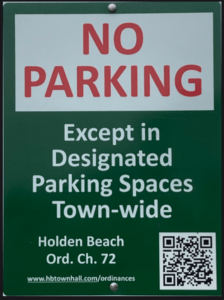
Per ordinance, there is no parking on the streets or rights-of-way except in designated parking spaces identified by Pay-to-Park signs. Click here to view an interactive map. The table with authorized parking can be viewed below.

Citations will be issued for:

      • Parking without an active paid permit in a designated parking area
      • Parking within 40 feet of a street intersection
      • Parking in a crosswalk, sidewalk, or pedestrian access ways
      • Parking blocking a driveway or mailbox
      • Parking facing opposing traffic
      • Parking in a no parking zone, or within right-of-way
      • Parking on any portion of the roadway or travel lane
      • Parking a non-LSV vehicle in an authorized LSV location

How Do I Pay to Park
The Town uses the SurfCAST by Otto Connect Mobile Solution. This is a mobile app downloadable for Apple and Android devices. Download the app today. Users will setup their account, enter their license plate details and pay for parking directly on the app. Alternatively, users can scan the QR Code located on the parking signs to access a secure website.

The Otto Connect customer service team will be available to help via phone and email.

A massive hurricane seen from space with a distinct eye.


A massive hurricane seen from space with a distinct eye.

Solid Waste Pickup Schedule
GFL Environmental change in service, October through May trash pickup will be once a week. This year September 27th will be the the last Saturday trash pick-up until June. Trash collection will go back to Tuesdays only.

Please note:

Trash carts must be at the street by 6:00 a.m. on the pickup day
BAG the trash before putting it in the cart
Carts will be rolled back to the front of the house


GFL Refuse Collection Policy
GFL has recently notified all Brunswick County residents that they will no longer accept extra bags of refuse outside of the collection cart. This is not a new policy but is stricter enforcement of an existing policy. While in the past GFL drivers would at times make exceptions and take additional bags of refuse, the tremendous growth in housing within Brunswick County makes this practice cost prohibitive and causes drivers to fall behind schedule.


Solid Waste Pickup Schedule –

starting October once a week

Recycling –

starting October every other week pick-up


A massive hurricane seen from space with a distinct eye.Yard Waste Service
Yard debris is collected on the second (2nd) and fourth (4th) Fridays during the months of October, November, and December.Yard debris needs to be secured in a biodegradable bag (not plastic) or bundled in a maximum length not to exceed five (5) feet and fifty (50) pounds in weight. Each residence is allowed a total of ten (10) items, which can include a combination of bundles of brush and limbs meeting the required length and weight and/ or biodegradable bags. Picks-ups are not provided for vacant lots or construction sites.


Curbside Recycling – 2025A massive hurricane seen from space with a distinct eye.
GFL Environmental is now offering curbside recycling for Town properties that desire to participate in the service. The service cost per cart is $119.35 annually paid in advance to the Town of Holden Beach. The service consists of a ninety-six (96) gallon cart that is emptied every other week during the months of October – May and weekly during the months of June – September.
Curbside Recycling Application » click here
Curbside Recycling Calendar » click here


A massive hurricane seen from space with a distinct eye.


Trash Can Requirements – Rental Properties
GFL Environmental – trash can requirements
Ordinance 07-13, Section 50.08

Rental properties have specific number of trashcans based on number of bedrooms.

* One extra trash can per every 2 bedrooms
.
.

§ 50.08 RENTAL HOMES.
(A) Rental homes, as defined in Chapter 157, that are rented as part of the summer rental season, are subject to high numbers of guests, resulting in abnormally large volumes of trash. This type of occupancy use presents a significantly higher impact than homes not used for summer rentals. In interest of public health and sanitation and environmental concerns, all rental home shall have a minimum of one trash can per two bedrooms. Homes with an odd number of bedrooms shall round up (for examples one to two bedrooms – one trash can; three to four bedrooms – two trash cans; five – six bedrooms – three trash cans, and the like).


Building Numbers
Ocean front homes are required to have house numbers visible from the beach strand.
Please call Planning and Inspections Department at 910.842.6080 with any questions.

§157.087 BUILDING NUMBERS.

(A) The correct street number shall be clearly visible from the street on all buildings. Numbers shall be block letters, not script, and of a color clearly in contrast with that of the building and shall be a minimum of six inches in height.

(B) Beach front buildings will also have clearly visible house numbers from the strand side meeting the above criteria on size, contrast, etc. Placement shall be on vertical column supporting deck(s) or deck roof on the primary structure. For buildings with a setback of over 300 feet from the first dune line, a vertical post shall be erected aside the walkway with house numbers affixed. In all cases the numbers must be clearly visible from the strand. Other placements may be acceptable with approval of the Building Inspector.


Upon Further Review 


A massive hurricane seen from space with a distinct eye.


A Second Helping


They just completed the twenty-first year of the program. For the last fifteen (15) weeks they have collected food on Saturday mornings in front of Beach Mart; the food is distributed to the needy in Brunswick County. During this summer season, they collected 10,057 pounds of food and $1,360 in monetary donations. Their food collections have now exceeded three hundred and seventeen thousand (317,000) pounds of food since this program began in June of 2005. Hunger exists everywhere in this country. Thanks to the Holden Beach vacationers for donating again this year! Cash donations are gratefully accepted. One hundred percent (100%) of these cash donations are used to buy more food. You can be assured that the money will be very well spent.

Mail Donations to:
A Second Helping

% Sharon United Methodist Church
2030 Holden Beach Road
Supply, NC 28462


A massive hurricane seen from space with a distinct eye.ReadyBrunswick Emergency Notifications Alerts
Brunswick County uses ReadyBrunswick as part of the County’s effort to continuously improve communications during emergency situations within our area. Powered by Everbridge, the ReadyBrunswick notification system sends emergency notifications in a variety of communication methods such as:

        • Landline (Voice)
        • VoIP (Voice over Internet Protocol)
        • Mobile (Voice)
        • Mobile SMS (Text Messaging)
        • Email

In the case of an emergency, you may choose to receive notifications via one or all of these communication methods. It’s recommended that you register several media options to receive messages in the event a particular communication device is unavailable.
For more information » click here


Corrections & Amplifications 


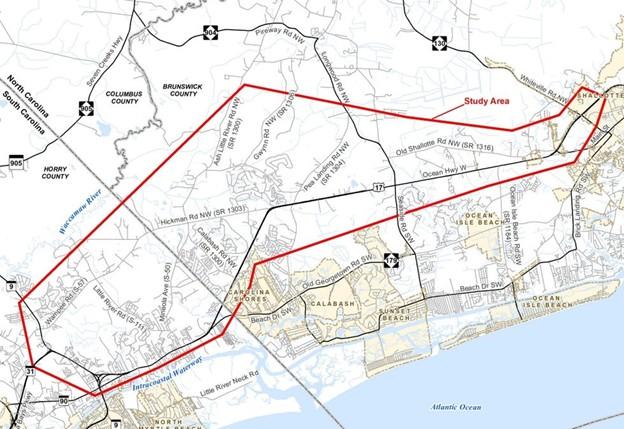
Map showing the boundary of Oraka Bay and surrounding areas.Carolina Bays Parkway project S.C. 31

OCEAN RIDGE MASTER ASSOCIATION COMMUNITY IMPACT COMMITTEE
The North Carolina Department of Transportation (NCDOT) is implementing several initiatives to relocate the Carolina Bays Parkway Extension to Brunswick County. Following extensive planning and anticipation, a recent environmental assessment has identified a suitable location for the significant highway project and initiated a public comment period. The NCDOT and the South Carolina Department of Transportation (SCDOT) are collaborating to extend South Carolina Highway 31 (SC 31), commonly referred to as the Carolina Bays Parkway, from South Carolina Highway 9 (SC 9) in Horry County to U.S. Route 17 (US 17) in Brunswick County. Should the project secure funding and proceed with construction, it will result in a newly constructed multi-lane full-access freeway that will connect the Carolinas. The route will be constructed in phases, potentially enhancing evacuation routes as Brunswick County experiences population growth. The Carolina Bays Parkway Extension project commenced in 2006 with a feasibility study that evaluated conceptual alternative routes. The construction of the road would have a significant impact on areas situated on either side of U.S. 17 in southern Brunswick County. The North Carolina Department of Transportation (NCDOT) had prepared seven alternative maps for preferred routes in Brunswick County, which ultimately converge onto U.S. 17. However, five alternatives have been eliminated, and the options have been reduced to Routes 4 and 4a. Attached are the maps for each route. The North Carolina Department of Transportation (NCDOT) website, updated on August 22, indicates that the $797 million project is currently in development with an anticipated commencement date of 2028. North Carolina’s portion of the project is projected to incur a cost of $610.9 million. South Carolina has secured the necessary funding and intends to initiate the process to connect Carolina Bays 31 from Route 9 to the state line at Hickman Road. Currently, North Carolina has secured funding for only the planning document, but not for the right-of-way or construction phases. Public hearings for the North Carolina side of the extension have been postponed on several occasions as the NCDOT awaited the availability of the draft environmental impact statement. However, the draft environmental impact statement is now available, and public hearings have been scheduled. The proposed project will involve two pre-hearing open houses and corridor public hearings. During these events, information will be presented, and NCDOT representatives will be available to address inquiries. The first public hearing will be from 5-8 p.m. on Sept. 29 at the Sea Trail Convention Center in Sunset Beach. The second hearing will be 5-8 p.m. on Sept. 30 at the North Strand Recreation Center in Longs, South Carolina. Alternative map 4 is identified in the Draft Environmental Impact Statement as the preferred alternative. Alternative map 4 crosses through Hickmans Crossroads and the Longwood area and continuing out to connect to Route 17 at the intersection of Route 904 and Route 17. Following the public hearing, the merger team will meet to select the preferred/ least environmentally damaging practicable alternative corridor, also called LEDPA, in accordance with the National Environmental Policy Act/ Section 404 Merger Process. This includes consideration of public comments and the local sponsors’ preferred alternative, potential impacts to noise, low income and disadvantaged populations, cultural resources and the environment are considered when selecting the least environmentally damaging and practicable alternative route. According to the merger process, the preferred/LEDPA corridor is the best solution to the problem satisfying the transportation need and considering environmental and community resources.

Landing spot identified for new highway connecting Brunswick County to SC
The North Carolina Department of Transportation is taking several steps toward moving the Carolina Bays Parkway Extension into Brunswick County. After years of planning and hoping, a recent environment statement has identified a landing spot for the major highway project and kickstarted a public comment period. The NCDOT and the South Carolina Department of Transportation are working together to extend S.C. 31, known as Carolina Bays Parkway, from S.C. 9 in Horry County, South Carolina, to U.S. 17 in Brunswick County. If funded and constructed, the proposed project will result in a new multi-lane full access freeway connecting the Carolinas. The route will be built in phases and could enhance evacuation routes as Brunswick County continues to grow in population.

Carolina Bays Parkway Extension project history
The Carolina Bays Parkway Extension project began in 2006 with a feasibility study with conceptual alternative routes. The road, if constructed, could impact places on each side of U.S. 17 in southern Brunswick County. NCDOT has seven alternative maps for preferred routes in Brunswick County that will eventually dump onto U.S. 17. However, five alternatives cross on the northern side of U.S. 17 around Hickman Crossroads along Hickman Road in Calabash. Interactive maps of the alternatives can be viewed on NCDOT’s website. “The primary purpose of the project is to improve transportation in the area by enhancing mobility and connectivity for traffic moving in and through the project area,” per NCDOT website.

New movement on the nearly $800 million project
The NCDOT website, updated Aug. 22, states the $797 million project is in development with an anticipated start date of 2028. The project is also part of NCDOT and SCDOT’s state transportation improvement program. North Carolina’s portion is expected to cost ​$610.9 million, per the website. “In North Carolina, this project is currently funded for the planning document, but not for right-of-way or construction,” Jenkins said.
Read more » click here

Previously reported –  June 2025
To fast-track highway extension into Brunswick, leaders push for toll study
A toll could be the only way to fund a new highway connecting North and South Carolina. After years of waiting, one local transportation organization is pressing the gas on a new highway in Brunswick County as the clock continues to tick by without funding.

Here’s what to know.

A new highway?
The N.C. Department of Transportation and the S.C. Department of Transportation are working together to extend S.C. 31, known as Carolina Bays Parkway, from S.C. 9 in Horry County, South Carolina, to U.S. 17 in Brunswick County. The Carolina Bays Parkway Extension project began in 2006 with a feasibility study with conceptual alternative routes and has evolved into seven potential​routes being studied. Interactive maps of the alternatives can be viewed on NCDOT’s website.

Funding troubles for North Carolina
The NCDOT’s website, last updated in October 2024, has the total project cost estimated at $552 million with North Carolina’s portion costing $367 million. However, the Federal Infrastructure Projects Permitting Dashboard lists the estimated project cost at $797 million.
Read more » click here

Previously reported – February 2025
Boom or doom: How a new highway could transform rural Brunswick County
A new road in southern Brunswick County will open the flood gates of opportunity for some but could close the
Read more » click here


Ocean Isle Beach Terminal Groin, Holden Beach AreaOIB Terminal Groin
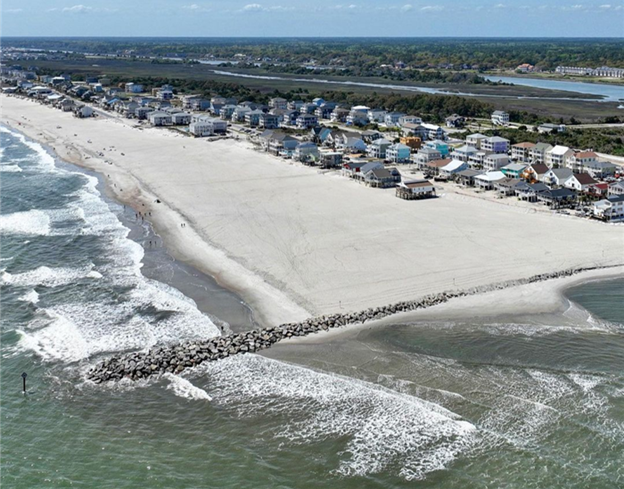
Ocean Isle Beach completed construction of a terminal groin on its east end in April 2022 to help protect the beach immediately behind it. However, this structure has contributed to significant erosion at the east end near Shallotte Inlet by interrupting natural longshore drift, prompting ongoing efforts such as sandbag use to prevent ocean encroachment on properties in that area.

Coastal area with rough waves hitting the shore and buildings nearby.

View of OIB east of the terminal groin after Hurricane Erin passed offshore 

2024 OIB SHORELINE AND INLET ANNUAL MONITORING REPORT

On Holden Beach, the recent volume change rates (May 2024 to November 2024) along the oceanfront shoreline indicated erosion at 12 of the 21 monitoring stations. Similarly, the MHW shoreline change rates indicated a shoreline retreat at 15 of the 21 monitoring stations. The long-term post-construction linear shoreline changes along the Holden Beach oceanfront shoreline indicated landward retreat. However, volumetric changes indicated slight accretion (0.2 cy/ft./yr.) within this area over the long-term period. The shoreline threshold analysis results along the Holden Beach oceanfront shoreline show that the post-construction shoreline change threshold was exceeded at only one monitoring station. This is the first time a threshold has been exceeded at Holden Beach since this annual analysis started in 2022. In addition, the analysis of May 2024 aerial imagery-derived wet/dry line revealed an 885 ft. section of Holden Beach’s inlet shoreline that exceeded the inlet shoreline threshold by a maximum distance of 100 feet. The inlet shoreline threshold on Holden Beach was also exceeded in Year-2. This marks two straight years where this threshold was exceeded. The inlet shoreline recession is believed to likely be attributed to a combination of morphological changes within Shallotte Inlet including the position and orientation of the main channel through Shallotte Inlet and the formation of a flood channel on the inlet shoulder of Holden Beach. Regardless, as stated in the Plan, because the shoreline changes in this area exceeded the threshold over the entire 2-year confirmation period, an assessment of the proper responsive measures will be made through coordination with State and Federal regulatory officials. 


Odds & Ends –


Map showing coastal towns along the southern shore.

Brunswick County 2024 Visitor Impact released
Domestic and international visitors in Brunswick County spent over $1.22 billion in 2024, an increase of 4.8% from 2023. Brunswick County ranked No. 6 among North Carolina’s 100 counties in visitor spending in 2024. This data comes from an annual study commissioned by Visit North Carolina, a unit of the Economic Development Partnership of North Carolina. “We’re pleased to see that 2024 marked another year of continued growth in the economic impact of visitor spending in Brunswick County,†said Whitney Sauls, chair of the Brunswick County Tourism Development Authority. “The latest data released by Visit North Carolina reinforces what we know. The money spent by visitors in our county creates jobs, helps to support our small businesses and generates funds for beach renourishment.â€

Brunswick County tourism impact highlights for 2024:

    • The travel and tourism industry directly employed approximately 5,838 people in Brunswick County, up 4% from 2023.
    • Total payroll directly generated by the tourism industry in Brunswick County was $240.97 million, up 4.5% from 2023.
    • State tax revenue generated in Brunswick County totaled $36.68 million through state sales and excise taxes, and taxes on personal and corporate income. About $51.41 million in local taxes were generated from occupancy and sales and property tax revenue from travel-generated and travel-supported businesses.
    • Each Brunswick County resident saved $523.96 in state and local taxes as a result of visitor spending in the county.

These statistics come from the “Economic Impact of Travel on North Carolina Counties,†which can be accessed at partners.visitnc.com/economic-impact-studies. The study was prepared for Visit North Carolina by Tourism Economics. Statewide, visitor spending in 2024 rose 3.1% to reach a record $36.7 billion. Direct tourism employment increased 1.4% to 230,338 people. “Scenic beauty, outdoor adventure, culinary innovation and authenticity help North Carolina remain a top choice for travelers,†said Wit Tuttell, executive director of Visit NC. “That appeal might be hard to quantify, but as we follow the numbers, we see the payoff in terms of the money that goes to businesses as well as state and local tax bases.â€

NC tourism facts:

    • Total spending by domestic and international visitors in North Carolina reached $36.7 billion in 2024. That sum represents a 3.1% increase over 2023 expenditures.
    • Visitors to North Carolina generated nearly $4.6 billion in federal, state and local taxes in 2024. The total represents a 2.9% increase from 2023.
    • State tax receipts from visitor spending rose 1.1% to $1.36 billion in 2024.
    • Local tax receipts grew 4.3% to $1.29 billion.
    • Direct tourism employment in North Carolina increased 1.4% to 230,338 people.
    • Direct tourism payroll increased 2.6% to over $9.5 billion.
    • Each North Carolina resident saved $242.37 on average in state and local taxes as a direct result of visitor spending in the state.

Read more » click here


This and That –


A horseshoe crab on sandy beach.

These crabs probably saved your life. Can we save theirs?
The medical world relies on horseshoe crab blood in the production of vaccines and equipment. A synthetic is available, but companies have been slow to adopt it.
Susan Linder was hunting for buried treasure. Kneeling at low tide, the biologist dug up small shovelfuls of sand, scanning each scoop for tiny jewels. One yielded a cluster of jade-colored beads. Another, from a few feet away, contained a clutch the color of amethyst. They were eggs. In a few weeks, they would hatch into horseshoe crabs, one of the most ancient and important animals in the United States. The crabs in the Delaware Bay are the stars of an annual ecological opera involving sex, binge eating and literal bloodlust. Every spring, the crabs clickety-clack ashore for a massive orgy timed to the rise and fall of the tides, depositing millions of eggs in the sand. “They’re easy to miss, really,†Linder said, digging the day after a new moon, one of the biggest breeding days of the year. Her job is to help conduct an egg census. She returns all the clutches she finds carefully to the holes. She knows, year after year, the numbers have been diminishing. For decades, the biomedical industry has relied on a compound in horseshoe crab blood to protect medical equipment from contamination, saving untold human lives. The surge in vaccine use during the coronavirus pandemic, as well as the growing popularity of injectable weight loss and diabetes drugs, has further fueled the blood harvest. But conservationists say modern medicine’s dependence on this bloodletting is upending a globe-spanning ecosystem in which birds bulk up on fatty crab eggs to fuel epic migrations. “We’re in this battle over horseshoe crab blood,†said Larry Niles, a wildlife biologist and co-founder of the Horseshoe Crab Recovery Coalition, a campaign trying to stop overharvesting. Now, finally, the crabs have a chance at a reprieve. A key group that sets standards for U.S. drugmakers has officially recognized a human-made alternative as safe and effective, opening the way for pharmaceutical companies to widely adopt alternatives and wean themselves off of crab blood. But only a handful of drugmakers have begun to adopt it. “We’re trying to encourage the pharmaceutical companies to switch to the synthetic,†Niles said, “not only to help horseshoe crabs, but also for their own sake.â€

The carnal crabs
It might as well be an extraterrestrial. Its helmet-shaped body is covered with 10 eyes, some sensitive to ultraviolet light so it can follow the phases of the moon and come ashore for a mating frenzy. Its mouth is on its underside and is surrounded by six pairs of legs it uses to test the water composition and to chew its food. When flipped belly-up on a beach, it uses its spear-like tail to pole-vault itself upright. But the crabs’ claim to Earth predates pretty much everything else here. They are what scientists call a “living fossil,†scuttling for hundreds of millions of years before the Atlantic Ocean was even a puddle. “When you think about the genetic diversity and how long these guys have survived, they must be doing something right,†Amanda Dey, a retired zoologist who works with and is married to Niles. Perhaps the best adaptation accumulated over their 445 million years is their blood. It is a haunting blue hue due to copper-based molecules used to transport oxygen. It is also laced with immune cells called amoebocytes that coagulate around bacterial intruders. For a half-century, the biomedical industry has harvested an extract from these immune cells. Known as limulus amebocyte lysate, or LAL, it is used to test for the presence of bacterial contaminants called endotoxins, which could cause a patient’s organ failure and death. Regulators require tests for vaccines, pacemakers, heart stents, surgical tools and other medical devices, as well as water systems used in drug manufacturing. The blood-drawing process involves plucking horseshoe crabs from shores and transporting them miles to bleeding facilities. There, they are inspected, cleaned and bent on racks to expose a membrane for blood extraction. Afterward, they are released back into the water. Companies involved in this work say the crabs are handled with care, with a limited amount of blood taken only from healthy crabs that are subsequently returned to their native waters. “Our processes are designed to preserve and protect horseshoe crabs,†said Nora Blair, a senior manager at Massachusetts-based Charles River Laboratories, a major lysate supplier for the pharmaceutical industry. The company has developed techniques for using crab blood more efficiently for testing, Blair added. As part of a lawsuit settlement with environmentalists in 2023, it also agreed to stop collecting crabs from certain beaches where birds feed and to stop placing female crabs in holding ponds so they can continue spawning. But conservationists say such measures aren’t enough. About 15 percent of the crabs collected each year perish, according to the Atlantic States Marine Fisheries Commission. In 2023 alone, that portion amounted to 178,000 dead crabs. (The bleeding companies contest those figures.) The density of eggs laid on the Delaware Bay beaches has declined by 80 percent, from about 50,000 eggs per square meter in the early 1990s to around just 10,000 today, according to research from Niles, Dey and others. For years, the practice of using horseshoe crab flesh as bait for commercial fishing was responsible for much of the decline. But that practice has become more regulated — while the number of crabs collected for bleeding has swelled, increasing fourfold since 2004. Last year, environmentalists petitioned the federal government to add the American horseshoe crab to the Endangered Species Act list. A decision is pending. The International Union for Conservation of Nature, which also tracks the status of species, has already declared the American horseshoe crab “vulnerable.â€

The binge-eating birds
There used to be more than enough eggs to both perpetuate the horseshoe crab population and provide a fatty feast for hungry shorebirds, establishing this stretch of New Jersey as a key pit stop for ruddy turnstones, sanderlings, short-billed dowitchers, dunlins and other migratory birds. The red knot, in particular, needs the extra calories. It makes one of the longest annual journeys of any bird, flying more than 9,000 miles from the southern tip of South America to its breeding ground in the Arctic tundra — and back again. By the time some arrive in the United States, they will have flown six days without stopping. While Linder counted eggs on the beach, ornithologists Humphrey Sitters and Stephanie Feigin sat at the front of a boat cruising along the New Jersey side of Delaware Bay to tally every shorebird that they could spot. A plane buzzed above to count, as well. “Dead ahead,†Sitters said, pointing across the bow to a flock of red knots on shore, as waves of semipalmated sandpipers darted across the surface of the water. “350 knots,†he announced. Feigin added the tally to her notebook. “Semis?†she asked. “Let’s say 3,000,†he answered. Sitters said he knows from practice what a group of about 50 birds looks like and extrapolates that figure to the size of the flock in front of him. “It’s experience,†he said. “Eventually, you get your eye†for it. There used to be many more knots to tally. The annual bird surveys show the decline in crab eggs has contributed to a staggering 70 percent drop in the average knot count from the early 1980s to 2014, when the U.S. Fish and Wildlife Service listed the bird as threatened under the Endangered Species Act. A quarter-century ago, “the Delaware Bay was one of the top birding destinations in the world,†Niles said as he piloted the boat. “There were so many shorebirds in one place.†Without bulking up on eggs, knots take longer to reach their nesting grounds — and many don’t make it at all, his research suggests. Now, four of the bay’s most abundant shorebirds — red knots, ruddy turnstones, sanderlings and semipalmated sandpipers — are all in decline. “The stopover is becoming unstable,†he said. “One year is good, the next year is not. And it’s all because the level and number of horseshoe crabs are so low.â€

A human-made solution
In the late 1990s, researchers in Singapore patented a lab-made alternative to the lysate in horseshoe crabs’ blood. But that breakthrough has yet to revolutionize the drug-making industry. “Pharma is just inherently conservative,†said Jay Bolden, a senior director at Eli Lilly. “Why change the status quo when it’s been working well for 40 years? But people don’t see the impact outside of our own four walls.†In 2018, the U.S. Food and Drug Administration allowed Eli Lilly to use a synthetic for endotoxin testing for a migraine drug. As both a businessman and amateur birder, Bolden thought the move made sense. One bad year for the crabs, he thought, could stifle drug production if enough blood isn’t harvested. “If we’re not reliant on a wild animal for one of our tests,†he said, “then we’re inherently in a better supply-chain position.†Crab advocates notched another victory when U.S. Pharmacopeia, a nonprofit that sets quality standards for drugs, issued guidelines deeming the synthetic safe and effective. The guidance, approved in July 2024 and made official in May, allows drugmakers to use lab-made alternatives instead of crab-derived lysate for new drugs with less lab testing and paperwork required. “Basically, it leveled the playing field,†Bolden said. But it’s still up to the drugmakers which to use. In May, a coalition of nonprofits that included Horseshoe Crab Recovery released the results of a survey of the 50 largest drugmakers by revenue about their use of horseshoe crab blood. Only 11 responded to acknowledge the need to switch or disclose concrete steps to actually do so. Among those rated highly by the survey were Eli Lilly, GSK, Amgen, Sanofi and Bristol Myers Squibb. One issue is that if a drugmaker wants to switch production of older drugs to a crab-free compound, it needs to do a whole new round of testing to verify that the compound works at catching contamination. “The biggest challenges right now are legacy products,†said Elizabeth Bennett, communications director at Revive & Restore, a conservation nonprofit that helped conduct the survey. For instance, Novo Nordisk, maker of the blockbuster diabetes drug Ozempic that can cause weight loss, has phased out the use of lysate from horseshoe crabs in research, but still uses it to make existing products “due to regulatory requirements.†In a statement to The Washington Post, the company said it has a “road map†for “phasing out the use of any lysate from horseshoe crab.†Johnson & Johnson and Pfizer, two of the biggest drugmakers by revenue, which each developed coronavirus vaccines that relied on crab blood, did not complete the survey. When reached for comment by The Post, Pfizer said it is using synthetics for testing pharmaceutical water systems and has begun implementing it for some products following the U.S. Pharmacopeia decision. Johnson & Johnson did not reply to a request for comment. Eli Lilly, which rated highest in the survey, has 10 products approved that use alternatives to horseshoe crab blood for endotoxin testing. But it still has to convert some of its existing drugs. “It’s been difficult to convert that last 20 percent on legacy molecules,†Bolden said. Horseshoe crabs as a species are survivors. They made it through the asteroid strike that killed the dinosaurs as well as three of Earth’s other mass extinctions. But whether the fragile web of life that depends on them can survive is more uncertain.
Read more » click here


Turtle Watch Program –


A massive hurricane seen from space with a distinct eye.


Turtle Watch Program – 2025


The first nest of the 2025 season was on
May 22nd

Average annual number of nests is 57

Current nest count – (35) as of 09/20/25

Total known eggs = 3,111

Total baby turtles to ocean = 2,313 around 74%

Members of the patrol started riding the beach every morning on May 1 and will do so through October looking for signs of turtle nests.
For more information » click here

Total number of nests historically –

                          • 2012: 48
                          • 2013: 73
                          • 2014: 19
                          • 2015: 53
                          • 2016: 52
                          • 2017: 50
                          • 2018: 30
                          • 2019: 105
                          • 2020: 65
                          • 2021: 68
                          • 2022: 65
                          • 2023: 75
                          • 2024: 67
                          • 2025: 35

A massive hurricane seen from space with a distinct eye.


Only half of state’s known sea turtle nests hatched before Erin
The North Carolina Sea Turtle Project kept careful watch over incubating nests threatened by the ocean overwash, storm surge and erosion associated with mid-August’s Hurricane Erin. Under the North Carolina Wildlife Resources Commission, the N.C. Sea Turtle Project is a coastwide, collaborative conservation effort that brings together federal, state, conservation and volunteer groups to monitor sea turtle activity, particularly during nesting and hatching season from early May to mid-November. The commission’s sea turtle biologist Matthew Godfrey, who manages the project, explained to Coastal Review that about half of all sea turtle nests laid in the state had finished incubation before Hurricane Erin impacts began to arrive. Of the nests that were still incubating, nearly all experienced at least some overwash because of large waves and wind associated with the hurricane. Coastal flooding and other signs of the storm moving north off the coast began around Aug. 19 and lasted throughout the week as the storm moved north. “Several beaches reported observing entire nests being washed away, and others reported today (Aug. 26) that some remaining nests experienced the emergence of hatchlings overnight,†illustrating that some sea turtle eggs can withstand storm-related inundation and still produce hatchlings, Godfrey said. Loggerhead, green, Kemp’s ridley, leatherback and hawksbill sea turtles all come ashore to lay eggs. The females return to the beach every few weeks to nest, up to four times a season. It usually takes about 55 days for the eggs to hatch. Nests can be excavated after a minimum of three days after the first hatchling emerges, or when the commission grants permission, if the nest is unsuccessful. “We won’t have a full account of how many nests were lost or negatively impacted until the end of the season, but based on experience from other years, it is likely that those lost to Erin will include nests that had been moved from more exposed areas to seemingly safer areas of the beach,†he said. Godfrey explained that sea turtles have been around for millennia, surviving despite impacts from storms and hurricanes on their nests. “Part of the life history strategy of sea turtles is to lay large clutches of eggs in nests on sandy beaches across different locations and times of the summer to spread out the risks associated with egg incubation in a dynamic environment, such as coastal areas,†he said. “While storms like Hurricane Erin may reduce the production of hatchlings from some specific nests, the overall rate of hatchling production from NC nests should remain relatively good this year.†Through the Sea Turtle Project, the Wildlife Resources Commission permits more than 20 different groups that help monitor sea turtle nesting and strandings on North Carolina beaches.
Read more » click here


Washed away:
Officials say Hurricane Erin likely took a big toll on NC sea turtle nests
Days of pounding surf churned up by Erin has likely inundated or washed away a chunk of NC’s sea turtle nests. But officials added that sea turtles are very resilient and would bounce back.
As the approaching Hurricane Erin brought heavy surf and dune-chewing waves crashing ashore all along the N.C. coast, emergency officials warned beachgoers to stay out of the water and, preferably, off the beach all together. But what if you can’t get off the beach? That’s the situation facing hundreds of sea turtle nests along N.C. beaches, and now officials fear many of those could have been lost to Hurricane Erin that battered the state’s coastline from end to end. According to the N.C. Wildlife Resources Commission, the Tar Heel State has seen 1,057 nests so far this season. Statewide, the two national seashores – Cape Hatteras and Cape Lookout – have seen a combined 432 nests. In the Wilmington area, the top beaches for nests are Topsail Island (90); Oak Island (76); Bald Head Island (58); and Caswell Beach (45). But days of heavy surf pushed hundreds of miles ahead of Erin’s eye have pounded the state’s beaches, washing away dunes and chewing up many beaches. That means some sea turtle nests could have been buried under mounds of wet sand, in effect suffocating any hatchlings, while others could have been exposed to the elements and the eggs simply washed away. Kathy Zagzebski, director of the Karen Beasley Sea Turtle Rescue and Rehabilitation Center on Topsail Island, said nests can handle some wave inundation. “Sometimes, in fact, washover can be helpful in cooling nests,” she said. The sex of hatchlings is based on sand temperature, so a warmer beach means more females and fewer males − a growing problem in a world warmed by climate change. But if hatchlings have started to emerge when the nest is overwashed, the baby turtles generally don’t survive since they breathe air, just like humans do. In short, they drown. On Ocean Isle Beach in Brunswick County, that almost happened on Wednesday, Aug. 20, when a nest started to hatch amid Erin’s storm-driven waves. Luckily, visitors saw the nest cavity and some hatchlings on the beach and alerted authorities, said Deb Allen, island coordinator for the Ocean Isle Beach Sea Turtle Protection Organization. She said team members were able to save 136 hatchlings and help them get to the ocean before the nest was completely flooded, which would have trapped the babies in water and heavy sand. But the overall picture for the island’s sea turtle nests, as likely for all beach areas along the N.C. coast, is pretty grim. “Out of 17 nests, maybe three survived,” Allen said. “We might be able to get some live hatchlings out of some of them, but we just don’t know at this point.” Rules for relocating nests are very strict, due to the difficulty of guaranteeing the health of the baby turtles once they’ve started to incubate in the eggs, and a move is only done in very special cases. Hurricanes also are natural events. But what isn’t natural, Allen said, are the many challenges sea turtles face these days − almost all of which are human-induced. From loss of nesting beach areas to artificial light that distracts hatchlings to fishermen catching and eating sea turtles and even their eggs, the deck is stacked against sea turtles, all species of which are considered threatened or endangered in U.S. waters. That’s why volunteers watch over nests, place predator-proof cages on them, educate the public on what to do and not do when they come across a nest or sea turtle on the beach, and help any stranded babies get out of a nest and reach the ocean. “We do our best to keep everything as natural as possible,” Allen said. “But it can be hard, even if hurricanes are natural events. When things like this happen, we cry. We get very upset. No one wants to see a sea turtle die. But we can’t prevent Mother Nature.” Dr. Matthew Godfrey, sea turtle biologist with N.C. Wildlife, said about half of the state’s turtle nests had finished incubation before the arrival of Erin, and nearly all experienced some inundation. While there are reports of nests washing away, he said some beach towns − like Ocean Isle Beach − reported seeing hatchlings emerge overnight during the storm. “This goes to show that some sea turtle eggs can withstand storm-related inundation and still produce hatchlings,” he said via email. “We won’t have a full account of how many nests were lost or negatively impacted until the end of the season, but based on experience from other years, it is likely that those lost to Erin will include nests that had been moved from more exposed areas to seemingly safer areas of the beach.” Godfrey also noted that sea turtles have evolved to spread their location and timing of their nests to mitigate the risk a single storm event can do to the reptile’s overall reproduction success. “While storms like Hurricane Erin may reduce the production of hatchlings from some specific nests, the overall rate of hatchling production from N.C. nests should remain relatively good this year,” he said.
Read more » click here


Holden Beach Turtle Patrol to open T-shirt design contest
Each year since 1994 the members of the Holden Beach Turtle Watch Program have produced and sold a new T-shirt design as the organization’s major fundraiser. Again, this year, you have a chance to design the shirt. The 501(c)(3) nonprofit founded in 1989 monitors, protects and preserves Holden Beach’s sea turtle population, works to foster community-based conservation and education and operates under the authority of the North Carolina Wildlife Resources Commission. The group is also known as the Holden Beach Turtle Patrol.

If you love sea turtles and have a talent for graphic design, consider donating your design. The program’s 2026 T-shirt design contest is open Sept. 15-Oct. 15. The winning 2025 T-shirt design was by Lois Palermo, a local sea turtle lover, and her sister Alyson Natale, of Woodlands, Texas, with “Let the Sea Set you Free.â€

Submissions of original hand-drawn designs for the 2026 season T-shirt must meet the following requirements:

    • Only one design submission allowed per individual.
    • The design must include a sea turtle.
    • The design must be an original hand-drawn design.
    • The design is limited to two colors.
    • The design must be in a PDF format to allow for possible changes in printing constraints.
    • The chosen design will become the property of the Holden Beach Turtle Watch Program.

Submit your design to orders www.hbturtlewatch.org by 11:59 p.m. Oct. 15. All submissions will be acknowledged upon receipt. Designs for all past T-shirts can be viewed at www.hbturtlewatch.org; click “Shop Here.â€


Factoid That May Interest Only Me –


Why your health insurance may be about to cost a lot more
Insurers blame the popularity of obesity drugs and the possibility of tariffs for rising prices.
Health insurance costs in the United States are on track for their biggest jump in at least five years, according to multiple surveys, adding turbulence to an uncertain economy and boosting expenses for millions of Americans already beset by inflation. In 2026, businesses will be hit with an increase of 9 percent or more and they are expected to push some of the burden onto employees, according to the research. For the 24 million enrollees of Affordable Care Act insurance plans, however, the news is far worse. The end of enhanced federal subsidies for that program means their costs are expected to rise by more than 75 percent next year, according to KFF, the nonpartisan health policy organization. Insurers and employers point to two recent factors to explain the rising prices: the tariffs on pharmaceutical imports being considered by the Trump administration and the high cost of new obesity treatments, called GLP-1 drugs. With inflation top of mind for many Americans, and broad discontent with health care, the spike in prices in both government-sponsored and private health insurance could make the costs of coverage an issue in the 2026 midterm elections. A Gallup poll in December reported that “Americans’ rating of the quality of U.S. healthcare has fallen to the lowest reading in 24 years, and views of healthcare coverage nationally remain broadly negative.†Now, even among Republicans opposed to the government insurance program, the rapid rise in prices and the end of the Obamacare subsidies has created worry. “Voters don’t want to see people losing their health insurance,†according to the pollsters of Fabrizio Ward, a Republican polling firm, which found overwhelming bipartisan support for extending the Affordable Care Act subsidies in a recent poll of 28 competitive congressional districts. Three recent research reports blame the insurance price hikes generally on rising prices and the more liberal use of health care services. All three reports — by Aon, a global consultancy; Mercer, a benefits company; and the Business Group on Health, an industry group — cited the rise of the new obesity drugs as a driver of costs. “We are seeing a continued surge in utilization†of the GLP-1 drugs, said Debbie Ashford, a chief actuary at Aon and an author of the report. She said use of the drugs rose 92 percent in 2023 and another 56 percent in 2024, and the growth continues this year at a similar pace. These drugs can cost as much as $800 a month. As employers seek to limit the bill for GLP-1s, 90 percent of them said they are paying for the drugs only after prior authorization reviews and nearly half are requiring that patients be substantially overweight as determined by BMI, or body mass index, the Business Group survey said. Other cost drivers cited in the forecasts include mental health, chronic conditions and cancer. The other new force behind the price hikes is the expectation of import tariffs, which would boost drug prices. Pharmaceuticals are currently exempt from the tariffs imposed by the Trump administration, but the Commerce Department is investigating the impact of drug imports on national security. The president has also said planned tariffs on the medicines could rise to as much as 250 percent. In a May letter to the Commerce Department, the American Hospital Association warned that the tariffs would significantly impact drug prices. The U.S. gets nearly 30 percent of its active pharmaceutical ingredients from China, the letter said. It also cited a survey indicating that many health care experts expect tariff-related expenses to raise hospital costs by at least 15 percent. Some insurers, in legal filings with regulators, have said explicitly that the expected tariffs were raising insurance prices. A document from United Healthcare of New York states that, to account for “uncertainty regarding tariffs and/or the onshoring of manufacturing and their impact on total medical costs, most notably on pharmaceuticals, a total price impact of 3.6% is built into the initially submitted rate filing.†While the obesity drugs and tariffs are expected to raise health care costs generally, the most urgent political matter is the fate of the extra subsidies for the 24 million people with Affordable Care Act plans, who could see their premium payments double in January if the subsidies go away. About half of adults with such coverage are small-business owners, their employees or are self-employed, according to KFF. The extra subsidies were first provided during the coronavirus pandemic, intended to make HealthCare.gov coverage more affordable, and have been in place the past five years. During that time, the number of enrollees in Obamacare plans has doubled to more than 24 million, helping to reduce the number of Americans without health insurance. The subsidies have come at a significant cost to taxpayers, however, and extending the subsidies another 10 years would cost $335 billion, according to the Congressional Budget Office. Congress has approved the subsidies twice, but now the GOP-controlled House and Senate appear likely to let them expire after December. They previously declined to extend them in the tax and spending bill they passed over the summer. About 4 million people will drop out of Affordable Care Act plans in the first year after the extra subsidies are discontinued, according to estimates from the Congressional Budget Office. That will leave behind sicker, more expensive patients in the marketplaces and could prompt insurers to hike premiums even more in the future. While some critics have predicted a “death spiral†for the marketplaces if such a trend occurred, others have said the original subsidies are enough to support the program. “As long as those original subsidies remain in place, there will be no death spiral,†said Cynthia Cox, a researcher at KFF who focuses on the Affordable Care Act. “But some individuals will face hardship.†There is growing unease among Republicans about the possibility of making Obamacare premiums unaffordable, and they are wary of attacks from Democrats who could accuse them of leaving millions of people without health coverage. Eleven House Republicans, many of them in vulnerable seats, have signed onto a bipartisan bill to extend the subsidies for another year — enough time to move the issue past the 2026 midterm elections. Rep. Jen Kiggans (R-Virginia), the bill’s lead sponsor, warned that if the tax credit ends, a Virginia family of four earning $64,000 could see their premiums jump by more than $2,500 a year. A 60-year-old couple earning $82,800 could face nearly $12,000 in higher annual premiums. “This is the last thing Virginians need and it’s unacceptable,†Kiggans said. Congress could extend the subsidies in a bill to fund the government after Oct. 1. There has also been talk of extending them in a year-end measure, possibly adding them to budget negotiations, but insurers warn that may be too late: At that point, most Healthcare.gov customers will have already selected plans. House conservatives, who have long railed against the Affordable Care Act, are opposed to continuing the extra federal assistance. House Freedom Caucus Chairman Andy Harris (R-Maryland) said it’s time “to end covid-era policies†and predicted “so many Republicans†would vote against it. But Sen. Josh Hawley (R-Missouri), known for his populist overtures during the debate over cutting Medicaid, said “we have to do something†to prevent skyrocketing premiums. “I think anytime somebody’s health care premiums go up by 200 percent when they’re already unaffordable, that’s a problem. We cannot allow that to happen,†he said.
Read more » click here


Health Care Costs for Workers Begin to Climb
A survey shows employers expect a sharp increase in benefit costs for next year, and many will want workers to shoulder more of the burden.
Employees of large and small companies are likely to face higher health care costs, with increases in premiums, bigger deductibles or co-pays, and will possibly lose some benefits next year, according to a large survey of companies nationwide that was released on Thursday. The survey of 1,700 companies, conducted by Mercer, a benefits consultant, indicated that employers are anticipating the sharpest increases in medical costs in about 15 years. Higher drug costs, rising hospital prices and greater demand for care are all contributing factors, experts said. With the projected increases, this is the fourth consecutive year in which employers — and their workers — have faced significantly higher costs for health insurance, with next year representing the biggest jump since 2010. A portion of the increases can still be traced to the lingering effects of the pandemic, but experts say the higher costs could represent a significant challenge. “I think affordability is a real issue for their work force,†said Ellen Kelsay, the chief executive of the Business Group on Health, which represents large employers that provide health insurance to their workers. Without making any changes to benefits — which would involve moves like shifting more costs to workers or reducing benefits — employers said they expected next year’s increases in health costs to reach nearly 9 percent on average. By altering plans, they projected increases overall of 6.5 percent on average in health costs next year. A quarter of those surveyed projected double-digit increases for 2026 even after changes to plans.

What will higher costs mean for workers?
While companies will impose a variety of measures to control health care costs, workers should expect their employers to pass on some of the burden. Some companies will increase the insurance premiums deducted from workers’ paychecks, while others will increase the out-of-pocket costs workers’ pay to see a doctor or get a prescription. “We’re at a point in time where employers are really having to think hard about shifting costs or doing something really disruptive,†said Tracy Watts, a senior partner and U.S. leader for health care policy at Mercer, which is a unit of Marsh McLennan. In recent years, employees have largely been shielded from significant premium hikes. Even as the cost of coverage for a family of four increased to $25,572 in 2024, the share paid by employees has remained relatively stable in recent years — about $6,000 a year, on average, according to KFF, a nonprofit health research group. Employees are likely to feel the pinch more acutely, given the current economic climate. “The context is different because groceries are more expensive,†said Gary Claxton, a senior vice president at KFF. “Everything seems more expensive.†Many people are already struggling to afford medical care — a recent poll found that a third of Americans, about 91 million adults, said that if they were to need medical care, they would not be able to pay for it. “People’s situations are going to worsen,†said Sara R. Collins, a vice president who studies health care coverage and access for the nonprofit Commonwealth Fund. “The drivers are all in the wrong direction in the problems people have in affording health care.†Some companies have become hesitant to ask employees to pay more, worried that workers will skip or delay medical care because they can no longer afford it. “For a lot of employers, they feel they have stretched their employees as far as they can go,†said Shawn Gremminger, the chief executive the National Alliance of Healthcare Purchaser Coalitions, which represents organizations that offer health benefits.

Workers may have fewer options
Some companies are considering changing the design of their benefits to offer less expensive alternatives. Some employers will add a plan that offers tiers of networks in which workers choose to pay less for fewer choices or more for a greater number of options, steering workers to hospitals where care might be less expensive. Others might feature plans in which patients have higher out-of-pocket costs when they get care from certain doctors or hospitals. Roughly a third of employers are considering offering this kind of alternative plan, according to Mercer.

Why are health care costs going up?
Benefit experts say the rising costs are the result of numerous factors, including higher labor costs for health care workers and the introduction of expensive new treatments, including pricey weight-loss drugs. Prescription drug costs are increasingly a concern, with a lot of the blame placed on both the drug manufacturers and the middlemen overseeing drug benefits, the pharmacy benefit managers, for keeping prices high. Some employers are beginning to move toward smaller, independent benefit managers that say they will more aggressively pass on savings to their clients and be more transparent about what employers are actually paying for prescription drugs. Both prices and the amount of care being used by employees are rising, said Sunit Patel, Mercer’s chief actuary for health and benefits in the United States. Roughly a third of the overall increase is the result of higher prices charged by hospitals, doctors and other providers, he said. But there is a higher demand for services, and specialized, expensive treatments for cancer and other diseases are driving medical costs upward. The aging of the population, workers who stay longer in jobs and the ability to receive care more easily through telemedicine and other means has also fueled costs by expanding access and use, said Ms. Watts of Mercer. Patients are also being diagnosed with cancer at younger ages. Rising hospital prices are also a culprit. Hospitals have encountered labor shortages and higher costs since the pandemic, and many have taken advantage of less competition to raise their prices.

It is likely to get worse
A series of economic and policy changes will affect many health care sectors. For one, President Trump’s decision to impose tariffs on imports from many countries could eventually increase the price of drugs and medical supplies, because much of the supply chain begins overseas and those items are largely produced in other nations. Policy changes related to health care under the Trump administration and the Republican-controlled Congress could drop millions of Americans from Medicaid or subsidized Obamacare insurance, driving up costs for hospitals and other providers. They in turn often try to recoup losses indirectly by charging employer plans at higher rates. “As hospitals and providers see more uninsured, we always worry that those costs will be absorbed in the system and passed along in terms of higher commercial prices,†said Don Moulds, the chief health director for CalPERS, which offers health benefits to state and local employees in California.

Will some employers drop health care coverage as costs rise?
In some competitive business sectors vying for laborers, health benefits remain a lure and, to a great extent, are a mainstay of a stable work force. “I think employers are stuck with it because it is such a valuable benefit to employees,†said Paul B. Ginsburg, a health policy professor at the University of Southern California.
Read more » click here


The price increases that should cause Americans more alarm
The price of health insurance is rising faster than the price of eggs or gasoline.
Wary of inflation, Americans have been watching the prices of everyday items such as eggs and gasoline. A less-noticed expense should cause greater alarm: rising premiums for health insurance. They have been trending upward for years and are now rising faster than ever. Consider that, from 2000 to 2020, egg prices fluctuated between just under $1 and about $3 a dozen; they reached $6.23 in March but then fell to $3.77 in June. Average gas prices, after seesawing between $2 and $4 a gallon for more than a decade starting in 2005, peaked at $4.93 in 2022, and are now back to just over $3. Meanwhile, since 1999, health insurance premiums for people with employer-provided coverage have more than quadrupled. From 2023 to 2024 alone, they rose more than 6 percent for both individuals and family coverage — a steeper increase than that of wages and overall inflation. For many people who have the kind of insurance plans created by the Affordable Care Act (because they work for small companies or insure themselves), rates have probably risen even more drastically. In this market, state regulators scrutinize insurers’ proposed rate increases, but only if they exceed 15 percent. And the situation is about to get worse: For 2026, ACA marketplace insurers have proposed eye-popping new prices: In New York, UnitedHealthcare has proposed a 66.4 percent rise. HMO Colorado has asked for an increase of more than 33 percent in that state. In Washington, the average proposed increase across all insurers is 21.2 percent, and in Rhode Island it’s 23.7 percent. According to Business Group on Health, a consortium of major employers, “actual health care costs have grown a cumulative 50% since 2017.†In a recent survey, 87 percent of companies said that in the next five to 10 years, the cost of providing health insurance for their workers would become “unsustainable.†And insurers in the ACA marketplace are increasing premiums by an average of 20 percent, according to a new analysis. Imagine if tens of millions of Americans’ rent or mortgage payments were to suddenly increase by that amount. Insurance regulators theoretically could demand that these proposed rates be lowered — and this often happens. But some states are more active than others in this regard. And all are wary that too much regulatory interference will drive insurers from their markets. Insurers offer many explanations for their calculations, some of which are tied to recent actions by Congress and President Donald Trump. New tariffs on America’s trading partners, for example, are expected to push up the cost of drugs and medical supplies. Meanwhile, reductions in health care spending included in the GOP budget bill, along with the expiration of some Biden-era premium subsidies at the end of this year, will cause many people to lose their health insurance. About 16 million Americans are expected to become uninsured in 2026, in many cases because keeping insurance will become unaffordable. Because most of these people are likely to be young and/or healthy, the “risk pool†of those remaining insured will become older and sicker — and therefore more expensive to cover. “Ultimately, we believe the ACA market will likely be smaller and higher acuity-driven next year,†Janey Kiryluik, vice president of corporate communications for Elevance Health (formerly known as Anthem), wrote in an email. She added: “Our position reflects early disciplined action.†Remember, most insurers in the United States are public, for-profit companies; as such, they tend to act in the interests of their shareholders, not the patients whose health care they cover. Large employers that manage their own health care plans might be able to negotiate better deals for their workers. But smaller companies, for the most part, will need to accept what’s on offer. Premiums are not the only part of health insurance that’s getting more expensive. Deductibles — the money that beneficiaries must spend out of pocket before insurance kicks in — are also rising. The average deductible for a standard ACA silver plan in 2025 was nearly $5,000, about double what it was in 2014. (For those with employer-based insurance, the average number is just under $2,000.) A few states are trying to stem the tide by offering a state-run “public option,†a basic affordable insurance plan that patients can choose. But they have struggled because a lower payment rate for workers generally means fewer participating providers and reduced access to care. If voters paid as much attention to the price of health insurance as they do to the cost of gas and eggs, maybe elected officials would respond with more action.
Read more » click here


Storm Events –


A massive hurricane seen from space with a distinct eye.Hurricane Vehicle Decals
Property owners were provided with four (4) decals that were included in this month’s water bill. It is important that you place your decals in your vehicle or in a safe place. A $10 fee will be assessed to anyone who needs to obtain either additional or replacement decals. Decals will not be issued in the 24-hour period before an anticipated order of evacuation.

The decals are your passes to get back onto the island to check your property in the event that an emergency would necessitate restricting access to the island. Decals must be displayed in the driver side lower left-hand corner of the windshield, where they are not obstructed by any other items. Officials must be able to clearly read the decal from outside the vehicle.

Property owners without a valid decal will not be allowed on the island during restricted access. No other method of identification is accepted in an emergency situation. Click here to visit the Town website to find out more information regarding decals and emergency situations.


EVACUATION, CURFEW & DECALS


NC General Statute 166A-19.22
Power of municipalities and counties to enact ordinances to deal with states ofemergency.

Synopsis – The governing body may impose by declaration or enacted ordinance, prohibitions, and restrictions during a state of emergency. This includes the prohibition and restriction of movements of people in public places, including imposing a curfew; directing or compelling the voluntary or mandatory evacuation of all or part of the population, controlling ingress and egress of an emergency area, and providing for the closure of streets, roads, highways, bridges, public vehicular areas. All prohibitions and restrictions imposed by declaration or ordinance shall take effect immediately upon publication of the declaration unless the declaration sets a later time. The prohibitions and restrictions shall expire when they are terminated by the official or entity that imposed them, or when the state of emergency terminates.

Violation – Any person who violates any provisions of an ordinance or a declaration enacted or declared pursuant to this section shall be guilty of a Class 2 misdemeanor.


Hot Button Issues –

Subjects that are important to people and about which they have strong opinions


A massive hurricane seen from space with a distinct eye.


Climate

For more information » click here
.


There’s something happening here
What it is ain’t exactly clear


How Climate Change Affects Hurricanes Like Erin
Global warming is changing the way storms behave.
Hurricane Erin is whipping up the Atlantic Ocean at speeds over 100 miles per hour. The trajectory of the storm has it staying out to sea, though many effects will be felt close to shore and on land. And some of those effects are made worse by global warming. Overnight on Friday, Hurricane Erin ratcheted up to a Category 5 storm, from a Category 1, becoming one of the top five most quickly intensifying hurricanes on record. As the planet warms, scientists say that rapidly intensifying hurricanes are becoming ever more likely. “It’s a very easy set of dots to connect,†said Jim Kossin, who worked at the National Oceanic and Atmospheric Administration as a hurricane specialist and climate scientist before he retired. “These rapid intensification events are linked pretty directly to that human fingerprint.†According to the National Hurricane Center, rapid intensification is an increase in a storm’s sustained wind speeds of at least 35 miles per hour in a 24-hour period. Between Friday morning and Saturday morning, Hurricane Erin’s wind speeds increased by nearly 85 miles per hour, peaking at 161 mph. Daniel Gilford, a climate scientist at Climate Central, a science communication nonprofit, likens hurricanes to the engine of a car. “They need some fuel source in order to spin, and the fuel source is the ocean surface,†he said. “So as the temperature of the ocean surface goes up, that adds more fuel that these storms can use to intensify.†For over a century, greenhouse gases emitted by human activity have trapped heat inside the planet’s atmosphere. A recent streak of record-breaking temperatures crowned 2024 as the hottest year on record. By May of 2024, super marine heat waves had turned nearly a quarter of the world’s ocean area into bath water, and this year’s Atlantic Ocean remains warmer than average. Earlier this summer, forecasters anticipated a busier than usual Atlantic hurricane season because of this lingering heat, along with other regional factors. Erin is the first named storm to become a hurricane this year. As a storm moves across warm oceans, it gathers more fuel and becomes stronger. Because warmer air can hold more moisture, hurricanes in hotter conditions can also carry more rain. According to Climate Central’s analysis of the storm, human-caused climate change made the warm water temperature around where Erin formed at least 90 times more likely. The group’s early estimate, using a statistical model developed by NOAA, also found that the extra heat could drive 50 percent greater damage, like tidal erosion and flooding, to coastal areas. Other features of storms have been exacerbated by the warming planet, too. As polar regions melt and sea levels rise, Dr. Gilford said, the rising tidal base line means that any coastal flooding from storms becomes correspondingly larger, too. During Hurricane Sandy, floods were four inches deeper than they would have been without sea level rise, according to a Climate Central paper published in the journal Nature. “That doesn’t sound like a lot, but four inches could be the difference between over topping the bottom floor of a building or not,†he said. After intensifying, Hurricane Erin grew a second larger eyewall, which is the meteorological term for the thick ring of clouds at the cyclone’s center. Hurricanes that go through an eyewall replacement cycle are larger in size but tend to have weaker wind speeds. As of Wednesday afternoon, Hurricane Erin was 530 miles wide, an expanse that would smother New England. While the storm’s strongest winds aren’t expected to reach coastlines, the powerful waves and riptides that are generated will. Faster intensification makes eyewall replacement more likely, Dr. Kossin said. “All of these behaviors are ultimately linked to the warm water that these storms are sitting on top of,†he said. “The water is warm because the planet is heating up.â€
Read more » click here


Top Scientists Find Growing Evidence That Greenhouse Gases Are, in Fact, a Danger
The assessment contradicts the Trump administration’s legal arguments for relaxing pollution rules.
The nation’s leading scientific advisory body issued a major report on Wednesday detailing the strongest evidence to date that carbon dioxide, methane and other planet-warming greenhouse gases are threatening human health. The report, published by the National Academies of Sciences, Engineering, and Medicine, is significant because it could complicate the Trump administration’s efforts to revoke a landmark scientific determination, known as the endangerment finding, that underpins the federal government’s legal authority to control the pollution that is driving climate change. The finding dates to 2009, when the Environmental Protection Agency concluded that planet-warming greenhouse gases pose a threat to public health and welfare and so should be regulated under the Clean Air Act. The Obama and Biden administrations used that determination to set strict limits on greenhouse gas emissions from cars, power plants and other industrial sources of pollution. But in July, the Trump administration proposed to rescind the endangerment finding and contended that subsequent research had “cast significant doubt†on its accuracy. The proposal is one of President Trump’s most significant steps yet to derail federal climate efforts. If the move is held up in court, future administrations would have no authority under the Clean Air Act to regulate greenhouse gas emissions from the burning of fossil fuels. The new National Academies assessment contradicts the administration’s claims. The 136-page report, assembled by a committee of two dozen scientists, concludes that the original endangerment finding was accurate and “has stood the test of time.†It says that there is now even stronger evidence that rising greenhouse gas levels can threaten public health and well-being, and that new risks have been uncovered. The report notes that multiple lines of evidence now show that human activities such as the burning of fossil fuels and deforestation are producing greenhouse gases that are heating the planet, and that climate change is exacerbating a wide variety of health risks like intense heat waves and increased wildfire smoke. Climate-driven changes in temperature and rainfall patterns have also led to negative effects on crops and less water availability in some places, among other disruptions. The National Academies of Sciences, Engineering, and Medicine is a nongovernmental body that was originally chartered in 1863 by Abraham Lincoln to advise the nation on scientific and medical questions. The influential body issues roughly 200 reports per year on a range of topics from particle physics to neurobiology, and its members are elected each year. In August, the National Academies announced that it was fast-tracking its study on the endangerment finding so that it could inform the E.P.A.’s decision-making process. Under federal law, the E.P.A. needs to solicit public comment on its proposal to revoke the finding and then must respond to all of the comments it receives. Some Republicans in Congress criticized the National Academies for racing to complete the report. Representative James Comer of Kentucky, the leading Republican on the House Oversight Committee, wrote in a recent letter to the body that the decision was “a blatant partisan act to undermine the Trump Administration†and said that some of the members overseeing the report had “shown partisan bias.†The committee that oversaw the report was led by Shirley Tilghman, an emeritus professor of molecular biology and public affairs and former president of Princeton University. While the committee was largely made up of academics, it also included a former employee of Chevron and a former executive at Cummins, a manufacturer of truck engines. “This study was undertaken with the ultimate aim of informing the E.P.A., following its call for public comments, as it considers the status of the endangerment finding,†Dr. Tilghman said in a statement. “We are hopeful that the evidence summarized here shows the strong base of scientific evidence available to inform sound decision-making.†In response to the report, Carolyn Holran, an E.P.A. spokeswoman, said, “The endangerment finding has been used by the Obama and Biden administrations to justify trillions of dollars of greenhouse gas regulations covering new motor vehicles and new motor vehicle engines. As we saw in the 16 intervening years since the endangerment finding was made, many of the extremely pessimistic predictions and assumptions E.P.A. relied upon have not materialized as expected.†She said the E.P.A. “looks forward to responding to a diverse array of perspectives on this issue,†when the public comment period ends on Sept. 22. To justify its proposal, the E.P.A. cited a variety of legal and technical arguments, saying among other things that the greenhouse gas emissions from vehicles on American roads are only a small sliver of total global greenhouse gas emissions. But the agency also tried to argue with the mainstream scientific view that climate change poses a significant risk to humanity. It cited a report that the Energy Department commissioned by a working group of five prominent researchers who dissent from the mainstream scientific view of climate change. They were handpicked by Energy Secretary Chris Wright and while their report acknowledged that the Earth is warming, it said that climate change is “less damaging economically than commonly believed.â€Â In response, a team of more than 85 scientists wrote a 439-page reply, saying that the Energy Department analysis was riddled with errors and cherry-picked data to fit the president’s political agenda. Separately, two environmental groups have filed a lawsuit in federal court charging that the formation of the Energy Department’s working group violated the Federal Advisory Committee Act and that the E.P.A. should not rely on its analysis. That case is ongoing. Mr. Wright disbanded the working group this month in the wake of the lawsuit. But the Energy Department has said it has no plans to withdraw its report. In a statement, Andrea Woods, an Energy Department spokeswoman, said that the agency had determined that the working group had achieved its purpose, “namely to catalyze broader discussion about the certainties and uncertainties of current climate science. We will continue to engage in the debate in favor of a more science-based and less ideological conversation around climate science.†Some legal experts said that the Trump administration’s attempts to argue against longstanding scientific findings on climate change could create problems in court for its deregulatory efforts. “It might have been a better strategy if they tried to sidestep the arguments about climate science altogether,†said Patrick Parenteau, an emeritus professor at the Vermont Law and Graduate School. “Instead, they’ve taken shots at climate science and that’s triggered an enormous response from scientists, and now they’re going to have to carefully respond to all of these comments,†Mr. Parenteau added. “And if they shortchange any of them, that creates a legal vulnerability. Courts are going to be very leery if the E.P.A. tries to ignore or reject the findings of the National Academies of Sciences.â€
Read more » click here


A massive hurricane seen from space with a distinct eye.


Flood Insurance Program

For more information » click here


A massive hurricane seen from space with a distinct eye.


National Flood Insurance Program: Reauthorization
Congress must periodically renew the NFIP’s statutory authority to operate. On March 14, 2025, the president signed legislation passed by Congress that extends the National Flood Insurance Program’s (NFIP’s) authorization to September 30, 2025.

Congress must now reauthorize the NFIP
by no later than 11:59 pm on September 30, 2025.


A massive hurricane seen from space with a distinct eye.


GenX

For more information » click here


A massive hurricane seen from space with a distinct eye.


Homeowners Insurance

For more information » click here


Brunswick and New Hanover ranked among NC’s most insurance-stressed counties
A new report on North Carolina’s home insurance ranks both New Hanover and Brunswick counties among the top five most at-risk counties in the state. A Raleigh-based independent insurance agency, Guardian Service, ranked both counties within the top five most at-risk counties in the state where high climate risk and insurance market stress are colliding. Guardian Service researchers analyzed around 90 North Carolina counties using data from a mix of federal, state and proprietary sources. The research team examined climate risk, insurance costs, historical trends and homeowner strain. The report estimates coastal counties such as Brunswick, New Hanover and Pender are expected to see some of the biggest increases in home insurance premiums in the next year.

Here’s how climate-related risks are expected to impact home insurance rates in the Cape Fear region.

New Hanover ranked first in climate and insurance pressures
Guardian Service ranked New Hanover County as the county with the most climate and insurance pressure in the state. In 16 of the studied counties, current average home insurance premium costs exceed $4,000. However, New Hanover County had the highest average cost of $6,631, the report states. Carteret and Dare counties follow suit with average insurance premium cost also above $6,000. According to the report, home insurance premium costs in New Hanover County by 2026 are expected to rise by more than $1,400, pushing the average annual cost of home insurance premiums around $8,000. Reasons for New Hanover County’s high climate and insurance vulnerability, per the report, include a 36% paid loss ratio and insurance claims averaging more than $17,000 each. Paid loss ratio is the percentage of premiums that insurance companies pay back to homeowners in claims, Guardian Service spokesperson Dayna Edens said.

Brunswick County home insurance premiums skyrocket
Brunswick County was the fourth most climate and insurance pressure-burdened counties in the report. The county also ranked fourth in having one of the highest insurance claim severity changes between 2018-2022. “Claim severity has grown by 33% statewide,” the report states. The report reveals that Brunswick County jumped from having a $7,800 average in home insurance claim in 2018 to nearly a $20,500 average in 2022. That’s a 162.4% increase in only five years – higher than both New Hanover and Pender counties. Edens said the average cost of a Brunswick County home insurance policy in 2025 is $4,813, based on a $350,000 dwelling coverage. “That figure is projected to rise to $5,865 in 2026, based on already-approved rate filings,” said Edens. From 2018-2022, the rate at which insurers chose not to renew policies decreased by 1.9% and the average rate of claims filed per policy also decreased by 4.9% since 2018, Edens said. Edens explained that the paid loss ratio in Brunswick County is 26%. “That number can reflect how much weather-related damage or other losses are occurring in the area,” Edens said.

Pender County could also see higher insurance rise
Pender County ranked 13th for climate and insurance pressure-burdened counties in the report. The county also ranked sixth in high claim severity changes from 2018-2022. The report shows Pender County had a 120.5% jump in insurance claim severity between 2018 and 2022. This hike was a nearly $10,000 swell over five years and was 0.3% higher than New Hanover County’s increase. Out of the three counties, New Hanover is expected to have the smallest bump in home insurance premium policy costs in the next year. Guardian Services anticipates the New Hanover County home insurance premium average to increase $999 by 2026.
Read more » click here 


A massive hurricane seen from space with a distinct eye.


Hurricane Season

For more information » click here

Hurricane season runs from June 1 through November 30


A massive hurricane seen from space with a distinct eye.

Hurricane season’s peak has arrived, but the Atlantic has gone silent
Atlantic hurricane season has hit a September speed bump. The season’s peak will pass this week with no active storms for the first time in nearly a decade. June is when the six-month-long season begins, but the true bulk of hurricane activity occurs from mid-August through September and into the first half of October. Right in the middle is September 10, the statistical high point of the season. An active tropical storm or hurricane has roamed somewhere in the Atlantic on that date in roughly three-fourths of the 76 years tracked by NOAA. The Atlantic is pitching a shut out on its official peak this year – a feat that last happened in 2016. The season’s last storm was Tropical Storm Fernand, which fizzled out far from land on August 28. The National Hurricane Center expects the Atlantic to remain quiet for at least the next week. If that happens, it would be the farthest into September the Atlantic has gone without a named storm forming since 1992, according to the National Weather Service in New Orleans. Bonnie was the first September storm that year, forming on September 18.

September’s special sauce
September is when the most real estate is open for hurricanes to form in the Atlantic thanks to a collision of weather ingredients. The most basic building block is that water temperatures reach their warmest levels after basking in summer’s heat. Right now, much of the Atlantic basin has plenty of warmer-than-average water for prospective storms to tap into. These temperatures aren’t at the record levels set in 2023 and 2024, but they’re still warmer than they should be, driven higher in a world warming due to fossil fuel pollution. Hurricane Erin took advantage of that warmth, becoming one of the fastest-strengthening Atlantic hurricanes on record when it hit Category 5 status in mid-August. However, warm water is only one piece of the puzzle, as September is showing us right now. The tropical Atlantic has been enveloped in dry, stable air so far this month, which is one of the main reasons it’s unusually quiet. Dry air can squash a storm’s ability to generate rainfall, and it’s typically less abundant at this time of year than earlier in the season. An area of stormy weather the hurricane center tracked for development between Africa and the Caribbean last week succumbed to this hostile factor. Wind shear – changes in wind speed and direction at different levels of the atmosphere – also tends to be lowest at this point. Shear can rip apart fully developed hurricanes and tropical storms, as well as systems still in formative stages, though it wasn’t a huge obstacle for last week’s failed system. September is also when areas of showers and thunderstorms from western Africa make the trek west toward the Caribbean. These seeds for development, known as tropical waves, can spin-up storms when ingredients in the atmosphere and ocean cooperate.

How the season stacks up so far and what lies ahead
This season seems to be running closer to empty at a time of year it should be firing on all cylinders: Six named storms have formed so far, which is two fewer than the average by September 9, according to 1991 to 2020 data. Most of those storms have been short-lived, with Hurricane Erin’s more than 10-day-long journey being the exception. Erin remains the only hurricane so far this season, behind the typical pace of three forming by early September. Of course, impacts matter more than any numbers and several storms this year have already had dangerous outcomes. The leftover moisture from what once was Tropical Storm Barry helped fuel the devastating July 4 Texas floods. Just two days later, Tropical Storm Chantal triggered destructive and deadly floods in a narrow strip of North Carolina. In August, Hurricane Erin brought heavy rain and strong winds to the northeast Caribbean before growing in size and churning up high surf and dangerous rip currents along the East Coast. Looking forward, just over 50% of the entire hurricane season’s activity occurs after the September 10 peak, according to one measure. And we’ve seen a number of hurricanes pack a huge punch in the back end of recent seasons. Last year, Hurricane Helene’s devastating impacts played out from Florida to Georgia, western North Carolina and eastern Tennessee in late September. That was followed by Hurricane Milton’s strike on the Florida Peninsula in early October. In late September 2022, Category 4 Hurricane Ian delivered a catastrophic storm surge to southwest Florida. Destructive winds and flooding rain also pummeled the state’s peninsula. The bottom line is there’s still a long way to go before the season ends. It’s important to stay prepared, especially for those living in hurricane-prone areas.
Read more » click here


It’s the typical peak of Atlantic hurricane season. Where are all the storms?
Subtropical ocean temperatures across the planet are at record-high levels. Here’s why that may be having a counterintuitive effect on hurricane season.
It’s Sept. 10, the typical peak of the Atlantic hurricane season. Normally, there would be a tropical storm or hurricane swirling around — or at least the threat of one forming. But the Atlantic Ocean is currently devoid of tropical depressions, storms and hurricanes — and on their website, the National Hurricane Center prominently displays a map of an empty basin that says “Tropical cyclone activity is not expected during the next 7 days.â€Â This comes after a disturbance last week, which had high odds of developing near the Caribbean islands, disintegrated after choking on dry, dusty air from the Sahara and is no longer a threat. And it’s not just the Atlantic. The tropics across the Northern Hemisphere have experienced less than 60 percent of their normal activity so far this year. That’s according to accumulated cyclone energy, or ACE, an integrated metric of tropical cyclone winds and longevity. So, what’s going on? Does it mean that hurricane season, which surged to life with Category 5 Erin last month, is fizzling out unexpectedly early? Not so fast. But there is something unusual going on. Subtropical oceans across the planet, including regions of the Atlantic, Pacific and Indian oceans, have surged to record levels of warmth, and that may be having the counterintuitive effect of contributing to fewer tropical storms. During August, subtropical oceans across the globe averaged 74.4 degrees, tying the record mark for August set just one year ago. On the other hand, tropical oceans, especially in the eastern and southern Atlantic, have cooled notably compared to last year’s record warmth — part of the reason 2024’s hurricane season was so busy. Because the subtropics have warmed significantly and the tropics have cooled, there’s less of a temperature difference, called a gradient, between the two regions. A weaker temperature gradient tends to lead to more stable, calmer atmospheric patterns in areas where storms typically form. Hurricanes play an important role in transferring heat from the tropics toward the poles. When the temperature difference between these regions decreases, that role somewhat diminishes and there may be a reduced tendency for storms to form. Also, a weather variable known as the atmospheric lapse rate — the rate at which air cools from the ground up through the atmosphere — has been weaker than normal across the Atlantic. A smaller lapse rate means rising air cools faster than its surroundings, so it can’t keep rising, making it harder for clouds and storms to form. Overall, this has meant that environmental conditions are less conducive to tropical storm development, with several meteorologists picking up on the trend. “I think what it shows is we have to look beyond just [rising] sea surface temperatures when we consider the implications of a warming climate,†said meteorologist Andy Hazelton. In a warming world, scientific research has found declining trends in the frequency of tropical storms in some ocean basins. However, storms that do form may become stronger and produce more rain. The subtropical ocean warming trend may also allow tropical storms to form or persist farther away from the tropics.

Dust from the Sahara
As seasonal winds strengthen across Africa, dust and sand from the Sahara get swept high into the atmosphere and carried thousands of miles, often across the Atlantic Ocean. When this hot, dry air mixes into the circulation of a developing tropical storm, it can stunt growth by cutting off the storm’s access to moisture. That’s what happened to a storm that had a high probability of developing last week. This season, dusty air probably influenced the behavior of a few storms, although there has been less dust than normal. Still, dust concentrations alone cannot fully explain the dearth of tropical disturbances.

Will there be a storm soon?
It’s important to remember that hurricane season is a marathon, not a sprint. Months still remain before the season ends after Nov. 30. Forecasters are closely watching a tropical cluster of clouds and thunderstorms that typically tracks around the planet every 30 to 60 days called the Madden-Julian Oscillation. It’s like an energy drink for storms, sparking conditions that are more conducive to their formation, such as rising air and towering thunderstorms, more moisture and spin in the lower levels of the atmosphere. This storm spark plug is currently located in the Pacific Ocean but is predicted to reach the Atlantic in late September into October — potentially providing some of the season’s most prime conditions for hurricane formation in a few weeks. Defense Department meteorologist Eric Webb said in a message that he thinks the period from late September through about early to mid-October is when hurricane-forming factors will intersect most comprehensively in the Atlantic, raising the risk of storms. From late September into October, fewer storms emerge from Africa as the monsoon season there begins to wane. Instead, hurricane tracks begin to favor the western part of the basin, such as the Caribbean and Gulf of Mexico, because it’s the focal point of ocean heat — which is currently above-average. In August, the National Oceanic and Atmospheric Administration issued a La Niña watch. Cool waters in the tropical Pacific Ocean — a hallmark of La Niña — can reduce the level of clouds and thunderstorms there while enhancing it over the Atlantic. This may mean that the bulk of this season’s hurricane activity may occur late and linger longer.
Read more » click here


A massive hurricane seen from space with a distinct eye.


Inlet Hazard Areas

For more information » click here


.A massive hurricane seen from space with a distinct eye.
Lockwood Folly Inlet

For more information » click here.


A massive hurricane seen from space with a distinct eye.


Seismic Testing / Offshore Drilling

For more information » click here.


A massive hurricane seen from space with a distinct eye.


Offshore Wind Farms

For more information » click here


Things I Think I Think –


A massive hurricane seen from space with a distinct eye.Eating out is one of the great little joys of life.

Restaurant Review:
The Dinner Club visits a new restaurant once a month. Ratings reflect the reviewer’s reaction to food, ambience and service, with price taken into consideration.
///// August 2025
Name:            Blue Drum Waterfront Restaurant                                                                   Cuisine:          Seafood/American
Location:       4430 Kingsport Road, Little River SC
Contact:         843.273.0081 /
 https://bluedrumwaterfront.com/little-river-waterfront-restaurant/
Food:              Average / Very Good / Excellent / Exceptional
Service:          Efficient / Proficient / Professional / Expert
Ambience:     Drab / Plain / Distinct / Elegant
Cost: $30        Inexpensive <=20 / Moderate <=26 / Expensive <=35 / Exorbitant <=60
Rating:           Two Stars
A popular casual restaurant that has both indoor and outdoor dining options with nice views of the ICW. While the venue is nice, with live music in a spacious outdoor area, but it is  a little pricey. All in all, we had a nice meal there, but it is really was nothing special. Despite the pleasant setting we found it to be just  underwhelming. With many unfavorable reviews suggesting that the establishment’s popularity may be more due to its view rather than the quality of its food or service.                                 


Longtime, well-known Wilmington restaurant closing; chef opening new concept downtown
The last day of service for a James Beard-nominated restaurant in Wilmington is Sept. 20. Chef Keith Rhodes, who owns Catch restaurant with wife Angela Rhodes, announced in May that they were looking to relocate following a property sale at 6623 Market St.  At the time, they said they wanted to have a busy final summer season in Ogden before moving the restaurant. That first part came to fruition, they said. It’s taken longer to find a new home for Catch.  “We just wanted to thank everyone for their support at this location,†Keith Rhodes said.  Angela Rhodes said she doesn’t consider that the restaurant is closing. “I don’t like that word,†she said. “This is not the end.† They opened catch in 2006, at first in downtown before opening in a retail center with Leisure World Casual Furniture and Wilmington Blind, Shutter & Closet Co. Those other businesses have already closed on Market Street. Preliminary plans for a Sheetz have been submitted for the property, according to the city of Wilmington. In the meantime, they continue to be booked with events with their food truck and catering. And they plan to open VOYCE, named for Keith Rhodes’ grandparents Vergie and Royce, in six weeks or so. “The downtown location has been in our back pocket for a long time,†Keith Rhodes said. He’s aiming for an upscale bistro, a cozy restaurant with 30 seats, beer and wine service, and a menu that reflects his signature style that blends seafood with Asian flavors and Southern tradition. He will also continue popular items like burgers and other favorites similar to what he serves at Catch. He said that having this eatery, close to other James Beard nominated Wilmington restaurants like Seabird and Olivero, could be an attraction for foodies. But they also might be close to announcing the next iteration of Catch. “Being a home-grown African American to open a really nice restaurant in Wilmington was a first,” Keith Rhodes said. “And we did it with integrity.” “The food scene has changed a lot. And I’ve learned a lot. We are looking ahead to the next 20 years, and I know what I want it to look like,” he said. He said ideally, he’d love to reopen Catch in a bigger space, with an outdoor seating area. The Rhodeses said they’ve looked extensively in the area from to Pender County to the Leland area of Brunswick County.  “We are a family restaurant,” Keith Rhodes said. “It’s important that we make the right decision for the family and our work family.” Keith Rhodes and Catch have been nominated for Best Chef: Southeast in the James Beard Foundation Awards twice, in 2011 and 2023. Catch was also on the inaugural USA TODAY Restaurants of the Year list in 2024. Rhodes is also well-known for participating in season nine of Bravo TV’s “Top Chef†series. In the coming days and weeks, look for more social media posts about VOYCE and a website and reservation launch for the new restaurant.
Read more » click here


Name:              Catch
Cuisine:           Seafood
Location:        6623 Market St., Wilmington NC
Contact:          910.799.3847 / https://catchwilmington.com/
Food:               Average / Very Good / Excellent / Exceptional
Service:           Efficient / Proficient / Professional / Expert
Ambience:      Drab / Plain / Distinct / Elegant
Cost: $35         Inexpensive <=20 / Moderate <=26 / Expensive <=35 / Exorbitant <=60
Rating:            Three Stars
Located in a nondescript strip mall on the main drag away from downtown Catch prepares modern seafood cuisine and is an award-winning eatery. Celebrity chef and owner Keith Rhodes opened Catch Restaurant in 2006. He has always favored wild caught or sustainably raised seafood and continually supports local fisheries and organic farmers. They have a very limited menu, which only offers about a dozen entrée choices following the trend of menu simplification. At Catch it’s all about the food, which is amazing!  If you dine out just for the food, not for anything else, Catch is one of Wilmington’s top restaurants. Despite the food being outstanding it was still overpriced. The prices are those of an upscale restaurant and they just aren’t one. Therefore, it’s hard to justify the expense. They are still on my short list of favorite restaurants.


                    A massive hurricane seen from space with a distinct eye.Cloud 9
9 Estell Lee Pl
Wilmington, North Carolina 28401
910.726.9226
Rooftop Bar
https://cloud9ilm.com/

Enjoy panoramic views from the Cloud 9 rooftop bar which overlooks picturesque downtown Wilmington. This premier open-air rooftop venue is located on the Riverwalk in downtown Wilmington on the ninth floor of the Embassy Suites. The bar is open seven (7) days a week at 4:00 PM and is currently serving almost fifty (50) different brews on tap and in cans and more than 20 wine selections. They also offer live music Thursday through Saturday evenings throughout the summer months.This is a must visit the next time you are in Wilmington.


Dining Guide – Local * Lou’s Views

Dining Guide – North * Lou’s Views

Dining Guide – South * Lou’s Views

Restaurant Reviews – North * Lou’s Views

Restaurant Reviews – South * Lou’s Views


Book Review:
Read several books from The New York Times best sellers fiction list monthly
Selection represents this month’s pick of the litter


Cover of Kristin Hannah's book 'The Women' with a helicopter silhouette.
THE WOMEN
by Kristin Hannah
A historical novel that follows Frances “Frankie” McGrath, a nursing student who enlists in the Army Nurse Corps and serves in Vietnam. Frankie faces the brutality of war and the emotional toll it takes, both during her service and upon returning home to a politically divided America. The story highlights the underappreciated courage, resilience, and sacrifices of female veterans who served in Vietnam.


Cover of 'The Storyteller's Secret' by Sejal Badani with warm tones and elegant typography.The Storyteller’s Secret by Sejal Badani
The Storyteller’s Secret follows Jaya, a New York journalist struggling with personal loss, including multiple miscarriages. To cope, she embarks on a journey to India to uncover her family’s hidden history. Along the way, she meets Ravi, her grandmother’s former servant, who shares the story of Amisha, a woman who faced societal restrictions and found love with a British soldier, Stephen. The narrative explores themes of forgiveness, resilience, and the power of storytelling as Jaya learns about her grandmother’s life and the impact of her own experiences on her family’s past. Ultimately, Jaya discovers a profound connection to her heritage and the strength to overcome her grief. 

A blast from the past 


That’s it for this newsletter

See you next month


Lou’s Views . HBPOIN

                    • Gather and disseminate information
                    • Identify the issues and determine how they affect you
                    • Act as a watchdog
                    • Grass roots monthly newsletter since 2008

https://lousviews.com/


08 – Town Meeting


Lou’s Views

“Unofficial” Minutes & Comments


A massive hurricane seen from space with a distinct eye.THB Newsletter (08/13/25)
Public Hearings on Proposed Bond Referendum for Pier
Following a legal notice published in the Wilmington Star News on August 3rd, the Town of Holden Beach is seeking voter approval for a $7.3 million bond to demolish the existing pier and build a new one.

What’s Happening
The Board of Commissioners will hold two public hearings where residents can share their thoughts on the proposed bond:

    • Saturday, August 16, 2025 at 11:00 a.m.
    • Tuesday, August 19, 2025 at 5:00 p.m.

Both hearings will be held at Town Hall Public Assembly, 110 Rothschild Street.

The Bond Referendum
Following the public hearing on August 19th, the Board will decide whether to approve the bond order and request that Brunswick County place the referendum on the November ballot. If approved by the Board, voters will decide on November 4, 2025 whether to authorize up to $7,300,000 in general obligation bonds to finance:

    • Demolition and removal of the current pier
    • Construction of a new pier and related improvements

The currently proposed language that would go on the ballot is as follows:

Additional property taxes may be levied on property located in the Town of Holden Beach, North Carolina in an amount sufficient to pay the principal of and interest on bonds if approved by the following ballot question. Shall the order authorizing $7,300,000 of bonds plus interest to finance the capital costs of the demolition and removal of the existing pier and construction of a new pier, including any improvements related thereto, and providing that additional taxes may be levied in an amount sufficient to pay the principal of and interest on the bonds be approved, in light of the following:

(1) The estimated cumulative cost over the life of the bond, using the highest interest rate charged for similar debt over the last 20 years, would be $11,586,345 (consisting of $7,300,000 principal amount of bonds plus $4,286,345 of interest).

(2) The estimated amount of property tax liability increase for each one hundred thousand dollars ($100,000) of property tax value to service the cumulative cost over the life of the bond provided above would be $31.60 per year.

Your Voice Matters
Anyone who wishes to be heard on the questions of the validity of the bond order and the advisability of issuing the bonds may appear at either public hearing listed above.

You may also submit written comments to:

    • Mail: Town Hall, 110 Rothschild Street, Holden Beach, NC 28462, Attention: Town Clerk
    • Email: heather@hbtownhall.com
    • Deadline: Written comments must be submitted between August 3rd and 24 hours before the public hearing

More Information

    • Full legal notice published in the Wilmington Star News on August 3rd.
    • Visit https://hbtownhall.com/ and scroll to announcements to view other documents relating to the process.

The estimated amount of property tax liability increase for each one hundred thousand dollars ($100,000) of property tax value to service the cumulative cost over the life of the bond provided above would be $31.60 per year.


THB Newsletter (08/04/25)
Public Hearings on Proposed Bond Referendum for Pier
Following a legal notice published in the Wilmington Star News on August 3rd, the Town of Holden Beach is seeking voter approval for a $7.3 million bond to demolish the existing pier and build a new one.

What’s Happening
The Board of Commissioners will hold two public hearings where residents can share their thoughts on the proposed bond:

    • Saturday, August 16, 2025 at 11:00 a.m.
    • Tuesday, August 19, 2025 at 5:00 p.m. 

Both hearings will be held at Town Hall Public Assembly, 110 Rothschild Street.

The Bond Referendum
Following the public hearing on August 19th, the Board will decide whether to approve the bond order and request that Brunswick County place the referendum on the November ballot. If approved by the Board, voters will decide on November 4, 2025 whether to authorize up to $7,300,000 in general obligation bonds to finance:

    • Demolition and removal of the current pier
    • Construction of a new pier and related improvements

The currently proposed language that would go on the ballot is as follows:

Additional property taxes may be levied on property located in the Town of Holden Beach, North Carolina in an amount sufficient to pay the principal of and interest on bonds if approved by the following ballot question. Shall the order authorizing $7,300,000 of bonds plus interest to finance the capital costs of the demolition and removal of the existing pier and construction of a new pier, including any improvements related thereto, and providing that additional taxes may be levied in an amount sufficient to pay the principal of and interest on the bonds be approved, in light of the following:

(1) The estimated cumulative cost over the life of the bond, using the highest interest rate charged for similar debt over the last 20 years, would be $11,586,345 (consisting of $7,300,000 principal amount of bonds plus $4,286,345 of interest).

(2) The estimated amount of property tax liability increase for each one hundred thousand dollars ($100,000) of property tax value to service the cumulative cost over the life of the bond provided above would be $31.60 per year.

Your Voice Matters
Anyone who wishes to be heard on the questions of the validity of the bond order and the advisability of issuing the bonds may appear at either public hearing listed above.

You may also submit written comments to:

    • Mail: Town Hall, 110 Rothschild Street, Holden Beach, NC 28462, Attention: Town Clerk
    • Email: heather@hbtownhall.com
    • Deadline: Written comments must be submitted between August 3rd and 24 hours before the public hearing

More Information

    • Full legal notice published in the Wilmington Star News on August 3rd.
    • Visit https://hbtownhall.com/ and scroll to announcements to view other documents relating to the process.

The estimated amount of property tax liability increase for each one hundred thousand dollars ($100,000) of property tax value to service the cumulative cost over the life of the bond provided above would be $31.60 per year.


Editor’s note –
This is what it will cost you based on the numbers presented

The average home price on the island is $1,034,831

($1,034,831 % $100,000) x $31.60 = $327.01 per year

$327.01 x 20 years = $6,540


Animated Image of a Old Man with My Two Cents Text

I don’t know about you, but I for one am not willing to ante up that kind of money for a pier I have never used and I don’t ever plan to use.


THB Newsletter (07/30/25)
NOTICE OF PUBLIC HEARING

BOND ORDER AUTHORIZING THE ISSUANCE OF $7,300,000 GENERAL OBLIGATION PUBLIC IMPROVEMENT BONDS OF THE TOWN OF HOLDEN BEACH, NORTH CAROLINA

WHEREAS, the Board of Commissioners (the “Boardâ€) of the Town of Holden Beach, North Carolina (the “Townâ€) has ascertained and determines that it is necessary to finance the capital costs of the demolition and removal of the existing pier and construction of a new pier, including any improvements related thereto; and

WHEREAS, an application has been filed with the Secretary of the Local Government Commission of North Carolina (the “Commissionâ€) requesting Commission approval of the General Obligation Public Improvement Bonds hereinafter described as required by the Local Government Bond Act, and the Town Clerk has notified the Board that the application has been accepted for submission to the Commission.

NOW, THEREFORE, BE IT ORDERED by the Board of Commissioners of the Town of Holden Beach, North Carolina, as follows:

Section 1. To raise the money required for the purposes described above, in addition to any funds which may be made available for such purpose from any other source, General Obligation Public Improvement Bonds of the Town are authorized and shall be issued pursuant to the Local Government Finance Act of North Carolina. The maximum aggregate principal amount of such General Obligation Public Improvement Bonds authorized by this order shall be $7,300,000. 

Section 2. Taxes will be levied in an amount sufficient to pay the principal and interest of the General Obligation Public Improvement Bonds. 

Section 3. A sworn statement of the Town’s debt has been filed with the Town Clerk and is open to public inspection.

Section 4. The bond order will take effect when approved by the voters of the Town at a referendum scheduled for November 4, 2025. 

The foregoing order has been introduced and a sworn statement of debt has been filed under the Local Government Bond Act showing the appraised value of the Town of Holden Beach, North Carolina to be $2,452,110,770 and the net debt thereof, including the proposed bonds, to be $ 12,639,326. The finance officer of the Town of Holden Beach, North Carolina has filed a statement estimating that the total amount of interest that will be paid on the bonds over the expected term of the bonds, if issued, is $4,286,345. A tax is authorized to be levied to pay the principal of and interest on the bonds if they are issued. The finance officer has filed a statement estimating that a property tax increase of $0.0316 per $100.00 of assessed valuation will be required to provide sufficient funds to pay the principal and interest on the proposed bonds. These estimates are preliminary, are for general informational purposes only, and may differ from the actual interest paid on the bonds or the actual property tax increases required to provide sufficient funds to pay the principal and interest on the bonds. 

Anyone who wishes to be heard on the questions of the validity of the bond order and the advisability of issuing the bonds may appear at a public hearing or an adjournment thereof to be held at the Town Hall Public Assembly, 110 Rothschild Street, Holden Beach, NC 28462, at 5:00 p.m., or as soon thereafter as practicable, on Tuesday, August 19, 2025. An additional public hearing is scheduled for Saturday, August 16, 2025 at 11:00 a.m. in the same location. 

Any person wishing to comment in writing should do so by submitting comments to Town Hall, 110 Rothschild Street, Holden Beach, NC 28462, Attention: Town Clerk, or heather@hbtownhall.com. Written comments must be submitted between the date of publication of this notice and 24 hours before the public hearing.

Visit https://hbtownhall.com/ and scroll to announcements to view other documents relating to the process.


Holden Beach sets public hearings for $7.3 million bond referendum
The Holden Beach Board of Commissioners during its July 15 meeting introduced a $7.3 million bond order to fund the demolition and reconstruction of the town pier. The board scheduled two public hearings on the bond proposal: one on Saturday, Aug. 16 at 11 a.m. and another on Tuesday, Aug. 19 at 5 p.m. The board is expected to vote on the bond order following the second public hearing. If the bond order is adopted, the board will likely also vote to set a bond referendum. If the referendum is approved, the referendum would be forwarded to the Brunswick County Board of Elections and appear on the November ballot for voter consideration. Estimated project costs include $200,000 for demolition, $3.3 million for the pier structure, $2.4 million for the work trestle and $1.4 million in contingency, totaling the $7.3 million not-to-exceed figure. The work trestle method is not the official plan for construction, but rather the method which would cost the most. Commissioner Page Dyer previously raised concerns at the board’s May 20 meeting about ensuring the voices of non-resident property owners — many of whom can’t vote in Holden Beach — are still heard in the decision-making process. During public comment at the board’s June 17 meeting, resident Sylvia Pate recommended adding a Saturday hearing to accommodate those unable to attend a weekday session. The board followed through with that recommendation, hence the hearing scheduled for a Saturday. Town staff submitted an application to the Local Government Commission (LGC) on July 7 after meeting with the town’s bond attorney and financial advisor. Although the application has been filed, the LGC will not consider approval until 2026, after voters weigh in on the bond referendum this fall. During the July 15 meeting, HDR Project Manager Will Fuller shared updates on the pier design and presented the engineering firm’s draft maintenance and repair plan. The preliminary design features a 996-foot-long pier with a 16-foot-wide walkway leading to a 48-by-48-foot T-head, which includes a 30-by-30-foot covered structure. The size of the covered structure will likely be reduced due to concerns brought up about casting fishing poles, Fuller said. “We went with that,†Fuller said, “just because it’s basically the biggest structure with which we would start. You wouldn’t want to go any larger than that.†The pier is designed for passive recreational use, such as walking, fishing and public gathering. Amenities in the draft plan include benches, fish cleaning stations and lighting. The structure is planned with a 30-year service life, though it could be extended depending on the maintenance plan, Fuller said. The new pier would sit about 30 feet southwest of the current one. Fuller emphasized that the presented design is still preliminary and subject to change based on future discussions with the board.
Read more » click here


BOC’s Public Hearing 08/16/25

Board of Commissioners’ Agenda Packet » click here

Audio Recording » click here 


1. Public Hearing: Public Hearing on the Bond Order Authorizing the Issuance of $7,300,000 General Obligation Public Improvement Bonds of the Town of Holden Beach, North Carolina for the Demolition and Removal of the Existing Pier and Construction of a New Pier, Including Any Improvements Related Thereto

Agenda Packet – pages 1 – 8

ISSUE/ACTION REQUESTED:
Consideration and possible action on required items related to the proposed GO Bond referendum.

    • Required Public Hearing and Adopt the Bond Order
    • Resolution Setting a Special Bond Referendum

BACKGROUND/PURPOSE OF REQUEST:
At the May meeting, the board decided to pursue a GO referendum regarding the pier. The following documents represent required actions as part of the process

TOWN MANAGER’S RECOMMENDATION:
Consider approval of documents to move forward to the next steps in the process.

Update –
The Public Hearing was held to give the public an opportunity to address the Board of Commissioners regarding the pier Bond Referendum.


BOC’s Public Hearing / Regular Meeting 08/19/25

Board of Commissioners’ Agenda Packet » click here

Audio Recording » click here 


Public Hearing


1. Public Hearing: Public Hearing on the Bond Order Authorizing the Issuance of $7,300,000 General Obligation Public Improvement Bonds of the Town of Holden Beach, North Carolina for the Demolition and Removal of the Existing Pier and Construction of a New Pier, Including Any Improvements Related Thereto

Agenda Packet – pages 12 – 19

ISSUE/ACTION REQUESTED:
Consideration and possible action on required items related to the proposed GO Bond referendum.

    • Required Public Hearing and Adopt the Bond Order
    • Resolution Setting a Special Bond Referendum

BACKGROUND/PURPOSE OF REQUEST:
At the May meeting, the board decided to pursue a GO referendum regarding the pier. The following documents represent required actions as part of the process

TOWN MANAGER’S RECOMMENDATION:
Consider approval of documents to move forward to the next steps in the process.

Update –
The Public Hearing was held to give the public an opportunity to address the Board of Commissioners regarding the pier Bond Referendum.


Regular Meeting


1. Conflict of Interest Check

2024 Rules of Procedure for the Holden Beach Board of Commissioners
(e) Conflict Check. Immediately after the approval of the agenda, the Presiding Officer shall poll each member to disclose any potential conflicts of interest. In the event that a potential conflict is disclosed, the members will vote on a motion to allow or excuse that member with respect to the agenda item. If excused, the member may not participate in any discussion, debate, or vote with respect to the agenda item.

The Board was polled by Heather our Town Clerk. All of them declared that there was no conflict of interest with any agenda item at this meeting.


2. Public Comments on Agenda Items

At the two (2) Public Hearings, there were comments made by thirty-one (31) members of the public with an additional fifty-four (54) comments that were posted on the Town’s website.

Public Comments 08/16 » click here

Public Comments 08/19 » click here


3. Consideration and Possible Action on Required Items Related to the Proposed General Obligation Bond Referendum – Interim Town Manager Ferguson
a. Required Public Hearings and Adopt the Bond Order
b. Resolution 25-07, Resolution Setting a Special Bond Referendum and Directing
the Publication of Notice of a Special Bond Referendum and Notification of the Board of Elections

Agenda Packet – pages 12 – 19

Resolution 25-07 » click here

Previously reported – July 2025
Required Items Related to the Proposed General Obligation Bond Referendum

Resolution 25-06 » click here

Bond Order
» click here

Previously reported – June 2025
Required Initial Board Actions to Pursue a 2025 General Obligation Referendum

Resolution 25-03
» click here

Resolution 25-04
» click here

Update –
Voting tonight was simply to approve moving forward with the bond referendum. The referendum is required in order for us to apply to get  loan approval from the Local Government Commission to build the pier. The motion was made to adopt the bond order and adopt Resolution 25-07. They also directed the town clerk to publish a notice of adoption. Commissioner Paarfus attempted to explain the state of affairs and recommended the town survey all property owners. Commissioner Thomas stressed that she supports the referendum in order that the public can decide whether to build a new pier.

A decision was made – Approved unanimously

Voter referendum on Holden Beach issuing bonds for pier funding to be on November ballot
The Holden Beach Board of Commissioners unanimously approved a motion to hold a voter referendum this fall on bonds meant to build a new pier. The Town of Holden Beach plans to issue $7.3 million in general obligation public improvement bonds to tear down the existing pier and build a new one. The town purchased the pier for $3.3 million in 2022, but disagreements over the cost of a new one led to delays in moving forward. With town leaders finally moving forward with issuing general obligation bonds, two public meetings were held on the proposal: one on August 16 and another during the regular meeting on August 19, where the Board then voted to approve the referendum. “If we do not go ahead with that referendum, we’re not going to be able to borrow money; the LGC won’t approve it,†Commissioner Tom Myers argued during the second meeting. “We will basically be voting tonight not to have the pier.†Myers says the town’s experience with the State Treasurer’s Local Government Commission in the past when trying to get a loan to buy the pier “was tough.†He says, “pledging the ability to tax taxpayers as collateral because we already committed the collateral when we bought the property the first time†and having voters officially approve the bond in an election would make the Local Government Commission more likely to approve of the town’s moves. Commissioner Page Dyer says, “the referendum gives the town seven years to make a decision on whether to use the bonds.†She says the $7.3 million is a worst case scenario, and town leaders could eventually decide to fund the pier in other ways, such as through donations or a public-private partnership. Commissioner Rick Parfus says it’s unlikely the town will get the pier 100% financed, but “it will be really hard to get something done with this pier†without the referendum. Election Day for this year’s municipal elections is November 4.
Read more » click here


Pier Bond – FAQ’s

What is the referendum for?
It is only for the demolition and removal of the existing pier and construction of a new pier.  It does not cover the debt on the initial purchase, building a pier building, maintenance, or any operating costs.  

• Can the bond money be used to construct a new pier building?
No,  the bond money can only be used to remove the existing pier and construct a new one.  Additional new debt may be needed to construct a building.  (Source: Bond Counsel)

• Can the bond money be used to pay for the pier property?
No, the land was purchased in March 2022 at a cost of $3.2M financed at 3.18% over 15 years with an annual debt service cost of $260k.  (Source: Audit Reports)

Why do we need to vote on a referendum?
Since the land was used as collateral for financing the purchase of the pier property, we will need to issue General Obligation bonds to fund the construction of a new pier, and General Obligation bonds require a voter referendum. (Source: State Statute § 159‑61 (a))

When will we vote on the referendum?
The referendum will be forwarded to the Brunswick County Board of Elections and appear on the November ballot for voter consideration.

What will the referendum ballot say?
It will have a YES or NO vote on approving the bonds.  The final wording will be set on September 5th, but it is required to state: 1) total amount of the bonds; 2) the amount of the principal and interest payments to pay off the debt; and 3) the amount property taxes would need to be increased to cover the payments. (Source: State Statute § 159‑61 (d))

Will property owners get to vote?
No, only registered voters who live on the island.  However, the HBPOA is planning to conduct a survey to allow property owners to have their voice heard in the decision. (Source: State Statute § 159‑61 (a))

• Will all registered voters in Brunswick County get to vote on the referendum?
No, only registered voters who live on the island.  (Source: Board of Elections)

How much will it cost to build a new pier?
The engineer’s Not-To-Exceed estimated construction cost is $7.3M.  The estimated interest cost of the bond is $4.3M, making the total cost $11.6M. (Sources: HDR report; Bond Counsel)

Are grants available to pay for the pier?
Not at this time.  Our lobbyist has been working with town staff to search for grant opportunities but they have not identified any.  A PARTF grant of $500k was obtained for the purchase of the land in 2022. (Source: Budget Meeting Minutes)

How does this affect my property taxes?
The estimated amount of property tax liability increase for each one hundred thousand dollars ($100,000) of property tax value to service the cumulative cost over the life of the bond provided above would be $31.60 per year.

Property tax increase of $0.0316 per $100.00 of assessed valuation
A home on the island with a value of $1,000,000 estimated cost will be:
($1,000,000 % $100,000) x $31.60 = $316.00 per year
$316.00 x 20 years = $6,320

Our current tax rate is 14 cents per $100
The new tax rate would be 17.16 cents per $100
This would be a 22.6% tax increase

If the referendum fails, can we still build the pier?
Probably not, since the Local Government Commission would most likely not approve the debt, our fund balances are not sufficient to pay for it without borrowing money, and the Board of Commissioners would need to go against the will of the voters. (Source: Bond Counsel)

If the referendum passes, are we required to build the pier?
No.  While the Local Government Commission typically defers to voters, it is possible they still might not approve the debt.  The Board of Commissioners could also decide to go against the will of the voters and not proceed with a new pier. (Source: Bond Counsel)

If the referendum passes, how long can we wait before issuing the bonds?
Seven (7) years. 

How long is the term of the bonds?
The expected term of the bonds is twenty (20) years. 

Can we insure the pier against storms?
No, a new pier will be uninsurable for wind or water, and we will still need to pay off the bonds even if the pier is damaged in a storm and is no longer usable.  (Source: LGC)

What is the design of the new pier?
It is a wooden, pedestrian-grade, 996-foot-long pier with a covered “T†at the end – very similar to the design of the original pier, but taller and stronger for better protection from waves. (Source: HDR report)

How deep will the water be at the end of the pier?
Between 10 to 20 feet, depending upon the tide, according to beach profile elevation survey conducted by the engineer. (Source: HDR report)

How much will it cost to maintain the pier?
The engineer’s estimated funding needs for maintenance, preservation, rehabilitation, and major capital replacement projects to extend its life to 50 years is $3.6M, which equates to $72,560 per year on an annualized basis. (Source: HDR report).

How much will it cost to operate the pier?
The engineer did not estimate operating costs, but they are anticipated to include water, electricity, insurance (liability, vandalism & fire) and personnel costs for staffing it.   (Source: HDR presentation to the BOC)

How will the pier generate revenue for the town?
Operating revenues have not been estimated, but are anticipated to include admission and fishing fees, increased parking revenues, and increased occupancy tax revenues.  Any increase in sales tax revenue would be insignificant due to the way it is allocated within the county. (Source: Town Budget)

Will the pier generate a profit?
Most likely no, since it is very doubtful if pier revenues will exceed operating and maintenance costs, let alone cover debt service costs.  (Source: HDR report on lifecycle costs)

Can parking revenue pay for the pier?
Partially, but all parking revenues are currently being used to pay other expenses, including the debt service cost of the pier property purchase. These expenses would need to be reduced, and/or parking fees increased, before parking revenues could be used to cover a meaningful portion of the debt service cost of the bonds. (Source: Town Budget)

Can we save the existing pier?
Possibly, but according to our engineering studies, it would cost more than to replace it, and the old pier does not comply with current building codes and would not be as strong as a new one. (Source: HDR report)

How much will it cost to remove the existing pier?
The $7.3M Not-To-Exceed estimate includes removal of the existing pier.  There is no cost estimate for removing the existing pier without replacing it. (Source: HDR report)

Will there be a new pier building?
Most likely, but there are no viable plans or cost estimates at this time, and the building design is dependent on the fate of the pier.  There are significant PARTF grant restrictions on what functions the building can support (i.e., it must be dedicated as a recreation site for the use and benefit of the public for a minimum of 25 years). (Source: PARTF Grant Contract)

Is a Public-Private Partnership a viable approach to pay for the pier or the building?
Possibly, but it would be a very complex arrangement that must meet the requirements of the PARTF grant and would require Local Government Commission approval.  (Source: NC Session Law 2013-401; House Bill 857)


4. Discussion and Possible Action Directing Architect Regarding Concert Venue – Interim Town Manager Ferguson, Randy Baker, Pinnacle Architecture

Agenda Packet – page 20

ISSUE/ACTION REQUESTED:
Pinnacle is working to create a master plan of the Block Q site by initially placing a concert venue on the site. At the July meeting, the board vocalized specifics they want to see regarding the site plan. The BOC can provide direction to the architect and staff in order to move the project forward.

BACKGROUND/PURPOSE OF REQUEST:
The Block Q site is under construction with a bathroom and associated parking. The next phase the BOC wanted to consider was a concert venue to try to have one in place by next season.

TOWN MANAGER’S RECOMMENDATION:
Provide direction for future renderings.

Previously reported – July 2025
ISSUE/ACTION REQUESTED:
Pinnacle is working to create a master plan of the Block Q site by initially placing a concert venue on the site. The attached site plan outlines the architect’s recommendation for placement of the facility.

BACKGROUND/PURPOSE OF REQUEST:
The Block Q site is under construction with a bathroom and associated parking. The next phase the BOC wanted to consider was a concert venue to try to have one in place by next season.

TOWN MANAGER’S RECOMMENDATION:
Review site plan and make a motion to move toward more detailed drawings if accepted.

A massive hurricane seen from space with a distinct eye.

Randy stated that the firm, for this meeting, was just tasked with where the location of the concert venue should be on the site. Their recommendation is that it should be positioned in the south portion of the site and he explained the reasoning behind that decision. They are being asked tonight to just approve the location only, the design of the band stand has not been addressed yet. The motion that was made to approve the location that was submitted for the concert venue.

Site Location Recommendation » click here

A massive hurricane seen from space with a distinct eye.I agree with Commissioner Paarfus that they should look at the whole area (Block Q, Pavilion, Jordan Boulevard) collectively and not proceed piecemeal but rather develop a comprehensive plan.

Editor’s note –
The phrase“begin with the end in mind”emphasizes the importance of having a clear vision of your goals before starting any task. This principle encourages you to envision your desired outcome, which helps in determining the steps needed to achieve it.

Update –
Randy  from Pinnacle Architecture was in attendance to seek direction regarding the design of the proposed concert venue. Commissioner Paarfus stated again that they should look at the whole area (Block Q, Pavilion, Jordan Boulevard) collectively and not proceed piecemeal but rather develop a comprehensive plan. Rick feels that the Board needs to establish guidelines only and let the architect figure out what and where things will go. The motion to move forward with the concert venue failed. The Board chose to develop a comprehensive plan for the whole area. Essentially they took a step backwards, now they will need to send out a new Request For Qualifications (RFQ).

No decision was made – No action taken

Cartoon man drafting a plan while sitting on a stool.


5. Discussion on HDR’s Summary Report for 30% Scope for the Pier – Interim Town Manager Ferguson, Will Fuller and Bill Kincannon, HDR

Agenda Packet – page 21, plus separate packet

HDR Summary Report » click here

ISSUE/ACTION REQUESTED:
HDR’s scope of work and performance schedule had a deliverable of 8/4 for a summary report of a 30% design plan. HDR will join us this evening to present the summary report under the current scope of work.

BACKGROUND/PURPOSE OF REQUEST:
The board hired HDR as the engineer firm for work on the pier structure. They will be presenting their summary report for the first phase of work.

TOWN MANAGER’S RECOMMENDATION:
Receive summary report for 30% design.

Previously reported – July 2025

HDR Draft Report » click here

HDR Report Supplement » click here

Project Information » click here

 Key Points –

      • HDR’s recommendation that the Town of Holden Beach consider a pier replacement option only.
      • The projected construction cost not-to-exceed number of $7.3 million dollars is with the most conservatively priced construction methodology.
      • The total life cycle with reactive maintenance brings the projected annualized budget to be approximately $70K
      • The estimated cumulative cost over the life of the bond, using the highest interest rate charged for similar debt over the last 20 years, would be $11,586,345 (consisting of $7,300,000 principal amount of bonds plus $4,286,345 of interest).

Update –
The motion was made to accept HDR’s summary report of a thirty (30) percent design plan for the pier. The HDR representative stated that they should have the sixty (60) percent design plan report completed for the next BOC’s meeting.

A decision was made – Approved (4-1)
Commissioners Smith opposed the motion


6. Police Report – Lieutenant Dilworth

Agenda Packet – pages 22 – 29

Police Report » click here 

Holden Beach Police patch with sunset and birds design.
Frank reviewed the actions that were taken by them last month
School starts next week, be mindful of school buses
Cautioned beach goers to stay out of the water this week due to Erin


Low Speed Vehicle Safety » click here
Low-speed vehicles (Golf Carts) are required to follow the same traffic laws as every other motor vehicle, including travel lane regulations. They are required to be registered with the DMV and all operators must possess a valid driver’s license.All occupants MUST wear a seat belt, including children who must be secured in an age/weight appropriate child safety restraint.


Download our free app for important updates and notifications.

A massive hurricane seen from space with a distinct eye.


Staffing –

Having the full complement of eleven (11) police officers seems to be an elusive goal.


What he did not say –

Its Hurricane Season, be prepared – have a plan!


If you know something, hear something, or see something –
call 911 and let the police deal with it.


A reminder of the Town’s beach strand ordinances:
…..1)
Chapter 90 / Animals / §90.20 / Responsibilities of owners
…….a)
pets are not allowed on the beach strand except between 5p.m. and 9a.m. daily
…….b)
dog’s must be on a leash at all times
…….c)
owner’s need to clean up after their animals
…..2)
Chapter 94 / Beach regulations / §94.05 / Digging of holes on beach strand
…….a)
digging holes greater than 12 inches deep without responsible person there
…….b)
holes shall be filled in prior to leaving
…..3)
Chapter 94 / Beach regulations / §94.06 / Placing obstructions on the beach strand
…….a)
all unattended beach equipment must be removed daily by 6:00pm

For a full list of beach regulations visit https://hbtownhall.com/visitors.


7. Inspections Department Report – Inspections Director Evans

Agenda Packet – pages 30 – 32

Inspections Report » click here 


ACTIVE NEW HOME PERMITS                                                              = 31
OTHER ACTIVE PERMITS                                                                       = 560
PERMITS ISSUED OVER $30,000                                                           = 72
.   *
AMOUNT INCLUDED IN ACTIVE TOTAL
PERMITS ISSUED OVER $100,000                                                         = 3
.   *
AMOUNT INCLUDED IN ACTIVE TOTAL
PERMITS ISSUED SUBSTANTIAL IMPROVEMENTS                          = 2
.   * AMOUNT INCLUDED IN ACTIVE TOTAL
PERMITS ISSUED WAITING PICK UP                                                   = 37
TOTAL PERMITS                                                                                       = 591


PERMITS IN REVIEW                                                                              = 10
CAMA ISSUED                                                                                           = 1
ZONING ISSUED                                                                                       = 8
NOTICE OF VIOLATIONS                                                                        = l0
DELINEATIONS                                                                                        = 3
CAMA SITE INSPECTIONS                                                                      = 2


PERMITS SERVICED FOR INSPECTIONS FROM 07/01 – 07/31          = 114
TOTAL INSPECTIONS MADE                                                               = 232


Update –
Timbo briefly reviewed department activity last month, the department is staying busy.


8. Finance Department Report – Finance Officer McRainey

Agenda Packet – pages 33 – 35

Finance Report » click here 

Update –
Daniel briefly reviewed the Finance Report


9.Town Manager Report – Interim Town Manager Ferguson

Agenda Packet – pages 36 – 37

Town Manager Report » click here

Christy reviewed the Town Manager Report

A two-story house under construction with boarded windows and covered materials outside.

Greensboro Street / Sewer Lift Station #2
Sixth application for payment was submitted to funding agencies
82% complete based on the time line

Previously reported – July 2025
Progress meeting between engineer, contractor, and town staff was held on June 26th
Fourth application for payment submitted to EPA
State still lags in sending payments and now they are doing a computer system changeover

Previously reported – June 2025
Contractor given an additional seventy-two (72) days to complete the project
Construction schedule completion will now be around October

Previously reported – April 2025
Construction schedule anticipates completion in August
Buy America Build America waivers granted by EPA


Construction workers installing a roof on a new house framed with wooden trusses.Block Q Restrooms & Parking
They have had numerous construction issues
Contractor had to have structural engineer back out to reevaluate some work performed.
Meeting with contractor, Pinnacle, and structural engineer occurred on August 7th
Contractor was at the meeting to address the BOC’s concerns
Timbo is monitoring the situation very closely and is confident we are back on track
The estimated completion date is now not till the end of September
The BOC’s are concerned about the work being completed as required
If the project is not done
by the deadline it could jeopardize the grant funding

Previously reported – July 2025

A massive hurricane seen from space with a distinct eye.
Breaking News
– now the vendor is saying completion will be sometime late in October, which may create some problems for the Town


Contractor struggled early to meet expectations but staff has engaged in several meetings and things appear to be improving
Deliverable for completion remains optimistic for end of August but money will need to be reallocated for contract at July meeting
Pouring concrete, the week of July 1st

Previously reported – June 2025
They have some serious concerns about the work that is being done there
New project superintendent taking over

Previously reported – May 2025
The bathroom on Block Q is scheduled to be completed by August 20th
There will be a Ground Breaking ceremony on June 4th at 10:00am

Previously reported – April 2025
Extension applied for with the state


Ocean Boulevard Stormwater
Awaiting Project Partnership Agreement from Wilmington District

Previously reported – July 2025
The Letter Report that Bob Keistler mentioned had the financial certification completed by finance officer
Wilmington District was submitting the Draft Letter Report for review

Previously reported – June 2025
The Town was awarded $2.2M in Environmental Infrastructure Disaster Relief Funding for stormwater projects. To get started USACE requires the execution of the Project Partnership Agreement. The Town portion of the 2.2 million dollar project is 25%, which would cost us $550,000. The motion was made to approve the project partnership agreement with the USACE and have the town staff execute the paperwork.


Pier Site
Draft report ready and on agenda for consideration
Future Scope of Work Discussion

THB Newsletter (04/15/25)
Work has been completed and the pier parking lot and walkways are now open.
Please be mindful not to stand or sit under the pier structure.


General Obligation Bond Referendum
Required advertising took place in newspaper on August 3rd
Public Hearings August 16th and 19th

Previously reported – July 2025
Required advertising took place in newspaper on 
June 27th 
Staff submitted LGC application July 8th
Met with bond attorney and financial advisor on June 24th to discuss how to proceed with application


NC Resilient Coastal Communities Program
The Town was selected to receive a technical assistance award through the program
ESP Associates has been assigned as our engineer firm and will receive $70,000
Staff will have an orientation session regarding our phase of the program on 09/09 

Previously reported – April 2025

N.C. Resilient Coastal Communities Program » click here

North Carolina Division of Coastal Management  is accepting applications from eligible communities for no-cost technical assistance to complete Phases I and 2 of the Resilient Coastal Communities Program. The motion was made to complete an application to Resilient Coastal Communities Program by the deadline of April 25th, if it is  at all possible.


Employee Updates
Chris “Beef†Benton named as new Public Works Director
Senior Police Officer Jessica Camara is back on the job from medical leave
Department Shout Outs – recognized staff going above and beyond what was required

Previously reported – July 2025
Public Works Director Chris Clemmons has announced his retirement, after twenty-nine (29) years with the Town, will be at the end of this month


Misc.

Christy gave an update on the  status of the following:

Dredging at Lockwood Folly Inlet that was planned for July-August has shifted to September-October

Dredging for the Bend Widener, which puts sand on the beach, estimated cost of $1.5M with THB paying 25%

Congressman Rouzer put an appropriation “earmark†for $900K for us in the congressional budget

FEMA may now become a separate agency in the President’s cabinet.  Unclear what will happen to it

More pumps for the sewer pump stations will need to be purchased after the lightning strike and fire

Completion date for the new sewer pump station is at the end of October


Tracking Tool
The BOC’s are looking for a status report on a monthly basis in order to track the progress of projects that they have prioritized.

      • #2 ADA Self-Assessment
      • #6 ADA bathroom (at block Q)
      • #7 Fire station Upgrades
      • #8 Improve Audio/Video for Town Meetings
      • #14 Block Q Site Plan
      • #18 Update Town Website
      • #19 Pier Repair/Replacement
      • #26 Investigate vacuum bypass system

The current status of each of the eight (8) items listed is in the Town Manager Report


What she did not say –


NA


In Case You Missed It –


THB Newsletter (08/15/25)
Sewer System Update
It appears that Sewer Lift Station 4 was impacted by a lightning strike yesterday evening. Public Works crews have been working diligently throughout the night and today to keep the system running without interruption. They will continue to work on repairs throughout the weekend and into next week.


THB Newsletter (07/31/25)
Holden Beach in the News!
Travel & Leisure recently mentioned Holden Beach on their website. Continue reading to view an excerpt of the article or visit https://www.travelandleisure.com/calmest-beach-in-usa-holden-beach-north-carolina-11766139 to read the whole article and see why the Town was recognized as the calmest beach in the U.S.

There are many ways to judge a beach: the softness of its sand, the clarity of its water, the quality of the surf, or nearby activities and dining. But for those seeking a peaceful escape, free from crowds and rogue volleyballs, tranquility is key. And when it comes to calm and quiet, one lesser-known U.S. beach stands out. Holden Beach in North Carolina has been named the calmest beach in the U.S., according to a study by McLuck, a social casino platform. The team analyzed approximately 250,000 TripAdvisor reviews from 158 beaches nationwide, tracking how often words like “calm,†“quiet,†and “relax†appeared. Based on the percentage of reviews that mentioned these terms, Holden Beach emerged as the most serene destination of them all. Holden Beach is a quiet seaside town between North Carolina’s more popular coastal destinations of Wilmington and Myrtle Beach. The town has just over 500 people and is primarily a residential community with a small commercial area. For that reason, beachgoers are treated to plenty of open space, natural beauty, and a welcome lack of buzzy beachfront boardwalks. In fact, in the study, over 38 percent of the Holden Beach reviews mentioned calmness. In its findings, the study noted that at Holden Beach, “uncrowded sands, small-town charm, and strict limits on commercial development may explain why so many people find it a peaceful haven. It’s a classic Carolina beach town where time seems to slow down with the tide.â€


THB Newsletter (07/02/25)
July Utility Bill Change
July utility bills will reflect the new wastewater base charge of $20 per month. This adjustment is necessary to address rising operational costs as previously discussed during the budget season.


THB Newsletter (06/06/25)
Concert/Public Safety Outreach Program
Concerts are held on Sundays at 6:30 p.m. throughout the summer. Members of the HB Police Department and Tri-Beach Fire Department will be onsite before the concert to provide important safety and community oriented tips from 4:00 p.m. – 6:00 p.m.


Dog Reminders
Please remember that any time your dog is off your premise, they must be on a leash, cord or chain at all times. Also, dog owners must remove dog waste immediately after it is deposited by the dog when on public property or any private property, including vacant lots, without the permission of the private property owner. Dog waste stations are conveniently located throughout the island.


Emergency Operations Center
The EOC building is being used by Tri-Beach Fire Department while they renovate their fire station on Sabbath Home


National Flood Insurance Program: Reauthorization
Congress must periodically renew the NFIP’s statutory authority to operate. On March 14, 2025, the president signed legislation passed by Congress that extends the National Flood Insurance Program’s (NFIP’s) authorization to September 30, 2025.


News from Town of Holden Beach
The town sends out emails of events, news, agendas, notifications and emergency information. If you would like to be added to their mailing list, please go to their web site to complete your subscription to the Holden Beach E-Newsletter.
For more information » click here


Upcoming Events –


Concerts on the Coast
Live performances featuring local musical groups are held at the pavilion on Sunday evenings from late May to early September. The concerts are free of charge.

Summer Concert Schedule * Lou’s Views


10. New Fire Station Research Presentation and Possible Direction from the Board – Inspections Director Evans (Interim Town Manager Ferguson)

Agenda Packet – pages 38 – 64

Fire Station Presentation » click here

TRI Beach Fire Department, Logo and Name

ISSUE/ACTION REQUESTED:
BOC asked staff to research a new fire station so they could begin to consider its inclusion in the capital improvement plan for future years.

BACKGROUND/PURPOSE OF REQUEST:
The Planning and Inspections Department has been working for several months to gather background information regarding a new fire station on the island. The presentation attached represents the research and provides the BOC with planning information.

TOWN MANAGER’S RECOMMENDATION:
Receive presentation. Suggest removing this item from the goal tracker spreadsheet until the BOC is ready to take further action.

Previously reported – July 2025
The Planning Department is working on plans for a new fire station.  Director Tim Evans talked to the State Fire Marshal and confirmed that the proposed fire station is the appropriate size, is in the appropriate location, and has the right staffing for a community of our size.

A large white garage with three doors and a paved driveway.Changes to a Brunswick beach town fire station could improve response and rescue times
Following residential growth and a recent drowning, this Brunswick beach town is looking to revamp its partly operating fire station into a 24/7 station. The town of Holden Beach and Tri-Beach Fire Department are planning to replace an existing fire station on the island with an upgraded, full-time fire station. A permanently staffed station could mean quicker response times all around. The Tri-Beach Fire Department serves Varnamtown, Holden Beach and unincorporated Brunswick County from two stations located on Sabbath Home Road SW and Seashore Road in Supply. A rebuild of the station on Sabbath Home Road, originally built in 1968, is underway and ahead of progress, Tri-Beach Fire Department Chief Doug Todd said. The new station will have updated sleeping quarters, a slide instead of a fireman’s pole and larger bay doors to accommodate newer fire trucks. However, the department hopes another dream construction project will soon become a reality.

Giving the island a permanent station
The town of Holden Beach contracts with the Tri-Beach Fire Department to provide services for the island. There is another fire station at Starfish Drive on Holden Beach, but the building is owned by the town and only partially used. Though both stations in Supply are staffed by at least two people at all times, Todd said the station on Holden Beach is only staffed by two firefighters during the day from May 1 to Sept. 30. The existing fire station on the island is not fit for a 24/7 staff, said Todd, noting there are no sleeping quarters for workers to spend the night. If the town decides to go through with upgrading the station, he said, a rebuild will be necessary. During the Holden Beach Board of Commissioners meeting on June 17, inspections director Tim Evans told the board he is in the early process of making plans to upgrade the existing fire station for the Tri-Beach Fire Department to permanently move in.

Increases in residents and calls for help
Water rescue calls normally occur between May 1 and Sept. 30, Todd said. Occasionally, he added, a water rescue call is made in the evening after the staff has left the station. “Most of the [water rescue calls] we have in the off season have something to do with a fisherman or somebody that’s fishing, and we have a boat that we run out of the main station and that usually is what takes care of that call,” Todd said. Surrounding beach town fire departments, like Oak Island and Ocean Isle Beach, have mutual aid agreements with the Tri-Beach Fire Department if additional help is needed, the chief said. However, having the beachside station staffed 24/7 will help with rescue and response times. The biggest thing is, the island is getting to where it’s got more full-time residents, and we’re having a few more calls over there than what we normally have,” said Todd, noting the increase in calls for help occur later in the day.

Current and future staffing
With the growth the area is experiencing, Todd said more personnel is needed in general. The Tri-Beach Fire Department has 19 full-time employees, around 11 part-time employees and 12 volunteers, Todd said. Asked if the department has enough personnel to operate the Holden Beach station full time, the chief said yes. “We can get by with the staffing we have now to do that, but it would be nice to have three personnel at each station on duty at a time,” he said. Two people are staffing the stations in Supply during the day, Todd explained, and adding a third person to the shift will allow them to work more efficiently. “Like in the nighttime and in the off season, we have that now at our main two stations, and the staff have seen how much more efficient they can handle things when they get on a call by having that third person,” Todd said.

What’s next?
During the June 17 meeting, Evans said a needs assessment and a draft site plan have been completed. “We actually verified that the location of our current fire station is where it should be,” Evans said. The Starfish Drive station location is in the middle of the eight-mile-long island, Todd said. A house count must be done before the project can be brought before the commissioners with roughly estimated costs, Evans said. The town will also seek input from the state fire marshal regarding recommendations for future needs, he added. The fire department sent information to the town several weeks ago, Todd said. No updates on where the town is at in process have been released as of July 1.
Read more » click here

Update –
Timbo gave a slide presentation that reviewed the justifications and requirements for a new fire station on the island at an estimated total cost of $3,375,000. He recommended that we should put the fire station project  into the Capital Improvement Plan which will improve our Community Rating System. The improved Community Rating System ratings could get us additional savings on our insurance premium rates. The motion was made to put the fire station project into the Capital Improvement Plan as an unfunded requirement.

A decision was made – Approved unanimously


11. Discussion and Possible Action to Task the Audit Committee with Advising the Board Regarding Potential Improvements to the Collection of Occupancy Tax Revenues – Mayor Pro Tem Myers and Commissioner Thomas

Agenda Packet – pages 65 – 67

ISSUE/ACTION REQUESTED:
Discussion and Possible Action to task the audit committee with advising the BOC regarding potential improvements to the collection of occupancy tax revenues.

BACKGROUND/PURPOSE OF REQUEST:
The audit committee met with the auditor on June 26th and identified occupancy tax revenue collection as an issue worthy of further investigation.

TOWN ATTORNEY RECOMMENDATION:
If BOC is acting under 30.27(8)(9) of Town Charter to 
ask Audit Committee to advise on collection of occupancy tax revenue, then Audit Committee may advise but does not have the ability to enact any policy. lt is advised that any advice or recommendations received be confirmed to be within the confines of the law prior to being acted on in any form by BOC
TOWN MANAGER’S RECOMMENDATION:
Defer to attorney’s opinion on the subject. Any referral to the Audit Committee should take into account the BPART law as they review it.

§30.27 AUDIT COMMITTEE.
(A) Creation, name and number of members. There is hereby established an Audit Committee which shall be comprised of a member of the Board of Commissioners and not less than two or more than four residents or property owners of the town as full members, plus one alternate.
(B) Powers and duties. The Audit Committee shall:


(1) Serve as an advisory committee for the town’s Board of Commissioners (BOC);
(2) Assist and advise the BOC in its oversight responsibilities for the town’s financial reporting process, systems of internal financial controls and the external audit process;
(7) Periodically confirm the suitability of the town’s internal control systems and/or policies, including information technology security and control;
(9) Perform other functions from time to time as shall be delegated or assigned to it by the BOC.

Previously reported – July 2025
ISSUE/ACTION REQUESTED:
Discussion and Possible Action regarding recommended tasks for the Audit Committee.

Possible Action:
Task the audit committee with:

    • Developing a draft BPART fund balance policy for consideration by the BOC
    • Investigating and reporting back to the BOC on potential occupancy tax collection

BACKGROUND/PURPOSE OF REQUEST:
The audit committee met with the auditor on June 26th. Several topics were discussed, and two were deemed worthy of further action by the audit committee:

    • Drafting a policy to establish guidelines for the management and use of the BPART fund balance to ensure compliance with legal requirements, financial stability, adequate reserves, and support for Town initiatives.
    • Investigating how the Town can best manage the collection of occupancy taxes on rentals made through platforms such as Airbnb, VRBO, and individual owner

It seemed pretty straight forward, they were requesting that the audit committee work on two (2) tasks, develop a draft policy, and make recommendation to the BOC’s for their consideration. The Mayor challenged them questioning whether the committee is able to establish policy. The motion was tabled. The new motion was then made that directed the town attorney to investigate the issue and report back to them at the next meeting.

A woman with a large afro smiles brightly against a blue backdrop with text.Update –
The motion was made to task the Audit Committee with advising the BOC’s on any potential improvements in the collection of occupancy tax revenue.

A decision was made – Approved (3-2)
Commissioners Smith and Dyer opposed the motion


Occupancy Tax Compliance

Previously reported –  July 2018
New software will redefine how New Hanover County tracks Short Term Rentals
The county’s new approach – known as Short Term Rental Helper – is produced by Bear Cloud Software, and was developed out of a similar, albeit slightly more extreme, set of circumstances. New Hanover County’s use of STR Helper focuses largely on its tax revenue aspect. For Lisa Wurtzbacher, the county’s chief financial officer, the two important pieces are an online portal that allow rental owners to make monthly room occupancy tax payments online. It also allows the county to know when people who aren’t paying ROT book a room or building online. Some people might think that there’s a punitive aspect to the compliance side, but that’s not really it – we’re just asking people to pay for what they’re using. If you have one property paying (ROT) and then another one not, that’s not a level playing field,†Wurtzbacher said. ‘We think most people will find this system much easier to use (than the current mail-in system). We want it to a win-win.†The county plans to finalize its deal with STR Helper in April and roll out the program by July 1, the start of the county’s fiscal year.
Read more » click here

Your Reservation Has Changed: Regulating the Sharing-Economy
What can our county do to capture lost tax revenue?
STRs present counties with two kinds of tax revenue possibilities: sales tax and, in many places, occupancy taxes. And one common reason for STR regulation is to create a plan for tax collection. The sales tax applies to everyone throughout the state. However, a local act is needed to establish an occupancy tax.

 Not all hope is lost for those wishing to collect the occupancy tax from local hosts. The Town of Ocean Isle has been extremely resourceful (and successful) in its approach to collecting the occupancy tax, and, according to tax collector Wendy Barbee, all it takes “is a little investigative work.†Barbee explained that the investigative work (which is handled by one customer service representative) includes scrolling through the online booking sites to identify new listings, locating those properties on the Brunswick County GIS, and notifying the homeowners of the requirement to pay the occupancy tax. To help with enforcement, the town sends a letter each December to property owners asking if they plan to rent their property in the following tax year. If so, the homeowner receives an occupancy tax coupon book to use in remitting the tax bill on a monthly basis. New homeowners are automatically sent a letter informing them of the obligation to pay local taxes on STR income. Barbee admits that the task of creating a master list of all STR properties was initially labor intensive. However, now the town primarily focuses on identifying new rentals, which they estimate to be about 40-50 properties per year. The takeaway here is that local governments may want to get creative in their tax collection efforts, even if they opt out of regulating the overall use of STRs. Educating homeowners on this topic and making compliance easy are ways to ensure that your local government does not miss out on a sizable portion of funding.
Read more » click here

Animated Image of a Old Man with My Two Cents Text

New Hanover County has had a hard time collecting occupancy tax. They have recently started to use software program to track rentals against the receipt of occupancy taxes.  The County is buying the software with Towns able to opt in.  Brunswick County and the Town of Holden Beach both have a financial stake in making sure the 6% Occupancy Tax is collected. Ocean Isle has been successful in its approach of the collection of Occupancy Tax. They have increased collections and made it more convenient for their property owners to submit the tax. Maybe we should get more creative in our occupancy tax collection efforts too.

Previously reported – April 2020
Discussion of Occupancy Tax collection from VRBO properties
Local occupancy tax collectors should put the burden on property owners to prove that they are either satisfying their occupancy tax obligations on their rentals or that they are not personally responsible for those taxes under the rules described above. If the tax collector knows of properties being rented on-line but not paying occupancy taxes and polite requests for payment have failed, the tax collector could send estimated occupancy tax bills to the owners based on the rates listed for those properties on-line. The bills could explain that the local government will proceed with enforced collection efforts unless the taxpayers provide documentation to disprove the local government’s estimates of liability. 

Previously reported –  November 2022
Occupancy Taxes and Airbnb
As the number of Airbnb and other short-term rentals continues to increase across North Carolina, more local governments grow concerned about the regulation and taxation of these properties. To help, my School of Government faculty colleague Rebecca Badgett and I created a half-day workshop available for on-demand viewing and a related book on this sometimes controversial topic. One important issue we discuss is how local governments can best collect occupancy taxes on rentals made through third-parties such as Airbnb or traditional rental agents. The good news is that many short-term rental (“STRâ€) websites and rental agents are sending monthly occupancy tax checks to North Carolina local governments.  The bad news is that those checks are often lump-sum payments with no way to identify the rental properties to which they relate.  This lack of detail makes it almost impossible to know if these third parties are satisfying their occupancy tax obligations. What’s more, North Carolina law lets most property owners off the hook for unpaid occupancy taxes on rentals made through STR websites or rental agents. To make things even more confusing, the General Assembly recently amended the law governing tax liability for these third-party rental facilitators.
Read more » click here

Previously reported – November 2023
How this Brunswick beach town is cracking down on short-term rental properties
Officials in one Brunswick County beach town are looking to keep a closer eye on short-term rental properties.
After discovering many short-term rentals in Sunset Beach were underreporting or not reporting proper accommodations tax to the town, town officials have signed a $45,000 yearlong contract with GovOS to help better monitor such properties in the town. GovOS is a software platform that works with state and local governments to streamline various processes involving property, licensing and taxing. GovOS promised its short-term rental software would help increase short-term compliance in the town. According to Sunset Beach staff, research on this subject in the town began over two years ago. GovOS estimated the town has 637 short-term rental properties. Of those, the company estimated that some 200 are fully in compliance with the town’s accommodation tax ordinance. Accommodations tax is a tax on short-term rental properties – properties that are rented through platforms such as AirBnB or VRBO. In Sunset Beach, accommodations taxes are levied at a rate of 6% of the gross rental income, which includes a 3% tourism-related expenditure tax, a 2% beach nourishment and protection tax, and a 1% county tourism and travel tax. According to Sunset Beach, the property owner or agent are required to pay the full 6% tax to the town with a tax report form monthly based on income from the previous month. Even if no rental receipts are applicable for that month, property owners or agents must file reports month. The software will allow the town to identify properties currently being used for short-term rentals – a feat town staff has struggled with in the wake of the explosion of short-term rental platforms such as AirBnB and VRBO. Once the properties are identified, the software will report the short-term rental properties to the town along with a variety of information on the properties and their tax reporting history. The more properties that properly comply, the more accommodations tax revenue the town will receive. According to the town’s budget for the 2023-24 fiscal year, the town anticipates collecting some $775,000 in accommodations taxes, a figure that could be nearly doubled if this software is successful. The Sunset Beach Town Council heard a presentation from GovOS in September before awarding the contract in October, at the request of town staff.
Read more » click here


12. Discussion and Possible Action to Task the Audit Committee with Advising the Board Regarding Potential Improvements to the Management of the BPART Fund Balance – Mayor Pro Tem Myers and Commissioner Thomas

Agenda Packet – pages 66 – 68

ISSUE/ACTION REQUESTED:
Discussion and Possible Action to task the audit committee with advising the BOC regarding potential improvements to the management of the BPART fund balance,

BACKGROUND/PURPOSE OF REQUEST:
The audit committee met with the auditor on June 26th and identified the BPART fund as an issue worthy of further investigation.

TOWN ATTORNEY RECOMMENDATION:
If BOC is acting under 30.27(8 )(9) of Town Charter to task Audit Committee, then it is requested that all laws regarding BPART be provided to the Audit Committee before the committee renders any advice. Audit Committee may advise or recommend but cannot enact policy. It is advised that any recommendations be confirmed to be within the confines of the law prior to being enacted as policy or acted on in any other form by BOC.

TOWN MANAGER’S RECOMMENDATION:
Defer to attorney’s opinion on the subject. Any referral to the Audit Committee should take into account the BPART law as they review it.

Update –
The motion was made to task the Audit Committee to advise the BOC’s regarding potential improvements to the management of the BPART fund balance policy.

A decision was made – Approved (3-2)
Commissioners Smith and Dyer opposed the motion


13. Discussion and Possible Approval of Ordinance 25-13, An Ordinance Amending Ordinance 25-11, The Revenues and Appropriations Ordinance for Fiscal Year 2025 – 2026 (Amendment No. 2, AIWW Crossing Underruns) – Interim Town Manager Ferguson

Agenda Packet – pages 69 – 70

Ordinance 25-13 » click here

ISSUE/ACTION REQUESTED:
Recognize funds returned to the Town via the MOA process that resulted from cost underruns on Al\/1/W crossing projects in federal FY 20, 22, and 24. Additionally, recognize portion that needs to be returned to the County based on their participation in project funding.

BACKGROUND/PURPOSE OF REQUEST:
I apprised the BOC on several occasions in the past that we should expect funds back from the Corps for cost underruns on AIWWW crossing projects. This is an oddity in that to my knowledge this has not occurred before for us. The budget amendment attached represents funds from underruns in federal FY 20, 22, and 24 that have passed back through the State via the MOA and the Town has been presented with remaining funds.  We owe the county back a portion they paid us toward the execution of the projects which will also be accomplished as part of the amendment.

TOWN MANAGER’S RECOMMENDATION:
Approve amendment to recognize funds. Since the source of funding for these projects that placed sand on the beach as result of the dredging was the Beach and Inlet Capital Reserve Fund, suggestion is to place the money in that fund.

PART I            $153,015.15
PART II           $100,173.81

 Update –
The motion was made to adopt Ordinance 25-13 which recognize the funds returned to the Town that resulted from cost underruns on the Lockwood Folly Crossing projects. A portion of the funds needs to be returned to the county based on their participation in the project funding. Just so you know, we never got money back from the USACE before.

A decision was made – Approved unanimously


14. Mayor’s Comments

Its Hurricane Season, be prepared – have a plan!


From the Mayor’s Desk (08/20/25)
Hurricane Erin Update
Governor Stein has signed a Declaration of Emergency for the entire State of North Carolina. NC Emergency Management has pre-positioned resources ahead of any impacts.

As of the 2:00 p.m. advisory from the National Hurricane Center, here are the specifics:

    • Category 2
    • Max sustained winds of 110 mph
    • Moving to the north at 13 mph
    • Pressure of 943 mb

 Impacts to our area:

    • Winds of around 20 mph with higher gusts up to 30 mph
    • Rain possibility of 0.5 – 1.0 inches over the next two to three days
    • Low risk of tornados
    • 1 – 3 feet of saltwater inundation above dry ground with the highest being during the morning and afternoon high tide cycles on Wednesday and Thursday. Don’t forget that the increase in wave action is on top of this inundation. There are no surge warnings in place.
    • High rip current risk along the beach. It is recommended people stay out of the water if possible.
    • Hurricane Erin could strengthen into a Category 3 storm.

From the Mayor’s Desk (08/20/25)
Town Manager Position
The Town of Holden Beach is pleased to announce the hiring of Bryan Chadwick as our next town manager. The Board of Commissioners approved Mr. Chadwick’s contract at their meeting Tuesday night. Mr. Chadwick, an ICMA Credentialed Manager, most recently served as the town administrator for the Town of Archer Lodge. He has over 25 years of local government experience, with a background in law enforcement and key leadership roles throughout this time. He has provided services in the towns of Newport, North Topsail Beach, Indian Beach and Pine Knoll Shores.  Mr. Chadwick will begin his employment with the Town within the next 45 days. We are very excited to have Mr. Chadwick join us in Holden Beach and look forward to working together. 


From the Mayor’s Desk (08/19/25)
Hurricane Season
As we are in hurricane season, continue to monitor local weather, tidal and surf conditions. The National Hurricane Center has issued an advisory with a high risk of rip currents for our area. Please be mindful as you visit the beach.


From the Mayor’s Desk (08/05/25)
We have had a good summer overall thus far! It has been hot! Now is the time we must turn our attention to the heart of hurricane season. Currently there continues to be activity offshore that requires observation. The next ninety days or so are the greatest threat. Please review your hurricane plan and be prepared to put it in action. We may experience some above normal tides without hurricane winds. Our oceanfront is in good condition overall. The sea oats and other protective vegetation is especially doing well.


15. Executive Session Pursuant to North Carolina General Statute 143-318.11(a)(3), To Consult with the Town Attorney

Agenda Packet – page 71

ISSUE/ACTION REQUESTED:
Discuss, Approve, or Reject Town Manager Contract.

BACKGROUND/PURPOSE OF REQUEST:
This contract has been prepared at the request of the Board for the Town Manager position.


16. Discussion and Possible Approval of Employment Agreement for Town Manager – Attorney Moore

Update –
The motion was made to approve the employment contract with Bryan Chadwick for the town manager position. 

A decision was made – Approved unanimously

Smiling man in a checkered shirt standing against a wooden background.

Town of Holden Beach hires new town manager
The Town of Holden Beach has a new town manager. In a Facebook post, the town announced that Bryan Chadwick has been selected to fill the role. “Mr. Chadwick, an ICMA Credentialed Manager, most recently served as the town administrator for the Town of Archer Lodge,†the town stated. “He has over 25 years of local government experience, with a background in law enforcement and key leadership roles throughout this time.†Chadwick has worked for the towns of Newport, North Topsail Beach, Indian Beach, and Pine Knoll Shores. The town states Chadwick will begin his employment within the next 45 days. The Board of Commissioners approved his contract at their meeting on Tuesday night. The previous town manager, David Hewett, was fired in Nov. 2024 in a vote of 3-2 by the board of commissioners. Mayor J. Alan Holden said at the time that he and the two commissioners who voted against terminating Hewett were surprised by the motion. The commissioners voted to appoint Assistant Town Manager Christy Ferguson as the interim town manager until a more permanent replacement could be found. “We are very excited to have Mr. Chadwick join us in Holden Beach and look forward to working together,†the town stated.
Read more » click here


BOC’s Public Hearing 08/26/25

Board of Commissioners’ Agenda Packet » click here NA

Audio Recording » click here NA


THB Newsletter (08/07/25)
Notice of Public Hearing – Planning & Zoning Board

The Town of Holden Beach Planning and Zoning Board will hold a public hearing on Tuesday, August 26, 2025, at 3:30 p.m., in the Town Hall Public Assembly to consider the following request: 

Consideration of consistency statement to revise Section 157.087 of the Town of Holden Beach Code of Ordinances. Click here to view the proposed revision.

If you have any questions, please contact Town Hall at (910) 842-6080.


Zoning policy
All proposed amendments to the zoning ordinance must go through Planning & Zoning Board for review, comments, and a consistency statement. State statutes require that the governing board hold a public hearing prior to the adoption, amendment, or repeal of any ordinance regulating development.


§157.087 BUILDING NUMBERS.

   (A)   The correct street number shall be clearly visible from the street on all buildings. Numbers shall be block letters, not script, and of a color clearly in contrast with that of the building and shall be a minimum of six inches in height. Numbers shall be provided on each unit in a duplex or multiple unit building and shall consist of the building number with a suffix letter (A, B, C, and the like). Numbers existing on the effective date of this chapter and at least four inches high and clearly visible from the street shall be allowed to remain. Replacement numbers shall comply with this section.

   (B)   Beach front buildings will also have clearly visible house numbers from the strand side meeting the above criteria on size, contrast, etc. Placement shall be on vertical column supporting deck(s) or deck roof on the primary structure. If no such condition exists for the building, or if a clearer line of sight position exists on the building, the numbers shall also be affixed to the primary structure. For buildings with a setback of over 300 feet from the first dune line, a vertical post shall be erected aside the walkway with house numbers affixed. The post shall not exceed eight feet in height above the base of the walkway. The post will be placed on the highest elevation of the walkway within 300 feet of the first dune line. In all cases the numbers must be clearly visible from the strand. Other placements may be acceptable with approval of the Building Inspector.

  (C)   Structures abutting the Atlantic Intercoastal Waterway, canals, and any public trust waters shall have house number affixed to the back of the structure or on the end of the dock/pier visible so as in case an emergency and per the North Carolina Residential Code Section R319.1


General Comments –

BOC’s Meeting
The Board of Commissioners’ next Regular Meeting is scheduled on the third Tuesday of the month, September 16th


2025 Municipal Elections

The following candidates have officially filed for Holden Beach municipal elections 

Holden Beach Mayor
Mike Felmly           137 Carolina Avenue     Holden Beach
Alan Holden          128 OBW                          Holden Beach (incumbent)

Holden Beach Commissioner
Robert Brown       109 Crab Street               Holden Beach
Sylvia Pate             11 Charlotte Street        Holden Beach
Keith Smith            105 Durham                   Holden Beach
Maria Surprise     159 OBE                           Holden Beach
Chad Hock             1222 OBW                       Holden Beach

Board of Commissioners Duties and Responsibilities include:

      • adopting the annual budget
      • establishing the annual tax rate
      • enacting local ordinances and Town policies
      • formulating policies for the conduct of Town operations
      • making appointments to advisory boards and committees
      • oversee long range plans for the community

2025 Municipal Election Guide Brochure (PDF)


A massive hurricane seen from space with a distinct eye.

It’s not like they don’t have anything to work on …

The following seven (7) items are what’s In the Works/Loose Ends queue:

        • Accommodation/Occupancy Tax Compliance 2018
        • Block Q Project/Carolina Avenue 2021
        • Dog Park 2019
        • Fire Station Project 2023
        • Pavilion Replacement – 2024
        • Pier Properties Project 2021
        • Rights-of-Way 2021

The definition of loose ends is a fragment of unfinished business or a detail that is not yet settled or explained, which is the current status of these items. All of these items were started and then put on hold, and they were never put back in the queue. This Board needs to continue working on them and move these items to closure.


A massive hurricane seen from space with a distinct eye.


A massive hurricane seen from space with a distinct eye.

.

Lost in the Sauce –

.


From 2024

NA


A massive hurricane seen from space with a distinct eye.


Hurricane Season
For more information » click here.

Be prepared – have a plan!


No matter what a storm outlook is for a given year,
vigilance and preparedness is urged.


A massive hurricane seen from space with a distinct eye.


Hurricane Season Outlook Update:
Colorado State University Projects 12 More Storms, Including 8 Hurricanes
Hurricane season still has a long way to go before it ends in November. Here’s a look at how many additional storms are expected.
Atlantic hurricane season has just entered what’s historically been its busiest and most damaging stretch, and the final outlook just issued by Colorado State University is giving a glimpse of what to expect in the coming months.

Updated Outlook By The Numbers

    • Led by Phil Klotzbach, CSU’s tropical meteorology project team is forecasting 16 total named storms, including the four that have already formed this season: Andrea, Barry, Chantal and Dexter.
    • That means 12 additional storms are predicted through the rest of summer and fall, with 8 of them expected to intensify into hurricanes. CSU says 3 of those hurricanes could become Category 3 or stronger, or so-called major hurricanes.
    • The number of tropical storms predicted and hurricanes predicted is the same as the July outlook, which is when numbers were dropped by one each compared to earlier outlooks from June and April.
    • The new outlook remains slightly above the 30-year average number for both hurricanes and storms, but below the tally of 18 storms, 11 hurricanes and five Category 3-plus hurricanes in 2024. CSU added that confidence in the August forecast is lower-than-normal.

The Season So Far

    • The number of named storms this season has been a bit above the average pace. Tropical Storm Dexter formed on Aug. 3, which is 12 days ahead of when the average fourth storm has historically arrived, based on the 1991-2020 average.
    • However, by another metric called the ACE Index the season’s activity was just 24% of the average to date as of Aug. 5, according to CSU. Instead of just tallying up the number of storms, the index sums up how long storms last and how strong they become. Since this season’s storms have been short-lived and weak, the ACE index is trailing well behind pace for now.
    • Despite the weak nature of this year’s storms so far, they have been impactful. Tropical Storm Barry’s remnants played a partial role in fueling the deadly July Fourth Texas flood. Just two days later, Tropical Storm Chantal brought 4 to 12 inches of rain to North Carolina, triggering damaging, deadly floods in a narrow strip between Raleigh and Greensboro.

Forecast Factors Ahead

    • The primary reason for the slightly more active than average outlook is plenty of warm water fuel in the Atlantic to aid in the formation and strengthening of tropical storms and hurricanes. “Sea-surface temperatures in the eastern and central tropical Atlantic have anomalously warmed over the past few weeks and are now somewhat warmer than normal, although not as warm as they were last year at this time,” Klotzbach wrote.
    • Higher-than-average Caribbean wind shear observed in June and July is the top uncertain factor. This change in wind speed and direction with height in the atmosphere can be a hostile factor that tropical storms and hurricanes sometimes battle. The outlook said increased amounts of Caribbean wind shear in June and July have historically been correlated with less active hurricane seasons.
    • Another factor weighed in the forecast is the lack of El Niño conditions expected for the peak of the season. This warming of the equatorial Pacific Ocean alters global wind patterns in a way that contributes to less active hurricane seasons. Instead, neutral conditions are in place, which means water temperature in the equatorial Pacific are near average. Neutral conditions have historically tipped the scales toward a more hospitable atmosphere for Atlantic tropical storms to form, although La Niña conditions (cooler equatorial Pacific waters) are usually most favorable.

Outlook Doesn’t Measure A Season’s Impacts

      • What this hurricane season outlook cannot tell you is whether or not your area will get struck this season and when that might happen.
      • A season with fewer storms or hurricanes can still deliver the one storm that makes a season destructive or devastating. In 1992, Andrew delivered a catastrophic Category 5 strike on South Florida in what would have been an otherwise forgettable season with just seven storms.
      • You can also see the opposite case. The 2010 season was very active, with 19 storms, 12 hurricanes and five Category 3-plus hurricanes. All 12 hurricanes missed the mainland U.S., although Hurricane Earl did pass near enough to produce storm surge flooding in North Carolina’s Outer Banks and downed trees and power lines in eastern Massachusetts.

Read more » click here


With hurricane season relatively quiet so far, forecasters warn storms are coming
While seemingly a quiet season so far, officials say things could quickly spin up with favorable ocean temperatures and conditions out there. The historical peak of hurricane season is mid-September
Tropical Storm Dexter? We hardly knew you. But Tropical Storm Chantal was a different story, especially for parts of central North Carolina. Still, the first few months of the 2025 hurricane season have been rather so-so, with some huffing and puffing from tropical waves forming in the Caribbean and Gulf, but not a lot of action from them when it comes to threatening the U.S. mainland. But as we prepare to move into the meat of hurricane season, when historically the tropics heat up just as water temperatures reach their apex, officials are warning residents − especially those along the coast − not to drop their guard. “Based on everything we see right now, it looks like the Atlantic is just heating up and it should stay active over the next couple months,” said Corey Davis, North Carolina’s assistant state climatologist. “The water across the basin is plenty warm enough for storms to form, and we’ve seen a couple of examples already of storms forming right along our coastline.”

What’s happened so far?
In the weeks before the June 1 start of hurricane season, forecasters almost unanimously predicted an above-average 2025 hurricane season due to relatively warm tropical Atlantic waters and neutral El Nino conditions − although one not as busy as the 2024 season. While impacts haven’t been too bad so far, and wind shear and sand from Africa have helped hinder storm development, that prediction has held. “With four named storms and still a month to go before the climatological season peak, it feels like we’re pretty much on schedule for that,” said Dr. Michael Mann, a meteorologist and scientist at the University of Pennsylvania. “But who knows what might still happen. Some of the climate predictions are calling for the development of La Niña conditions this fall, and if that happens we could see things ramp up further.”

What could happen in the coming weeks?
While slightly tweaked downward, updated seasonal forecasts issued recently by NOAA’s National Hurricane Center and Colorado State University are still calling for up to 18 named storms, with winds of 39 mph or greater, and 2-5 major hurricanes of Category 3 or stronger. “Many of the factors we identified ahead of the season are still at play, and conditions are largely tracking along with our May predictions,†said Matt Rosencrans, lead hurricane season forecaster with NOAA’s National Centers for Environmental Prediction, in a release. Davis said the reason officials are maintaining their above-average predictions is due to several factors, including the warm waters in the Gulf and Caribbean that are near last year’s bath tub-like levels. Tropical Storm Helene formed in the Gulf last year thanks to the steaming water temperatures and carried all that moisture and strength hundreds of miles inland, pummeling parts of Georgia, Western N.C., and Tennessee. “That warm water also increases the risk of rapid intensification, and that will become even more of a threat as we near the peak of the season in September, when the water is warmest,” Davis said.

When is the historic height of hurricane season?
According to the National Hurricane Center, the most active time for tropical storm activity is around Sept. 10, although peak season is generally seen as running from mid-August through mid-October. Among the notable storms that have hit the Wilmington area during that window include Hurricanes Bonnie on Aug. 26, 1998; Fran on Sept. 5, 1996; Florence on Sept. 14, 2018; Floyd on Sept. 16, 1999; Matthew on Oct. 8, 2016; and Hazel on Oct. 15, 1954. But Davis said in recent times it hasn’t been hurricanes that have caused the most pain and suffering in the Tar Heel State. While it’s been five years since a hurricane made landfall in North Carolina, with Isaias hitting Brunswick County in early August 2020, the state has been hammered by recent storm systems − fueled by climate change, experts say − that brought intense precipitation and deadly consequences to both ends of the state. Along with Helene out west, that included the no-name storm last September that surprised officials with its intensity and swamped Pleasure Island in New Hanover County and much of Brunswick County. Davis said it’s those storms, and not just the ones that grab all the headlines and online focus, that folks also should prepare for, especially with the state’s long-standing problems in many areas of handling even moderate rain events. “It’s a good reminder that people don’t need to wait to hear that ‘hurricane’ buzzword to start preparing for impacts, especially heavy rain and flooding,” he said.
Read more » click here


Do you enjoy this newsletter?
Then please forward it to a friend!


Lou’s Views . HBPOIN

• Gather and disseminate information
• Identify the issues and determine how they affect you

• Act as a watchdog
• Grass roots monthly newsletter since 2008

https://lousviews.com/


08 – News & Views


Lou’s Views
News & Views / August Edition


Calendar of Events –


NA


A massive hurricane seen from space with a distinct eye.Discover a wide range of things to do in the Brunswick Islands for an experience that goes beyond the beach.
For more information » click here.


Calendar of Events Island –


A massive hurricane seen from space with a distinct eye.Concerts on the Coast Series
The Town’s summer concert series calendar has been released! Live performances featuring local musical groups will be held at the Bridgeview Park picnic pavilion across from Town Hall. It will be on Sunday evenings at 6:30pm from May 25th to August 31st. The concerts are free of charge.

Summer Concert Schedule * Lou’s Views

The park will be blocked from vehicular access beginning Saturday evening. The splash pad will be closed on Sundays and the multipurpose court will close at 3:00 p.m. each Sunday. No seating will be provided so everyone should bring their own chair for the event.


Parks & Recreation / Programs & Events
For more information » click here


Reminders –


A massive hurricane seen from space with a distinct eye.


Pets on the Beach Strand

Pets – Chapter 90 / Animals / 90.20
From May 20th through September 10th it is unlawful to have any pet on the beach strand during the hours of 9:00am through 5:00pm.


A massive hurricane seen from space with a distinct eye.Free Cleanup Week
The Brunswick County Solid Waste and Recycling Division hosts two free clean up weeks a year, the third week in April and September. The next Free Cleanup Week at the Brunswick County Landfill will take place September 22nd – 27th. Brunswick County property owners and residents can dispose of all materials, except for regular household trash and hazardous waste, at the Brunswick County Landfill free of charge during Free Cleanup Week events. Individuals can dispose of metal, tires, electronics, appliances, latex paint, clothing, shoes, used oil, oil filters, antifreeze, gasoline, fluorescent bulbs, used cooking oil, smoke detectors, household batteries, and yard debris in their designated areas at the landfill during this week. Participants must show proof of Brunswick County property ownership or residency.

Businesses and commercial vehicles will be charged normal tipping fees.

For questions, email Brunswick County Operation Services or call 910-253-2520.

LOCATION
Brunswick County Landfill
172 Landfill Rd NE
Bolivia, NC 28422

HOURS OF OPERATION
Monday through Friday :30 a.m. until 5:00 p.m.
Saturday 7:30 a.m. until 3:00 p.m.


A massive hurricane seen from space with a distinct eye.

Bird Nesting Area
NC Wildlife Commission has posted signs that say –
Bird Nesting Area
The signs are posted on the west end beach strand around 1335 OBW.
People and dogs are supposed to stay out of the area from April through November
. 1) It’s a Plover nesting area
. 2) Allows migrating birds a place to land and rest without being disturbed


A massive hurricane seen from space with a distinct eye.


A Second Helping

.


Program to collect food Saturday mornings (8:00am to 10:30am) during the summer at the Beach Mart on the Causeway.
1) Twenty-first year of the program
2) Food collections have now exceeded 307,000 pounds
3)
Collections will begin on Memorial Day weekend
4) Food is distributed to the needy in Brunswick County
For more information » click here
.
Hunger exists everywhere in this country; join them in the fight to help end hunger in Brunswick County. Cash donations are gratefully accepted. One hundred percent (100%) of these cash donations are used to buy more food. You can be assured that the money will be very well spent.

Mail Donations to:
A Second Helping
% Sharon United Methodist Church
2030 Holden Beach Road
Supply, NC 28462


A massive hurricane seen from space with a distinct eye.News from Town of Holden Beach
The town sends out emails of events, news, agendas, notifications, and emergency information. If you would like to be added to their mailing list, please go to their web site to complete your subscription to the Holden Beach E-Newsletter.
For more information »
click here


A massive hurricane seen from space with a distinct eye.Paid Parking

Paid parking in Holden Beach
Paid parking will be enforced from 9:00 a.m. to 5:00 p.m. daily with free parking before and after that time. All parking will use license plates for verification.

Rates
Parking rates for a single vehicle in all designated areas will be:

$5 per hour for up to four hours
$20 per day for any duration greater than four hours
$80 per week for seven consecutive days

Handicap Parking
A vehicle displaying a handicap license plate and/or hang tag parked in a designated handicap space is free. Any other parking space will require a parking permit via the app.

Annual Passes
Annual permits for the calendar year allow vehicles (this includes low-speed vehicles and trailers) access to designated parking.

$175 for a single vehicle

Passes can be purchased via the app, website or by telephone.

Where to Park
Per ordinance, there is no parking on the streets or rights-of-way except in designated parking spaces identified by Pay-to-Park signs. Click here to view an interactive map. The table with authorized parking can be viewed below.

Citations will be issued for:

      • Parking without an active paid permit in a designated parking area
      • Parking within 40 feet of a street intersection
      • Parking in a crosswalk, sidewalk, or pedestrian access ways
      • Parking blocking a driveway or mailbox
      • Parking facing opposing traffic
      • Parking in a no parking zone, or within right-of-way
      • Parking on any portion of the roadway or travel lane
      • Parking a non-LSV vehicle in an authorized LSV location

How Do I Pay to Park
The Town uses the SurfCAST by Otto Connect Mobile Solution. This is a mobile app downloadable for Apple and Android devices. Download the app today. Users will setup their account, enter their license plate details and pay for parking directly on the app. Alternatively, users can scan the QR Code located on the parking signs to access a secure website.

The Otto Connect customer service team will be available to help via phone and email.

A massive hurricane seen from space with a distinct eye.


A massive hurricane seen from space with a distinct eye.

Solid Waste Pick-Up Schedule
GFL Environmental change in service, October through May trash pickup will be once a week. Trash collection is on Tuesdays only.


Please note:

. Trash carts must be at the street by 6:00 a.m. on the pickup day
. BAG the trash before putting it in the cart
. Carts will be rolled back to the front of the house


GFL Refuse Collection Policy
GFL has recently notified all Brunswick County residents that they will no longer accept extra bags of refuse outside of the collection cart. This is not a new policy but is stricter enforcement of an existing policy. While in the past GFL drivers would at times make exceptions and take additional bags of refuse, the tremendous growth in housing within Brunswick County makes this practice cost prohibitive and causes drivers to fall behind schedule.


Solid Waste Pickup Schedule –

starting the Saturday before Memorial Day (May 25th) twice a week

Recycling –

starting after Memorial Day (June 4th) weekly pick-up


Curbside Recycling – 2025A massive hurricane seen from space with a distinct eye.
GFL Environmental is now offering curbside recycling for Town properties that desire to participate in the service. The service cost per cart is $119.35 annually paid in advance to the Town of Holden Beach. The service consists of a ninety-six (96) gallon cart that is emptied every other week during the months of October – May and weekly during the months of June – September.
Curbside Recycling Application » click here
Curbside Recycling Calendar » click here


A massive hurricane seen from space with a distinct eye.


Trash Can Requirements – Rental Properties
GFL Environmental – trash can requirements
Ordinance 07-13, Section 50.08

Rental properties have specific number of trashcans based on number of bedrooms.

* One extra trash can per every 2 bedrooms
.
.

§ 50.08 RENTAL HOMES.
(A) Rental homes, as defined in Chapter 157, that are rented as part of the summer rental season, are subject to high numbers of guests, resulting in abnormally large volumes of trash. This type of occupancy use presents a significantly higher impact than homes not used for summer rentals. In interest of public health and sanitation and environmental concerns, all rental home shall have a minimum of one trash can per two bedrooms. Homes with an odd number of bedrooms shall round up (for examples one to two bedrooms – one trash can; three to four bedrooms – two trash cans; five – six bedrooms – three trash cans, and the like).


Building Numbers
Ocean front homes are required to have house numbers visible from the beach strand.
Please call Planning and Inspections Department at 910.842.6080 with any questions.

§157.087 BUILDING NUMBERS.

(A) The correct street number shall be clearly visible from the street on all buildings. Numbers shall be block letters, not script, and of a color clearly in contrast with that of the building and shall be a minimum of six inches in height.

(B) Beach front buildings will also have clearly visible house numbers from the strand side meeting the above criteria on size, contrast, etc. Placement shall be on vertical column supporting deck(s) or deck roof on the primary structure. For buildings with a setback of over 300 feet from the first dune line, a vertical post shall be erected aside the walkway with house numbers affixed. In all cases the numbers must be clearly visible from the strand. Other placements may be acceptable with approval of the Building Inspector.


Upon Further Review –


A partial infographic showing steps in a process, including organizing resources and developing a mitigation plan.Coastal counties seek regional hazard mitigation plan input
Southeast coastal counties and municipalities within them are teaming with the N.C. Emergency Management to update the Southeastern N.C. Regional Hazard Mitigation Plan. The federally required plan helps prepare for future disasters by identifying natural hazard risks, potential impacts of those risks on communities, and mitigation goals and actions. Plans must be updated every five years. Residents of Brunswick, New Hanover, Onslow and Pender counties are invited to take a short public survey to provide feedback as part of the update to the plan. A virtual meeting about the updated plan is scheduled for 6 p.m. on Aug. 18. Anyone wishing to attend may register online. Hazard mitigation plans are required under the Disaster Mitigation Act of 2000, which mandates state, tribal, county, and local governments create, approve and adopt mitigation plans in order to be eligible for Federal Emergency Management Agency disaster and non-disaster grant programs. There are 30 regional multijurisdictional hazard mitigation plans in North Carolina. This is the state’s fifth update of those local mitigation plans. Updates are managed and funded by N.C. Emergency Management through grant funding. The update process includes a thorough community-level review of natural hazard risks and potential impacts, capabilities, and a review and updating of mitigation goals and actions established in previous plan editions.
Read more » click here 


A bright green plume in ocean water near a sandy shore.How to Stay Safe From Rip Currents, and What to Do if You’re Caught in One
From land, a rip current can appear relatively calm, as a strip of water that extends out between breaking waves. Its appearance can be deceiving.
As hot summer days lure people to sandy shores and cool waters, experts say that people going on beach trips should be aware of the potential danger of rip currents, like one the authorities said swept away the actor Malcolm-Jamal Warner while he was swimming off the Caribbean coast of Costa Rica on Sunday. At least three dozen people in the United States have drowned in the surf so far this summer, most of them caught in rip currents, channels of water that flow away from the shore and can drag people along, according to the National Weather Service, which tracks surf-zone deaths across the country. As the summer holidays get in full swing, reports of rescues and fatalities tend to rise. Mr. Warner, the American actor best known for playing Theo Huxtable on “The Cosby Show,†was swept away at a Costa Rican beach known for rip currents on a day when there was no lifeguard on duty, the local authorities said. Earlier in July, Chase Childers, a former minor league baseball player, died after rushing into the surf in Pawleys Island, S.C., to save swimmers in a rip current, the police said. In Australia, an average of 26 people drowned each year in rip currents, statistics from 2011 to 2021 show. And the fatalities do not just occur in oceans. In the Great Lakes region, rip currents caused an average of 50 drownings per year from 2010 to 2017, Chris Houser, the dean of science at the University of Waterloo in Ontario, Canada, said.

Can you see a calm strip of water cutting through the waves?
Rip currents occur when water flows away from the beach through a narrow channel that has been created by an underwater feature or a sandbar. They are easiest to see from an elevated position like a beach access point and are harder to spot when a person is closer to the water. From land, a rip current can appear relatively calm on the surface, as a strip of water that extends out from the beach between breaking waves. Its appearance can be deceiving, because the forceful flow of water away from the shore can sweep a swimmer far into the body of water. The current can also appear as a patch of darker water stretching away from the beach, or as a distinct offshore flow. Rip currents are swift and unrelenting. They can move at speeds of up to eight feet per second, which is faster than the pace of an Olympic swimmer. But drownings often happen with far weaker currents, said Gregory Dusek, a senior scientist with the Ocean Service at the National Oceanic and Atmospheric Administration. “It doesn’t have to be moving that fast to cause a problem,†Mr. Dusek said. “It just needs to be pulling you enough to get you from where you can touch to where you can’t.†The currents can occur at any time and in any conditions, but they are most dangerous when waves are two to three feet high, Mr. Dusek added. There is also added risk in late summer, when tropical storm systems and hurricanes can move through a region and prompt strong waves, even on clear, sunny days. “You can have a storm far away driving pretty large waves, and you can have strong rip currents where you are, even when the weather seems fine,†Mr. Dusek said.

Check the surf forecast at your beach.
NOAA maintains beach weather forecasts for several popular destinations, which contain information about rip currents and waves, at weather.gov/beach. Surf zone forecasts also assess the low, moderate or high risks of rip currents associated with your destination beach. Some lists of safety tips from government agencies also state the obvious for people dipping into the surf: Make sure you know how to swim.

Read signs and avoid swimming near piers.
Try to swim at a beach that is under the watch of lifeguards and ask them about the conditions before you enter the water. Comply with their orders and read and follow instructions from official posted signs. Do not swim alone or within 100 feet of piers and jetties, because rip currents flourish alongside them, NOAA recommends. Families with children should swim near a lifeguard if there is one. It also helps if children bring something that floats into the water with them, such as a boogie board, a surfboard or a lifejacket, all of which can help weaker swimmers navigate a rip current. Hopefully, you will never need the advice in the next section.

Don’t fight the rip current.
Many people panic when they get pulled into a rip current, which leads them to waste energy and make irrational decisions, Mr. Dusek said. If you find yourself carried off by a rip current, try to relax and evaluate your surroundings. Remember that a rip current will not pull you under, he said. And don’t try to swim against it. Not every rip current is the same, and you may use different strategies depending on the water’s movement and your swimming abilities, Mr. Dusek said. It is possible that the current itself will circulate back to shore. If so, float. The rip current is generally narrow, so try to escape it through its side, rather than head-on. Strong swimmers should move in a direction that follows along the shoreline, or swim toward breaking waves and then at an angle toward the beach, he said. “If you don’t think you can do that, or you feel like you’re swimming anywhere in particular, you want to just float and wave your hands and call for help,†Mr. Dusek said. It’s important to stay above the water and avoid exhausting yourself to give time for a lifeguard to reach you or for someone on the shore to call 911. To do so, you can also embrace the “flip, float, follow†strategy, which involves flipping on your back to float above water and following the current until it takes you past breaking waves or back to shore.

How to help someone stuck in a current.
Rip current drownings often occur when bystanders wade into dangerous conditions to help another person. To assist someone safely, you can help direct them to swim parallel to the shore or flip on their back to float. If you are near someone stuck in a rip current, alert a lifeguard. If there is no lifeguard on duty, call 911. Even if the person escapes the rip current, they may still need lifesaving support, Mr. Dusek said. For swimmers who are pulled by the current closer to the shore, give them something that floats to hold onto, such as a boogie board or a cooler. If you feel like the only option is to enter the water — and you’re a strong swimmer — it’s important to still bring a flotation device, Mr. Dusek said.
Read more » click here


Corrections & Amplifications –


Holden Island Properties Sold ComparisonBrunswick County real estate market stays hot

Brunswick County’s residential real estate market continued its momentum in June, racking up the second highest number of sales in June during the past decade. The luxury market remained strong and total sales volume for the year crossed over $1.4 billion. “Back in 2017, I remember being excited about hitting $1 billion in sales,†said Cynthia Walsh, CEO of the Brunswick County Association of Realtors (BCAR). “Right now, we’re on track with last year’s pace, where we had a total sales of $2.7 billion by the end of the year. Any reports of real estate slowing down are just not factual in Brunswick County.†New listings increased 1% compared to last June, rising from 724 to 731. The number of homes sold was nearly level with last June, increasing from 557 to 558. Thirty-seven% of sales in June were at or above list price, a total of 205. Of those sales, 125 were new construction and 80 were resales. Total sales volume jumped 17.2%, from $248,259,701 to $291,034,700. The average sales price increased 17% from $445,709 to $521,568, and the median sales price rose 9.1%, from $357,000 to $389,500. Brunswick County’s luxury market was especially strong in June 2025, recording 46 sales over $1 million, including a $6 million sale on Bald Head Island, the largest of the year so far. The absorption rate is approaching five months, while average days on market dropped below 75 and median days on market is now 37 days, signaling continued demand and an environment that favors sellers to an extent. Year-to-date sales volume through June totaled $1,382,241,575, up 1.7% from $1,359,525,972 at the same point in 2024. The average year-to-date sales price is holding steady, up just 0.1% from $478,131 to $478,722, while the median sales price dipped slightly by 0.5% from $374,325 to $372,273. The number of units sold through June increased 1.9% compared to last year, rising from 2,836 to 2,889, and new listings are up 9.6%, from 4,267 to 4,678.

 Brunswick County

 New Listings

      • June 2025: 731.
      • June 2024: 724.
      • Increase/Decrease: +1%.

Units Sold

      • June 2025: 558.
      • June 2024: 557.
      • Increase/Decrease: +0.2%.

Average Sales Price

      • June 2025: $521,568.
      • June 2024: $445,709.
      • Increase/Decrease: +17%.

Median Sales Price

      • June 2025: $389,500.
      • June 2024: $357,000.
      • Increase/Decrease: +9.1%.

Total Sales Volume

      • June 2025: $291,034,700.
      • June 2024: $248,259,701.
      • Increase/Decrease: +17.2%.

The Brunswick County Association of Realtors (BCAR) is the local association level of the largest trade association in the nation, presently serving its members, which are comprised of realtors, appraisers and affiliate members. Chartered in 1959 by the National Association of Realtors (NAR), BCAR represents the interests of its members in southeastern North Carolina and northeastern South Carolina. For more information, visit bcarnc.com.
Read more » click here


County presents timeline for potential fire funding changes
Brunswick County Manager Steve Stone on Monday, July 21 presented the county commissioners with tentative timeline for transitioning the county’s fire service funding mechanism from the existing fire fee structure to a form of fire tax, emphasizing that the goal of the switch is to provide “truly adequate funding for the fire service in Brunswick County to make sure that every community has the fire protection services that they need.†The potential move from fire fees was suggested by Stone in October in response to the commissioners’ request for county administration to bring forward some recommendations to help the county better control and respond to ongoing development. Now is not the first time the county has considered a switch, as it in 2017 conducted a study to investigate changing the fire service funding method but elected to stay under the fire fee system, which was enacted in 1999. Stone, in his October recommendation, said fire fees are an inadequate source of funding for many local departments. Many local nonprofit departments are facing challenges stemming from declining volunteer firefighter number necessitating most departments to hire paid staff, increasing costs for fire apparatus and equipment and increased call volume and the need for new or updated facilities due to ongoing growth. These departments operate entirely on fire fees and grants, fundraising and donations. Municipal departments are facing similar struggles related to growth and increased costs. These departments funded partly by fire fees supplemented by ad valorem (property) taxes collected by the department’s municipality, so municipal residents pay fire fees to the county and pay property taxes to their municipalities that are used to fund fire service. Throughout the process so far, Stone and county commissioners have maintained the county with the change from fire fees to fire tax is not seeking to create a countywide fire department, like in neighboring New Hanover County. “There are several optional ways to do [switch from fire fees], but it is not the intent of anyone in our office for any of those options to be a county fire service,†said Stone during the July 21 meeting. “That is not it’s not even on the maybe list.†The county manager shared the tentative schedule for the next steps in the transition process. The immediate next step, Stone noted, will be for county staff to complete its review and analysis “of the tax rates needed to adequately fund the fire service in each of the current fire districts, as well as the rate needed to adequately fund a theoretical single unincorporated county fire district.†The target completion date for this step is Aug. 29. Next, the county will hold discussions with the Brunswick County Fire Chiefs Association and municipalities that fund fire departments about possible consolidation or reconfiguration of fire service district boundaries, with that step projected to be completed by Oct. 17. The penultimate step will involve presenting draft fire district alignment and tax rate alternatives to the Brunswick County Board of Commissioners on Nov. 17, with staff projected to present final recommendations for changes to the board by its annual January goals retreat next year. As the process gets underway, both the Brunswick County Mayors Association and the Brunswick County Fire Chiefs Association have requested the county include them in discussions concerning the potential switch. In a June 6 letter to county commissioners, the mayors of Bald Head Island, Leland, Ocean Isle Beach, Oak Island, Shallotte, Southport, Sunset Beach and St. James asked the county to include the mayors and eight municipalities in its planning and discussions regarding a new fire service funding system. “We welcome the county’s willingness to review funding alternatives to ensure adequate fire protection for all Brunswick County residents,†the letter notes. “We agree with you that the current fire fee system is inadequate to meet those needs and the increasing costs resulting from the substantial increase in the County’s population. Developing a new fire revenue system is complicated and the two models noted above present a series of challenges. Due to the impact on town citizens and our budgets, we respectfully request that mayors be included in the planning and discussions of any new fire revenue system.†During the July 21 meeting, Brunswick County Fire Chiefs Association President Scott Drew, who is chief of the Southport Fire Department, also asked commissioners and county administration to include the association in its “deliberations, discussions and options with funding of fire service in the county.â€Â Chief Drew, who during the meeting was accompanied by nearly a dozen other local fire chiefs, noted the mayors association wants to partner with the chiefs association and open dialogue to discussion options for funding. “A collaborative effort of nonprofit departments, municipal departments with the mayors, the county commissioners and the citizens of this county will be needed to bring about a successful change to the funding mechanism for Brunswick County,†Drew told commissioners. Stone during the July 21 meeting said the county “fully intends to include the Fire Chiefs Association, the municipalities that have municipal departments, and the municipalities that support volunteer departments, and the other municipalities in the conversation.â€Â Commissioner Marty Cooke reiterated Stone’s comments about the county’s complete disinterest in creating a countywide fire department. “I know of no plans whatsoever create a county wide fire department — none,†Cooke said. “As the manager stated, it’s not even part of the conversation. There’s no plans for it. Nobody wants to do it. Thing about it is, we want to make sure that everybody’s made whole … we want everybody to be on the same page how we bring this thing together.†Commissioner Pat Sykes said she wants to ensure the county is not simply putting “a band-aid†on the issue but is actually working to resolve it. “What’s best for the county, it might not be best for each one of your departments,†told fire chiefs in attendance. “However, we need to do it right for the citizens because if we’re going to give you money, you need to be accountable. Money — people’s tax money — shouldn’t just be spent to be spent.†Other commissioners noted they want to be sure all the important aspects are reviewed and addressed, even if that means not sticking to the proposed timeline. “Don’t skip important steps to get to that timeline,†Commissioner Frank Williams said. “We want it done by the timeline, but we also want to make sure we don’t miss something important that can make a good idea turn into a bad idea because this is a very big change in the way we do fire business in Brunswick County if we go down that path.†Commissioner Randy Thompson said that there will need to be “considerable meetings†between the county and fire service providers to discuss the potential consolidation or reconfiguration of fire service districts, adding that many local fire departments are still in a “very dangerous situation†due to existing staffing levels. “We need to make sure that we’re providing certified personnel at the stations — that still needs to be one of our critical areas,†Thompson said. “I think that we’re running a risk of waiting as long as we’re waiting, but I understand how processes work.â€
Read more » click here


Ocean Isle Beach Terminal Groin, Holden Beach AreaOIB Terminal Groin
Ocean Isle Beach completed construction of a terminal groin on its east end in April 2022 to help protect the beach immediately behind it. However, this structure has contributed to significant erosion at the east end near Shallotte Inlet by interrupting natural longshore drift, prompting ongoing efforts such as sandbag use to prevent ocean encroachment on properties in that area.

Coastal area with rough waves hitting the shore and buildings nearby.

View of OIB east of the terminal groin after Hurricane Erin passed offshore 


Odds & Ends –


Warren Buffett’s longtime Social Security warning is coming to fruition, with retirees facing an $18,000 annual cut
In just seven years, Social Security will reach a fiscal cliff that could leave millions of American retirees with drastically reduced benefits, according to a recent analysis by the Committee for a Responsible Federal Budget (CRFB). The think tank’s new report projects that, unless Congress acts, Social Security’s main trust fund will be insolvent by the end of 2032, triggering automatic and painful benefit cuts for everyone relying on the program. How painful? Around $18,000 less per year for retirees who depend on the program. This is not the first time the CRFB has warned about this, and it’s a common refrain from no less than the Oracle of Omaha himself: famed investor Warren Buffett.

The ticking clock
Social Security and Medicare, the two bedrock programs supporting older Americans, are drawing closer to insolvency than many might realize. The most recent data, compiled from the programs’ own trustees and enhanced by CRFB calculations, forecasts that by late 2032, Social Security’s retirement program will no longer be able to pay out promised benefits in full. At that point, the law dictates that payments must be limited to the amount coming in from payroll taxes—resulting in an immediate, across-the-board benefit reduction.

The scope of the cut: $18,100 shortfall for typical couples
For millions of future retirees, the numbers are stark. CRFB’s estimate reveals that a typical dual-earning couple retiring at the start of 2033 would see their annual Social Security benefit drop by approximately $18,100. The percentage cut is projected to be 24% for that year, instantly slashing retirement incomes for over 62 million Americans who depend on the program. The pain would be widespread but would vary by income and household type. For example, single-earner couples could see a $13,600 cut, while low-income, dual-earner couples face a $11,000 shortfall. And high-income couples might lose up to $24,000 a year. While the dollar cut is smaller for lower-income households, the relative burden is even more severe, devouring a larger share of retirement income and past earnings. Also, these cuts are in nominal dollars; adjusted to 2025 dollars, the actual cut would be about 15% less.

What’s causing the crisis?
Social Security is funded by a dedicated payroll tax, but the gap between what goes out in benefits and what comes in through taxes is growing. The newly enacted One Big Beautiful Bill Act (OBBBA) has accelerated the timeline by reducing Social Security’s revenue through tax rate cuts and an expanded senior standard deduction. According to CRFB, these policies increase the necessary benefit reduction by about one percentage point; if the changes become permanent, the benefit cuts would be even deeper. Over time, the gap is expected to worsen: By the end of the century, CRFB adds, Social Security could face required benefit cuts of over 30%, unless lawmakers shore up the program’s finances. Despite these dire projections, many policymakers have pledged not to alter Social Security, promising to keep benefits untouched. But if nothing changes, the law automatically enforces cuts when the trust fund runs dry. The CRFB report urges policymakers to be candid about the situation and to work toward bipartisan solutions that secure Social Security’s future. Ideas could include new revenue sources, adjusting benefits, or a combination—anything to avoid the “steep and sudden†cut that looms for tens of millions. Without meaningful congressional action before 2032, the Social Security safety net will be abruptly—and dramatically—shrunk, so Americans approaching retirement will at least want to pay close attention to congressional action on the looming cliff.

Buffett’s bugbear
Warren Buffett has been vocal about the dangers of Social Security insolvency and the looming benefit cuts that millions of retirees could face if action is not taken soon. The retiring Berkshire Hathaway CEO has stated that reducing Social Security payments below their current guaranteed levels would be a grave mistake, and urged prompt congressional action. Buffett, who has signed the Giving Pledge and has advocated for higher taxes on higher earners, has criticized the cap on income subject to Social Security taxes, arguing that higher earners—including himself—should contribute more. He’s also suggested that Social Security’s finances could partially be eased by raising the retirement age, with the 95-year-old investing legend himself working well beyond the standard end of most careers.

CRFB background
The CRFB is not just any think tank, either. It’s a respected bipartisan institution that stretches back to 1981. Its board has consistently included former members and directors of key budgetary, fiscal, and policy institutions, such as the Congressional Budget Office, the House and Senate Budget Committees, the Office of Management and Budget, and the Federal Reserve. The CRFB regularly produces analyses of government spending, tax proposals, debt and deficit trends, and trust fund solvency (such as Social Security and Medicare), as well as recommendations and scorecards for major fiscal legislation. The CRFB has consistently advanced a centrist position on budgetary matters, regularly advocating for reducing federal deficits and controlling the growth of national debt. The organization has often criticized large spending bills that are not offset by reductions elsewhere, as well as tax cuts that are not revenue-neutral. The think tank favors reforms to federal “entitlement†programs, especially Social Security and Medicare, aiming to make them fiscally sustainable, an emphasis that has drawn criticism from the left. For example, Paul Krugman characterized it as a “deficit scold†when he was still with the New York Times. In the Social Security sphere, the CRFB has supported or proposed ideas like raising the retirement age, adjusting cost-of-living increases (using the chained CPI), increasing the amount of wages subject to payroll tax, and progressive indexing (in which benefits grow more slowly for higher earners). The CRFB has also weighed proposals for new revenue streams and some means-testing of benefits. On the right wing, the CRFB’s proposed reforms to Social Security have drawn criticism for, as Charles Blahous of the Manhattan Institute put it, creating a structure more like “welfare†than an earned income benefit. Still, the CRFB is widely respected in policy circles as a knowledgeable, data-driven budget watchdog, with a long track record of analysis and advocacy for sustainable fiscal policy.
Read more » click here

Graph showing social security's unfunded promises increasing over time.


This and That –


Curved highway bridge spanning over a river and urban area.This Peaceful Southern Spot Was Just Named the Calmest Beach in the U.S. and
It Has Small Town Charm and Few Crowds
With uncrowded sands and small-town vibes, a North Carolina beach leads a new list of America’s calmest shores.
There are many ways to judge a beach: the softness of its sand, the clarity of its water, the quality of the surf, or nearby activities and dining. But for those seeking a peaceful escape, free from crowds and rogue volleyballs, tranquility is key. And when it comes to calm and quiet, one lesser-known U.S. beach stands out. Holden Beach in North Carolina has been named the calmest beach in the U.S., according to a study by McLuck, a social casino platform. The team analyzed approximately 250,000 TripAdvisor reviews from 158 beaches nationwide, tracking how often words like “calm,†“quiet,†and “relax†appeared. Based on the percentage of reviews that mentioned these terms, Holden Beach emerged as the most serene destination of them all. Holden Beach is a quiet seaside town between North Carolina’s more popular coastal destinations of Wilmington and Myrtle Beach. The town has just over 500 people and is primarily a residential community with a small commercial area. For that reason, beachgoers are treated to plenty of open space, natural beauty, and a welcome lack of buzzy beachfront boardwalks. In fact, in the study, over 38 percent of the Holden Beach reviews mentioned calmness.  In its findings, the study noted that at Holden Beach, “uncrowded sands, small-town charm, and strict limits on commercial development may explain why so many people find it a peaceful haven. It’s a classic Carolina beach town where time seems to slow down with the tide.†Following Holden Beach on the list was Lewes Beach in Delaware. Like Holden Beach, the town of Lewes has a small population (just over 3,000 people) and is known for being quiet and void of party crowds. Beaches in Virginia came in at No. 3, No. 4, and No. 5, making it the dominant state in the top 10 list. There were no West Coast states in the top 10 ranking and only one beach in the upper Northeast—Goose Rocks Beach in Maine (No. 10).
Read more » click here


Shark Teeth Along Coastline of North CarolinaWhy the NC coast is a hot bed for fossilized shark teeth, where to look in the Wilmington area
Thanks to lots of fossil beds, lots of beaches, and eager beachcombers, the Cape Fear coast is a known hot spot for finding shark teeth.
If you’re excited about Discovery’s “Shark Week” and the celebrations around the 50th anniversary of the classic “Jaws” film, there’s an easier way to learn about some of the Cape Fear’s oldest and toothiest residents without worrying about having a face-to-face encounter. And with nearly 50 species of sharks found along the N.C. coast and in the state’s extensive estuaries, all of which have different types and shapes of teeth, there’s plenty of opportunity for lucky beachgoers to come across a toothy surprise − even if it’s been thousands of years since that particular shark swam around a Tar Heel State that looked much different then than it does today. The Wilmington area, thanks to geology and a bit of luck, is a known hot spot for shark teeth. “It’s just a good location, with the right fossil beds just off the coast and great sandy beaches and a lot of people looking for them,” said Dr. Christian Kammerer, research curator of paleontology at the N.C. Museum of Natural Sciences. “It’s a matter of geological happenstance. We’re really in this lucky situation down here.”

Why are there so many shark teeth out there?
While humans and sharks both have teeth, that’s about where the commonality ends. Unlike people, sharks are always growing − and losing − their teeth. That’s because unlike teeth in humans, a shark tooth isn’t attached to their gums but instead is connected by tissue. Sharks also have multiple rows of teeth, and when one pops off, say getting stuck in a fish or from biting something hard, a tooth in a row behind it quickly moves up to take its place. With several rows of teeth, and it common for them to drop off, a shark can go through thousands and thousands of teeth during its lifetime. “Some sharks go through 35,000 teeth in their lifetime, so they’re adding a lot to the fossil record,” Kammerer said. “It’s a very valuable resource for showing us about extinct ecosystems and the changes in species over millions of years.”

How do they get “fossilized?”
The outer part of sharks teeth is made of enameloid, a mineralized tissue similar but harder than the enamel found in human teeth. That means when other parts of the shark, which are mainly cartilage instead of bone, dissolve, the teeth hang around. When teeth drop off, they sink to the bottom of the ocean and eventually become buried by sediment. As more material crowds on top of the sharks teeth, pressure grows and minerals and water gets pushed into the tooth’s pores and other small openings. As the minerals then harden, permineralization − a form of fossilization − takes place.

What can shark teeth tell us?
Like nearly all fossils, shark teeth tell a story. While most of us might think finding a shark tooth is just cool, for biologists the teeth can tell them how the fish lived, perhaps what they ate, and how they’ve evolved and some species have thrived while others have disappeared over the past 400 million years. “They have a lot of important information for scientists,” Kammerer said, including showing there’s been a dramatic decrease in biomass and abundance of these top predators in the marine environment in recent times due to overfishing and climate change. Shark’s teeth also range in shape, purpose and size, with the tooth of the now-extinct megalodon reaching almost 7 inches long − not bad for a fish with a jaw big enough to swallow a compact car.

What are the best beaches to go shark-tooth hunting?
Experts say areas near sand bars and tidal pools can be tooth hot spots. Dredging of sand that’s then pumped onto beaches as part of nourishment projects or an inlet deepening also can prove to be a treasure trove for uncovering sharks teeth. But all beaches aren’t created equally when it comes to shark-tooth hunting. Several Brunswick County beaches, notably Holden Beach and Ocean Isle Beach, are often mentioned as offering some of the best opportunities along the N.C. coast. Topsail Island also offers great hunting opportunities. And it’s not just Wilmington-area beaches that are known tooth hot spots. In the Cape Fear River, a series of islands created by the dredging of the river in the late 19th century is such a prolific site for sharks teeth that they’ve been collectively tagged “Shark’s Tooth Island.” The site is easily accessible by kayak or boat and is near New Hanover County’s River Road Park, and several local excursion companies also offer tours of the islands.
Read more » click here


Golf Carts Have Taken Over Suburbia. Cue the Resistance

Black and White Image of a Golf Cart, Lous Views

Demand for street-legal carts is surging, despite complaints; ‘We all hate you’
A slow-rolling cavalry is conquering America’s public roads.  Golf carts are becoming street legal in one community after another as families ditch their minivans and SUVs when they want to run a quick errand or ramble around town. Dan Pearson bought a six-seat cart this summer after the village board he leads in the Chicago suburb of East Dundee, Ill., approved the vehicles. As he drove through downtown on a recent afternoon, pedestrians gawked and diners waved. “Dude, I love it,” a man called out as Pearson cruised past. “It’s fun to get out,” Pear–son said. “People tend to talk to people in a small little cart as opposed to a big car or truck.” But with the boom has come a backlash. Some residents of cart-friendly towns say slow drivers are clogging the streets and reckless ones are making them unsafe. They grumble about cart drivers, including tweens and young teens, speeding, swerving and treating the road like their own private parade route. “We all hate you,” a Florida motorist snapped on TikTok when slow-moving carts on a coastal road clogged traffic in both directions. “Get off your golf cart and drive a regular car.” Paul Ernest, a photographer who lives in McKinney, Texas, said a golf cart driven by a young girl, her eyes fixed to her smartphone, almost collided with his pickup truck on a neighborhood road earlier this summer. Some states including Texas require a driver’s license to take a cart on public roads. “These things are dangerous,” he said. “They’re around vehicles much bigger than they are, and when they’re operated by children with no adult supervision, it’s just a recipe for disaster.” The momentum, however, belongs to the carts. Golf carts designed for the road have been around since the early 2000s, but demand has soared in the past five years. Mark Rickell, a sales executive at cart maker Club Car, estimated the total U.S. market for the vehicles at $5 billion, up from $1 billion before the pandemic. “One thing you could do in Covid was get outside,” he said. “I think that really spurred on the popularity of the golf cart lifestyle.” Many of today’s carts have little in common with old-school fairway ramblers. Street-ready versions usually come with seat belts, headlights and turn signals, and can cost anywhere from a few thousand dollars to more than $25,000. Manufacturers typically cap their speed at 20 or 25 miles an hour, though some owners say that can be boosted with a little tinkering. Johnny Horn bought a four-seater this year that looks like a cruise ship crossed with a UFO. It has a turquoise frame, white seats and orange rims, along with four-wheel drive for the rare occasions when it snows in his hometown of Gaffney, S.C. The dashboard has a built-in refrigerator. The sound system has 24 speakers, all of which can light up and pulse to the rhythm of the music. “It’s like a parade,” said Horn, a Realtor who sometimes drives it to showings. South Carolina law allows golf carts to travel on public roads with a speed limit of 35 mph or less and within 4 miles of the driver’s home. The vehicles don’t need a license plate but must have a permit. Other states allow municipalities to decide, and some are pumping the brakes. Last year, the beach town of Norwalk, Conn., rejected a request to allow the vehicles. Police said carts had been acting as rogue food delivery services, and they worried young drivers would take them for wintertime joy rides. In Elburn, Ill., a petition to legalize golf carts on local roads was signed by nearly 600 people—more than typically vote in municipal elections. The village board debated a proposed ordinance for seven months before unanimously voting against it in June, citing the potential for carts crossing busy highways. Resident Melissa Bollivar, who helped gather the signatures, disagreed with the verdict. “You have a seat belt on,” she said. “You have rearview mirrors. You have a frame around you. I feel they’re safer than e-bikes and scooters and everything else flying around here.” Some dealers say only carts classified as low-speed vehicles, which receive license plates, should be allowed on public roads, even though they account for a minority of sales. “Anything without a plate should be like riding a moped on the freeway— you can’t do it,” said Brian Rott, president and chairman of the recently formed Low Speed Vehicle Dealer Association. Back in East Dundee, golf carts are riding high. Ten people sought registration stickers after the village legalized the vehicles. Pearson, the village president, got sticker No. 1. Driving around town, he encountered No. 4. It was a bright yellow golf cart with a Big Bird decal affixed to the hood. Cody and Jessica Wolff had run out to get a bag of ice with their 2-year-old daughter, Winnie, and decided to leave their SUV at home. “It’s just more convenient to bring downtown,” Jessica said. “And it’s fun for our daughter to do. She thinks it’s the coolest experience in the entire world.”
The Wall Street Journal


A horseshoe crab on sandy beach.

These crabs probably saved your life. Can we save theirs?
The medical world relies on horseshoe crab blood in the production of vaccines and equipment. A synthetic is available, but companies have been slow to adopt it.
Susan Linder was hunting for buried treasure. Kneeling at low tide, the biologist dug up small shovelfuls of sand, scanning each scoop for tiny jewels. One yielded a cluster of jade-colored beads. Another, from a few feet away, contained a clutch the color of amethyst. They were eggs. In a few weeks, they would hatch into horseshoe crabs, one of the most ancient and important animals in the United States. The crabs in the Delaware Bay are the stars of an annual ecological opera involving sex, binge eating and literal bloodlust. Every spring, the crabs clickety-clack ashore for a massive orgy timed to the rise and fall of the tides, depositing millions of eggs in the sand. “They’re easy to miss, really,†Linder said, digging the day after a new moon, one of the biggest breeding days of the year. Her job is to help conduct an egg census. She returns all the clutches she finds carefully to the holes. She knows, year after year, the numbers have been diminishing. For decades, the biomedical industry has relied on a compound in horseshoe crab blood to protect medical equipment from contamination, saving untold human lives. The surge in vaccine use during the coronavirus pandemic, as well as the growing popularity of injectable weight loss and diabetes drugs, has further fueled the blood harvest. But conservationists say modern medicine’s dependence on this bloodletting is upending a globe-spanning ecosystem in which birds bulk up on fatty crab eggs to fuel epic migrations. “We’re in this battle over horseshoe crab blood,†said Larry Niles, a wildlife biologist and co-founder of the Horseshoe Crab Recovery Coalition, a campaign trying to stop overharvesting. Now, finally, the crabs have a chance at a reprieve. A key group that sets standards for U.S. drugmakers has officially recognized a human-made alternative as safe and effective, opening the way for pharmaceutical companies to widely adopt alternatives and wean themselves off of crab blood. But only a handful of drugmakers have begun to adopt it. “We’re trying to encourage the pharmaceutical companies to switch to the synthetic,†Niles said, “not only to help horseshoe crabs, but also for their own sake.â€

The carnal crabs
It might as well be an extraterrestrial. Its helmet-shaped body is covered with 10 eyes, some sensitive to ultraviolet light so it can follow the phases of the moon and come ashore for a mating frenzy. Its mouth is on its underside and is surrounded by six pairs of legs it uses to test the water composition and to chew its food. When flipped belly-up on a beach, it uses its spear-like tail to pole-vault itself upright. But the crabs’ claim to Earth predates pretty much everything else here. They are what scientists call a “living fossil,†scuttling for hundreds of millions of years before the Atlantic Ocean was even a puddle. “When you think about the genetic diversity and how long these guys have survived, they must be doing something right,†Amanda Dey, a retired zoologist who works with and is married to Niles. Perhaps the best adaptation accumulated over their 445 million years is their blood. It is a haunting blue hue due to copper-based molecules used to transport oxygen. It is also laced with immune cells called amoebocytes that coagulate around bacterial intruders. For a half-century, the biomedical industry has harvested an extract from these immune cells. Known as limulus amebocyte lysate, or LAL, it is used to test for the presence of bacterial contaminants called endotoxins, which could cause a patient’s organ failure and death. Regulators require tests for vaccines, pacemakers, heart stents, surgical tools and other medical devices, as well as water systems used in drug manufacturing. The blood-drawing process involves plucking horseshoe crabs from shores and transporting them miles to bleeding facilities. There, they are inspected, cleaned and bent on racks to expose a membrane for blood extraction. Afterward, they are released back into the water. Companies involved in this work say the crabs are handled with care, with a limited amount of blood taken only from healthy crabs that are subsequently returned to their native waters. “Our processes are designed to preserve and protect horseshoe crabs,†said Nora Blair, a senior manager at Massachusetts-based Charles River Laboratories, a major lysate supplier for the pharmaceutical industry. The company has developed techniques for using crab blood more efficiently for testing, Blair added. As part of a lawsuit settlement with environmentalists in 2023, it also agreed to stop collecting crabs from certain beaches where birds feed and to stop placing female crabs in holding ponds so they can continue spawning. But conservationists say such measures aren’t enough. About 15 percent of the crabs collected each year perish, according to the Atlantic States Marine Fisheries Commission. In 2023 alone, that portion amounted to 178,000 dead crabs. (The bleeding companies contest those figures.) The density of eggs laid on the Delaware Bay beaches has declined by 80 percent, from about 50,000 eggs per square meter in the early 1990s to around just 10,000 today, according to research from Niles, Dey and others. For years, the practice of using horseshoe crab flesh as bait for commercial fishing was responsible for much of the decline. But that practice has become more regulated — while the number of crabs collected for bleeding has swelled, increasing fourfold since 2004. Last year, environmentalists petitioned the federal government to add the American horseshoe crab to the Endangered Species Act list. A decision is pending. The International Union for Conservation of Nature, which also tracks the status of species, has already declared the American horseshoe crab “vulnerable.â€

The binge-eating birds
There used to be more than enough eggs to both perpetuate the horseshoe crab population and provide a fatty feast for hungry shorebirds, establishing this stretch of New Jersey as a key pit stop for ruddy turnstones, sanderlings, short-billed dowitchers, dunlins and other migratory birds. The red knot, in particular, needs the extra calories. It makes one of the longest annual journeys of any bird, flying more than 9,000 miles from the southern tip of South America to its breeding ground in the Arctic tundra — and back again. By the time some arrive in the United States, they will have flown six days without stopping. While Linder counted eggs on the beach, ornithologists Humphrey Sitters and Stephanie Feigin sat at the front of a boat cruising along the New Jersey side of Delaware Bay to tally every shorebird that they could spot. A plane buzzed above to count, as well. “Dead ahead,†Sitters said, pointing across the bow to a flock of red knots on shore, as waves of semipalmated sandpipers darted across the surface of the water. “350 knots,†he announced. Feigin added the tally to her notebook. “Semis?†she asked. “Let’s say 3,000,†he answered. Sitters said he knows from practice what a group of about 50 birds looks like and extrapolates that figure to the size of the flock in front of him. “It’s experience,†he said. “Eventually, you get your eye†for it. There used to be many more knots to tally. The annual bird surveys show the decline in crab eggs has contributed to a staggering 70 percent drop in the average knot count from the early 1980s to 2014, when the U.S. Fish and Wildlife Service listed the bird as threatened under the Endangered Species Act. A quarter-century ago, “the Delaware Bay was one of the top birding destinations in the world,†Niles said as he piloted the boat. “There were so many shorebirds in one place.†Without bulking up on eggs, knots take longer to reach their nesting grounds — and many don’t make it at all, his research suggests. Now, four of the bay’s most abundant shorebirds — red knots, ruddy turnstones, sanderlings and semipalmated sandpipers — are all in decline. “The stopover is becoming unstable,†he said. “One year is good, the next year is not. And it’s all because the level and number of horseshoe crabs are so low.â€

A human-made solution
In the late 1990s, researchers in Singapore patented a lab-made alternative to the lysate in horseshoe crabs’ blood. But that breakthrough has yet to revolutionize the drug-making industry. “Pharma is just inherently conservative,†said Jay Bolden, a senior director at Eli Lilly. “Why change the status quo when it’s been working well for 40 years? But people don’t see the impact outside of our own four walls.†In 2018, the U.S. Food and Drug Administration allowed Eli Lilly to use a synthetic for endotoxin testing for a migraine drug. As both a businessman and amateur birder, Bolden thought the move made sense. One bad year for the crabs, he thought, could stifle drug production if enough blood isn’t harvested. “If we’re not reliant on a wild animal for one of our tests,†he said, “then we’re inherently in a better supply-chain position.†Crab advocates notched another victory when U.S. Pharmacopeia, a nonprofit that sets quality standards for drugs, issued guidelines deeming the synthetic safe and effective. The guidance, approved in July 2024 and made official in May, allows drugmakers to use lab-made alternatives instead of crab-derived lysate for new drugs with less lab testing and paperwork required. “Basically, it leveled the playing field,†Bolden said. But it’s still up to the drugmakers which to use. In May, a coalition of nonprofits that included Horseshoe Crab Recovery released the results of a survey of the 50 largest drugmakers by revenue about their use of horseshoe crab blood. Only 11 responded to acknowledge the need to switch or disclose concrete steps to actually do so. Among those rated highly by the survey were Eli Lilly, GSK, Amgen, Sanofi and Bristol Myers Squibb. One issue is that if a drugmaker wants to switch production of older drugs to a crab-free compound, it needs to do a whole new round of testing to verify that the compound works at catching contamination. “The biggest challenges right now are legacy products,†said Elizabeth Bennett, communications director at Revive & Restore, a conservation nonprofit that helped conduct the survey. For instance, Novo Nordisk, maker of the blockbuster diabetes drug Ozempic that can cause weight loss, has phased out the use of lysate from horseshoe crabs in research, but still uses it to make existing products “due to regulatory requirements.†In a statement to The Washington Post, the company said it has a “road map†for “phasing out the use of any lysate from horseshoe crab.†Johnson & Johnson and Pfizer, two of the biggest drugmakers by revenue, which each developed coronavirus vaccines that relied on crab blood, did not complete the survey. When reached for comment by The Post, Pfizer said it is using synthetics for testing pharmaceutical water systems and has begun implementing it for some products following the U.S. Pharmacopeia decision. Johnson & Johnson did not reply to a request for comment. Eli Lilly, which rated highest in the survey, has 10 products approved that use alternatives to horseshoe crab blood for endotoxin testing. But it still has to convert some of its existing drugs. “It’s been difficult to convert that last 20 percent on legacy molecules,†Bolden said. Horseshoe crabs as a species are survivors. They made it through the asteroid strike that killed the dinosaurs as well as three of Earth’s other mass extinctions. But whether the fragile web of life that depends on them can survive is more uncertain.
Read more » click here


Turtle Watch Program –


A massive hurricane seen from space with a distinct eye.


Turtle Watch Program – 2025


The first nest of the 2025 season was on
May 22nd

Average annual number of nests is 57

Current nest count – (35) as of 08/22/25

Members of the patrol started riding the beach every morning on May 1 and will do so through October looking for signs of turtle nests.
For more information » click here


Washed away:
Officials say Hurricane Erin likely took a big toll on NC sea turtle nests
Days of pounding surf churned up by Erin has likely inundated or washed away a chunk of NC’s sea turtle nests. But officials added that sea turtles are very resilient and would bounce back.
As the approaching Hurricane Erin brought heavy surf and dune-chewing waves crashing ashore all along the N.C. coast, emergency officials warned beachgoers to stay out of the water and, preferably, off the beach all together. But what if you can’t get off the beach? That’s the situation facing hundreds of sea turtle nests along N.C. beaches, and now officials fear many of those could have been lost to Hurricane Erin that battered the state’s coastline from end to end. According to the N.C. Wildlife Resources Commission, the Tar Heel State has seen 1,057 nests so far this season. Statewide, the two national seashores – Cape Hatteras and Cape Lookout – have seen a combined 432 nests. In the Wilmington area, the top beaches for nests are Topsail Island (90); Oak Island (76); Bald Head Island (58); and Caswell Beach (45). But days of heavy surf pushed hundreds of miles ahead of Erin’s eye have pounded the state’s beaches, washing away dunes and chewing up many beaches. That means some sea turtle nests could have been buried under mounds of wet sand, in effect suffocating any hatchlings, while others could have been exposed to the elements and the eggs simply washed away. Kathy Zagzebski, director of the Karen Beasley Sea Turtle Rescue and Rehabilitation Center on Topsail Island, said nests can handle some wave inundation. “Sometimes, in fact, washover can be helpful in cooling nests,” she said. The sex of hatchlings is based on sand temperature, so a warmer beach means more females and fewer males − a growing problem in a world warmed by climate change. But if hatchlings have started to emerge when the nest is overwashed, the baby turtles generally don’t survive since they breathe air, just like humans do. In short, they drown. On Ocean Isle Beach in Brunswick County, that almost happened on Wednesday, Aug. 20, when a nest started to hatch amid Erin’s storm-driven waves. Luckily, visitors saw the nest cavity and some hatchlings on the beach and alerted authorities, said Deb Allen, island coordinator for the Ocean Isle Beach Sea Turtle Protection Organization. She said team members were able to save 136 hatchlings and help them get to the ocean before the nest was completely flooded, which would have trapped the babies in water and heavy sand. But the overall picture for the island’s sea turtle nests, as likely for all beach areas along the N.C. coast, is pretty grim. “Out of 17 nests, maybe three survived,” Allen said. “We might be able to get some live hatchlings out of some of them, but we just don’t know at this point.” Rules for relocating nests are very strict, due to the difficulty of guaranteeing the health of the baby turtles once they’ve started to incubate in the eggs, and a move is only done in very special cases. Hurricanes also are natural events. But what isn’t natural, Allen said, are the many challenges sea turtles face these days − almost all of which are human-induced. From loss of nesting beach areas to artificial light that distracts hatchlings to fishermen catching and eating sea turtles and even their eggs, the deck is stacked against sea turtles, all species of which are considered threatened or endangered in U.S. waters. That’s why volunteers watch over nests, place predator-proof cages on them, educate the public on what to do and not do when they come across a nest or sea turtle on the beach, and help any stranded babies get out of a nest and reach the ocean. “We do our best to keep everything as natural as possible,” Allen said. “But it can be hard, even if hurricanes are natural events. When things like this happen, we cry. We get very upset. No one wants to see a sea turtle die. But we can’t prevent Mother Nature.” Dr. Matthew Godfrey, sea turtle biologist with N.C. Wildlife, said about half of the state’s turtle nests had finished incubation before the arrival of Erin, and nearly all experienced some inundation. While there are reports of nests washing away, he said some beach towns − like Ocean Isle Beach − reported seeing hatchlings emerge overnight during the storm. “This goes to show that some sea turtle eggs can withstand storm-related inundation and still produce hatchlings,” he said via email. “We won’t have a full account of how many nests were lost or negatively impacted until the end of the season, but based on experience from other years, it is likely that those lost to Erin will include nests that had been moved from more exposed areas to seemingly safer areas of the beach.” Godfrey also noted that sea turtles have evolved to spread their location and timing of their nests to mitigate the risk a single storm event can do to the reptile’s overall reproduction success. “While storms like Hurricane Erin may reduce the production of hatchlings from some specific nests, the overall rate of hatchling production from N.C. nests should remain relatively good this year,” he said.
Read more » click here
.


A massive hurricane seen from space with a distinct eye.


Fort Fisher Aquarium offers tips to protect sea turtles during nesting season
The North Carolina Aquarium at Fort Fisher (NCAFF) has provided the community with tips on how to protect sea turtles during their nesting season beginning this month. “The Aquarium team is passionate about sea turtle conservation and we hope that our work in protecting these species inspires the community to find their own way to protect them,” said NCAFF education curator, Karissa Bearer.

NCAFF suggests a variety of tips, including:

      • Reduce, reuse, and recycle plastics.
      • Never release balloons. Pop them and put them in the trash.
      • Never release sky lanterns. Try alternatives like bubbles or planting trees in celebration.
      • Pick up trash and share that data with scientists studying marine plastics.
      • Organize or participate in a beach cleanup or local trash pickup.
      • Write a letter to the editor or local government officials about the dangers of marine debris.

Read more » click here

A massive hurricane seen from space with a distinct eye.


Factoid That May Interest Only Me –


The price increases that should cause Americans more alarm
The price of health insurance is rising faster than the price of eggs or gasoline.
Wary of inflation, Americans have been watching the prices of everyday items such as eggs and gasoline. A less-noticed expense should cause greater alarm: rising premiums for health insurance. They have been trending upward for years and are now rising faster than ever. Consider that, from 2000 to 2020, egg prices fluctuated between just under $1 and about $3 a dozen; they reached $6.23 in March but then fell to $3.77 in June. Average gas prices, after seesawing between $2 and $4 a gallon for more than a decade starting in 2005, peaked at $4.93 in 2022, and are now back to just over $3. Meanwhile, since 1999, health insurance premiums for people with employer-provided coverage have more than quadrupled. From 2023 to 2024 alone, they rose more than 6 percent for both individuals and family coverage — a steeper increase than that of wages and overall inflation. For many people who have the kind of insurance plans created by the Affordable Care Act (because they work for small companies or insure themselves), rates have probably risen even more drastically. In this market, state regulators scrutinize insurers’ proposed rate increases, but only if they exceed 15 percent. And the situation is about to get worse: For 2026, ACA marketplace insurers have proposed eye-popping new prices: In New York, UnitedHealthcare has proposed a 66.4 percent rise. HMO Colorado has asked for an increase of more than 33 percent in that state. In Washington, the average proposed increase across all insurers is 21.2 percent, and in Rhode Island it’s 23.7 percent. According to Business Group on Health, a consortium of major employers, “actual health care costs have grown a cumulative 50% since 2017.†In a recent survey, 87 percent of companies said that in the next five to 10 years, the cost of providing health insurance for their workers would become “unsustainable.†And insurers in the ACA marketplace are increasing premiums by an average of 20 percent, according to a new analysis. Imagine if tens of millions of Americans’ rent or mortgage payments were to suddenly increase by that amount. Insurance regulators theoretically could demand that these proposed rates be lowered — and this often happens. But some states are more active than others in this regard. And all are wary that too much regulatory interference will drive insurers from their markets. Insurers offer many explanations for their calculations, some of which are tied to recent actions by Congress and President Donald Trump. New tariffs on America’s trading partners, for example, are expected to push up the cost of drugs and medical supplies. Meanwhile, reductions in health care spending included in the GOP budget bill, along with the expiration of some Biden-era premium subsidies at the end of this year, will cause many people to lose their health insurance. About 16 million Americans are expected to become uninsured in 2026, in many cases because keeping insurance will become unaffordable. Because most of these people are likely to be young and/or healthy, the “risk pool†of those remaining insured will become older and sicker — and therefore more expensive to cover. “Ultimately, we believe the ACA market will likely be smaller and higher acuity-driven next year,†Janey Kiryluik, vice president of corporate communications for Elevance Health (formerly known as Anthem), wrote in an email. She added: “Our position reflects early disciplined action.†Remember, most insurers in the United States are public, for-profit companies; as such, they tend to act in the interests of their shareholders, not the patients whose health care they cover. Large employers that manage their own health care plans might be able to negotiate better deals for their workers. But smaller companies, for the most part, will need to accept what’s on offer. Premiums are not the only part of health insurance that’s getting more expensive. Deductibles — the money that beneficiaries must spend out of pocket before insurance kicks in — are also rising. The average deductible for a standard ACA silver plan in 2025 was nearly $5,000, about double what it was in 2014. (For those with employer-based insurance, the average number is just under $2,000.) A few states are trying to stem the tide by offering a state-run “public option,†a basic affordable insurance plan that patients can choose. But they have struggled because a lower payment rate for workers generally means fewer participating providers and reduced access to care. If voters paid as much attention to the price of health insurance as they do to the cost of gas and eggs, maybe elected officials would respond with more action.
Read more » click here


Washing away: How funding for NC’s beach nourishment projects could erode
The cost and need for fresh injections of sand along the N.C. coast is growing thanks to climate change even as funding for the beach-building projects grows more tenuous
When the Army Corps of Engineers announced in May that a contract had been signed for fresh sand to be pumped onto Pleasure Island’s beaches, Carolina and Kure beach officials expressed a sigh of relief. Without wide, attractive beaches, there wouldn’t be many tourists. And without visitors, well, the economies of the two New Hanover County beach towns would likely find themselves in a financial mess. The announcement was especially welcome after the nourishment project had been delayed a year because initial bids for the project came in well over estimates. To put it simply, there was too much work along the Gulf and East coasts after a series of big tropical storms and not enough money earmarked to cover the escalating project costs. The work, expected to begin this fall or winter, will buy Pleasure Island about three years of beach relief − assuming a sand-chomping hurricane or strong nor’easter doesn’t take aim at the Cape Fear coast. But what happens after that? While the nourishment agreement between Washington and the beach towns has been extended, the Trump administration has shown little reservation in reversing policy decisions and financial agreements made by previous congresses and administrations.

Mix of funding sources
Coastal communities use a variety of financial models to fund their beach-building projects.Arguably among the luckiest North Carolina towns are New Hanover County’s three beach towns and Ocean Isle Beach in Brunswick County, which see periodic federal beach nourishment projects. Under the agreements with Washington, the federal government generally picks up 65% of the nourishment’s cost while the remaining 35% is the responsibility of local governments or the state. In the case of Wrightsville, Carolina and Kure beaches, New Hanover County and the state split the local cost-share. New Hanover uses room-tax proceeds, a special additional tax on hotel and short-term rentals, to pay for its beach nourishment costs. While a sustainable model, even local officials admit the fund could get stretched quickly if the county had to pick up more of a nourishment project’s cost if the aggressive cost-cutting moves underway in Washington take aim at beach funding. Funding for beach building could become a heated issue in a world of tighter budgets when many see nourishment projects as only benefiting oceanfront property owners and that the work needs to be done every several years to be truly effective and offer protection, since erosion is a natural process that’s only been increasing in recent years due to rising seas and increased storm activity fueled by climate change. The upcoming Pleasure Island project, for example, will cost $23.5 million. According to corps and county officials, the cost-share of the Carolina Beach portion of the project is 50% federal, 25% county, and 25% state. In Kure Beach, the break down is 65% federal, with New Hanover and Raleigh splitting the remaining 35%.

Tough choices
For beach towns that don’t have the federal funding backstop, the financial question looms large. Yet local officials admit just letting their beaches wash away isn’t a viable option, either. Beaches draw visitors, prime the local economy, and keep real estate values high. And for communities that have few sources of income and jobs other than tourism, sand is the only game in town. But funding beach nourishment projects is becoming perilously expensive for many coastal communities, and tough choices are already being made. In 2021 North Topsail Beach, which is facing serious erosion woes at the town’s northern end, opted out of a federal beach nourishment project with neighboring Topsail Island town Surf City due to concerns about meeting the cost-sharing requirements. Farther up the coast, Rodanthe on the Outer Banks is a small, unincorporated Dare County community that has some of the highest annual beach erosion rates in North Carolina. That constant pounding of the Atlantic has seen 10 oceanfront homes topple into the ocean in the past four years. But county officials have told residents they simply don’t have the money to fund a nourishment project for the community, especially as they are already paying for other large beach projects along the Outer Banks. They said a one-time beach nourishment for Rodanthe could cost as much as $40 million, and maintaining the village’s beach over 30 years, where sand is washing away upwards of 20 feet a year in places, would cost more than $175 million. Besides room-tax proceeds, many coastal communities dedicate a portion of their property taxes to help fund beach-related project. But most beach towns are pretty small, and the cost of beach nourishment projects isn’t − and have been increasing in recent years. The upcoming Pleasure Island project, for example, had an estimated cost of just under $20 million. But the only bid for the work the corps received came in at $37.5 million, forcing a year-delay to the work until a lower bid could be secured. That’s left many beach towns looking to Raleigh for help. Surf City recently completed a nearly $20 million beach nourishment project, using sand from Banks Channel, which was largely funded with a $14.5 million state grant. Oak Island also is looking at a large-scale, end-to-end nourishment project that will cost at least $40 million, with a state grant projected to pick up about half the cost.But grants are only good for a single dredging contract, and beach nourishment needs to take place every few years to really be effective. And with the state struggling to pay for Tropical Storm Helene relief and recovery efforts, especially with federal support getting cut, pumping sand might not be a priority in Raleigh for much longer. The hollowing out of the Federal Emergency Management Agency by the Trump administration also could hit some coastal towns hard since FEMA often pays to rebuild eroded beaches if the initial placement of sand were paid for by the local community. But with FEMA all but getting out of the disaster-relief business, that funding source also could soon dry up for beach towns.
Read more » click here


A massive hurricane seen from space with a distinct eye.Amidst FEMA staff cuts, worries grow about summer hurricane, tornado seasons
The Trump administration wants to rethink FEMA’s role in disasters. So far it’s mostly ’caused a lot of confusion.’
Federal Emergency Management Agency employees are trained to respond to disasters but have struggled this spring with the situation unfolding at their agency. While they’ve been deployed to wildfires in Los Angeles, flooding along the Kentucky River and throughout the southeast in response to Hurricane Helene, FEMA workers have watched a roiling turmoil of staff cuts, slashed budgets and threats to dismantle their agency. They’re fielding difficult questions from friends, co-workers and disaster victims about what the future holds. “It’s caused a lot of confusion,” said Michael Coen, a FEMA veteran of more than 15 years who left his position as chief of staff on Inauguration Day. At least 2,000 of the agency’s roughly 6,100 full-time employees have either left or plan to leave under the waves of terminations and voluntary retirements ordered by Elon Musk’s Department of Governmental Efficiency, Coen told USA TODAY. That doesn’t include a reduction in force expected to take place in the federal government in the coming weeks. President Donald Trump also has launched an agency review and cut funds for some FEMA grant programs, outraging officials in states where those funds already had been committed. The controversy taps into a long-running debate over the role of states and the federal government in disaster response. It’s hard to find a public official who doesn’t think the way the nation responds to disasters could be improved, but the 30% cut in its full-time staff raises concerns about whether FEMA will be able to respond to major disasters during the approaching summer storm season that could bring hurricanes, tornadoes and wildfires. Jay Inslee, whose term as the Democratic governor of Washington State ended in January, is among those gravely concerned about FEMA’s ability to respond. “Gutting FEMA is just going to make more and more families have to be living under blue tarps for years, and not to have the financial assistance they deserve when they pay their taxes,” Inslee said. “I’m outraged on their behalf.”

States can’t go it alone, workers are worn out
Major disasters require federal resources, and state and local governments cannot cope on their own, said Shana Udvardy, senior climate resilience policy analyst at the Union of Concerned Scientists “With the summer danger season of extreme weather, including climate-fueled disasters, getting underway soon, these attacks on FEMA could not come at a worse time,” Udvardy said. “Congress must push back assertively on these egregious plans in a bipartisan way “’ disasters do not discriminate based on politics.” When enormous natural disasters befall communities, especially small ones, they just don’t have the local resources, Inslee said. “It’s basically everybody pitching in together from the county to the Red Cross to the state, to the federal government.” FEMA’s remaining full-time employees, even those who work at headquarters and don’t typically deploy, have been warned to be ready to deploy to disasters this summer. The agency has been short-staffed for years, federal documents show. The staff flexes up and down as the need arises, with roughly 12,000 employees who respond as reservists or local temporary hires. Among the cuts this year to the permanent employees were 200 probationary staff, dismissed because they had been either recently hired or recently promoted. Coen said another 800 took the “fork-in-the-road” plan that placed employees on administrative leave with pay until the end of the summer, when they’d lose their jobs. “A lot of people with the agency were just exhausted,” he said. “Last year was a very challenging year for FEMA employees with all the disasters that took place, plus all the (Hurricane) Helene misinformation.” In the aftermath of Helene, some FEMA officials found their personal information had been made public on the web, and some were threatened. The inauguration opened a new chapter. Trump had been critical of FEMA during the campaign, and his first official trip was to visit the Helene disaster zone in western North Carolina, where he said the administration was “very disappointed” in FEMA. After information was leaked from one early meeting with the new FEMA officials, at least a dozen staff members were asked to submit to lie detector tests, Coen said. Employees are afraid to talk, even to former colleagues, because they’re afraid they might be subjected to a lie detector, Coen said. “If the head of the agency isn’t even respected by the Secretary’s office, if he’s being subjected to a lie detector test, you know, why would I stay here?” Even some of the younger staff are thinking, “I don’t need this anxiety,” he said.

FEMA’s role in disaster response
FEMA responds to every major natural disaster, assessing damage and providing assistance under pre-established guidelines and state agreements. In Washington State, “FEMA has been a tremendous, absolutely essential partner,” Inslee said. “From a boots-on-the-ground perspective, FEMA has been incredibly valuable.” In recent years, FEMA has seen an enormous increase in the number of disasters that require a response. That’s, in part, because the number of extreme weather events is rising, with more intense rainfall and larger wildfires brought on by climate change, Inslee said. That’s backed up by numerous federal reports. The scope and complexity of disasters are also growing because more people live in vulnerable areas, where they’re more exposed to storms and fires. In the current fiscal year, the agency carries financial obligations for 30 major disasters, dating back to Hurricane Katrina in 2005, according to its February 2025 monthly report. Its actual and estimated total obligations for those disasters are around $57 billion. Its budget authority for this year was $33 million.

FEMA’s reputation problems
The agency’s reputation has struggled in part because FEMA meets people when they are likely to be at their lowest, most desperate point, and, in part, because its mission is often misunderstood, Coen said. FEMA is supposed to function primarily as a backstop for people who don’t have insurance. It covers uninsured losses, so if you have homeowners insurance, “you’re probably not going to be eligible,” he said. “That frustrates people who feel like they did everything right.” Victims often expect FEMA to be there first, even though the agency must wait to be requested by state government. That message is often hammered home by emergency management officials, who remind residents to store enough supplies for five to seven days after a disaster. The agency’s mission has evolved and it walks a tightrope at times between trying to battle fraud and not attach so many rules that money can’t get where it needs to. State and local officials often refer to the recovery phase as the “disaster after the disaster.” A General Accounting Office Report in 2022 made numerous suggestions for addressing “red tape” in disaster recovery. Coen said a prime example of the misunderstandings is the frustration from states where the Trump administration recently denied claims for disaster assistance and denied extensions of certain assistance in others. “I’m personally not critical of that,” he said. When the federal government takes the bulk of the financial responsibility, it often slows down recovery, he said, adding that when new bridges or other infrastructures are complete, other officials and organizations sometimes take credit and forget to acknowledge FEMA’s role.

What happens next with FEMA?
By executive order on Jan. 24, Trump ordered a “full-scale review” of FEMA. Federal responses to Helene and other disasters “demonstrate the need to drastically improve” the agency’s efficiency, priorities and competence, his executive order stated. Appointees to the review council, announced April 28, will be tasked with taking a sweeping look at everything from disaster aid during periods before and after FEMA, the traditional role of states and citizens in securing life, liberty and property and how FEMA could serve as a support agency if the states were in control of disaster relief. They’re expected to make recommendations to Trump for improvements or structural changes to promote the national interest and enable national resilience. Members include Secretary of Defense Pete Hegseth, Homeland Security Kristi Noem, Texas Gov. Greg Abbott, Florida’s emergency management chief Kevin Guthrie and Tampa, Florida, Mayor Jane Castor. Noem already has stated she wants to eliminate FEMA.On Truth Social, Trump posted: “I know that the new Members will work hard to fix a terribly broken System and return power to State Emergency Managers.” Udvardy, with the Union of Concerned Scientists, is among many who agree there’s room for reform at the federal agency. Genuine reforms, she said, “should be informed by science, expertise, and the experiences of disaster survivors.” Meanwhile, the clock is ticking. The start of the Atlantic hurricane season is just a month away.
Read more » click here

States and Cities Fear a Disaster Season Full of Unknowns Amid Federal Cuts
President Trump’s efforts to downsize the government threaten essential functions that Americans have come to rely on before, during and after natural disasters. States and cities along “‹the Atlantic and Gulf coasts are “‹heading into hurricane season“‹ with an extraordinary level of uncertainty, unable to “‹g“‹auge how significant cuts at vital federal agencies will affect weather forecasts, emergency response and long-term recovery. They are bracing for the likelihood that fewer meteorologists at the National Oceanic and Atmospheric Administration will lead to less accurate forecasts, and that the loss of experienced managers at the Federal Emergency Management Agency will lead to less coordination and more inaction. Governors and mayors are also anticipating less financial aid, as the Trump administration shifts the burden of response and recovery away from the federal government. Exactly who will pay for what moving forward is a gaping question as disasters become bigger and costlier. “There’s no plan in writing for how FEMA intends to respond during this disaster season,” said Trina Sheets, the executive director of the National Emergency Management Association, which represents state emergency managers. “Things seem to be changing on a daily basis. But there’s no road map for states to follow or to be able to plan for.” The Department of Government Efficiency, the cost-cutting initiative led by Elon Musk, has left agencies that would normally be preparing for a run of extreme weather at this point in the year trying instead to find their footing after leadership changes and staffing cuts. FEMA has lost about a quarter of its full-time staff, including one-fifth of the coordinating officers who manage responses to large-scale disasters, according to a former senior official. Many of those employees made their own decision to leave. NOAA has lost about one-fifth of its staff, including hundreds of people from the National Weather Service. The thought of a shrunken FEMA – or eliminating the agency altogether, which President Trump has raised – is unnerving coastal residents like Trasi Sharp, of Sanibel Island, Fla. Her business, Over Easy Cafe, was destroyed by Hurricane Ian in 2022. “To just get rid of it with no plan is frightening,” Ms. Sharp said of the agency. It took her 18 months to rebuild, and then she lost $60,000 worth of equipment in Hurricane Milton last year, after the low-lying restaurant took on two-and-a-half feet of water. She did not receive FEMA assistance to repair her restaurant or her home, but she said the agency’s debris removal services were essential to the island’s recovery. “It’s just such a confusing time,” she added. “We’re all on pins and needles this season.” The agency did not respond to requests for comment before this story was published online. In an email after publication, a spokesperson for FEMA said that it was “shifting from a bloated, DC-centric dead weight to a lean, deployable disaster force that empowers state actors to provide relief for their citizens.” Kristi Noem, the Department of Homeland Security secretary, whose department includes FEMA, said on Tuesday that the agency was prepared for hurricane season, which extends from June through November. Some of the other federal agencies involved in disaster response agreed, in responses to emailed questions. But the Army Corps of Engineers, which is often called on to help communities after storms, acknowledged that it did not know “the full impact that staff departures or other reductions will have.” The unknowns extend beyond hurricanes. States and cities in the West, going into peak wildfire season, say they are concerned about how much they will be able to lean on the federal government after the Trump administration reduced the ranks of United States Forest Service personnel who support frontline firefighters. The domino effect may be that more local firefighters are deployed to help other jurisdictions fight wildfires sooner and for longer – leaving fewer available back at home, Chief Leonard Johnson of the McLane Black Lake Fire Department near Olympia, Wash., said in a news conference this month. Several state officials in the West said all the uncertainty affirmed their decision to devote more resources to their own firefighting efforts in recent years. “We have made the effort to try to take our fate back,” said Stan Hilkey, executive director of the Colorado Department of Public Safety. There is no historical comparison since no other administration has made such deep cuts to FEMA or other disaster-response agencies. In the recent past, the nightmare scenario came in 2017, when FEMA struggled to respond to three devastating hurricanes in quick succession – Harvey, Irma and Maria – as well as widespread wildfires in California. The agency came close to running out of staff to deploy. At the start of that year’s hurricane season, FEMA had 6,588 trained staff members available to deploy to disasters, according to agency records. As of Wednesday, it had 1,952. States with robust budgets and considerable experience with disasters, such as Texas and Florida, may be better suited to working with less federal help than less affluent, more rural states that have fewer funds to tap into. Climate change has not only made extreme weather more frequent and deadlier, but also more likely to hit where it rarely did before. Even some who believe that FEMA needs an overhaul have acknowledged that the speed and volume of the changes could make this disaster season bumpy. “We’re going to be massively transforming the response system while that response system has to be effectively responding,” Gov. Glenn Youngkin of Virginia, a Republican, said on Tuesday at the inaugural meeting of a Trump-appointed council that will make recommendations on FEMA’s future. Few question the need for improvements to the nation’s disjointed disaster response system, especially when it comes to long-term recovery. FEMA employees say they are often buried in months of paperwork. States and cities may submit a rebuilding proposal, only to find themselves caught in a lengthy back-and-forth after FEMA underestimates its price tag. Disaster victims often complain that FEMA takes too long, and offers too little, to be of real help. “They need to be revamped,” said Karen Small, 54, whose elevated home on Sanibel Island suffered damage during Hurricane Ian. That storm caused more deaths in Florida than any in almost 90 years. After her property insurance payout fell short, Ms. Small turned to FEMA to help cover some of her repairs. Agency officials insisted on meeting in person four times to review her application, while she was staying more than three hours away. In the end, she received $700, the standard amount that FEMA offers disaster victims. “That $700 covered my gas just to meet them,” she said. “It was almost an insult.” Yet few can fathom disaster recovery without the federal government. “My God where would this community be without FEMA?” said Nic Hunter, the outgoing mayor of Lake Charles, near the Louisiana coastline, who steered the city through Hurricane Laura in 2020. His city alone claimed more than $200 million after that storm and Hurricane Delta that year, he said. Had the federal government not stepped in, the city would have had to raise taxes and cut back services to make up the difference. “By and large, my experience with FEMA has been a positive one,” he said. FEMA is weighing whether to make it more difficult for states to qualify for financial assistance, and whether to reimburse state and local governments at a lower rate. The Trump administration wants states and cities to bear the brunt of the response and cost, saying they can be quicker and more effective. One possibility is to give states block grants to disburse as needed. “He wants us to be there in a time of need, but he wants the response to be led by those who know best,” Ms. Noem told the advisory council on Tuesday. She asked members to think of a new name for the restructured agency. In previous administrations, both Republican and Democratic, new presidents had appointed permanent, Senate-confirmed administrators of FEMA by the onset of hurricane season. Mr. Trump has not. The administration pushed out Cameron Hamilton, its first acting head, after he told lawmakers this month that the agency should not be eliminated. He was replaced by David Richardson, who has no emergency management background and on his first full day told FEMA employees during a town hall that if any of them tried to get in his way, “I will run right over you.” On Wednesday, Mr. Richardson told employees that he was rescinding the agency’s previous strategic plan. He added that a new plan would be developed “this summer,” according to a copy of the memo reviewed by The New York Times. When Arkansas was struck by tornadoes in March, FEMA surprised the state by initially denying its request to help victims cover housing, rental and other expenses. The federal government approved the request this month after Gov. Sarah Huckabee Sanders, a Republican who served as press secretary during Mr. Trump’s first term, sent a personal appeal to the president. Mayor Cara Spencer of St. Louis pleaded for help after a tornado ripped through her city on Friday, killing at least five people and causing an estimated more than $1.6 billion in damage. “We’re going to run out of resources here pretty quickly,” she said in an interview, calling it a “classic” example of when the federal government needs to step in. Beyond concerns about funding, emergency managers fear that sharp cuts to federal weather forecasting may give them less precise information to make decisions on evacuations, shelters and positioning of aid materials. “Having an accurate forecast is one of the most critical pieces of information for effective warning and alerting of populations,” said David Merrick, who runs the emergency management and homeland security program at the Center for Disaster Risk Policy at Florida State University. NOAA did not respond to a request for comment. James Franklin, a meteorologist who retired in 2017 from the National Hurricane Center, which is part of the National Weather Service at NOAA, has seen administrations come and go and federal budgets grow and shrink. What is happening now, he said, is more alarming because it amounts to “hostility to gaining knowledge about how the atmosphere works and how to make forecasts better.” “We are largely giving up on the next 20 years of improvements that we could have had,” he said. “The best we can kind of hope for right now is that we stagnate in our abilities to keep people safe over the next couple of decades.”
Read more » click here


Beach Strand –


A massive hurricane seen from space with a distinct eye.As weather warms, nesting shorebirds and sea turtles join people heading to NC’s beaches
With people flocking to the coast, officials hope education and outreach can help efforts to share the sand with nesting birds and sea turtles.
As the weather warms, sun-seeking tourists aren’t the only ones drawn to North Carolina’s rich necklace of barrier islands along its 320 miles of coastline. If you’re visiting the beach this summer, there’s a good chance you’ll see wildlife mixed in with visitors and the occasional resident. But sharing valuable beach real estate with nesting shorebirds and sea turtles can be challenging. Mix in the loss of habitat on many islands to development, the growing risk from climate change, and the increased threat of disturbance tied to human activities, dogs and even predators and the odds are often stacked against the native fauna. The eggs and chicks of nesting shorebirds often blend in perfectly with the sand, making it easy for people or pets to accidentally step on them. Getting close to the nests or babies can be just as bad, scaring the parents off and leaving the eggs and chicks at the mercy of predators and the summer heat. That’s where groups like the N.C. Wildlife Resources Commission and Audubon North Carolina come in to help level the playing field. Hundreds of signs ring the state’s coastal nesting sanctuaries from Currituck Sound in the north to Sunset Beach in the south, warning visitors to respect nesting areas. In some locations, including Wrightsville Beach, volunteers help reinforce that message. Hope Sutton, eastern wildlife diversity supervisor with the wildlife commission, said education and outreach efforts are some of the most powerful tools officials have to raise awareness about the birds’ requirements. “It’s a critical component, whether its students at Wrightsville Beach Elementary making cute signs to warn beachgoers to stay out of the refuge or adults learning about these birds through one of our outreach activities,” she said. “Our behavior patterns can really impact the chance of success many of these birds species have.” The helping hand comes as regulators worry about the future of some of the state’s shorebirds. North Carolina’s 2023 waterbird survey, which is conducted every three years and is a collaborative effort among government agencies and environmental groups, showed substantial dips in the numbers of many nesting shorebirds. Among wading birds, that list included cattle egrets, tricolored heron, little blue herons, snowy egrets and glossy ibis. Beach-nesting species showing substantial declines included the common tern, gull-billed tern, and Caspian tern. Another species that is in trouble is the black skimmer, with North Carolina’s populationdecreasing by half since 1999. Because skimmers nest directly on the open sand, they are especially vulnerable to disturbance and loss of nesting sites. But the survey wasn’t all bad news. Least tern numbers were found to be increasing, with many of the nests found on the beaches at the south end of Wrightsville Beach and on Lea-Hutaff Island in Pender County. Brown pelicans also are doing well, with 5,227 nests reported in 2023, well above the 15-year average of about 4,000 nests. Many of the shorebirds holding their own nest on spoil islands, like those in the Cape Fear River or Intracoastal Waterway, or on sections of protected natural areas like Masonboro Island that are hard to access. But climate change is an unknown variable that could add to the pressure many species face. On low-lying manmade dredge islands, for example, rising seas and stronger tropical storms tied to warming temperatures could increase erosion and over wash threats. “And the competition for sand is already tough and is likely to get worse in the coming decades,” Sutton said, referring to the limited nearshore sand resources and many coastal towns now seeking nourishment projects to boost their eroding beaches. A warming climate also could prompt some birds to nest sooner. Lindsay Addison, a coastal biologist with Audubon North Carolina, said learning to share the beach and knowing when to back away, such as when a shorebird starts acting irritated, can go a long way to help. “Anyone who has lived down here for a while knows that there are more and more people now, and sometimes it’s really hard to go anywhere along the coast and not run into a lot of people,” she said. “The birds also are experiencing that, and there are a lot of opportunities for people to disturb them and impact their survival. “But if we just keep our distance and take some other steps, like keeping our dogs on a leash during certain times, it can make a really huge difference.” Shorebird nesting season runs from March through mid-September.

Turtle time
Shorebirds aren’t the only ones looking to nest on area beaches. Peak sea turtle nesting season beginsMay 1and continues through the end of October.Most local beaches are monitored daily during sea turtle nesting season to look for evidence of nests, which are then monitored and protected if needed during the roughly two-month incubation period. While sea turtle nesting numbers have been showing increases in recent years, regulators and environmentalists warn the marine reptiles still face many threats − especially during the decades they navigate the oceans before females return to their birth beach to nest. While on the beach, threats dangers include holes dug in the sand and left by beachgoers, which can trap hatchlings after they emerge from the nest, and bright lights from homes and businesses that can distract nesting mothers and hatchlings and lead them away from the ocean.

Sharing the beach
Tips from the N.C. Wildlife Resources Commission on how to share the beach with nesting wildlife this summer:

      • Respect the boundaries of the roped-off nesting areas
      • Keep dogs on a leash
      • Follow beach driving regulations
      • Throw away trash properly, including fishing line and kite strings
      • Don’t feed sea gulls or least terns
      • Don’t fly drones or kites near nesting sites

Read more » click here


A massive hurricane seen from space with a distinct eye.

Most rip current deaths are preventable. Yet people keep drowning.
Beach-safety experts are frustrated by the mounting fatalities despite awareness campaigns and improved forecasts
Rip-current deaths in the United States are running ahead of last year’s pace – at least 29 since the beginning of the year – with peak beach season yet to come. Experts are warning the public to be aware of this largely hidden hazard ahead of Memorial Day weekend, traditionally one of the busiest beach weekends of the year. The risk of dangerous rip currents is expected to be particularly high this weekend along portions of the Southeast coast where a storm could produce heavy rain, gusty winds and rough seas. Experts say most rip-current fatalities can be prevented. Still, the number of annual rip-current deaths has steadily climbed since the National Weather Service began tracking them in 2010, reaching a record of 130 in 2021, then dipping to 85 last year. Rip currents were the third-leading cause of weather-related deaths from 2012 to 2021, behind only heat and flooding, according to the Weather Service, and in a typical year they kill more people than lightning, hurricanes or tornadoes. Rip currents are strong, narrow streams of water that flow away from the shoreline and can suddenly sweep swimmers out to sea. They can form on almost any beach with breaking waves, especially near low spots or breaks in sandbars, and near jetties or piers. Predicting where and when a rip current will form is difficult because of the many weather and ocean factors involved. The Weather Service cautions that “rip currents often form on calm, sunny days.” The Weather Service lists 26 rip-current deaths this year through April 27, not including three deaths believed to be caused by rip currents on April 28 in Destin, Fla., May 6 in Ocean City, Md., and May 12 at Cannon Beach, Ore. At this point last year, there were 19 total such deaths. Beach-safety experts are expressing frustration as fatalities trend higher again this year despite annual awareness campaigns, such as the United States Lifesaving Association’s National Beach Safety Week held every year during the week before Memorial Day, and recent improvements to rip current forecasts. “It is frustrating when we produce videos and graphics and educational information and release it at the beginning of each beach season, and it still misses so many people,” Scott Stripling, a senior meteorologist at the National Hurricane Center in Miami, said in an email. “The problem seems to be one of communication and/or lack of attention by the general public.”
Rip-current forecasts and warning signs
The Weather Service issues daily rip-current forecasts for beaches on the Atlantic Ocean, Gulf Coast, Southern California, Great Lakes, Puerto Rico and the U.S. Virgin Islands. The forecasts categorize the rip-current risk as low, moderate or high, and are informed by a rip-current model recently developed by NOAA that has made it possible to differentiate the risk between adjacent beaches. Previously the same forecast could span 100 miles or more. However, the model doesn’t enable reliable forecasts of the exact location and time of rip currents. These are influenced by a number of factors including wave characteristics, water levels, winds and the shape of a beach. Advances in artificial intelligence could help with rip-current detection – NOAA is partnering with the Southeast Coastal Ocean Observing Regional Association on a project using AI to detect rip currents in webcam imagery – but such efforts are still in their infancy. In some cases, there are visible clues to the existence of a rip current, such as a break in the waves, foamy water or objects being carried offshore, or darker water that is due to a break in a sandbar. Often, though, rip currents are difficult to see, or are best seen from a high point such as a dune line or the top of a beach access. Rip currents are particularly hard to spot in South Florida, where, the Weather Service says, they “consistently rank at or near the top of the list of deadliest weather-related hazards,” because there is not much sediment to darken or muddy the current at the shoreline. In Brevard County alone, home to nearly 72 miles of sandy beaches, there have been eight apparent rip-current drownings since November, all at beaches without lifeguards. “We have clear-water rips, so these offshore-flowing currents are very hard to detect,” Stephen Leatherman, a professor in the department of earth and environment at Florida International University, said in an email. “The best thing is to have lifeguards and for people to swim close to lifeguards. But lifeguards are very expensive, and Florida has 825 miles of good quality sandy beaches which are swimmable for most of the year.”
Warnings and tips for surviving a rip current
Rip currents flow at speeds up to 5 miles per hour. That may not sound fast, but it’s faster than many Olympic swimmers. If you are caught in a rip current, experts say not to swim directly back to shore against the current, which can quickly exhaust and drown you. Instead, swim parallel to the shore until you are out of the current, which is typically no wider than about 50 to 100 feet. You might also escape by floating or treading water, allowing the current to take you out just past the breaking waves where many rip currents tend to dissipate, and then circulate you back toward the shore. However, some rip currents can extend hundreds of yards offshore. If you see someone caught in a rip current, experts urge you not to risk your own life to attempt a swimming rescue unless you have been trained to do so and have a flotation device to assist you and the person in distress. Instead, you should get help from a lifeguard or call 911 if no lifeguard is present. You should also throw the victim something that floats, such as a lifejacket, body board, cooler or a ball, and yell instructions on how to escape. Experts agree that the best way to survive a rip current is to avoid it in the first place. That means checking the rip-current forecast before you enter the water, heeding warnings for rip currents or rough surf, and only swimming close to a lifeguard. The United States Lifesaving Association estimates the chance of someone’s drowning at a beach with a lifeguard at 1 in 18 million. “Lifeguards are trained to spot rip currents and other beach hazards and intervene as and when needed,” Chris Houser, a professor at the University of Windsor School of Environment and a longtime beach-safety researcher, said in an email. “While there is some evidence that individual beach users can be trained to spot rips, most beach users are not aware of what to look for.” U.S. lifeguards make an estimated 80,000 or more rip-current rescues each year, which suggests that education and warning messages are not reaching or are not resonating with as many people as experts would like. “If the lifeguards are flying precautionary flags, and there are signs on the lifeguard stand identifying the potential for rips in that area, and the National Weather Service and media have advertised that there is at least a moderate risk for rip currents to be present at your local beach, what else can we do?” the Weather Service’s Stripling said.
Read more » click here


A massive hurricane seen from space with a distinct eye.


Jellyfish Guide


A massive hurricane seen from space with a distinct eye.Staying safe at the beach: Rip currents, jellyfish, sharks, and other hazards
A trip to the beach can turn deadly (or painful) due to natural hazards but being aware of risks and mitigating hazards is a good way to prevent problems.
Picture this: warm weather, blue skies, and your toes in the sand – it sounds like a perfect lazy summer day at the beach. Maybe you decide to cool down in the ocean and find yourself bobbing around when suddenly you realize you are a little too far out. As panic sinks in and you start to swim towards dry land you realize your efforts are in vain and your whole body is getting tired, all the while you are drifting further into the Atlantic – you have gotten stuck in a rip current. It’s not the only potential danger in the ocean, though. There are also sharks. And, of course, there are some things on shore that ruin your day at the beach, too, including stepping on jellyfish and, of course, good old-fashionedsunburn.

Rip currents
According to the U.S. Lifesaving Association (USLA), 80 percent of all ocean rescues are related to rip currents and annually more than 100 fatalities across the country are due to rip currents. While it is obvious that swimming at a beach with lifeguards is one of the safer options, there are plenty of area beaches that lack lifeguards or maybe ocean rescue season has not started just yet. So, what is the best course of action for surviving a rip current? According to the National Weather Service, there are several things swimmers should keep in mind when dealing with these often-unseen dangers.

    • Relax. Rip currents don’t pull you under.
    • A rip current is a natural treadmill that travels an average speed of 1-2 feet per second but has been measured as fast as 8 feet per second – faster than an Olympic swimmer. Trying to swim against a rip current will only use up your energy; energy you need to survive and escape the rip current.
    • Do NOT try to swim directly into to shore. Swim along the shoreline until you escape the current’s pull. When free from the pull of the current, swim at an angle away from the current toward shore.
    • If you feel you can’t reach shore, relax, face the shore, and call or wave for help. Remember: If in doubt, don’t go out!
    • If at all possible, only swim at beaches with lifeguards.
    • If you choose to swim on beaches without a lifeguard, never swim alone. Take a friend and have that person take a cell phone so he or she can call 911 for help.

Sharks
Sharks are a fear on most every swimmer’s mind, regardless of the actual dangers posed by the large predatory fish. “NOAA states that while shark attacks are rare, they are most likely to occur near shore, typically inshore of a sandbar or between sandbars where sharks can be trapped by low tide, and near steep drop-offs where sharks’ prey gather. While the risks are small, it’s important to be aware of how to avoid an attack,” according to previous reporting.

Suggestions from NOAA for reducing the risk of a shark attack include:

    • Don’t swim too far from shore.
    • Stay in groups – sharks are more likely to attack a solitary individual.
    • Avoid being in the water during darkness or twilight when sharks are most active.
    • Don’t go in the water if bleeding from a wound – sharks have a very acute sense ofsmell.
    • Leave the shiny jewelry at home – the reflected light resembles fish scales.
    • Avoid brightly-colored swimwear – sharks see contrast particularly well.

Sunburns
Most everyone has experienced a sunburn at one point in their life and while not often thought as a major concern for many, overexposure to UV light can cause serious long-term problems including skin cancer. The Centers for Disease Control and Prevention (CDC) recommends using at least S.P.F. 15 sunscreen at least 15 minutes prior to sun exposure. Wearing a hat, long sleeves, and other protective clothing is also recommended to keep skin protected.

Jellyfish
Jellyfish and Portuguese Man of War have been spotted along the beaches of New Hanover County and surrounding area beaches already this season and the little floating creatures can pack a punch. Often times beachgoers will spot them washed up on shore and other times they can be spotted in the water, but it is best to avoid them when you can. “While all jellyfish sting, not all contain poison that hurts humans. Be careful of jellies that wash up on shore, as some can still sting if tentacles are wet. NOAA recommends that if you are stung by a jellyfish to first seek a lifeguard to give first aid. If no lifeguards are present, wash the wound with vinegar or rubbing alcohol,” NOAA suggests. And what about that … other method of treating stings? Turns out, it’s a myth. In fact, urine can actually aggravate the stinging cells of jellyfish, making things worse. These cells, which detach and stick into the skin of prey, can continue to inject venom. Urine, as well as fresh water, can cause an imbalance to the salt solution surrounding the stinging cells, causing them to continue to fire. According to Scientific American, if you don’t have vinegar or rubbing alcohol, rinsing with salt water may be your best bet.
Read more »
click here


A massive hurricane seen from space with a distinct eye.


Beachcombing Guide


Storm Events –


A massive hurricane seen from space with a distinct eye.Hurricane Vehicle Decals
Property owners were provided with four (4) decals that were included in this month’s water bill. It is important that you place your decals in your vehicle or in a safe place. A $10 fee will be assessed to anyone who needs to obtain either additional or replacement decals. Decals will not be issued in the 24-hour period before an anticipated order of evacuation.

The decals are your passes to get back onto the island to check your property in the event that an emergency would necessitate restricting access to the island. Decals must be displayed in the driver side lower left-hand corner of the windshield, where they are not obstructed by any other items. Officials must be able to clearly read the decal from outside the vehicle.

Property owners without a valid decal will not be allowed on the island during restricted access. No other method of identification is accepted in an emergency situation. Click here to visit the Town website to find out more information regarding decals and emergency situations.


EVACUATION, CURFEW & DECALS


NC General Statute 166A-19.22
Power of municipalities and counties to enact ordinances to deal with states ofemergency.

Synopsis – The governing body may impose by declaration or enacted ordinance, prohibitions, and restrictions during a state of emergency. This includes the prohibition and restriction of movements of people in public places, including imposing a curfew; directing or compelling the voluntary or mandatory evacuation of all or part of the population, controlling ingress and egress of an emergency area, and providing for the closure of streets, roads, highways, bridges, public vehicular areas. All prohibitions and restrictions imposed by declaration or ordinance shall take effect immediately upon publication of the declaration unless the declaration sets a later time. The prohibitions and restrictions shall expire when they are terminated by the official or entity that imposed them, or when the state of emergency terminates.

Violation – Any person who violates any provisions of an ordinance or a declaration enacted or declared pursuant to this section shall be guilty of a Class 2 misdemeanor.


Hot Button Issues –

Subjects that are important to people and about which they have strong opinions


A massive hurricane seen from space with a distinct eye.


Climate

For more information » click here
.


There’s something happening here
What it is ain’t exactly clear


A massive hurricane seen from space with a distinct eye.


Flood Insurance Program

For more information » click here


A massive hurricane seen from space with a distinct eye.


National Flood Insurance Program: Reauthorization
Congress must periodically renew the NFIP’s statutory authority to operate. On March 14, 2025, the president signed legislation passed by Congress that extends the National Flood Insurance Program’s (NFIP’s) authorization to September 30, 2025.

Congress must now reauthorize the NFIP
by no later than 11:59 pm on September 30, 2025.


A massive hurricane seen from space with a distinct eye.


GenX

For more information » click here


A massive hurricane seen from space with a distinct eye.


Homeowners Insurance

For more information » click here


Brunswick and New Hanover ranked among NC’s most insurance-stressed counties
A new report on North Carolina’s home insurance ranks both New Hanover and Brunswick counties among the top five most at-risk counties in the state. A Raleigh-based independent insurance agency, Guardian Service, ranked both counties within the top five most at-risk counties in the state where high climate risk and insurance market stress are colliding. Guardian Service researchers analyzed around 90 North Carolina counties using data from a mix of federal, state and proprietary sources. The research team examined climate risk, insurance costs, historical trends and homeowner strain. The report estimates coastal counties such as Brunswick, New Hanover and Pender are expected to see some of the biggest increases in home insurance premiums in the next year.

Here’s how climate-related risks are expected to impact home insurance rates in the Cape Fear region.

New Hanover ranked first in climate and insurance pressures
Guardian Service ranked New Hanover County as the county with the most climate and insurance pressure in the state. In 16 of the studied counties, current average home insurance premium costs exceed $4,000. However, New Hanover County had the highest average cost of $6,631, the report states. Carteret and Dare counties follow suit with average insurance premium cost also above $6,000. According to the report, home insurance premium costs in New Hanover County by 2026 are expected to rise by more than $1,400, pushing the average annual cost of home insurance premiums around $8,000. Reasons for New Hanover County’s high climate and insurance vulnerability, per the report, include a 36% paid loss ratio and insurance claims averaging more than $17,000 each. Paid loss ratio is the percentage of premiums that insurance companies pay back to homeowners in claims, Guardian Service spokesperson Dayna Edens said.

Brunswick County home insurance premiums skyrocket
Brunswick County was the fourth most climate and insurance pressure-burdened counties in the report. The county also ranked fourth in having one of the highest insurance claim severity changes between 2018-2022. “Claim severity has grown by 33% statewide,” the report states. The report reveals that Brunswick County jumped from having a $7,800 average in home insurance claim in 2018 to nearly a $20,500 average in 2022. That’s a 162.4% increase in only five years – higher than both New Hanover and Pender counties. Edens said the average cost of a Brunswick County home insurance policy in 2025 is $4,813, based on a $350,000 dwelling coverage. “That figure is projected to rise to $5,865 in 2026, based on already-approved rate filings,” said Edens. From 2018-2022, the rate at which insurers chose not to renew policies decreased by 1.9% and the average rate of claims filed per policy also decreased by 4.9% since 2018, Edens said. Edens explained that the paid loss ratio in Brunswick County is 26%. “That number can reflect how much weather-related damage or other losses are occurring in the area,” Edens said.

Pender County could also see higher insurance rise
Pender County ranked 13th for climate and insurance pressure-burdened counties in the report. The county also ranked sixth in high claim severity changes from 2018-2022. The report shows Pender County had a 120.5% jump in insurance claim severity between 2018 and 2022. This hike was a nearly $10,000 swell over five years and was 0.3% higher than New Hanover County’s increase. Out of the three counties, New Hanover is expected to have the smallest bump in home insurance premium policy costs in the next year. Guardian Services anticipates the New Hanover County home insurance premium average to increase $999 by 2026.
Read more » click here 


A massive hurricane seen from space with a distinct eye.


Hurricane Season

For more information » click here

Hurricane season runs from June 1 through November 30


A massive hurricane seen from space with a distinct eye.

Hurricane Season Outlook Update:
Colorado State University Projects 12 More Storms, Including 8 Hurricanes
Hurricane season still has a long way to go before it ends in November. Here’s a look at how many additional storms are expected.
Atlantic hurricane season has just entered what’s historically been its busiest and most damaging stretch, and the final outlook just issued by Colorado State University is giving a glimpse of what to expect in the coming months.

Updated Outlook By The Numbers

    • Led by Phil Klotzbach, CSU’s tropical meteorology project team is forecasting 16 total named storms, including the four that have already formed this season: Andrea, Barry, Chantal and Dexter.
    • That means 12 additional storms are predicted through the rest of summer and fall, with 8 of them expected to intensify into hurricanes. CSU says 3 of those hurricanes could become Category 3 or stronger, or so-called major hurricanes.
    • The number of tropical storms predicted and hurricanes predicted is the same as the July outlook, which is when numbers were dropped by one each compared to earlier outlooks from June and April.
    • The new outlook remains slightly above the 30-year average number for both hurricanes and storms, but below the tally of 18 storms, 11 hurricanes and five Category 3-plus hurricanes in 2024. CSU added that confidence in the August forecast is lower-than-normal.

The Season So Far

    • The number of named storms this season has been a bit above the average pace. Tropical Storm Dexter formed on Aug. 3, which is 12 days ahead of when the average fourth storm has historically arrived, based on the 1991-2020 average.
    • However, by another metric called the ACE Index the season’s activity was just 24% of the average to date as of Aug. 5, according to CSU. Instead of just tallying up the number of storms, the index sums up how long storms last and how strong they become. Since this season’s storms have been short-lived and weak, the ACE index is trailing well behind pace for now.
    • Despite the weak nature of this year’s storms so far, they have been impactful. Tropical Storm Barry’s remnants played a partial role in fueling the deadly July Fourth Texas flood. Just two days later, Tropical Storm Chantal brought 4 to 12 inches of rain to North Carolina, triggering damaging, deadly floods in a narrow strip between Raleigh and Greensboro.

Forecast Factors Ahead

    • The primary reason for the slightly more active than average outlook is plenty of warm water fuel in the Atlantic to aid in the formation and strengthening of tropical storms and hurricanes. “Sea-surface temperatures in the eastern and central tropical Atlantic have anomalously warmed over the past few weeks and are now somewhat warmer than normal, although not as warm as they were last year at this time,” Klotzbach wrote.
    • Higher-than-average Caribbean wind shear observed in June and July is the top uncertain factor. This change in wind speed and direction with height in the atmosphere can be a hostile factor that tropical storms and hurricanes sometimes battle. The outlook said increased amounts of Caribbean wind shear in June and July have historically been correlated with less active hurricane seasons.
    • Another factor weighed in the forecast is the lack of El Niño conditions expected for the peak of the season. This warming of the equatorial Pacific Ocean alters global wind patterns in a way that contributes to less active hurricane seasons. Instead, neutral conditions are in place, which means water temperature in the equatorial Pacific are near average. Neutral conditions have historically tipped the scales toward a more hospitable atmosphere for Atlantic tropical storms to form, although La Niña conditions (cooler equatorial Pacific waters) are usually most favorable.

Outlook Doesn’t Measure A Season’s Impacts

      • What this hurricane season outlook cannot tell you is whether or not your area will get struck this season and when that might happen.
      • A season with fewer storms or hurricanes can still deliver the one storm that makes a season destructive or devastating. In 1992, Andrew delivered a catastrophic Category 5 strike on South Florida in what would have been an otherwise forgettable season with just seven storms.
      • You can also see the opposite case. The 2010 season was very active, with 19 storms, 12 hurricanes and five Category 3-plus hurricanes. All 12 hurricanes missed the mainland U.S., although Hurricane Earl did pass near enough to produce storm surge flooding in North Carolina’s Outer Banks and downed trees and power lines in eastern Massachusetts.

Read more » click here


With hurricane season relatively quiet so far, forecasters warn storms are coming
While seemingly a quiet season so far, officials say things could quickly spin up with favorable ocean temperatures and conditions out there. The historical peak of hurricane season is mid-September
Tropical Storm Dexter? We hardly knew you. But Tropical Storm Chantal was a different story, especially for parts of central North Carolina. Still, the first few months of the 2025 hurricane season have been rather so-so, with some huffing and puffing from tropical waves forming in the Caribbean and Gulf, but not a lot of action from them when it comes to threatening the U.S. mainland. But as we prepare to move into the meat of hurricane season, when historically the tropics heat up just as water temperatures reach their apex, officials are warning residents − especially those along the coast − not to drop their guard. “Based on everything we see right now, it looks like the Atlantic is just heating up and it should stay active over the next couple months,” said Corey Davis, North Carolina’s assistant state climatologist. “The water across the basin is plenty warm enough for storms to form, and we’ve seen a couple of examples already of storms forming right along our coastline.”

What’s happened so far?
In the weeks before the June 1 start of hurricane season, forecasters almost unanimously predicted an above-average 2025 hurricane season due to relatively warm tropical Atlantic waters and neutral El Nino conditions − although one not as busy as the 2024 season. While impacts haven’t been too bad so far, and wind shear and sand from Africa have helped hinder storm development, that prediction has held. “With four named storms and still a month to go before the climatological season peak, it feels like we’re pretty much on schedule for that,” said Dr. Michael Mann, a meteorologist and scientist at the University of Pennsylvania. “But who knows what might still happen. Some of the climate predictions are calling for the development of La Niña conditions this fall, and if that happens we could see things ramp up further.”

What could happen in the coming weeks?
While slightly tweaked downward, updated seasonal forecasts issued recently by NOAA’s National Hurricane Center and Colorado State University are still calling for up to 18 named storms, with winds of 39 mph or greater, and 2-5 major hurricanes of Category 3 or stronger. “Many of the factors we identified ahead of the season are still at play, and conditions are largely tracking along with our May predictions,†said Matt Rosencrans, lead hurricane season forecaster with NOAA’s National Centers for Environmental Prediction, in a release. Davis said the reason officials are maintaining their above-average predictions is due to several factors, including the warm waters in the Gulf and Caribbean that are near last year’s bath tub-like levels. Tropical Storm Helene formed in the Gulf last year thanks to the steaming water temperatures and carried all that moisture and strength hundreds of miles inland, pummeling parts of Georgia, Western N.C., and Tennessee. “That warm water also increases the risk of rapid intensification, and that will become even more of a threat as we near the peak of the season in September, when the water is warmest,” Davis said.

When is the historic height of hurricane season?
According to the National Hurricane Center, the most active time for tropical storm activity is around Sept. 10, although peak season is generally seen as running from mid-August through mid-October. Among the notable storms that have hit the Wilmington area during that window include Hurricanes Bonnie on Aug. 26, 1998; Fran on Sept. 5, 1996; Florence on Sept. 14, 2018; Floyd on Sept. 16, 1999; Matthew on Oct. 8, 2016; and Hazel on Oct. 15, 1954. But Davis said in recent times it hasn’t been hurricanes that have caused the most pain and suffering in the Tar Heel State. While it’s been five years since a hurricane made landfall in North Carolina, with Isaias hitting Brunswick County in early August 2020, the state has been hammered by recent storm systems − fueled by climate change, experts say − that brought intense precipitation and deadly consequences to both ends of the state. Along with Helene out west, that included the no-name storm last September that surprised officials with its intensity and swamped Pleasure Island in New Hanover County and much of Brunswick County. Davis said it’s those storms, and not just the ones that grab all the headlines and online focus, that folks also should prepare for, especially with the state’s long-standing problems in many areas of handling even moderate rain events. “It’s a good reminder that people don’t need to wait to hear that ‘hurricane’ buzzword to start preparing for impacts, especially heavy rain and flooding,” he said.
Read more » click here


A massive hurricane seen from space with a distinct eye.


Inlet Hazard Areas

For more information » click here


.A massive hurricane seen from space with a distinct eye.
Lockwood Folly Inlet

For more information » click here.


A massive hurricane seen from space with a distinct eye.


Seismic Testing / Offshore Drilling

For more information » click here.


A massive hurricane seen from space with a distinct eye.


Offshore Wind Farms

For more information » click here


Have politics and changing energy policies sunk Brunswick’s proposed offshore wind farms?
A move away from clean energy in Washington and Raleigh could make it more difficult for N.C.’s large, expensive offshore wind projects to get built.
Call it a state of suspended animation. A mix of politics, changing national energy priorities, a lack of regulatory direction, and industry nervousness has all but frozen progress on a handful of wind farms that were under development off the North Carolina coast, including two roughly 20 miles south of the Brunswick County shoreline. But does that mean the state, and the U.S. as a whole, is out of the offshore wind game even as they continue to increasingly sprout in waters around Europe, China and South Asia? Not necessarily, experts say. But until there’s more political support for the renewable energy source, they admit it’s going to be hard to convince companies to make the massive investments it takes to get the still-nascent industry in the U.S. really up and running.

What’s planned for Brunswick County?
In 2022, TotalEnergies Renewables USA and a Duke Energy subsidiary paid the federal government a combined $315 million to lease nearly 140 miles of ocean off Brunswick County for a pair of huge wind farms. If fully developed, which would occur sometime in the early 2030s, the wind farms could produce enough power to supply 750,000 homes. The pair of wind farms proposed for Long Bay will join another offshore wind farm, now also split into two parts, planned for waters roughly 27 miles off Kitty Hawk on the Outer Banks. That project is farther along than the Southeastern N.C. wind projects.

Why look to offshore wind for power?
Offshore wind is seen by clean energy advocates as a key component in helping governments de-carbonize their energy grids by reducing their reliance on dirty, greenhouse gas-spewing power sources like coal and natural gas. While embraced by clean energy advocates, offshore wind farms have their critics − including notably President Donald Trump. The projects also are very capital intensive to build, although those costs drop dramatically once the turbines are up and running. Some coastal residents are also worried that the giant windmills will damage their ocean “viewscapes,” although officials have said the Brunswick turbines will be next to invisible from the county’s south-facing beaches.

What is the situation today?
When many of the offshore wind farms for the East Coast were proposed, President Joe Biden was in office and pushing green energy as a way to fight climate change was a government priority. To help jump start the industry, the Biden administration simplified and speeded up the permit process and, crucially, provided tax breaks and other incentives for the projects, notably in the massive 2022 Inflation Reduction Act. Trump has all but ended those perks for offshore wind, although a handful of projects mostly in the Northeast are still moving forward. His administration also has slow-walked issuing new permits for projects and, in some cases, begun a review of previously approved offshore wind farms to see if they were adequately vetted. But the biggest hit occurred recently with Congress approving Trump’s “One Big Beautiful Bill” that removed almost all of the federal financial incentives for renewable energy like wind and solar in favor of giving breaks to more traditional, fossil fuel-driven sources like oil, coal and natural gas.

State mandates and goals
While federal support for offshore wind projects has all but evaporated over the past six months, many states have goals of incorporating more and more energy from renewable sources into their power sectors to help reduce their greenhouse gas emissions. That includes North Carolina, where carbon emissions from the power sector are the state’s second largest source of heat-trapping gasses after transportation. Current state law requires the state’s utilities, which largely means Duke Energy, to reduce its 2005 level of carbon emissions by 70% by 2030 − although that goal has been pushed back to 2035 − and become carbon-neutral by 2050. Duke has proposed to meet those goals by incorporating solar, land and offshore-based wind farms, more nuclear and maybe even hydrogen into its future energy grid as it retires its older, dirty coal-fired power plants. The latest version of the company’s carbon plan calls for including up to 2,400 megawatts (MW) of offshore wind in its energy portfolio by 2035. But Senate Bill 266 in Raleigh that has passed the Republican-run General Assembly, but been vetoed by Gov. Josh Stein, a Democrat, would eliminate the 2030-35 interim carbon reduction goal while keeping in place the longer-term goal of being carbon neutral by 2050. Legislators are likely to consider overriding the governor’s veto when they reconvene later this summer. Supporters say the bill will save customers money by keeping utility bills from rising too quickly and offer Duke flexibility in meeting rising electricity demand from a growing population and power-hungry businesses, like data centers. But environmentalists and clean energy advocates say the move, which mirrors some of the climate change rollbacks implemented by the Trump administration, would be short-sighted and slow down the state’s transition to sources of clean energy − especially capital-intensive projects like offshore wind farms. “You really need that interim carbon target to make sure we are taking steps now to put as many renewables on the grid as possible in the short term, otherwise we won’t see any real movement until decades from now, and by then it’s going to be too late,”  said Katharine Kollins, president of the Southeastern Wind Coalition, a nonprofit that advocates for wind energy development in the Southeastern U.S.

Future of the Brunswick offshore wind farms
With the projects still young in the development stage, not a lot has changed. Among the work that is going on is a Duke-led study, due this summer, into the financial feasibility of offshore wind ordered by the N.C. Utilities Commission. “We still have a long-term horizon before we see any steel in the water,” Collins said. That gives plenty of time for maybe a change of focus in Washington and Raleigh back toward a more green energy friendly view − or even moves to show continued support for the green energy path the states have been on. But even the most optimistic clean energy supporters know the clock is ticking. “There is a lot states can do even with federal permitting and financial support paused,” Kollins said. “It really is in the hands of the states right now as to where things go and if we do move forward, especially in North Carolina.”
Read more » click here

Duke Energy scraps wind projects off NC coast, including Brunswick County. Here’s why.
The decision is another blow to the state’s nascent offshore wind sector that has been facing serious economic and political headwinds in Washington and Raleigh recently
In a move sure to draw blowback from clean energy advocates, Duke Energy says it won’t pursue any wind farms off the N.C. coast − including two wind-to-energy areas just south of Brunswick County − in the coming years. The move was driven by financial considerations, the utility giant said this week. “The (acquisition request for information) process determined that offshore wind is not cost-competitive at this time, so no RFP will be issued – this decision is supported by the independent evaluator that oversaw the proceedings,” said Duke spokesperson Bill Norton. “Nonetheless, the evaluation process provided valuable project, cost and schedule data that will inform long-term planning assumptions for the Carolinas Resource Plan being filed later this year.†Offshore wind, along with solar, was seen by environmentalists and others as a key component of an ambitious plan by North Carolina officials to significantly reduce the state’s carbon footprint from the Tar Heel State’s energy sector, the second largest polluter of greenhouse gasses that fuel climate change after transportation. But since legislation hashed out by then-Gov. Roy Cooper, GOP legislative leaders and Duke in 2021 set goals of substantially reducing carbon emissions by 2030 and the state reaching carbon-neutral by 2050, the law has been steadily chipped away at by economic factors and changing political winds. First, the N.C. Utilities Commission agreed with Duke and others that the 2030 goal was unrealistic and should be pushed back to at least 2035. Second, a bill passed this summer over the veto of Gov. Josh Stein drops the interim carbon-reduction goal, but maintains the 2050 target, due to concerns over rising power bills and the reliability of some renewable energy sources under certain conditions. And finally, President Donald Trump has not hidden his disdain for renewable energy sources − and offshore wind in general. That has sent the sector into financial limbo as permitting for projects has been halted or placed under additional review and financing for the projects, which require a lot of upfront capital, has become increasingly hard to secure.

 ‘Not cost effective’
The decision announced this week by Duke to scrap any immediate plans for offshore wind comes out of an update last year to the Carolinas Resource Plan, commonly known as the carbon plan, which called for a review of the financial feasibility of possibly developing up to 2,400 megawatts of N.C. offshore wind power on one or more of three sites approved by the federal government. Two of those areas are about 20 miles south of Brunswick County and the other is roughly 27 miles off Kitty Hawk on the Outer Banks. The independent evaluator’s review, approved by the N.C. Utilities Commission, started in January and was filed with the commission Aug. 11. The report included several different financial scenarios, involving confidential pricing details, submitted by the three owners of the lease areas − Cingery, a nonregulated subsidiary of Duke Energy, and TotalEnergies off Brunswick County and Avangrid off Kitty Hawk. “Because all submissions exceeded the reference price, the companies determined through the (action request for information) that offshore wind generation is not cost effective relative to other available resources at this time such that undertaking a binding RFP to procure offshore wind would not be a reasonable step toward executing the least cost (combined carbon plan and integrated resource plan),” states the filing.

 So, is this the end of offshore wind in N.C.?
While obviously not a good sign for supporters of clean energy, this week’s announcement isn’t likely the end of offshore wind as a potential power source for North Carolina’s future power grid. While Duke officials said no further action will be taken on pursuing offshore wind in the near term, the information gathered through the economic report and other actions will be incorporated into future reviews of the carbon plan and help inform long-term planning considerations. The next proposed update to the carbon plan is to be submitted by Duke to the utilities commission in October. The alure of renewables as a way of building a greener power grid also isn’t going away, especially as economies of scale mean the cost of building wind and solar projects will continue to drop in the future and the impacts of climate change − from warmer summers and more intense rain events to stronger hurricanes and increased sea-level rise − continue to impact more and more parts of the globe. How Duke will replace the power generation that could have been produced by the offshore wind farms, whether through more natural gas plants or relying on emerging technologies like hydrogen or small modular nuclear reactors, also is a question that needs to be answered. But at least in the short term, it doesn’t look like offshore wind will be part of the answer to North Carolina’s future power needs.
Read more » click here


Things I Think I Think –


A massive hurricane seen from space with a distinct eye.Eating out is one of the great little joys of life.

Restaurant Review:
The Dinner Club visits a new restaurant once a month. Ratings reflect the reviewer’s reaction to food, ambience and service, with price taken into consideration.
/////
Will Chianti South Restaurant in Little River close down?
What we know so far

Chianti South, located at 2109 Highway 17, Little River, will close in 2024. General manager Joseph McDermott told The Sun News that a development company is in the final stages of purchasing the establishment. McDermott said the company is not interested in continuing a restaurant at the location. Chianti South will close down for January, as it typically does, but McDermott said he is unsure if it will reopen in February. If it reopens in February, it will close for good around July 2024. “So much is in the air,†McDermott said. “The current owner would like to reopen, and that’s what he’s shooting for.†A Facebook post from a patron on Dec. 23 said, “Celebratory last meal at Chianti South was Awesome. So many good meals & memories. Bittersweet…We are going to miss this place.†Looking at property records, the land the restaurant sits on has been owned by Vivian Vereen or various partnerships with that name from 2001 until this year. In August, ownership was transferred to Pearl Street LLC. There is little information about the LLC online. Chianti South, which opened the 1997, has a four-star rating or higher on Google, Yelp and TripAdvisor. Chianti will be open from 5 p.m. to 9 p.m. on Friday and Saturday. The restaurant is no longer accepting reservations for New Year’s Eve.
Read more » click here
/////
Name:             Chianti South                                                                                                           Cuisine:          Italian
Location:       2109 Highway 17 South, Little River SC
Contact:         843.249.7888 /
NA
Food:               Average / Very Good / Excellent / Exceptional
Service:          Efficient / Proficient / Professional / Expert
Ambience:     Drab / Plain / Distinct / Elegant
Cost: $27        Inexpensive <=20 / Moderate <=26 / Expensive <=35 / Exorbitant <=60
Rating:           Two Stars
A great local classic authentic family professionally run Italian restaurant, serving traditional Italian cuisine. Broad based menu offers something for everyone. They also have an extensive wine list, which has earned Wine Spectator’s “Award of Excellence†every year since 1988. We have always enjoyed the dining experience there. I’ve never heard anything but good reviews about this restaurant. Serving some of the best Italian cuisine in the area, it’s as good as it gets here.
/////
Little River Italian restaurant preparing to re-open. Here’s when and where
An Italian restaurant in Little River that has been closed for a year has plans to reopen. Chianti South, located at 2109 Highway 17, is in the process of being spruced up inside and out for a re-opening in the coming months. The restaurant closed in 2024, after a development company bought the property and was no longer interested in continuing to run the restaurant there, The Sun News previously reported. The restaurant opened originally in 1997. Crews working on the restaurant have confirmed that it will re-open, and that parts of the building from the roof to the interior are being worked on. The improvement process is expected to last at least a few more months before the restaurant’s doors are open to customers again, those involved with the project said. The company working on the re-opening project declined to comment with more information until it is closer to the restaurant’s opening date.
Read more » click here


A massive hurricane seen from space with a distinct eye.Cloud 9
9 Estell Lee Pl
Wilmington, North Carolina 28401
910.726.9226
Rooftop Bar
https://cloud9ilm.com/

Enjoy panoramic views from the Cloud 9 rooftop bar which overlooks picturesque downtown Wilmington. This premier open-air rooftop venue is located on the Riverwalk in downtown Wilmington on the ninth floor of the Embassy Suites. The bar is open seven (7) days a week at 4:00 PM and is currently serving almost fifty (50) different brews on tap and in cans and more than 20 wine selections. They also offer live music Thursday through Saturday evenings throughout the summer months.This is a must visit the next time you are in Wilmington.


Dining Guide – Local * Lou’s Views

Dining Guide – North * Lou’s Views

Dining Guide – South * Lou’s Views

Restaurant Reviews – North * Lou’s Views

Restaurant Reviews – South * Lou’s Views


Book Review:
Read several books from The New York Times best sellers fiction list monthly
Selection represents this month’s pick of the litter


Book cover of 'The Wedding People' with a hand holding a bottle.THE WEDDING PEOPLE by Alison Espach
Phoebe Stone a woman in the throes of a personal crisis arrives at an exclusive hotel in Newport, Rhode Island. She has fled her troubled life in St. Louis intending to end her life. Except when she arrives, she unexpectedly becomes involved in the chaos of a lavish wedding celebration. Forming a pivotal connection with the bride, Lila, leading her to choose life and begin a journey of healing and self-discovery.


That’s it for this newsletter

See you next month


Lou’s Views . HBPOIN

                    • Gather and disseminate information
                    • Identify the issues and determine how they affect you
                    • Act as a watchdog
                    • Grass roots monthly newsletter since 2008

https://lousviews.com/


07 – Town Meeting


Lou’s Views

“Unofficial” Minutes & Comments


BOC’s Special Meeting 07/08/25

Board of Commissioners’ Agenda Packet » click here

Audio Recording » click here


1. Closed Session Pursuant to North Carolina General Statute 143-318.11(a)(6), To Consider theQualifications of Prospective Employees and North Carolina General Statute 143-318.11(a)(3),Consult with the Attorney – Commissioners Smith and Dyer

Previously reported – May 2025
Renee via conference call provided an update on the Town Manager recruitment process. They have received forty-five (45) applications and are in the process of reviewing them. The Board agreed to schedule a Special Meeting/Executive Session on June 3rd at which time Renee will make recommendations of candidates to the Board. At that meeting they will review the candidates and then come to a consensus in order to narrow the field to just three (3) to five (5) candidates. On June 16th after the Budget Meeting, they will interview candidates for the position.

The Board of Commissioners recessed

their July 8th meeting to Monday, July 14th at 6:00 p.m.


BOC’s Special Meeting 07/15/25

Board of Commissioners’ Agenda Packet » click here

Audio Recording » click here NA


1. Interview for Vacancies on Town Boards


BOC’s Regular Meeting 07/15/25

Board of Commissioners’ Agenda Packet click here

Audio Recording » click here


1. Conflict of Interest Check

2024 Rules of Procedure for the Holden Beach Board of Commissioners
(e) Conflict Check. Immediately after the approval of the agenda, the Presiding Officer shall poll each member to disclose any potential conflicts of interest. In the event that a potential conflict is disclosed, the members will vote on a motion to allow or excuse that member with respect to the agenda item. If excused, the member may not participate in any discussion, debate, or vote with respect to the agenda item.

The Board was polled by Heather our Town Clerk. All of them declared that there was no conflict of interest with any agenda item at this meeting.


2. Consideration and Possible Action on Required Items Related to the Proposed General Obligation (GO) Bond Referendum – Interim Town Manager Ferguson
a. Introduction of Bond Order
b. Resolution 25-06, Resolution Calling for Public Hearing

Agenda Packet – pages 18 – 22

Resolution 25-06 » click here

Bond Order » click here

ISSUE/ACTION REQUESTED:
Consideration and possible action on required items related to the proposed GO Bond referendum.

    • Introduction of Bond Order
    • Resolution calling for Public Hearing

BACKGROUND/PURPOSE OF REQUEST:
At the May meeting, the board decided to pursue a GO referendum regarding the pier. The following documents represent required actions as part of the process

TOWN MANAGER’S RECOMMENDATION:
Consider approval of documents to move forward to the next steps in the process.


Previously reported – June 2025
Review and Undertake Required Initial Board Actions to Pursue a 2025 General Obligation Referendum – Interim Town Manager Ferguson, Scott Leo, Parker Poe & Andrew Carter, DEC Associates
a. Resolution 25-03, Resolution Directing the Publication of Notice of Intention to Apply to the Local Government Commissioner for Approval of Bonds
b.
Resolution 25-04 – Resolution Making Certain Statements of Fact Concerning Proposed Bond Issue and Authorizing the Application to the Local Government Commission

Resolution 25-03 » click here

Resolution 25-04 » click here

HDR is unable to provide the cost estimate for demolition of the current pier and construction of a new pier until Friday, which is past the agenda’s deadline. A supplement to the agenda will be sent out once staff receives the information. The cost estimate will affect the supporting information for agenda items 8 &9.

ISSUE/ ACTION REQUESTED:
Review and undertake required initial board actions to pursue a 2025 GO Referendum.

BACKGROUND/PURPOSE OF REQUEST:
At the May meeting the board decided to pursue a GO Referendum regarding the pier. The following documents represent required actions to begin the process.

TOWN MANAGER,S RECOMMENDATION:
Consider approval of documents to move forward to the next steps in the process.


RESOLUTION OF THE BOARD OF COMMISSIONERS OF THE TOWN OF HOLDEN BEACH, NORTH CAROLINA DIRECTING THE PUBLICATION OF NOTICE OF INTENTION TO APPLY TO THE LOCAL GOVERNMENT COMMISSION FOR APPROVAL OF BONDS

WHEREAS, the Board of Commissioners (the “Board”) of the Town of Holden Beach, North Carolina (the “Town”) is considering the issuance of general obligation bonds of the Town which shall be for the following purposes and in the following maximum amount:

$ of bonds to finance the capital costs of the demolition and removal of the existing pier and construction of a new pier, including any improvements related thereto.

NOW, THEREFORE, BE IT RESOLVED by the Board that the Town Clerk is hereby directed to cause a copy of the “NOTICE OF INTENTION TO APPLY TO THE LOCAL GOVERNMENT COMMISSION FOR APPROVAL OF BONDS” to be published in a newspaper of general circulation in the Town.


NOTICE OF INTENTION TO APPLY TO THE LOCAL GOVERNMENT COMMISSION FOR APPROVAL OF BONDS

NOTICE IS HEREBY GIVEN of the intention of the Town of Holden Beach, North Carolina to file an application with the Local Government Commission, Raleigh, North Carolina for its approval of the issuance of general obligation bonds of the Town of Holden Beach, North Carolina which shall be for the following purposes and in the following maximum amounts:

$ of bonds to finance the capital costs of the demolition and removal of the existing pier and construction of a new pier, including any improvements related thereto.

Any citizen or taxpayer of the Town of Holden Beach, North Carolina objecting to the issuance of any or all of said bonds, within seven (7) days after the date of publication of this notice, may file with the Local Government Commission, 3200 Atlantic Avenue, Longleaf Building, Raleigh, NC 27604, Attention: Deputy Secretary, and with the Board of Commissioners of the Town of Holden Beach, North Carolina, a written statement setting forth each objection to the proposed bond issue and such statement shall contain the name and address of the person filing it.

The $7.3 million is a not-to-exceed number, that number can always be lowered but can’t be raised without starting the process all over again. The referendum is the only option that meets statuary requirements. This is a tool that they may deploy to get the job done. The Local Government Commission (LGC) informed the town that at all of our public meetings that the item is discussed they must state that the new pier structure is not insurable for a storm event. (Why is this important? – because we will have to repay the bonds even if the pier is destroyed by a storm event) HDR is still working on developing a life cycle cost of maintenance for the next thirty (30) years. The motion was made to approve both resolutionsand have the Town Manager execute the contract.
A decision was made – Approved unanimous

Previously reported – May 2025
Discussion and Possible Action on Securing Bond Counsel and a Financial Advisor for aPossible Referendum – Scott Leo, Parker Poe & Andrew Carter, DEC Associates (InterimTown Manager Ferguson)

ISSUE/ACTION REQUESTED:
Discussion and possible action on securing bond counsel and a financial advisor for a possible referendum.

BACKGROUND/PURPOSE OF REQUEST:
Following discussions in the budget workshops about potentially moving forward with a referendum for the pier rebuild, staff coordinated with our bond counsel and financial advisor. Bond counsel will be present to lead you through what would be involved in this process.


Bond Attorney and Financial Advisor Services
At the April meeting and at a subsequent budget workshop, there was a reference to a possible referendum regarding the pier. At the budget workshop, I stated I had been in contact with our financial advisor and bond attorney and there was a lengthier process involved than what had been discussed. Scott Leo, with Parker Poe, has prepared an engagement letter and included sample calendars with required actions for board consideration of entering this process. He will be available to answer questions.


Town of Holden Beach, North Carolina General Obligation Referendum
(Pier Project)

Scope of Engagement.
Our understanding is that the Town is considering holding a general obligation bond referendum for the authorization of the Bonds in either 2025 or 2026. As bond counsel, the Firm will provide certain legal services for the Bonds related to referendum process. Specifically, our services include:

    • participation in meetings with Town staff and the Town Board of Commissioners, as required;
    • preparation of various resolutions, bond orders and public hearing notices relating to the authorization of the referendum on the question as to whether to approve the issuance of the Bonds; and
    • participation with the Local Government Commission in the approval of the Bonds;

If the voters of the Town approve the Bonds at the referendum and the Town proceeds to Issue the Bonds, the Town and the Firm will determine at that time the services to be rendered related to the issuance of the Bonds.

I would expect that the total costs for the referendum process would range from $25,000 to $30,000


DEC Associates Inc is a financial advisory firm based in Charlotte, NC, specializing in providing worry-free and fast digital or printed financial document services. With a commitment to accessibility, they offer 24/7 support to their clients, ensuring efficient handling of their financial needs.

As experts in their field, DEC Associates Inc assists clients in various financial matters, including the issuance of special obligation bonds. They work closely with reputable institutions like BofA Merrill Lynch and Parker Poe Adams Bernstein LLP to provide comprehensive financial advice and support. With a team of experienced professionals, DEC Associates Inc is dedicated to delivering reliable and efficient financial solutions to their clients.


HDR Executive Summary » click here

In summary, the overall condition of the existing fishing pier was assessed to be in POOR condition and HOR recommends replacing the timber superstructure in its entirety. The pier approach (superstructure and substructure) will also be required to be replaced in its entirety to satisfy federal ADA requirements. The existing substructure has many structural deficiencies which would require extensive repairs and is currently at the end of its useful service life. This coupled with the fact that the recommended construction methods would be similar for both repair and replacement options supports the conclusion that repairing the existing pier would not be structurally cost effective, nor would it provide the longevity or service life that results from replacing the timber fishing pier. Therefore, it is HDR’s recommendation that the Town of Holden Beach consider a pier replacement option only.

A massive hurricane seen from space with a distinct eye.

A presentation was made by Scott the Town’s bond counsel on a possible bond referendum to fund the pier project. He explained what a general bond obligation is, that is to issue debt for a capital project. Since we signed over the land rights of the pier property for grant money we have no collateral to borrow against. That said, the only viable financing option is a general obligation bond. The key is that we are pledging the taxing power of the town. In order to do that the taxpayers must approve the pledging of that taxing power therefore the referendum on the general election November ballot. The main issue with a referendum is that a majority of property owners are not registered to vote here and will not be able to participate. Unfortunately, the referendum is the only option that meets statuary requirements.at is We will need to state what we are doing the bond for and for how much money. There are very specific protocols that spell out the required actions the Board will need to take. He proceeded to walk them through the proposed calendar that they would need to adhere to. The statute tells us the prescribed language that is required to be put on the ballot. If the referendum is approved by the voters, the bond order will then need approval from North Carolina’s Local Government Commission. When the Town was pursuing the purchase of the pier property in 2022 we were told not come back and ask for more money for the pier and we told them that we wouldn’t but now we are going to have to ask for additional funding approval . The LGC typically tend to defer to the voters will. Voter-approved General Obligation bonds are pretty much the only viable way for us to get approval from the LGC to borrow money for funding a new pier. The town retains flexibility, as it is not obligated to issue bonds even if the referendum passes, and additional funding sources can supplement the pier project. We knew that paying for the pier was going to be challenging, if we want to move forward with a building a new pier this is what we have to do. Commissioner Thomas made a motion to secure bond counsel and a financial advisor and possible referendum for a pier rebuild and to move ahead with the second schedule in the agenda packet.

A decision was made – Approved (3-2)
Commissioners Smith and Dyer opposed the motion

The projected construction cost not-to-exceed number of $7.3 million dollars is with the most conservatively priced construction methodology. That is the ceiling that we are planning on going to move forward with for the construction of the pier. The Board by consensus accepted the report.

Update –
Both the bond attorney and the financial consultant participated remotely via a conference call. The Board took additional steps moving forward with a General Obligation Bond referendum for a new pier and scheduled a Public Hearing on August 19th prior to the Regular Meeting. The motion was made to approve introduction of the Bond Order and Resolution 25-06

A decision was made – Approved unanimously

In order to have non-resident property owners to have an opportunity to be heard, another motion was made to schedule an additional Public Hearing meeting at 11:00 a.m. on Saturday, August 16tth

A decision was made – Approved unanimously

Editor’s note –
Additional property taxes may be levied in an amount sufficient to pay the principal and interest on bonds.This is what it will cost you based on the numbers presented at this time.

The average home price on the island is $1,034,831

($1,034,831 % $100,000) x $31.60 = $327.01 per year

$327.01 x 20 years = $6,540


3. Discussion and Possible Action to Realign the Block Q Bathroom Contract to the CurrentFiscal Year – Interim Town Manager Ferguson, Randy Baker, Pinnacle Architecture
a. Ordinance 25-12, An Ordinance Amending Ordinance 25-11, The Revenues and
Appropriations Ordinance for Fiscal Year 2025 – 2026 (Amendment No. 1)

Agenda Packet – pages 23 – 24

Ordinance 25-12 » click here

ISSUE/ACTION REQUESTED:
Consideration and possible action on budget amendment to account for Block Q contract for Kowen.

BACKGROUND/PURPOSE OF REQUEST:
The contractor did not meet their threshold for billing the town out of last year’s budget. That means a budget amendment is needed for this year’s budget to account for the difference. The manager apprised the BOC this may be needed during her report at the June meeting.

Update –
This is a housekeeping item, need budget amendment to reappropriate $90,580 to this fiscal year’s budget for the Kowan Construction contract. The motion was made to approve Ordinance 25-12.

A decision was made – Approved unanimously


4. Discussion and Possible Action on Block Q Site Plan for Concert Venue Placement – InterimTown Manager Ferguson, Randy Baker, Pinnacle Architecture

Agenda Packet – pages 25 – 28

ISSUE/ACTION REQUESTED:
Pinnacle is working to create a master plan of the Block Q site by initially placing a concert venue on the site. The attached site plan outlines the architect’s recommendation for placement of the facility.

BACKGROUND/PURPOSE OF REQUEST:
The Block Q site is under construction with a bathroom and associated parking. The next phase the BOC wanted to consider was a concert venue to try to have one in place by next season.

TOWN MANAGER’S RECOMMENDATION:
Review site plan and make a motion to move toward more detailed drawings if accepted.

A massive hurricane seen from space with a distinct eye.

Update –
Randy stated that the firm, for this meeting, was just tasked with where the location of the concert venue should be on the site. Their recommendation is that it should be positioned in the south portion of the site and he explained the reasoning behind that decision. They are being asked tonight to just approve the location only, the design of the band stand has not been addressed yet. The motion that was made to approve the location that was submitted for the concert venue.

A decision was made – Approved (4-1)
Commissioner Paarfus opposed the motion

Site Location Recommendation » click here

A massive hurricane seen from space with a distinct eye.I agree with Commissioner Paarfus that they should look at the whole area (Block Q, Pavilion, Jordan Boulevard) collectively and not proceed piecemeal but rather develop a comprehensive plan.

Editor’s note –
The phrase“begin with the end in mind”emphasizes the importance of having a clear vision of your goals before starting any task. This principle encourages you to envision your desired outcome, which helps in determining the steps needed to achieve it.
A massive hurricane seen from space with a distinct eye.


5. Discussion on HDR’s Preliminary Design, Maintenance and Repair Plan for the Pier –Interim Town Manager Ferguson, Will Fuller and Bill Kincannon, HDR

Agenda Packet – page 29, plus separate packet

HDR Draft Report » click here

HDR Report Supplement » click here

Project Information » click here

ISSUE/ACTION REQUESTED:
HDR’s scope of work and performance schedule had a deliverable of 6/27 for a draft preliminary design, maintenance, and repair plan. They have the maintenance and repair plan organized as “life cycle analysis” and will be here to present their findings.

BACKGROUND/PURPOSE OF REQUEST:
The board hired HDR as the engineer firm for work on the pier structure. They will be presenting findings regarding design and life cycle analysis.

TOWN MANAGER’S RECOMMENDATION:
Receive draft preliminary design and draft preliminary life cycle analysis from HDR.

Previously reported – June 2025
Following the completion of preliminary structural design and an initial constructability review, HDR recommends a Not-To-Exceed (NTE) construction cost for the Town’s fishing pier at $7,300,000. This amount reflects the demolition of the existing structure, material and labor for the proposed pier structure, the material and labor for the most conservatively priced construction methodology, and a 25% contingency factor.


Previously reported – May 2025

HDR Executive Summary » click here

In summary, the overall condition of the existing fishing pier was assessed to be in POOR condition and HOR recommends replacing the timber superstructure in its entirety. The pier approach (superstructure and substructure) will also be required to be replaced in its entirety to satisfy federal ADA requirements. The existing substructure has many structural deficiencies which would require extensive repairs and is currently at the end of its useful service life. This coupled with the fact that the recommended construction methods would be similar for both repair and replacement options supports the conclusion that repairing the existing pier would not be structurally cost effective, nor would it provide the longevity or service life that results from replacing the timber fishing pier. Therefore, it is HDR’s recommendation that the Town of Holden Beach consider a pier replacement option only.

The projected construction cost not-to-exceed number of $7.3 million dollars is with the most conservatively priced construction methodology. That is the ceiling that we are planning on going to move forward with for the construction of the pier. The Board by consensus accepted the report.

Update –
HDR representatives were there to make the presentation on a draft preliminary pier design and life cycle analysis. In other words, what the on-going estimated maintenance costs for the pier will be.Additional consideration is necessary for operational costs which were not addressed. The total life cycle annualized cost in the report was $56,682 but adding reactive maintenance costs brings the projected annualized budget to be approximately $60K to $70K range.

Facebook –Tom Myers/Mayor Pro Tempore

PIER LIFECYCLE COST ESTIMATES
At our BOC’s meeting last Tuesday, HDR presented a report summarizing their preliminary analysis of the estimated lifecycle costs associated with the new pier. These costs and estimates were broken down into the following categories:

Maintenance – Ongoing activities focused on routine inspections, preventative care, and minor upkeep to ensure the pier remains safe, functional, and visually appealing throughout its service life.

Preservation – Minor repair activities to address specific deterioration and/or extend the expected service life of the pier.

Rehabilitation – More substantial repairs or upgrades performed to restore functionality, address localized deterioration, or enhance structural performance beyond routine maintenance.

Replacement – Full replacement or reconstruction of the entire pier or a large portion of it.

Reactive Work – Response activities designed to address unforeseen damage or failures.

HDR estimated the timing and cost of maintenance, preservation and rehabilitation work as shown in the chart below. Their final report will also include cost estimates for replacement and reactive work.

These lifecycle costs will be in addition to the estimated not-to-exceed $7.3M construction cost discussed last month. While construction costs can be financed by general obligation bond debt, operating and maintenance costs will need to be paid out of our annual budgets.


6. Police Report – Chief Jeremy Dixon

Agenda Packet – pages 30 – 06

Police Report » click here

Holden Beach Police patch with sunset and birds design.
Jeremy reviewed the actions that were taken by them last month

It’s the busy season on Holden Beach and
t
hey are in full summertime mode


THB Newsletter (07/01/25)
Message from Chief Dixon
As we enter one of the busiest holiday weekends on the island, we would like to remind everyone of a few state laws and local ordinances for your safety and that of your neighbors.

    • Fireworks are strictly prohibited and the use and/or possession of fireworks is a Class 2 misdemeanor that carries a maximum sentence of 60 days imprisonment and up to a $1,000 fine.If you light it, we will write it!!
    • Driving while impaired and boating while impaired are both serious offenses that endanger the safety of everyone on our roadways and waterways.Please designate a sober driver this weekend.
    • Motorists are asked to slow down and watch for both pedestrians and cyclists.Meanwhile, pedestrians and cyclists are reminded to be aware of your surroundings and use caution, especially when crossing Ocean Boulevard heading to the beach.
    • Low-speed vehicles are required to be registered with the DMV and all operators must possess a valid driver’s license.All occupants MUST wear a seat belt, including children who must be secured in an age/weight appropriate child safety restraint.
    • Paid parking is in effect daily from 9:00 a.m.- 5:00 p.m. and vehicles may park only in designated parking areas marked with signage.More parking information is available on the town’s website at hbtownhall.com/paid-parking.
    • Pets are not permitted on the beach strand from 9:00 a.m. – 5:00 p.m.Pets on the strand outside of restricted times must remain on leash.
    • All personal beach equipment (towels, chairs, canopies, etc.) must be at least 10′ from any sea turtle nest or dune vegetation and must be removed by its owner on a daily basis.

Low Speed Vehicle Safety » click here
Low-speed vehicles (Golf Carts) are required to follow the same traffic laws as every other motor vehicle, including travel lane regulations. They are required to be registered with the DMV and all operators must possess a valid driver’s license.All occupants MUST wear a seat belt, including children who must be secured in an age/weight appropriate child safety restraint.


Download our free app for important updates and notifications.

A massive hurricane seen from space with a distinct eye.


Staffing –

Austin Bell was sworn in on 6/30/25 as our newest police officer

John Trudea tendered his resignation from the Police Department

Of the three officers that were on medical leave – one is back to work

Having the full complement of eleven (11) police officers seems to be an elusive goal.


What he did not say –

Remind everyone its Hurricane Season – be prepared, have a plan!

First few weeks in July are the busiest weeks of the year

Defensive DrivingBe mindful on the road, tourists are out there and frankly many of them are not paying attention. Defensive driving is driving characterized by prudence, diligence, and reasonable cautiousness. Its aim is to reduce the risk of collision by anticipating dangerous situations, despite adverse conditions or the actions of others.


If you know something, hear something, or see something –
call 911 and let the police deal with it.


A reminder of the Town’s beach strand ordinances:
…..1)
Chapter 90 / Animals / §90.20 / Responsibilities of owners
…….a)
pets are not allowed on the beach strand except between 5p.m. and 9a.m. daily
…….b)
dog’s must be on a leash at all times
…….c)
owner’s need to clean up after their animals
…..2)
Chapter 94 / Beach regulations / §94.05 / Digging of holes on beach strand
…….a)
digging holes greater than 12 inches deep without responsible person there
…….b)
holes shall be filled in prior to leaving
…..3)
Chapter 94 / Beach regulations / §94.06 / Placing obstructions on the beach strand
…….a)
all unattended beach equipment must be removed daily by 6:00pm

For a full list of beach regulations visit https://hbtownhall.com/visitors.


7. Inspections Department Report – Inspections Director Evans

Agenda Packet – pages 37 – 40

Inspections Report » click here


ACTIVE NEW HOME PERMITS                                                          = 30
OTHER ACTIVE PERMITS                                                                   = 542
PERMITS ISSUED OVER $30,000                                                       = 66
*
AMOUNT INCLUDED IN ACTIVE TOTAL
PERMITS ISSUED OVER $100,000                                                     = 4
*
AMOUNT INCLUDED IN ACTIVE TOTAL
PERMITS ISSUED SUBSTANTIAL IMPROVEMENTS                      = 3
   * AMOUNT INCLUDED IN ACTIVE TOTAL
PERMITS ISSUED WAITING PICK UP                                              = 31
TOTAL PERMITS                                                                                  = 603


PERMITS IN REVIEW                                                                         = 5
CAMA ISSUED = 2
ZONING ISSUED = 6


PERMITS SERVICED FOR INSPECTIONS FROM 06/01 – 07/01    = 123
TOTAL INSPECTIONS MADE                                                         = 264

Update –
Timbo briefly reviewed department activity last month, the department is staying busy.


9. Finance Department Report – Finance Officer McRainey

Agenda Packet – pages 41 – 43

Finance Report » click here

Finance Report Supplement » click here

Update –
Daniel briefly reviewed the Finance Report


9. Town Manager Report – Interim Town Manager Ferguson

Agenda Packet – pages 44 – 45

Town Manager Report » click here

Christy reviewed the Town Manager Report

A massive hurricane seen from space with a distinct eye.Greensboro Street / Sewer Lift Station #2
Progress meeting between engineer, contractor, and town staff was held on June 26th Fourth application for payment submitted to EPA
State still lags in sending payments and now they are doing a computer system changeover

Previously reported – June 2025
Contractor given an additional seventy-two (72) days to complete the project
Construction schedule completion will now be around October

Previously reported – April 2025
Construction schedule anticipates completion in August
Buy America Build America waivers granted by EPA


Block Q Restrooms & Parking

A massive hurricane seen from space with a distinct eye.
Breaking News
now the vendor is saying completion will be sometime late in October, which may create some problems for the Town


Contractor struggled early to meet expectations but staff has engaged in several meetings and things appear to be improving
Deliverable for completion remains optimistic for end of August but money will need to be reallocated for contract at July meeting
Pouring concrete, the week of July 1st

Previously reported – June 2025
They have some serious concerns about the work that is being done there
New project superintendent taking over

Previously reported – May 2025
The bathroom on Block Q is scheduled to be completed by August 20th
There will be a Ground Breaking ceremony on June 4th at 10:00am

Previously reported – April 2025
Extension applied for with the state


Ocean Boulevard Stormwater
The Letter Report that Bob Keistler mentioned had the financial certification completed by finance officer
Wilmington District was submitting the Draft Letter Report for review

Previously reported – June 2025
The Town was awarded $2.2M in Environmental Infrastructure Disaster Relief Funding for stormwater projects. To get started USACE requires the execution of the Project Partnership Agreement. The Town portion of the 2.2 million dollar project is 25%, which would cost us $550,000. The motion was made to approve the project partnership agreement with the USACE and have the town staff execute the paperwork.


Pier Site
Draft report ready and on agenda for consideration

THB Newsletter (04/15/25)
Work has been completed and the pier parking lot and walkways are now open.
Please be mindful not to stand or sit under the pier structure.


General Obligation Bond Referendum
Required advertising took place in newspaper on 6/27/25
Staff submitted LGC application July 8th
Met with bond attorney and financial advisor on June 24th to discuss how to proceed with application


Employee Updates
Several employees in public works received collections certifications to include the following:

“Chris Benton-Operator 2 – sewer
“Shane Barton-Operator 1- sewer
“Mark Thomas-Operator 2- sewer

Public Works Director Chris Clemmons has announced his retirement, after twenty-nine (29) years with the Town, will be at the end of this month

Austin Bell was sworn in on 6/30/25 as our newest police officer

John Trudea tendered his resignation from the Police Department

Raqueel Archibald started as a technician in the Public Works Department on 7/7/2025

Fire Department Station
The Planning Department is working on plans for a new fire station. Director Tim Evans talked to the State Fire Marshal and confirmed that the proposed fire station is the appropriate size, is in the appropriate location, and has the right staffing for a community of our size.

Changes to a Brunswick beach town fire station could improve response and rescue times
Read more » click here


Tracking Tool
The BOC’s are looking for a status report on a monthly basis in order to track the progress of projects that they have prioritized.

      • #2 ADA Self-Assessment
      • #6 ADA bathroom (at block Q)
      • #7 Fire station Upgrades
      • #8 Improve Audio/Video for Town Meetings
      • #14 Block Q Site Plan
      • #18 Update Town Website
      • #19 Pier Repair/Replacement
      • #26 Investigate vacuum bypass system

The current status of each of the eight (8) items listed is in the Town Manager Report


What she did not say –


NA


In Case You Missed It –


THB Newsletter (07/02/25)
July Utility Bill Change
July utility bills will reflect the new wastewater base charge of $20 per month. This adjustment is necessary to address rising operational costs as previously discussed during the budget season.

THB Newsletter (07/02/25)
Multipurpose Courts
The Town is aware of the issue with the Pickleball paint lines not adhering to the surface. The contractor will be working to resolve the issue over the next couple of days.

THB Newsletter (06/26/25)
Stage 1 Water Conservation Alert
Brunswick County has issued a Stage 1 Water Conservation Alert.They are asking that customers use water wisely because demand for water has exceeded 80% of the available production and distribution capacity and we are still approaching the July 4th holiday influx.Below are tips and strategies to help with conservation efforts that they recommend:

1. Use the following recommended irrigation schedule to even out system demands:
Odd address numbers: Tuesday/Thursday/Saturday
“Even address numbers: Wednesday/Friday/Sunday
“No irrigation on Mondays

      1. Defer all non-essential water use (lawn irrigation) to outside the peak demand hours of 5:00 a.m. to 11:00 a.m., preferably after nightfall.
      2. Do not overwater your yard. One inch of water per week in the summer will keep most types of grass healthy.
      3. Install rain shut-off devices on automatic sprinkler systems.
      4. Do not water pavement and impervious surfaces.
      5. Limit lawn watering to that necessary for plant survival. Water lawns outside of the peak demand hours of 5:00 a.m. to 11:00 a.m.; preferably after nightfall.
      6. Water shrubbery at the minimum required. Water shrubbery outside of the peak demand hours of 5:00 a.m. to 11:00 a.m. Use drip irrigation systems in shrubbery beds and around trees to prevent water loss through evaporation.
      7. Use ample mulch around trees and shrubs to retain moisture.
      8. Plant drought-tolerant grasses, trees, and plants.
      9. Adjust mower height to a higher setting to retain moisture.
      10. Limit the use of washers and dishwashers and when used, operate fully loaded. Operate dishwashers outside of the peak demand hours of 5:00 a.m. to 11:00 a.m., preferably after nightfall.
      11. Limit vehicle washing to a minimum. Use commercial car washes that recycle water.
      12. Use shower for bathing rather than bathtub and limit shower to no more than five minutes.
      13. Inspect and repair all faulty and defective parts of faucets and toilets. Pay attention to dripping sounds.
      14. Do not leave faucets running while shaving, brushing teeth, rinsing, or preparing food.
      15. Do not wash down outside areas such as sidewalks, driveways, patios, etc.
      16. Install water-saving showerheads and other water conservation devices.
      17. Install water-saving devices in toilets such as early closing flappers.
      18. Limit hours of water-cooled air conditioners.
      19. Keep drinking water in a container in the refrigerator instead of running water from a faucet until it is cool.
      20. Fill or top off swimming pools only from dusk until dawn.
      21. Cover pool and spas when not in use to prevent evaporation.
      22. Use disposable and biodegradable dishes where possible.

THB Newsletter (06/26/25)
Splash Pad Limited Hours
Effective immediately the splash pad will only operate Tuesday, Thursday and Saturday.

THB Newsletter (06/06/25)
Concert/Public Safety Outreach Program
Concerts are held on Sundays at 6:30 p.m. throughout the summer. Members of the HB Police Department and Tri-Beach Fire Department will be onsite before the concert to provide important safety and community oriented tips from 4:00 p.m. – 6:00 p.m.


Dog Reminders
Please remember that any time your dog is off your premise, they must be on a leash, cord or chain at all times. Also, dog owners must remove dog waste immediately after it is deposited by the dog when on public property or any private property, including vacant lots, without the permission of the private property owner. Dog waste stations are conveniently located throughout the island.


Emergency Operations Center
The EOC building is being used by Tri-Beach Fire Department while they renovate their fire station on Sabbath Home


National Flood Insurance Program: Reauthorization
Congress must periodically renew the NFIP’s statutory authority to operate. On March 14, 2025, the president signed legislation passed by Congress that extends the National Flood Insurance Program’s (NFIP’s) authorization to September 30, 2025.


News from Town of Holden Beach
The town sends out emails of events, news, agendas, notifications and emergency information. If you would like to be added to their mailing list, please go to their web site to complete your subscription to the Holden Beach E-Newsletter.
For more information » click here


Upcoming Events –


Concerts on the Coast
Live performances featuring local musical groups are held at the pavilion on Sunday evenings from late May to early September. The concerts are free of charge.

Summer Concert Schedule * Lou’s Views


10. Discussion and Possible Selection of Members to Serve on Town Boards – Town ClerkFinnell (Interim Town Manager Ferguson)

Agenda Packet – pages 4663

ISSUE/ACTION REQUESTED:
Discussion and Possible Selection of Members to Serve on Boards

BACKGROUND/PURPOSE OF REQUEST:
Interviews are scheduled for 4:45 p.m. on July 15th“¢ Attached is a memo that details the terms and people who are interested in filling them.


Membership of Boards
Interviews for people interested in serving on various Town boards are scheduled for July 15th at 4:45p.m. Just a reminder that current members are not normally interviewed again, so I did not ask them to be at the meeting. Below is a breakdown of the vacancies on each board.

Parks & Recreation Advisory Board: There are two terms expiring. Peggy Schiavone is eligible and willing to serve another term. Keith Smith has decided not to serve again.

Planning & Zoning Board: There are two alternate member terms and one regular member term expiring . Regular member Kate Day and alternate member Mark Francis are willing and eligible to serve another term. Pete Pallas has decided not to serve again.

Board of Adjustment: There is one regular member term and one alternate member term that needs to be filled. Current alternate members Rick Mcinturf and Richard Roberts have both expressed interest in moving to the regular member position.

I have received new applications as follows:

Parks & Recreation Advisory Board – Suzannah Tucker, Ronald Bristol II and Christina Page Planning & Zoning Board – no new applicants

Board of Adjustment – no new applicants

Ballots will be supplied at the meeting if the Board desires to vote by ballot.

Previously reported – June 2025
Discussion and Possible Scheduling of a Date to Hold Interviews for Vacancies on TownBoards – Town Clerk Finnell

ISSUE/ACTION REQUESTED:
Discussion and possible scheduling of a date to hold interviews for vacancies on Town Boards.

BACKGROUND/PURPOSE OF REQUEST:
There are terms expiring on Town Boards in July. I recommend the Board hold interviews on Tuesday, July 15th at 4:45pm for people interested in filling the vacant terms. Attached are the lists with current members and their terms.

Heather indicated that some Boards would have vacancies and they will need to hold interviews. The Board agreed by consensus to hold interviews to fill the vacancies before the next BOC’s Regular July meeting.
A decision was made – Approved unanimously

Update –
The Board selected the following candidates to fill the vacancies on Town Boards:

Parks & Recreation
Peggy Schiavone
Suzannah Tucker

Planning & Zoning
Kate Day
Mark Francis – alternate
Christina Page – alternate

Board of Adjustment
Richard Roberts
Rick McInturf – alternate

Volunteers needed
The Town is always looking for people to volunteer for their various Boards and Committees. Please fill out an application form if you are interested in serving on a Board or Committee. Completed applications can be emailed to heather@hbtownhall.comor dropped off at Town Hall.


A massive hurricane seen from space with a distinct eye.I’m of the opinion that our Board term policy
unnecessarily creates vacancies.

§155.11MEMBERSHIP AND VACANCIES
No regular member shall serve for more than two consecutive terms, and a member having served two consecutive terms shall not be eligible for reappointment until after remaining off the Board for one year.


11. Discussion and Possible Action Regarding Recommended Tasks for the Audit Committee –Mayor Pro Tem Myers and Commissioner Thomas

Agenda Packet – pages 6470

ISSUE/ACTION REQUESTED:
Discussion and Possible Action regarding recommended tasks for the Audit Committee.

Possible Action: Task the audit committee with:

    • Developing a draft BPART fund balance policy for consideration by the BOC
    • Investigating and reporting back to the BOC on potential occupancy tax collection

BACKGROUND/PURPOSE OF REQUEST:
The audit committee met with the auditor on June 26th. Several topics were discussed, and two were deemed worthy of further action by the audit committee:

    • Drafting a policy to establish guidelines for the management and use of the BPART fund balance to ensure compliance with legal requirements, financial stability, adequate reserves, and support for Town initiatives.
    • Investigating how the Town can best manage the collection of occupancy taxes on rentals made through platforms such as Airbnb, VRBO, and individual owner

Update –
It seemed pretty straight forward, they were requesting that the audit committee work on two (2) tasks, develop a draft policy, and make recommendation to the BOC’s for their consideration. The Mayor challenged them questioning whether the committee is able to establish policy. The motion was tabled. The new motion was then made that directed the town attorney to investigate the issue and report back to them at the next meeting.

A decision was made – Approved unanimously


12. Consideration and Possible Action on Letter of Support for UNCW Grant – Interim TownManager Ferguson

Agenda Packet – pages 7175

ISSUE/ACTION REQUESTED:
Consideration and possible action on letter of support for UNCW grant.

BACKGROUND/PURPOSE OF REQUEST:
Dr. Long from UNCW has asked for letters of support for a regional sediment management initiative. The university is applying for a grant from National Fish and Wildlife. Early feedback from the board shows that there is a divide between formal participation and informal participation.

TOWN MANAGER’S RECOMMENDATION:
Discuss how the board wants to move forward and provide direction to the interim manager.


The Town of Holden Beach would like to take this opportunity to express our support for the University of North Carolina Wilmington proposal to the National Fish and Wildlife Federation (NFWF) entitled Building Community Capacity for Regional Sediment Management to Support Nature-Based Solutions (NC) (EasyGrants #88503). We are enthusiastic about the opportunity to collaborate on this initiative and intend to participate in the workshops and local knowledge gathering efforts that have been proposed .

This letter confirms our support for the overall project objective of strengthening community ties and engaging local, state, and federal entities to promote coordination of sediment management for nature­ based solutions at regional, system-level scales.

Brunswick County Beaches are sand starved for future nourishments when it comes to available sand resources. Regional sediment management provides a tool to explore how available resources may be used advantageously throughout the system.

Given the urgent need for efficient and effective use of sediments to support coastal risk reduction and ecosystem services in all coastal areas, we hope that the National Fish and Wildlife Foundation will select this grant application to support the work of our partners at the University of North Carolina Wilmington.

Update –
UNCW is applying for a grant for a regional sediment management initiative and is asking municipalities for letters of support. Apparently there was a divide among the Commissioners whether to provide formal or informal support. Cindy encouraged the Board to support UNCW efforts. Formal participation would be to send letter of support as included in the agenda packet. Informal participation would be either verbal or a letter of support. Apparently they want to be involved but are not prepared to support UNCW without knowing the particulars of the grant request. The Mayor suggested a comprised approach, to send a letter approving the concept, that they agreed to by consensus.


13. Mayor’s Comments

Hurricane season – be prepared!
No Wake Zone by the bridge is not being enforced, it’s a safety issue
Aware of public concerns about lack of warning flags and lifeguards on the beach strand


General Comments –

BOC’s Meeting
The Board of Commissioners’ next Regular Meeting is scheduled on the third Tuesday of the month, August 19th


2025 Municipal Elections

Filing for Municipal Office
In Brunswick County, municipal elections are held in odd-numbered years to elect governing officials (mayors, city councils, town councils). The municipal election is open to residents who live in the municipality and must have lived in the district for at least 30 days before Election Day.
The two-week filing period for municipal elections has ended. Candidates were able to file for municipal office from noon Monday July 7th until noon Friday, July 18tt.

The following candidates have officially filed for Holden Beach municipal elections before the deadline.

Holden Beach Mayor
Mike Felmly 137 Carolina Avenue Holden Beach
Alan Holden 128 OBW Holden Beach (incumbent)

Holden Beach Commissioner
Robert Brown 109 Crab Street Holden Beach
Sylvia Pate 11 Charlotte Street Holden Beach
Keith Smith 105 Durham Holden Beach
Maria Surprise 159 OBE Holden Beach
Chad Hock 1222 OBW Holden Beach

It would appear that incumbents Rick Smith and Rick Paarfus
have chosen not to run for office

Board of Commissioners Duties and Responsibilities include:

      • adopting the annual budget
      • establishing the annual tax rate
      • enacting local ordinances and Town policies
      • formulating policies for the conduct of Town operations
      • making appointments to advisory boards and committees
      • oversee long range plans for the community

2025 Municipal Election Guide Brochure (PDF)

Previously reported – June 2017

Staggered Terms
Appointing the members of Boards so that all the members do not change at the same time because their terms expire at different times.

Advantage of Staggered Terms –
Help preserve institutional memory by not allowing total rotation of the leadership at one time. Good institutional memory generally improves decision-making and promotes the continuity of good practices and programs.

Reinstitute Staggered Terms –
Holden Beach and Bolivia are the only Brunswick County town governments that do not have staggered terms. The Board normally would have two (2) options on how they could make a change back to staggered terms. We will need to do a referendum for it to be in effect before the November 2017 elections. It will take two election cycles to fully implement. Justification given is to preserve continuity.

Referendum – a general vote by the electorate on a single political question that has been referred to them for a direct decision.

Update –
By unanimous vote, the Board of Commissioners approved the crafting of a resolution that would put the proposed changes to voters as a referendum on the ballot in November of 2017. If the referendum is approved the staggered terms would be implemented after the November of 2019 election. To be clear, only registered voters of Holden Beach would get to vote on the referendum.

A decision was made – Approved unanimously


A massive hurricane seen from space with a distinct eye.

It’s not like they don’t have anything to work on …

The following seven (7) items are what’s In the Works/Loose Ends queue:

        • Accommodation/Occupancy Tax Compliance
        • Block Q Project/Carolina Avenue
        • Dog Park
        • Fire Station Project
        • Pavilion Replacement
        • Pier Properties Project
        • Rights-of-Way

The definition of loose ends is a fragment of unfinished business or a detail that is not yet settled or explained, which is the current status of these items. All of these items were started and then put on hold, and they were never put back in the queue. This Board needs to continue working on them and move these items to closure.

A massive hurricane seen from space with a distinct eye.


A massive hurricane seen from space with a distinct eye.

.

Lost in the Sauce –

.


From 2024


A massive hurricane seen from space with a distinct eye.Rights-of-Way

Previously reported – June 2021
§95.05 STREET RIGHTS-OF-WAY.

(A)The purpose of this regulation is to establish what may be placed in street rights-of-way which are cleared by installation or repair of utilities, streets, or walkways. This regulation is not intended to remove or destroy landscaping or structures which are presently in place. Landscaping in street rights-of-way:

(1) Must not present a safety hazard;
(2) Must not impede traffic;
(3) Is placed at the risk of the individual; and
(4) Is encouraged.

Timbo had pictures and a video to show what property owners have put up in the rights-of-way. Many were not in compliance with the ordinance.

Question: So, why hasn’t he enforced any ordinance noncompliance?

The ordinance as written states:
. 1) “must not present a safety hazard” so we can address any safety issues without any changes
. 2)
“post and rope not to exceed 24 inches from grade” so we can enforce any noncompliance

The Ordinance is vague, if it stands as is written then perhaps, we should clarify exactly what can be done:
. 1) Size of posts used
. 2)
Minimum setback from the street

Previously reported – June 2022
Pat presented some proposed changes to the current Post and Rope ordinance. This was simply a discussion of the variables that need to be considered. All these things need to be worked out in order to put together an ordinance. They agreed that it needs to be standardized, and easily understood by the public. The Town Manager will get feedback from the League of Municipality before they proceed.

Update –
Well, it’s over four (4) years later and all things are as they were …
We identified properties that were not in compliance, and nothing was done
I’m not an attorney, but this goes from being a liability to negligence

Liability – the state of being responsible for something, especially by law

Negligence – failure to take proper care that a reasonably prudent person would exercise in like circumstances

Maybe we should try getting ordinance compliance at least on safety hazards.

Do ya think?


A massive hurricane seen from space with a distinct eye.


Hurricane Season
For more information » click here.

Be prepared – have a plan!


No matter what a storm outlook is for a given year,
vigilance and preparedness is urged.


NOAA 2025 Atlantic Hurricane Season Outlook
The 2025 North Atlantic Hurricane Season Outlook is an official product of the National Oceanic and Atmospheric Administration (NOAA) Climate Prediction Center (CPC). The outlook is produced in collaboration with hurricane experts from NOAA’s National Hurricane Center (NHC) and Atlantic Oceanographic and Meteorological Laboratory (AOML). The Atlantic hurricane region includes the North Atlantic Ocean, Caribbean Sea, and Gulf of America.

Interpretation of NOAA’s Atlantic Hurricane Season Outlook:
This outlook is a general guide to the expected overall activity during the upcoming hurricane season. It is not a seasonal hurricane landfall forecast, and it does not predict levels of activity for any particular location.

Preparedness:
Hurricane-related disasters can occur during any season, even for years with low overall activity. It only takes one hurricane (or tropical storm) to cause a disaster. It is crucial that residents, businesses, and government agencies of coastal and near-coastal regions prepare for every hurricane season regardless of this, or any other, seasonal outlook. The Federal Emergency Management Agency (FEMA) through Ready.gov (English) and www.listo.gov (Spanish), the NHC, the Small Business Administration, and the American Red Cross all provide important hurricane preparedness information on their web sites.

NOAA does not make seasonal hurricane landfall predictions:
NOAA does not make seasonal hurricane landfall predictions. Hurricane landfalls are largely determined by the weather patterns in place as the hurricane approaches, and those patterns are usually only predictable when the storm is within several days of making landfall.

Preparedness for tropical storm and hurricane landfalls:
It only takes one storm hitting an area to cause a disaster, regardless of the overall activity for the season. Therefore, residents, businesses, and government agencies of coastal and near-coastal regions should prepare every hurricane season regardless of this, or any other, seasonal outlook.

Nature of this outlook and the “likely” ranges of activity:
This outlook is probabilistic, meaning the stated “likely” ranges of activity have a certain likelihood of occurring. The seasonal activity is expected to fall within these ranges in 7 out of 10 seasons with similar conditions and uncertainties to those expected this year. They do not represent the total possible ranges of activity seen in past similar years. Years with similar levels of activity can have dramatically different impacts.

This outlook is based on analyses of 1) predictions of large-scale factors known to influence seasonal hurricane activity, and 2) long-term forecast models that directly predict seasonal hurricane activity. The outlook also takes into account uncertainties inherent in such outlooks.

Sources of uncertainty in the seasonal outlooks:

    • Predicting the El Niño-Southern Oscillation (ENSO) phases, which include El Niño and La Niña events and ENSO-neutral and their impacts on North Atlantic basin hurricane activity, is an ongoing scientific challenge facing scientists today. Such forecasts made during the spring generally have limited skill.
    • Many combinations of named storms (tropical and subtropical storms), hurricanes, and major hurricanes can occur for the same general set of conditions. For example, one cannot know with certainty whether a given signal may be associated with several shorter-lived storms or fewer longer-lived storms with greater intensity.
    • Model predictions of sea-surface temperatures (SSTs), vertical wind shear, moisture, atmospheric stability, and other factors known to influence overall seasonal hurricane activity have limited skill this far in advance of the peak months (August-October) of the hurricane season.
    • Shorter-term weather patterns that are unpredictable on seasonal time scales can sometimes develop and last for weeks or months, possibly affecting seasonal hurricane activity.

2025 North Atlantic Hurricane Season Outlook Summary

a) Predicted Activity

NOAA’s outlook for the 2025 Atlantic Hurricane Season indicates that an above-normal season is most likely, with a moderate probability that the season could be near-normal and lower odds for a below-normal season. The outlook calls for a 60% chance of an above-normal season, along with a 30% chance for a near-normal season and only a 10% chance for a below-normal season. See NOAA definitions (https://www.cpc.ncep.noaa.gov/products/outlooks/Background.html) of above-, near-, and below-normal seasons.

The 2025 outlook calls for a 70% probability for each of the following ranges of activity during the 2025 hurricane season, which officially runs from June 1st through November 30th:

    • 13-19 Named Storms
    • 6-10 Hurricanes
    • 3-5 Major Hurricanes
    • Accumulated Cyclone Energy (ACE) range of 95 to 180% of the median

The seasonal activity is expected to fall within these ranges in 70% of seasons with similar conditions and uncertainties to those expected this year. These ranges do not represent the total possible ranges of activity seen in past similar years. These expected ranges are centered above the 1991-2020 seasonal averages of 14 named storms, 7 hurricanes, and 3 major hurricanes. Most of the predicted activity is likely to occur during August-September-October (ASO), the peak months of the hurricane season.
The North Atlantic hurricane season officially runs from June 1st through November 30th. This outlook will be updated in early August to coincide with the onset of the peak months of the season (ASO).

b) Reasoning behind the outlook

This 2025 seasonal hurricane outlook reflects the expectation of factors during ASO that have historically produced active Atlantic hurricane seasons, though some were not as active, resulting in a range of activity. The main atmospheric and oceanic factors for this outlook are:

      • The set of conditions that have produced the ongoing high-activity era for Atlantic hurricanes which began in 1995 are likely to continue in 2025. These conditions include warmer sea-surface temperatures (SSTs) and weaker trade winds in the Atlantic hurricane Main Development Region (MDR), along with weaker vertical wind shear, and a conducive West African monsoon. The oceanic component of these conditions is often referred to as the Atlantic Multidecadal Oscillation (AMO), while the ocean/atmosphere combined system is sometimes referred to as Atlantic Multidecadal Variability (AMV). The MDR spans the tropical North Atlantic Ocean and Caribbean Sea. Currently observed SSTs in the MDR are similar to those normally observed in mid-June. Saharan Air Layer outbreaks typically mitigate some of the activity early in the season, but it is not known if this will significantly affect activity during the peak months. Tradewinds are weaker than normal which contributes to lower vertical wind shear. The upper-level circulation with the West African Monsoon is near average, though monsoon rainfall is predicted to be shifted northward and be potentially above-average for the entire season.
      • The most recent forecast from the NOAA Climate Prediction Center indicates ENSO-neutral conditions are likely through the hurricane season. During the peak months (ASO), the odds are highest for ENSO-neutral (54%), with moderate probabilities for La Niña (33%), and low chances of an El Niño event (13%) occurring. During a high-activity era, ENSO-neutral is typically associated with above-average levels of hurricane activity. La Niña events tend to reinforce those high-activity era conditions and further increase the likelihood of an above-normal hurricane season, while most of the inactive seasons are associated with El Niño events.

Read more » click here


NOAA predicts above-normal 2025 Atlantic hurricane season
Above-average Atlantic Ocean temperatures set the stage
NOAA’s outlook for the 2025 Atlantic hurricane season, which goes from June 1 to November 30, predicts a 30% chance of a near-normal season, a 60% chance of an above-normal season, and a 10% chance of a below-normal season. The agency is forecasting a range of 13 to 19 total named storms (winds of 39 mph or higher). Of those, 6-10 are forecast to become hurricanes (winds of 74 mph or higher), including 3-5 major hurricanes (category 3, 4 or 5; with winds of 111 mph or higher). NOAA has a 70% confidence in these ranges.”NOAA and the National Weather Service are using the most advanced weather models and cutting-edge hurricane tracking systems to provide Americans with real-time storm forecasts and warnings,” said Commerce Secretary Howard Lutnick. “With these models and forecasting tools, we have never been more prepared for hurricane season.””As we witnessed last year with significant inland flooding from hurricanes Helene and Debby, the impacts of hurricanes can reach far beyond coastal communities,” said Acting NOAA Administrator Laura Grimm. “NOAA is critical for the delivery of early and accurate forecasts and warnings, and provides the scientific expertise needed to save lives and property.”

A massive hurricane seen from space with a distinct eye.Factors influencing NOAA’s predictions
The season is expected to be above normal – due to a confluence of factors, including continued ENSO-neutral conditions, warmer than average ocean temperatures, forecasts for weak wind shear, and the potential for higher activity from the West African Monsoon, a primary starting point for Atlantic hurricanes. All of these elements tend to favor tropical storm formation. The high activity era continues in the Atlantic Basin, featuring high-heat content in the ocean and reduced trade winds. The higher-heat content provides more energy to fuel storm development, while weaker winds allow the storms to develop without disruption.This hurricane season also features the potential for a northward shift of the West African monsoon, producing tropical waves that seed some of the strongest and most long-lived Atlantic storms. “In my 30 years at the National Weather Service, we’ve never had more advanced models and warning systems in place to monitor the weather,” said NOAA’s National Weather Service Director Ken Graham. “This outlook is a call to action: be prepared. Take proactive steps now to make a plan and gather supplies to ensure you’re ready before a storm threatens.”

Improved hurricane analysis and forecasts in store for 2025
NOAA will improve its forecast communications, decision support, and storm recovery efforts this season. These include:

    • NOAA’s model, the Hurricane Analysis and Forecast System, will undergo an upgrade that is expected to result in another 5% improvement of tracking and intensity forecasts that will help forecasters provide more accurate watches and warnings.
    • NOAA’s National Hurricane Center (NHC) and Central Pacific Hurricane Center will be able to issue tropical cyclone advisory products up to 72 hours before the arrival of storm surge or tropical-storm-force winds on land, giving communities more time to prepare.
    • NOAA’s Climate Prediction Center’s Global Tropical Hazards Outlook, which provides advance notice of potential tropical cyclone risks, has been extended from two weeks to three weeks, to provide additional time for preparation and response.

Enhanced communication products for this season

    • NHC will offer Spanish language text products to include the Tropical Weather Outlook, Public Advisories, the Tropical Cyclone Discussion, the Tropical Cyclone Update and Key Messages.
    • NHC will again issue an experimental version of the forecast cone graphic that includes a depiction of inland tropical storm and hurricane watches and warnings in effect for the continental U.S. New for this year, the graphic will highlight areas where a hurricane watch and tropical storm warning are simultaneously in effect.
    • NHC will provide a rip current risk map when at least one active tropical system is present. The map uses data provided by local National Weather Service forecast offices. Swells from distant hurricanes cause dangerous surf and rip current conditions along the coastline.

Innovative tools for this year

NOAA’s outlook is for overall seasonal activity and is not a landfall forecast. NOAA also issued seasonal hurricane outlooks for the eastern Pacific and central Pacific hurricane basins. NOAA’s Climate Prediction Center will update the 2025 Atlantic seasonal outlook in early August, prior to the historical peak of the season.
Read more » click here


Do you enjoy this newsletter?
Then please forward it to a friend!


Lou’s Views . HBPOIN

• Gather and disseminate information
Identify the issues and determine how they affect you

• Act as a watchdog
• Grass roots monthly newsletter since 2008

https://lousviews.com/


07 – News & Views


Lou’s Views
News & Views / July Edition


Calendar of Events –


NA


A massive hurricane seen from space with a distinct eye.Discover a wide range of things to do in the Brunswick Islands for an experience that goes beyond the beach.
For more information » click here.


Calendar of Events Island –


A massive hurricane seen from space with a distinct eye.Concerts on the Coast Series
The Town’s summer concert series calendar has been released! Live performances featuring local musical groups will be held at the Bridgeview Park picnic pavilion across from Town Hall. It will be on Sunday evenings at 6:30pm from May 25th to August 31st. The concerts are free of charge.

Summer Concert Schedule * Lou’s Views

The park will be blocked from vehicular access beginning Saturday evening. The splash pad will be closed on Sundays and the multipurpose court will close at 3:00 p.m. each Sunday. No seating will be provided so everyone should bring their own chair for the event.


A massive hurricane seen from space with a distinct eye.

Tide Dyed Program
The Tide Dye program will be held on Tuesdays between 1:00 to 2:30 p.m. at Bridgeview Park picnic pavilion. Participants must be in line by 2:00 p.m. to participate because the process takes approximately 30 minutes to complete. Fee is $7 per shirt for youth sizes through Adult XL and $10 per shirt for 2XL. Payment via cash or check only.

.Beginning June 10th and continuing through August 12th


A massive hurricane seen from space with a distinct eye.Turtle Talk
Two programs both are held every Wednesday during the summer at
the Holden Beach Chapel. Children’s Turtle Time is at 4:00 p.m. with crafts, stories and activities for children ages 3 – 6. All children must be accompanied by an adult. Turtle Talk is an educational program at 7:00 p.m. for everyone else. (Beginning June 18th)


Parks & Recreation / Programs & Events
For more information » click here


Reminders –


A massive hurricane seen from space with a distinct eye.

Bird Nesting Area
NC Wildlife Commission has posted signs that say –
Bird Nesting Area
The signs are posted on the west end beach strand around 1335 OBW.
People and dogs are supposed to stay out of the area from April through November
. 1) It’s a Plover nesting area
. 2) Allows migrating birds a place to land and rest without being disturbed


A massive hurricane seen from space with a distinct eye.


A Second Helping

.


Program to collect food Saturday mornings (8:00am to 10:30am) during the summer at the Beach Mart on the Causeway.
1) Twenty-first year of the program
2) Food collections have now exceeded 307,000 pounds
3)
Collections will begin on Memorial Day weekend
4) Food is distributed to the needy in Brunswick County
For more information » click here
.
Hunger exists everywhere in this country; join them in the fight to help end hunger in Brunswick County. Cash donations are gratefully accepted. One hundred percent (100%) of these cash donations are used to buy more food. You can be assured that the money will be very well spent.

Mail Donations to:
A Second Helping
% Sharon United Methodist Church
2030 Holden Beach Road
Supply, NC 28462


A massive hurricane seen from space with a distinct eye.News from Town of Holden Beach
The town sends out emails of events, news, agendas, notifications, and emergency information. If you would like to be added to their mailing list, please go to their web site to complete your subscription to the Holden Beach E-Newsletter.
For more information »
click here


A massive hurricane seen from space with a distinct eye.Paid Parking

Paid parking in Holden Beach
Paid parking will be enforced from 9:00 a.m. to 5:00 p.m. daily with free parking before and after that time. All parking will use license plates for verification.

Rates
Parking rates for a single vehicle in all designated areas will be:

$5 per hour for up to four hours
$20 per day for any duration greater than four hours
$80 per week for seven consecutive days

Handicap Parking
A vehicle displaying a handicap license plate and/or hang tag parked in a designated handicap space is free. Any other parking space will require a parking permit via the app.

Annual Passes
Annual permits for the calendar year allow vehicles (this includes low-speed vehicles and trailers) access to designated parking.

$175 for a single vehicle

Passes can be purchased via the app, website or by telephone.

Where to Park
Per ordinance, there is no parking on the streets or rights-of-way except in designated parking spaces identified by Pay-to-Park signs. Click here to view an interactive map. The table with authorized parking can be viewed below.

Citations will be issued for:

      • Parking without an active paid permit in a designated parking area
      • Parking within 40 feet of a street intersection
      • Parking in a crosswalk, sidewalk, or pedestrian access ways
      • Parking blocking a driveway or mailbox
      • Parking facing opposing traffic
      • Parking in a no parking zone, or within right-of-way
      • Parking on any portion of the roadway or travel lane
      • Parking a non-LSV vehicle in an authorized LSV location

How Do I Pay to Park
The Town uses the SurfCAST by Otto Connect Mobile Solution. This is a mobile app downloadable for Apple and Android devices. Download the app today. Users will setup their account, enter their license plate details and pay for parking directly on the app. Alternatively, users can scan the QR Code located on the parking signs to access a secure website.

The Otto Connect customer service team will be available to help via phone and email.

A massive hurricane seen from space with a distinct eye.


A massive hurricane seen from space with a distinct eye.

Solid Waste Pick-Up Schedule
GFL Environmental change in service, October through May trash pickup will be once a week. Trash collection is on Tuesdays only.


Please note:

. “¢ Trash carts must be at the street by 6:00 a.m. on the pickup day
. “¢ BAG the trash before putting it in the cart
. “¢ Carts will be rolled back to the front of the house


GFL Refuse Collection Policy
GFL has recently notified all Brunswick County residents that they will no longer accept extra bags of refuse outside of the collection cart. This is not a new policy but is stricter enforcement of an existing policy. While in the past GFL drivers would at times make exceptions and take additional bags of refuse, the tremendous growth in housing within Brunswick County makes this practice cost prohibitive and causes drivers to fall behind schedule.


Solid Waste Pickup Schedule –

starting the Saturday before Memorial Day (May 25th) twice a week

Recycling

starting after Memorial Day (June 4th) weekly pick-up


Curbside Recycling – 2025A massive hurricane seen from space with a distinct eye.
GFL Environmental is now offering curbside recycling for Town properties that desire to participate in the service. The service cost per cart is $119.35 annually paid in advance to the Town of Holden Beach. The service consists of a ninety-six (96) gallon cart that is emptied every other week during the months of October – May and weekly during the months of June – September.
Curbside Recycling Application » click here
Curbside Recycling Calendar » click here


A massive hurricane seen from space with a distinct eye.


Trash Can Requirements – Rental Properties
GFL Environmental – trash can requirements
Ordinance 07-13, Section 50.08

Rental properties have specific number of trashcans based on number of bedrooms.

* One extra trash can per every 2 bedrooms
.
.

§ 50.08 RENTAL HOMES.
(A) Rental homes, as defined in Chapter 157, that are rented as part of the summer rental season, are subject to high numbers of guests, resulting in abnormally large volumes of trash. This type of occupancy use presents a significantly higher impact than homes not used for summer rentals. In interest of public health and sanitation and environmental concerns, all rental home shall have a minimum of one trash can per two bedrooms. Homes with an odd number of bedrooms shall round up (for examples one to two bedrooms – one trash can; three to four bedrooms – two trash cans; five – six bedrooms – three trash cans, and the like).


Building Numbers
Ocean front homes are required to have house numbers visible from the beach strand.
Please call Planning and Inspections Department at 910.842.6080 with any questions.

§157.087 BUILDING NUMBERS.

(A) The correct street number shall be clearly visible from the street on all buildings. Numbers shall be block letters, not script, and of a color clearly in contrast with that of the building and shall be a minimum of six inches in height.

(B) Beach front buildings will also have clearly visible house numbers from the strand side meeting the above criteria on size, contrast, etc. Placement shall be on vertical column supporting deck(s) or deck roof on the primary structure. For buildings with a setback of over 300 feet from the first dune line, a vertical post shall be erected aside the walkway with house numbers affixed. In all cases the numbers must be clearly visible from the strand. Other placements may be acceptable with approval of the Building Inspector.


Upon Further Review –


Colorful beach umbrella on sandy shore.A tall, thin pole with a wire against a cloudy sky near houses.

§ 94.06PLACING OBSTRUCTIONS ON THE BEACH.

(A) All beach equipment must be removed from the beach by its owner or permitted user on a daily basis. All personal items and beach equipment unattended and remaining on the beach between the hours of 6:00 p.m. and 7:00 a.m. will be classified as abandoned property and shall be removed and disposed of by the town.

(B) All beach equipment shall be set at least ten feet from any sea turtle nest or dune vegetation.

Just so you know, there was a catamaran on the beach strand the holiday week
Both pictures are of unattended items on the beach strand

Which of these ordinance compliance choices do you think is correct?

Select from the following choices:

      1. Both items are in violation of the ordinance
      2. Neither item is in violation of the ordinance
      3. The catamaran is in violation / the beach umbrella is in compliance
      4. The catamaran is in compliance / the beach umbrella is in violation

In my world either both are in compliance or both are in violation
Apparently Ordinance §94.06 dated 09/14/10 does not apply to the catamaran
So, the answer is #4 / The catamaran is in compliance / the beach umbrella is in violation
It makes no sense that the large catamaran is allowed while the smaller umbrella is not

In what universe does this make sense?


Corrections & Amplifications –


A massive hurricane seen from space with a distinct eye.Oak Island revises ordinance to target big beach holes
The Town of Oak Island has changed an ordinance to target unfilled beach holes. Since the start of May, theOakIslandBeach Safety Unit has responded to and filled inover205large, deep holes left unattended on the public beach areas.The Town says deep holes in the sand can be dangerous to beachgoers, wildlife, and Beach Safety crews responding to emergencies. At well over 100 lbs. per cubic foot, the weight of sand from a collapsed hole can immediately crush most children, small pets, and wildlife. Often difficult to see when left unattended, and nearly impossible to see at night, these hazards regularly lead to damaged emergency equipment and severe injuries for people, pets, and wildlife walking along the beach.OnJuly 8,theOakIslandTown Council approved anupdate to Ordinance 14-142, which will now limit the depth and tools used to dig recreational holes on the public beach areas.

As noted in the new Ordinance Amendment, Holes dug on the beach strand:

    • Cannot be deeper than 12″
    • Can only be dug using toy shovels intended for use by children
    • Must be attended at all times, and completely filled in by 6:00 p.m.

Violation of this ordinance can now result in a $50 fine, issued by the Beach Safety Unit or the Oak Island Police Department.To educate beachgoers on the ordinance update, the Town is inviting everyone to help say “Goodbye to Deep Holes” – through this effort, the graphic below will be shared with accompanying information on multiple visitor-targeted pages of the Town Website, as well as social media platforms and on roadside billboards.
Read more » click here
A massive hurricane seen from space with a distinct eye.

Oak Island restricts depth, tools used for digging on beach
Large, deep holes left by dig-loving beachgoers on Oak Island’s ocean shore have prompted the town’s council to restrict the depth and the tools that may be used to shovel recreational holes on the public beach. The Oak Island Town Council on July 8 updated ordinance 14-142, which addresses digging holes on the beach, to include specific rules that go beyond the original ordinance’s wording that holes be “be attended at all times and filled prior to leaving the beach.” The update was made in response to “the recent call volume and overwhelming safety concerns” that have resulted from deep holes beachgoers have left on the town’s ocean shore,” according to a release the Brunswick County town issued Friday. “Since the start of May 2025, the Oak Island Beach Safety Unit has responded to and filled in over 205 large, deep holes left unattended on the public beach areas,” the release states. “Deep holes in the sand can be dangerous to beachgoers, wildlife, and Beach Safety crews responding to emergencies. At well over 100 lbs. per cubic foot, the weight of sand from a collapsed hole can immediately crush most children, small pets, and wildlife.” These holes can be difficult to see, particularly at night, and regularly cause damage to emergency equipment and severe injuries to people, pets and wildlife walking the beach. The amended ordinance mandates that holes may be dug only using toy shovels, not more than one foot deep, must be attended at all times, and completely filled by 6 p.m. Violators will face a $50 fine issued by the Beach Safety Unit or the Oak Island Police Department.
Read more » click here


A massive hurricane seen from space with a distinct eye.Changes to a Brunswick beach town fire station could improve response and rescue times
Following residential growth and a recent drowning, this Brunswick beach town is looking to revamp its partly operating fire station into a 24/7 station. The town of Holden Beach and Tri-Beach Fire Department are planning to replace an existing fire station on the island with an upgraded, full-time fire station. A permanently staffed station could mean quicker response times all around. The Tri-Beach Fire Department serves Varnamtown, Holden Beach and unincorporated Brunswick County from two stations located on Sabbath Home Road SW and Seashore Road in Supply. A rebuild of the station on Sabbath Home Road, originally built in 1968, is underway and ahead of progress, Tri-Beach Fire Department Chief Doug Todd said. The new station will have updated sleeping quarters, a slide instead of a fireman’s pole and larger bay doors to accommodate newer fire trucks. However, the department hopes another dream construction project will soon become a reality.

Giving the island a permanent station
The town of Holden Beach contracts with the Tri-Beach Fire Department to provide services for the island. There is another fire station at Starfish Drive on Holden Beach, but the building is owned by the town and only partially used. Though both stations in Supply are staffed by at least two people at all times, Todd said the station on Holden Beach is only staffed by two firefighters during the day from May 1 to Sept. 30. The existing fire station on the island is not fit for a 24/7 staff, said Todd, noting there are no sleeping quarters for workers to spend the night. If the town decides to go through with upgrading the station, he said, a rebuild will be necessary. During the Holden Beach Board of Commissioners meeting on June 17, inspections director Tim Evans told the board he is in the early process of making plans to upgrade the existing fire station for the Tri-Beach Fire Department to permanently move in.

Increases in residents and calls for help
Water rescue calls normally occur between May 1 and Sept. 30, Todd said. Occasionally, he added, a water rescue call is made in the evening after the staff has left the station. “Most of the [water rescue calls] we have in the off season have something to do with a fisherman or somebody that’s fishing, and we have a boat that we run out of the main station and that usually is what takes care of that call,” Todd said. Surrounding beach town fire departments, like Oak Island and Ocean Isle Beach, have mutual aid agreements with the Tri-Beach Fire Department if additional help is needed, the chief said. However, having the beachside station staffed 24/7 will help with rescue and response times. The biggest thing is, the island is getting to where it’s got more full-time residents, and we’re having a few more calls over there than what we normally have,” said Todd, noting the increase in calls for help occur later in the day.

Current and future staffing
With the growth the area is experiencing, Todd said more personnel is needed in general. The Tri-Beach Fire Department has 19 full-time employees, around 11 part-time employees and 12 volunteers, Todd said. Asked if the department has enough personnel to operate the Holden Beach station full time, the chief said yes. “We can get by with the staffing we have now to do that, but it would be nice to have three personnel at each station on duty at a time,” he said. Two people are staffing the stations in Supply during the day, Todd explained, and adding a third person to the shift will allow them to work more efficiently. “Like in the nighttime and in the off season, we have that now at our main two stations, and the staff have seen how much more efficient they can handle things when they get on a call by having that third person,” Todd said.

What’s next?
During the June 17 meeting, Evans said a needs assessment and a draft site plan have been completed. “We actually verified that the location of our current fire station is where it should be,” Evans said. The Starfish Drive station location is in the middle of the eight-mile-long island, Todd said. A house count must be done before the project can be brought before the commissioners with roughly estimated costs, Evans said. The town will also seek input from the state fire marshal regarding recommendations for future needs, he added. The fire department sent information to the town several weeks ago, Todd said. No updates on where the town is at in process have been released as of July 1.
Read more » click here


Odds & Ends –


A massive hurricane seen from space with a distinct eye.

More than a machine: How a robot is propelling beach conservation
One local environmental group is aiming to help keep coastal environments cleaner with new technology. While navigating permitting challenges, their end goal is to amplify community engagement in addressing beach pollution and foster greater public responsibility for the health of the shoreline. More than just a beach-cleaning robot, Keep New Hanover Beautiful’s BeBot serves as a unique and visible catalyst for change. The robot cleans up litter and has been utilized so far in Carolina and Wrightsville beaches for under two years. Last year, it cleaned over 100,000 square feet of beach overall but hopes to expand along the North Carolina coast. “It’s kind of like pushing a rock up a hill for us, which we’ve been successful at so far and been able to do these things, especially with Carolina Beach, but the rock still needs to be pushed up in many other spaces for us to be able to expand out,” Veda Lewin, Vice President of Keep New Hanover Beautiful, said of permitting struggles. The BeBot’s deployment has encountered permitting hurdles, primarily due to existing regulations not being tailored for advanced, low-impact technology. To take the BeBot onto the beach for cleaning, Keep New Hanover Beautiful has to obtain a Coastal Area Management Act minor permit and Department of Environmental Quality beach-raking permit, in addition to getting permission from local municipalities. “The state won’t process the application unless the municipality is on board first, but the municipality would like us to have the state permit first,” Keep New Hanover Beautiful Executive Director Dick Brightman explained. “Then it kind of turns into this hamster wheel where we’re just kind of stuck.” As a result, the BeBot was out on the beaches five times last year. It takes more than a month to get permits on average. Brightman added current legislation was not written with technology like BeBot in mind. He explained existing state regulations are antiquated, designed for traditional beach-cleaning machinery rather than low-impact robots. While there isn’t a clear regulatory pathway specifically for devices like the BeBot, Brightman said the DEQ has been understanding of the technology, acknowledging it isn’t a traditional beach rake. (Port City Daily contacted the DEQ for comment on its permitting process for technology not covered by current regulations; a response wasn’t received by press, but this will be updated upon contact.) “We’ve done demos in the DEQ parking lot,” Lewin said, “demos for both municipal governments on Carolina Beach and Wrightsville Beach. What’s made the difference is them being able to actually get involved with it and see that it’s not a tank, something that’s coming and demolishing the shoreline.” The BeBot, acquired by Keep New Hanover Beautiful in 2023, is a 1,300 pound, manually-operated beach-cleaning robot. Also dubbed “Robot DeNiro,” it works by dragging a rake approximately 4 inches below the sand’s surface, where smaller debris often settles. In contrast, a traditional beach rake pulled by a tractor can dig up to 6 inches, making BeBot a less disruptive option when it comes to sand erosion and wildlife protection.
It works like this: BeBot’s rake pushes sand onto a grate, allowing clean sand to fall through, back onto the shoreline, while trapping litter. The collected trash is then deposited into a rear bin for disposal.Items most commonly trapped include small plastics, such as bottlecaps, food wrappers and cups, as well as cigarette butts. With a sifting width of about 51 inches, the BeBot runs up to three hours on an eight-hour charge, augmented by solar panels for air pollution-free operation. Lewin explained the BeBot’s less invasive design sets it apart considerably from a traditional large beach rake. It has a more environmentally friendly, gentle-cleaning approach, solar-powered and quietly operates, causing significantly less sand compaction and disturbance than heavy, fuel-powered machinery. “This is not impacting in any negative way and I would not stand behind something that I felt was,” said Lewin, who has a master’s degree in coastal resource protection.By comparison, Carolina Beach’s Public Works Department primarily uses large, tractor-pulled rakes, which weigh close to 2 tons, for maintenance, though sea turtle restrictions limit these operations to just a few times annually. The BeBot also has to adhere to sea turtle nesting season restrictions; from May 1 to August 31 deep raking of the sand is prohibited to avoid disturbing or destroying nests and eggs. “I agree these protections need to be in place and I’m happy that the project is difficult to get through the regulations,” Lewis said, “especially with the turtle populations that we have here.”Supplementing Carolina Beach’s beach cleanup is also the volunteer group CB Trash Walkers, who organize regular litter collections along the strand, often on Wednesdays. A high-tech addition to these efforts is the BeBot, last deployed on Carolina Beach on June 10 and 11.According to Carolina Beach Mayor Lynn Barbee, the BeBot often draws in beachgoers whenever it goes out and the results so far have been promising.”There’s two pieces to it – one is it picks up the trash, but two is it also brings awareness to the trash left behind,” Barbee said. “It might not be the end all be all, but if we can be a little better tomorrow and can continue to improve, we can really reduce the waste that gets into the ocean.” Barbee said the Town of Carolina Beach is open to purchasing its own robot in the future; the robots cost roughly $80,000. Keep New Hanover Beautiful hopes to expand the BeBot’s reach into neighboring beach communities like Topsail Beach next, seeking to spread litter prevention awareness eventually throughout the Atlantic coast.”Being able to partner with them and talk to their municipalities and be able to get the word into their communities too,” Brightman said. The organization is dedicated to litter prevention, waste reduction, recycling, and beautification throughout the southeastern North Carolina region. It prominently features its advanced beach cleaning robot in community engagement and educational programs to help promote awareness. For instance, Keep New Hanover Beautiful held a field day with New Horizons Elementary School in March. Brightman said third-through-fifth-graders could see how BeBot operated. Despite its impressive capabilities, the BeBot alone cannot eradicate beach pollution. Brightman and Lewin said lasting change requires a deeper shift in how people interact with the beaches they enjoy, recognizing technology is a tool for awareness, not a complete replacement for human responsibility.”Is this machine going to solve beach pollution and beach litter? No, absolutely not,” Lewin said.However, she said beachgoers, especially children, learn by merely seeing BeBot at work. In a previous outing, she explained that a group of kids tailed behind the robot for two hours, fascinated by its ability to find trash hidden beneath the sand.”So, it’s more than the machine picking up litter, it’s talking to people about what it’s collecting and bringing attention to it,” Lewin said. Brightman explained much of the beach’s pollution goes unnoticed by the casual visitor.”They probably know there’s cans left behind, but they don’t know about the cigarette butts or the bottle caps,” he said.Pollutants often include tiny, seemingly innocuous items, such as the plastic tabs from new clothing, which can easily drop into the sand unnoticed.”It’s kind of like death by a thousand cuts,” Lewin said. “Say you bring a Publix sandwich out to the beach, you remember to wrap up the leftovers of your sandwich in the wrapping paper, but the little tab of your mustard packet, you dropped it, and it flew away in the wind. That’s the kind of thing that we’re picking up, so a bird doesn’t eat it, so a turtle doesn’t eat it.” One of the most frequently found pollutants around New Hanover are cigarette butts.According to the National Oceanic and Atmospheric Administration, cigarette butts are the most common form of marine litter. In addition to the BeBot project, Keep New Hanover Beautiful has managed a cigarette butt recycling program since 2017 with over 400 cigarett ereceptacles at 64 sites around the county.Since the program’s inception, the group has sent approximately 3 million cigarette butts or roughly 1.5 tons to be recycled into hard plastic pellets and plastic lumber. According to recycler TerraCycle, Keep New Hanover Beautiful ranks in the top 10 as one of the top cigarette butt recyclers in the country, among the likes of large cities and corporations, including Amazon warehouses. Nearly two years after the BeBot made its maiden voyage on Carolina Beach, KNHB is focusing their attention on a new social media campaign highlighting the organization, its members and volunteers, and the often-unseen pollutants the BeBot targets. It’s urging beachgoers to adopt a “pack-in, pack-out” mentality. “It really resonates with people and it lands when they’re camping,” Lewin stated. “I think if we were able to translate that mentality to going to the beach for the day it’s essentially the same thing.” The campaign aims to shift the public mindset, moving beyond the idea of “someone else will clean it up.”
Read more » click here


This and That –


A massive hurricane seen from space with a distinct eye.

Bird Nesting Area
NC Wildlife Commission has posted signs that say –
Bird Nesting Area
The signs are posted on the west end beach strand around 1335 OBW.
People and dogs are supposed to stay out of the area from April through November
. 1) It’s a Plover nesting area
. 2) Allows migrating birds a place to land and rest without being disturbed


As temperatures surge, sunbathers and shorebirds look to share Wrightsville Beach
Both like sand and being at the coast. But sometimes humans and birds find it hard to share the beach. How Audubon NC is looking to help both coexist.
The southern end of this New Hanover County beach town was a cacophony of noises on a hot June morning as the fight to find the best space and the location of loved ones saw a few ruffled feathers. But the amicable squabbling wasn’t among beachgoers searching for a way to stay cool as a heat dome descended on the Cape Fear region, but shorebirds and waterbirds jostling for space amid the sand dunes and beach areas in close proximity to some of the priciest real estate along the N.C. coast. And that right there sums up the challenges of managing a vital nesting and roosting colony alongside a thriving and popular beach town that can see its population surge from around 2,400 full-time residents in the winter to more than 30,000 during the peak of summer. “In many cases they’re competing for the same habitat as people, so that can be very difficult,” said Lindsay Addison, a coastal biologist with Audubon North Carolina.That balancing act between humans and Mother Nature comes as researchers warn about the continued threats, many manmade, facing bird species across the country.

‘A full-on emergency’
This spring a coalition of conservation and science groups, including Audubon, released the 2025 State of the Birds report. According to the study, about a third of all bird species nationally are considered of high or moderate concern because of declining populations. Researchers have issued alerts for nearly 80 species of birds that are or remain despite conservation efforts in danger of eventually disappearing from the American landscape, meaning they have lost more than half of their measurable populations in the past 50 years. “Birds tell us that we have a full-on emergency across all habitats,” said Marshall Johnson, chief conservation officer at the National Audubon Society, in a release. Among the most at risk are shorebirds, which have seen a 33% decline since 1980, according to the report. While waterbirds have shown some improvement, they face some of the same threats that shorebirds do. Those include loss of habitat due to booming coastal development and rising sea levels tied to climate change that’s causing increased flooding of important colony nesting and roosting sites, especially in sandy areas at the ends of barrier islands that are favored by many coastal bird species. The warming of the planet from increased greenhouse gas emissions is also leading to longer and more intense heat waves, which can impact food supplies for the birds. Tropical storms also are growing stronger and bigger as ocean temperatures increase, researchers warn. Predation from coyotes and other predators also is a constant threat. But it is human interaction with the birds that remains one of the biggest problems although it is also the factor that can be most easy to manage.

Sharing the coast
Audubon and other groups have worked hard over recent decades to get areas favored by coastal birds, like the sandy spits near inlets, declared protected areas when the feathered friends are around. But the secret, officials say, is reinforcing that message every year through signs and the occasional gentle reminders to beachgoers, like to keep dogs away from the birds whether on or off a leash. Looking at the big picture, Addison said most visitors to the reserve sites are very respectful of the birds’ needs and the rules regarding the sanctuaries. At the south end of Wrightsville, volunteers help keep the peace between visitors and birds. A plethora of signs and illustrations, drawn by local school students, and a rope barrier also help to reinforce the idea of keeping a safe space between the parties. “We really don’t have too many problems, and when we do one of our volunteers is generally there to talk to folks about what they should and shouldn’t be doing and give them a good idea of what’s going on and what they’re seeing,” Addison said, noting the bird steward program at the south end of Wrightsville has nearly 80 volunteers. “People really do want to be responsible coastal visitors when they come here.” Nesting shorebird season runs from March 1 through mid-September, overlapping near the tail end with the arrival of migrating waterbirds moving south from their nesting grounds in the Canadian Arctic. Among the shorebirds still at the south end nearing the end of June are hundreds of least terns and black skimmers, mixed in with some common terns and the occasional oystercatcher, which are either still taking care of fledgling chicks or incubating eggs.Nearby undeveloped islands, like Lea-Hutaff and Masonboro, also are popular nesting and roosting sites, and have several protected areas to help the visiting birds and visitors share the islands. Addison said the importance of these islands to the birds ongoing recovery can’t be overstated, with Lea-Hutaff Island, squeezed between Figure Eight and Topsail islands in Pender County, accounting for nearly one-third of the nesting least terns in the state.But that doesn’t mean the birds can’t be found outside of the posted-off areas, especially as fledglings explore their surroundings and all of the birds head to tidal areas for food and to stay cool. “So, when you’re at the beach, it’s really important that people don’t think every bird is a seagull, so don’t chase them,” Addison said. “Some of them can’t fly, and even if they can they really can’t be wasting important energy and calories running and flying away when they’re trying to feed their young or just find food for themselves.”

‘We can learn a lot from them’
Because of its accessibility, the south end of Wrightsville Beach is a magnet for bird watchers − and birdwatching is big business in the U.S. The recent birds report highlights findings from the 2022 National Survey of Fishing, Hunting, and Wildlife-Associated Recreation that found total economic output related to bird watching activities is $279 billion, and birding related activities support 1.4 million jobs. On this roasting late June day, though, there weren’t many visitors of any sorts paying attention to the birds. Staying cool was the name of the game for beachgoers. But that wasn’t stopping Joanna Smothers, relaxing on her beach chair on the Intracoastal Waterway side of the sandy spit, from keeping an eye on the vocal and busy birds and offering any help to visitors who came her way. This was the fourth year Smothers had volunteered with the bird ambassador program. “I love it,” said the Wrightsville Beach resident. “This really is one of the best ways to spend time at the beach.” Smothers added that she really enjoys observing the birds and their interactions, and when she explains their behavior to visitors they also are impressed. She added that she really likes how the birds, while sometimes seemingly arguing with each other, learn to share the beach and embrace the diversity found within the multiple species that together call the sandy spit home at least for a few months. “I think we can learn a lot from them,” she said with a smile.
Read more » click here

Previously reported – June 2025
Shorebirds among species in steepest decline in latest count
As the weather and water warm, beachgoers will flock to the North Carolina coast just as many of the native shorebirds and seagoing avian residents begin to nest. Piping plovers skittering up and down the sand with the surf, gulls loitering for picnic castoffs and tossed fish bait and pelicans soaring overhead or skimming the swells are all well-known and welcome sights for tourists to the North Carolina coast. The annual nesting sanctuary closure window from March 1 to Sept. 15 helps both early and late-season nesters like brown pelicans and black skimmers. Least terns have already begun their courting and nesting rituals and American oystercatchers have started hatching chicks. While almost any sandcastle builder, surfer or fisherman can expect to share the shore with these birds, almost all of them are in steep decline from habitat loss, rising sea levels, pollution and other threats, a new study led by the Audubon Society shows. The 2025 State of the Birds Report shows sharp declines in shorebirds and other species along the Atlantic Coast, including least terns, American oystercatchers and piping plovers. In North Carolina, black skimmers have also seen a drop in documented nests, leading to their designation as a state-threatened species. “The issues facing shorebirds are complex,” Audubon North Carolina spokesperson Brittany Salmons told Coastal Review. “The combined effects of sea level rise due to climate change and how we respond to that by choosing natural solutions versus shoreline hardening play a central role in the long-term hope for these species. Development brings more people and more alterations – like dredging, beach nourishment, terminal groins – to the habitats birds need. For shorebirds in particular this can be catastrophic. Having inlets with natural oscillation and broad flats are critical, along with water quality and prey abundance.” If shorebirds can rise above all of that, many species also have to endure lengthy, challenging migrations from their nests on the Arctic tundra to wintering grounds in South America and places in between. The quality of each of the habitats they will encounter on their multi-thousand-mile annual odysseys is critical to their survival and ability to return to their nesting grounds to breed once more, Salmons said. Nationally, about a third of all bird species – Audubon kept count of 229 individual species from coast to coast – are considered of high or moderate concern because of declining populations. Of those, 42 species are listed as red-alert tipping point species, or “birds with perilously low populations and steep declining trends.” Another 37 species are considered orange-alert, populations that show long-term population losses and accelerated declines within the past decade. Thirty-three species qualify for yellow-alert status, showing long-term population losses that have stabilized in recent years yet still require conservation to sustain that tenuous recovery, Audubon said. All of those species, regardless of their color coding, have one thing in common: They have each lost more than half of their measurable populations in the past 50 years. “Some of these species lack sufficient monitoring to thoroughly investigate losses,” states the report. “Tipping point species require focused scientific research to pinpoint drivers of declines, paired with fast action on conservation measures to bring these birds back.” As a group, shorebirds fared worst among the bird populations outlined in the report. Since 1980, shorebirds have suffered a 33% decline in overall population, which the report characterizes as “widespread declines with accelerating losses.” Of 28 species of shorebirds measured, 19 showed “definitive negative population trends,” with 18 of those showing accelerated losses in recent years. Shorebirds are most heavily represented among the species listed as at a tipping point. “Surveys show steep shorebird declines at migratory staging sites along the Atlantic Coast from North Carolina to Nova Scotia, as well as the Gulf Coast,” the report says. “Conservation actions to restore these critical coastal habitats will protect shorebirds, people and property from storms, flooding and sea level rise.”

Targeted efforts needed
Targeted conservation efforts are needed to protect shorebirds along the North Carolina coast and elsewhere along the Eastern Flyway, Audubon said. The report highlights efforts to protect the American oystercatcher, the black, white and brown shorebird notable for its thick, sturdy orange bill. Fifteen years ago, the oystercatcher was in serious decline throughout its Atlantic Coast range. In 2009, Manomet Conservation Sciences, in partnership with the National Fish and Wildlife Foundation, launched the American Oystercatcher Recovery Initiative composed of state, federal and private groups across 16 states all along the Atlantic and Gulf coasts. The coordinated conservation effort has resulted in a 43% increase in oystercatcher populations, from about 10,000 individuals in 2009 to nearly 15,000 in 2023, according to the report. Targeted management and monitoring along the coast, including protecting areas for oystercatcher use paid off, the report says. Remote islands and portions of public beaches were also roped off to keep the public from interfering with the birds’ natural behavior and reproduction. “This coordinated, multi-state effort saved this iconic, orange-billed bird from irreversible loss,” Audubon Coastal Biologist Lindsay Addison said. “People visiting the coast this summer can do their part by respecting posted sanctuaries and keeping a safe distance from beach-nesting birds. We’ve already limited available habitat with development, the least we can do is share the shore.” Seabirds – gulls and similar species that spend much of their time soaring over ocean waves – were also found to be in freefall. Audubon characterized seabird populations as suffering “cascading declines, but recovery efforts show great promise.”

Seabirds face numerous threats
Rising sea levels coupled with booming coastal development have wreaked havoc on natural seabird habitat and roosting sites, the report says. Seabird colonies on low-lying islands, like North Carolina’s barrier islands, are flooding more often. Marine heat waves are shocking their food sources. Ravenous invasive species consume seabirds and their eggs in many coastal areas. They also become bycatch in many coastal fisheries and fall prey to plastic pollution and infectious disease, Audubon says. “Protected nesting colonies and marine foraging areas can provide refuges for seabirds during extreme storm events,” the report says. “Policies that reduce fishing bycatch and plastics pollution can help mitigate direct human-caused stressors. Most of the shorebird species highlighted in the report are long-distance migrants, which face a somewhat different set of challenges than temperate-nesting, shorter distance migrants like the American oystercatcher, Salmons said. “To get between breeding and wintering grounds, these long-distance migrants must navigate a series of steppingstone sites where they stopover before continuing on,” Salmons wrote in an email. “Many of these are impacted by human presence on the coast, be it from beach renourishment or other coastal engineering projects that degrade habitat quality and prey availability.” Waterfowl and waterbirds – ducks, rails, egrets, heron and the like – showed some of their long-term population gains level off but have fared better than their seaside cousins, according to the report. In general, duck populations have grown 24% in the past half century and waterfowl were the only group of birds in the report that showed population gains. Of 20 species of duck measured, 14 were found to be increasing in population while one was stable and just five are declining. Large-scale conservation policies and efforts from legislation like the North American Wetlands Conservation Act and the Duck Stamp program are partially responsible for the health of duck species in particular. “But today, this legacy is in jeopardy,” the report said. “Loss of wetlands and grasslands is accelerating in key regions for waterfowl and wetland protections are being weakened. Environmental land-use changes are driving recent duck and marsh bird declines in many areas.” Declining bird populations were laid bare in a 2019 study published in the journal Science that showed a net loss of 3 billion birds in North America over the past half-century. The 2025 State of the Birds report shows those losses are continuing. But, Audubon stresses, conservation works. Coastal restoration, conservation ranching, forest renewal and seabird translocations “show how proactive, concerted efforts and strategic investments can recover bird populations,” the report says. “The science is solid on how to bring birds back,” according to the report. “Private lands conservation programs, and voluntary conservation partnerships for working lands, hold some of the best opportunities for sparking immediate turnarounds for birds.”

Share their habitats
Policies aimed at reversing bird population decline can also benefit humans who share their habitats by creating healthier agricultural land, cleaner water and natural landscapes that better resist flooding, wildfire and drought, Audubon says. Birds are also the natural foundation for a soaring outdoors industry. Around 100 million Americans are avid birdwatchers, not to mention hunters and anglers, all activities to which healthy bird populations are a keystone feature, Salmons said. Audubon puts the total economic impact of birding activity at $279 billion annually. Regular folks can help support healthy bird populations by giving them room this summer, as they roost and lay their eggs along the North Carolina coast. Getting too close to a nest can scare parents away from eggs or hatchlings, Salmons said. Human disturbance, in which recreational or other activities disrupt shorebirds’ survival behaviors, she said. Such activities include people walking through resting or foraging flocks and allowing dogs or children to chase birds which wastes their energy and makes otherwise suitable habitat unavailable for their use. Repeated disturbance has a cumulative impact on birds at the coast. “Just as running once to catch the mailman won’t cause a person to be too exhausted to cook dinner and clean the house but doing it all day can, being repeatedly disturbed over and over impacts the health of shorebirds,” Salmons said. “Compounding these challenges which relate to the heavy development and recreational use of coastal sites are issues related to climate change, such as impacts to Arctic nesting grounds, timing of resource availability, and other factors.”
Read more » click here

Previously reported – June 2023
Wildlife Commission asks beachgoers to be mindful of nesting birds
Waterbirds are nesting and brood-rearing now through Aug. 31
Before hitting the beach this summer, visitors should remember to “share the shore” with beach-nesting birds, giving them, their eggs and chicks a wide berth. Waterbird nesting is now under way along the coast, and biologists with the N.C. Wildlife Resources Commission urge people to watch where they step on the beach because these birds are very sensitive to human disturbance. Eggs and chicks are well camouflaged and can be unintentionally stepped on and crushed by humans and pets. Getting too close to a nesting bird can cause it to fly off, leaving the eggs or chicks vulnerable to the elements or to predators. “Birds have their ways of letting you know when you’re too close,” said Carmen Johnson, the Wildlife Commission’s waterbird biologist. “They’ll call loudly and dive at you. Some species will pretend to have a broken wing to lure you or other perceived predators away from the nest and chicks.” Because beachgoers may not recognize bird-nesting habitats, the Wildlife Commission asks the public to observe the black-and-white signs posted by the agency and signs posted by agency partners around important beach-nesting areas and islands. The signs help people avoid nesting grounds from April 1 through Aug. 31, the sensitive nesting and brood-rearing season, and advise that entering an area can result in the loss of eggs or chicks. Wildlife Commission staff also remind boaters to be mindful of nesting birds on islands, particularly if they approach an island posted with the black-and-white signs. “You can help North Carolina’s waterbirds have a successful nesting season by observing them from outside the posted areas, and avoiding islands marked as bird-nesting areas, or unmarked islands where you see nesting birds,” Johnson said. “Some birds nest near the high tide line, and the likelihood of disturbing nests and stepping on flightless chicks is high.” Johnson added that it is especially important to adhere to the “no dogs” rule on the signs. Not only is it the law, but one dog can destroy an entire bird nesting colony in minutes. Some islands that serve as beach-nesting habitat are not marked with black-and-white signs, such as many of the state’s marsh islands in the sounds. Johnson recommends that people give these islands a buffer between their activities and any nesting birds. Likewise, not all nesting areas on the beach are posted, so coastal visitors and residents should always be aware of their surroundings. Beachgoers can help protect nesting shorebirds by: Keeping dogs on a leash at all times. Dogs may chase and harass birds, as well as trample nests, killing chicks or crushing eggs. Following the beach driving regulations. If driving is permitted, only drive on the lower part of the beach and drive slowly enough to avoid running over chicks. Disposing of trash properly when leaving the beach, including bait and scraps from cleaned fish, which can attract predators such as gulls, raccoons, feral cats and foxes. Discarding fishing line and kite string in an appropriate receptacle. These materials can entangle and kill birds and other wildlife if left on the beach. Abstaining from feeding gulls. Gulls are a major predator of young chicks and eggs. Avoiding flying drones and kites near nesting colonies. They may be mistaken for a predator. Cooperating with these simple steps and observing the posted signs will protect valuable bird resources and preserve our amazing beaches and wild waterfronts. For more information about beach-nesting waterbirds and how to protect them, down-load the “North Carolina’s Beach-Nesting Birds” document or visit the Wildlife Commission’s conserving webpage
(
https://www.ncwildlife.org/Conserving/Conserving-North-Carolinas-Wildlife-Resources)
Beacon


Turtle Watch Program –


A massive hurricane seen from space with a distinct eye.


Turtle Watch Program – 2025


The first nest of the 2025 season was on
May 22nd

Average annual number of nests is 57

Current nest count – (31) as of 07/18/25

Members of the patrol started riding the beach every morning on May 1 and will do so through October looking for signs of turtle nests.
For more information » click here
.


.Turtle Talks
The Holden Beach Turtle Watch Program conducts weekly educational programs on selected Wednesday evenings in June, July and August. Please check our Events Calendar for details on dates, times and locations. Seating is limited.

Children’s Turtle Time
Special programs for younger turtle enthusiasts are held at 4 p.m. on Wednesday afternoons in June, July and August on select dates.

Both programs are free of charge and will be held at the Holden Beach Chapel.

A massive hurricane seen from space with a distinct eye.


Holden Beach welcomes first sea turtle hatchlings of the season
The first two sea turtle nests of the season hatched on Thursday night at Holden Beach.
Sea turtle hatching season is underway. The town of Holden Beach posted pictures on Facebook. The first two sea turtle nests hatched on Thursday night. “What excitement on the beach,” the post reads. When sea turtles hatch, they find their way to the ocean via the downward slope of the beach along with the reflections of the moon and stars on the water, according to the National Oceanic and Atmospheric Administration. Turtle patrol members are expected to be on the beach to watch the nests, the town wrote. The turtle patrol members are also scheduled to pick up trash on Saturday morning. “We love Holden Beach and want to make it clean and beautiful,” The post reads. “We love our sea turtles, too and want to make the beach safe for them. “Their travels on the beach can be impeded or worse they can become trapped and die in trash.”
Read more » click here

Hatchlings are Here!
WOOHOO! We have hatchlings! 89 babies from nest #1 and 69 hatchlings from nest #2 went into the water last night (July 17) within minutes of each other. This was 56 days after they were laid. Also, Holden Beach Turtle Patrol members will be on the beach tomorrow morning (Saturday July 19) picking up trash. This will be our first Beach Sweep! Look for us early! We love Holden Beach and want to make it clean and beautiful. We love our sea turtles, too, and want to make the beach safe for them. Their travels on the beach can be impeded or worse they can become trapped and die in trash. Please do your share to help by picking up your trash. Thanks.
Read more » click here


Fort Fisher Aquarium offers tips to protect sea turtles during nesting season
The North Carolina Aquarium at Fort Fisher (NCAFF) has provided the community with tips on how to protect sea turtles during their nesting season beginning this month. “The Aquarium team is passionate about sea turtle conservation and we hope that our work in protecting these species inspires the community to find their own way to protect them,” said NCAFF education curator, Karissa Bearer.

NCAFF suggests a variety of tips, including:

      • Reduce, reuse, and recycle plastics.
      • Never release balloons. Pop them and put them in the trash.
      • Never release sky lanterns. Try alternatives like bubbles or planting trees in celebration.
      • Pick up trash and share that data with scientists studying marine plastics.
      • Organize or participate in a beach cleanup or local trash pickup.
      • Write a letter to the editor or local government officials about the dangers of marine debris.

Read more » click here

A massive hurricane seen from space with a distinct eye.


Factoid That May Interest Only Me –


Washing away: How funding for NC’s beach nourishment projects could erode
The cost and need for fresh injections of sand along the N.C. coast is growing thanks to climate change even as funding for the beach-building projects grows more tenuous
When the Army Corps of Engineers announced in May that a contract had been signed for fresh sand to be pumped onto Pleasure Island’s beaches, Carolina and Kure beach officials expressed a sigh of relief. Without wide, attractive beaches, there wouldn’t be many tourists. And without visitors, well, the economies of the two New Hanover County beach towns would likely find themselves in a financial mess. The announcement was especially welcome after the nourishment project had been delayed a year because initial bids for the project came in well over estimates. To put it simply, there was too much work along the Gulf and East coasts after a series of big tropical storms and not enough money earmarked to cover the escalating project costs. The work, expected to begin this fall or winter, will buy Pleasure Island about three years of beach relief − assuming a sand-chomping hurricane or strong nor’easter doesn’t take aim at the Cape Fear coast. But what happens after that? While the nourishment agreement between Washington and the beach towns has been extended, the Trump administration has shown little reservation in reversing policy decisions and financial agreements made by previous congresses and administrations.

Mix of funding sources
Coastal communities use a variety of financial models to fund their beach-building projects.Arguably among the luckiest North Carolina towns are New Hanover County’s three beach towns and Ocean Isle Beach in Brunswick County, which see periodic federal beach nourishment projects. Under the agreements with Washington, the federal government generally picks up 65% of the nourishment’s cost while the remaining 35% is the responsibility of local governments or the state. In the case of Wrightsville, Carolina and Kure beaches, New Hanover County and the state split the local cost-share. New Hanover uses room-tax proceeds, a special additional tax on hotel and short-term rentals, to pay for its beach nourishment costs. While a sustainable model, even local officials admit the fund could get stretched quickly if the county had to pick up more of a nourishment project’s cost if the aggressive cost-cutting moves underway in Washington take aim at beach funding. Funding for beach building could become a heated issue in a world of tighter budgets when many see nourishment projects as only benefiting oceanfront property owners and that the work needs to be done every several years to be truly effective and offer protection, since erosion is a natural process that’s only been increasing in recent years due to rising seas and increased storm activity fueled by climate change. The upcoming Pleasure Island project, for example, will cost $23.5 million. According to corps and county officials, the cost-share of the Carolina Beach portion of the project is 50% federal, 25% county, and 25% state. In Kure Beach, the break down is 65% federal, with New Hanover and Raleigh splitting the remaining 35%.

Tough choices
For beach towns that don’t have the federal funding backstop, the financial question looms large. Yet local officials admit just letting their beaches wash away isn’t a viable option, either. Beaches draw visitors, prime the local economy, and keep real estate values high. And for communities that have few sources of income and jobs other than tourism, sand is the only game in town. But funding beach nourishment projects is becoming perilously expensive for many coastal communities, and tough choices are already being made. In 2021 North Topsail Beach, which is facing serious erosion woes at the town’s northern end, opted out of a federal beach nourishment project with neighboring Topsail Island town Surf City due to concerns about meeting the cost-sharing requirements. Farther up the coast, Rodanthe on the Outer Banks is a small, unincorporated Dare County community that has some of the highest annual beach erosion rates in North Carolina. That constant pounding of the Atlantic has seen 10 oceanfront homes topple into the ocean in the past four years. But county officials have told residents they simply don’t have the money to fund a nourishment project for the community, especially as they are already paying for other large beach projects along the Outer Banks. They said a one-time beach nourishment for Rodanthe could cost as much as $40 million, and maintaining the village’s beach over 30 years, where sand is washing away upwards of 20 feet a year in places, would cost more than $175 million. Besides room-tax proceeds, many coastal communities dedicate a portion of their property taxes to help fund beach-related project. But most beach towns are pretty small, and the cost of beach nourishment projects isn’t − and have been increasing in recent years. The upcoming Pleasure Island project, for example, had an estimated cost of just under $20 million. But the only bid for the work the corps received came in at $37.5 million, forcing a year-delay to the work until a lower bid could be secured. That’s left many beach towns looking to Raleigh for help. Surf City recently completed a nearly $20 million beach nourishment project, using sand from Banks Channel, which was largely funded with a $14.5 million state grant. Oak Island also is looking at a large-scale, end-to-end nourishment project that will cost at least $40 million, with a state grant projected to pick up about half the cost.But grants are only good for a single dredging contract, and beach nourishment needs to take place every few years to really be effective. And with the state struggling to pay for Tropical Storm Helene relief and recovery efforts, especially with federal support getting cut, pumping sand might not be a priority in Raleigh for much longer. The hollowing out of the Federal Emergency Management Agency by the Trump administration also could hit some coastal towns hard since FEMA often pays to rebuild eroded beaches if the initial placement of sand were paid for by the local community. But with FEMA all but getting out of the disaster-relief business, that funding source also could soon dry up for beach towns.
Read more » click here


A massive hurricane seen from space with a distinct eye.Amidst FEMA staff cuts, worries grow about summer hurricane, tornado seasons
The Trump administration wants to rethink FEMA’s role in disasters. So far it’s mostly ’caused a lot of confusion.’
Federal Emergency Management Agency employees are trained to respond to disasters but have struggled this spring with the situation unfolding at their agency. While they’ve been deployed to wildfires in Los Angeles, flooding along the Kentucky River and throughout the southeast in response to Hurricane Helene, FEMA workers have watched a roiling turmoil of staff cuts, slashed budgets and threats to dismantle their agency. They’re fielding difficult questions from friends, co-workers and disaster victims about what the future holds. “It’s caused a lot of confusion,” said Michael Coen, a FEMA veteran of more than 15 years who left his position as chief of staff on Inauguration Day. At least 2,000 of the agency’s roughly 6,100 full-time employees have either left or plan to leave under the waves of terminations and voluntary retirements ordered by Elon Musk’s Department of Governmental Efficiency, Coen told USA TODAY. That doesn’t include a reduction in force expected to take place in the federal government in the coming weeks. President Donald Trump also has launched an agency review and cut funds for some FEMA grant programs, outraging officials in states where those funds already had been committed. The controversy taps into a long-running debate over the role of states and the federal government in disaster response. It’s hard to find a public official who doesn’t think the way the nation responds to disasters could be improved, but the 30% cut in its full-time staff raises concerns about whether FEMA will be able to respond to major disasters during the approaching summer storm season that could bring hurricanes, tornadoes and wildfires. Jay Inslee, whose term as the Democratic governor of Washington State ended in January, is among those gravely concerned about FEMA’s ability to respond. “Gutting FEMA is just going to make more and more families have to be living under blue tarps for years, and not to have the financial assistance they deserve when they pay their taxes,” Inslee said. “I’m outraged on their behalf.”

States can’t go it alone, workers are worn out
Major disasters require federal resources, and state and local governments cannot cope on their own, said Shana Udvardy, senior climate resilience policy analyst at the Union of Concerned Scientists “With the summer danger season of extreme weather, including climate-fueled disasters, getting underway soon, these attacks on FEMA could not come at a worse time,” Udvardy said. “Congress must push back assertively on these egregious plans in a bipartisan way “’ disasters do not discriminate based on politics.” When enormous natural disasters befall communities, especially small ones, they just don’t have the local resources, Inslee said. “It’s basically everybody pitching in together from the county to the Red Cross to the state, to the federal government.” FEMA’s remaining full-time employees, even those who work at headquarters and don’t typically deploy, have been warned to be ready to deploy to disasters this summer. The agency has been short-staffed for years, federal documents show. The staff flexes up and down as the need arises, with roughly 12,000 employees who respond as reservists or local temporary hires. Among the cuts this year to the permanent employees were 200 probationary staff, dismissed because they had been either recently hired or recently promoted. Coen said another 800 took the “fork-in-the-road” plan that placed employees on administrative leave with pay until the end of the summer, when they’d lose their jobs. “A lot of people with the agency were just exhausted,” he said. “Last year was a very challenging year for FEMA employees with all the disasters that took place, plus all the (Hurricane) Helene misinformation.” In the aftermath of Helene, some FEMA officials found their personal information had been made public on the web, and some were threatened. The inauguration opened a new chapter. Trump had been critical of FEMA during the campaign, and his first official trip was to visit the Helene disaster zone in western North Carolina, where he said the administration was “very disappointed” in FEMA. After information was leaked from one early meeting with the new FEMA officials, at least a dozen staff members were asked to submit to lie detector tests, Coen said. Employees are afraid to talk, even to former colleagues, because they’re afraid they might be subjected to a lie detector, Coen said. “If the head of the agency isn’t even respected by the Secretary’s office, if he’s being subjected to a lie detector test, you know, why would I stay here?” Even some of the younger staff are thinking, “I don’t need this anxiety,” he said.

FEMA’s role in disaster response
FEMA responds to every major natural disaster, assessing damage and providing assistance under pre-established guidelines and state agreements. In Washington State, “FEMA has been a tremendous, absolutely essential partner,” Inslee said. “From a boots-on-the-ground perspective, FEMA has been incredibly valuable.” In recent years, FEMA has seen an enormous increase in the number of disasters that require a response. That’s, in part, because the number of extreme weather events is rising, with more intense rainfall and larger wildfires brought on by climate change, Inslee said. That’s backed up by numerous federal reports. The scope and complexity of disasters are also growing because more people live in vulnerable areas, where they’re more exposed to storms and fires. In the current fiscal year, the agency carries financial obligations for 30 major disasters, dating back to Hurricane Katrina in 2005, according to its February 2025 monthly report. Its actual and estimated total obligations for those disasters are around $57 billion. Its budget authority for this year was $33 million.

FEMA’s reputation problems
The agency’s reputation has struggled in part because FEMA meets people when they are likely to be at their lowest, most desperate point, and, in part, because its mission is often misunderstood, Coen said. FEMA is supposed to function primarily as a backstop for people who don’t have insurance. It covers uninsured losses, so if you have homeowners insurance, “you’re probably not going to be eligible,” he said. “That frustrates people who feel like they did everything right.” Victims often expect FEMA to be there first, even though the agency must wait to be requested by state government. That message is often hammered home by emergency management officials, who remind residents to store enough supplies for five to seven days after a disaster. The agency’s mission has evolved and it walks a tightrope at times between trying to battle fraud and not attach so many rules that money can’t get where it needs to. State and local officials often refer to the recovery phase as the “disaster after the disaster.” A General Accounting Office Report in 2022 made numerous suggestions for addressing “red tape” in disaster recovery. Coen said a prime example of the misunderstandings is the frustration from states where the Trump administration recently denied claims for disaster assistance and denied extensions of certain assistance in others. “I’m personally not critical of that,” he said. When the federal government takes the bulk of the financial responsibility, it often slows down recovery, he said, adding that when new bridges or other infrastructures are complete, other officials and organizations sometimes take credit and forget to acknowledge FEMA’s role.

What happens next with FEMA?
By executive order on Jan. 24, Trump ordered a “full-scale review” of FEMA. Federal responses to Helene and other disasters “demonstrate the need to drastically improve” the agency’s efficiency, priorities and competence, his executive order stated. Appointees to the review council, announced April 28, will be tasked with taking a sweeping look at everything from disaster aid during periods before and after FEMA, the traditional role of states and citizens in securing life, liberty and property and how FEMA could serve as a support agency if the states were in control of disaster relief. They’re expected to make recommendations to Trump for improvements or structural changes to promote the national interest and enable national resilience. Members include Secretary of Defense Pete Hegseth, Homeland Security Kristi Noem, Texas Gov. Greg Abbott, Florida’s emergency management chief Kevin Guthrie and Tampa, Florida, Mayor Jane Castor. Noem already has stated she wants to eliminate FEMA.On Truth Social, Trump posted: “I know that the new Members will work hard to fix a terribly broken System and return power to State Emergency Managers.” Udvardy, with the Union of Concerned Scientists, is among many who agree there’s room for reform at the federal agency. Genuine reforms, she said, “should be informed by science, expertise, and the experiences of disaster survivors.” Meanwhile, the clock is ticking. The start of the Atlantic hurricane season is just a month away.
Read more » click here

States and Cities Fear a Disaster Season Full of Unknowns Amid Federal Cuts
President Trump’s efforts to downsize the government threaten essential functions that Americans have come to rely on before, during and after natural disasters. States and cities along “‹the Atlantic and Gulf coasts are “‹heading into hurricane season“‹ with an extraordinary level of uncertainty, unable to “‹g“‹auge how significant cuts at vital federal agencies will affect weather forecasts, emergency response and long-term recovery. They are bracing for the likelihood that fewer meteorologists at the National Oceanic and Atmospheric Administration will lead to less accurate forecasts, and that the loss of experienced managers at the Federal Emergency Management Agency will lead to less coordination and more inaction. Governors and mayors are also anticipating less financial aid, as the Trump administration shifts the burden of response and recovery away from the federal government. Exactly who will pay for what moving forward is a gaping question as disasters become bigger and costlier. “There’s no plan in writing for how FEMA intends to respond during this disaster season,” said Trina Sheets, the executive director of the National Emergency Management Association, which represents state emergency managers. “Things seem to be changing on a daily basis. But there’s no road map for states to follow or to be able to plan for.” The Department of Government Efficiency, the cost-cutting initiative led by Elon Musk, has left agencies that would normally be preparing for a run of extreme weather at this point in the year trying instead to find their footing after leadership changes and staffing cuts. FEMA has lost about a quarter of its full-time staff, including one-fifth of the coordinating officers who manage responses to large-scale disasters, according to a former senior official. Many of those employees made their own decision to leave. NOAA has lost about one-fifth of its staff, including hundreds of people from the National Weather Service. The thought of a shrunken FEMA – or eliminating the agency altogether, which President Trump has raised – is unnerving coastal residents like Trasi Sharp, of Sanibel Island, Fla. Her business, Over Easy Cafe, was destroyed by Hurricane Ian in 2022. “To just get rid of it with no plan is frightening,” Ms. Sharp said of the agency. It took her 18 months to rebuild, and then she lost $60,000 worth of equipment in Hurricane Milton last year, after the low-lying restaurant took on two-and-a-half feet of water. She did not receive FEMA assistance to repair her restaurant or her home, but she said the agency’s debris removal services were essential to the island’s recovery. “It’s just such a confusing time,” she added. “We’re all on pins and needles this season.” The agency did not respond to requests for comment before this story was published online. In an email after publication, a spokesperson for FEMA said that it was “shifting from a bloated, DC-centric dead weight to a lean, deployable disaster force that empowers state actors to provide relief for their citizens.” Kristi Noem, the Department of Homeland Security secretary, whose department includes FEMA, said on Tuesday that the agency was prepared for hurricane season, which extends from June through November. Some of the other federal agencies involved in disaster response agreed, in responses to emailed questions. But the Army Corps of Engineers, which is often called on to help communities after storms, acknowledged that it did not know “the full impact that staff departures or other reductions will have.” The unknowns extend beyond hurricanes. States and cities in the West, going into peak wildfire season, say they are concerned about how much they will be able to lean on the federal government after the Trump administration reduced the ranks of United States Forest Service personnel who support frontline firefighters. The domino effect may be that more local firefighters are deployed to help other jurisdictions fight wildfires sooner and for longer – leaving fewer available back at home, Chief Leonard Johnson of the McLane Black Lake Fire Department near Olympia, Wash., said in a news conference this month. Several state officials in the West said all the uncertainty affirmed their decision to devote more resources to their own firefighting efforts in recent years. “We have made the effort to try to take our fate back,” said Stan Hilkey, executive director of the Colorado Department of Public Safety. There is no historical comparison since no other administration has made such deep cuts to FEMA or other disaster-response agencies. In the recent past, the nightmare scenario came in 2017, when FEMA struggled to respond to three devastating hurricanes in quick succession – Harvey, Irma and Maria – as well as widespread wildfires in California. The agency came close to running out of staff to deploy. At the start of that year’s hurricane season, FEMA had 6,588 trained staff members available to deploy to disasters, according to agency records. As of Wednesday, it had 1,952. States with robust budgets and considerable experience with disasters, such as Texas and Florida, may be better suited to working with less federal help than less affluent, more rural states that have fewer funds to tap into. Climate change has not only made extreme weather more frequent and deadlier, but also more likely to hit where it rarely did before. Even some who believe that FEMA needs an overhaul have acknowledged that the speed and volume of the changes could make this disaster season bumpy. “We’re going to be massively transforming the response system while that response system has to be effectively responding,” Gov. Glenn Youngkin of Virginia, a Republican, said on Tuesday at the inaugural meeting of a Trump-appointed council that will make recommendations on FEMA’s future. Few question the need for improvements to the nation’s disjointed disaster response system, especially when it comes to long-term recovery. FEMA employees say they are often buried in months of paperwork. States and cities may submit a rebuilding proposal, only to find themselves caught in a lengthy back-and-forth after FEMA underestimates its price tag. Disaster victims often complain that FEMA takes too long, and offers too little, to be of real help. “They need to be revamped,” said Karen Small, 54, whose elevated home on Sanibel Island suffered damage during Hurricane Ian. That storm caused more deaths in Florida than any in almost 90 years. After her property insurance payout fell short, Ms. Small turned to FEMA to help cover some of her repairs. Agency officials insisted on meeting in person four times to review her application, while she was staying more than three hours away. In the end, she received $700, the standard amount that FEMA offers disaster victims. “That $700 covered my gas just to meet them,” she said. “It was almost an insult.” Yet few can fathom disaster recovery without the federal government. “My God where would this community be without FEMA?” said Nic Hunter, the outgoing mayor of Lake Charles, near the Louisiana coastline, who steered the city through Hurricane Laura in 2020. His city alone claimed more than $200 million after that storm and Hurricane Delta that year, he said. Had the federal government not stepped in, the city would have had to raise taxes and cut back services to make up the difference. “By and large, my experience with FEMA has been a positive one,” he said. FEMA is weighing whether to make it more difficult for states to qualify for financial assistance, and whether to reimburse state and local governments at a lower rate. The Trump administration wants states and cities to bear the brunt of the response and cost, saying they can be quicker and more effective. One possibility is to give states block grants to disburse as needed. “He wants us to be there in a time of need, but he wants the response to be led by those who know best,” Ms. Noem told the advisory council on Tuesday. She asked members to think of a new name for the restructured agency. In previous administrations, both Republican and Democratic, new presidents had appointed permanent, Senate-confirmed administrators of FEMA by the onset of hurricane season. Mr. Trump has not. The administration pushed out Cameron Hamilton, its first acting head, after he told lawmakers this month that the agency should not be eliminated. He was replaced by David Richardson, who has no emergency management background and on his first full day told FEMA employees during a town hall that if any of them tried to get in his way, “I will run right over you.” On Wednesday, Mr. Richardson told employees that he was rescinding the agency’s previous strategic plan. He added that a new plan would be developed “this summer,” according to a copy of the memo reviewed by The New York Times. When Arkansas was struck by tornadoes in March, FEMA surprised the state by initially denying its request to help victims cover housing, rental and other expenses. The federal government approved the request this month after Gov. Sarah Huckabee Sanders, a Republican who served as press secretary during Mr. Trump’s first term, sent a personal appeal to the president. Mayor Cara Spencer of St. Louis pleaded for help after a tornado ripped through her city on Friday, killing at least five people and causing an estimated more than $1.6 billion in damage. “We’re going to run out of resources here pretty quickly,” she said in an interview, calling it a “classic” example of when the federal government needs to step in. Beyond concerns about funding, emergency managers fear that sharp cuts to federal weather forecasting may give them less precise information to make decisions on evacuations, shelters and positioning of aid materials. “Having an accurate forecast is one of the most critical pieces of information for effective warning and alerting of populations,” said David Merrick, who runs the emergency management and homeland security program at the Center for Disaster Risk Policy at Florida State University. NOAA did not respond to a request for comment. James Franklin, a meteorologist who retired in 2017 from the National Hurricane Center, which is part of the National Weather Service at NOAA, has seen administrations come and go and federal budgets grow and shrink. What is happening now, he said, is more alarming because it amounts to “hostility to gaining knowledge about how the atmosphere works and how to make forecasts better.” “We are largely giving up on the next 20 years of improvements that we could have had,” he said. “The best we can kind of hope for right now is that we stagnate in our abilities to keep people safe over the next couple of decades.”
Read more » click here


Beach Strand –


A massive hurricane seen from space with a distinct eye.As weather warms, nesting shorebirds and sea turtles join people heading to NC’s beaches
With people flocking to the coast, officials hope education and outreach can help efforts to share the sand with nesting birds and sea turtles.
As the weather warms, sun-seeking tourists aren’t the only ones drawn to North Carolina’s rich necklace of barrier islands along its 320 miles of coastline. If you’re visiting the beach this summer, there’s a good chance you’ll see wildlife mixed in with visitors and the occasional resident. But sharing valuable beach real estate with nesting shorebirds and sea turtles can be challenging. Mix in the loss of habitat on many islands to development, the growing risk from climate change, and the increased threat of disturbance tied to human activities, dogs and even predators and the odds are often stacked against the native fauna. The eggs and chicks of nesting shorebirds often blend in perfectly with the sand, making it easy for people or pets to accidentally step on them. Getting close to the nests or babies can be just as bad, scaring the parents off and leaving the eggs and chicks at the mercy of predators and the summer heat. That’s where groups like the N.C. Wildlife Resources Commission and Audubon North Carolina come in to help level the playing field. Hundreds of signs ring the state’s coastal nesting sanctuaries from Currituck Sound in the north to Sunset Beach in the south, warning visitors to respect nesting areas. In some locations, including Wrightsville Beach, volunteers help reinforce that message. Hope Sutton, eastern wildlife diversity supervisor with the wildlife commission, said education and outreach efforts are some of the most powerful tools officials have to raise awareness about the birds’ requirements. “It’s a critical component, whether its students at Wrightsville Beach Elementary making cute signs to warn beachgoers to stay out of the refuge or adults learning about these birds through one of our outreach activities,” she said. “Our behavior patterns can really impact the chance of success many of these birds species have.” The helping hand comes as regulators worry about the future of some of the state’s shorebirds. North Carolina’s 2023 waterbird survey, which is conducted every three years and is a collaborative effort among government agencies and environmental groups, showed substantial dips in the numbers of many nesting shorebirds. Among wading birds, that list included cattle egrets, tricolored heron, little blue herons, snowy egrets and glossy ibis. Beach-nesting species showing substantial declines included the common tern, gull-billed tern, and Caspian tern. Another species that is in trouble is the black skimmer, with North Carolina’s populationdecreasing by half since 1999. Because skimmers nest directly on the open sand, they are especially vulnerable to disturbance and loss of nesting sites. But the survey wasn’t all bad news. Least tern numbers were found to be increasing, with many of the nests found on the beaches at the south end of Wrightsville Beach and on Lea-Hutaff Island in Pender County. Brown pelicans also are doing well, with 5,227 nests reported in 2023, well above the 15-year average of about 4,000 nests. Many of the shorebirds holding their own nest on spoil islands, like those in the Cape Fear River or Intracoastal Waterway, or on sections of protected natural areas like Masonboro Island that are hard to access. But climate change is an unknown variable that could add to the pressure many species face. On low-lying manmade dredge islands, for example, rising seas and stronger tropical storms tied to warming temperatures could increase erosion and over wash threats. “And the competition for sand is already tough and is likely to get worse in the coming decades,” Sutton said, referring to the limited nearshore sand resources and many coastal towns now seeking nourishment projects to boost their eroding beaches. A warming climate also could prompt some birds to nest sooner. Lindsay Addison, a coastal biologist with Audubon North Carolina, said learning to share the beach and knowing when to back away, such as when a shorebird starts acting irritated, can go a long way to help. “Anyone who has lived down here for a while knows that there are more and more people now, and sometimes it’s really hard to go anywhere along the coast and not run into a lot of people,” she said. “The birds also are experiencing that, and there are a lot of opportunities for people to disturb them and impact their survival. “But if we just keep our distance and take some other steps, like keeping our dogs on a leash during certain times, it can make a really huge difference.” Shorebird nesting season runs from March through mid-September.

Turtle time
Shorebirds aren’t the only ones looking to nest on area beaches. Peak sea turtle nesting season beginsMay 1and continues through the end of October.Most local beaches are monitored daily during sea turtle nesting season to look for evidence of nests, which are then monitored and protected if needed during the roughly two-month incubation period. While sea turtle nesting numbers have been showing increases in recent years, regulators and environmentalists warn the marine reptiles still face many threats − especially during the decades they navigate the oceans before females return to their birth beach to nest. While on the beach, threats dangers include holes dug in the sand and left by beachgoers, which can trap hatchlings after they emerge from the nest, and bright lights from homes and businesses that can distract nesting mothers and hatchlings and lead them away from the ocean.

Sharing the beach
Tips from the N.C. Wildlife Resources Commission on how to share the beach with nesting wildlife this summer:

      • Respect the boundaries of the roped-off nesting areas
      • Keep dogs on a leash
      • Follow beach driving regulations
      • Throw away trash properly, including fishing line and kite strings
      • Don’t feed sea gulls or least terns
      • Don’t fly drones or kites near nesting sites

Read more » click here


A massive hurricane seen from space with a distinct eye.

Most rip current deaths are preventable. Yet people keep drowning.
Beach-safety experts are frustrated by the mounting fatalities despite awareness campaigns and improved forecasts
Rip-current deaths in the United States are running ahead of last year’s pace – at least 29 since the beginning of the year – with peak beach season yet to come. Experts are warning the public to be aware of this largely hidden hazard ahead of Memorial Day weekend, traditionally one of the busiest beach weekends of the year. The risk of dangerous rip currents is expected to be particularly high this weekend along portions of the Southeast coast where a storm could produce heavy rain, gusty winds and rough seas. Experts say most rip-current fatalities can be prevented. Still, the number of annual rip-current deaths has steadily climbed since the National Weather Service began tracking them in 2010, reaching a record of 130 in 2021, then dipping to 85 last year. Rip currents were the third-leading cause of weather-related deaths from 2012 to 2021, behind only heat and flooding, according to the Weather Service, and in a typical year they kill more people than lightning, hurricanes or tornadoes. Rip currents are strong, narrow streams of water that flow away from the shoreline and can suddenly sweep swimmers out to sea. They can form on almost any beach with breaking waves, especially near low spots or breaks in sandbars, and near jetties or piers. Predicting where and when a rip current will form is difficult because of the many weather and ocean factors involved. The Weather Service cautions that “rip currents often form on calm, sunny days.” The Weather Service lists 26 rip-current deaths this year through April 27, not including three deaths believed to be caused by rip currents on April 28 in Destin, Fla., May 6 in Ocean City, Md., and May 12 at Cannon Beach, Ore. At this point last year, there were 19 total such deaths. Beach-safety experts are expressing frustration as fatalities trend higher again this year despite annual awareness campaigns, such as the United States Lifesaving Association’s National Beach Safety Week held every year during the week before Memorial Day, and recent improvements to rip current forecasts. “It is frustrating when we produce videos and graphics and educational information and release it at the beginning of each beach season, and it still misses so many people,” Scott Stripling, a senior meteorologist at the National Hurricane Center in Miami, said in an email. “The problem seems to be one of communication and/or lack of attention by the general public.”
Rip-current forecasts and warning signs
The Weather Service issues daily rip-current forecasts for beaches on the Atlantic Ocean, Gulf Coast, Southern California, Great Lakes, Puerto Rico and the U.S. Virgin Islands. The forecasts categorize the rip-current risk as low, moderate or high, and are informed by a rip-current model recently developed by NOAA that has made it possible to differentiate the risk between adjacent beaches. Previously the same forecast could span 100 miles or more. However, the model doesn’t enable reliable forecasts of the exact location and time of rip currents. These are influenced by a number of factors including wave characteristics, water levels, winds and the shape of a beach. Advances in artificial intelligence could help with rip-current detection – NOAA is partnering with the Southeast Coastal Ocean Observing Regional Association on a project using AI to detect rip currents in webcam imagery – but such efforts are still in their infancy. In some cases, there are visible clues to the existence of a rip current, such as a break in the waves, foamy water or objects being carried offshore, or darker water that is due to a break in a sandbar. Often, though, rip currents are difficult to see, or are best seen from a high point such as a dune line or the top of a beach access. Rip currents are particularly hard to spot in South Florida, where, the Weather Service says, they “consistently rank at or near the top of the list of deadliest weather-related hazards,” because there is not much sediment to darken or muddy the current at the shoreline. In Brevard County alone, home to nearly 72 miles of sandy beaches, there have been eight apparent rip-current drownings since November, all at beaches without lifeguards. “We have clear-water rips, so these offshore-flowing currents are very hard to detect,” Stephen Leatherman, a professor in the department of earth and environment at Florida International University, said in an email. “The best thing is to have lifeguards and for people to swim close to lifeguards. But lifeguards are very expensive, and Florida has 825 miles of good quality sandy beaches which are swimmable for most of the year.”
Warnings and tips for surviving a rip current
Rip currents flow at speeds up to 5 miles per hour. That may not sound fast, but it’s faster than many Olympic swimmers. If you are caught in a rip current, experts say not to swim directly back to shore against the current, which can quickly exhaust and drown you. Instead, swim parallel to the shore until you are out of the current, which is typically no wider than about 50 to 100 feet. You might also escape by floating or treading water, allowing the current to take you out just past the breaking waves where many rip currents tend to dissipate, and then circulate you back toward the shore. However, some rip currents can extend hundreds of yards offshore. If you see someone caught in a rip current, experts urge you not to risk your own life to attempt a swimming rescue unless you have been trained to do so and have a flotation device to assist you and the person in distress. Instead, you should get help from a lifeguard or call 911 if no lifeguard is present. You should also throw the victim something that floats, such as a lifejacket, body board, cooler or a ball, and yell instructions on how to escape. Experts agree that the best way to survive a rip current is to avoid it in the first place. That means checking the rip-current forecast before you enter the water, heeding warnings for rip currents or rough surf, and only swimming close to a lifeguard. The United States Lifesaving Association estimates the chance of someone’s drowning at a beach with a lifeguard at 1 in 18 million. “Lifeguards are trained to spot rip currents and other beach hazards and intervene as and when needed,” Chris Houser, a professor at the University of Windsor School of Environment and a longtime beach-safety researcher, said in an email. “While there is some evidence that individual beach users can be trained to spot rips, most beach users are not aware of what to look for.” U.S. lifeguards make an estimated 80,000 or more rip-current rescues each year, which suggests that education and warning messages are not reaching or are not resonating with as many people as experts would like. “If the lifeguards are flying precautionary flags, and there are signs on the lifeguard stand identifying the potential for rips in that area, and the National Weather Service and media have advertised that there is at least a moderate risk for rip currents to be present at your local beach, what else can we do?” the Weather Service’s Stripling said.
Read more » click here


A massive hurricane seen from space with a distinct eye.


Jellyfish Guide


A massive hurricane seen from space with a distinct eye.Staying safe at the beach: Rip currents, jellyfish, sharks, and other hazards
A trip to the beach can turn deadly (or painful) due to natural hazards but being aware of risks and mitigating hazards is a good way to prevent problems.
Picture this: warm weather, blue skies, and your toes in the sand – it sounds like a perfect lazy summer day at the beach. Maybe you decide to cool down in the ocean and find yourself bobbing around when suddenly you realize you are a little too far out. As panic sinks in and you start to swim towards dry land you realize your efforts are in vain and your whole body is getting tired, all the while you are drifting further into the Atlantic – you have gotten stuck in a rip current. It’s not the only potential danger in the ocean, though. There are also sharks. And, of course, there are some things on shore that ruin your day at the beach, too, including stepping on jellyfish and, of course, good old-fashionedsunburn.

Rip currents
According to the U.S. Lifesaving Association (USLA), 80 percent of all ocean rescues are related to rip currents and annually more than 100 fatalities across the country are due to rip currents. While it is obvious that swimming at a beach with lifeguards is one of the safer options, there are plenty of area beaches that lack lifeguards or maybe ocean rescue season has not started just yet. So, what is the best course of action for surviving a rip current? According to the National Weather Service, there are several things swimmers should keep in mind when dealing with these often-unseen dangers.

    • Relax. Rip currents don’t pull you under.
    • A rip current is a natural treadmill that travels an average speed of 1-2 feet per second but has been measured as fast as 8 feet per second – faster than an Olympic swimmer. Trying to swim against a rip current will only use up your energy; energy you need to survive and escape the rip current.
    • Do NOT try to swim directly into to shore. Swim along the shoreline until you escape the current’s pull. When free from the pull of the current, swim at an angle away from the current toward shore.
    • If you feel you can’t reach shore, relax, face the shore, and call or wave for help. Remember: If in doubt, don’t go out!
    • If at all possible, only swim at beaches with lifeguards.
    • If you choose to swim on beaches without a lifeguard, never swim alone. Take a friend and have that person take a cell phone so he or she can call 911 for help.

Sharks
Sharks are a fear on most every swimmer’s mind, regardless of the actual dangers posed by the large predatory fish. “NOAA states that while shark attacks are rare, they are most likely to occur near shore, typically inshore of a sandbar or between sandbars where sharks can be trapped by low tide, and near steep drop-offs where sharks’ prey gather. While the risks are small, it’s important to be aware of how to avoid an attack,” according to previous reporting.

Suggestions from NOAA for reducing the risk of a shark attack include:

    • Don’t swim too far from shore.
    • Stay in groups – sharks are more likely to attack a solitary individual.
    • Avoid being in the water during darkness or twilight when sharks are most active.
    • Don’t go in the water if bleeding from a wound – sharks have a very acute sense ofsmell.
    • Leave the shiny jewelry at home – the reflected light resembles fish scales.
    • Avoid brightly-colored swimwear – sharks see contrast particularly well.

Sunburns
Most everyone has experienced a sunburn at one point in their life and while not often thought as a major concern for many, overexposure to UV light can cause serious long-term problems including skin cancer. The Centers for Disease Control and Prevention (CDC) recommends using at least S.P.F. 15 sunscreen at least 15 minutes prior to sun exposure. Wearing a hat, long sleeves, and other protective clothing is also recommended to keep skin protected.

Jellyfish
Jellyfish and Portuguese Man of War have been spotted along the beaches of New Hanover County and surrounding area beaches already this season and the little floating creatures can pack a punch. Often times beachgoers will spot them washed up on shore and other times they can be spotted in the water, but it is best to avoid them when you can. “While all jellyfish sting, not all contain poison that hurts humans. Be careful of jellies that wash up on shore, as some can still sting if tentacles are wet. NOAA recommends that if you are stung by a jellyfish to first seek a lifeguard to give first aid. If no lifeguards are present, wash the wound with vinegar or rubbing alcohol,” NOAA suggests. And what about that … other method of treating stings? Turns out, it’s a myth. In fact, urine can actually aggravate the stinging cells of jellyfish, making things worse. These cells, which detach and stick into the skin of prey, can continue to inject venom. Urine, as well as fresh water, can cause an imbalance to the salt solution surrounding the stinging cells, causing them to continue to fire. According to Scientific American, if you don’t have vinegar or rubbing alcohol, rinsing with salt water may be your best bet.
Read more »
click here


A massive hurricane seen from space with a distinct eye.


Beachcombing Guide


Storm Events –


A massive hurricane seen from space with a distinct eye.Hurricane Vehicle Decals
Property owners were provided with four (4) decals that were included in this month’s water bill. It is important that you place your decals in your vehicle or in a safe place. A $10 fee will be assessed to anyone who needs to obtain either additional or replacement decals. Decals will not be issued in the 24-hour period before an anticipated order of evacuation.

The decals are your passes to get back onto the island to check your property in the event that an emergency would necessitate restricting access to the island. Decals must be displayed in the driver side lower left-hand corner of the windshield, where they are not obstructed by any other items. Officials must be able to clearly read the decal from outside the vehicle.

Property owners without a valid decal will not be allowed on the island during restricted access. No other method of identification is accepted in an emergency situation. Click here to visit the Town website to find out more information regarding decals and emergency situations.


EVACUATION, CURFEW & DECALS


NC General Statute 166A-19.22
Power of municipalities and counties to enact ordinances to deal with states ofemergency.

Synopsis – The governing body may impose by declaration or enacted ordinance, prohibitions, and restrictions during a state of emergency. This includes the prohibition and restriction of movements of people in public places, including imposing a curfew; directing or compelling the voluntary or mandatory evacuation of all or part of the population, controlling ingress and egress of an emergency area, and providing for the closure of streets, roads, highways, bridges, public vehicular areas. All prohibitions and restrictions imposed by declaration or ordinance shall take effect immediately upon publication of the declaration unless the declaration sets a later time. The prohibitions and restrictions shall expire when they are terminated by the official or entity that imposed them, or when the state of emergency terminates.

Violation – Any person who violates any provisions of an ordinance or a declaration enacted or declared pursuant to this section shall be guilty of a Class 2 misdemeanor.


Hot Button Issues

Subjects that are important to people and about which they have strong opinions


A massive hurricane seen from space with a distinct eye.


Climate

For more information » click here
.


There’s something happening here
What it is ain’t exactly clear


The World Is Warming Up. And It’s Happening Faster.
Human-caused global warming has been increasing faster and faster since the 1970s.
Summer started barely a week ago, and already the United States has been smothered in a record-breaking “heat dome.” Alaska saw itsfirst-ever heat advisorythis month. And all of this comes on the heels of 2024, thehottest calendar yearin recorded history. The world is getting hotter, faster. A report published last week found that human-caused global warming is nowincreasing by 0.27 degreesCelsius per decade. That rate was recorded at 0.2 degrees in the 1970s and has been growing since. This doesn’t surprise scientists who have been crunching the numbers. For years, measurements have followed predictions that the rate ofwarming in the atmosphere would speed up. But now, patterns that have been evident in charts and graphs are starting to become a bigger part of people’s daily lives. “Each additional fractional degree of warming brings about a relatively larger increase in atmospheric extremes, like extreme downpours and severe droughts and wildfires,” said Daniel Swain, a climate scientist at the University of California. While this aligns with scientific predictions of how climate change can intensify such events, the increase in severity may feel sudden to people who experience them. “Back when we had lesser levels of warming, that relationship was a little bit less dramatic,” Dr. Swain said. “There is growing evidence that the most extreme extremes probably will increase faster and to a greater extent than we used to think was the case,” he added. Take rainfall, for example. Generally, extreme rainfall is intensifying at a rate of 7 percent with each degree Celsius of atmospheric warming. But recent studies indicate that so-called record-shattering events are increasing at double that rate, Dr. Swain said. “There is no weather that’s happening outside of climate,” said Kate Marvel, a climate scientist and author of the book “Human Nature.” “This is stuff that’s manifesting in the real world,” she said, citing catastrophes like Hurricane Helene and Vermont’s historic floods in 2023.According to Dr. Swain, scientists have yet to come to a universal understanding of these events, in part because the infrequent nature of outliers makes them difficult to study. And as warming has intensified, so have the impacts on vulnerable regions of the planet like the Arctic and Antarctic, making previously rare or hidden consequences more apparent. Scientists are fine-tuning their models to understand the behavior of the vast ice sheets in such places to match the rapid changes they’re observing. In March,a NASA analysisfound that sea levels had risen faster than expected in 2024, in part because of a combination of melting glaciers and heat penetrating deeper into oceans, causing them to expand thermodynamically. Sea surface temperatures are rising faster than previously predicted, too, according toa studypublished in April by researchers at the National Center for Earth Observation in Britain. Cecilia Bitz, a professor of climate science at the University of Washington, said that modeling the Earth is complex, and that there are an innumerable amount of small factors that could be taken into account. But even with these uncertainties, scientists have ways of building their models to identify trends that are largely accurate. “Nothing is defying our big picture about the physics of the climate system,” Dr. Bitz said. Overall atmospheric warming has consistently followed modeling predictions for decades. But recently, the fundamental imbalance responsible for this heat has been tilting – catching even scientists off guard.Global warming is a symptom of Earth’s energy imbalance, which is a measure of the difference between the total amount of heat reaching Earth from the sun, and the amount radiating back into space. In May,a paperanalyzing data from a NASA satellite found that this imbalance had grown faster than expected, more than doubling in the past two decades and becoming nearly twice as large as it was previously predicted to be. Zeke Hausfather, a research scientist at Berkeley Earth, said climate scientists were still working to understand these findings. There are various theories, such as fewer emissions of aerosols, a type of air pollution that is harmful to human health and that increases the reflectivity of clouds, which bounce the sun’s heat back into space. Historically, aerosol emissions have masked the warming effect of greenhouse gases like carbon dioxide. Over the past half-century or so, as nations reduced certain kinds of air pollution, aerosol emissions fell significantly. According to Dr. Hausfather, this change is the primary reason atmospheric warming has accelerated in recent decades. But the most worrying possibility behind Earth’s energy imbalance, he said, is how the general nature of clouds may be changing in response to climbing temperatures. It’s a feedback loop that could potentially exacerbate warming and is “one of the single biggest uncertainties in predicting future climate,” he said. As the world continues to emit planet-warming greenhouse gasses, and temperatures climb past what the human world was built to handle, Dr. Marvel said, more people will experience climate change in damaging and frightening ways. “It’s always worse than expected when it happens to you,” Dr. Marvel said. “It is one thing to see something in a climate model, and it’s a totally different thing to actually experience it in your own life.”
Read more » click here

We May Not Agree on Climate, but We All Feel the Heat
Just five days into summer, much of the United States is gripped by a record-breaking heat dome. Pavement is buckling in Wisconsin. Trains in the Northeast have had to slow or stop to avoid heat-induced “sun kinks” in the rails. Emergency rooms are expected to fill with patients with heat-related illness across the Midwest. Power grids are straining and the Washington Monument is closed to visitors. These events aren’t outliers; they are the signs of a new era of more frequent and intense heat waves that will test infrastructure, public health systems and communities. For my research on heat, I meet people from across the political spectrum who are living through these extreme heat episodes and stressing over escalating electric bills, dying livestock and dangerous working conditions. I have found that there is no need to litigate the science of climate change in these conversations. Rather, if our leaders focus on the disruptions and damage caused by heat, they can open the door to broader, more effective bipartisan solutions. Unlike hurricanes or floods, extreme heat doesn’t leave behind eye-catching wreckage. But its toll is no less profound. Exposure to heat in the workplace drags down labor productivity, suppresses local gross domestic product and hits rural economies hardest – especially those heavily dependent on manufacturing or agriculture. Supply chain disruptions and power outages that destroy inventories also drive up costs for producers and consumers, from food spoilage in grocery stores and warehouses to heat-damaged electronics and pharmaceuticals rendered unusable. The risks go beyond the economy and public health. Extreme heat is also emerging as a national security concern. It threatens the physical readiness of soldiers, weakens military installation infrastructure and complicates logistics and supply chains critical to defense operations. The Department of Defense has begun incorporating heat-related stressors into its strategic planning because of the compounding effects on personnel, equipment and mission reliability, especially in rural and remote regions. Like other sectors, the military isn’t waiting for political consensus on climate change. It’s adapting to the effects that are already here. As the costs from extreme heat mount, there is growing interest from industries and lawmakers to come up with new solutions. Congress recently formed a bipartisan Extreme Heat Caucus – proof that the issue is gaining recognition across the aisle. The focus is on responding to worker injuries, economic losses and public safety risks. That’s a promising sign that heat can unite lawmakers on urgently needed nonpartisan solutions. Imagine if our approach to heat mirrored how we prepare for hurricanes – anticipating its damage, issuing targeted alerts and deploying protective infrastructure, such as cooling centers, shaded transit stops and reflective roofing materials. A new approach should also include better emergency response systems that prioritize vulnerable populations. While the National Weather Service does issue heat alerts, they are often based on statistical thresholds (like the 95th or 98th percentile of past regional heat waves) and generally do not incorporate health outcomes. Many of the most serious health effects occur well below those statistical thresholds. As a result, alerts may come too late or not at all. More nonpartisan support for dealing with increasingly brutal summers could also mean updated alerts, as well as better workplace protections, a modernized electric grid to avoid outages and the development of smarter technologies. Business leaders are beginning to recognize the need to address extreme heat. GE Appliances recently installed sensor-driven ventilation systems to keep factory floors cooler and less humid. The result was increased employee comfort, greatly improved retention of workers and safer working conditions. In the construction industry, some firms are giving employees devices that detect early signs of heat stress, helping field supervisors respond before a medical emergency occurs. Delta Air Lines is working with the Korey Stringer Institute, a research center focused on heat and health, to develop policies to protect their ground crews, who can be exposed to very high temperatures from heat radiating off the tarmac and jet engines. United Parcel Service recently rolled out cooling hats, towels and sleeves along with water for its delivery workers and added fans and exhaust heat shields to vehicles as part of a new heat-safety agreement with the Teamsters. The insurance industry is also beginning to rethink how it responds to the rising risks of extreme heat. One emerging tool is parametric insurance, a policy that issues automatic payouts when specific temperature thresholds are met, rather than requiring damage assessments or lengthy claims processes. This kind of approach isn’t about replacing income; it’s about helping businesses, farms and independent workers absorb shocks and keep operating. The solutions are out there – we just need to scale them. Congress should support bipartisan efforts like the new Extreme Heat Caucus. Businesses should treat heat not as a seasonal inconvenience, but a year-round operational risk. And cities, states and the federal government must invest in extreme heat preparedness, not just recovery. Extreme heat is not a niche environmental issue. It determines whether construction crews can safely finish a job, whether school buildings without adequate air-conditioning can stay open and whether crops make it to market or wither in the field. If we get serious about heat, we don’t just weather the summer – we will protect workers, safeguard infrastructure and strengthen the systems that communities rely upon every day, building a more resilient economy for everyone.
Read more » click here


A massive hurricane seen from space with a distinct eye.


Flood Insurance Program

For more information » click here


A massive hurricane seen from space with a distinct eye.


National Flood Insurance Program: Reauthorization
Congress must periodically renew the NFIP’s statutory authority to operate. On March 14, 2025, the president signed legislation passed by Congress that extends the National Flood Insurance Program’s (NFIP’s) authorization to September 30, 2025.

Congress must now reauthorize the NFIP
by no later than 11:59 pm on September 30, 2025.


A massive hurricane seen from space with a distinct eye.


GenX

For more information » click here


A massive hurricane seen from space with a distinct eye.


Homeowners Insurance

For more information » click here


A massive hurricane seen from space with a distinct eye.


Hurricane Season

For more information » click here

Hurricane season runs from June 1 through November 30


NOAA predicts above-normal 2025 Atlantic hurricane season
Above-average Atlantic Ocean temperatures set the stage
NOAA’s outlook for the 2025 Atlantic hurricane season, which goes from June 1 to November 30, predicts a 30% chance of a near-normal season, a 60% chance of an above-normal season, and a 10% chance of a below-normal season. The agency is forecasting a range of 13 to 19 total named storms (winds of 39 mph or higher). Of those, 6-10 are forecast to become hurricanes (winds of 74 mph or higher), including 3-5 major hurricanes (category 3, 4 or 5; with winds of 111 mph or higher). NOAA has a 70% confidence in these ranges.”NOAA and the National Weather Service are using the most advanced weather models and cutting-edge hurricane tracking systems to provide Americans with real-time storm forecasts and warnings,” said Commerce Secretary Howard Lutnick. “With these models and forecasting tools, we have never been more prepared for hurricane season.””As we witnessed last year with significant inland flooding from hurricanes Helene and Debby, the impacts of hurricanes can reach far beyond coastal communities,” said Acting NOAA Administrator Laura Grimm. “NOAA is critical for the delivery of early and accurate forecasts and warnings, and provides the scientific expertise needed to save lives and property.”

A massive hurricane seen from space with a distinct eye.Factors influencing NOAA’s predictions
The season is expected to be above normal – due to a confluence of factors, including continued ENSO-neutral conditions, warmer than average ocean temperatures, forecasts for weak wind shear, and the potential for higher activity from the West African Monsoon, a primary starting point for Atlantic hurricanes. All of these elements tend to favor tropical storm formation. The high activity era continues in the Atlantic Basin, featuring high-heat content in the ocean and reduced trade winds. The higher-heat content provides more energy to fuel storm development, while weaker winds allow the storms to develop without disruption.This hurricane season also features the potential for a northward shift of the West African monsoon, producing tropical waves that seed some of the strongest and most long-lived Atlantic storms. “In my 30 years at the National Weather Service, we’ve never had more advanced models and warning systems in place to monitor the weather,” said NOAA’s National Weather Service Director Ken Graham. “This outlook is a call to action: be prepared. Take proactive steps now to make a plan and gather supplies to ensure you’re ready before a storm threatens.”

Improved hurricane analysis and forecasts in store for 2025
NOAA will improve its forecast communications, decision support, and storm recovery efforts this season. These include:

    • NOAA’s model, the Hurricane Analysis and Forecast System, will undergo an upgrade that is expected to result in another 5% improvement of tracking and intensity forecasts that will help forecasters provide more accurate watches and warnings.
    • NOAA’s National Hurricane Center (NHC) and Central Pacific Hurricane Center will be able to issue tropical cyclone advisory products up to 72 hours before the arrival of storm surge or tropical-storm-force winds on land, giving communities more time to prepare.
    • NOAA’s Climate Prediction Center’s Global Tropical Hazards Outlook, which provides advance notice of potential tropical cyclone risks, has been extended from two weeks to three weeks, to provide additional time for preparation and response.

Enhanced communication products for this season

    • NHC will offer Spanish language text products to include the Tropical Weather Outlook, Public Advisories, the Tropical Cyclone Discussion, the Tropical Cyclone Update and Key Messages.
    • NHC will again issue an experimental version of the forecast cone graphic that includes a depiction of inland tropical storm and hurricane watches and warnings in effect for the continental U.S. New for this year, the graphic will highlight areas where a hurricane watch and tropical storm warning are simultaneously in effect.
    • NHC will provide a rip current risk map when at least one active tropical system is present. The map uses data provided by local National Weather Service forecast offices. Swells from distant hurricanes cause dangerous surf and rip current conditions along the coastline.

Innovative tools for this year

NOAA’s outlook is for overall seasonal activity and is not a landfall forecast. NOAA also issued seasonal hurricane outlooks for the eastern Pacific and central Pacific hurricane basins. NOAA’s Climate Prediction Center will update the 2025 Atlantic seasonal outlook in early August, prior to the historical peak of the season.
Read more » click here


Atlantic Hurricane Season Could Go ‘0 For June.’
Does That Matter For The Rest Of The Season?
Unlike one year ago, this June has been dead quiet in the Atlantic. Our deeper dive examines whether this is unusual and whether that provides anything meaningful about what the rest of the season holds.
The 2025 Atlantic hurricane season may fail to produce its first storm through the rest of June for the first time in 11 years. But that doesn’t mean the rest of the season won’t pose dangers to the U.S. and Caribbean.

‘0 For June,’ Unlike Last Year
While the Eastern Pacific has already generated five storms and two hurricanes, including Erick, we’re still waiting for the first named storm, “Andrea”, to develop in the Atlantic Basin. -One year ago, Alberto first became a tropical storm on June 19 in the Gulf, then Beryl exploded from a tropical storm to a Cat 4 hurricane by June 30 in the eastern Caribbean Sea.

Is This Unusual?
The short answer is, “For recent years, yes, but in general, not really.” Since the satellite era (1966), the season’s first storm arrived, on average, around June 10. Over a 30-year period from 1991 through 2020, that average date was June 20, according to the National Hurricane Center. Twenty-seven of 59 hurricane seasons since 1966 have failed to generate a June storm. That last happened in 2018 and 2019. This may be the first season to not produce a single storm in June, or before June, since 2014. But the last five seasons from 2020 through 2024 each produced at least one June storm. Four of those seasons, including the past two, produced multiple June storms.

Why So Quiet?
June and November are typically the two quietest months of hurricane season. By a measure known as accumulated cyclone energy or ACE, only about 2% of the Atlantic hurricane season’s activity occurs through June. This year, a combination of strong wind shear over the western Gulf and Caribbean Sea, higher than average surface pressure, more stable air suppressing thunderstorms, and less ocean heat than last year are keeping a lid on development, so far.

Does This Matter For The Rest Of The Season?
Given this “0 for June,” there is less of a chance that 2025’s season will be as frenetic as, say, 2020, 2017 or 2005.Since 1993, Junes with multiple storms correlate to hyperactive seasons, averaging 18 more storms, nine hurricanes and four major (Cat 3-plus) hurricanes, according to Todd Crawford, Vice President of Meteorology at Atmospheric G2. Crawford also found that seven of eight seasons with at least 10 hurricanes also had at least one June storm.

‘It Only Takes One’
Here’s what happened in the last two seasons without a June storm:

2019: Another 17 storms, six hurricanes and three major hurricanes formed, including Cat 5 Dorian’s catastrophic raking of the northwest Bahamas.

2018: Another 14 storms, eight hurricanes and two major hurricanes formed, including Florence’s catastrophic rainfall in the Carolinas, followed by Michael’s Cat 5 landfall in the Florida Panhandle.

Each of those three hurricanes was so destructive and/or deadly that their names were retired from future use.

Despite potentially somewhat reduced numbers for the season overall, the Atmospheric G2 team is forecasting three hurricanes to make a U.S. landfall in 2025. And it only takes one storm to strike where you are to make any season memorably bad.

Prepare Now, Regardless
The bottom line is we’re still very early in the season, with the most active months of August and September ahead. Now, not in the days before a hurricane strikes, is a good time to refresh or develop a plan. That includes knowing if you live in an evacuation zone, assembling a disaster kit at home, making your home as resilient as possible, checking on your insurance policy and making an inventory of your belongings.
Read more » click here


A massive hurricane seen from space with a distinct eye.


Inlet Hazard Areas

For more information » click here


.A massive hurricane seen from space with a distinct eye.
Lockwood Folly Inlet

For more information » click here.


A massive hurricane seen from space with a distinct eye.


Seismic Testing / Offshore Drilling

For more information » click here.


A massive hurricane seen from space with a distinct eye.


Offshore Wind Farms

For more information » click here


Things I Think I Think –


A massive hurricane seen from space with a distinct eye.Eating out is one of the great little joys of life.

Restaurant Review:
The Dinner Club visits a new restaurant once a month. Ratings reflect the reviewer’s reaction to food, ambience and service, with price taken into consideration.
///// June 2025
Name: Rx Chickens & Oysters
Cuisine: Seafood
Location: 421 Castle Street, Wilmington NC
Contact: 910.399.3080 / https://www.rxwilmington.com
Food: Average / Very Good / Excellent / Exceptional
Service: Efficient / Proficient / Professional / Expert
Ambience: Drab / Plain / Distinct / Elegant
Cost: $26 Inexpensive <=17 / Moderate <=26 / Expensive <=35 / Exorbitant <=40
Rating: Two Stars
Rx is located in downtown Wilmington on the corner of Fifth and Castle; in a residential neighborhood, away from any other downtown eatery. The name Rx pays homage to the building’s heritage, occupying the old Hall’s Drug Store. Rx, originally a farm-to-table restaurant, closed the doors in February 2022 and reopened in January 2024 after rebranding as Rx Chicken and Oysters a sea-to-table restaurant that farms their own oysters and catch their own fish. Now offering a casual menu focused on chicken and seafood, with a limited number of entrees.


A massive hurricane seen from space with a distinct eye.Cloud 9
9 Estell Lee Pl
Wilmington, North Carolina 28401
910.726.9226
Rooftop Bar
https://cloud9ilm.com/

Enjoy panoramic views from the Cloud 9 rooftop bar which overlooks picturesque downtown Wilmington. This premier open-air rooftop venue is located on the Riverwalk in downtown Wilmington on the ninth floor of the Embassy Suites. The bar is open seven (7) days a week at 4:00 PM and is currently serving almost fifty (50) different brews on tap and in cans and more than 20 wine selections. They also offer live music Thursday through Saturday evenings throughout the summer months.This is a must visit the next time you are in Wilmington.


Dining Guide – Local * Lou’s Views

Dining Guide – North * Lou’s Views

Dining Guide – South * Lou’s Views

Restaurant Reviews – North * Lou’s Views

Restaurant Reviews – South * Lou’s Views


Book Review:
Read several books from The New York Times best sellers fiction list monthly
Selection represents this month’s pick of the litter


A massive hurricane seen from space with a distinct eye.


KING OF ASHES
by S.A. Cosby
In this southern crime novel Roman, the eldest brother, returns home to uncover that their father’s coma was caused by an accident linked to a local drug gang, prompting him to use his financial skills to protect his family from danger stemming from his brother Dante’s recklessness.


That’s it for this newsletter

See you next month


Lou’s Views . HBPOIN

. “Gather and disseminate information
. “Identify the issues and determine how they affect you

. “Act as a watchdog
. “Grass roots monthly newsletter since 2008

https://lousviews.com/