

Lou’s Views
News & Views / September Edition
Calendar of Events

U.S. Open King Mackerel Fishing Tournament
October 1st thru 3rd
Southport
The U.S. Open King Mackerel Tournament has taken place since 1979 and is held annually the first week in October. The U.S. Open is one of the largest king mackerel tournaments on the East Coast and part of the SKA (Southern Kingfish Association) Tournament Trail. The tournament now attracts almost 400 boats annually.
For more information » click here

Riverfest Cancelled
October 3rd & 4th
Wilmington
.
.
Wilmington’s Riverfest is celebrated in October since 1979 and runs from the foot of Market Street to Cape Fear Community College over a half mile of free family entertainment.
For more information » click here

Sunset at Sunset
October 3rd
Sunset Beach
Held the first Saturday in October each year, Sunset at Sunset is the Town of Sunset Beach’s Community Block Party. The annual autumn event has been celebrated since 2007, and is scheduled to happen again this year, in front of Ingram Planetarium on Sunset Boulevard in Sunset Beach.
For more information » click here

.
N.C. Oyster Festival
October 17th & 18th
Ocean Isle Beach
.
.The annual North Carolina Oyster Festival has been taking place since 1978. Come celebrate everything Oyster witha variety of foods, crafts, contests, children’s activities,and musical performances at Mulberry Park in Shallotte. Signature Festival events include theOyster Shucking Contest, Oyster Eating Contest, and Oyster Stew Cook-off.
For more information » click here
 Brunswick County Agricultural Fair and Expo
October 21st thru 25th
Ash
The first annual agricultural fair and expo. Experience thrilling amusement rides and enjoy our vibrant agricultural and livestock exhibits.
For more information » click here

N.C. Festival by the Sea
October 24th & 25th
Holden Beach
Hosted by the Holden Beach Merchants Association this annual two-day festival which started in the 1980’s occurs on the last full weekend in October. The festival is kicked off with a parade down the Holden Beach causeway. There is a fishing tournament, horseshoe tournament, and a sandcastle building contest. Vendors provide food, arts and crafts, amusement rides and other activities. There is live musical entertainment both days at the Holden Beach’s Pavilion.
For more information » click here
 Discover a wide range of things to do in the Brunswick Islands for an experience that goes beyond the beach.
For more information » click here.
Calendar of Events Island

Volunteer Appreciation Luncheon
The Town of Holden Beach will hold its annual Volunteer Appreciation Luncheon on Friday, September 25th at noon.Town board and committee members are invited to attend and bring a guest. Please RSVP by emailing Christy at christy.ferguson@hbtownhall.com with your name and the total number in your party.
 Barktoberfest
The Town of Holden Beach will hold Barktoberfest on Friday, October 30th. Owners and their dogs should meet at Bridgeview Park Picnic shelter at 5:00 p.m. where we will do a trick-or-trot around the block.There will be a doggie costume contest and fall pictures. Registration is required by October 17th. Email Christy at christy.ferguson@hbtownhall.com to register.
 Monster Mash Trunk-or-Treat
The Town of Holden Beach will hold a trunk-or-treat on Friday, October 30th from 5:30-7:00 p.m. at Bridgeview Park. Residents, property owners, and businesses may register by October 17th to decorate your trunk and pass out candy.Trunks must be ready by 5:00 p.m. No political activity may be represented at the booth displays. There will be a prize for best decorated trunk and a costume contest held at 6:00 p.m. Categories include 3 and under, 4-7, 8-11, 12-15 and adult. Register by emailing Christy at christy.ferguson@hbtownhall.com. Those planning to attend the event may also email so that there is a headcount for candy purposes. In the email, please indicate whether you will be setting up a truck or trick-or-treating.

 SBI Three Bridge Tour
The South Brunswick Islands Rotary Club SBI Three Bridge Tour is set to take place on Saturday, November 7th, in Ocean Isle Beach, North Carolina. This event offers a unique opportunity for cyclists to ride across the three bridges of Sunset Beach, Ocean Isle Beach, and Holden Beach. Participants can choose from various ride options, including family-friendly routes and more challenging distances, ensuring a memorable experience for everyone. The tour supports local and international Rotary projects, enriching the lives of children and youth in Brunswick County. Proceeds from the event will be used to fund these projects, providing experiences and learning opportunities that will benefit the community.
For more information » click here
 Turkey Trot
The Town of Holden Beach will hold its annual Turkey Trot on Thanksgiving morning Thursday, November 26th at 8:00 a.m. All individuals interested in participating should call 910.842.6488 to register. Please bring a canned food item to donate to the local food pantry.
Tentative Schedule – dates are still to be determined
Dates are based on last year’s schedule
Events are not yet on the Town calendar

Shag Lessons
The Town of Holden Beach is taking names for an interest list for shag lessons at the Holden Beach Town Hall on Wednesday evenings, beginning October 14th and going through November 18th. The cost is $60 for residents for the series and $70 for non-residents. Beginners’ classes will run from 5:30-6:30 p.m. and intermediate from 6:30-7:30 p.m. You must have a dance partner in order to sign up. The instructor for the class will be Chuck Boney and participants will pay him directly. Register by emailing Christy at christy.ferguson@hbtownhall.com.
Note: The classes will only be held if there is enough interest.
 Veterans Appreciation Luncheon
The Town of Holden Beach will hold its Veterans Appreciation Luncheon on Monday, November 9th. The event will be held at 11:30 a.m. in the Town Hall Board Room. Please RSVP by emailing Christy at christy.ferguson@hbtownhall.com prior to Friday, November 1st with your name and the name of your guest.
 Contractors Information Seminar
The Planning & Inspections Department, supported by the town staff, will be hosting the fifteenth annual Contractors Information Seminar on Thursday, November 12th. Contractors and electricians will earn two hours of continuing education credits. Don’t miss this FREE educational opportunity.
 Tree Lighting
The Town of Holden Beach will hold its annual tree lighting ceremony on Thursday, December 3rd at 6:00 p.m.
Parks & Recreation / Programs & Events
For more information » click here
Reminders

Pets on the Beach Strand
§90.20 RESPONSIBILITIES OF OWNERS
Effective September 10th
-
-
- Pets are allowed on the beach strand during the hours of 9am through 5pm
- Dog’s need to be on a leash
- Owner’s need to clean up after their animals
-
 Free Cleanup Week
The Brunswick County Solid Waste and Recycling Division hosts two free clean up weeks a year, the third week in April and September. The next Free Cleanup Week at the Brunswick County Landfill will take place Monday, September 21st through Saturday, 26th. Brunswick County property owners and residents can dispose of all materials, except for regular household trash and hazardous waste, at the Brunswick County Landfill free of charge during Free Cleanup Week events. Individuals can dispose of metal, tires, electronics, appliances, latex paint, clothing, shoes, used oil, oil filters, antifreeze, gasoline, fluorescent bulbs, used cooking oil, smoke detectors, household batteries, and yard debris in their designated areas at the landfill during this week. Participants must show proof of Brunswick County property ownership or residency.
For questions, email Brunswick County Operation Services or call 910-253-2520.
LOCATION
Brunswick County Landfill
172 Landfill Rd NE
Bolivia, NC 28422
HOURS OF OPERATION
Monday through Friday :30 a.m. until 5:00 p.m.
Saturday 7:30 a.m. until 3:00 p.m.
Editor’s note –
The Brunswick County Solid Waste and Recycling Division hosts two Free Cleanup Week events a year, typically the third full week in April and September.
International Coastal Cleanup
The Town of Holden Beach will partner with the Turtle Patrol for International Coastal Cleanup on Saturday, September 19th. Individuals interested in helping to pick up trash from the beach should report to the picnic shelter at Bridgeview Park at 7:30 a.m. You will be assigned an area of the beach to cover and should return back to the picnic shelter by 9:00 a.m. to dispose of the trash. Suggested supplies to bring with you include gloves, a bucket or trash bag, reach grabbers, sunscreen, bug spray, and water. Your participation makes a huge difference in protecting our precious marine life and maintaining the pristine condition of our beaches. If you cannot participate this day but have another day the week prior to the 20th that you could help, please plan to visit one of the town parks to clear it of any trash that may be on the ground.
Editor’s note –
International Coastal Cleanup Day in 2026 takes place on the third Saturday of September, mobilizing millions worldwide to remove trash from beaches, rivers, and waterways.
 News from Town of Holden Beach
The town sends out emails of events, news, agendas, notifications, and emergency information. If you would like to be added to their mailing list, please go to their web site to complete your subscription to the Holden Beach E-Newsletter.
For more information » click here
 Paid Parking
Paid parking in Holden Beach
Paid parking will be enforced from 9:00 a.m. to 5:00 p.m. daily with free parking before and after that time. All parking will use license plates for verification.
Rates
Parking rates for a single vehicle in all designated areas will be:
$5 per hour for up to four hours
$20 per day for any duration greater than four hours
$80 per week for seven consecutive days
Handicap Parking
A vehicle displaying a handicap license plate and/or hang tag parked in a designated handicap space is free. Any other parking space will require a parking permit via the app.
Annual Passes
Annual permits for the calendar year allow vehicles (this includes low-speed vehicles and trailers) access to designated parking.
$175 for a single vehicle
Passes can be purchased via the app, website or by telephone.
Where to Park
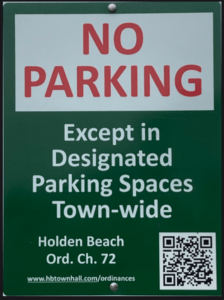
Per ordinance, there is no parking on the streets or rights-of-way except in designated parking spaces identified by Pay-to-Park signs. Click here to view an interactive map. The table with authorized parking can be viewed below.
Citations will be issued for:
-
-
- Parking without an active paid permit in a designated parking area
- Parking within 40 feet of a street intersection
- Parking in a crosswalk, sidewalk, or pedestrian access ways
- Parking blocking a driveway or mailbox
- Parking facing opposing traffic
- Parking in a no parking zone, or within right-of-way
- Parking on any portion of the roadway or travel lane
- Parking a non-LSV vehicle in an authorized LSV location
-
How Do I Pay to Park
The Town uses the SurfCAST by Otto Connect Mobile Solution. This is a mobile app downloadable for Apple and Android devices. Download the app today. Users will setup their account, enter their license plate details and pay for parking directly on the app. Alternatively, users can scan the QR Code located on the parking signs to access a secure website.
The Otto Connect customer service team will be available to help via phone and email.
THB Newsletter (06/18/26)
OttoView by Otto Connect
Just in time for peak beach season, Otto Connect, Inc. has launched a new feature designed to make parking along the coast easier and less stressful for visitors and residents alike. “OttoView by Otto Connect,” is part of the SurfCAST parking system and allows users to check parking availability in real time before heading to the beach. The feature is now available in Holden Beach. For many drivers, finding parking during busy summer weekends can be one of the most frustrating parts of a beach trip. OttoView aims to reduce congestion and save time by showing which lots have open spaces—and which do not—before users arrive. “Instead of circling for a spot, people can now see their options ahead of time and go directly to available parking,” Jim Varner (CEO) said in a statement.
Know before you go:
OttoView can be accessed through the SurfCAST website
(https://park.surfcast.ottoconnect.us/), the QRcode link, and will be available soon via mobile app update (“SurfCAST by Otto”) making it easy for visitors to plan from home or on the go.
What OttoView Shows:
-
- A map of the area and locations of all parking lots
- Real-time parking availability by location
- Estimated availability based on permit turnover
- Directions to nearby parking areas
- Filters for amenities such as restrooms, handicap spaces, and LSV parking
OttoView is fully integrated into the SurfCAST system and is available at no additional cost.
For more information, visit https://www.ottoconnect.us.

Solid Waste Pickup Schedule
GFL Environmental change in service, the Saturday before Memorial Day till the end of September, trash pickup will be twice a week.
Please note:
Trash carts must be at the street by 6:00 a.m. on the pickup day
BAG the trash before putting it in the cart
Carts will be rolled back to the front of the house
GFL Refuse Collection Policy
GFL has recently notified all Brunswick County residents that they will no longer accept extra bags of refuse outside of the collection cart. This is not a new policy but is stricter enforcement of an existing policy. While in the past GFL drivers would at times make exceptions and take additional bags of refuse, the tremendous growth in housing within Brunswick County makes this practice cost prohibitive and causes drivers to fall behind schedule.
Solid Waste Pickup Schedule
starting October once a week
Recycling
starting October every other week pick-up
Yard Waste Service
Yard debris is collected on the second (2nd) and fourth (4th) Fridays during the months of October, November, and December.Yard debris needs to be secured in a biodegradable bag (not plastic) or bundled in a maximum length not to exceed five (5) feet and fifty (50) pounds in weight. Each residence is allowed a total of ten (10) items, which can include a combination of bundles of brush and limbs meeting the required length and weight and/ or biodegradable bags. Picks-ups are not provided for vacant lots or construction sites.
Curbside Recycling – 2026
GFL Environmental is now offering curbside recycling for Town properties that desire to participate in the service. The service cost per cart is $122.93 annually paid in advance to the Town of Holden Beach. The service consists of a ninety-six (96) gallon cart that is emptied every other week during the months of October – May and weekly during the months of June – September.
Curbside Recycling Application » click here
Curbside Recycling Calendar » click here

Trash Can Requirements – Rental Properties
GFL Environmental – trash can requirements
Ordinance 07-13, Section 50.08
Rental properties have specific number of trashcans based on number of bedrooms.
* One extra trash can per every 2 bedrooms
..
§ 50.08 RENTAL HOMES.
(A) Rental homes, as defined in Chapter 157, that are rented as part of the summer rental season, are subject to high numbers of guests, resulting in abnormally large volumes of trash. This type of occupancy use presents a significantly higher impact than homes not used for summer rentals. In interest of public health and sanitation and environmental concerns, all rental home shall have a minimum of one trash can per two bedrooms. Homes with an odd number of bedrooms shall round up (for examples one to two bedrooms – one trash can; three to four bedrooms – two trash cans; five – six bedrooms – three trash cans, and the like).
Upon Further Review

A Second Helping since 2005
For the last fifteen (15) weeks they have collected food on Saturday mornings in front of Beach Mart; the food is distributed to the needy in Brunswick County. During this summer season, they collected 10,028 pounds of food and $1,755 in monetary donations. Their food collections have now exceeded three hundred and seventeen thousand (327,000) pounds of food since this program began in June of 2005. Hunger exists everywhere in this country. Thanks to the Holden Beach vacationers for donating again this year! Cash donations are gratefully accepted. One hundred percent (100%) of these cash donations are used to buy more food. You can be assured that the money will be very well spent.
Mail Donations to:
A Second Helping
% Sharon United Methodist Church
2030 Holden Beach Road
Supply, NC 28462
 ReadyBrunswick Emergency Notifications Alerts
Brunswick County uses ReadyBrunswick as part of the County’s effort to continuously improve communications during emergency situations within our area. Powered by Everbridge, the ReadyBrunswick notification system sends emergency notifications in a variety of communication methods such as:
-
-
-
- Landline (Voice)
- VoIP (Voice over Internet Protocol)
- Mobile (Voice)
- Mobile SMS (Text Messaging)
-
-
In the case of an emergency, you may choose to receive notifications via one or all of these communication methods. It’s recommended that you register several media options to receive messages in the event a particular communication device is unavailable.
For more information » click here
 North Carolina sets new tourism spending record in 2025
North Carolina set a new tourism spending record in 2025, with travelers spending more than $37.2 billion across the state. Gov. Josh Stein announced the new record Monday, surpassing the previous high of $36.7 billion set in 2024. “North Carolina remains a great place to visit from our beautiful shore to our breathtaking mountains,” Stein said. “Even in the face of challenges from Hurricane Helene recovery last year, we saw record visitor spending — proof that people want to be here and experience all our state has to offer.” Tourism spending also had a major impact across the Cape Fear. Brunswick County saw nearly $1.25 billion in visitor spending in 2025, up 1.3% from the previous year. Tourism supported 6,035 jobs in the county and generated about $37.9 million in state taxes and $52.6 million in local taxes. New Hanover County recorded more than $1.2 billion in visitor spending, an increase of 5.8% from 2024. Tourism supported 7,250 jobs and generated about $40.2 million in state taxes and $45.1 million in local taxes. Pender County saw more than $203 million in visitor spending, up 0.4%, while tourism supported 1,051 jobs. Visitor spending reached about $60.8 million in Columbus County, down 2.8% from 2024, and about $56.3 million in Bladen County, up 0.2%. Statewide, direct tourism employment increased 0.3% to 230,997 jobs in 2025. Tourism payroll increased 3.5% to $9.8 billion. Visitor spending generated more than $2.7 billion in state and local tax revenue. Domestic travelers spent a record $36.1 billion in North Carolina, up 1.5% from 2024. International travelers spent more than $1.1 billion, down 2.8%. Despite the record spending, North Carolina fell in domestic visitation rankings, dropping from fifth in the country in 2024 to seventh in 2025, behind California, Florida, Texas, New York, Pennsylvania and Georgia. According to Visit North Carolina, visitors spent more than $101 million per day across the state in 2025. The tourism spending figures are preliminary findings from research commissioned by Visit North Carolina and conducted by Tourism Economics.
Read more » click here
Corrections & Amplifications
Fire Service Funding
State and Brunswick officials raise fire fees to boost funding
Following wildfires and annual surges in population, North Carolina officials have allowed a boost in some of Brunswick County’s fire fee funding. The county’s fire fee was being charged at the maximum allowed, not allowing room for local fire departments to have additional revenue to continue growing. Now, the maximum fire fee amounts that some local fire departments may charge within their fire districts could bring in thousands of additional revenue all together. “Brunswick County is the only county in North Carolina that funds fire protection through a fire fee system rather than a fire tax… Most Brunswick County fire departments have already reached those statutory maximums,” as stated in recent county commissioner meeting packet. In April, representatives from local fire departments and the commissioners requested state legislators increase the statutory fire fee caps to help address critical funding needs. Fire fee amounts are governed by North Carolina General Statutes, which establishes maximum fee limits. Fire fees are calculated based on the heated square footage of a building, or on the acreage of a vacant property. Gov. Josh Stein signed the Fiscal Year 2026–2027 State Budget into law on July 7. The budget included legislation amending the county’s fire fee authority, ultimately boosting some fire department’s ability to charge an additional 10-25%. Although the legislation is now in effect, county commissioners had to amend the county’s adopted fiscal year 2027 budget ordinance to incorporate the updated fire fees for the affected fire districts. The Brunswick County Board of Commissioners held a public hearing regarding the changes in the fire fee funding as a result of the adopted state budget. Following the hearing, board members approved the requested changes as presented, Brunswick County Commissioner Pat Sykes being the only opposing vote.
Read more » click here
Previously reported – February 2026
County proposes new fire service contract focused on performance, accountability
While Brunswick County continues working out how it will fund local fire service in the future, county commissioners on Jan. 20 were presented with an updated fire services agreement draft aimed at establishing performance standards and improving financial reporting standards for local nonprofit fire departments. The board did not vote on adopting the updated agreement on Jan. 20, instead providing county administration with feedback on the proposed changes. The primary changes outlined in the updated service contracts related to establishing performance standards for local fire departments and increasing financial accountability for departments that plan to accept additional funding the county plans to provide in the upcoming fiscal year, county staff explained. For over a year, Brunswick County has been investigating how to sufficiently fund in-county fire service following concerns about the existing fire fee funding model adequacy. Fire fees are imposed by the county on real property owners to fund the furnishing of fire protection services, per state law. Fire fees for improved properties are calculated based on a building’s heated square footage; fire fees for vacant land are calculated based on property acreage. Fire fees are not based on tax value. Many local nonprofit departments are facing challenges stemming from declining volunteer numbers necessitating most departments to hire paid staff, increasing costs and delivery time for fire apparatus and equipment, increased call volume and the need for new or updated facilities due to growth. These departments operate entirely on fire fees, grants, fundraising and private donations. Municipal departments are facing similar struggles related to growth and increased costs. These departments are funded partly by fire fees supplemented by ad valorem (property) taxes collected by each department’s municipality. As a potential solution, the county has been exploring moving away from its fire fee funding model to a fire tax funding model. With a fire tax model, counties can charge a 10-cent fire tax per $100 property value in each fire district or between 11- and 15-cents per $100 value with a voter-approved referendum. If the county moves to a fire tax system, citizens would no longer pay fire fees. Though this change is not planned for fiscal year 2026-2027, which begins July 1, county officials are working to prepare for a possible change in FY 2027-2028. In lieu of the funding model switch in FY 26-27, County Manager Steve Stone in November recommended the county revise its fire service funding contracts with local nonprofit departments to clarify its service expectations and require more financial accountability aimed at improving service across the county. The county is also considering providing between $10 million and $12 million in one-time supplemental funding to local departments to help meet service demands while a permanent solution is worked out. Stone said the $10-$12 million estimate is based on funding needed for minimum staffing levels at each department. The final subsidy funding figure will be calculated as part of the FY 26-27 budget process, he added. “It could be more. It could be less.” The county manager also explained fire departments would need to sign the finalized new services agreement “to be eligible to receive supplemental funding.” Brunswick County Spokesperson Meagan Kascsak said the current agreements between local fire departments and the county do not expire for another two fiscal years, and departments can continue operating under those agreements if they so choose. “However, if a department chooses this route, they will not be able to request subsidized funding for particular projects or purchases that their current fire fee allotment may not be able to cover,” Kascsak said. The new agreement contains a proposed stipulation requiring any equipment fire departments purchase with county-subsidized funds to be titled to Brunswick County and leased to respective fire departments, Kascsak confirmed. “Any existing equipment a fire department owns that was purchased in the past from their general fund/fire fees allocation, grant funding, donations, etc. will continue to belong to that fire department and will not be titled to the county,” she added. County staff has met with the Brunswick County Fire Chief’s Association to discuss the updated agreement and its provisions, Stone said. County officials following the Jan. 20 meeting were also set to meet with the municipal fire departments, he added, though these departments’ contracts differ and will apply to areas outside municipal fire departments’ corporate limits. The county manager during the Jan. 20 meeting explained the major changes in the proposed new agreement. “What we have here essentially are for the really the first time in the past 26 or 27 years or more, whereby we have some specific department performance standards which are based on national standards from the National Fire Protection Association for rural areas,” Stone said. “We also are moving towards more financial accountability with this agreement, but we would not really require additional financial work on the part of the departments. The additional auditing, we would propose that the county actually engage an auditor to do that work.” The proposed agreement also adds requirements related to response times, staffing, operational capabilities, required data collection and reporting that data to the county Fire Oversight Committee. Concerning response times, the proposed agreement requires fire departments to “make reasonable efforts to deliver the first-arriving unit and the minimum Effective Response Force (ERF) to emergency incidents within” 14 minutes or less from dispatch to arrival on-scene for structural fire suppression, and eight minutes or less from dispatch to arrival on-scene for single unit response. Departments would be expected to achieve these response times in “at least 80% of all emergency incidents occurring within the contract service area, measured annually.” If a department’s performance falls below the outlined 80% threshold, it would be required to: conduct a root-cause analysis with the county fire administrator and submit a written corrective action plan within 60 days identifying the deficiency and outlining corrective measures. Regarding response staffing, the proposed agreement would require a total of six “qualified firefighters” on the scene for fire suppression incidents requiring an initial attack capability within the required response times. Four of the six qualified firefighters would be required to be from the primary responding department. The proposed agreement defines “qualified firefighters” as “individuals of the department who meet the training and certification standards recognized by the department and applicable state and federal regulations for their assigned role.” Additionally, each department would be required to maintain records of dispatch times, turnout times, travel times, personnel counts upon arrival on scene, incident types and locations and any factors resulting in delayed or impaired response. Departments would also need to submit quarterly performance reports to the Brunswick County Fire Oversight Committee. Information contained in those reports include the percentage of incidents in which the departments met the 14-minute performance objective, staffing compliance data, analysis of deficiencies and contributing factors and performance improvement recommendations. The county would provide the software to each department for aforementioned data and records collection, Stone told the board. Brunswick County Fire Chiefs Association Vice President Keith McGee, who is also the Calabash Fire Department Chief, said the proposed agreement “represents several fundamental shifts in how fire service governance, performance expectations, and accountability are structured in Brunswick County,” noting the chief’s association is “not at this time expressing agreement with the contract as currently written.” McGee asked the county to continue conservation and collaboration with local fire departments and allow departments more time to review the agreement before bringing it to a vote. “We believe that this approach will help ensure a final agreement that is clear, workable, and supported by both the county and the fire departments that are responsible for delivering emergency services to our citizens,” he said. County administration is expected to bring an updated draft, incorporating board feedback and additional feedback from local fire departments to the board of commissioners during its Monday, Feb. 16 meeting at 6 p.m.
Read more » click here
Previously reported – May 2026
Brunswick County formally requests fire fee cap increase
The Brunswick County Board of Commissioners on May 4 voted to ratify a resolution requesting the North Carolina General Assembly amend local fire fee legislation to increase fire fee caps by 50% total over the next two fiscal years. Fire fees are imposed by the county on real property owners to fund the furnishing of fire protection services, per state law. Fire fees for improved properties are calculated based on a building’s heated square footage; fire fees for vacant land are calculated based on property acreage. Fire fees are not based on tax value. The cap increase, originally requested by local fire departments through the Brunswick County Fire Chiefs’ Association, would allow fire departments to increase maximum collectable fire fee amounts by a total of 50% by fiscal year 2027-2028, with a maximum 25% cap increase in FY 2026-2027 beginning July 1. The requested cap increase, if approved, will not require local fire departments to increase fire fee rates, but rather will allow them to do so if demand requires it. For example, Calabash Fire Department in a social media statement last week said it does not plan to raise fire fees in FY 2026-27. Primary fire service in Brunswick County jurisdiction is typically provided by nonprofit volunteer fire departments — most of which now are primarily staffed by paid firefighters — with nearby municipal fire departments, and other nonprofit departments, providing secondary response. Municipal departments also often cover areas in county jurisdiction within their respective fire districts that also include areas within municipal jurisdiction. Many local nonprofit departments, which operate entirely on fire fees and grants, fundraising and donations, are facing challenges stemming from exploding call volume, declining volunteer firefighter numbers, increasing costs for fire apparatus and other equipment and the need for new or updated facilities due to ongoing growth. Some municipal departments, funded partly by fire fees supplemented by property taxes collected by their respective municipalities, are facing similar struggles related to growth and increased costs. The current fire fee schedule was last adjusted in 2017, and the resolution notes in-county growth and fire service demand has necessitated another adjustment. The existing fee schedule, the resolution states, has “become further outdated” and is “insufficient to keep up with inflation as well as the growing population and needs of Brunswick County.” The resolution asserts that the requested cap increase will “enhance the ability of Brunswick County to meet the fire protection needs of its citizens.” During the May 4 meeting, Calabash Fire Department Chief and Fire Chiefs’ Association Vice President Keith McGee requested commissioners support for the resolution.
Read more » click here
Previously reported – June 2026
Brunswick County to form fire service committee
The Brunswick County Board of Commissioners on June 1 voted unanimously to form a committee to review the fire service situation in Brunswick County and work to develop a path forward for a new fire service funding mechanism. Commissioner Frank Williams made the recommendation for the establishment of the committee, first proposed earlier this spring by Brunswick County Fire Chief’s Association President Charles Drew, who is also the Southport Fire Department Chief. Drew on April 20 asked the commissioners to form a committee including fire chiefs, county commissioners, mayors and citizens to study a new funding fire service mechanism to be established in Brunswick County by the 2027-28 fiscal year, beginning July 1, 2027. Williams on June 1 noted Drew’s recommendation was for the proposed committee “to review the fire situation and, specifically, to help develop a path forward for a new funding mechanism, review and agree on a contract, and possibly discuss capital oversight.” “[Drew’s] proposed structure was two commissioners, two chiefs (one from a municipal and one from a nonprofit department), two mayors (one a town with a municipal department, one from a town without), and two citizen members,” Commissioner Williams said last week. “I would like to see us form a committee, but with a couple of additional people on it. One being the county fire administrator, one being a member of our county management team, and then other county staff, whether it be finance or legal, in an advisory capacity as needed.” The board of commissioners unanimously agreed with Williams’ recommendation and instructed county staff to add the official creation of the committee as an item on the board of commissioners’ June 15 meeting agenda. Brunswick County for over a year has been exploring moving away from its current fire fee funding model that both county and fire service leadership have called inadequate at meeting the needs of the growing county. Fire fees are imposed by the county on real property owners to fund the furnishing of fire protection services, per state law. Fire fees for improved properties are calculated based on a building’s heated square footage; fire fees for vacant land are calculated based on property acreage. Fire fees are not based on tax value. A funding model change is not planned for fiscal year 2026-2027 that begins July 1, though county officials have previously said they are working towards enacting a change in FY 2027-2028 that starts next July 1. Primary fire service in Brunswick County jurisdiction is typically provided by nonprofit volunteer fire departments — most of which now are primarily staffed by paid firefighters — with nearby municipal fire departments, and other nonprofit departments, providing secondary response. Municipal departments also often cover areas in county jurisdiction within their respective fire districts that also include areas within municipal jurisdiction. Many local nonprofit departments, which operate entirely on fire fees and grants, fundraising and donations, are facing challenges stemming from exploding call volume, declining volunteer firefighter numbers, increasing costs for fire apparatus and other equipment and the need for new or updated facilities due to ongoing growth. Some municipal departments, funded partly by fire fees supplemented by property taxes collected by their respective municipalities, are facing similar struggles related to growth and increased costs. In lieu of a funding mechanism change in FY 26-27, the Brunswick County Board of Commissioners on May 4 voted to ratify a resolution requesting the North Carolina General Assembly amend local fire fee legislation to increase fire fee caps by 50% total over the next two fiscal years. The cap increase, originally requested by local fire departments through the Brunswick County Fire Chiefs’ Association, would allow fire departments to increase maximum collectable fire fee amounts by a total of 50% by fiscal year 2027-2028, with a maximum 25% cap increase in FY 2026-2027 beginning July 1. The cap increase would not require local fire departments to increase fire fee rates but rather will allow them to do so if demand requires it. This is a developing story. The Brunswick Beacon will continue reporting updates on this situation as it progresses.
Read more » click here
Ocean Isle Beach Terminal Groin
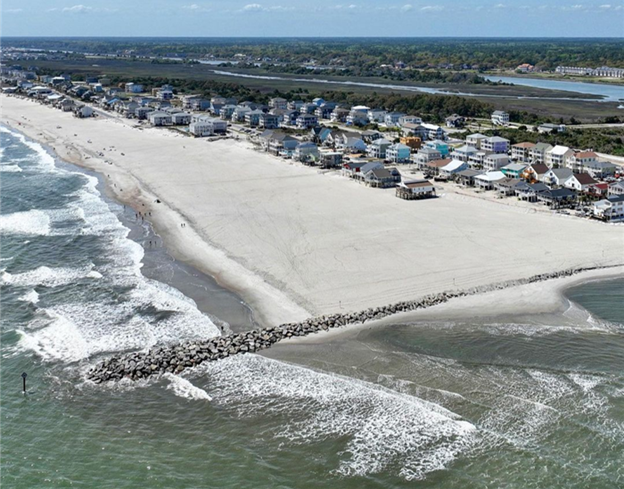 Ocean Isle Beach completed construction of a terminal groin on its east end in April 2022 to help protect the beach immediately behind it. However, this structure has contributed to significant erosion at the east end near Shallotte Inlet by interrupting natural longshore drift, prompting ongoing efforts such as sandbag use to prevent ocean encroachment on properties in that area.
2024 OIB SHORELINE AND INLET ANNUAL MONITORING REPORT
On Holden Beach, the recent volume change rates (May 2024 to November 2024) along the oceanfront shoreline indicated erosion at 12 of the 21 monitoring stations. Similarly, the MHW shoreline change rates indicated a shoreline retreat at 15 of the 21 monitoring stations. The long-term post-construction linear shoreline changes along the Holden Beach oceanfront shoreline indicated landward retreat. However, volumetric changes indicated slight accretion (0.2 cy/ft./yr.) within this area over the long-term period. The shoreline threshold analysis results along the Holden Beach oceanfront shoreline show that the post-construction shoreline change threshold was exceeded at only one monitoring station. This is the first time a threshold has been exceeded at Holden Beach since this annual analysis started in 2022. In addition, the analysis of May 2024 aerial imagery-derived wet/dry line revealed an 885 ft. section of Holden Beach’s inlet shoreline that exceeded the inlet shoreline threshold by a maximum distance of 100 feet. The inlet shoreline threshold on Holden Beach was also exceeded in Year-2. This marks two straight years where this threshold was exceeded. The inlet shoreline recession is believed to likely be attributed to a combination of morphological changes within Shallotte Inlet including the position and orientation of the main channel through Shallotte Inlet and the formation of a flood channel on the inlet shoulder of Holden Beach. Regardless, as stated in the Plan, because the shoreline changes in this area exceeded the threshold over the entire 2-year confirmation period, an assessment of the proper responsive measures will be made through coordination with State and Federal regulatory officials.
 East End/Terminal Groin Short Term Mitigation
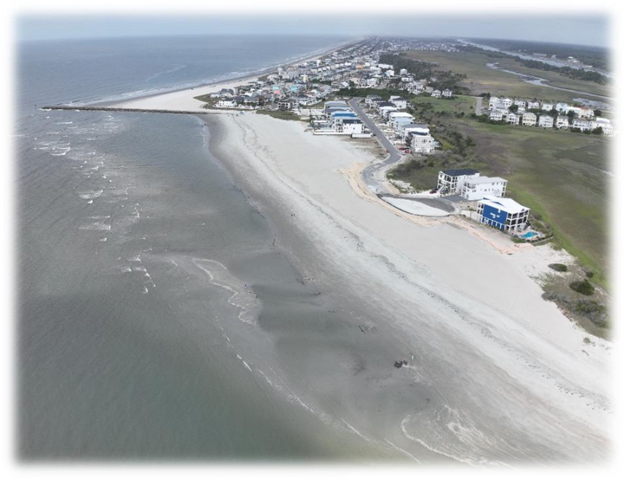
As required by State and Federal permits associated with the Town’s Shoreline and Inlet Management Plan, annual shoreline monitoring identified erosion east of the terminal groin that exceeded established management thresholds. To maintain permit compliance and address localized erosion concerns, the Town implemented a short-term mitigation project consisting of targeted beach nourishment east of the terminal groin.
Project Update
-
- Project completed: May 24, 2026
- Sand placed: Approximately 45,000 c/y
- Engineer: Coastal Protection Engineering
- Contractor: Southwind Construction
- Total project cost: $667,696.61
This project, along with the US Army Corps of Engineers – Shallotte Inlet Crossing & Widener Project, placed 70,000 cy of sand east of the terminal groin with another 35,000 cy west of the terminal groin. With this short-term mitigation measure in place, the Town has engaged with Coastal Protection Engineering (CPE) to investigate long-term mitigation plans to prevent any further erosion adjacent to the terminal groin.
‘150 years of negative impacts’ to New Jersey coast: Corbett
In the last six years the Atlantic Ocean has demolished nearly three dozen privately owned oceanfront homes in Buxton and Rodanthe. These collapsed houses represent a broader coastal management challenge, even pushing the commission that makes coastal development rules to reconsider a decades long ban on hardened structures built for erosion control, Dr. Reide Corbett said during a recent talk at Core Sound Waterfowl Museum and Heritage Center on Harker’s Island. A coastal oceanographer and geochemist, Corbett, as of July 16, is the new interim dean of the Thomas Harriot College of Arts and Sciences on East Carolina University’s main campus. He spent the last 14 years as head of the Coastal Studies Institute, or CSI, in Wanchese, led by ECU. His talk was one of five in the “Water/Ways” speaker series last month organized to complement the Smithsonian traveling exhibit with the same name that was on display at the time. “There’s no doubt that we are seeing changes along our shoreline,” and because there’s not just one thing driving coastal change, there’s not one simple solution, Corbett said early in the presentation. “I’ll go ahead and put quotes around ‘solution’ now because I might not do it throughout the entire talk, because a solution to many of these challenges we face is likely only temporary. It’s not going to solve the problem. The process that is driving many of these changes won’t be solved by one thing.”
The process
North Carolina’s coast is protected by low-lying sand deposits called barrier islands. These mobile landforms that separate the mainland from the ocean are in constant but slow motion toward the mainland. This natural process is how these islands maintain elevation and width. This is nothing new, “barrier islands have always changed,” Corbett said, but now these mobile landforms are developed. “For better or worse, it is where we are. These coastlines have been changing since there were coastlines. The difference is we have a lot of infrastructure today in the same areas where these coastlines are changing.” The natural process of erosion on the oceanside and growth on the sound side of the island is being exacerbated by increasing sea levels, development associated with population growth, and storm impacts. The National Oceanographic Atmospheric Administration reported a few years ago that sea level is expected to rise 1 to 1.5 feet by 2050. “To put that in perspective, it took the last almost 100 years for sea levels to change 1 foot in coastal North Carolina,” Corbett said. “And from roughly 2000 to 2050, we’ll expect at least an additional 1-to 1.5-foot rise.” That is a significant amount, and “When you look at what sea level is doing based on tide gauges up and down our coast, we are right on track to meet that if not surpass that” projection that he said has a 95% chance of happening. To illustrate, when a house on the Outer Banks gets taken by the ocean, Corbett said the “narrative is ‘often why did people build here? Why would they put their house right there? It’s so vulnerable,’” but when the houses were built in Buxton, for example, in the 1970s and 1980s, there was 100 to 300 feet of beach, or a few dunes, in front at the time. Now, the ocean is on their doorstep. It’s because these shorelines have been eroding for decades, some at 5, 10 or 15 feet per year every year. Then put a storm on top of that, or this past fall, three storms “one after another after another without any time for recovery, and what you end up doing is deflating the beach, dropping the elevation of that beach, removing significant amount of sand because of the energy in the system.” There has been roughly a 1-foot rise in sea level since 1975 at this location, and erosion has continued anywhere from 4 to 8 feet per year there. “You put those two things together and this is what you have,” he said. As Corbett said early in the program, “there’s not going to be a single simple solution for any community” and what may work for one won’t necessarily work for another.
Community questions
Communities need to ask themselves what they are trying to protect. “Is it an individual home? Is it a way of life? Is it an economy? Where are we acting? Where is it most vulnerable? What are we trying to protect? And where is that? You can ask ‘why are we trying to protect that?’ as well if you like. How far are we looking out into the future? Because I think that’s important to consider when acting on a potential solution.” What can a community do once it decides on a path forward? There are a handful of options, starting with nothing, which Corbett said isn’t really a response. Some areas can be protected. For example, a living shoreline in an estuary could protect infrastructure. Accommodate the change and that might look like houses being raised or a bridge around a very vulnerable location or leave. “Nobody likes to hear the word ‘retreat’ because it seems like you’re giving up. And I don’t disagree with that,” he said, but the idea is to move out of those most vulnerable locations. Corbett said that hardened structures are “being pointed to a lot today as a way of protection, a solution to the problem. And I think it’s important to recognize the tradeoffs.” In North Carolina, hardened structures have not been used to control erosion in decades, because of a policy in the 1980s and then a law in the early 2000s. Corbett noted on the presentation slide that the state law “prohibits the construction of a permanent erosion control structure in an ocean shoreline, including breakwater, bulkhead, groin, jetty, revetment, seawall or any similar structure. This ban was based on extensive studies and technical data documenting the detrimental impacts of erosion control structures, including 150 years of documented negative impacts of shoreline stabilization on the barrier islands of New Jersey.” The different kinds of hardened structures come with their own sets of problems. A vertical structure like a seawall might protect what’s behind it but will lead to higher erosion rates on either side of the structure and a total loss of recreation beach in front of it, Corbett said. The houses actively crumbling have pressed the Coastal Resources Commission to consider potential changes to its laws on hardened structures and charged its science panel, on which he serves, in February to draft a report on the various types of hardened structures for oceanfront and the advantages and disadvantages of each type. The report was first presented during the commission’s June meeting. The North Carolina Department of Environmental Quality’s Division of Coastal Management, which carries out the development rules established by the commission, announced that the commission is to hear an update on the report during the Aug. 26-27 meeting in Manteo. But with all those responses, “I think it’s important to recognize that the processes aren’t changing,” Corbett said. Buxton has three terminal groins that were built in the 1960s that have deteriorated, and the narrative suggests that the deterioration and large holes in the structure farthest south has led to significant erosion. “My argument is, it’s not just that. It’s an erosional system. There’s a lot of data to show that even with these groins, there’s a reason we moved the lighthouse,” said Corbett, referring to the Cape Hatteras Light, which was moved in 1999 a distance of 2,900 feet from where it was built in 1870 because of its proximity to the waves. “It wasn’t a stable system. And those groins have been there since the late ’60s. And so, this is an eroding system. And it’s been eroding regardless of whether those groins were there or not. And it will continue to erode whether we rebuild those groins or not.” Nourishment does protect but is a temporary solution. It’s not changing the process causing the erosion. Beach nourishment is when sand is taken from a borrow area and pumped onto the beach. The amount of time the new sand lasts on the shoreline is no longer projected to be seven years. Now the project planners are calculating for five years. But that’s not long enough either. The sand from a 2022 beach nourishment in Buxton only lasted two years until more was needed. Corbett’s hypothesis is that nourishment projects are causing the shoreface to steepen 15 to 20 feet from the shoreline. He said he was considering looking further into this untested theory to see if the nourishment areas are becoming more vulnerable. Data available on coastsat.space, which uses satellite imagery to map ocean shorelines, shows how the beach is changing and responding to a beach nourishment project. For south Nags Head, the first nourishment project was in late 2011 or 2012, and data shows that after nourishment, the erosion rate became significantly faster. “You place a lot of sand on the beach, it’s unnatural. Yes, it provides a wider beach, but you also increase that erosion rate,” Corbett said. “I’m not saying this isn’t protecting infrastructure” but it doesn’t stop the process. “Nourishment is a Band-Aid for that real physical process of erosion. It hasn’t slowed the process. It is a temporary solution that has to continue. You don’t do a single nourishment, you develop a nourishment program,” he said. “It’s $20 million today. It’s $20 million in five years.” Ultimately, Corbett said communities need to decide what they want to protect and if they’re willing to accept the tradeoff.
Read more » click here
CRC meets amid debate over NC’s hardened shoreline structures ban
The debate over whether to repeal or amend the state’s ban on hardened structures for shoreline protection resumes this week when the North Carolina Coastal Resources Commission (CRC) meets on Aug. 26 and 27 at the Dare County Government Complex in Manteo. A major catalyst behind the effort to re-examine the ban is the crisis in Buxton, where 32 privately owned oceanfront houses have fallen into the ocean since 2020—with 20 of them collapsing since September 2025, generating national headlines. According to the meeting agenda, the CRC will hear a report from its Science Panel on hardened oceanfront structures. On June 18, the panel presented a 47-page report recommending that the state “maintain a cautious approach to any expansion of the use of hardened structures along its sandy, open-ocean coastline.” It also advised that before changing its oceanfront management policies, the state should “include a broad assessment of the benefits, costs, limitations and distribution of effects” arising from an expanded use of hardened structures. The Outer Banks Voice – CRC panel report recommends ‘cautious approach’ to use of hardened structures. In 1985, the CRC banned hardened structures through regulatory action, followed 15 years later by a ban approved by the state legislature, unless a groin was less than 50 percent damaged. Along with its Buxton beach nourishment project this summer, Dare County is also conducting an $8.6 million project to repair the Buxton terminal groin, work allowed under the state exemption. More Beach to Love | Dare County, NC. In the past year, there has also been a flurry of advocacy to revise or repeal the hardened structure ban coming from Outer Banks communities and officials. In October 2025, the Buxton Civic Association asked residents to contact state officials to lobby for an “immediate exclusion of CAMAs hardened structures law” for Buxton. A month later, Dare County Commissioner Chair Bob Woodard sent a letter to North Carolina legislators asking them to take action to combat coastal erosion, a request that included reconsidering the ban on hardened structures. In May 2026, the Currituck County Commissioners approved a resolution supporting state legislative efforts—NC Senate Bill 1009—to repeal the hardened structures ban. The resolution noted that “North Carolina is one of the only U.S. coastal states with a long-standing ban on hardened structure.” That ban, it added, leaves beach nourishment, which the resolution characterizes as “a costly and temporary solution to erosion…as one of the only tools available to counties to combat coastal erosion.” A committee of the North Carolina Senate approved that legislation to repeal the ban in June. Senate Bill 1009 (2025-2026 Session) – North Carolina General Assembly. Asked about the repeal of the hardened structures ban during a visit to the Outer Banks in late June, Governor Josh Stein said solutions to beach erosion need “to be based in science. There [are] clear emotions that are flying here…We want people’s homes to be preserved. But we have to do it in a way that will make long-term success possible.”
Read more » click here
Odds & Ends
August Ties the Record for Earth’s Hottest Month on the Books
Sweltering summer temperatures put last month on par with July 2023 for global warmth, scientists said. More records could be broken in the months ahead.
Last month tied July 2023 as the planet’s hottest month on record, European scientists said on Thursday, as human-caused warming pushes the Northern Hemisphere’s muggiest, most uncomfortable time of year into new realms of stickiness and discomfort. Dangerous heat hammered Europe for the fifth time since May. Temperatures soared into the triple digits across the southern United States from California to Texas. South Korea recorded its highest temperature reading in modern history: 108.5 degrees Fahrenheit in the southern city of Yangsan on Aug. 2. August tied the record for the oceans’ hottest month in history as well, scientists said, as El Niño conditions caused warm water to accumulate at the surface of the tropical Pacific. This extra warmth will spread to the rest of the planet in the months ahead, making the globe’s average temperatures likely to break more records through the end of the year and into 2027. “These observations show how climate change is driving extremes across both the atmosphere and the oceans,” said Samantha Burgess, a climate scientist at Copernicus, the European Union’s climate monitoring service, which published the analysis of August temperatures. “The impacts of these conditions are increasingly being felt by communities, economies and ecosystems across the world.” August’s sweltering temperatures capped the warmest summer on record for both Western Europe and the contiguous United States. Across the lower 48 states, the average temperature last month was 75.6 degrees Fahrenheit, the highest on record for August and 3.5 degrees Fahrenheit above the 20th-century average, the National Oceanic and Atmospheric Administration said on Wednesday. Summer in the Northern Hemisphere is also the warmest time of year for the planet as a whole. The reason is that the sun’s energy heats the air above land more than it does the air above water, and most of Earth’s land lies north of the Equator. According to Copernicus, the average air temperature at the planet’s surface last month was 1.65 degrees Celsius, or roughly three degrees Fahrenheit, higher than it was at the start of the industrial age, when large-scale burning of fossil fuels began raising global temperatures. That made August the first month since last November when global warming exceeded 1.5 degrees Celsius, an important number in humanity’s efforts to curb climate change. More than a decade ago, nearly all nations agreed at a global summit in Paris to try to keep global warming “well below” two degrees Celsius and, ideally, to limit it to 1.5 degrees Celsius above preindustrial levels. In a report last week, the United Nations declared that the world would not achieve that second, more ambitious goal and predicted that, within the next few years, average global warming would surpass 1.5 degrees Celsius. By 2100, warming could peak at 1.8 degrees Celsius if governments are highly successful at slowing warming, or at 2.6 degrees Celsius or higher if they aren’t, the report said. The goal now, the U.N. report said, should be to bring temperatures back down as quickly as possible, both by slashing greenhouse gas emissions and by developing novel technologies to draw carbon dioxide out of the atmosphere. The world also needs to learn to cope more effectively with the elevated risks of intense hot spells, downpours, wildfires and coastal floods that a warmer planet has created, the U.N. said. “This is the spiraling price of humanity’s fossil fuel addiction, and the global climate crisis it is fueling,” said Simon Stiell, the head of the U.N. entity that supports the international response to climate change.
Read more » click here
The US just had its hottest summer on record, beating the Dust Bowl era
The United States just had its hottest summer in 132 years of recordkeeping, soundly beating the summer of 1936 — during the Dust Bowl era — as well as the summer of 2021, according to data released Wednesday by the National Oceanic and Atmospheric Administration. Previously, those two years had tied for the hottest summer. The Dust Bowl summer of 1936 has been long been regarded as the benchmark of hottest summers in the US but has now been equaled or eclipsed twice in the past five years thanks to the influence of human-caused climate change. August 2026 and the June-through-August period both set all-time records, and July was the hottest month of any month on record in the US. The difference between the new and old seasonal records was 0.4 degrees Fahrenheit, which is relatively large for an all-time temperature record. Summer featured widespread above-average temperatures across the Lower 48 states, with well-above-normal nighttime low temperatures throughout the country — largely driven by a series of powerful heat domes that affected nearly every state besides Alaska and Hawaii. The average temperature during August in the Lower 48 states was 75.6 degrees Fahrenheit, which was 3.5 degrees above the 20th century average. The average for meteorological summer — from June through August — was 74.4 degrees, which was 3 degrees above average. Record-breaking heat was especially present across the Southwest, with Arizona, New Mexico, Utah and Colorado each setting records for their warmest summer. The searing season only exacerbated the Colorado River water crisis. One sign of how incredibly hot the summer was can be seen in the balance of record highs to record lows. There were a staggering 1,541 record monthly highs set or tied nationally, compared to just 87 monthly record lows set or tied. In a climate that was not rapidly warming, one would expect the ratio of records to be closer to even. The summer temperature record comes amid a strengthening El Niño in the tropical Pacific, along with the growing effects of long-term climate change. Climate change in particular is leading to more intense, frequent and long-lasting heat waves, while El Niño is further increasing global average temperatures. According to NOAA data, the months of June through August in the US have warmed by about 0.46 degrees Fahrenheit per decade since 1970.
Read more » click here
Previously reported – August 2026
Contiguous US breaks its record for hottest month ever, NOAA says
The contiguous United States sizzled to its hottest month ever last month, according to the National Oceanic and Atmospheric Administration. July averaged 76.89 degrees Fahrenheit (24.94 degrees Celsius) across the Lower 48 states, eclipsing the Dust Bowl’s July 1936 by an eighth of a degree. Records go back to 1895. “It’s not good when you’re breaking records from the Dust Bowl, which we are in this case,” said meteorologist Jeff Masters of Yale Climate Connections. “And that was a crazy sort of situation where you put tens of millions of people in motion. You had this great migration because of the drought and the heat that hit the center of the U.S. — just a cataclysmic event in U. S. history. If we’re exceeding records from The Dust Bowl, that says that we’re in deep trouble.” Although it was unusually cool in Alaska, hotter-than-normal conditions blanketed the Lower 48, with the most excessive heat in the Mountain West, Southwest, Northern Plains and Southeast. The heat was so widespread that every one of the Lower 48 states was at least 1 degree Fahrenheit (nearly 0.6 degrees Celsius) warmer than the 20th century average, said Russ Vose, chief of monitoring at NOAA’s National Center for Environmental Information. The heat in the Dust Bowl years was more concentrated in parts of the Midwest and was aggravated by agricultural practices at the time, Vose said. What’s happening now is due to the burning of coal, oil and gas, scientists said. “Extremely high temperatures across the continental U.S. this summer, along with intense drought and fire conditions, are absolutely consistent with the climate change signal,’ said Katharine Jacobs, a climate scientist at the University of Arizona. The biggest driver of the record heat was nighttime lows that smashed the old mark for hottest minimums by 0.7 degrees, NOAA said. Hotter nights are a classic sign of human-caused climate change, according to scientists and several studies in peer-reviewed literature. NOAA’s calculation is based on averaging 24 hours of temperature, not just highs or lows. “If you’re talking heat waves, that nighttime low is incredibly important for determining total heat stress,” Masters said. “So if it doesn’t cool off at night, your body doesn’t have time to readjust to all the heat.” As nighttime temperatures increase, more people die and lose sleep, studies show. The years 2021 and 1936 tie for America’s hottest summer, which is June through August. Through July, 2026 is a shade cooler than 2021, which was powered by record heat in June. Because of climate change, Masters said, “this may be one of the coolest years we’re gonna experience for the rest of our lives.” What’s needed, Masters said, is “to stop burning so many fossil fuels. We also need to be spending money to adapt to the new climate that we’ve put in place.”
Read more » click here
July was the hottest month in the US since records began in 1895
July was the hottest month ever recorded in the United States, according to data released Monday by the National Oceanic and Atmospheric Administration. The month featured long, intense heat domes that led to record hot temperatures from the East Coast to the Plains and Southwestern states. NOAA’s temperature records date back to 1895. By the end of the month, large wildfires were burning in the Pacific Northwest and Canada, mirroring what has been taking place in Europe, which is having its hottest summer on record. July’s average temperature in the Lower 48 states was 3.3 degrees Fahrenheit above the 20th-century average, NOAA reported. This was about 0.1 to 0.2 degrees warmer than July 1936 and July 2012 — the previous record holders — NOAA stated. July tends to be the hottest month of the year in most of the US. More than 600 monthly records for highest maximum and minimum temperatures have been set this year in July across the US. There were fewer than 50 monthly records set on the cool side for temperatures. In any given month those should average out to be even. Climate change due to the burning of fossil fuels has altered this pattern. One feature of the July weather pattern in the US was a seemingly endless series of heat domes that popped up in different parts of the country depending on the contortions of the jet stream. Heat domes act like a lid on a pot, trapping and enhancing hot air beneath them. The jet stream is a narrow corridor of fast-moving air at about 30,000 feet above the Earth’s surface, and it plays a key role in steering and providing energy for weather systems. Long-term, human-caused climate change is making heat waves more intense, longer-lasting and more likely to occur. Last month saw an intense heat wave that enveloped the eastern half of the country through the July 4th holiday weekend, with subsequent rounds of extreme heat that hit after that as well. Above average temperatures stretched across the entirety of the Lower 48 states, with 13 states having monthly average temperatures that ranked in their top-5 warmest Julys. Wyoming had its hottest July and hottest month of any month on record. No state had a ranking near or below average for the month, NOAA found. July has been warming especially rapidly during the past few decades. According to Climate Central, a research and communications nonprofit, in 229 US cities, July temperatures have climbed an average of 2.6 degrees since 1970, with the highest rates of warming occurring in cities in the Pacific Northwest and the Southwest. Cities that had their warmest Julys include Denver and Salt Lake City, as the Intermountain West had the most significant heat compared to average last month. But many cities across the country had a month that ranked in the top-5 warmest, including Miami, L.A. and Minneapolis. In addition to long-term climate change, a rapidly intensifying El Niño event in the tropical Pacific Ocean is also beginning to be a factor in elevating global average sea and air temperatures and may have played a supporting role in increasing July’s air temperatures across the US. However, studies showed that individual heat waves that struck the country were more connected to climate change plus the natural variability of weather systems than El Niño. July’s extreme heat was not limited to the US, as much of Europe saw multiple heat waves that led to wildfire outbreaks at the end of the month and into early August in Spain, France, the UK, Greece and other countries. According to the Copernicus Climate Change Service, Western Europe has had its hottest first two months of summer on record so far.
Read more » click here
This and That
Brunswick County and DuPont Chemours Settlement
Brunswick County announced today that The Chemours Company, along with Dupont and Corteva, have officially entered into a $95 million settlement agreement, marking a major milestone in the County’s efforts to receive compensation for major capital investments necessary to remove per- and polyfluoroalkyl substances (PFAS) from the County’s main source of drinking water. Brunswick County’s settlement is part of a $590 million group settlement agreement, Brunswick County v. DowDuPont, Inc. et. al. (Chemours), which includes the State of Noth Carolina and 10 other local entities in the state. “It’s been a long time coming, but we are proud to stand up for our County and demand what is due for our community,” Brunswick County Chairman Mike Forte said. “We commend all our staff, legal counsel, local leaders, and partner agencies for their tremendous work over the years to ensure that Brunswick County received recognition and compensation for the costly infrastructure improvements we have had to make to combat the PFAS issue in the Cape Fear River.” Of the total $590 million of the settlement, $380 million will go to local entities and $75 million to the State. The remaining $135 million will go to a reserve fund connected to the N.C. Department of Environmental Quality’s 2019 Consent Order to ensure that Chemours or DuPont will continue mandated PFAS cleanup efforts in the Cape Fear River. The finalization of the agreement marks the end of nearly nine years of litigation against Chemours and DuPont. Brunswick County will receive payments over the course of the next eight years. The settlement is front loaded with the County receiving slightly over $24 million in each of the first three years.
Water Alert
THB Newsletter (08/31/26)
Brunswick County Public Utilities Stage 1 Voluntary Conservation Alert
Due to current and projected weather forecasts, as well as reduced system demands, Brunswick County has moved from a Stage 2 Mandatory Water Conservation Alert to a Stage 1 Voluntary Water Conservation Alert. Under Stage 1, all water usage adjustments become voluntary.
Under a Stage 1 Water Conservation Alert, water system customers are requested to make voluntary adjustments to their water usage habits and to follow the recommended irrigation schedule (see below). The voluntary automatic irrigation schedule applies to automatic sprinkler systems for residential and commercial lawn and landscape irrigation.
Recommended Irrigation Schedule (Voluntary)
Water customers are asked to only water lawns and landscaping with automatic irrigation systems (spray irrigation, drip irrigation, etc.) up to one inch of water per week, between the hours of 8:00 p.m. to 4:00 a.m. on their designated days.
A full list of recommended water usage adjustments can be found online at BrunswickCountyNC.gov/WaterWise
Recent rains help but heat has amplified long-dry conditions
Weather forecasts in areas of North Carolina this summer have played like a needle on a scratched vinyl record, bouncing backward in a repeating loop: dry and hot, dry and hot, dry and hot. Well before high temperatures with heat indexes climbing into triple digits smothered the air hanging over portions of the state, coastal counties being no exception, the land beneath our feet was parched. The North Carolina Drought Management Advisory Council, or DMAC, announced at the beginning of this year that the state was experiencing widespread dry conditions, the result of a drought the origins of which trace back to August 2025. About a week into the new year, 15 of the state’s 20 coastal counties were classified as abnormally dry. By June’s end, Brunswick County Public Utilities customers were placed under mandatory water restrictions. As June turned over to July, drought conditions in that county further deteriorated. Though the western portion of North Carolina’s southernmost coastal county as of Aug. 18 remained under exceptional drought, the highest drought classification, rain since July has relieved dry conditions marginally but enough to prompt the county to ease water, though not completely lift, water use restrictions. North Carolina has since last month started to see some notable rainfall, particularly in the western part of the state and northern part of the coast, said Klaus Albertin, DMAC chair and water resources engineer with the North Carolina Department of Environmental Quality’s Division of Water Resources. “Most areas are starting to see improvements, and a lot of the state, lawns, gardens, agriculture is looking good because we’ve been getting regular rains,” he said. “Not everywhere improves at the same rate. That’s kind of the tough part about the summertime in North Carolina. We’ll get some rains that are really spotty, so you’ll have areas that get 2, 3, 3½ inches, but then, not far away, they may only get a quarter of an inch.” This helped some state reservoirs recover their water levels faster than others. Rainfall in the watershed above Jordan Lake, for example, helped that reservoir bounce back to its target water level within a couple of weeks, Albertin said. Falls Lake, which is a little more than 30 miles northeast of Jordan Lake, hasn’t been as lucky. “It’s going to take some good rains or a lot of smaller, consistent rains to bring all of them back up to where we’d like to see them,” Albertin said. As for aquifers, he said, “I would say, instead of weeks you probably are looking at months, and some of it just takes a while for the water to percolate down into the aquifers.” Gabrielle Chianese, DWR’s Groundwater Resource Branch supervisor, explained that there are portions of the state where groundwater, or superficial aquifer wells, are showing decreases. “However, the deeper aquifers, the only way the drought really impacts those deeper aquifers is due to higher usage,” including lawn irrigation, she said. “That’s when we’ll see impacts to the lower aquifers. But all of these seem to be recovering very well, especially the ones that the deeper aquifers that are being used more, we are seeing recovery in those so that’s good news.” She encourages private well water owners to have their well water tested, a service typically provided by county health departments for a fee. Parts of the state continue to face lingering rainfall deficits despite recent summer storms. As of Aug. 18, Wilmington, for example, was at a 21-inch rain deficit. “It just goes to show that we haven’t really had a whole lot of rain, especially in some parts of the state, since last August,” of 2025, said North Carolina State Climate Office Director Dr. Jared Bowden. And the hot weather much of the state has experienced this summer has only aided and abetted drought conditions. Intense heat paired with dry conditions creates what is called a “hot drought,” which amplifies the loss of moisture in the soil. “If you basically dry out the soil then all the energy goes into heating up that surface and then it gets just hotter, so it feels hotter, and that’s because all the energy goes directly into heating the surface rather than evaporation,” Bowden said. “There’s this coupling process as the atmosphere continues to warm and it becomes thirstier that you get these hotter and drier droughts.” This, he explained, is a fingerprint of the changing climate. According to the State Climate Office, North Carolina over the last 120 years has warmed by about 1 degree Fahrenheit. “This is less than Earth as a whole, which has warmed by nearly two degrees,” the office states. But warming has accelerated in recent decades, with the period between 2009 and 2018 becoming the state’s warmest recorded decade.
Wetter weather patterns ahead?
The National Oceanic and Atmospheric Administration in early June confirmed that the globe was officially in an El Niño year. El Niño is a recurring weather phenomenon that forms when the sea surface temperatures in the central and eastern tropical Pacific Ocean are warmer than average. And, Bowden said, its impacts are already being felt. “Hurricanes, like them or not, they do contribute to our climatological rainfall into late fall in particular,” he said. “Basically, El Niño is decreasing the likelihood that we’ll have significant rains from a tropical-like system.” What does that mean for say, Brunswick County? As we move into peak hurricane season, if the probability for a named storm is low, so too is the likelihood of short-term drought relief. “But, as you go into the fall, when El Niño picks up in strength, the impacts are for a wetter winter,” Bowden explained. In fact, in the coming months – October, November and into December – North Carolina could experience similar rain events to those of 2015, when there was in a strong El Niño. “We had our wettest December on record, and the strong El Niño event of 1997 and ’98, we had our wettest winter on record for the state of North Carolina,” Bowden said. “That’s kind of where we’re headed. Ideally, it’s going to be months of needed rain. I mean, of course, you can get the big hurricane — even that would just really put a dent in something like that — but the odds of that type of event are not as likely. It will probably be more steady rainfall over the winter months that would bring places like Wilmington that are currently, over the last year, in 20-inches-plus deficit to get them back to normal. But, the short term is we might stay dry for a little longer across the state.”
Read more » click here
Turtle Watch Program –

Turtle Watch Program – 2026
.
.
The first nest of the 2025 season was on May 21st
Average annual number of nests is 59
Current nest count – (78) as of 09/20/26
Total known eggs = 8,762
Total baby turtles to ocean = 6,957 around 79%
Total number of nests historically
-
-
-
-
-
-
-
-
-
-
-
-
- 2012: 48
- 2013: 73
- 2014: 19
- 2015: 53
- 2016: 52
- 2017: 50
- 2018: 30
- 2019: 105
- 2020: 65
- 2021: 68
- 2022: 65
- 2023: 75
- 2024: 67
- 2025: 35
- 2026: 78
-
-
-
-
-
-
-
-
-
-
-
Sea turtles are hatching in near-record numbers in NC this year. Here’s why
Almost 2,000 sea turtle nests have been spotted along North Carolina’s coast this year — the second-most since the state started tracking nests in 2009. North Carolina’s 300-plus miles of coastline are a crucial habitat for endangered turtles, especially loggerhead turtles, the most common species on the state’s beaches. As female turtles have lumbered ashore to lay their eggs, volunteer groups have fanned out along the coastline, helping to spot turtle tracks, count eggs and get hatchlings safely from the dunes to the ocean. “We’re out there every single night, because we have nests hatching every night, and we will into October,” said Terry Meyer, conservation director for the Topsail Turtle Project on Topsail Island. Right now, nesting season is winding down; adult turtles typically lay their eggs from May to August. However, since turtle eggs usually incubate for around 60 days, eggs will likely continue to hatch well into the fall. This year’s surge isn’t completely unexpected, Meyer said. Loggerhead turtles typically lay eggs every two to three years. The state last saw a major uptick in turtle nesting three summers ago, meaning this summer was expected to be a big year for nesting. Still, 2019 holds the record for the most turtle nests in North Carolina. Volunteers counted over 2,300 nests across the state that season, according to data compiled by the Wildlife Resource Commission. This summer’s hot weather has brought one unusual trend to turtle nesting patterns in parts of the state, said Suzan Bell, the volunteer coordinator for the Oak Island Sea Turtle Protection Program. Usually, sea turtle eggs incubate for about 60 days before they hatch and make their way back to the ocean — that’s called an emergence. But research suggests that hot weather can cause the turtles to hatch earlier than expected. Bell said that in Oak Island and surrounding areas, hatchlings have started emerging after 50 days or less. “When there’s excessive heat, it seems that they are starting to emerge much quicker,” Bell said. “Heat just incubates them faster.” This year, Cape Hatteras National Seashore has led the state, with over 400 turtle nests along the shore’s 70 miles of coastline. Cape Lookout National Seashore is close behind, with 320 nests spotted this year. Yet there have also been high numbers counted along smaller stretches of coastline, especially toward the southern end of the state. Oak Island has reported the third-highest number of nests in North Carolina, though Bell’s volunteer group covers just 10 miles of beach. And near the Virginia coastline, turtle nesting in the Outer Banks has surpassed the area’s 2019 record, WHRO Radio in Norfolk reported earlier this week. “Through the efforts of thousands of volunteers, sea turtles are making a comeback. Our nest numbers are getting higher, and I do attribute all that to beach programs,” Bell said. “We’re just trying to educate everyone on the fact of, you know, we need to protect and care for this species. We don’t want to lose it.” Human disruptions, like loud noises or artificial lighting, can keep turtles from nesting. Volunteers advise beachgoers to clean up litter before leaving the beach, avoid using flashlights at night, turn off any outdoor lighting near beachfront homes, and give turtles, nests and hatchlings plenty of space. If you spot a turtle or a nest, you can call local authorities or your area’s sea turtle monitoring group to report the sighting but leave it alone.
Read more » click here


Fauna & Flora –

NC State Native Plant Resources » click here
NC Native Plants for Pollinators » click here
NC Sea Grant Coastal Landscapes » click here
New Hanover County Arboretum Native Plant Garden » click here
Audubon Native Plant Database » click here
North Carolina Extension Gardener Plant Toolbox » click here
Fauna & Flora » click here
Holden Beach recommended plant list – deer resistant & salt tolerant
Factoid That May Interest Only Me
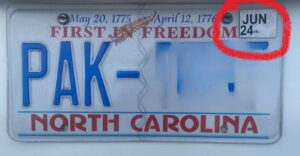 This tiny sticker on your car is a big waste of time and money
States are ditching auto decals to save millions and cut red tape.
Artificial intelligence has many Americans afraid of losing their jobs. Though these fears are understandable, it’s worth noting that some jobs would not exist in the first place were they not for senseless government regulations. A good example is the D.C. city employee at my Department of Motor Vehicles emissions inspection site whose job is to scrape off a sticker on the inside of my windshield and replace it with this year’s edition, thus proving to the outside world that I passed the inspection and paid the required fee. The city gives car owners the job of removing and replacing their vehicle registration sticker, a task which is next to impossible if they took the common anti-theft advice to score it with a razor to make it theftproof. In the digital age, are car stickers really necessary? They aren’t a requirement for other taxes. Imagine having to affix a sticker to the window of your home to signify that you’d paid your property taxes. Or being required to wear a lapel pin on April 15 as a public symbol that you’d paid your income taxes. State and local governments have been obsessed with requiring stickers and license plates on vehicles since the invention of the horseless carriage at the turn of the 20th century. New York was the first state to require registrations for automobiles in 1901. Other state and local governments began adopting registration fees, which some labeled a “privilege tax,” for the privilege of operating a vehicle. I guess that is different from the gas taxes I pay for the privilege of driving on the roads. In 1904, automakers Henry Ford and Horace Dodge sued the city of Detroit over the constitutionality of a $1 registration fee. They claimed it was double taxation because motorists had already paid a tax when they purchased the vehicle. They also said the fee was unjust because owners of horse-drawn vehicles were not required to display identification tags. An added complaint was that children under age 16 were allowed to drive carriages but not automobiles. How quaint. The court rejected their claims and said the fee was constitutional. A complicating factor in the adoption of these registrations and fees was that they were often location-specific and lacked reciprocity with other jurisdictions. In Missouri, state law required a separate registration fee for each county a car was driven in. By one account, in 1906, “the motorist who wished to drive legally in every county of Missouri had to pay $295.50 in registration fees.” The law was later changed to allow for a single statewide registration fee. As of 1910, New Jersey did not recognize New York’s auto registration, so thousands of New Yorkers who had vacation homes on the Jersey Shore had to pay a full year’s registration fee in both states. For many states, these fees were as much about generating revenue as they were about regulating motorized vehicles. The system came with costs, however. Some states sent motorists a new license plate every year, changing the color annually so that police could tell which cars were up-to-date. That practice was eventually replaced with a cheaper yearly sticker that car owners were required to affix to the license plate. By 1974, many states relied on stickers. After more than a century of managing these arcane and outdated rules, a growing number of states are going electronic and sticker-free. New Jersey was the first to ditch its vehicle decals in 2004. One cited reason was sticker theft. Connecticut followed in 2010 because technology made registration stickers unnecessary, saving the state hundreds of thousands of dollars per year. Pennsylvania stopped in 2017. A Pennsylvania State study found the change had zero effect on how many drivers stayed current on their registration, and it saved the state $1.1 million a year on tag production and another $2 million on mailing them out. This year, Idaho joined the no-registration-sticker club, saving the state about $300,000 annually. North Carolina is moving to an electronic system starting Oct. 1, eliminating printing and mailing costs that total $4.8 million annually. The anti-sticker movement hasn’t always been successful. A bill in the Minnesota House of Representatives to repeal vehicle registration stickers died in committee, as did a similar bill in the Florida legislature to eliminate the state’s yellow validation decal. Supporters said the Florida proposal could have saved taxpayers some $24 million annually. It passed the state’s House 93-17 but died in the Senate. The bill’s sponsor, state Rep. Tom Fabricio, touted its impact on modernizing the process: “It cuts the yellow tape, reduces the burden on every Floridian and brings our registration system into the 21st century.” AI may not be driving these trends, but more state lawmakers should be encouraged to recognize that car stickers and decals are an obsolete and costly vestige of an age when automobiles shared the road with horse-drawn carriages. If repealing such requirements means fewer city workers at the DMV replacing stickers by hand, well, welcome to the modern age.
Read more » click here
Editor’s note –
North Carolina does not issue physical inspection stickers, and the state is moving to an entirely digital system that eliminates physical license plate stickers starting October 1, 2026.
 Ding! Ding! Ding! The long, strange fight over your car’s seat-belt chime.
The reminders can annoy, but they also save lives. So why have regulators taken years to tighten rules for new vehicles?
David Kidd is an expert in something that some people hate and others tend to just tolerate: Seat-belt warning systems — the “ding ding ding” chimes and flashing dashboard lights that serve as reminders to buckle up. He’s spent years testing different systems in cars and trucks as part of his work at the Insurance Institute for Highway Safety. So he knows very well that the incessant chimes can be annoying. They’re “an irritant,” he admits. But he prefers a different term. “We use the word ‘motivating,’” Kidd said. The lowly seat belt is still considered the best way to avoid serious injury or death in a crash. Forget air bags, anti-lock braking systems or any other new-fangled safety technology. Unbelted occupants are roughly twice as likely to be killed in a car crash. Buckling up works. So does nagging. Kidd’s research found that belt warnings came in a variety of tones and volumes, but if they are “heard and persistent,” people respond. The seat-belt chime is such a recognizable refrain that when pop star Olivia Rodrigo needed an iconic car sound to open her hit song “Drivers License” a few years ago, she reportedly used a recording of the seat-belt beep in her mom’s car. The “buckle up” reminders were set to become even more widespread this month, when new federal safety regulations were supposed to require more persistent chimes not just for the driver’s seat but for the front passenger seat, as well. But automakers objected, saying they couldn’t be ready in time. Regulators backed down. So the new rules have been delayed for another two years — 2028 at the earliest — when some rear-seat warnings would be required, too. The National Highway Traffic Safety Administration said in a statement that it found the automakers’ worries “have merit.” Others were not convinced. “It was a bit of mystery to us why this has taken so long already. And now it’s going to take even longer,” said Peter Kurdock, general counsel for Advocates for Highway and Auto Safety, which began pushing for the new rules in 2007. “It’s disappointing,” he said. The technology is not cutting-edge. Europe has required seat-belt alarms in new vehicles since 2021. Some automakers, such as Volvo and Subaru, already have voluntarily installed them in vehicles sold in the U.S.
But the fight over the warning chimes feeds into Americans’ long-running love-hate relationship with seat belts. Seat belts are still seen by some as a question of choice and freedom. State laws and education campaigns have helped soften some of those attitudes. Today, 49 states require adults in the front to buckle up. The lone holdout is New Hampshire, which lives up to its license plate motto of “Live Free or Die.” Just 34 states plus D.C. require adults to wear seat belts in rear seats. (Children are covered by different restraining-device requirements.) Still, researchers know some people remain militant in their opposition. They’re the ones buying $6 devices and printing 3D tools to fool the alarm. They sit on top of buckled seat-belt straps. They watch online videos claiming to reveal the hidden tricks to deactivate the warning chimes. “Those that don’t like seat belts are really hardcore against buckling up,” Kurdock said. These holdouts are why U.S. seat-belt usage rates have largely flat-lined in the last decade, according to NHTSA observational studies. The unbuckled make up a minority of all vehicle occupants, but they die at a much higher rate in crashes: Roughly half of all vehicle fatalities involve unbuckled occupants. At one point, federal officials tried a much tougher tactic than just chimes. In 1974, the federal government required many cars to have ignition interlock devices that prevented a car from even starting until the front occupants were buckled up. Motorists hated it. It blew up in NHTSA’s face. “That got a lot of blowback that reached Congress,” Kidd said. The idea was quickly pulled, and Congress banned NHTSA from requiring interlocks. Lawmakers then went further and limited seat-belt warning chimes to a fleeting eight seconds. Some advocates say this is why NHTSA has seemed reluctant ever since to even tinker with seat-belt warnings. In 2007, Public Citizen and Advocates for Highway and Auto Safety petitioned NHTSA to change the belt-reminder rules and add them for rear seats. Little happened for years. In 2012, Congress passed a bill that abolished the eight-second chime limit and required federal officials to create new warning rules for seating positions besides the driver’s seat. It was a start, but a very slow one. “The chime is very important,” said Shaun Kildare, research director for the Advocates for Highway and Auto Safety. While NHTSA worked on a plan, the lack of government action created an opening for the Insurance Institute for Highway Safety, which rates vehicles on a series of safety metrics. It began rating cars and trucks on the quality of their seat-belt reminders with the 2021 model year. IIHS wants seat-belt chimes to last at least 90 seconds and be easy to hear, among other criteria. The chimes should annoy drivers enough to get them to buckle up — but not so much that they complain. “It was: Get them to wear a seat belt, but at the same time not email their congressperson to demand a change,” Kidd said. Compliance has been voluntary, but some automakers have jumped at the chance to make a good showing. IIHS saw rapid adoption, even without federal regulations, Kidd said. At first, less than 20 percent of vehicles scored IIHS’s top “good” ranking for seat-belt reminders. Five years later, 71 percent of vehicles qualified. “You’ve had a complete change in the seat belt reminders in the new vehicles,” he said. In 2025 — 13 years after Congress asked for a plan — NHTSA finally unveiled its blueprint for overhauling the nation’s seat-belt warning system. The new rules will require a chime lasting at least 30 seconds for either an unbuckled driver or front passenger when the vehicle starts up, and if they are still unbuckled when the vehicle reaches slightly faster than 6 mph, a second chime will play endlessly until the seat belt is secured. That’s the rule that was supposed to hit new vehicles on Sept. 1. A rule requiring a 30-second chime if someone unbuckled a seat belt in the rear seats was set to start in September 2027. But in April, NHTSA acquiesced to arguments from the Alliance for Automotive Innovation, an industry trade group, that the changes “require significant hardware and software changes” and would need more testing. Now, regulations for both front- and rear-seat warnings are being pushed back to September 2028. Despite the delay, automakers still “support efforts to increase seat belt use and for decades have voluntarily and proactively installed seat belt reminder systems across the vehicle fleet,” Audrey LaForest, communications director for the Alliance, said in a statement last week. Kurdock, whose group first petitioned for this change nearly 20 years ago, was in disbelief. “This is not a new technology. Seat-belt reminders have been in cars for a very long time,” he said. Kidd said he was frustrated with what he saw as an unnecessary delay. He has estimated that nearly 1,600 lives could be saved annually if all vehicles had more noticeable and persistent seat-belt warnings leading to more people buckling up. “The disappointing piece is we’ve known what to do for a long time,” he said, “but we just haven’t done it.”
Read more » click here
Storm Events
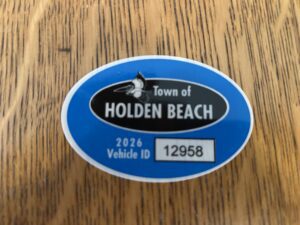 Hurricane Vehicle Decals
Property owners were provided with four (4) decals that were included in there water bill. It is important that you place your decals in your vehicle or in a safe place. A $10 fee will be assessed to anyone who needs to obtain either additional or replacement decals. Decals will not be issued in the 24-hour period before an anticipated order of evacuation.
The decals are your passes to get back onto the island to check your property in the event that an emergency would necessitate restricting access to the island. Decals must be displayed in the driver side lower left-hand corner of the windshield, where they are not obstructed by any other items. Officials must be able to clearly read the decal from outside the vehicle.
Property owners without a valid decal will not be allowed on the island during restricted access. No other method of identification is accepted in an emergency situation. Click here to visit the Town website to find out more information regarding decals and emergency situations.
NC General Statute 166A-19.22
Power of municipalities and counties to enact ordinances to deal with states of emergency.
Synopsis – The governing body may impose by declaration or enacted ordinance, prohibitions, and restrictions during a state of emergency. This includes the prohibition and restriction of movements of people in public places, including imposing a curfew; directing or compelling the voluntary or mandatory evacuation of all or part of the population, controlling ingress and egress of an emergency area, and providing for the closure of streets, roads, highways, bridges, public vehicular areas. All prohibitions and restrictions imposed by declaration or ordinance shall take effect immediately upon publication of the declaration unless the declaration sets a later time. The prohibitions and restrictions shall expire when they are terminated by the official or entity that imposed them, or when the state of emergency terminates.
Violation – Any person who violates any provisions of an ordinance or a declaration enacted or declared pursuant to this section shall be guilty of a Class 2 misdemeanor.
Hot Button Issues
Subjects that are important to people and about which they have strong opinions

Climate
For more information » click here.
There’s something happening here
What it is ain’t exactly clear

Flood Insurance Program
For more information » click here

National Flood Insurance Program: Reauthorization
Congress must periodically renew the NFIP’s statutory authority to operate. On February 3, 2026, the president signed legislation passed by Congress that extends the National Flood Insurance Program’s (NFIP’s) authorization to September 30, 2026.
Congress must now reauthorize the NFIP
by no later than 11:59 pm on September 30, 2026.

GenX
For more information » click here

Homeowners Insurance
For more information » click here
Homeowners are paying much more for insurance —
and keeping coverage is getting harder
Homeowners insurance costs are swelling rapidly for consumers — and even for those able to pay, policies are getting harder to keep as insurers drop customers at a higher rate, according to a new industry report. Average premiums for homeowners insurance rose faster than inflation across all major regions of the country from 2018 to 2024, according to a report released Wednesday by the National Association of Insurance Commissioners, a group that represents state insurance regulators. Consumers saw their average premiums rise by 18% in the Northeast, 25% in the Midwest, 27% in the Southeast and 43% in the West over that seven-year period, even after accounting for inflation, according to the report, which broke out data across four regional zones. Average premiums were highest in the Southeast, at $1,818 per year in 2024, while those in the Northeast were lowest at $1,396, NAIC said. Premiums have risen another 7% since the beginning of 2025, according to the Bureau of Labor Statistics’ producer price index. The index doesn’t necessarily reflect consumers’ out-of-pocket costs, but provides a proxy for the movement of premiums over time, according to the National Association of Realtors. The report, compiled with data from state insurance agencies, was the group’s first comprehensive data analysis of the homeowners insurance market in several years, NAIC officials said. Climate change, rising home rebuilding costs and other factors have driven up financial risk for insurers, who are passing that financial burden on to consumers, at least in part, insurance experts said. Meanwhile, the dynamic is straining homeowners amid a broader affordability crunch and a U.S. inflation rate that has been above policymakers’ target for more than five years. People’s ability to afford a home is about 10% lower than it would otherwise be if insurance costs had remained stable since the late 1990s, according to NAR. The expense disproportionately burdens low-income households, who are more likely to drop their coverage altogether — and put their house, often their largest financial asset, at risk if disaster strikes, said Peter Kochenburger, an insurance expert and a visiting professor of law at Southern University Law Center. “It’s a big problem,” Kochenburger said of rising costs for consumers. The NAIC analysis also showed that insurers are dropping customers at elevated rates, opting not to renew their policies when their terms expire. This generally happens when an insurer thinks the risk outweighs their profit potential, Kochenburger said. Nonrenewal rates per 1,000 in-force policies have increased across the country since 2018, by anywhere from 96% in the Southeast to 216% in the West, NAIC found. These nonrenewals are those initiated by insurance companies. There were 103 million homeowners insurance policies in force in the U.S. as of 2024, according to NAIC. “The data tells the story of a homeowners insurance market that is overall operationally robust but nonetheless under pressure and exhibiting signs of stress,” the report’s co-authors, Jeffrey Czajkowski and Paula Harms, wrote. “These trends support consumer sentiment that coverage is becoming more expensive and harder to find or keep in some places,” they wrote.
Why homeowners insurance costs are rising
The report’s findings broadly echo those of other analyses in recent years. The U.S. Treasury Department, for example, said in a report last year that average premiums per policy increased 8.7% faster than the rate of inflation from 2018 to 2022. A poll conducted this year by the Pew Research Center, a nonpartisan research group, found that 42% of homeowners said their costs had gone up “a lot” in recent years. Consumers generally buy homeowners insurance as a form of financial protection against unexpected physical damage to their house. Mortgage lenders also often require prospective homebuyers to buy such an insurance policy to secure a loan. If homeowners insurance becomes too pricey for consumers, there could be a “cascading or domino effect” in the U.S. economy — for example, if fewer people choose to buy homes, Kochenburger said. He said he thinks climate risk is the main driver of rising premiums. Climate change has fueled an increase in the number — and intensity — of severe weather events like wildfires, hurricanes, droughts and floods. The dynamic increases the likelihood that policyholders will need to file insurance claims and the odds that those claims will be for higher amounts, experts said. The number of weather and climate disasters that caused more than $1 billion in damage increased more than fivefold from 2018 through 2022, compared with the 1980s, after adjusting for inflation, according to the Treasury Department. “Catastrophic risk — these hurricanes, wildfire, severe convective storms, winter storms — these are events that are happening more and more frequently,” Czajkowski, director of the NAIC Center for Insurance Policy and Research, told CNBC in an interview. “And they’re impacting consumers.” The elevated risk comes as the Trump administration has moved to dismantle the federal government’s efforts to fight climate change and reduce planet-warming greenhouse gas emissions. While those natural disasters are more obvious in certain parts of the country — wildfires in the West and hurricanes in the Southeast, for example — weather-related risks are growing throughout the country, Kochenburger said. “Hail is a significant source of property damage, and that occurs in a number of states that don’t have much coastal exposure,” he said, as an example. However, factors beyond climate risk also contribute to higher insurance costs. For example, inflation has increased the cost of repairing and rebuilding homes, thereby raising the amount insurers pay out when policyholders file an insurance claim, experts said. Replacement costs for property and casualty-related losses increased by 45%, on average, between 2020 and 2023, according to the Treasury Department. Homeowners insurance is a type of property and casualty insurance. The NAIC data may even undersell the scope of the issue. For one, since the report only breaks out costs by regional zones, it’s “likely” that there are smaller, local areas where premiums have risen much faster than a particular region, according to the NAIC report. It’s also “quite possible” policyholders reduced coverage to blunt the impact of rising premiums, “which would likely show up in the data as a decrease or no change in premium,” it said. Insurers have also generally made their policies less comprehensive over the years, perhaps by removing certain risks from a general homeowners policy or reducing the dollar limits for certain coverage, Kochenburger said.
Read more » click here
Hurricane Season
For more information » click here
Hurricane season runs from June 1 through November 30
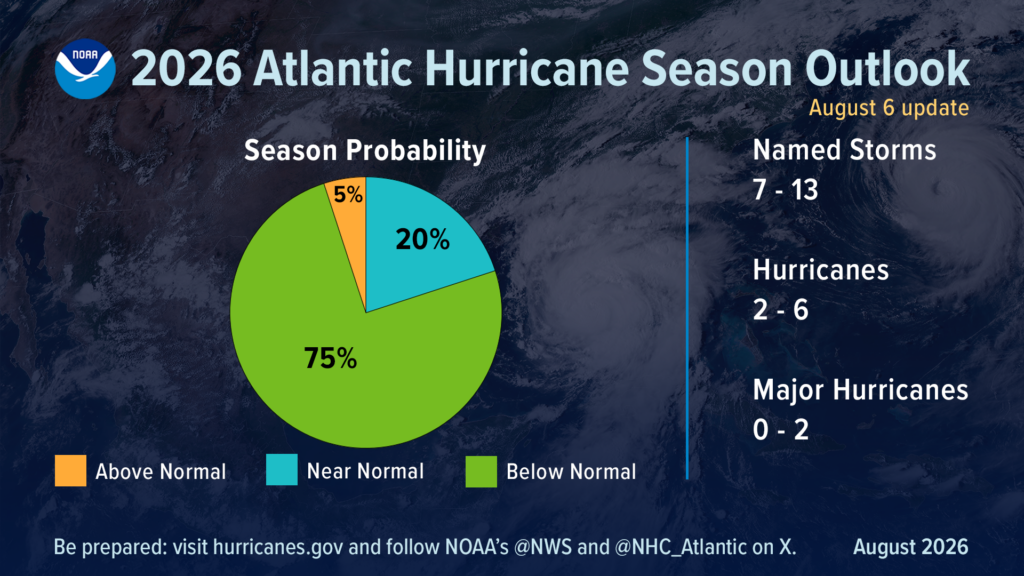
El Niño has broken Atlantic hurricanes. Now the season is breaking records
No hurricanes have formed in the Atlantic Ocean 103 days into the season, a new record-long wait driven by a beast of an El Niño strangling fledgling storms. Until today, September 11 was the date of the latest first hurricanes — Gustav (2002) and Humberto (2013). Or at least, the latest we know with confidence since 1966, when satellites started tracking hurricanes more accurately. The first hurricane is now more than a month overdue, and there are no prospects for one in the foreseeable future. Thursday marked the statistical peak of the season, and with just five short-lived tropical storms to date, it is now also the least active one since 1950, according to Phil Klotzbach, a hurricane expert with Colorado State University. The only system that made a run at becoming a hurricane was tiny Tropical Storm Edouard on September 1. Edouard was 14 mph shy of hurricane strength and intensifying when it made landfall near the Texas-Louisiana border, cutting it off from the Gulf’s warm water fuel. Looking forward, just over 50% of the entire season’s activity typically occurs after September 10, but El Niño will likely have a say in stifling the Atlantic’s final stretch this year. Last year’s first hurricane showed up in mid-August, and three more spun up in the second half of September. The United States managed to avoid a hurricane landfall last year — if the current quiet season repeats that, it’ll be the first back-to-back years without a hurricane landfall since 2009 and 2010. But it’s worth noting that hurricanes can find windows of opportunity to develop even in the most inactive years – and not a single season since 1966 has gone by without one. Most notably, Category 5 Hurricane Andrew’s catastrophic South Florida landfall in August 1992 happened in a season with just seven storms.
El Niño’s hurricane shredder
September is hurricane season’s peak because storm-fueling warm water is at its most expansive and hottest alongside ripe atmospheric factors. About two to three hurricanes develop this month on average. The results can be dangerous, as 2024’s Helene and 2022’s Ian proved, slamming the US Gulf Coast as Category 4s. Water temperatures are warm enough for hurricanes right now, but El Niño-fueled wind shear, aka tropical-system kryptonite, has soured the situation. Wind shear involves changes in wind speed and direction at different levels of the atmosphere, and it can shred apart anything from budding tropical systems to fully developed hurricanes. The shear has been record-strong this summer across the Atlantic’s so-called main development region, which extends from Africa through the Caribbean, according to Klotzbach. Many storms get their start in this region at the height of the season — mid-August to early October — but this year it’s been nearly shutdown. Tropical Storm Dolly is the only system that has formed in this part of the ocean so far in 2026, and a wall of wind shear ripped it apart just 24 hours later. A few other systems have tried to develop but were also defeated by shear. El Niño’s storm-killing winds will remain an obstacle for development in hurricane season’s back stretch, though that’s no reason to get complacent. Plus, late-season storms tend to develop closer to the US, including in the Gulf and off the Southeast coast. Those areas tend to be affected less by El Niño’s wind shear, so they’ll be watched closely. And as we’ve already learned this year, it doesn’t take a hurricane-strength system to cause significant impacts, particularly in a warming world making tropical systems wetter. Tropical Storm Arthur’s remnants fueled widespread flooding along the central Gulf Coast in June. Cottonport, Louisiana, was drenched by 29.06 inches of rain in 24 hours, which obliterated the previous state record of 22 inches set back in 1962. The record is still being reviewed and certified. Heavy rain from Tropical Storm Edouard less than two weeks ago resulted in dangerous flash flooding and water rescues in eastern Texas. A month’s worth of rain fell in an hour and rainfall totals topped 20 inches in some areas north of Beaumont.
Read more » click here
Inlet Hazard Areas
For more information » click here
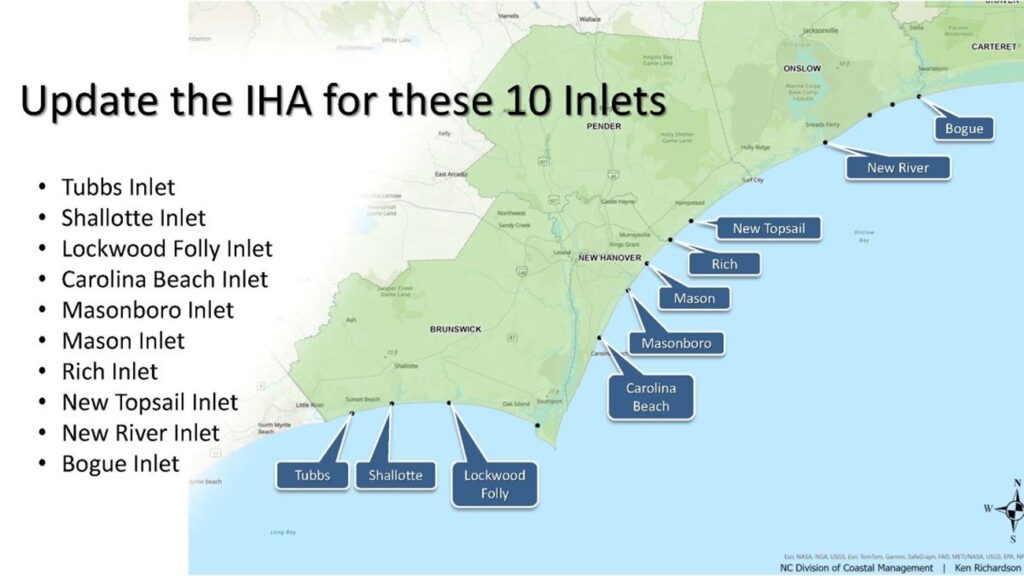
.
Lockwood Folly Inlet
For more information » click here.

Seismic Testing / Offshore Drilling
For more information » click here.

Offshore Wind Farms
For more information » click here
Things I Think I Think
 Eating out is one of the great little joys of life.
Restaurant Review:
Ratings reflect the reviewer’s reaction to food, ambience, and service, with price taken into consideration.
///// June 2026
Name: Oak & Anchor
Cuisine: American
Location: 19 Clubhouse Drive, Supply NC
Contact: 910.842.4544 / https://lockwoodfolly.com/restaurant/
Food: Average / Very Good / Excellent / Exceptional
Service: Efficient / Proficient / Professional / Expert
Ambience: Drab / Plain / Distinct / Elegant
Cost: $15 Inexpensive <=20 / Moderate <=26 / Expensive <=35 / Exorbitant <=60
Rating: Two Stars
The Oak & Anchor is located in the clubhouse of Lockwood Folly Country Club, just three miles from the Holden Beach bridge, and offers casual indoor and outdoor waterfront dining with panoramic views of the Lockwood Folly River and Intracoastal Waterway. Open to the public for breakfast and lunch daily, the restaurant also serves dinner on Tuesdays, Thursdays, and Fridays.
The Oak & Anchor is temporarily closed in October during its transition to new management.
Name: Seabird
Cuisine: Seafood
Location: 1 South Front Street, Wilmington, NC
Contact: 910.769.5996 / https://www.seabirdnc.com/
Food: Average / Very Good / Excellent / Exceptional
Service: Efficient / Proficient / Professional / Expert
Ambience: Drab / Plain / Distinct / Elegant
Cost: $32 Inexpensive <=20 / Moderate <=26 / Expensive <=35 / Exorbitant <=60
Rating: Three Stars
The seafood restaurant and oyster bar are located at the intersection of Front Street and Market Street, right in the very heart of Wilmington’s historic downtown. The restaurant is aesthetically pleasing with clean lines, there are floor to ceiling windows, which is accented by blues and white, giving the space a calming, coastal feel that is both retro and modern. Those big windows are also great for people watching at the bustling downtown intersection. Seabird celebrates the seasonality of the seafood and ingredients found in North Carolina. They have a very limited menu, divided into Small Plates with eight (8) choices and Large Plates that only offers six (6) entrée choices with no additional daily specials. They exceeded our expectations, what a delightful dining experience. I would recommend putting it on your short-list of must try restaurants.
Acclaimed Wilmington chef expands Seabird with new restaurant
More details have been announced about what’s happening at the renovation project at 9 S. Front St. in downtown Wilmington, beside Seabird restaurant. For months, award-winning Chef Dean Neff has been planning a sister restaurant. Little Bird is expected to open in early 2027. “It is really kind of an expansion of Seabird in a way,” Neff said. Little Bird will add about 2,200 square feet to Seabird’s existing 2,600, nearly doubling the footprint, according to a press release. That’s also an additional 55-60 seats in a new dining room and a separate bar room. Neff said he’s also excited about adding more kitchen and storage space. Neff said Seabird quickly reached capacity for the back-of-the-house operations, especially since they use so many fresh, local ingredients. He also said the new space will offer more options for events and new experiences. “We can’t wait to bring this historic space to life for the Wilmington community in the new year,” Neff said. After opening Seabird in 2021, Neff and his wife Lydia Clopton turned their attention to Zora’s Market and Kitchen, which launched a new menu earlier this year. Neff is also a James Beard Foundation Outstanding Chef finalist and Best Chef Southeast nominee. The renovation at Little Bird has been a project with James Goodnight, Old School Rebuilders and Smith Hanes Studio.
Read more » click here
Dining Guide – Local * Lou’s Views
Dining Guide – North * Lou’s Views
Dining Guide – South * Lou’s Views
Restaurant Reviews – North * Lou’s Views
Restaurant Reviews – South * Lou’s Views
Book Review:
Read several books from The New York Times best sellers fiction list monthly
Selection represents this month’s pick of the litter
 RANSOM by Daniel Silva
In the twenty-sixth installment of the Gabriel Allon series, the retired art restorer, assassin, and former chief of Israel’s intelligence service is pulled back into the perilous world he believed he had left behind. When a British socialite and social media star vanishes while on holiday, her billionaire husband turns to Gabriel for help. What starts as a private search for a missing woman quickly unravels into a far-reaching global conspiracy.
That’s it for this newsletter
See you next month
Lou’s Views . HBPOIN
-
-
-
-
-
-
-
-
-
- Gather and disseminate information
- Identify the issues and determine how they affect you
- Act as a watchdog
- Grass roots monthly newsletter since 2008
-
-
-
-
-
-
-
-