

Lou’s Views
News & Views / October Edition
Calendar of Events

Holiday Boat Flotilla
The flotilla is scheduled for Saturday, November 28th at 5:30 p.m. Participation is limited to 25 boats. Boaters may register at www.hbflotilla.com.
Editor’s note –
Holden Beach last held this event in December 2013.
Holden Beach Flotilla to bring Christmas lights, boats and community spirit to ICW Nov. 28
A new holiday tradition is coming to Holden Beach this November as the Holden Beach Flotilla takes to the Intracoastal Waterway on Saturday, Nov. 28. The inaugural event will feature up to 25 boats decorated in Christmas lights and holiday displays, creating a festive procession along the Holden Beach waterway. While this will be the first Holden Beach Flotilla, the event will serve as a continuation a holiday tradition that has been part of the local community for many years. The Ocean Isle Flotilla had been held for the past 21 years, and participating boaters and members of the community were saddened to learn that the event would not be returning this year. The flotilla had also served as a significant fundraiser for Brunswick Family Assistance (BFA), leaving the organization facing the loss of an important annual fundraising event. The idea to bring the flotilla to Holden Beach came from Jason Murphy, who had participated in the Ocean Isle Flotilla for the past several years. After learning that the event would not return, Murphy reached out to the Holden Beach Marina, which quickly came on board and began working to build support for the event within the community. Ashley Dyer played an important role in helping move the idea forward and build the foundation needed to make the event possible. Without Dyer’s work and the early support of the Holden Beach Marina, organizers said this announcement may not have been possible. From there, Murphy reached out to Keith Smith, who is also a Holden Beach town commissioner, and the two began working together to bring the idea to life in Holden Beach, with the support of the Marina and other community partners. Their goal was to bring the Christmas lights, boats and community spirit to Holden Beach while continuing the fundraising effort for BFA and the Brunswick County families it assists. The participating boats will begin staging just west of Sailfish Park on the Intracoastal Waterway at approximately 4:30 p.m., with a final radio check scheduled for 5:15 p.m. Then, at approximately 5:30 p.m., the festive lights will begin to glow at Sailfish Park as the flotilla gets underway. From Sailfish Park, the boats will travel along the waterway toward Provisions, continuing toward the Holden Beach Bridge and on to The Wharf Restaurant, where the flotilla will turn around and begin making its way back toward the Holden Beach Marina. With boats spaced approximately one to two minutes apart, the procession is expected to remain visible along the route for an extended period, giving spectators multiple opportunities to see the decorated boats as they make their way along the waterway. The Holden Beach Marina will serve as the final destination for the flotilla, as well as the location for judging and the awards presentation. Judges will be positioned at the marina as the boats arrive. Following the completion of the flotilla, post-flotilla activities and the awards presentation are expected to begin between approximately 7:30 and 7:45 p.m. Following the awards, the celebration will continue with after-parties at local area restaurants, giving residents and visitors an opportunity to continue the holiday festivities while supporting local businesses. While the Holden Beach Flotilla is designed first and foremost as a night of fun, Christmas excitement and community celebration, it also has a charitable purpose. Proceeds from the event will benefit Brunswick Family Assistance, a local nonprofit organization that helps Brunswick County families experiencing times of need. “We want this to be something families look forward to every year,” organizers said. “It’s about seeing the boats, enjoying the Christmas lights, bringing people together and having a great time — but it’s also about giving back to our community and helping our neighbors.”
Registration and sponsorship
Boat registration is now open. Boaters can register through the event website at www.hbflotilla.com. Registration forms can also be requested by email or text using the contact information below. The flotilla is limited to 25 participating boats, with entries being accepted on a first-come, first-served basis. Once all 25 spots are filled, registration will close. Sponsorship opportunities are also filling quickly. Sponsorships are anticipated to remain open through Oct. 28, or until available sponsorship spots are filled. Sponsorship opportunities are also first come, first served. Businesses and organizations interested in supporting the event are encouraged to contact the organizers as soon as possible. The event is being supported by local sponsors and community partners, with additional details about participating boats, sponsors, viewing opportunities and restaurant after-parties to be announced as the event approaches. For safety on the water, the Holden Beach Police Department will lead the flotilla, with Sea Tow following the procession to assist with any issues involving participating vessels. Spectators are encouraged to find locations along the route where they can safely watch the boats pass. More information about viewing locations and event details will be released as plans are finalized.
Read more » click here
 Discover a wide range of things to do in the Brunswick Islands for an experience that goes beyond the beach.
For more information » click here.
Calendar of Events Island
 Contractors Information Seminar
The Planning & Inspections Department, supported by the town staff, will be hosting the fifteenth annual Contractors Information Seminar on Thursday, November 5th. Contractors and electricians will earn two hours of continuing education credits. Don’t miss this FREE educational opportunity.
 Veterans Appreciation Luncheon
The Town of Holden Beach will hold its Veterans Appreciation Luncheon on Friday, November 6th. The event will be held at 11:30 a.m. in the Town Hall Public Assembly Room. Please RSVP by emailing Christy at christy.ferguson@hbtownhall.com prior to Thursday, October 29th with your name and the name of your guest.
 SBI Three Bridge Tour
The South Brunswick Islands Rotary Club SBI Three Bridge Tour is set to take place on Saturday, November 7th, in Ocean Isle Beach, North Carolina. This event offers a unique opportunity for cyclists to ride across the three bridges of Sunset Beach, Ocean Isle Beach, and Holden Beach. Participants can choose from various ride options, including family-friendly routes and more challenging distances, ensuring a memorable experience for everyone. The tour supports local and international Rotary projects, enriching the lives of children and youth in Brunswick County. Proceeds from the event will be used to fund these projects, providing experiences and learning opportunities that will benefit the community.
For more information » click here
 Turkey Trot
The Town of Holden Beach will hold its annual Turkey Trot on Thanksgiving morning Thursday, November 26th at 8:00 a.m. All individuals interested in participating should call 910.842.6488 to register. Please bring a canned food item to donate to the local food pantry.
 Tree Lighting
The Town of Holden Beach will hold its annual tree lighting ceremony on Thursday, December 3rd at 6:00 p.m.
Parks & Recreation / Programs & Events
For more information » click here
Reminders
Smoke Detectors
Time change means time to check smoke detectors, too. The fire department is encouraging people to test their smoke alarms and change the battery. Smoke alarms should be replaced every 10 years, whether they are battery-operated or hard-wired.
 Brunswick County Rescinds Stage One Water Conservation
PUBLIC NOTICE
Brunswick County Public Utilities is rescinding its Stage 1 Voluntary Water Conservation Alert effective Friday, Oct. 16, 2026. This notice does not apply to properties that use water sources outside of the County’s public water system (i.e., private groundwater wells, retention ponds, and Brunswick Regional – H2GO). H2GO customers should check their website for information about any water conservation or best practices they may have issued for their customers: https://www.h2gonc.gov/. This conservation alert was originally issued Aug. 31, 2026. Recent rainfall, improving drought conditions, and the public’s efforts to use water wisely have helped even out demands for water from Brunswick County’s available production and distribution capacity. Brunswick County appreciates the efforts our water customers took to follow our mandatory and voluntary water restrictions while Extreme Drought (D3) and Exceptional Drought (D4) conditions affected our county this summer.
 THB Police Newsletter (10/15/26)
 THB Police Newsletter
Reminders
October brings cooler weather, the Festival by the Sea, and more fall activities to Holden Beach. HBPD reminds everyone to keep safety in mind.
Festival by the Sea
Expect increased vehicle and pedestrian traffic. Slow down, stay alert, and follow directions from officers and event personnel.
Lock it Up
Lock vehicles, remove keys and valuables, and secure bicycles, golf carts, garages, and outdoor property. Don’t provide an easy opportunity for crime.
Leaving for the Season?
Secure doors, windows, and outdoor items. Consider having someone periodically check your property.
Halloween
Drivers, watch for pedestrians and slow down. Parents and children, stay visible and use extra caution around roadways.
Holden Beach Police Department
Community • Safety • Service
The seasons may change, but our commitment to Holden Beach does not.
If you see us out on patrol, stop and say hello!
Stay safe and enjoy October at Holden Beach!
Pets on the Beach Strand
§90.20 RESPONSIBILITIES OF OWNERS
Effective September 10th
-
-
- Pets are allowed on the beach strand
- Dog’s need to be on a leash
- Owner’s need to clean up after their animals
-
 News from Town of Holden Beach
The town sends out emails of events, news, agendas, notifications, and emergency information. If you would like to be added to their mailing list, please go to their web site to complete your subscription to the Holden Beach E-Newsletter.
For more information » click here
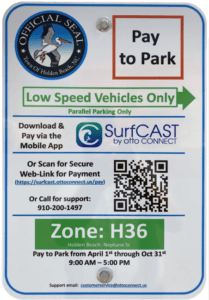 Paid Parking
Paid parking in Holden Beach
Paid parking will be enforced from 9:00 a.m. to 5:00 p.m. daily with free parking before and after that time. All parking will use license plates for verification.
Rates
Parking rates for a single vehicle in all designated areas will be:
$5 per hour for up to four hours
$20 per day for any duration greater than four hours
$80 per week for seven consecutive days
Handicap Parking
A vehicle displaying a handicap license plate and/or hang tag parked in a designated handicap space is free. Any other parking space will require a parking permit via the app.
Annual Passes
Annual permits for the calendar year allow vehicles (this includes low-speed vehicles and trailers) access to designated parking.
$175 for a single vehicle
Passes can be purchased via the app, website or by telephone.
Where to Park
Per ordinance, there is no parking on the streets or rights-of-way except in designated parking spaces identified by Pay-to-Park signs. Click here to view an interactive map. The table with authorized parking can be viewed below.
Citations will be issued for:
-
-
- Parking without an active paid permit in a designated parking area
- Parking within 40 feet of a street intersection
- Parking in a crosswalk, sidewalk, or pedestrian access ways
- Parking blocking a driveway or mailbox
- Parking facing opposing traffic
- Parking in a no parking zone, or within right-of-way
- Parking on any portion of the roadway or travel lane
- Parking a non-LSV vehicle in an authorized LSV location
-
How Do I Pay to Park
The Town uses the SurfCAST by Otto Connect Mobile Solution. This is a mobile app downloadable for Apple and Android devices. Download the app today. Users will setup their account, enter their license plate details and pay for parking directly on the app. Alternatively, users can scan the QR Code located on the parking signs to access a secure website.
The Otto Connect customer service team will be available to help via phone and email.
THB Newsletter (06/18/26)
OttoView by Otto Connect
Just in time for peak beach season, Otto Connect, Inc. has launched a new feature designed to make parking along the coast easier and less stressful for visitors and residents alike. “OttoView by Otto Connect,” is part of the SurfCAST parking system and allows users to check parking availability in real time before heading to the beach. The feature is now available in Holden Beach. For many drivers, finding parking during busy summer weekends can be one of the most frustrating parts of a beach trip. OttoView aims to reduce congestion and save time by showing which lots have open spaces—and which do not—before users arrive. “Instead of circling for a spot, people can now see their options ahead of time and go directly to available parking,” Jim Varner (CEO) said in a statement.
Know before you go:
OttoView can be accessed through the SurfCAST website
(https://park.surfcast.ottoconnect.us/), the QRcode link, and will be available soon via mobile app update (“SurfCAST by Otto”) making it easy for visitors to plan from home or on the go.
What OttoView Shows:
-
- A map of the area and locations of all parking lots
- Real-time parking availability by location
- Estimated availability based on permit turnover
- Directions to nearby parking areas
- Filters for amenities such as restrooms, handicap spaces, and LSV parking
OttoView is fully integrated into the SurfCAST system and is available at no additional cost.
For more information, visit https://www.ottoconnect.us.
Solid Waste Pickup Schedule
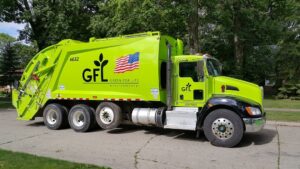
GFL Environmental change in service, the Saturday before Memorial Day till the end of September, trash pickup will be twice a week.
Please note:
Trash carts must be at the street by 6:00 a.m. on the pickup day
BAG the trash before putting it in the cart
Carts will be rolled back to the front of the house
GFL Refuse Collection Policy
GFL has recently notified all Brunswick County residents that they will no longer accept extra bags of refuse outside of the collection cart. This is not a new policy but is stricter enforcement of an existing policy. While in the past GFL drivers would at times make exceptions and take additional bags of refuse, the tremendous growth in housing within Brunswick County makes this practice cost prohibitive and causes drivers to fall behind schedule.
Solid Waste Pickup Schedule
starting October once a week
Recycling
starting October every other week pick-up
Yard Waste Service
Yard debris is collected on the second (2nd) and fourth (4th) Fridays during the months of October, November, and December.Yard debris needs to be secured in a biodegradable bag (not plastic) or bundled in a maximum length not to exceed five (5) feet and fifty (50) pounds in weight. Each residence is allowed a total of ten (10) items, which can include a combination of bundles of brush and limbs meeting the required length and weight and/ or biodegradable bags. Picks-ups are not provided for vacant lots or construction sites.
Curbside Recycling – 2026
GFL Environmental is now offering curbside recycling for Town properties that desire to participate in the service. The service cost per cart is $122.93 annually paid in advance to the Town of Holden Beach. The service consists of a ninety-six (96) gallon cart that is emptied every other week during the months of October – May and weekly during the months of June – September.
Curbside Recycling Application » click here
Curbside Recycling Calendar » click here
Trash Can Requirements – Rental Properties
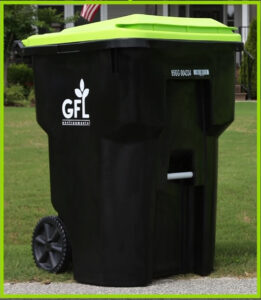
GFL Environmental – trash can requirements
Ordinance 07-13, Section 50.08
Rental properties have specific number of trashcans based on number of bedrooms.
* One extra trash can per every 2 bedrooms
..
§ 50.08 RENTAL HOMES.
(A) Rental homes, as defined in Chapter 157, that are rented as part of the summer rental season, are subject to high numbers of guests, resulting in abnormally large volumes of trash. This type of occupancy use presents a significantly higher impact than homes not used for summer rentals. In interest of public health and sanitation and environmental concerns, all rental home shall have a minimum of one trash can per two bedrooms. Homes with an odd number of bedrooms shall round up (for examples one to two bedrooms – one trash can; three to four bedrooms – two trash cans; five – six bedrooms – three trash cans, and the like).
Upon Further Review

A Second Helping since 2005
For the last fifteen (15) weeks they have collected food on Saturday mornings in front of Beach Mart; the food is distributed to the needy in Brunswick County. During this summer season, they collected 10,028 pounds of food and $1,755 in monetary donations. Their food collections have now exceeded three hundred and seventeen thousand (327,000) pounds of food since this program began in June of 2005. Hunger exists everywhere in this country. Thanks to the Holden Beach vacationers for donating again this year! Cash donations are gratefully accepted. One hundred percent (100%) of these cash donations are used to buy more food. You can be assured that the money will be very well spent.
Mail Donations to:
A Second Helping
% Sharon United Methodist Church
2030 Holden Beach Road
Supply, NC 28462
 ReadyBrunswick Emergency Notifications Alerts
Brunswick County uses ReadyBrunswick as part of the County’s effort to continuously improve communications during emergency situations within our area. Powered by Everbridge, the ReadyBrunswick notification system sends emergency notifications in a variety of communication methods such as:
-
-
-
- Landline (Voice)
- VoIP (Voice over Internet Protocol)
- Mobile (Voice)
- Mobile SMS (Text Messaging)
-
-
In the case of an emergency, you may choose to receive notifications via one or all of these communication methods. It’s recommended that you register several media options to receive messages in the event a particular communication device is unavailable.
For more information » click here
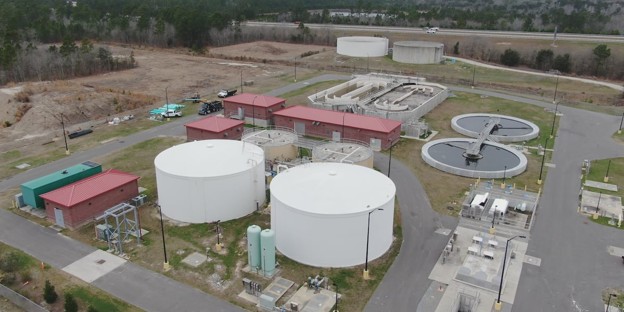
Brunswick County facing hundreds of millions in wastewater expansion costs
As North Carolina’s fastest-growing county continues to expand, Brunswick County leaders are discussing how to increase wastewater treatment capacity, an investment that will likely cost more than half a billion dollars. Earlier this month, Brunswick County Public Utilities Director John Nichols presented county commissioners with several expansion options. Between expected construction on the county’s Navassa treatment plant, slated to start mid-next year, and expansion plans for the Supply and Shallotte plants, Nichols said costs could exceed $700 million. “It’s challenging because we are growing fast,” Nichols said, explaining the importance of addressing the issue. “It determines how development in Brunswick County occurs. So the policy will provide a plan for the strategy behind that development.” The project in Navassa should cost roughly $173 million (split between the county and H2GO) and increase the plant’s capacity by 3.75 MGD from its current capacity of 4.975 MGD. The Supply and Shallotte projects, meanwhile, would likely cost between $440 and $550 million in total, Nichols said Tuesday. Those two projects are still at least three years away from construction, he said. The total cost of the latter two projects would depend on how much capacity is added to the plants. According to the presentation given to commissioners, Supply and Shallotte expansion options range from adding 5-14 MGD. Earlier this year, sewer capacity issues temporarily halted new construction projects in Brunswick County that required sewer line extensions. Senate Bill 673 requires the state to count anticipated wastewater from future homes as already present in the system. Under that calculation, Brunswick County’s wastewater treatment plants were considered over-allotted in the state’s accounting — even though the pipes are not full. The state freeze on issuing new sewer permits started in October 2025, but ended in May 2026, a county spokesperson confirmed Tuesday. The freeze ended after NCDEQ allowed new projects to move forward “with an added variance process,” the spokesperson said. Commissioners will continue discussing how to address the issue at upcoming meetings. Nichols said staff plan to update commissioners with a draft plan at a meeting before the end of the year. Commissioners will also discuss sunset provisions on projects that haven’t made significant progress from approval, which could give the county more space when looking at capacity limits. On Tuesday, Commissioner Pat Sykes said it’s important for the county to keep up infrastructure-wise with development as projects continue popping up. “The issue needs to be tackled immediately,” Sykes said. “It’s always important, whether it’s sewer, water, roads, it’s always important to stay ahead of the growth. But we are behind.”
Read more » click here
Corrections & Amplifications

Revaluation
PUBLIC NOTICE
Over the coming months, Brunswick County will be sharing information and reminders about the county’s latest revaluation, which goes into effect at the start of calendar year 2027. Property owners are expected to receive a notice showing their updated 2027 property value by the end of March 2027. A revaluation (also known as a reappraisal) is a routine update to property tax values to bring them back in line with the current sale price of properties. Our state certified in-house appraisers have diligently and carefully researched and analyzed sales in our local market to determine an estimate of market value for all properties as required by North Carolina law. Below are some of the key reminders to keep in mind as we work toward finalizing assessed values, as well as some upcoming dates when the Board of Commissioners will discuss and/or take possible action on items related to the 2027 Revaluation process. The Brunswick County Tax Office also has a robust website featuring full details and answers to questions about the 2027 Revaluation at https://brunswickcountync.gov/448/2027-Revaluation.
Upcoming Dates
Note: Some dates or time periods for certain processes like the appeal period and 2027 property tax bill mailings are still to be determined and may not be listed here yet. Brunswick County will provide information on any updates or changes to dates or time periods as they become available.
-
- Monday, Oct. 5, 2026, at 3 p.m.: Schedule of Values introduced at Board of Commissioners meeting (The schedule will be available in the agenda packet and can be viewed after this date in person at the Clerk to the Board’s Office, or online at https://brunswickcountync.gov/448/2027-Revaluation.
- Monday, Oct. 19, 2026, at 6 p.m.: Public Hearing for Schedule of Values During Board of Commissioners Meeting
- Monday, Nov. 2, 2026, at 3 p.m.: Board of Commissioners Consider Adoption of Schedule of Values (A possible second public hearing (if desired/necessary) could take place during this meeting)
- Friday, Jan.1, 2027: 2027 Revaluation Effective Date (All real property will be valued based on its market value and condition as of Jan. 1, 2027)
- February/March 2027: Property Owners Receive Notice Showing Updated 2027 Property Value
Important Reminders
Often when we hear about revaluation, we immediately think about property taxes. However, the purpose of a revaluation is to determine a property’s current market value to ensure everyone pays their fair share of the costs for the local government services they use and rely on. Your property taxes help your County, municipality, school district, and/or other public entities provide essential services like education, public safety, ambulance service, fire protection, health clinics and inspections, parks, libraries, planning and community enforcement, municipal roads, and more. Ultimately, your property’s appraised value is only one factor that determines how much property tax you pay.
Here are some things to keep in mind as you prepare to receive your new assessed value in 2027:
-
- An increase in your property value does not necessarily mean your next tax bill will increase.
- It is currently impossible to determine how your new assessed value affects your property taxes until the County, your municipal government, and/or other public entities that serve your property adopt their FY 2028 operating budgets and set tax rates. This is most likely to occur in late spring or early summer 2027.
- The 2027 Revaluation is still not complete, so be cautious of any claims about how much property values or taxes are increasing, whether by dollars or percentage. Wait for your official mailing from Brunswick County to see what your property’s new assessed value is (estimated to arrive February or March 2027).
- Market value is set by the choices of buyers and sellers in the marketplace. The Brunswick County Tax Office does not create market value. Your local tax office analyzes market sales to determine market patterns and trends in different locations across the county.
- Property values will not change uniformly throughout the county or even within your city or town—a lot depends on market conditions and recent sales in your neighborhood. Your assessed value could increase, decrease, or remain the same.
Contacting the Tax Office
The Brunswick County Tax Office is open to discussing the revaluation process with property owners. You are encouraged to check our website first to see if the answers to your questions are available online. Our Tax team is available Monday through Friday from 8:30 a.m. to 5 p.m.
When contacting our office, please have your parcel number or property address available.
-
- Website: https://brunswickcountync.gov/447/Tax-Office
- Phone: 910.253.2829
- Email: taxreval@brunswickcountync.gov
- Main Office: Brunswick County Sandifer Administration Building, 30 Government Center Drive, Bolivia, NC 28422
Ocean Isle Beach Terminal Groin
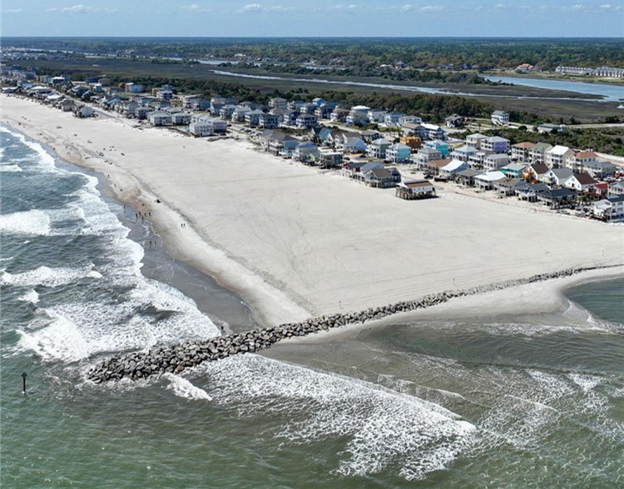 Ocean Isle Beach completed construction of a terminal groin on its east end in April 2022 to help protect the beach immediately behind it. However, this structure has contributed to significant erosion at the east end near Shallotte Inlet by interrupting natural longshore drift, prompting ongoing efforts such as sandbag use to prevent ocean encroachment on properties in that area.
2024 OIB SHORELINE AND INLET ANNUAL MONITORING REPORT
On Holden Beach, the recent volume change rates (May 2024 to November 2024) along the oceanfront shoreline indicated erosion at 12 of the 21 monitoring stations. Similarly, the MHW shoreline change rates indicated a shoreline retreat at 15 of the 21 monitoring stations. The long-term post-construction linear shoreline changes along the Holden Beach oceanfront shoreline indicated landward retreat. However, volumetric changes indicated slight accretion (0.2 cy/ft./yr.) within this area over the long-term period. The shoreline threshold analysis results along the Holden Beach oceanfront shoreline show that the post-construction shoreline change threshold was exceeded at only one monitoring station. This is the first time a threshold has been exceeded at Holden Beach since this annual analysis started in 2022. In addition, the analysis of May 2024 aerial imagery-derived wet/dry line revealed an 885 ft. section of Holden Beach’s inlet shoreline that exceeded the inlet shoreline threshold by a maximum distance of 100 feet. The inlet shoreline threshold on Holden Beach was also exceeded in Year-2. This marks two straight years where this threshold was exceeded. The inlet shoreline recession is believed to likely be attributed to a combination of morphological changes within Shallotte Inlet including the position and orientation of the main channel through Shallotte Inlet and the formation of a flood channel on the inlet shoulder of Holden Beach. Regardless, as stated in the Plan, because the shoreline changes in this area exceeded the threshold over the entire 2-year confirmation period, an assessment of the proper responsive measures will be made through coordination with State and Federal regulatory officials.
 East End/Terminal Groin Short Term Mitigation
As required by State and Federal permits associated with the Town’s Shoreline and Inlet Management Plan, annual shoreline monitoring identified erosion east of the terminal groin that exceeded established management thresholds. To maintain permit compliance and address localized erosion concerns, the Town implemented a short-term mitigation project consisting of targeted beach nourishment east of the terminal groin.
Project Update
-
- Project completed: May 24, 2026
- Sand placed: Approximately 45,000 c/y
- Engineer: Coastal Protection Engineering
- Contractor: Southwind Construction
- Total project cost: $667,696.61
This project, along with the US Army Corps of Engineers – Shallotte Inlet Crossing & Widener Project, placed 70,000 cy of sand east of the terminal groin with another 35,000 cy west of the terminal groin. With this short-term mitigation measure in place, the Town has engaged with Coastal Protection Engineering (CPE) to investigate long-term mitigation plans to prevent any further erosion adjacent to the terminal groin.
CRC meets amid debate over NC’s hardened shoreline structures ban
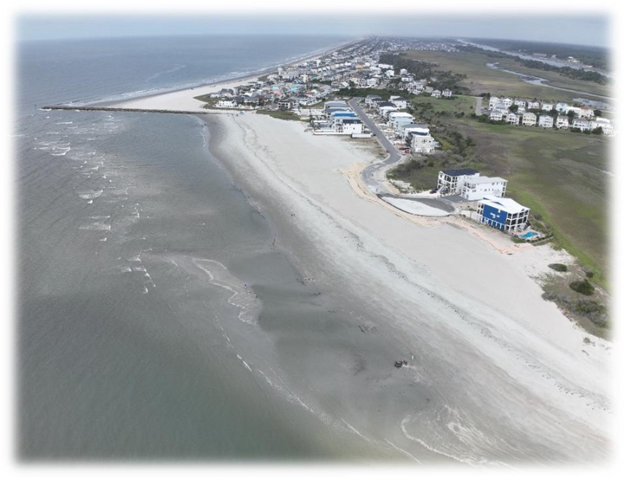
The debate over whether to repeal or amend the state’s ban on hardened structures for shoreline protection resumes this week when the North Carolina Coastal Resources Commission (CRC) meets on Aug. 26 and 27 at the Dare County Government Complex in Manteo. A major catalyst behind the effort to re-examine the ban is the crisis in Buxton, where 32 privately owned oceanfront houses have fallen into the ocean since 2020—with 20 of them collapsing since September 2025, generating national headlines. According to the meeting agenda, the CRC will hear a report from its Science Panel on hardened oceanfront structures. On June 18, the panel presented a 47-page report recommending that the state “maintain a cautious approach to any expansion of the use of hardened structures along its sandy, open-ocean coastline.” It also advised that before changing its oceanfront management policies, the state should “include a broad assessment of the benefits, costs, limitations and distribution of effects” arising from an expanded use of hardened structures. The Outer Banks Voice – CRC panel report recommends ‘cautious approach’ to use of hardened structures. In 1985, the CRC banned hardened structures through regulatory action, followed 15 years later by a ban approved by the state legislature, unless a groin was less than 50 percent damaged. Along with its Buxton beach nourishment project this summer, Dare County is also conducting an $8.6 million project to repair the Buxton terminal groin, work allowed under the state exemption. More Beach to Love | Dare County, NC. In the past year, there has also been a flurry of advocacy to revise or repeal the hardened structure ban coming from Outer Banks communities and officials. In October 2025, the Buxton Civic Association asked residents to contact state officials to lobby for an “immediate exclusion of CAMAs hardened structures law” for Buxton. A month later, Dare County Commissioner Chair Bob Woodard sent a letter to North Carolina legislators asking them to take action to combat coastal erosion, a request that included reconsidering the ban on hardened structures. In May 2026, the Currituck County Commissioners approved a resolution supporting state legislative efforts—NC Senate Bill 1009—to repeal the hardened structures ban. The resolution noted that “North Carolina is one of the only U.S. coastal states with a long-standing ban on hardened structure.” That ban, it added, leaves beach nourishment, which the resolution characterizes as “a costly and temporary solution to erosion…as one of the only tools available to counties to combat coastal erosion.” A committee of the North Carolina Senate approved that legislation to repeal the ban in June. Senate Bill 1009 (2025-2026 Session) – North Carolina General Assembly. Asked about the repeal of the hardened structures ban during a visit to the Outer Banks in late June, Governor Josh Stein said solutions to beach erosion need “to be based in science. There [are] clear emotions that are flying here…We want people’s homes to be preserved. But we have to do it in a way that will make long-term success possible.”
Read more » click here
Odds & Ends
August Ties the Record for Earth’s Hottest Month on the Books
Sweltering summer temperatures put last month on par with July 2023 for global warmth, scientists said. More records could be broken in the months ahead.
Last month tied July 2023 as the planet’s hottest month on record, European scientists said on Thursday, as human-caused warming pushes the Northern Hemisphere’s muggiest, most uncomfortable time of year into new realms of stickiness and discomfort. Dangerous heat hammered Europe for the fifth time since May. Temperatures soared into the triple digits across the southern United States from California to Texas. South Korea recorded its highest temperature reading in modern history: 108.5 degrees Fahrenheit in the southern city of Yangsan on Aug. 2. August tied the record for the oceans’ hottest month in history as well, scientists said, as El Niño conditions caused warm water to accumulate at the surface of the tropical Pacific. This extra warmth will spread to the rest of the planet in the months ahead, making the globe’s average temperatures likely to break more records through the end of the year and into 2027. “These observations show how climate change is driving extremes across both the atmosphere and the oceans,” said Samantha Burgess, a climate scientist at Copernicus, the European Union’s climate monitoring service, which published the analysis of August temperatures. “The impacts of these conditions are increasingly being felt by communities, economies and ecosystems across the world.” August’s sweltering temperatures capped the warmest summer on record for both Western Europe and the contiguous United States. Across the lower 48 states, the average temperature last month was 75.6 degrees Fahrenheit, the highest on record for August and 3.5 degrees Fahrenheit above the 20th-century average, the National Oceanic and Atmospheric Administration said on Wednesday. Summer in the Northern Hemisphere is also the warmest time of year for the planet as a whole. The reason is that the sun’s energy heats the air above land more than it does the air above water, and most of Earth’s land lies north of the Equator. According to Copernicus, the average air temperature at the planet’s surface last month was 1.65 degrees Celsius, or roughly three degrees Fahrenheit, higher than it was at the start of the industrial age, when large-scale burning of fossil fuels began raising global temperatures. That made August the first month since last November when global warming exceeded 1.5 degrees Celsius, an important number in humanity’s efforts to curb climate change. More than a decade ago, nearly all nations agreed at a global summit in Paris to try to keep global warming “well below” two degrees Celsius and, ideally, to limit it to 1.5 degrees Celsius above preindustrial levels. In a report last week, the United Nations declared that the world would not achieve that second, more ambitious goal and predicted that, within the next few years, average global warming would surpass 1.5 degrees Celsius. By 2100, warming could peak at 1.8 degrees Celsius if governments are highly successful at slowing warming, or at 2.6 degrees Celsius or higher if they aren’t, the report said. The goal now, the U.N. report said, should be to bring temperatures back down as quickly as possible, both by slashing greenhouse gas emissions and by developing novel technologies to draw carbon dioxide out of the atmosphere. The world also needs to learn to cope more effectively with the elevated risks of intense hot spells, downpours, wildfires and coastal floods that a warmer planet has created, the U.N. said. “This is the spiraling price of humanity’s fossil fuel addiction, and the global climate crisis it is fueling,” said Simon Stiell, the head of the U.N. entity that supports the international response to climate change.
Read more » click here
The US just had its hottest summer on record, beating the Dust Bowl era
The United States just had its hottest summer in 132 years of recordkeeping, soundly beating the summer of 1936 — during the Dust Bowl era — as well as the summer of 2021, according to data released Wednesday by the National Oceanic and Atmospheric Administration. Previously, those two years had tied for the hottest summer. The Dust Bowl summer of 1936 has been long been regarded as the benchmark of hottest summers in the US but has now been equaled or eclipsed twice in the past five years thanks to the influence of human-caused climate change. August 2026 and the June-through-August period both set all-time records, and July was the hottest month of any month on record in the US. The difference between the new and old seasonal records was 0.4 degrees Fahrenheit, which is relatively large for an all-time temperature record. Summer featured widespread above-average temperatures across the Lower 48 states, with well-above-normal nighttime low temperatures throughout the country — largely driven by a series of powerful heat domes that affected nearly every state besides Alaska and Hawaii. The average temperature during August in the Lower 48 states was 75.6 degrees Fahrenheit, which was 3.5 degrees above the 20th century average. The average for meteorological summer — from June through August — was 74.4 degrees, which was 3 degrees above average. Record-breaking heat was especially present across the Southwest, with Arizona, New Mexico, Utah and Colorado each setting records for their warmest summer. The searing season only exacerbated the Colorado River water crisis. One sign of how incredibly hot the summer was can be seen in the balance of record highs to record lows. There were a staggering 1,541 record monthly highs set or tied nationally, compared to just 87 monthly record lows set or tied. In a climate that was not rapidly warming, one would expect the ratio of records to be closer to even. The summer temperature record comes amid a strengthening El Niño in the tropical Pacific, along with the growing effects of long-term climate change. Climate change in particular is leading to more intense, frequent and long-lasting heat waves, while El Niño is further increasing global average temperatures. According to NOAA data, the months of June through August in the US have warmed by about 0.46 degrees Fahrenheit per decade since 1970.
Read more » click here
This and That
Brunswick County and DuPont Chemours Settlement
Brunswick County announced today that The Chemours Company, along with Dupont and Corteva, have officially entered into a $95 million settlement agreement, marking a major milestone in the County’s efforts to receive compensation for major capital investments necessary to remove per- and polyfluoroalkyl substances (PFAS) from the County’s main source of drinking water. Brunswick County’s settlement is part of a $590 million group settlement agreement, Brunswick County v. DowDuPont, Inc. et. al. (Chemours), which includes the State of Noth Carolina and 10 other local entities in the state. “It’s been a long time coming, but we are proud to stand up for our County and demand what is due for our community,” Brunswick County Chairman Mike Forte said. “We commend all our staff, legal counsel, local leaders, and partner agencies for their tremendous work over the years to ensure that Brunswick County received recognition and compensation for the costly infrastructure improvements we have had to make to combat the PFAS issue in the Cape Fear River.” Of the total $590 million of the settlement, $380 million will go to local entities and $75 million to the State. The remaining $135 million will go to a reserve fund connected to the N.C. Department of Environmental Quality’s 2019 Consent Order to ensure that Chemours or DuPont will continue mandated PFAS cleanup efforts in the Cape Fear River. The finalization of the agreement marks the end of nearly nine years of litigation against Chemours and DuPont. Brunswick County will receive payments over the course of the next eight years. The settlement is front loaded with the County receiving slightly over $24 million in each of the first three years.

Why deer-car collisions are rising in the Wilmington area, and November is the worst month
As development pushes out from Wilmington, deer-vehicle collisions are on the rise. But the number of deer also appears to be increasing as they adapt and hunting becomes more difficult in many areas
Billy Sampson said he didn’t see much before the collision. The sun had just set as he drove on Sidbury Road in northern New Hanover County headed home from work in November 2024. Just a streak crossing the road before the crash, and then a young doe sitting on his cracked windshield, her neck broken. “You just don’t have time to react,” Sampson said. “It happens before you know it.” Luckily, the damage to Sampson’s car was minimal, and he escaped the incident with only frayed nerves. But deer-vehicle collisions are an increasingly common occurrence in the Wilmington area as the region continues to boom. With subdivisions popping up in formerly off-the-beaten-track areas, deer and human interaction are rising. And with white-tailed deer among the most adaptable of all large animals in North America, in many areas their number are increasing just as the number of residents around the Cape Fear coast and other fast-growing parts of the Tar Heel State continue to rise. The result is an increase in deer-vehicle collisions on area roads after a slight downturn during the COVID-19 pandemic shutdown due to the reduction in traveling. With November the most common month for collisions, here’s a look at why drivers might want to pay a bit more attention out driving over the next few weeks and why this could be a troublesome situation that’s here to stay.
By the numbers
According to the N.C. Department of Transportation’s latest animal-related crash report, which tracked animal-vehicle collisions stretching back to 2017, last year showed a rising trend of incidents. Brunswick County saw the highest number of collisions in the Wilmington area, with 1,422 between 2022-24, ranking ninth in the state. Pender County saw 1,103 crashes over the same three-year period. The damage caused by the 2022-24 collisions was valued at $4.6 million in Brunswick and $3.4 million in Pender, with 39 total injures in Brunswick and 49 − including one fatal − in Pender. Fast-growing Wake County, home to Raleigh and Cary, saw the most animal crashes out of North Carolina’s 100 counties in the 2022-24 period, recording 2,676. Although state collision report forms don’t distinguish between animal types, data analyses shows that approximately 90% of all reported animal related crashes involve deer. In all three counties, 2024 saw the highest number of crashes − a trend that’s been increasing since 2020. While that’s partly due to the COVID-19 pandemic-related restrictions earlier this decade, which severely curtailed people’s traveling, the figures also likely reflect the tremendous population growth the three counties have seen in recent years. Brunswick County, for example, has seen it’s population jump from roughly 136,000 in 2020 to an estimated 175,000 in 2025. Due to its relatively small size and largely urban nature, deer-vehicle collisions in New Hanover County aren’t as high as larger counties, but are still a worry − especially as development pushes into the undeveloped northern parts of the county. According to the DOT report, New Hanover saw 86 collisions in 2024, and 250 in the 2022-24 window. That ranked 73rd in the state.
When are collisions most common?
According to the DOT report, the most collisions, 23% of the 63,487 recorded statewide 2022-24, occurred in November. Officials say a “perfect storm” of factors is to blame for this. They include November representing the height of the deer-mating season, which sees the animals on the move more than normal. Bucks especially can act erratically and with less caution as they chase does. Throw in Daylight Saving Time, which sees the clocks moved back in early November and means shorter days and more darkness during peak travel times, and it’s harder for drivers to see deer just when they are most active. According to the DOT, tips to help lower the chance of an animal collision include slowing down in areas known to be frequented by deer; driving with high beams on as much as possible; slow down and blow your horn if you see deer on the side of the road; and keep a safe distance between vehicles to help prevent you from becoming collateral damage if the car in front of you strikes a deer. After November, the three months that saw the most deer-car collisions were October (14.6%), December (12.9%) and January (8.2%). The DOT report also listed times that most crashes occur, and not surprisingly there were centered around dawn and dusk, with 6 a.m. the worst hour with 9.1% of all crashes. Next was 8 p.m., with 8.4% of crashes.
Why are collisions on the rise?
In many areas of Southeastern North Carolina, deer have always been a common part of the landscape. But as areas that used to be forest are turned into subdivisions and shopping centers, people and deer are coming into contact more often. That, however, doesn’t mean deer numbers are dropping per se. Deer, like coyotes, are very adaptable, and can easily live among human development, sharing parks and wooded areas just around the corner or even within neighborhoods. Limits on hunting in many areas due to public sentiment and safety concerns along with a lack of natural predators, aside from cars, also has allowed deer numbers to explode in many areas. That many yards and gardens include deer-friendly shrubs and flowers also has helped keep the mammals close to suburbia, since finding food is no longer a problem. According to the N.C. Wildlife Resources Commission, there are an estimated 1 million white-tailed deer in the state, a figure that’s remained relatively stable for a few decades. But while some rural areas have seen deer numbers fall slightly, the opposite has been happening in some of the state’s fast-growing metro areas. “Those areas where populations are rapidly increasing are typically urban/suburban areas where the utilization of hunting as a management tool has been greatly hindered,” the wildlife commission stated on its website. The combination of a lack of predators, a hunting ban and a deer smorgasbord of tasty garden treats saw Bald Head Island’s deer population surge in the late 1990s and early 2000s, prompting the ritzy Brunswick County island to turn to contraception to try and control its herd. But that isn’t an option, due to cost and questions of its effectiveness, for most communities. In areas where hunting remains popular, harvest numbers appear to be rising even as deer-vehicle collisions also are ticking up. In Brunswick County, for example, 2,128 deer were harvested in the 2024-25 season. That compares to 1,737 a decade before in the 2014-15 season, according to the wildlife commission. Pender County showed a similar trend, with hunters taking 3,070 deer in 2024-25 compared to 2,622 in 2014-15. Overall, N.C. hunters harvested nearly 189,000 deer during the 2024-25 season.
Read more » click here
 Fear the deer: Crash data illuminates America’s deadliest animal
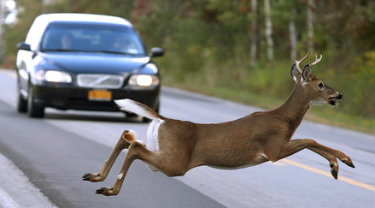
Behold the deer, the deadliest beast in North America. Deer are responsible for the deaths of about 440 of the estimated 458 Americans killed in physical confrontations with wildlife in an average year, according to Utah State University biologist Mike Conover, employing some educated guesswork in the latest edition of “Human-Wildlife Interactions.” Those deer-inflicted fatalities are not, so far as we know, caused by deer-on-human predation. They’re the unfortunate result of more than 2 million people a year plowing into deer with their sedans and SUV’s, usually on a two-lane road, often at high speed. You might wonder: Where and when am I most likely to hit a deer? And how can I avoid it? To shed light on this herbivorous hazard, we turned, of course, to data. Specifically, we analyzed more than 1 million animal-vehicle collisions compiled by Calumn Cunningham, Laura Prugh and their colleagues at the University of Washington for a recent paper published in Current Biology. They estimate deer were involved in more than 90 percent of the collisions, which occurred in 23 states between 1994 and 2021. With a few exceptions, the data show deer are at their most dangerous in November. Indeed, the deer threat peaks just before Thanksgiving typically Nov. 7 through 14 when you’re about three times more likely to hit a deer than at any other time of year. Experienced deer hunters can probably guess why driving in November can turn into Russian roulette on certain highways and byways: In much of the country, that’s rutting season. And during the rut, deer focus on procreation, not self-preservation. Marianne Gauldin of the Alabama Wildlife and Freshwater Fisheries Division compares rutting bucks to teenage boys. “They are hyper-focused on the opportunity to breed, and they therefore lose some of their wits,” Gauldin said. “They are full tilt looking for does, chasing does and running after does for the opportunity to breed. And they are doing this with tunnel vision … literally running across the road.” Does share similar distractions. They’re either in estrus hormonally receptive to sex and looking to breed or fleeing hot-and-bothered bucks until their cycles catch up. Collisions occur more often in states with the most white-tailed deer which experts say tend to have a shorter, sharper rut than the western mule deer and in states with long stretches of busy rural roads. Separate insurance claim data from State Farm, which is widely cited in academic research, shows a driver out minding her own business on the wending, bending roads of West Virginia had a 1 in 35 chance of hitting an animal between June 2021 and June 2022, making the Mountain State easily the most dangerous in terms of deer-car collisions. Montana and Michigan were next. D.C. drivers, by contrast, had only a 1 in 907 chance of stopping a buck while driving down Pennsylvania Avenue, or anywhere else. Fun fact: Deer are responsible for at least 69 percent of animal-related accident claims, according to State Farm. Another 12 percent of claims involve unidentified animals, many of which could be deer that bounded off before the driver got a good look at them or were mangled beyond recognition in the crash. The third-most-dangerous animals on the road are undifferentiated rodents, which are cited in 5 percent of all animal-related accident claims. However, State Farm spokesperson Dave Phillips noted that many of the drivers never make contact with said rodent: The vast majority of those accidents occur when motorists swerve to avoid a suicidal squirrel or moseying marmot. Our more calendar-conscious readers will note that peak deer-crash season coincides with another big moment in November: the first week of daylight saving time, which begins the first Sunday of the month. And the University of Washington team has found that the two events are not unrelated. To understand why, we need to spelunk deeper into their data, which breaks new ground by including the exact location, date and hour of all these deer disasters. When we glance at a chart of accidents that includes time of day and time of year, one fact strikes us right between the headlights: Evening, the twilight of each day especially in November is the hour of the Gotterdeermmerung. Conveniently for us, the University of Washington scholars used accident coordinates and some basic weather math to calculate exactly when the sun would have risen or set at each location. It turns out that deer danger skyrockets about 30 minutes after sunset and remains extraordinarily elevated for almost half an hour. Those with deer-behavior expertise say drivers should be on high alert as darkness falls in autumn especially when careening through the deer’s favorite transitional habitats, the forest-edge ecosystem created by roads and other developments. But they urge us to take a lesson from the thousands of people who land in hospitals and body shops each year after attempting to avoid a turtle or chipmunk: If you do see a deer, don’t swerve. “Slow down as much as you can, obviously, coming up to it,” said Karlin Gill of the National Deer Association, a hunting and conservation organization. “But if it’s unavoidable and you’re going to hit the deer, don’t try and swerve out of the way. That can cause an even worse car wreck, and you still might hit the deer regardless.” Deer crashes also rise in the morning, about 30 minutes before sunrise, but the number is significantly lower than after sunset. To understand why, we need to dig deeper into both deer and human activity patterns. Biologist after biologist told us deer are crepuscular, meaning they’re most active at dawn and dusk. When Texas A&M University wildlife scientist Stephen Webb and his colleagues fitted GPS trackers onto white-tailed deer in Oklahoma, they found deer movement peaks at both sunrise and sunset. “Deer, unlike humans, don’t lay down for eight hours at night and then get up and move throughout the day,” said Gill , who, as a hunter, closely examines deer behavior. “They actually go through a cycle where they’ll lay down, bed, get up, eat, lay down, bed, get up, eat, and they’ll do this throughout a 24-hour period.” But if deer are equally active at dawn and dusk, why are they so much more likely to be hit in the evening? To untangle that one, we need to examine another somewhat crepuscular species: the American commuter. Our commutes also peak in the morning and evening, but we’re much more likely to be driving at dusk than we are at dawn, and we stay on the roads even as darkness falls, and the deer start moving often squarely into our headlights. It’s a matter of visibility. Deer are just as active two hours before dusk as they are two hours after, yet we’re about 14 times more likely to hit a deer after sundown than we are before. And, as Cunningham notes, right at the peak of the whitetail rut, we throw another variable into the stew: We end daylight saving time. Suddenly, as far as the deer are concerned, our 6 p.m. commute happens an hour later. Millions of drivers find themselves contending with lower visibility just as sex hormones flood the local deer population. “It’s like one of the grandest-scale natural experiments that we can come up with, where humans impose these very arbitrary and abrupt changes on the wildlife,” Cunningham told us from his native Tasmania (he’s at the University of Washington as a Fulbright fellow). People living on the far eastern side of a time zone are about 1.35 times as likely to hit a deer as folks on the far western edge, since folks in the east are more likely to be driving home in the dark. Similarly, folks in Northern states, where days are short and darkness rules the winter, are 1.86 times more likely to hit a deer than their friends in America’s sunny South. Taking these effects into account, the University of Washington team estimates that “falling back” causes a 16 percent jump in deer carnage in the weeks after the shift. It’s possible that adopting permanent daylight saving time would thus save the lives of more than 36,000 deer and 33 humans each year. On the down side, chronobiologist Eva Winnebeck of the University of Surrey argues that any gains might be offset by an increase in deaths spurred by the chronic drowsiness that would inevitably set in if our solar-powered circadian rhythms were forced to endure a never-ending disconnect between the sun and clocks set permanently to daylight saving time. Here at the Department of Data, we’ve found a strong connection between happiness and the great outdoors. So, we’re partial to any move that would give us more daylight hours to get out after work and fish, run or dominate the competitive wood-chopping circuit, circadian rhythms be darned.
Read more » click here
Watch out for deer
NCDOT warns motorists across North Carolina to stay alert for deer now that fall has arrived. Every year during late autumn, auto and body shops across the region brace for a bumper crop of business, comprised of an influx of cars with damage from collisions with deer. Beginning in October, roads across the state become hazardous as North Carolina’s deer population fans out, lurking on highway shoulders in search of food and potential mates. It’s the deadliest time of the year for deer, which also pose a particular danger to motorists. Nearly half of vehicle accidents involving white-tail deer occur from October to December. Deer accidents typically begin rising in October, peak in November and begin dropping off after December, according to the Insurance Institute for Highway Safety. Deer are crepuscular mammals, meaning they’re most active at dawn and dusk which, following the onset of daylight savings time, places them near roads and byways precisely when large numbers of residents are commuting to and from work.
NCDOT has some helpful tips for motorists in regard to deer-vehicle crashes:
-
- Although it does not decrease the risk of being in a crash, wearing a seat belt gives you a better chance of avoiding or minimizing injuries if you hit a deer or other animal.
- Always maintain a safe amount of distance between your vehicle and others, especially at night. If the vehicle ahead of you hits a deer, you could also become involved in a crash.
- Slowdown in areas posted with deer crossing signs and in heavily wooded areas, especially during the late afternoon and evening.
- Most deer-vehicle crashes occur where deer are more likely to travel, near bridges or overpasses, railroad tracks, streams, and ditches. Be vigilant when passing through potentially risky landscapes.
- Drive with high beams on when possible and watch for eyes reflecting in the headlights.
- Deer often travel in groups, so if you see one deer near a road, be alert that others may be around.
- If you see deer near a road, slow down and blow your horn with one long blast.
- Do not swerve to avoid a collision with deer. This could cause you to lose control of your vehicle, increasing the risk of it flipping over, veering into oncoming traffic, or overcorrecting and running off the road and causing a more serious crash.
Officials say the most crashes occur between 6 p.m. and midnight, accounting for about 45% of the overall total. With the end of daylight savings time at 2 a.m. Sunday, Nov. 1, the time shift increases the chance of deer being by roadways when drivers are traveling in the dark, especially for their evening commute. If your vehicle does strike a deer, officials say do not touch the animal. A frightened and wounded deer can be dangerous or further injure itself. Get your vehicle off the road if possible and call 911.
Read more » click here
Turtle Watch Program –

Turtle Watch Program – 2026
.
.
The first nest of the 2025 season was on May 21st
Average annual number of nests is 59
Current nest count – (78) as of 10/08/26
Total known eggs = 9,092
Total baby turtles to ocean = 7,216 around 79%
Total number of nests historically
-
-
-
-
-
-
-
-
-
-
-
-
- 2012: 48
- 2013: 73
- 2014: 19
- 2015: 53
- 2016: 52
- 2017: 50
- 2018: 30
- 2019: 105
- 2020: 65
- 2021: 68
- 2022: 65
- 2023: 75
- 2024: 67
- 2025: 35
- 2026: 78
-
-
-
-
-
-
-
-
-
-
-
Holden Beach Turtle Patrol sees successful nesting season
More than 7,000 sea turtle hatchlings surfaced from their nests onto Holden Beach’s ocean shore this year, making it the second-highest nesting season in the local turtle patrol’s history. The Holden Beach Turtle Patrol on Monday announced the results of its 39th season, one in which 78 nests were laid with a success rate of 81%. New hatchlings included those that emerged from a recently vandalized nest, the last one laid this season. “This year’s nest success may have been due to the absence of foxes, severe storms, and extremely high tides,” according to a patrol release. “Nest success may also have benefited from the relocation of many nests laid below or in the middle of escarpments created by beach erosion.” The Holden Beach Turtle Patrol’s record-setting year was in 2019, when 52 female sea turtles laid 105 nests on the Brunswick County town’s ocean beach. The patrol was established in 1989. “That year, the nest success rate was 68%,” the group stated. Patrol officials are waiting to review the 2026 DNA results, which will be compiled later this year, to learn how many females laid nests on Holden Beach this season. Also this year, Steve McNeill was named the turtle patrol’s program director following the retirement of Pat Cusak, who devoted 19 years to the patrol. The patrol also has a new president, Deva Tucker, who this year succeeded John Cifelli.
Read more » click here
Fauna & Flora –

NC State Native Plant Resources » click here
NC Native Plants for Pollinators » click here
NC Sea Grant Coastal Landscapes » click here
New Hanover County Arboretum Native Plant Garden » click here
Audubon Native Plant Database » click here
North Carolina Extension Gardener Plant Toolbox » click here
Fauna & Flora » click here
Holden Beach recommended plant list – deer resistant & salt tolerant
Factoid That May Interest Only Me
North Carolina is now home to the cheapest gas in the U.S.
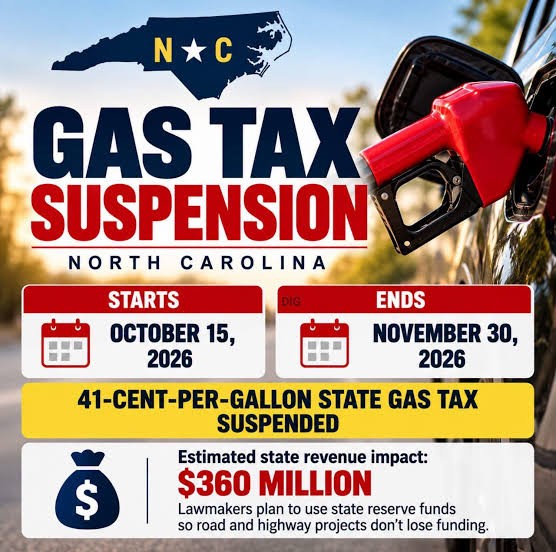
The cost of a gallon of gas has dropped so sharply across North Carolina following Gov. Josh Stein’s signing of House Bill 3 that the Tar Heel State is now home to the cheapest gas in the nation. “Rising grocery, utility, and gas prices are making the costs too high for people across our state,” said Stein in a news release on the bill’s signing. “I am signing this bill to keep more money in people’s wallets, but this temporary relief is just one step. I remain committed to continuing to work with anyone who wants to make everyday living more affordable all year long – not just during election season.” Following the signing of the “Relief at the Pump” law, an Oct. 15 report from the American Automobile Association confirmed that North Carolina is now home to the cheapest gas in the nation. Here’s how much fuel costs in the state and just how long relief measures will last.
Why did gas prices drop so much in North Carolina?
On Friday, Oct. 9, Stein signed N.C.’s House Bill 3, also known as the “Relief at the Pump” bill, into law. The law temporarily eliminates the state’s motor fuel tax, replacing the lost revenue with reserve funds. HB 3 made gas 41 cents cheaper by the gallon in the state through Nov. 30.
What is the average price of gas in North Carolina? In the U.S.?
In North Carolina on Oct. 19, the average price for regular gas was $3.61 per gallon, according to AAA. The average price of regular gas countrywide was $4.29 per gallon.
What are gas prices like in Asheville, Western NC?
In the Asheville area, the average price for a gallon of regular gas was $3.73 as of Oct. 19, according to AAA. One month ago on the same date, before the bill’s signing, the price was $4.173.
Where are the lowest gas prices in NC? Highest gas prices in NC?
The Goldsboro area ranked lowest for gas prices in the state on Oct. 19, with the average cost for a gallon of regular gas placed at $3.453. The Norfolk-Virginia Beach-Newport News area was home to the highest prices, with an average of $3.745 per gallon.
What states have the highest gas prices?
As of an Oct. 15 AAA report, the five most expensive gas markets in the U.S. included:
-
-
- No. 1 – California ($6.23)
- No. 2 – Hawaii ($5.63)
- No. 3 – Washington ($5.42)
- No. 4 – Nevada ($5.42)
- No. 5 – Oregon ($4.97)
-
What states have the lowest gas prices? Does North Carolina have the cheapest gas in the U.S.?
Following the passing of HB 3, North Carolina is officially the state with the cheapest gas prices in the U.S. The nation’s least expensive gas can be found in the following states:
-
-
- No. 46 – Indiana ($3.89)
- No. 47 – Tennessee ($3.88)
- No. 48 – Texas ($3.83)
- No. 49 – Georgia ($3.77)
- No. 50 – North Carolina ($3.70)
-
Read more » click here
 This tiny sticker on your car is a big waste of time and money
States are ditching auto decals to save millions and cut red tape.
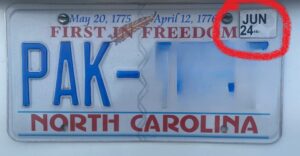
Artificial intelligence has many Americans afraid of losing their jobs. Though these fears are understandable, it’s worth noting that some jobs would not exist in the first place were they not for senseless government regulations. A good example is the D.C. city employee at my Department of Motor Vehicles emissions inspection site whose job is to scrape off a sticker on the inside of my windshield and replace it with this year’s edition, thus proving to the outside world that I passed the inspection and paid the required fee. The city gives car owners the job of removing and replacing their vehicle registration sticker, a task which is next to impossible if they took the common anti-theft advice to score it with a razor to make it theftproof. In the digital age, are car stickers really necessary? They aren’t a requirement for other taxes. Imagine having to affix a sticker to the window of your home to signify that you’d paid your property taxes. Or being required to wear a lapel pin on April 15 as a public symbol that you’d paid your income taxes. State and local governments have been obsessed with requiring stickers and license plates on vehicles since the invention of the horseless carriage at the turn of the 20th century. New York was the first state to require registrations for automobiles in 1901. Other state and local governments began adopting registration fees, which some labeled a “privilege tax,” for the privilege of operating a vehicle. I guess that is different from the gas taxes I pay for the privilege of driving on the roads. In 1904, automakers Henry Ford and Horace Dodge sued the city of Detroit over the constitutionality of a $1 registration fee. They claimed it was double taxation because motorists had already paid a tax when they purchased the vehicle. They also said the fee was unjust because owners of horse-drawn vehicles were not required to display identification tags. An added complaint was that children under age 16 were allowed to drive carriages but not automobiles. How quaint. The court rejected their claims and said the fee was constitutional. A complicating factor in the adoption of these registrations and fees was that they were often location-specific and lacked reciprocity with other jurisdictions. In Missouri, state law required a separate registration fee for each county a car was driven in. By one account, in 1906, “the motorist who wished to drive legally in every county of Missouri had to pay $295.50 in registration fees.” The law was later changed to allow for a single statewide registration fee. As of 1910, New Jersey did not recognize New York’s auto registration, so thousands of New Yorkers who had vacation homes on the Jersey Shore had to pay a full year’s registration fee in both states. For many states, these fees were as much about generating revenue as they were about regulating motorized vehicles. The system came with costs, however. Some states sent motorists a new license plate every year, changing the color annually so that police could tell which cars were up-to-date. That practice was eventually replaced with a cheaper yearly sticker that car owners were required to affix to the license plate. By 1974, many states relied on stickers. After more than a century of managing these arcane and outdated rules, a growing number of states are going electronic and sticker-free. New Jersey was the first to ditch its vehicle decals in 2004. One cited reason was sticker theft. Connecticut followed in 2010 because technology made registration stickers unnecessary, saving the state hundreds of thousands of dollars per year. Pennsylvania stopped in 2017. A Pennsylvania State study found the change had zero effect on how many drivers stayed current on their registration, and it saved the state $1.1 million a year on tag production and another $2 million on mailing them out. This year, Idaho joined the no-registration-sticker club, saving the state about $300,000 annually. North Carolina is moving to an electronic system starting Oct. 1, eliminating printing and mailing costs that total $4.8 million annually. The anti-sticker movement hasn’t always been successful. A bill in the Minnesota House of Representatives to repeal vehicle registration stickers died in committee, as did a similar bill in the Florida legislature to eliminate the state’s yellow validation decal. Supporters said the Florida proposal could have saved taxpayers some $24 million annually. It passed the state’s House 93-17 but died in the Senate. The bill’s sponsor, state Rep. Tom Fabricio, touted its impact on modernizing the process: “It cuts the yellow tape, reduces the burden on every Floridian and brings our registration system into the 21st century.” AI may not be driving these trends, but more state lawmakers should be encouraged to recognize that car stickers and decals are an obsolete and costly vestige of an age when automobiles shared the road with horse-drawn carriages. If repealing such requirements means fewer city workers at the DMV replacing stickers by hand, well, welcome to the modern age.
Read more » click here
Editor’s note –
North Carolina does not issue physical inspection stickers, and the state is moving to an entirely digital system that eliminates physical license plate stickers starting October 1, 2026.
 Ding! Ding! Ding! The long, strange fight over your car’s seat-belt chime.
The reminders can annoy, but they also save lives. So why have regulators taken years to tighten rules for new vehicles?
David Kidd is an expert in something that some people hate and others tend to just tolerate: Seat-belt warning systems — the “ding ding ding” chimes and flashing dashboard lights that serve as reminders to buckle up. He’s spent years testing different systems in cars and trucks as part of his work at the Insurance Institute for Highway Safety. So he knows very well that the incessant chimes can be annoying. They’re “an irritant,” he admits. But he prefers a different term. “We use the word ‘motivating,’” Kidd said. The lowly seat belt is still considered the best way to avoid serious injury or death in a crash. Forget air bags, anti-lock braking systems or any other new-fangled safety technology. Unbelted occupants are roughly twice as likely to be killed in a car crash. Buckling up works. So does nagging. Kidd’s research found that belt warnings came in a variety of tones and volumes, but if they are “heard and persistent,” people respond. The seat-belt chime is such a recognizable refrain that when pop star Olivia Rodrigo needed an iconic car sound to open her hit song “Drivers License” a few years ago, she reportedly used a recording of the seat-belt beep in her mom’s car. The “buckle up” reminders were set to become even more widespread this month, when new federal safety regulations were supposed to require more persistent chimes not just for the driver’s seat but for the front passenger seat, as well. But automakers objected, saying they couldn’t be ready in time. Regulators backed down. So the new rules have been delayed for another two years — 2028 at the earliest — when some rear-seat warnings would be required, too. The National Highway Traffic Safety Administration said in a statement that it found the automakers’ worries “have merit.” Others were not convinced. “It was a bit of mystery to us why this has taken so long already. And now it’s going to take even longer,” said Peter Kurdock, general counsel for Advocates for Highway and Auto Safety, which began pushing for the new rules in 2007. “It’s disappointing,” he said. The technology is not cutting-edge. Europe has required seat-belt alarms in new vehicles since 2021. Some automakers, such as Volvo and Subaru, already have voluntarily installed them in vehicles sold in the U.S.
But the fight over the warning chimes feeds into Americans’ long-running love-hate relationship with seat belts. Seat belts are still seen by some as a question of choice and freedom. State laws and education campaigns have helped soften some of those attitudes. Today, 49 states require adults in the front to buckle up. The lone holdout is New Hampshire, which lives up to its license plate motto of “Live Free or Die.” Just 34 states plus D.C. require adults to wear seat belts in rear seats. (Children are covered by different restraining-device requirements.) Still, researchers know some people remain militant in their opposition. They’re the ones buying $6 devices and printing 3D tools to fool the alarm. They sit on top of buckled seat-belt straps. They watch online videos claiming to reveal the hidden tricks to deactivate the warning chimes. “Those that don’t like seat belts are really hardcore against buckling up,” Kurdock said. These holdouts are why U.S. seat-belt usage rates have largely flat-lined in the last decade, according to NHTSA observational studies. The unbuckled make up a minority of all vehicle occupants, but they die at a much higher rate in crashes: Roughly half of all vehicle fatalities involve unbuckled occupants. At one point, federal officials tried a much tougher tactic than just chimes. In 1974, the federal government required many cars to have ignition interlock devices that prevented a car from even starting until the front occupants were buckled up. Motorists hated it. It blew up in NHTSA’s face. “That got a lot of blowback that reached Congress,” Kidd said. The idea was quickly pulled, and Congress banned NHTSA from requiring interlocks. Lawmakers then went further and limited seat-belt warning chimes to a fleeting eight seconds. Some advocates say this is why NHTSA has seemed reluctant ever since to even tinker with seat-belt warnings. In 2007, Public Citizen and Advocates for Highway and Auto Safety petitioned NHTSA to change the belt-reminder rules and add them for rear seats. Little happened for years. In 2012, Congress passed a bill that abolished the eight-second chime limit and required federal officials to create new warning rules for seating positions besides the driver’s seat. It was a start, but a very slow one. “The chime is very important,” said Shaun Kildare, research director for the Advocates for Highway and Auto Safety. While NHTSA worked on a plan, the lack of government action created an opening for the Insurance Institute for Highway Safety, which rates vehicles on a series of safety metrics. It began rating cars and trucks on the quality of their seat-belt reminders with the 2021 model year. IIHS wants seat-belt chimes to last at least 90 seconds and be easy to hear, among other criteria. The chimes should annoy drivers enough to get them to buckle up — but not so much that they complain. “It was: Get them to wear a seat belt, but at the same time not email their congressperson to demand a change,” Kidd said. Compliance has been voluntary, but some automakers have jumped at the chance to make a good showing. IIHS saw rapid adoption, even without federal regulations, Kidd said. At first, less than 20 percent of vehicles scored IIHS’s top “good” ranking for seat-belt reminders. Five years later, 71 percent of vehicles qualified. “You’ve had a complete change in the seat belt reminders in the new vehicles,” he said. In 2025 — 13 years after Congress asked for a plan — NHTSA finally unveiled its blueprint for overhauling the nation’s seat-belt warning system. The new rules will require a chime lasting at least 30 seconds for either an unbuckled driver or front passenger when the vehicle starts up, and if they are still unbuckled when the vehicle reaches slightly faster than 6 mph, a second chime will play endlessly until the seat belt is secured. That’s the rule that was supposed to hit new vehicles on Sept. 1. A rule requiring a 30-second chime if someone unbuckled a seat belt in the rear seats was set to start in September 2027. But in April, NHTSA acquiesced to arguments from the Alliance for Automotive Innovation, an industry trade group, that the changes “require significant hardware and software changes” and would need more testing. Now, regulations for both front- and rear-seat warnings are being pushed back to September 2028. Despite the delay, automakers still “support efforts to increase seat belt use and for decades have voluntarily and proactively installed seat belt reminder systems across the vehicle fleet,” Audrey LaForest, communications director for the Alliance, said in a statement last week. Kurdock, whose group first petitioned for this change nearly 20 years ago, was in disbelief. “This is not a new technology. Seat-belt reminders have been in cars for a very long time,” he said. Kidd said he was frustrated with what he saw as an unnecessary delay. He has estimated that nearly 1,600 lives could be saved annually if all vehicles had more noticeable and persistent seat-belt warnings leading to more people buckling up. “The disappointing piece is we’ve known what to do for a long time,” he said, “but we just haven’t done it.”
Read more » click here
Storm Events
 Hurricane Vehicle Decals
Property owners were provided with four (4) decals that were included in there water bill. It is important that you place your decals in your vehicle or in a safe place. A $10 fee will be assessed to anyone who needs to obtain either additional or replacement decals. Decals will not be issued in the 24-hour period before an anticipated order of evacuation.
The decals are your passes to get back onto the island to check your property in the event that an emergency would necessitate restricting access to the island. Decals must be displayed in the driver side lower left-hand corner of the windshield, where they are not obstructed by any other items. Officials must be able to clearly read the decal from outside the vehicle.
Property owners without a valid decal will not be allowed on the island during restricted access. No other method of identification is accepted in an emergency situation. Click here to visit the Town website to find out more information regarding decals and emergency situations.
NC General Statute 166A-19.22
Power of municipalities and counties to enact ordinances to deal with states of emergency.
Synopsis – The governing body may impose by declaration or enacted ordinance, prohibitions, and restrictions during a state of emergency. This includes the prohibition and restriction of movements of people in public places, including imposing a curfew; directing or compelling the voluntary or mandatory evacuation of all or part of the population, controlling ingress and egress of an emergency area, and providing for the closure of streets, roads, highways, bridges, public vehicular areas. All prohibitions and restrictions imposed by declaration or ordinance shall take effect immediately upon publication of the declaration unless the declaration sets a later time. The prohibitions and restrictions shall expire when they are terminated by the official or entity that imposed them, or when the state of emergency terminates.
Violation – Any person who violates any provisions of an ordinance or a declaration enacted or declared pursuant to this section shall be guilty of a Class 2 misdemeanor.
Hot Button Issues
Subjects that are important to people and about which they have strong opinions

Climate
For more information » click here.
There’s something happening here
What it is ain’t exactly clear

Flood Insurance Program
For more information » click here
National Flood Insurance Program: Reauthorization
Congress must periodically renew the NFIP’s statutory authority to operate. On September 30, 2026, the president signed legislation passed by Congress that extends the National Flood Insurance Program’s (NFIP’s) authorization to December 11, 2026.
Congress must now reauthorize the NFIP
by no later than 11:59 pm on December 11, 2026.

GenX
For more information » click here

Homeowners Insurance
For more information » click here
Hurricane Season
For more information » click here
Hurricane season runs from June 1 through November 30
El Niño just gave us the first no-hurricane September in decades.
How long can the Atlantic shutout last?
The Atlantic Ocean has failed to produce a hurricane in the month of September for the first time in more than 30 years, the latest feat by a super El Niño widely predicted to become the strongest ever. Only three other Septembers have gone hurricane-free in the Atlantic in records dating back to 1950. It last happened in 1994, and before that in 1972 and 1962, according to Dr. Phil Klotzbach, a hurricane expert with Colorado State University. Three tropical storms did form last month, so the Atlantic wasn’t completely closed for business. Of those, Tropical Storm Fay was closest to hurricane intensity. Its winds fell short by 4 mph, but there’s a chance Fay gets upgraded in the National Hurricane Center’s final review. The numbers have been stark. The average for a season is seven hurricanes, and we should have seen five of them by now. Last year was below average, with five hurricanes — but four had already shown up by the start of October, three of which came in September. September is usually prime time for hurricanes because storm-fueling warm water is at its most expansive and hottest alongside ripe atmospheric factors. About two to three hurricanes develop in the month on average. This El Niño-stifled season had already blown past the most reliable record for the longest wait for the first hurricane to materialize, and the lack of any as October begins sets the stage for an even rarer possibility: an entire Atlantic season without hurricanes.
El Niño’s thumbprint is all over the tropics
Water temperatures have been warm enough for Atlantic hurricanes, but El Niño-fueled wind shear, aka tropical-system kryptonite, is the biggest reason the season has been squashed. Wind shear refers to changes in wind speed and direction at different levels of the atmosphere, and it can shred apart anything from budding tropical systems to full-blown hurricanes. The shear has been record-strong since this summer across parts of the Atlantic’s so-called main development region, which extends from Africa through the Caribbean, according to Klotzbach. As the name suggests, this is where many storms get their start at the height of the season — mid-August to early October — but this year it’s been nearly shutdown. Tropical storms Dolly and Gonzalo are the only systems that have formed in this part of the ocean so far, and a wall of wind shear ripped both of them apart. Dolly lasted one day; Gonzalo almost made it two. Meanwhile, El Niño’s extremely warm water has turned hurricane season in the eastern and central Pacific hyperactive. A total of 20 named storms — including three Category 5 hurricanes — have roamed those ocean basins. Hurricane Polo’s extreme rapid intensification to a Category 5 with 180 mph winds off the coast of Mexico last week tied it as the third strongest eastern Pacific hurricane on record.
Year without a hurricane?
There have been just two years without an Atlantic hurricane: 1914 and 1907. But both come with an asterisk since they were before satellites and aircraft started tracking hurricanes more accurately, so one could have been missed. In more modern records — since 1950 — there hasn’t been a single Atlantic season without a hurricane. The 1982 and 2013 seasons saw the fewest, with just two. There are still two months to go, and October averages about one hurricane formation each year; occasionally November can spin one up, too. But the deeper we head into the month, the greater the odds the season could end without one. Late-season storms tend to form closer to the United States, including in the Gulf, Caribbean and off the Southeast coast, which gives them greater odds to impact land. The Caribbean is fully entrenched in El Niño’s shear, so it’s likely off the table as a development area the rest of the way. But as this year has shown, it doesn’t take a hurricane-strength system to cause significant impacts, particularly in a warming world that’s making tropical systems wetter. Tropical storms Arthur and Edouard didn’t last long, but heavy rain from both resulted in significant flash flooding and water rescues near the Gulf Coast.
Read more » click here
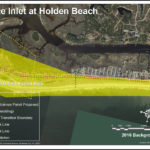
Inlet Hazard Areas
For more information » click here
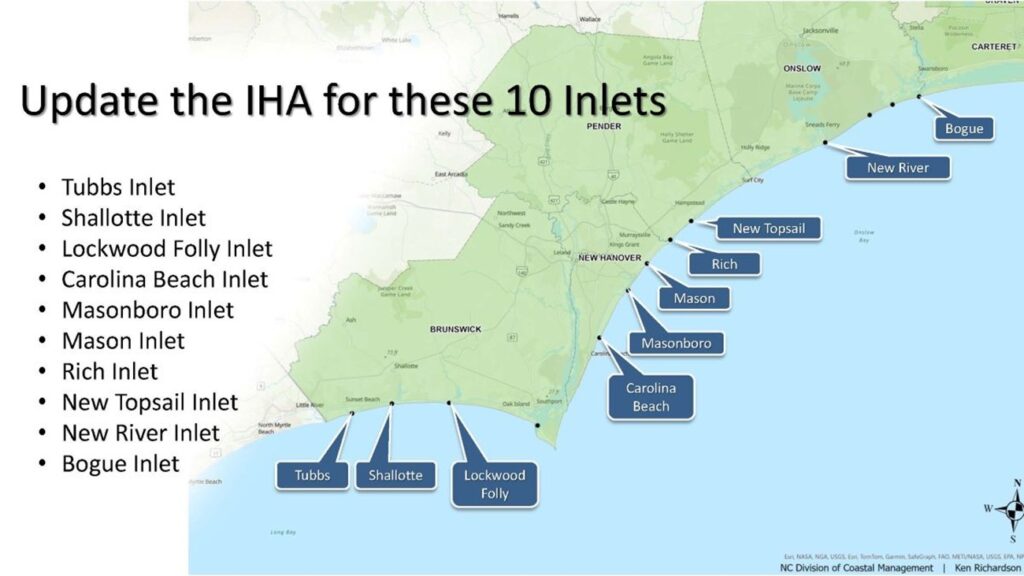
.
Lockwood Folly Inlet
For more information » click here.

Seismic Testing / Offshore Drilling
For more information » click here.

Offshore Wind Farms
For more information » click here
Things I Think I Think
 Eating out is one of the great little joys of life.
Restaurant Review:
Ratings reflect the reviewer’s reaction to food, ambience, and service, with price taken into consideration.
///// September 2026
Name: Frying Pan
Cuisine: American
Location: 319 West Bay Street, Southport, NC 28461
Contact: 910.363.4382 / https://fryingpansouthport.com/
Food: Average / Very Good / Excellent / Exceptional
Service: Efficient / Proficient / Professional / Expert
Ambience: Drab / Plain / Distinct / Elegant
Cost: $21 Inexpensive <=20 / Moderate <=26 / Expensive <=35 / Exorbitant <=60
Rating: Two Stars
Located in Southport’s historic Old Yacht Basin, this restaurant has offered casual indoor and outdoor waterfront dining since 2012, along with panoramic views of the Intracoastal Waterway. The same menu is available for lunch and dinner, featuring a wide range of entrées to suit nearly every taste. Because reservations are not accepted, lunch may be the best option—especially during tourist season. Ultimately, the restaurant’s popularity may stem more from its scenic waterfront setting than from the quality of its food.
Dining Guide – Local * Lou’s Views
Dining Guide – North * Lou’s Views
Dining Guide – South * Lou’s Views
Restaurant Reviews – North * Lou’s Views
Restaurant Reviews – South * Lou’s Views
Book Review:
Read several books from The New York Times best sellers fiction list monthly
Selection represents this month’s pick of the litter

THEO OF GOLDEN by Allen Levi
Theo, an enigmatic and wealthy 86-year-old Portuguese man, settles in the small town of Golden, Georgia. At a local coffee shop, he discovers 92 pencil portraits of residents, all drawn by a local artist. Moved by the artwork, Theo begins purchasing the portraits and giving each one to its “rightful owner.” Through these quiet acts of generosity, the novel shows how truly seeing others and extending kindness can transform a community, creating a warm and hopeful message.
That’s it for this newsletter
See you next month
Lou’s Views . HBPOIN
-
-
-
-
-
-
-
-
-
- Gather and disseminate information
- Identify the issues and determine how they affect you
- Act as a watchdog
- Grass roots monthly newsletter since 2008
-
-
-
-
-
-
-
-